Hand hygiene is the cornerstone of any infection prevention program. Prior studies have reported lower rates of hand hygiene adherence in skilled nursing facilities (NFs) compared with hospitals.Reference Smith, Carusone and Loeb1, Reference Pan, Domenighini and Signorini2 Additionally, high rates of inappropriate glove use by healthcare personnel (HCP) have been reported in NFs.Reference Burdsall, Gardner and Cox3 Prior data on the relationship between glove use and hand hygiene have been mixed, but the predominance of data suggest that use of gloves is associated with lower rates of HCP hand hygiene adherence.Reference Eveillard, Joly-Guillou and Brunel4, Reference Girou, Chai and Oppein5 Understanding what factors influence an HCP’s decision to perform hand hygiene, particularly before they provide care, can help inform interventions to improve adherence. This improvement is particularly relevant in NFs, where a ‘home-like setting’ is promoted and both formal and informal interactions among patients are common and encouraged.Reference Mody, Bradley and Huang6
An HCP’s decision to perform hand hygiene may be influenced by many factors, such as their perceptions of risk, attitude regarding its importance, and normative beliefs.Reference Whitby, Pessoa-Silva and McLaws7 For example, one may be more likely to perform hand hygiene before and after an activity one perceives to be unclean, or high-risk for self-contamination (eg, incontinence care) and less likely during seemingly low-risk interactions such as giving medications or performing physical therapy.Reference Whitby, Pessoa-Silva and McLaws7
In this study, we sought to determine whether HCP hand hygiene adherence in an NF is influenced by (1) time spent in the room, (2) type of patient care activity performed, or (3) glove use. Additionally, we explored the frequency of antibiotic-resistant organism (ARO) colonization events on the hands of HCP, and whether it could be traced to patient and/or environmental ARO colonization. We postulate that increased HCP hand hygiene adherence is associated with more time spent within the room and performance of activities that are generally perceived by HCP as higher risk for bacterial contamination.
Materials and Methods
Study population design
This study was performed as part of a larger prospective cohort study examining ARO colonization patterns of patients at 6 NFs in southeast Michigan between November 2013 and March 2016.Reference Mody, Foxman and Bradley8 Any patient within 14 days of NF admission who provided consent (or his/her proxy) to collect surveillance samples and patient-specific data was enrolled in the study. Follow-up patient visits were conducted on days 14 and 30 and monthly thereafter until facility discharge. This research was approved by the University of Michigan Institutional Review Board.
Hand hygiene observations
Trained research staff observed and documented hand hygiene adherence of HCP providing care for enrolled NF patients. HCP observations were conducted during visits for the parent cohort study, typically once or twice weekly during daytime hours. After obtaining verbal consent from the HCP, hand cultures were obtained from the HCP before and after providing patient care. A standardized HCP observation form was used (Supplemental Fig. 1 online). Adherence was considered use of alcohol-based hand rub or washing with soap and water. The following data were captured for each observation: HCP role, start and end time of interaction, type of care provided, hand hygiene adherence prior to touching patient and after touching patient or environment, method of hand hygiene, and use of gloves and/or gowns. Activities defined as high-risk were bathing (eg, assistance with bathing or showering), performing personal hygiene (eg, brushing teeth, washing mouth), toileting assistance, incontinence care, dressing the patient, and changing linens. These activities were chosen based on potential contact with body fluids, mucous membranes, or soiled/contaminated objects, which would require glove use according to the 2007 Healthcare Infection Control Advisory Practice Committee (HICPAC) guidelines for isolation precautions.Reference Siegel, Rhinehart, Jackson and Chiarello9 All other activities, including transfer of patient, repositioning patient, taking vitals, giving medications and performing physical therapy, were considered low risk for the purposes of our data analysis. Observed activities without contact with the patient or the patient’s immediate environment (ie, removing food tray, taking out trash) were excluded from statistical analysis.
Specimen collection and microbiology
Microbiologic samples were obtained using sterile swabs (BactiSwab, Remel, Lenexa, KS) from patients and their environment upon enrollment, at days 14 and 30, then monthly for up to 6 months. Study staff attempted to swab the following anatomic sites at each visit: nares, oropharynx, perianal area, groin, and the dominant hand. Environmental cultures were obtained during the same visit from the following sites in the patient’s room: bed controls, bedside table (top and bottom), nurse call button, bed curtain, toilet seat, door knob, TV remote control, bedrail, and wheelchair handles.Reference Cassone, Mantey and Perri10 We sampled the dominant hands of HCP, including the palm, fingers, and around nails with premoistened swabs, using techniques previously described, before and after completion of observed patient care activity, but prior to hand hygiene.Reference Cao, Min, Lansing, Foxman and Mody11 When HCP wore gloves, samples were collected immediately after glove removal but before hand hygiene.
Swabs obtained from anatomical sites other than hands were plated on mannitol salt agar (MSA), MacConkey agar, and bile-esculin plates with 6 µg/mL vancomycin (BEV6) on the same day. Swabs from hands and the environment were enriched overnight in brain-heart infusion broth at 36°C before culturing on MSA agar, MacConkey agar, and BEV6 plates. Disk diffusion antimicrobial susceptibility testing for both Staphylococcus aureus and gram-negative bacilli (GNB) isolates was performed according to Clinical and Laboratory Standards Institute (CLSI) guidelines (M100-S23). The GNB genus and species were identified using bioMerieux API. An isolate was considered R-GNB if it was resistant to ≥1 of the following: ceftazidime, ciprofloxacin, or imipenem. Staphylococcus aureus were tested for methicillin resistance using cefoxitin disc diffusion according to CLSI criteria. Vancomycin-resistant Enterococci (VRE) were identified by suggestive phenotype on BEV6 medium and using pyrrolidonyl arylamidase testing (PYR) (DrySlide, Becton Dickinson, Franklin Lakes, NJ). Pulsed-field gel electrophoresis (PFGE) was performed on methicillin-resistant Staphylococcus aureus (MRSA) and vancomycin-resistant Enterococcus (VRE) isolates from patients who newly acquired these organisms using previously described techniques.Reference Cassone, Mantey and Perri10
Statistical analysis
We used Stata version 15.1 software (StataCorp, College Station, TX) for data analysis. Descriptive statistics were obtained to characterize the study population. Our primary outcome of interest was hand hygiene adherence. Odds ratios and 95% confidence intervals were calculated to determine the level of association between independent variables and hand hygiene adherence. The HCP time in room variable was dichotomized post hoc into <4 minutes and ≥4 minutes based on the median value of distribution to obtain to 2 groups of approximately equal size. Multivariable logistic regression was performed to identify variables associated with hand hygiene adherence, adjusted for other variables in the model. To account for correlation between observations in the same facility, we calculated robust standard errors using clustered sandwich estimators. For all values a 2-tailed P < .05 was considered significant. Pearson correlation coefficients were calculated among independent variables to assess for confounding.
The following variables were included in the multivariable logistic regression model: glove use, HCP type (nurse, certified nursing assistant [CNA], or physical or occupational therapist [PT/OT]), whether a high-risk activity was performed in the visit (ie, encounters with both high- and low-risk activities were classified as high risk), and whether the HCP performed all activities in <4 minutes. Variables were chosen based on biologic plausibility and existing literature on factors influencing hand hygiene adherence.Reference Pittet, Allegranzi and Boyce12
Results
Facility characteristics
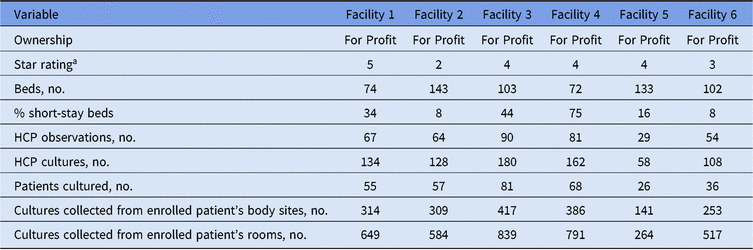
The characteristics of all 6 participating facilities are listed in Table 1. All 6 NF study sites were for-profit facilities ranging from 72 to 143 beds (average, 105 beds). All sites had an active infection prevention program in place and reported conducting hand hygiene observations of their staff regularly. We have shown that 56.8% of patients from this cohort were colonized with ≥1 ARO at the time of NF enrollment (16.1% MRSA, 33.2% VRE, and 32.0% R-GNB).Reference Mody, Foxman and Bradley8
Facility Characteristics

Note. HCP, healthcare personnel.
a Star rating according to https://www.medicare.gov/nursinghomecompare.
Healthcare personnel hand hygiene observations
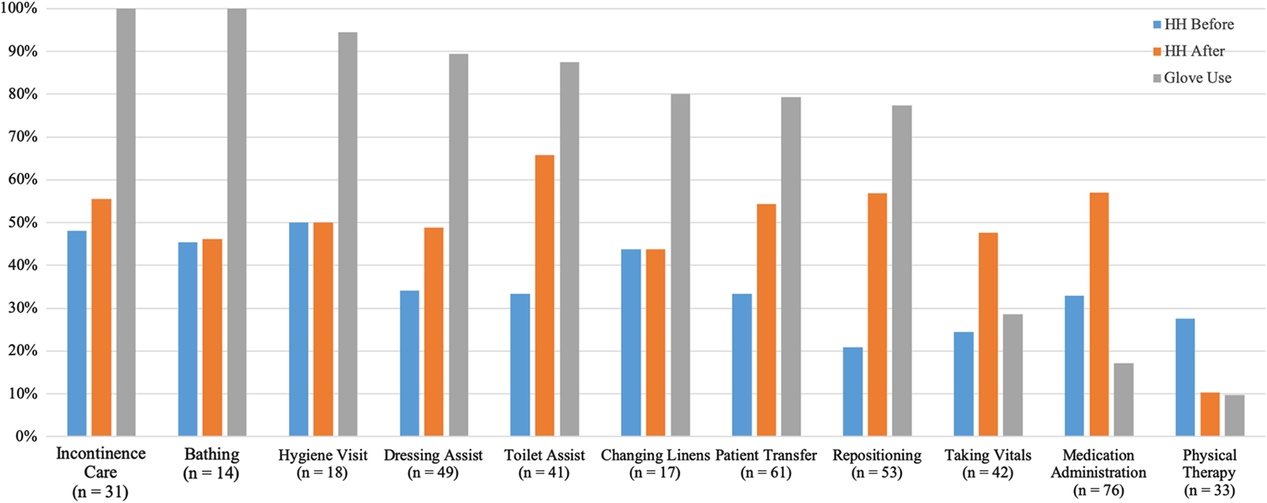
Of 651 enrolled patients, we obtained HCP observations on 323 patients when research staff were present during care activity. In total, 385 observations of HCP and paired hand cultures were collected. Also, 323 unique patients were cultured and 3,475 environmental cultures were obtained. For 62% of study visits, HCP hand cultures were obtained on the same day as patient and environmental cultures; the mean difference in days between HCP hand cultures and patient/environmental cultures was 3.0 (interquartile range [IQR], 0–6). The following HCP roles were most common: 48.6% CNA, 28.6% nurse, and 17.9% PT/OT. Overall, HCP hand hygiene adherence occurred in 96 of 352 observations (27.3%) before patient care and in 166 of 358 observations (46.4%) after patient care. In hand hygiene before patient care, 65 HCP (68%) used soap and water and 25 HCP (26%) used alcohol-based hand rub. In hand hygiene after care, 120 HCP (72%) used soap and water and 36 (22%) used alcohol-based hand rub. HCP hand hygiene adherence before patient care was highest with a hygiene visit (9 of 18, 50.0%) and lowest with repositioning the patient (10 of 47, 21.2%) (Fig. 1 and Supplementary Table 1 online). HCP hand hygiene adherence after patient care was highest with toileting assistance (25 of 38, 65.8%) and lowest with physical therapy (3 of 29, 10.3%).
Healthcare personnel hand hygiene adherence and glove use by activity. Percentage of healthcare personnel adherence with hand hygiene before patient care (blue bar) and after patient care (orange bar) were collected, as well as use of gloves (grey bar). Note. HH, hand hygiene.
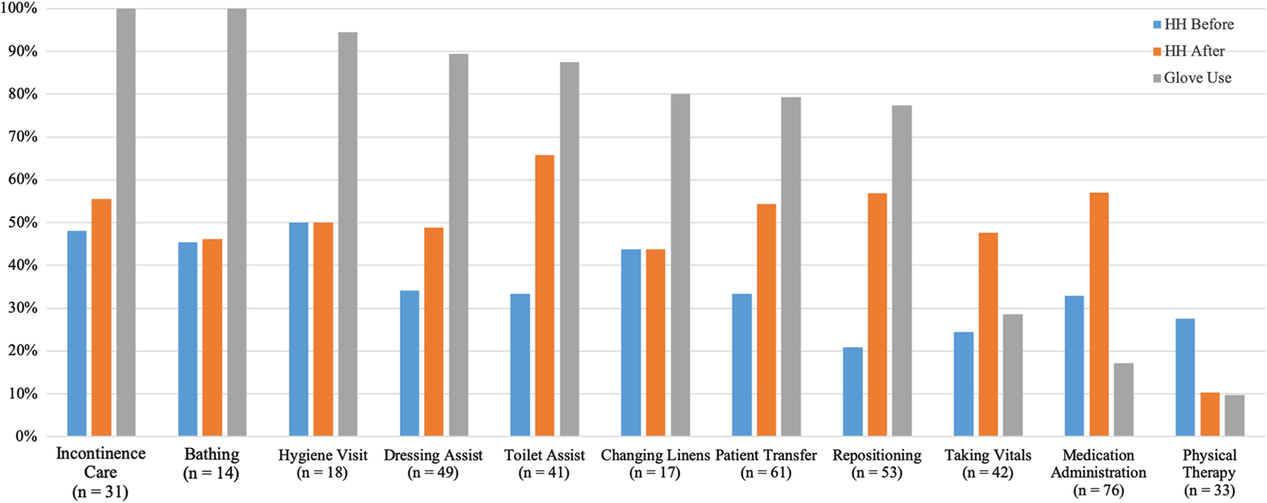
HCP glove use was captured in 376 of the 385 observations. Job role, activity type, and time in room were captured in all 385 observations. HCP wore gloves during 169 of 376 (44.9%) of patient care encounters. Glove use was ≥75% for the following activities: incontinence care, bathing, hygiene visit, toilet assistance, dressing assist, repositioning the patient, and changing linens. HCP hand hygiene and glove use varied by activity; providing incontinence care had the highest overall hand hygiene and glove adherence and physical therapy had the lowest overall hand hygiene and glove use. HCP spent ≥4 minutes in the room for 206 observations (53.5%). For activities ≥4 minutes, hand hygiene was 33% on entry and 46.8% on exit, whereas glove use was 56.1%. For activities <4 minutes duration, and hand hygiene was 21.0% on entry and 45.3% on exit, whereas glove use was 32.6%.
Association between hand hygiene and healthcare personnel role, glove use, and activities performed
By job title, hygiene adherence was highest for nurses (before room entry 35.9%, after room exit 57.1%), followed by CNAs (before room entry 24.3%, after room exit 48.6%), and lowest for PT/OT staff (before room entry 24.1%, after room exit 22.8%). Glove use was highest for CNAs (65.0%), followed by nurses (29.1%), and was lowest for PT/OT staff (14.1%).
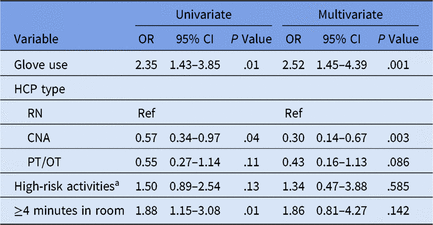
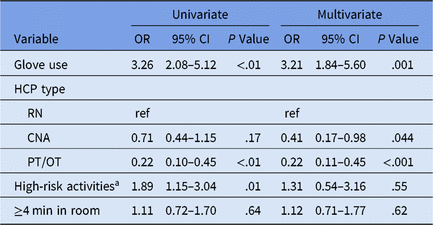
On univariate analysis, hand hygiene adherence before patient care was higher with glove use and spending ≥4 minutes in the room (P = .01), and it was lower among CNAs (P = .04) (Table 2). Hand hygiene adherence after patient care was higher with glove use (P < .01) and performing high-risk activities (P = .01) and lower within the PT/OT job role (P < .01).
Univariate and Multivariate Analysis of Factors Influencing Hand Hygiene Adherence Before Patient Care

Note. OR, odds ratio; CI, confidence interval; HCP, healthcare personnel; RN, registered nurse, CAN, certified nurse assistant; PT/OT, physical therapy/occupational therapy.
a Includes bathing, showering, performing personal hygiene such as brushing teeth and combing hair, toileting assistance, incontinence care, dressing the patient, and changing linens.
Abbreviations: OR, odds ratio; CI, confidence interval; RN, registered nurse; CNA, certified nursing assistant; PT/OT, physical therapy/occupational therapy.
Univariate and Multivariate Analysis of Factors Influencing Hand Hygiene Adherence After Patient Care

Note. OR, odds ratio; CI, confidence interval; HCP, healthcare personnel; RN, registered nurse, CAN, certified nurse assistant; PT/OT, physical therapy/occupational therapy.
a Includes bathing, showering, performing personal hygiene such as brushing teeth and combing hair, toileting assistance, incontinence care, dressing the patient, and changing linens.
Abbreviations: OR, odds ratio; CI, confidence interval; RN, registered nurse; CNA, certified nursing assistant; PT/OT, physical therapy/occupational therapy.
On multivariate analysis, increased hand hygiene adherence was associated with glove use both before patient care (P = .001) and after patient care (P = .001) (Table 3). Lower hand hygiene adherence before patient care was associated with CNA job role, and lower hand hygiene adherence after patient care was associated with with CNA job role and PT/OT job role. We detected no significant association between hand hygiene and type or duration of patient care activity performed. Significant correlation (Pearson coefficient > 0.5) was observed between the following variables: incontinence care and bathing activities (0.50), PT/OT role type and PT activity (0.51), and nursing role type and medication administration activity (0.64).
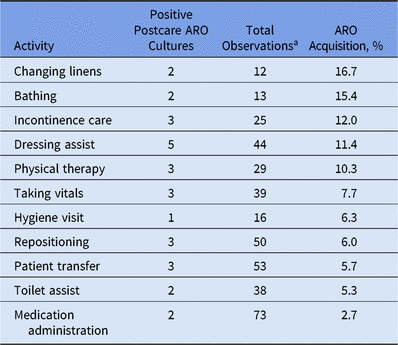
ARO Acquisition on HCP Hands After Patient Care Activities

Note. ARO, antibiotic-resistant organism; HCP, healthcare personnel.
a Sum of all observations exceeds 350 because multiple activities could be performed during a single observation; 80 observations were included multiple activities.
ARO contamination of HCP hands
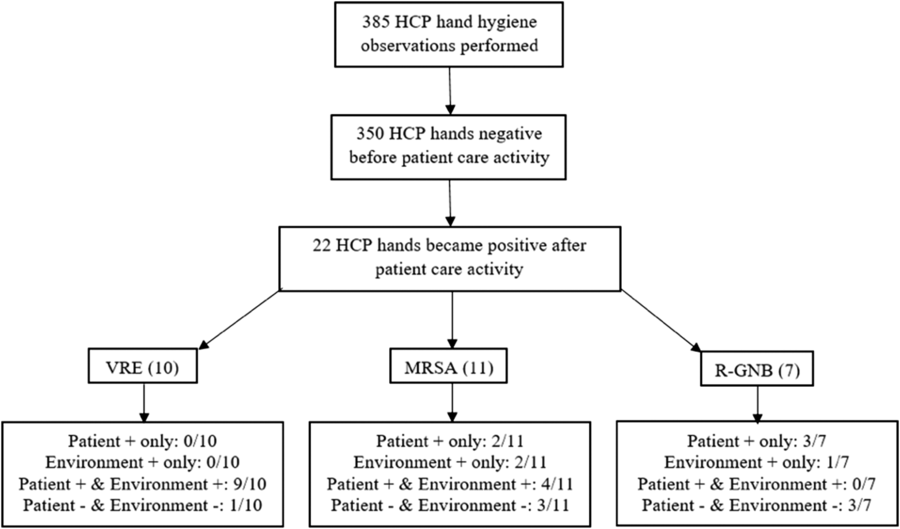
Of 385 paired hand cultures collected from HCP, 35 cultures (0.9%) collected before patient care were positive for AROs. Of the 350 paired hand cultures collected before patient care that were negative, 22 (6.3%) paired hand cultures collected after patient care were positive for ≥1 ARO (6 from nurses, 12 from CNAs, 3 from PT/OT staff, and 1 unknown). The following organisms were acquired: VRE (n = 10), MRSA (n = 11), and R-GNB (n = 7). Among the 7 HCP who acquired a new R-GNB, 10 different R-GNB were isolated (Fig. 2). Of these 22 instances of a new acquisition, 17 (77.3%) correlated with the same organism isolated from either the patient or the patient’s room. Among these HCP with a new ARO acquisition, hand hygiene adherence was 5 of 22 observations (22.7%) before patient care and 8 of 22 observations (36.4%) after patient care, whereas glove use occurred in 9 of 22 observations (40.9%). Hand hygiene before care was higher for those with negative hand cultures before care than those with positive cultures before care (28.7% vs 12.9%; P = .09) (Supplementary Table 2 online). The patient care activities associated with the highest rates of HCP hand ARO acquisition were changing linens (2 of 12, 16.7%) and bathing (2 of 13, 15.4%) (Table 3). In 2 instances of MRSA acquisition and 1 instance of VRE acquisition, PFGE was performed on all isolates from the HCP, patient, and environment. In all 3 instances, the PFGE patterns of all tested isolates were identical.
New acquisition of AROs on HCP hands compared to patient colonization and environment contamination. In total, 385 HCP observations were performed; in 350 of these observations, HCP hands were negative for AROs before entering the patient’s room. Of these 350 observations, 22 HCP (6.3%) acquired an ARO on his or her hands upon room exit; 10 acquired VRE, 11 acquired MRSA, and 7 acquired R-GNB. Among the 7 R-GNB acquisitions, 10 different R-GNB were isolated: Klebsiella pneumoniae (n = 2), Proteus mirabilis (n = 2), Escherichia coli (n = 1), Morganella morganii (n = 1), Acinetobacter baumanii (n = 1), Pseudomonas fluorescens(n = 1), Pantoea spp. We have included data on how often the same organism (with the same resistance profile) was found on the patient only, in the patient’s environment only, on both the patient and the environment, or on neither the patient nor environment. Note. ARO, antibiotic-resistant organism; HCP, healthcare personnel; VRE, vancomycin-resistant enterococci; MRSA, methicillin-resistant Staphylococcus aureus; R-GNB, resistant gram-negative bacteria.

Discussion
In this study, rates of hand hygiene adherence among HCP in NFs were low, particularly prior to patient care, and overall rates of glove use were high. We detected a positive association between glove use and hand hygiene before and after patient care. Hand hygiene rates varied considerably based on the role of the provider and the activities performed in the room. We also found a 6.3% rate of new ARO acquisition on the hands of HCP after patient care. The specific ARO acquired on HCP hands was associated with patient colonization or room contamination with the same pathogen. This finding is particularly notable considering the high ARO colonization pressure at these facilities; prior data showed ~58% of patients colonized with ≥1 ARO within 14 days of NF admission.
The low rate of hand hygiene adherence (36.7%) evident in our study was within the 15%–54% range reported by other studies in similar settings.Reference Smith, Carusone and Loeb1, Reference Pan, Domenighini and Signorini2, Reference Ho, Seto, Wong and Wong13, Reference Pineles, Petruccelli and Perencevich14 Hand hygiene rates were particularly low for CNAs and PT/OT staff. Hand hygiene in NFs poses specific challenges due to limited staff training, low HCP-to-patient ratio, and the need for HCP to provide care in a setting that serves as a community living environment with potential for frequent spontaneous, unplanned interactions with patients.Reference Schweon and Kirk15 Individualized hand hygiene education for nonnursing HCP, such as rehabilitation therapists, will likely be influential in improving future adherence.
In our study, glove use was independently associated with hand hygiene adherence before room entry and after room exit. Prior studies have shown conflicting results regarding the impact of glove use on hand hygiene; the preponderance of data suggest that glove use decreases hand hygiene adherence. In a large study of >7,000 observations at 15 acute-care hospitals in England, Fuller et alReference Fuller, Savage and Besser16 reported lower rates of hand hygiene with glove use versus without gloves (41% vs 50%, relative risk [RR], 0.83).Reference Fuller, Savage and Besser16 Furthermore, multiple studies have demonstrated improved rates of hand hygiene after discontinuation of mandatory gloving policies in the inpatient setting.Reference Cusini, Nydegger, Kaspar, Schweiger, Kuhn and Marschall17, Reference Kuruno, Kasahara and Mikasa18 Conversely, a large multicenter cluster-randomized trial assessing rates of MRSA/VRE acquisition with universal gowning and gloving versus usual care found higher rates of hand hygiene at room exit in the universal gown-and-glove group (78% vs 63%, difference 15.4%; P = .02).Reference Harris, Pineles and Belton19 However, their results were obtained in the hospital setting and may not translate to the distinctive environment found in long-term care facilities, where the setting is residential and the acuity of illness is lower. In our multivariate analysis, a robust association between hand hygiene and glove use was detected, but not with high-risk activities or duration of time in the room. This association may be due to bundling of glove use with hand hygiene by HCP and different care patterns performed in NFs.
Rates of hand hygiene among nurses were higher than those for CNAs before patient care and both CNAs and physical therapists after patient care, consistent with prior data.Reference Pittet, Mourouga and Perneger20, Reference Conly, Hill, Ross, Lertzman and Louie21 Targeted hand hygiene education for nonnursing HCP will likely be influential in improving future adherence. This improvement is of particular importance considering the frequent physical contact that occurs during patient care for the CNA and physical therapists, offering ample opportunity for pathogen transmission.
In addition, AROs were present on the hands of HCP before patient contact in 0.9% of observations in this study and after patient contact in 6.3%. The rate of ARO acquisition was similar to rates reported in prior studies of transmission of R-GNB to the gloves of NF HCP and was lower than rates observed in MRSA transmission.Reference Blanco, Pineles and Lydecker22–Reference Pineles, Morgan and Lydecker24 Pathogen acquisition was diverse, with relatively equal numbers of VRE, MRSA, and R-GNB isolated. In most cases, the relevant pathogen was also cultivated from the patient or environment, with identical PFGE patterns in a small subset of tested isolates. High rates of ARO acquisition were observed with both high-risk (eg, incontinence care, dressing assist) and low-risk (eg, repositioning, patient transfers) activities. Prior work by Blanco et alReference Blanco, Johnson and Sorkin23 found assisting residents with dressing, bathing, hygiene, incontinence care, and transfers, in addition to showering, to be the highest risk activities for HCP in the NF setting, each with a R-GNB transmission rate of >12%. Potential exposure to mucous membranes or body fluid among these activities is variable; sustained patient contact may be a more important risk factor for ARO acquisition among HCP in the NF setting; however, further studies are needed.Reference Jackson, Thom and Magder25, Reference Wolfensberger, Clack and Kuster26 Molecular typing to characterize AROs isolated from patients and their environment in close temporal relationship to HCP ARO acquisitions will be important to establish which transmission pathways are most common and thus should be targeted in future interventions.
Our study has several limitations. We did not assess all indications for hand hygiene during patient care, such as before aseptic procedures, after exposure to body fluids, and after contact with the environment. Additionally, we did not assess the appropriateness of glove use or glove changing during patient care. Study staff performing observations and cultures may have influenced HCP behavior, though the frequent presence of study personnel at NFs as part of the parent study likely mitigated any potential Hawthorne effect. We did not record the number of HCP who refused to participate in the study. We also did not assess HCP motivating factors for hand hygiene and glove use, which was beyond the scope of this study.
In conclusion, we found a low rate of overall hand hygiene adherence and high rates of glove use among HCP at NFs. Glove use and job title were associated with higher hand hygiene adherence. ARO acquisition on hands of HCP occurred after performing both ostensibly high-risk and low-risk tasks. A better understanding of HCP decision making regarding hand hygiene, particularly in context of each provider’s individual patient care activities, could improve overall hand hygiene rates and could decrease ARO transmission within NFs and across healthcare settings.
Supplementary material
To view supplementary material for this article, please visit https://doi.org/10.1017/ice.2019.292
Acknowledgements
We thank the patients and their families who participated in this study.
Financial support
This research was supported by the National Institutes of Health (grant nos. RO1 AG041780 and K24 AG050685).
Conflicts of interest
The study authors declare no conflicts of interest related to this article.