Introduction
The rising cost of living, the increased pace of life, and work intensification have placed pressure on work–life balance within China (Zhang, Li, & Foley, Reference Zhang, Li and Foley2014). Chinese women, and mothers in particular, face specific work–life challenges as they engage in paid employment and remain responsible for duties within the home (Cook & Dong, Reference Cook and Dong2011). Some Chinese nationals, including women, are responding to this imbalance by migrating to countries, which conceivably offer greater opportunities to reconcile work and family life.
In our own national context, for example, Ip and Friesen (Reference Ip and Friesen2001) found that over a third of the Chinese migrants in their study were primarily attracted to New Zealand by the opportunity to achieve a more relaxed and better quality of life and to live in a clean environment, and 29% were attracted by the stable political system. Additional lifestyle attractions have been found to include educational opportunities for themselves and less competitive education for their children (Yeung, Reference Yeung2012), and more recently, family reunification of elder parents (Zhang, Reference Zhang2014). Only 10% of respondents in Ip and Friesen’s study were primarily attracted by employment considerations. These lifestyle motivations contrast significantly with New Zealand immigration policy which targets suitably skilled migrants to alleviate labour shortages (Merwood, Reference Merwood2008).
These reasons for migrating also suggest that achieving work–life balance is a complex process involving relationships between the socio-cultural, work, and family domains. In this research, we explore the sense of work–life balance achieved by 15 Chinese-born migrant mothers since moving to New Zealand. We do so by examining their experiences within the socio-cultural, work, and family domains. We consider if there is an interrelationship between participant experiences in these three domains and their overall sense of balance or conflict since migrating to New Zealand.
We begin by reviewing work–life balance theories and then reflect on understandings of work–life balance within the Chinese context. Next, Chinese postmigration experiences in the socio-cultural, work, and family domains, and the methods used in this study are presented. Our findings reveal that the participants had both shared and unique postmigration experiences within the socio-cultural, work, and family domains. Moreover, the interrelationship between these three domain experiences influenced their overall sense of balance or conflict since migrating to New Zealand. We discuss the Human Resource Management implications of our findings and conclude that migration results in an increased sense of balance for some and an overall sense of imbalance for others.
Theories of Work–Life Balance
Growth in the participation rates of women, and especially maternal employment (OECD, 2010) have challenged traditional male breadwinner and female caregiver roles, and sparked debates about work–life balance. While there is no one definition of work–life balance, the successful integration between work and family life and experiencing satisfaction in both domains has become a common theme in the literature (Kirchmeyer, Reference Kirchmeyer2000; Clarke, Koch, & Hill, Reference Clarke, Koch and Hill2004; Blyton & Dastmalchian, Reference Blyton and Dastmalchian2006). In their development of Role Conflict Theory, for example, Greenhaus and Beutell (Reference Greenhaus and Beutell1985) recognised that satisfaction can be influenced by the extent to which demands and expectations required in one domain enables or prohibits the ability to fulfil commitments in the other. Specifically, they suggested that work–life conflict arises if there is insufficient time to perform the required tasks in each domain, if the inherent strains or stressors in one role affect the ability to perform in the other, or when there is incompatibility between the behavioural norms expected across the two domains. Conversely, Greenhaus, Collins, and Shaw (Reference Grbic2003: 513) saw that work–life balance is enhanced when there is a sense of ‘time balance, involvement balance, and satisfaction balance’ between the two domains. Consequently, they defined work–life balance as ‘the extent to which an individual is engaged in – and equally satisfied with – his or her work role and family role’.
In contrast, Staines (Reference Staines1980) considered that experiencing equal satisfaction or engagement in each domain is not a necessary perquisite for achieving work–life balance. Instead, he suggested that experiences in one domain might positively or negatively spillover to the other domain, and thus influence well-being. Moreover, Staines viewed that people who are unsatisfied in one domain may still experience satisfaction by engaging in compensatory behaviours in the other domain. Those unhappy at work, for instance, might invest more time and energy in their family to achieve an overall sense of balance.
Clark (Reference Clark2000) drew on these theorisations to explore how individual actions and their interactions with others influences work–life balance. She conceptualised work and home as two distinct domains separated by a border; with each domain comprising a unique culture, specific rules, and a set of expectations required by domain members. Clark recognises that individual needs differ, therefore, how work–life balance is achieved also differs. Hence, balance might be achieved by experiencing satisfaction in each domain; or by fixed or fluid demarcation lines between the work and home spaces; or by engaging in compensatory behaviours. Balance is also influenced by the level of support provided by domain members (e.g., partners, managers, or colleagues), and the ability to negotiate meaningful domain borders, rules, and expected norms and behaviours. Clark suggests those who cannot create an overall sense of balance may remove themselves entirely by changing their employer or leaving the family; or, as in our case, through migration.
Within individualistic cultures, work interfering with family is considered both a cause of conflict for the worker and the family, and a sign that the worker is failing to meet family obligations (Yang, Chen, Choi, & Zou, Reference Yang, Chen, Choi and Zou2000). Yang et al. show that there is increasing evidence that when this occurs, the family withdrawals support from the worker, which can manifest in separation and divorce. Within the human resource management literature, managers are thus encouraged to design work–life balance policies to help mitigate against personal costs, such as illness, and personal and family stress. Such polices also have the aim of reducing negative organisational outcomes that arise from work–life conflict, such as absenteeism and turnover. Typical work–life balance initiatives include offering flexible work arrangements and childcare support (Brough, O’Driscoll, & Kalliath, Reference Brough, O’Driscoll and Kalliath2005).
These theories offer insight into the complexity of the work–life interrelationship. However, concerns have been raised about the Euro-centric understandings embedded in notions of family, individuals, and workers. From a cultural perspective, concerns have also been raised about how many of these theories confer responsibility to managers to facilitate work–life balance. Powell, Francesco, and Ling (Reference Powell, Francesco and Ling2009) have thus argued that cultural influences have not been fully recognised in the work–life literature. In response, there is a growing body of research focussing on the work–life interrelationship within the Chinese socio-cultural context.
Theorising Work–life Balance in China
Changes within the socio-cultural and political economy within China have significantly strengthened Chinese women’s status in the home and increased their employment rates (China Daily, 2015). Since the founding of the People’s Republic of China in 1949, women have been encouraged to engage in paid employment. The 1978 economic reforms further supported this through the creation of manufacturing sector employment opportunities for women (Lee, Reference Lee2012). More recently, Chinese women have entered tertiary sector and professional employment, progressed in managerial positions, and engaged in entrepreneurial activity (China Daily, 2015). These trends are linked to the raft of government and organisational gender equality initiatives implemented over the past 30 years (China Daily, 2015), and to the increased family investment in girls post-compulsory education since the 1979 one-child policy (Lee, Reference Lee2012). Cook and Dong (Reference Cook and Dong2011) also show that maternal employment has been facilitated by the combination of the one-child policy and the early retirement age of women compared to men. That is, the one-child policy has freed up mothers time for work and the early retirement has freed up grandmothers time to provide childcare. Currently, Chinese women have one of the highest employment rates in the world, and account for 45% of China’s labour force (China Daily, 2015).
Zhang, Li, and Foley (Reference Zhang, Li and Foley2014) draw on Chinese family arrangements to theorise that the work–life interface might be experienced differently within the contemporary Chinese industrial-cultural context. They argue that despite significant changes in the industrial economy and the growth in women’s employment, family and the embedded values of obligation and interdependence, remain the foundation for most Chinese people. Accordingly, family members are obligated to sacrifice personal interests for the sake of family interests. Thus, working long hours or weekends to improve the status and financial well-being of the family might not be experienced as conflict but as an acceptable self-sacrifice for the family. In accordance with the value of interdependence, the family in turn supports those working long hours. In this way, work–life balance or conflict is managed by the family and not by an individual or by the organisation. Zhang et al. conclude that rather than experiencing work–life balance or conflict, Chinese workers prioritise work for family.
These Chinese family arrangements, and the enactment of obligation and interdependence, however, remain based on traditional male breadwinner/female caregiver roles (Zhang, Li, & Foley, Reference Zhang, Li and Foley2014). Thus, men are obligated to prioritise work for family and women are obligated to prioritise family over work and career aspirations (Xiao & Cooke, Reference Xiao and Cooke2012). Moreover, the near 10% decline in women’s employment between 2000 and 2010 has been interpreted by Zhang et al., as evidence of a revival of these traditional roles.
In contrast, Cook and Dong (Reference Cook and Dong2011) link this decline in women’s employment to the economic reforms. They argue these reforms have resulted in both female redundancy and the forced withdrawal from employment due to reductions in state and private-sector childcare funding. In addition, Foster and Ren (Reference Foster and Ren2015) link work intensification to these economic reforms. They argue this intensification has caused work–life conflict for working women who also remain responsible for the majority of housework, even among dual-earner couples. Moreover, the one-child policy, and the resultant 4-2-1 population structure, has meant that women have greater care responsibilities for their ageing parents and grandparents (Lee, Reference Lee2013).
Further, Zhang, Zhou, Wang, and Cone (Reference Zhang, Zhou, Wang and Cone2011) argue that the economic reforms and the modernisation process have challenged the traditional Chinese values of obligation and interdependence. Instead, they found that the influence of modernity at the individual level sees an embracement of Western values associated with self-reliance, independence, freedom of expression, and the perusing of personal goals. In this way, working long hours, for example, is not always regarded as an acceptable self-sacrifice for the benefit of the family, but rather as a source of work–life conflict. A conflict that some appear to be resolving through migration. We now turn to a review of postmigration experiences, with a particular emphasis on Chinese-born women migrants living in New Zealand.
Postmigration socio-cultural, work, and family domain experiences
Chinese migration to New Zealand began in the 1860s with men coming to work in the gold mines, with the expectation that they would return to China (Xue, Friesen, & O’Sullivan, Reference Xue, Friesen and O’Sullivan2011). Chinese migration, and especially that of women, remained tightly controlled up until the 1980s. For example, by 1930 ~4,217 Chinese men and 52 women had been granted entry to New Zealand and a small number of women and children gained refugee entry during World War Two and then citizenship throughout the 1950s (Ip, Reference Ip2002).
During the 1980s, changes in China’s emigration and New Zealand’s immigration policies from race to skill-based criteria, stimulated substantial growth in migration from China to New Zealand (Li, Reference Li2014). Between 2001 and 2013 Census, the New Zealand0Chinese population grew to 171,411 people; over 73% of whom were born overseas (Statistics New Zealand, 2013, 2014). Since 1991, women have made up just over half of the New Zealand-Chinese population (Ip, Reference Ip2002; Statistics New Zealand, 2013). Moreover, a significant cohort of Chinese-born international students have gained permanent residency (Merwood, Reference Merwood2008), and the maturing of this cohort is attributed to the increase in Asian birth rates since 2008 (Johnston, Reference Johnston2015). So to, a considerable number of elderly Chinese have migrated to be near their adult children and to provide them with domestic and childcare support (Zhang, Reference Zhang2014).
A number of studies document that Chinese-born migrants have both positive and negative experiences within the socio-cultural, work, and family domains. Within the New Zealand socio-cultural domain, Chinese-born migrants have been found to appreciate the lifestyle, the clean environment, the educational opportunities for their children, the friendliness of the local people, and the supportive welfare system (Yeung, Reference Yeung2012). Chinese migrants also experience social isolation often due to language barriers (Ho, Au, Bedford, & Cooper, Reference Ho, Au, Bedford and Cooper2003; Zhang, Reference Zhang2014), cultural misunderstandings between themselves and the local community (Clydesdale, Reference Clydesdale2011), and interpersonal racism (Yeung, Reference Yeung2012). Racist media portrayals have reinforced negative stereotypes and stimulated backlash views that Chinese migrants take jobs from locally born New Zealanders (Ip, Reference Ip2003). Tolerance towards migrants are particularly influenced by ethnic identity and socio-economic status of the locals (Grbic, Reference Greenhaus, Collins and Shaw2010).
Yet, within the work domain, prior research repeatedly concludes that Chinese migrants in general, and women in particular, encounter difficulties in gaining employment reflecting their skills and qualifications (Beine, Docquier, & Rapoport, Reference Beine, Docquier and Rapoport2007; Cooke, Reference Cooke2007; Foroutan, Reference Foroutan2008; Li, Reference Li2008). In New Zealand, Chinese migrants experience downward mobility in their employment status and income levels compared to premigration standards (Ho et al., Reference Ho, Au, Bedford and Cooper2003; Statistics New Zealand, 2012). In relation to the locally born, migrants earn less, and are more likely to be under or unemployed; with migrant women the most likely group to be unemployed or not in the labour market (Clydesdale, Reference Clydesdale2011). Clydesdale attributes these outcomes to language and cultural differences which especially affect Asian migrants’ employment integration and their ability to communicate with clients and colleagues. Moreover, Clydesdale points out that there is a mismatch between New Zealand skilled-based immigration policies and the availability of skilled employment.
Chinese women’s socio-cultural and employment outcomes, however, are also tightly entwined with their postmigration family domain responsibilities. In the British context, Lee, Chan, Bradby, and Green (Reference Lee, Chan, Bradby and Green2002) found that women who migrated independently to escape restrictive gender roles, and who subsequently married in Britain, shared childcare and housework with their husbands and were more active in their careers. In contrast, women who migrated with their family remained responsible for housework, maintaining the family, and advancing their husband’s careers. Thus, the women bore the ‘brunt of anxieties, social isolation, responsibilities, and sacrifices required for the family strategy to succeed’ (Lee et al., Reference Lee, Chan, Bradby and Green2002: 613). Similarly, Cooke (Reference Cooke2007) found that Chinese professional women lost considerable career traction once they migrated to Britain. Instead, they prioritised their husband’s career and their children’s well-being over their professional lives. They did so by taking on the responsibility for housework and for integrating their children into the local community.
Within the Australian context, Ho (Reference Ho2006) also found complex relationships between professional Chinese women’s postmigration employment and their family roles. The majority of the women in her study worked full time prior to migration and had considerable domestic and childcare support from hired help, mothers, or mother-in-laws to do so. The lack of this support in Australia meant that the women organised their employment to accommodate their family needs by accepting part-time work that often did not reflect their skills. Both Cooke (Reference Cooke2007) and Ho (Reference Ho2006) concluded that migration escalates traditional Chinese women’s roles as wives and mothers at the expense of their role as income earners, and consolidates men’s careers and their status as breadwinners. Their position is supported by Hibbins (Reference Hibbins2005), who found that Chinese-migrant men living in Australia saw themselves as financial providers and, while they wanted to be more active fathers, expected their wives to be responsible for the home and children.
Less attention has been given to Chinese women’s postmigration family domain experiences within the New Zealand context, an issue we consider in this article. However, the growth in elderly Chinese migrants providing domestic and childcare support (Zhang, Reference Zhang2014) suggests that the postmigration family domain responsibilities of mothers living in New Zealand might differ to those previously found by Ho and Cooke. In summary, prior research has documented the postmigration experiences of Chinese migrants within the socio-cultural, work, and family domains. Less attention has been given to whether there is an interrelationship between the experiences in these three domains and the achievement of postmigration work–life balance or conflict for Chinese-born mothers. In the next section, we present the qualitative methods used to explore whether such an interrelationship exists.
Methods
We adopted an exploratory design (Maykut & Morehouse, Reference Maykut and Morehouse1994) because this approach is useful when little is known about the research interest. In support of this design, we used in-depth interviews to capture the participants’ specific experiences within the socio-cultural, work, and family domains in China and New Zealand. The in-depth interviews also enabled us to consider if there was an interrelationship between the experiences within these three domains and the participants sense of balance or conflict since migrating to New Zealand.
The extant literature informed the development of five broad interview themes. First, to set the scene, we explored the reasons why the women chose to migrate to New Zealand. We also asked when they came, who they came with, if they had children since coming to New Zealand, and whether other family members had since joined them. Second, we asked about the women’s experiences within the socio-cultural domain in regards to language or cultural barriers, isolation, racism, local friendships, and community ties.
Third, participants were asked to compare their employment outcomes and experiences between China and New Zealand. Specifically, we asked if their work and income levels reflected their skills and qualifications obtained in China and/or New Zealand, if they had experienced discrimination in the postmigration employment process, and if they were happy with their collegial and client relationships. Fourth, the women compared their family life between China and New Zealand, especially in terms of whether they had domestic and childcare support, and if they had elder-care responsibilities. The interviews were concluded by asking the participants to consider whether they had achieved a sense of work–life balance compared to their lives in China.
The selection criteria included that participants be Chinese-born migrant mothers living in New Zealand, and have prior work experience. The participants were recruited through existing social networks (Petersen & Valdez, Reference Petersen and Valdez2005) and subsequently through snowballing (Cohen & Arieli, Reference Cohen and Arieli2011). Initially, seven women known to the second author were contacted. These women introduced us to a further eight participants. Reflecting the use of social networks to generate the sample, the participants shared a number of similarities that went beyond the selection criteria. Specifically, the women lived in Auckland or Hamilton, were all born in Mainland China, and had gained tertiary qualifications either in China or in New Zealand, and in some cases in both countries.
The interviews were conducted in the participants’ second language of English; which at times meant that they felt unable to fully describe their emotions or experiences. The interviews ranged between 60 and 90 min, were recorded and transcribed. The transcripts were thematically analysed after the completion of all the interviews (Braun & Clarke, Reference Braun and Clarke2006). The migration literature framed the analysis of the socio-cultural, work, and family domain experiences. The work–life balance literature framed the analysis of the interrelationship between these three domains and the participants’ sense of postmigration work–life balance or conflict.
Given the sample size, the findings are not necessarily generalisable across Chinese-born migrant mothers, nor across other migrant groups living in New Zealand. However, small samples do offer the opportunity to compare unique experiences of participants with what is already known in the literature (Tsoukas, Reference Tsoukas2009). Thus, despite the limitations posed by sample size, snowballing, and being interviewed in a second language, a number of distinct themes emerged from the interviews. The participants unique experiences indicate that achieving a sense of postmigration balance is a far more nuanced and complex process that is suggested by prior research. In this way, the experiences of this small group of women do provide deeper insight in to the work–life balance experiences of Chinese-born migrant mothers. We now present an overview of the participants.
Participant overview
All 15 women in our study were born in Mainland China. At the time of the study, they either lived in Auckland, where the majority of Chinese-born migrants have settled (Statistics New Zealand, 2013), or Hamilton, where Chinese form the largest new-comer migrant community (Yeung, Reference Yeung2012). The women’s ages ranged from 20 to 50 years, and had been living in New Zealand between 1 and 20 years.
The most common primary reason for coming to New Zealand was to pursue tertiary-level education (e.g., Participants 1, 2, 6, 7, 11, 12, 13, and 15). The second most common reason related to family, for example, Participants 8 and 10 came as trailing wives, Participants 3 and 5 came to be near ageing parents, and Participant 4 migrated as a dependent child. Only Participants 9 and 14 specifically migrated to achieve a more balanced lifestyle.
In terms of who they migrated with, seven migrated as independent students (e.g., Participants 2, 6, 7, 11, 12, 13, and 15). Four women migrated with their husband and first child (e.g., Participants 1, 3, 8, and 14). Participants 9 and 10 migrated with their husband and Participant 4 migrated with her parents. Participant 5 migrated with her two school-aged children while her husband remained in China and financially supported the family.
Seven women had one child (e.g., Participants 8, 10, 11, 12, 13, 14, 15), seven women had two children (e.g., Participants 1, 2, 4, 5, 6, 7, 9), and Participant 3 had three children. Three of the women had all their children in China (e.g., Participants 5, 8, and 14) and the remaining 12 women either had their first, second, or third child in New Zealand. Reflecting national trends, this growth in family size was particularly evident among all eight women who initially came to study and subsequently stayed on in New Zealand (e.g., Participants 1, 2, 6, 7, 11, 12, 13, and 15).
All of the women had tertiary-level qualifications, reflecting both researcher social networks and immigration policies that target skilled migrants. These qualifications were obtained in China (e.g., Participants 3, 5, 8, 9, 10, and 14), New Zealand (e.g., Participants 2, 4, and 12), or a combination of both (e.g., Participants 1, 6, 7, 11, 13, 15).
Seven women had worked in both China and New Zealand (e.g., Participants 1, 6, 7, 8, 9, 10, 11), Participants 3 and 5 had only worked in China, and the remaining six women had only worked in New Zealand (e.g., Participants 2, 4, 12, 13, 14, 15). At the time of the study, five were employed (Participants 1, 6, 8, 9, and 11), five were self-employed (Participants 4, 7, 13, 14, and 15), three were on parental leave (Participants 2, 10, and 12), and Participants 3 and 5 were a full-time student and unemployed, respectively. We now turn to our findings.
Findings
The two most common primary reasons for moving to New Zealand was to study or for family reasons. However, similar to Ip and Friesen’s (Reference Ip and Friesen2001) research, the women were also attracted to New Zealand because they perceived that, compared to China, they would achieve greater balance in their lives. This was particularly evident among the nine women who were employed in China and had personally experienced work intensification in their lives (Zhang, Li, & Foley, Reference Zhang, Li and Foley2014). Some of the women based their premigration perceptions of greater balance on hearsay from other migrants, an enjoyable holiday experience, and on advertising campaigns targeting the tourist market. The women who came primarily for education developed their perceptions on the basis of experiencing a more relaxed lifestyle and friendly local people during their study years. This is best captured by Participant 11:
I had worked in China for almost six years before I came … and I felt very tired of the fast pace of living and work pressures. I was so attracted by local people’s way of living when I studied in New Zealand. So I decided to stay here for a better life standard.
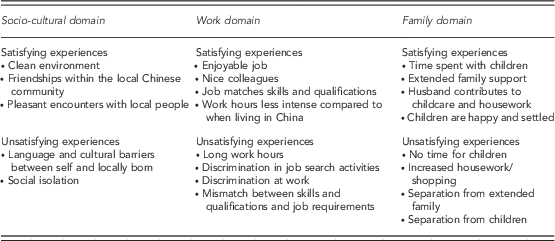
While the women were attracted by the perception of an improved lifestyle, as we see in the following section, and summarised in Table 1, they had differing experiences within the socio-cultural, work, and family domains.
Experiences in the socio-cultural, work, and family domains

Experiencing the socio-cultural domain
The most significant themes to emerge within the socio-cultural domain reflect what others have found in relation to Chinese migrants. For example, like Yeung (Reference Yeung2012), all 15 women in our study considered that New Zealand has a lovely environment and that the majority of the local people they encountered were ‘nice’ and ‘friendly’. As with prior research (e.g., Ho et al., Reference Ho, Au, Bedford and Cooper2003; Clydesdale, Reference Clydesdale2011; Zhang, Reference Zhang2014), the women also found it difficult to engage with local people. These women took personal responsibility for this by attributing these difficulties to their own language skill deficiencies or to cultural barriers. Participant 4 described this situation: ‘It is not easy to get into their culture, even after 10 years’. Thus, ‘friendliness’ did not translate into close friendships; rather locals were perceived as ‘just nodding friends’ (Participant 11).
These language and cultural barriers resulted in social isolation from the wider community. However, reflecting the size of the Chinese communities in both Auckland and Hamilton, most of the women formed close friendships with other Chinese migrants. Participant 12 explains both her sense of comfort with her Chinese friends and her sense of nervousness when attempting to communicate with local New Zealanders:
All my close friends are Chinese. I like to communicate and get on with Chinese, maybe because we share same culture and speak same language. To be honest, I feel nervous and have to concentrate on listening very carefully when I have conversation with local people in English … otherwise I may not understand well about the conversation. (Participant 12)
Experiencing the work domain
The women’s work domain experiences both confirmed and extended current understandings on Chinese-migrant women’s employment. For instance, all 15 women encountered discrimination in their job search activities and, at times, within their places of employment. These experiences affected the women’s confidence which left them feeling ‘upset’, ‘uncomfortable’, and ‘inadequate’. These experiences are captured by Participant 12:
I found being discriminated when I trying to get a job. I knew my language and communication skill is not good enough, and I think that is the main reason why employers generally considered local kiwis first when recruiting.
Reflecting Ip and Friesen’s (Reference Ip and Friesen2001) analysis, however, these discriminatory experiences had different employment outcomes for the women. In the first instance, two women in our study (e.g., Participants 6 and 11) did secure employment that reflected their skills and qualifications gained in China and New Zealand. They both enjoyed their work and found their colleagues to be ‘nice and friendly. I am happy working with them’ (Participant 11).
Like pervious research (e.g., Ho et al., Reference Ho, Au, Bedford and Cooper2003; Cooke, Reference Cooke2007; Foroutan, Reference Foroutan2008; Li, Reference Li2008), the remaining women did not gain employment that reflected their skills or qualifications that were gained in China and/or New Zealand. The employment outcomes of five women reflected broader employment trends experienced by migrant women living in New Zealand (Clydesdale, Reference Clydesdale2011; Statistics New Zealand, 2012). Thus, Participant 5 was unemployed because her Chinese medical degree was unrecognised in New Zealand, and Participant 3 withdrew from the labour market to raise her three children. Both women primarily came to be with elder parents; hence from the outset, migration was an act of prioritising family over personal needs.
Participants 1, 8, and 9 experienced downward mobility and were dissatisfied with their jobs. Participant 1, as a trained teacher in China and had gained a New Zealand Master’s Degree and PhD in Education, worked as a part-time receptionist. Participant 8, as a trained teacher in China noted that ‘I cannot speak much English, so the only job I can find is the cook in a Chinese restaurant’. Participant 9, a qualified mechanical engineer and employed as a telecommunication manager in China, worked as a part-time sales clerk. Participants 1 and 9 experienced workplace discrimination while Participant 8 reported having good working relationships.
Four of the five self-employed women had New Zealand tertiary-level qualifications. Self-employment was the preferred career option for Participants 7 (upon completing her degree) and 14 (upon arrival with her Chinese qualifications). Participant 13 set up a family business with her husband and mother to alleviate their unemployment. Participants 4 and 15 initially secured jobs that matched their New Zealand qualifications. However, they both experienced discrimination from colleagues and clients. As Clark (Reference Clark2000) asserts, they both resigned from their jobs and set up businesses as a way to remove themselves from the unsatisfactory work situation. Participant 15 describes the effect of her experiences:
Well, I cannot well-concentrated on my work. I kept thinking why and how to change people’s attitude to me. I worked very hard, but with a bad mood. So I finally decided to quit my former job and started the small business with my husband.
Three women had resigned from their jobs to care for new-born babies. These women had similar experiences of job search discrimination, and prior to their parental leave, worked in areas unrelated to their qualifications. Participant 2 worked in a casino, a job she enjoyed ‘very much’, but chose to resign to become a stay-home mother. Participant 10 was unable to gain employment in her area of finance, and instead worked in her husband’s coffee shop. Participant 12 worked in retail despite having a New Zealand degree in media studies. Participants 10 and 12 intended to look for ‘a better job’ reflecting their qualifications when their babies were older. These women were unaware, that under New Zealand law, they were entitled to 12 months parental leave. Thus, it was not necessary for them to resign from their jobs, but because they did so, they must face a new round of job search activity.
Experiencing the family domain
In terms of the family domain, we found that both separation from and reunification with extended family manifest in three complex patterns of continuation, entrenchment, and challenges to premigration childcare and housework arrangements. Reflecting the growth in elder-Chinese migration (Zhang, Reference Zhang2014), 10 participants continued to have support with childcare and, to a lesser extent, housework from their parents. This help significantly reduced the time pressures experienced by the working women, as captured in the following quote:
They helped me a lot. My husband and I are always very busy with our small business and we rarely have time with our children and other family chores. They came and they helped us with almost every aspect of life. (Participant 13)
Similar to prior research (e.g., Ho, Reference Ho2006; Cooke, Reference Cooke2007), we found that the gendering of cleaning, cooking, and shopping became entrenched for some of the women. The number of women receiving help from their mother or mother-in-law with these activities, for example, declined from nine in China to four in New Zealand. Conversely, the number of women performing all household chores doubled from three in China to six within New Zealand. This entrenchment was partly explained by separation from wider family networks and by the number of women on parental leave. In contrast, the entrenchment of shopping was explicitly attributed to their mother or mother-in-law’s inability to speak English.
Separation from wider family networks also resulted in some women and their husbands challenging traditionally gendered family practices. For example, five women shared childcare with their husbands, compared to two in China, and the number of husbands helping with housework increased from one in China to four in New Zealand. This spousal sharing of unpaid work in the home was only partly attributed to separation from wider family. Significantly, this sharing was also due to the husbands reduced paid work hours since moving to New Zealand. Hence, these husbands had more time to spend with family. This contribution from the husbands had a positive effect on family life, as described by Participant 3:
I am happy that my husband and I are caring for our kids together. I think one of the reason is that he is not very busy, compared to his primary job in China. So he had spare time to spend with whole family.
These patterns of continuation, entrenchment, and challenges to family domain arrangements were mostly explained by separation from or reunification with wider family networks. Participant 1 and her husband, however, were separated from their preschool child for 3 years. She reflects that their feelings of guilt were only reconciled because their son had since settled in New Zealand:
When I first came to New Zealand my little boy was only four years old… For many complicated reasons, my husband and I could not look after our son by ourselves; and I left our little boy with my parents in China until he reached seven years old. I felt very guilty for not being there for my son during his childhood. He is now very happy to stay in New Zealand. So I think this also the reason why I choose to stay in New Zealand.
In addition to these patterns as they relate to the composition of household tasks, some women found that the language barriers encountered in the socio-cultural and work domains also encroached their family domain. For example, because of poor English proficiency, some of the women had few social activities outside of work, and instead retreated to the home, as explained by Participant 8: ‘I do not know much English so I do not have many social activities after work. Therefore, I spent most of my spare time with my kids’. Yet, these language barriers were increasingly being experienced within the home as their children became fluent with New Zealand colloquialisms, a situation that left them feeling ‘sad’ (Participant 6).
So far we have presented the women’s pre and postmigration domain experiences. However, as we see in the following section, it was the interrelationship between their experiences within the socio-cultural, work, and family domains that ultimately affected their overall sense of balance or conflict.
Socio-cultural, work, and family domains and postmigration balance and conflict
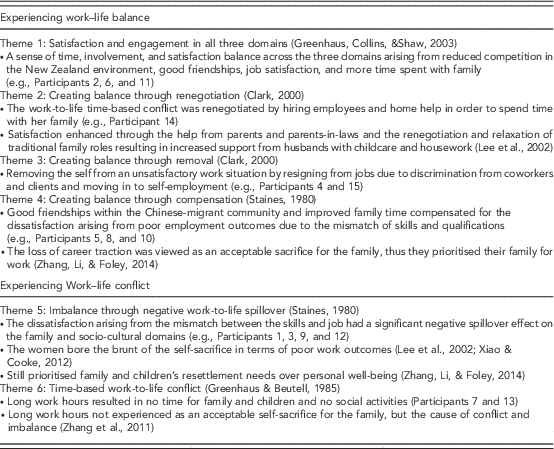
The 15 women in our study had both similar and unique experiences within the socio-cultural, work, and family domains. Moreover, these shared and unique experiences were evident in relation to each other and in relation to the extant literature. By drawing on the theorisations of work–life balance, six themes emerged in terms of the interrelationship between the three domains and the women’s overall sense of balance or conflict, as summarised in Table 2. The emergence of six themes support Clark’s (Reference Clark2000) assertion that work–life balance or conflict is experienced differently.
Work–life balance and conflict

First, we found support for the assertion that work–life balance is achieved through satisfying experiences across all domains (Kirchmeyer, Reference Kirchmeyer2000; Clarke, Koch, & Hill, Reference Clarke, Koch and Hill2004; Blyton & Dastmalchian, Reference Blyton and Dastmalchian2006). Mirroring Greenhaus, Collins, and Shaw’s (Reference Grbic2003) position, Participants 2, 6, and 11 felt a sense of time, involvement, and satisfaction balance in the socio-cultural, work, and family domains. These women felt they had achieved work–life balance since migrating because of the less competitive environment in New Zealand compared to China, and because they had formed good friendships, enjoyed their jobs, and were satisfied with the time they spent with their families. This sense of balance was nicely expressed by Participant 6:
Before I came to New Zealand, I hope I could have a relax lifestyle [in New Zealand] …, also have less competition compared with my life in China. And yes, I think I have achieved my goals here. I have more time to spend with my children and I enjoy my current life.
The second and third themes to emerge reflect Clark’s (Reference Clark2000) argument that people will create balance either by renegotiating the source of imbalance or by leaving an unsatisfactory situation. As a business owner, Participant 14 experienced time-based conflict; because of the long work hours she was unsatisfied with the time spent with her children. She created balance by hiring both domestic support in the home and additional staff in her business. Participants 4 and 15 resigned from the jobs where they had experienced discrimination from colleagues and clients, and created their sense of balance by setting up their own businesses.
The fourth and fifth themes to emerge mirrored Staines (Reference Staines1980) compensation and negative spillover theories on work–life balance. In these themes, seven women had satisfying experiences in the socio-cultural and family domains, and unsatisfactory experiences within the work domain. Their satisfying experiences in the socio-cultural domain stemmed from having a more enjoyable and relaxed lifestyle compared to living in China, and with the exception of Participant 3, who experienced social isolation, had formed close friendships within the Chinese community. Satisfaction in their family domain particularly stemmed from having more time with children and seeing their children happily settled in New Zealand. For some, this satisfaction also stemmed from the continuation of traditional Chinese family roles along with the migration of their parents. Satisfaction was enhanced for others through the relaxation of traditional male roles resulting in their husbands both spending more time with the family and contributing to housework and childcare.
The work domain experiences were unsatisfying because these seven women were unable to find employment matching their skills and qualifications, and indeed, all perceived that they could find more suitable work in China. Three of these women (e.g., Participants 5, 8, and 10) felt that the relaxed lifestyle and the time spent with their families more than compensated for the loss of career traction and poor employment outcomes. These women prioritised their family over their work, and as such, experienced an overall sense of balance as an outcome of migration because of the quality family time:
My husband and I were very busy in China, and we did not have much time to stay with my children… My mum took majority responsibilities of taking care of my children [including] … taking them to public park on weekends … It is better now, I see my children.
In contrast, the unsatisfactory work domain experiences had a significant negative spillover effect in the lives of four of the women (e.g., Participants 1, 3, 9, and 12). Participant 1 describes the complexity of this interrelationship:
I think my life in New Zealand is full of challenges and is a process of experiencing and learning something new. My life is totally changed since I decided to stay in New Zealand. On one hand, I enjoy the environment and the lifestyle here is easier compared to China, and my kids are happy here. But on the other hand, I am so unhappy for my current job. So I am actually quite struggling and cannot say whether I achieved my work-life balance in New Zealand. I’m just still working hard to make our life better.
Thus, similar to Lee et al. (Reference Lee, Chan, Bradby and Green2002) and Xiao and Cooke (Reference Xiao and Cooke2012) assertions, these four women bore the brunt of the self-sacrifice in terms of poor work outcomes, and according to Chinese values, continued to prioritise their family over their own well-being. This self-sacrifice and family prioritisation is illustrated by Participant 3:
Sometimes I feel very upset but I am not going to give up. I did everything for my kids. If they are happy living in New Zealand, then I will keep going.
In the final theme, Participants 7 and 13 experienced time-based work–life conflict (Greenhaus & Beutell, Reference Greenhaus and Beutell1985), which prevented them from engaging in the socio-cultural and family domains. As business owners, working long hours and weekends meant they had no time for social activities and very little time with their children. Like Zhang et al.’s (Reference Zhang, Zhou, Wang and Cone2011) assertion, these women did not see this as an acceptable self-sacrifice benefitting the family, but as the primary source of dissatisfaction and imbalance:
My major in college was management. I cannot find a related job but owning a small takeaway store instead. Before I came to New Zealand, I never thought I would run a small takeaway store with a Management Master Degree. I am not satisfied with my current lifestyle and I am so busy every day. I have no weekends, and have no time for my son. I never have achieved work-life balance in New Zealand. (Participant 13)
In summary, the interrelationship between the socio-cultural, work, and family domain experiences did influence the participants’ overall sense of balance and conflict. We now discuss these findings and consider government policy initiatives and the human resource management implications arising from them.
Discussion
The findings show that the participants had both shared and unique experiences between each other and in relation to the extant literature. Moreover, the overall sense of balance or conflict was influenced by the interrelationship between their unique experiences within the socio-cultural, work, and family domains. Thus, balance or conflict resulted either from satisfying experiences across all three domains (Greenhaus, Collins, &Shaw, Reference Grbic2003), negative spillover, complex processes of compensation (Staines, Reference Staines1980), renegotiation, or removal (Clark, Reference Clark2000).
Thus, like prior research, the participants in our study had conflicting experiences within the New Zealand socio-cultural domain, such as loving the environment and achieving a more relaxed lifestyle compared to China, all the while, experiencing communication difficulties with local people. In contrast to prior research, only one woman experienced social isolation due to language barriers. Instead, the remaining 14 women formed close friends within the expanding Chinese community in the towns where they lived.
While some enjoyed their jobs and colleagues, the work domain was the cause of the most dissatisfaction among the participants. As with previous research, this dissatisfaction stemmed from discrimination in job search activities and in their places of employment. Dissatisfaction was also experienced due to a mismatch between the job requirements and their skills, even among the women who had gained New Zealand qualifications. The work domain also caused imbalance through time-based conflict (Greenhaus & Beutell, Reference Greenhaus and Beutell1985). These work domain experiences at times did negatively spillover into the socio-cultural and family domains (Staines, Reference Staines1980).
However, the family domain was the main source of satisfaction among the participants, even for those who experienced entrenched gendered roles in the home. Their satisfaction was largely due to the time spent with children and husbands, and because of the continuation of or challenges to traditional Chinese family roles. Yet, the causes of work-based balance and conflict emphasised the importance of family, the embedded values of interdependence and obligation, and the centrality of women’s responsibility to manage work–life conflict (Zhang, Li, & Foley, Reference Zhang, Li and Foley2014). This importance was shown through the distress caused by time-based conflicts restricting family time, the willingness to prioritise family needs over personal careers (Xiao & Cooke, Reference Xiao and Cooke2012), and by the expressions that personal unhappiness is an acceptable self-sacrifice for the benefit of the family.
These traditional Chinese values were blended with an adaptation of Western values, in particular, the willingness to renegotiate their lives to pursue personal goals and to create personal and family balance (Zhang et al., Reference Zhang, Zhou, Wang and Cone2011). This willingness to renegotiate was evident by all the women through the act of migration. Postmigration renegotiations continued both within the family domain, through the redistribution of housework and childcare, and within the work domain, through the act of resigning from jobs.
These women’s experiences highlight the need for an institutional response. In terms of the mismatch of skills, we agree with Li (Reference Li2008), who writing in the Canadian context, argues that this represents an underutilisation of qualified migrants. A situation that should be addressed by the establishment of a government agency charged with the purpose of providing businesses with information and advice about international credentials. We also see a vital leadership role for tertiary-level education institutions to develop work-ready English proficiency of second language, international students. This is particularly important given that this student body is both an important export industry and a source of skilled migrants within the New Zealand context (Merwood, Reference Merwood2008).
The workplace experiences have implications for organisations and human resource managers in terms of recruitment, retention, turnover, and diversity management. The discriminatory job search experiences reveal an ongoing need to develop and implement affirmative action and equal employment opportunity practices in recruitment and selection processes. The discriminatory employment experiences reveal that diversity can create conflict and tensions in the workforce (Marina, Reference Marina2010). Marina argues, that while equal employment opportunity and affirmative action may increase diversity, redressing conflict and integrating workers requires active management and organisation cultural change. Reflecting the discriminatory experiences encountered by our participants, these active management strategies need to involve existing staff and be communicated to the client base.
Participant willingness to resign due to pregnancy highlights the need for human resource managers to communicate organisational policies and employment law. This is especially important for migrants who may be unfamiliar with their rights in a new national context. Moreover, while the participants were not involved in eldercare at the time the study, based on the number of parents who migrated, they are likely to have these responsibilities at some stage in their working lives. Given the general ageing of the population, the family reunifications serve to highlight the urgency for work–life balance strategies that enable employees to tend to elder-care responsibilities.
Conclusion
This exploratory study contributes theoretically to the work–life balance, migration, and human resource management literatures. It does so by revealing that work–life balance and conflict is influenced by the interrelationship between the socio-cultural, work, and family domains. The study also reveals that this interrelationship has a complex and nuanced influence on postmigration work–life balance and conflict. This complexity and nuance was particularly evident in the centrality of family in the contradictory outcomes of balance and conflict in the presence of unsatisfactory work domain experiences. The postmigration experiences of the Chinese-born mothers in the present study continue to highlight the need for a comprehensive and concerted approach by government, tertiary education institutions, and human resource managers to develop responsive policy initiatives that support migrants to settle in to all aspects of their lives.
The findings, coupled with the limitations of the small sample and snowballing technique used to generate the sample, also show the need for future research that explores postmigration work–life balance. By increasing the sample size, such research could verify whether our findings reflect the unique experiences of our participants or offer generalisable insights about Chinese-born mother’s postmigration lives. Moreover, the extent to which our findings are unique or generalisable could be verified by widening the demographic profile of migrant participants. This widening could include fathers, single and coupled men, single women, trailing grandparents, and a broader range of emigration nations. However, within the context of this study, we can conclude that for these 15 participants, postmigration work–life balance and conflict was embedded in the complex interrelationship between their experiences in the socio-cultural, work, and family domains.
Acknowledgements
This research received no specific grant from any funding agency, commercial, or not-for-profit sectors.
Conflicts of Interest
None.