INTRODUCTION
The main characteristics of Mediterranean agroecosystems are a scarcity of water resources and the high evaporative demand of the atmosphere during the spring and summer periods, which together induce frequent water stress situations in most crop plants. This situation, added to the increasingly serious shortages of water, has stimulated the search for ways to reduce water irrigation consumption in agriculture (Greenwood et al. Reference Greenwood, Zhang, Hilton and Thompson2010; Jiménez et al. Reference Jiménez, de Juan, Tarjuelo and Ortega2010).
Peach trees, which are native to humid and temperate regions, are sensitive to water stress during some phenological periods, such as flowering, fruiting and stem extension (Berman & DeJong Reference Berman and DeJong1997; Xiloyannis et al. Reference Xiloyannis, Massai, Dichio, Fideghelli and Sansavini2005). Deficit irrigation applied from the early stages of fruit growth until the end of shoot growth influences fruit size and number slightly (Boland et al. Reference Boland, Jerie, Mitchell, Goodwin and Connor2000). However, deficit irrigation during phase III of fruit growth causes smaller fruits and an increase in total soluble solids in the fruit (Crisosto et al. Reference Crisosto, Johnson, DeJong and Day1997; Besset et al. Reference Besset, Genard, Girard, Serra and Bussi2001), this phase is the final period of rapid fruit growth, the critical phase more sensitive to water deficit (Chalmers et al. Reference Chalmers, Mitchell and van Heek1981; Li et al. Reference Li, Huguet, Schoch and Orlando1989).
In early maturing peach trees, which have a very short period from fruit set to harvest and a very long post-harvest phenological period, deficit irrigation could be applied during the post-harvest period in order to save irrigation water and avoid any effect on yield and fruit quality. In this respect, Xiloyannis et al. (Reference Xiloyannis, Massai, Dichio, Fideghelli and Sansavini2005) indicated that deficit irrigation during post harvest has to be performed in a controlled manner to prevent it from affecting the accumulation of carbohydrate reserves, flower development and thus crop yield. For this, a better understanding of the effects of water deficit during this period on early maturing peach plants is of primary importance for improving irrigation management practices.
Woody crops may resist dehydration through drought avoidance and tolerance mechanisms. The avoidance of drought in some crop species is increased by efficient stomatal control which may minimize water loss. Also, crops can survive soil moisture deficit through tolerance strategies. In this respect, the main mechanisms for turgor maintenance are active osmotic adjustment through the active accumulation of osmotically active solutes and/or elastic adjustment (Torrecillas et al. Reference Torrecillas, Sánchez-Blanco, Alarcón and Ruiz-Sánchez2001).
To control water stress severity levels and facilitate reproducibility and statistical verification, most studies on plant–water relations under drought have been performed in potted plants and controlled glasshouse conditions (Arndt et al. Reference Arndt, Wanek, Clifford and Popp2000). However, the imposition of realistic field levels of water stress is difficult under these experimental conditions, with observations dependent to a large extent on the rate of development of stress (Jones & Rawson Reference Jones and Rawson1979; Turner & Jones Reference Turner, Jones, Turner and Kramer1980). In this respect, reports based on glasshouse experiments using potted peach saplings in which root development was restricted, together with relatively rapid development of drought stress, concluded that mature leaves from peach trees do not exhibit any osmotic adjustment (Young et al. Reference Young, Hand and Wiest1982; Steinberg et al. Reference Steinberg, Miller and McFarland1989; Rieger Reference Rieger1995; Escobar-Gutierrez et al. Reference Escobar-Gutierrez, Zipperlin, Carbonne, Moing and Gaudillère1998). However, Arndt et al. (Reference Arndt, Wanek, Clifford and Popp2000) showed that young peach trees under natural conditions were able to develop active osmotic adjustment in response to progressive and prolonged (100 days) water stress.
The purpose of the present study was to analyse the plant water relations in adult early maturing peach trees under field conditions, in order to clarify the resistance mechanisms (avoidance and tolerance) developed in response to a gradually applied water stress and recovery during the post-harvest period. The extent of elastic and osmotic adjustments, turgor maintenance, leaf conductance, leaf water potential at the turgor loss point, relative water content (RWC) at the turgor loss point and relative apoplastic water content (RWCa) were measured.
MATERIALS AND METHODS
Experimental conditions, plant material and treatments
The experiment was performed during summer 2009 at the CEBAS-CSIC experimental station in Santomera (Murcia, Spain) (38º06′N, 1º02′W, 110 m altitude). The soil, classified as a Lithic xeric haploxeroll (Soil Survey Staff 2006), was stony (330 g/kg) and shallow, with a clay–loam texture. Analytical data showed a high lime content (560 g CaCO3/kg), very low organic matter content (3·4 g/kg), low cation exchange capacity (12·6 meq/100 g) and low levels of available potassium and phosphorus. The available soil water capacity was c. 0·20 m3/m3. The irrigation water had a mean electrical conductivity of 1·1 deci-Siemens/m and an average Cl− concentration of 26 mg/l.
The plant material consisted of 8-year-old early maturing (mid-May) peach trees (Prunus persica (L.) Batsch cvar Flordastar) grafted onto P. persica×Prunus amygdalus GF-677 peach rootstock and trained to an open-centre canopy. Tree spacing followed a 5×5 m pattern. Pest control and fertilization practices were commonly used by the growers (Conejero et al. Reference Conejero, Ortuño, Mellisho and Torrecillas2010), and no weeds were allowed to develop within the orchard.
Crop irrigation requirements (ETC) were estimated according to daily crop reference evapotranspiration (ETo), calculated using the Penman–Monteith equation (Allen et al. Reference Allen, Pereira, Raes and Smith1998), and a crop factor based on the time of the year (Allen et al. Reference Allen, Pereira, Raes and Smith1998) and the proportion of ground area shaded by the tree canopy (Fereres & Goldhamer Reference Fereres, Goldhamer, Stewart and Nielsen1990). Irrigation was carried out during the night using a drip irrigation system with one lateral pipe per tree row and eight emitters (each delivering 2 litres/h) per plant.
Two irrigation treatments were compared: (1) a control in which plants were irrigated daily above the estimated crop reference evapotranspiration (c. 1·3 ETC) in order to obtain non-limiting soil water conditions (denoted T0) and (2) a treatment in which irrigation was withheld for 28 days (from day of the year (DOY) 211–239, denoted T1). The recovery of T1 plants was ensured by re-irrigation at the levels used in T0 for 7 days (DOY 240–246).
Measurements
Leaf conductance (gl) in attached leaves was measured on the south-facing side and the middle-third of the trees, with a steady-state porometer (LI-1600, LICOR Inc., Lincon, USA), on the abaxial surface of two fully developed leaves per tree of each replicate.
Using a similar number and type of leaves as used for the gl measurements, leaf water potential (Ψl) was determined with a pressure chamber (model 3005, Soil Moisture Equipment Co., Santa Barbara, CA, USA), as recommended by Turner (Reference Turner1988). Midday stem water potential (Ψstem) was measured in a similar number and type of leaves as used for Ψl, enclosing leaves in a small black plastic bags covered with aluminium foil for at least 2 h before measurements were taken in the pressure chamber.
After measuring midday leaf water potential (Ψmd) and Ψstem, the leaves were frozen in liquid nitrogen and osmotic potential was measured after thawing the samples and expressing sap, using a vapour pressure osmometer (Wescor 5500, Logan, USA). Midday leaf turgor potential (Ψpmd) was derived as the difference between osmotic and water potentials.
At the end of the period for which irrigation was withheld, pressure–volume (P–V) curves were performed in order to determine values of leaf osmotic potential at full turgor (Ψos), leaf water potential at the turgor loss point (Ψtlp), leaf bulk modulus of elasticity (Є), RWC at the turgor loss point (RWCtlp) and RWCa (Tyree & Richter Reference Tyree and Richter1981, Reference Tyree and Richter1982; Savé et al. Reference Savé, Peñuelas, Marfá and Serrano1993). Leaves were excised pre-dawn and resaturated by dipping the petioles in distilled water for 24 h in darkness at 4°C. Leaf weight and the decrease in Ψl were measured periodically as leaves were dehydrated on a laboratory bench at room temperature (22±2°C) (Kikuta & Richter Reference Kikuta and Richter1986). Leaves were weighed to the nearest 0·1 mg before each pressure chamber measurement, and data for initial saturated weight, intermediate fresh weight (corresponding to values for Ψl) and final dry weight were used to calculate the RWC. The fall in 1/Ψlv. RWC (type II transformation; Tyree & Richter Reference Tyree and Richter1981, Reference Tyree and Richter1982) was plotted. Extrapolation on the straight portion of the curve obtained for a value of RWC=1 gave the reciprocal of the Ψos and extrapolation to the abscissa gave RWCa. Ψtlp and RWCtlp were estimated as the point of intersection of the linear and curvilinear portions of the P–V curve. Є at 1·00 RWC (RWCo) was estimated by assuming a near linear relationship between Ψp and RWC, according to Wilson et al. (Reference Wilson, Fisher, Schulze, Dolby and Ludlow1979) as Є (MPa)=Ψop×RWCtlp/(RWCo−RWCtlp), where Ψop is turgor potential at RWCo, taken as |Ψos|.
Statistical design and analysis
The design of the experiment was completely randomized with four replications, each replication consisting of three adjacent tree rows, each with 13 trees. Measurements were taken on the inner tree of the central row of each replicate, which presented very similar appearances (leaf area, trunk cross-sectional area, height, ground shaded area, etc.), whereas the other trees served as border trees. Statistical analysis was performed by an analysis of variance using the general linear model (GLM) of SPSS v. 17.0 (SPSS Inc. 1996).
All the measurements were taken on the same tree in each replicate. Values for each replicate were averaged before the mean and the standard error of each treatment were calculated.
RESULTS
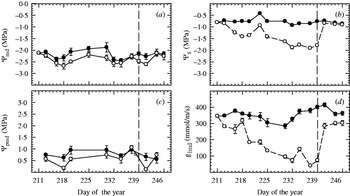
Midday leaf water potential (Ψmd) values in T0 and T1 plants were lower than the Ψstem values and varied very slightly during the experimental period (Fig. 1a). Also, Ψmd values in T1 plants were lower than those of T0 plants but only on DOY 218, 219 and 239 during the stress period (Fig. 1a). After rewatering the plants, Ψmd values in T1 plants recovered, but more slowly than Ψstem values.
Leaf water potential (Ψmd), stem water potential (Ψstem), leaf turgor potential (Ψpmd) and leaf conductance (glmd) values (mean±s.e., not shown when smaller than symbols) measured at midday for peach plants in T0 (closed circles) and T1 (open circles) plants during the experimental period. Asterisks indicate significant differences at P⩽0·05 (n=4). Vertical dashed line indicates the end of the period for which irrigation was withheld.

Ψstem values in T0 plants were high and fairly constant during the experimental period (Fig. 1b), whereas Ψstem values for T1 plants progressively decreased, reaching minimum values at the end of the period for which irrigation was withheld and recovering rapidly after rewatering (Fig. 1b).
Midday leaf turgor potential (Ψpmd) values in both treatments were almost constant and always above zero, indicating turgor maintenance. Also, the values in both treatments were similar except at the beginning of the stress (DOY 218) and recovery (DOY 241) periods (Fig. 1c).
Midday leaf conductance (glmd) in T1 plants decreased more rapidly during the stress period than Ψstem and Ψmd values, and reached minimum values of only 40 mmol/m2/s on DOY 237. Also, the recovery of glmd after the stress period was slower than observed for Ψstem and Ψmd, and did not reach similar values to T0 values at any time during the recovery period (Fig. 1d).
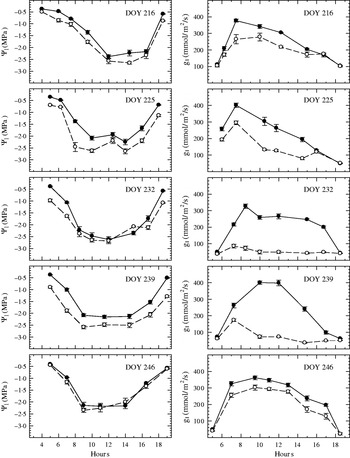
Leaf water potential (Ψl) values showed a similar circadian rhythm on the five studied dates (DOY 216, 225, 232, 239 and 246), decreasing very quickly early in the morning, regardless of the treatment, reaching a slight stabilization of minimum values at around midday and recovering sharply in the afternoon (Fig. 2). Ψl values at predawn remained high and nearly constant in T0 plants throughout the experiment (c. −0·4 MPa), whereas Ψl values at predawn in T1 plants showed a tendency to decrease as the stress progressed. The diurnal time course of Ψl at the end of the recovery period (DOY 246) showed similar values in both treatments, indicating the full recovery of Ψl.
Diurnal course of leaf water potential (Ψl) and leaf conductance (gl) values (mean±s.e., not shown when smaller than symbols) in T0 (closed circles) and T1 (open circles) plants at four times during the period for which irrigation was withheld (day of the year (DOY) 216, 225, 232 and 239) and at the end of the recovery period (DOY 246). Asterisks indicate significant differences at P⩽0·05 (n=4).

At sunrise, the increase in radiation induced stomatal opening while leaf conductance (gl) increased (Fig. 2), following a similar trend to photosynthetically active radiation (PAR) (data not shown). In T1 plants, the duration of maximum stomatal opening was gradually shortened in response to water stress and very low gl values were registered during most of the day at the end of the period for which irrigation was withheld (DOY 232 and 239), indicating an early and regular regulation of water losses (Fig. 2). At the end of the recovery period (DOY 246), the diurnal pattern of gl reflected a substantial increase in its values, but they were always significantly below those of the T0 treatment.
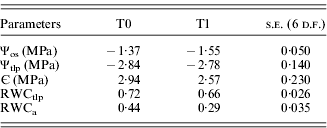
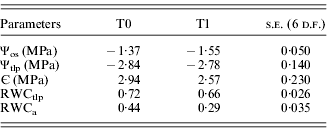
At the end of the period for which irrigation was withheld, no significant differences in Ψtlp, RWCtlp and Є values were found between T0 and T1 plants (Table 1). Values of Ψos were significantly lower in T1 than in T0 plants at the end of the period for which irrigation was withheld, pointing to an active osmotic adjustment of 0·18 MPa (Table 1). RWCa values were high both on T0 and T1 plants, and decreased as a result of water stress (Table 1).
Effect of water stress on leaf osmotic potential at full turgor (Ψos), leaf osmotic potential at turgor loss point (Ψtlp), RWC at turgor loss point (RWCtlp), relative apoplastic water content (RWCa) and leaf bulk modulus of elasticity (Є) of peach plants in control (T0) and stress (T1) plants at the end of the period for which irrigation was withheld (DOY 239)
DISCUSSION
The high and near constant values of Ψmd, Ψstem and Ψl at predawn in T0 plants during the experimental period (Figs 1a, b and 2) indicated that water supplies were adequate. In this respect, Torrecillas et al. (Reference Torrecillas, Ruiz-Sánchez, Del Amor and León1988) showed that the predawn leaf water potential depends mainly on soil moisture levels. The fast recovery of Ψmd and Ψstem values in T1 plants after rewatering (Fig. 1a, b) has also been observed when other crops were subjected to severe water stress (Fereres et al. Reference Fereres, Cruz-Romero, Hoffman and Rawlins1979; Torrecillas et al. Reference Torrecillas, Guillaume, Alarcón and Ruiz-Sánchez1995, Reference Torrecillas, Alarcón, Domingo, Planes and Sánchez-Blanco1996; Ruiz-Sánchez et al. Reference Ruiz-Sánchez, Domingo, Savé, Biel and Torrecillas1997).
Because glmd decreased rapidly in T1 plants as a result of stress and also because Ψmd values were lower than those in T0 plants on 3 days only (Fig. 1d), suggests that the stomata played an active role in regulating leaf water status. A decrease in stomatal conductance of peach leaves in response to water stress has been reported as a primary response to water deficit, together with increasing water-use efficiency (Rieger & Duemmel Reference Rieger and Duemmel1992; Girona et al. Reference Girona, Mata, Goldhamer, Johnson and DeJong1993). It has been suggested that this behaviour, together with the delay in stomatal reopening after rewatering the plants (Fig. 1), could be related to chemical signalling between the roots and the shoot, such as an increase in abscisic acid and/or a decrease in cytokinin content (Mansfield Reference Mansfield and Davies1987; Davies & Zhang Reference Davies and Zhang1991; Melgar et al. Reference Melgar, Dunlop and Syvertsen2010). Plants that delay stomatal opening following rewatering after drought might compete better on drier sites, since this would allow them to regain full turgor more effectively (Torrecillas et al. Reference Torrecillas, Galego, Pérez-Pastor and Ruiz-Sánchez1999).
The decrease in Ψos values in T1 plants (0·18 MPa) through the effect of water stress (Table 1) reflected the active osmotic adjustment in mature leaves of early maturing peach plants. This adjustment was able to maintain turgor (Ψpmd above zero) (Fig. 1c), despite frequent leaf water potentials of c. −2·3 MPa (Figs 1a and 2). This value has been proposed as a physiological limit for turgor maintenance for mature peach leaves (Young et al. Reference Young, Hand and Wiest1982; Escobar-Gutierrez et al. Reference Escobar-Gutierrez, Zipperlin, Carbonne, Moing and Gaudillère1998) as well as for many other cultivated species (Morgan Reference Morgan1984). The present results agree with those reported for leaves of other Rosaceous fruit tree species, such as apple (Wang et al. Reference Wang, Quebedeaux and Stutte1995), apricot (Torrecillas et al. Reference Torrecillas, Galego, Pérez-Pastor and Ruiz-Sánchez1999) and cherry (Ranney et al. Reference Ranney, Bassuk and Whitlow1991), under very severe water stress and with a turgor pressure close to zero. However, the present results contrast with those from other authors (Young et al. Reference oung, Hand and Wiest1981; Steinberg et al. Reference Steinberg, Miller and McFarland1989; Escobar-Gutierrez et al. Reference Escobar-Gutierrez, Zipperlin, Carbonne, Moing and Gaudillère1998), who indicated that peach had no capacity to control the turgor of mature leaves through active solute accumulation. Nevertheless, Steinberg et al. (Reference Steinberg, Miller and McFarland1989) showed that osmoregulation plays a role in the maintenance of young leaf water status in water-stressed peach trees, and Arndt et al. (Reference Arndt, Wanek, Clifford and Popp2000) indicated that mature leaves and roots of field-grown peach trees exhibited active osmotic adjustment, with a significant accumulation of monosaccharide sugars, anions and cations in leaves. These different behaviours may arise from the fact that in woody crops, the capacity for osmotic adjustment varies as a function of species as well as cultivar (Lakso Reference Lakso1990; Torrecillas et al. Reference Torrecillas, Alarcón, Domingo, Planes and Sánchez-Blanco1996) or because active osmotic adjustment may be developed only when water stress is imposed gradually (Turner & Jones Reference Turner, Jones, Turner and Kramer1980), as in the present experiment, which underlines the importance of field studies in which water stress is developed gradually over a prolonged period.
Even though it has been shown that Ψos affects Ψtlp in other crop species (Sánchez-Blanco et al. Reference Sánchez-Blanco, Bolarín, Alarcón and Torrecillas1991; Torrecillas et al. Reference Torrecillas, Alarcón, Domingo, Planes and Sánchez-Blanco1996), the fact that a different response in Ψos and Ψtlp values was observed in peach plants under water stress (Table 1) could indicate that the osmotic adjustment reached (0·18 MPa) was not sufficient to modify the Ψtlp values.
In contrast with the behaviour observed in other woody crops (Savé et al. Reference Savé, Biel, Domingo, Ruiz-Sánchez and Torrecillas1995; Sharon et al. Reference Sharon, Bravdo and Bar2001), peach plants were not able to develop elastic adjustment (Є decrease) under water stress (Table 1). The parallel between Є and RWCtlp (Table 1) confirmed that Є controlled RWCtlp values (Savé et al. Reference Savé, Biel, Domingo, Ruiz-Sánchez and Torrecillas1995). In species that show osmotic adjustment, maintenance of, or increase in, cell wall rigidity may be necessary to maintain cell tissue integrity upon rehydration following a period of stress (Clifford et al. Reference Clifford, Arndt, Corlett, Joshi, Sankhla, Popp and Jones1998; Álvarez et al. Reference Álvarez, Navarro, Bañón and Sánchez-Blanco2009).
The values of RWCa (0·29–0·44) (Table 1) can be considered relatively high compared with other tree species (Parker & Pallardi Reference Parker and Pallardi1987; Correia et al. Reference Correia, Torres and Pereira1989), but lower than those found for grapes (0·51–0·63) (Rodrigues et al. Reference Rodrigues, Chaves, Wendler, David, Quick, Leegood, Stitt and Pereira1993) and similar to those found in almond trees (Torrecillas et al. Reference Torrecillas, Alarcón, Domingo, Planes and Sánchez-Blanco1996). These high RWCa values are common in xeromorphic plants (Cutler et al. Reference Cutler, Rains and Loomis1977). The decrease in the apoplastic water fraction as a result of water stress effect might be interpreted as a non-adaptive mechanism (Serrano & Peñuelas Reference Serrano and Peñuelas2005). However, the existence of relatively high RWCa values under water stress could contribute to the retention of water at low leaf water potentials (Torrecillas et al. Reference Torrecillas, Alarcón, Domingo, Planes and Sánchez-Blanco1996).
The main conclusions are that peach trees exposed to water stress depend primarily on avoidance and tolerance mechanisms, with avoidance mechanisms being progressive. In the present experiment, leaf conductance decreased gradually to control water loss via transpiration and avoid decrease in leaf water potential. When severe water stress developed and the plants were rewatered, other avoidance mechanisms were triggered. The gradual recovery of gl after rewatering can also be considered as a mechanism for maintaining leaf productivity and promoting leaf rehydration. Drought-tolerance characteristics were also observed in peach trees, which were based mainly on the existence of high (RWCa) and active osmotic adjustment, which could contribute to the maintenance of leaf turgor during stress.
The research was financed by Fundación Séneca. Centro de Coordinación de la Investigación de la CARM. No. 11981/PI/09 and Agencia Española de Cooperación Internacional para el Desarrollo (AECID). No. D/016779/08 (Sponsoring information). The authors are grateful to Dr A. Torrecillas for critically reading the manuscript.