Introduction
Domestic violence can be defined as ‘any incident of threatening behaviour, violence or abuse (psychological, physical, sexual, financial or emotional) between adults who are or have been an intimate partner or family member, regardless of gender or sexuality’ (Home Office, 2008) and is one of the most common forms of inter-personal violence internationally (Krug et al. Reference Krug, Mercy, Dahlberg and Zwi2002). In the general population, the lifetime prevalence of isolated domestic violence incidents is comparable for men and women, but women are at greater risk of repeated coercive, sexual or severe physical violence (Tjaden & Thoennes, Reference Tjaden and Thoennes2000). The British Crime Survey (2001) estimated that 45% of women and 26% of men aged 16–59 have experienced at least one episode of inter-personal violence (using the broad definition above) in their lifetimes; if financial or emotional abuse are excluded, then 21% of women and 10% of men have experienced domestic violence since the age of 16 (Walby & Allen, Reference Walby and Allen2004). Equivalent US research has found that nearly 25% of surveyed women and 7.6% of surveyed men report that they were raped and/or physically assaulted by a current or former partner at some time in their lifetime (Tjaden & Thoennes, Reference Tjaden and Thoennes2000). The World Health Organization (WHO) multi-country study of violence against women found that the reported lifetime prevalence of physical or sexual partner violence, or both, varied from 15% to 71% across the different sites; between 4% and 54% of respondents reported physical or sexual partner violence, or both, in the previous year (Garcia-Moreno et al. Reference Garcia-Moreno, Jansen, Ellsberg, Heise and Watts2006). Two women are murdered by their partner or ex-partner every week in England and Wales (Walby & Allen, Reference Walby and Allen2004) and similar figures are reported internationally; the time of highest risk is at the point of, or recently after, separation from the abuser.
In addition to physical injuries and long-term conditions (comprehensively reviewed by Campbell, Reference Campbell2002), domestic violence is associated with many mental health problems including post-traumatic stress disorder (PTSD), depression, suicidal ideation and substance misuse (Golding, Reference Golding1999), functional symptoms (Campbell, Reference Campbell2002) and exacerbation of psychotic symptoms (Neria et al. Reference Neria, Bromet, Carlson and Naz2005). However, women who experience domestic violence are at increased risk of not receiving mental health care (Lipsky & Caetano, Reference Lipsky and Caetano2007). Pre-existing mental health problems influence the likelihood of being in unsafe environments and relationships (McHugo et al. Reference McHugo, Kammerer, Jackson, Markoff, Gatz, Larson, Mazelis and Hennigan2005) and influence the vulnerability and the response to violence (Briere & Jordan, Reference Briere and Jordan2004). Conversely, analysis of prospective data has found that, in addition to the association between earlier histories of mental health disorders and subsequent involvement in abusive relationships, women who are involved in abusive relationships also have an increased risk of subsequent psychiatric morbidity (Ehrensaft et al. Reference Ehrensaft, Moffitt and Caspi2006; Zlotnick et al. Reference Zlotnick, Johnson and Kohn2006). In addition, data from a systematic review (Golding, Reference Golding1999) found that rates of depression declined over time once the abuse had ceased, and the severity or duration of violence was associated with the prevalence or severity of depression. There is therefore evidence supporting a causal association between domestic violence and psychiatric disorders in both directions: psychiatric disorders can render a woman more vulnerable to domestic violence and domestic violence can damage mental health.
Richardson et al. (Reference Richardson, Feder and Coid2002) reported a 17% prevalence of domestic violence in the previous year in female patients attending primary care and MacMillan et al. (Reference MacMillan, Wathen, Jamieson, Boyle, McNutt, Worster, Lent and Webb2006) found similar or higher prevalence in women attending accident and emergency departments. Domestic violence is frequently witnessed by children and is associated with significant disruptions in children's cognitive and emotional development, psychosocial functioning and long-term mental health, even if the child is not a direct victim of the violence (Kitzmann et al. Reference Kitzmann, Gaylord, Holt and Kenny2003).
There has been considerable debate on how primary health-care services should address domestic violence and, though controversial, routine enquiry has been advocated as a policy by some experts (Taket et al. Reference Taket, Wathen and MacMillan2004). A recent systematic review of screening for domestic violence in health-care settings (Feder et al. Reference Feder, Ramsay, Dunne, Rose, Arsene, Norman, Kuntze, Spencer, Bacchus, Hague, Warburton and Taket2009) found insufficient evidence to justify a screening programme, but reported growing evidence for the effectiveness of advocacy and psychological interventions after women disclose recent abuse. The review concluded that health-care professionals should ensure they are open to disclosure of domestic violence with a low threshold for asking about abuse; indicators of possible abuse include mental health symptoms.
There has been much less research on the prevalence of domestic violence experienced by men and women with severe mental disorders than in other clinical populations. There is very little research into how to address domestic violence experienced by this patient population. This paper reviews research on the prevalence of domestic violence in patients with severe mental disorders and on interventions to improve outcomes for those patients who have been exposed to domestic violence.
Method
Medline (from 1950), EMBASE (from 1980) and PsycINFO (from 1806) databases were searched for English-language primary studies examining domestic violence, using the UK Home Office definition of domestic violence above, experienced by adults in contact with in-patient or out-patient/community psychiatric services, focusing on prevalence, routine enquiry and interventions. The search terms for domestic violence were adapted from terms published in the Cochrane protocols by Dalsbo et al. (Reference Dalsbo, Johme, Smedslund, Steiro and Winsvold2006) and Ramsay et al. (2004) (see Appendices for full details of search strategies) and included family violence. We searched for papers published up to 27 May 2008.
Using Reference Manager software, titles and abstracts of all downloaded citations were evaluated independently for relevance to the topics under investigation by two reviewers (K.T. and A.W.) for inclusion in this review. Where it was not possible to determine whether a citation was relevant, it was included at this stage. Copies of all the papers identified as potentially suitable were obtained and again evaluated by the two reviewers. Reference lists of all included papers were searched to identify other relevant studies. Studies that did not report on the domains of prevalence, screening or interventions for psychiatric patients experiencing domestic violence were excluded. Data were extracted onto electronic forms and ordered into summary tables. Data on inclusion and exclusion criteria, time-frame for prevalence rates (e.g. 12-month prevalence of violence, lifetime prevalence), number and characteristics of non-respondents were extracted if reported. We did not use formal ratings of study quality (but did critically appraise the studies) and have commented on the methodological quality of primary studies in the results.
Results
Prevalence
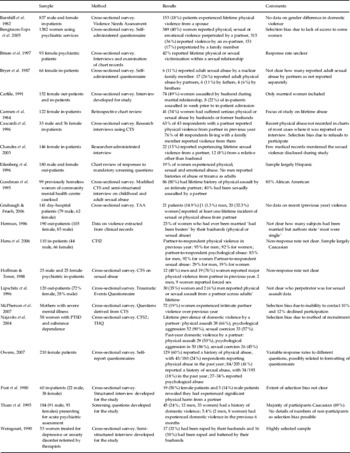
Reported lifetime prevalence of domestic violence in female in-patient psychiatric samples ranges from 34% to 92% (Post et al. Reference Post, Willett, Franks, House, Back and Weissberg1980; Carmen et al. Reference Carmen, Rieker and Mills1984; Hoffman & Toner, Reference Hoffman and Toner1988; Cascardi et al. Reference Cascardi, Mueser, DeGiralomo and Murrin1996; Heru et al. Reference Heru, Stuart, Rainey, Eyre and Recupero2006) and from 14% to 93% for male in-patients (Post et al. Reference Post, Willett, Franks, House, Back and Weissberg1980; Hoffman & Toner, Reference Hoffman and Toner1988; Heru et al. Reference Heru, Stuart, Rainey, Eyre and Recupero2006) (see Table 1 for details of studies). One of these studies had a highly selected in-patient sample as it included only patients with suicidality and who had lived with a partner in the previous 6 months (Heru et al. Reference Heru, Stuart, Rainey, Eyre and Recupero2006); if this study is not included then the prevalence reported ranges from 34% to 63% for female in-patients and from 14% to 48% for male in-patients. Reported prevalence for the previous year in in-patient populations ranges from 22% to 76% for female in-patients (Hoffman & Toner, Reference Hoffman and Toner1988; Carlile, Reference Carlile1991; Cascardi et al. Reference Cascardi, Mueser, DeGiralomo and Murrin1996; 92% in the Heru study) and is 48% for male in-patients (Hoffman & Toner, Reference Hoffman and Toner1988; 93% in the Heru study).
Prevalence of domestic violence in psychiatric patients

PTSD, Post-traumatic stress disorder; CTS, Conflict Tactics Scales; CTS2, Revised Conflict Tactics Scales; TAA, Trauma Assessment for Adults; THQ, Trauma History Questionnaire.
In psychiatric out-patients the reported lifetime prevalence for women ranges from 15% to 90% (Herman, Reference Herman1986; Bryer et al. Reference Bryer, Nelson, Miller and Krol1987; Weingourt, Reference Weingourt1990; Goodman et al. Reference Goodman, Dutton and Harris1995; Eilenberg et al. Reference Eilenberg, Thompson Fullilove, Goldman and Mellman1996; Lipschitz et al. Reference Lipschitz, Kaplan, Sorkenn, Faedda, Chorney and Asnis1996; Briere et al. Reference Briere, Woo, McRae, Foltz and Sitzman1997; Chandra et al. Reference Chandra, Deepthivarma, Carey, Carey and Shalinianant2003; Najavits et al. Reference Najavits, Sonn, Walsh and Weiss2004; Grubaugh & Frueh, Reference Grubaugh and Frueh2006; Bengtsson-Tops & Tops, Reference Bengtsson-Tops and Tops2007; Owens, Reference Owens2007) and for men ranges from 0% to 13% (Tham et al. Reference Tham, Ford and Wilkinson1995; Eilenberg et al. Reference Eilenberg, Thompson Fullilove, Goldman and Mellman1996; Lipschitz et al. Reference Lipschitz, Kaplan, Sorkenn, Faedda, Chorney and Asnis1996; Grubaugh & Frueh, Reference Grubaugh and Frueh2006). Reported prevalence for the previous year in female out-patients ranges from 19% to 86% (Najavits et al. Reference Najavits, Sonn, Walsh and Weiss2004; McPherson et al. Reference McPherson, Delva and Cranford2007; Owens, Reference Owens2007) and is 8% over the previous 6 months in one study (Tham et al. Reference Tham, Ford and Wilkinson1995); for male out-patients there is only one report, which gives a prevalence of 5% over the previous 6 months (Tham et al. Reference Tham, Ford and Wilkinson1995) (see Table 1).
A larger, more representative study than those cited above attempted to survey all women in contact with in-patient and out-patient psychiatric services over 1 week in south Sweden using a self-administered questionnaire. The study reported that, during adulthood, 349 (40%) had experienced partner violence, 315 (36%) reported violence perpetrated by an ex-partner and 151 (17%) by a relative (Bengtsson-Tops et al. Reference Bengtsson-Tops, Markstrom and Lewin2005). However, this study excluded some women with severe mental illness (defined as severe depression, acute psychosis, confusion and developmental disability) and some services did not allow access to their patients. Details of the numbers of patients thus excluded were not provided. Twenty-one per cent of eligible women did not complete the questionnaire.
Table 1 shows that a range of different measures have been used by researchers to elicit experiences of domestic violence, including validated questionnaires [e.g. the Traumatic Events questionnaire (Vrana & Lauterbach, Reference Vrana and Lauterbach1994), Violence Needs Assessment (Barnhill et al. Reference Barnhill, Squires and Gibson1982), Conflict Tactics Scales (CTS; Straus, Reference Straus1979) and the Revised Conflict Tactics Scales (CTS2; Straus et al. Reference Straus, Hamby, Boney-McCoy and Sugarman1996), and Trauma Assessment for Adults (TAA; Resnick et al. Reference Resnick, Best, Freedy, Kilpatrick and Falsetti1993)], clinical interviews and data from clinical charts. This variation in outcome measures may partly explain the heterogeneity in prevalence. In addition, different inclusion criteria have been used to define study populations and no studies identified compared domestic violence prevalence in psychiatric patients with a non-psychiatric population. Few studies reported the distribution of different diagnoses in the study population and it was therefore not possible to examine prevalence in different diagnostic groups.
Routine enquiry for domestic violence in psychiatric settings
Several studies have found that mental health-care professionals do not routinely ask about domestic violence. For example, a survey of 221 American psychiatric residents using postal questionnaires (66% response rate) found that most residents do not routinely ask patients about domestic violence; 61% reported asking about domestic violence only when a problem was suspected, and a further 15% reported not asking even when a problem was suspected. Residents admit that although they were particularly unlikely to ask male patients, they also did not ask most female patients (Currier et al. Reference Currier, Barthauer, Begier and Bruce1996). Low rates of detection (around 10–30% of cases) have been found in routine clinical practice when compared with results obtained by specific screening questionnaires (Cascardi et al. Reference Cascardi, Mueser, DeGiralomo and Murrin1996; Chandra et al. Reference Chandra, Deepthivarma, Carey, Carey and Shalinianant2003; Cusack et al. Reference Cusack, Frueh and Brady2004) and surveys of members of mental health consumers in New Zealand (Lothian & Read, Reference Lothian and Read2002) and the USA (Frueh et al. Reference Frueh, Knapp, Cusack, Grubaugh, Sauvageot, Cousins, Yim, Robins, Monnier and Hiers2005; Cusack et al. Reference Cusack, Grubaugh, Knapp and Frueh2006) have confirmed that the majority are not asked about a history of abuse.
These low rates of detection, and the low rates of detection of childhood abuse reported in other studies (Agar et al. Reference Agar, Read and Bush2002), have led to the introduction of routine enquiry policies for all forms of abuse in some psychiatric services. The few studies evaluating such policies have reported that detection of childhood and adulthood abuse (including domestic violence) is improved when routine enquiry for childhood and adulthood abuse is introduced, although these studies have major methodological limitations. A before-and-after study found that, after the introduction in a New Zealand community mental health centre of an assessment form with a specific abuse section, detection of any adulthood abuse significantly increased from 1.5% (n=136) to 11.5% (n=26) (Agar et al. Reference Agar, Read and Bush2002), although a subsequent paper reported that, of the detected childhood and adulthood abuse, only 16.3% were mentioned in the treatment plan found in case files and no (even recent or ongoing) alleged crimes were reported to legal authorities (Agar & Read, Reference Agar and Read2002). A study of the impact of an abuse section on an admission form for psychiatric in-patients found that the rate of documented abuse was significantly higher when the abuse section of the form was used, but the authors noted that the abuse section was avoided by clinicians in 68% of cases (Read & Fraser, Reference Read and Fraser1998). The introduction in 1989 in New York of mandated routine enquiry about a history of abuse was similarly associated with substantial detection of abuse histories of out-patients receiving psychotherapy (19% of 138 women experienced some form of adult physical abuse, ‘mostly domestic violence’) (Eilenberg et al. Reference Eilenberg, Thompson Fullilove, Goldman and Mellman1996), but there was no comparison with detection rates before the introduction of the mandated enquiry policy. Moreover, information about childhood or adulthood abuse was rarely used in assessment and planning of treatment: most (56%) treatment plans in medical records made no mention of the trauma; even in the 44% of records where trauma was mentioned, relevant treatment recommendations (such as safety planning) were not included in more than one-third of plans. Currier et al. (Reference Currier, Barthauer, Begier and Bruce1996) found that when domestic violence survivors were identified, less than half were referred by medical residents to specialized services such as women's shelters or domestic violence hotlines. Similarly, the introduction of a self-report trauma screening instrument into the intake assessment process at a US community mental health centre, while increasing detection of trauma, had no impact on the rates of actual treatment of the trauma (Cusack et al. Reference Cusack, Frueh and Brady2004).
Acceptability of routine enquiry
We did not find any studies that specifically investigated psychiatric patients' views on acceptability of routine enquiry. There is an extensive literature on psychiatric professionals' views on the acceptability of asking for a history of childhood and adulthood abuse (Read et al. Reference Read, Hammersley and Rudegeair2007), although this literature usually focuses on childhood sexual abuse. In the smaller literature on routine enquiry for domestic violence in the psychiatric setting, we identified studies detailing barriers to routine enquiry from studies using qualitative research methods (Minsky-Kelly et al. Reference Minsky-Kelly, Hamberger, Pape and Wolff2005) and quantitative surveys using postal questionnaires (Currier et al. Reference Currier, Barthauer, Begier and Bruce1996; Cann et al. Reference Cann, Withnell, Shakesphere, Doll and Thomas2001; Salyers et al. Reference Salyers, Evans, Bond and Meyer2004). The barriers to enquiry reported by clinicians were a lack of rapport (Currier et al. Reference Currier, Barthauer, Begier and Bruce1996), lack of expertise (Salyers et al. Reference Salyers, Evans, Bond and Meyer2004; Minsky-Kelly et al. Reference Minsky-Kelly, Hamberger, Pape and Wolff2005), and the patient being under the influence of drugs or alcohol (Currier et al. Reference Currier, Barthauer, Begier and Bruce1996) or floridly psychotic (Minsky-Kelly et al. Reference Minsky-Kelly, Hamberger, Pape and Wolff2005), making clinicians doubt if they can rely on patients' accounts (Minsky-Kelly et al. Reference Minsky-Kelly, Hamberger, Pape and Wolff2005). In one questionnaire study (with a 48% response rate), 13% of 61 UK mental health practitioners completing the questionnaire were concerned about offending patients if they carried out routine enquiry and only 26% of the 61 mental health practitioners thought it would be valuable for all patients to be asked (Cann et al. Reference Cann, Withnell, Shakesphere, Doll and Thomas2001). However, this study also reported that mental health practitioners were more likely to know about local domestic violence services than practitioners in primary care or obstetrics/gynaecology.
Interventions
A wide range of individual psychological interventions benefit women with depression and PTSD, including reduced depressive symptoms and post-traumatic stress symptoms, and improved self-esteem (Feder et al. Reference Feder, Ramsay, Dunne, Rose, Arsene, Norman, Kuntze, Spencer, Bacchus, Hague, Warburton and Taket2009). In particular, two trials of cognitive behavioural therapy (CBT) for women with PTSD who were no longer experiencing violence suggest that cognitive behavioural approaches are helpful (Kubany et al. Reference Kubany, Hill and Owens2003, Reference Kubany, Hill, Owens, Iannce-Spencer, McCaig, Tremayne and Williams2004). There are also studies of group psychological interventions that show improvement in psychological outcomes, although these have major methodological limitations (Feder et al. Reference Feder, Ramsay, Dunne, Rose, Arsene, Norman, Kuntze, Spencer, Bacchus, Hague, Warburton and Taket2009). However, these findings cannot be extrapolated to women still in abusive relationships, or to women with more severe psychiatric illnesses in contact with mental health services. Only one small randomized controlled trial (RCT) of trauma-focused CBT for patients with severe mental illness was identified in our search. This reported the potential effectiveness for co-morbid PTSD in patients with a primary diagnosis of schizophrenia or major mood disorders (Mueser et al. Reference Mueser, Rosenberg, Xie, Jankowski, Bolton, Lu, Hamblen, Rosenberg, McHugo and Wolfe2008); however, this study does not specifically focus on trauma in the context of domestic violence.
We also found descriptions of policy initiatives to improve services to mental health service users who are trauma survivors; these are not specific to domestic violence but could be expected to address domestic violence as part of these initiatives. These attempt to increase the rates of detection of trauma by mental health services and to increase rates of treatment of the trauma as part of the management plan (Eilenberg et al. Reference Eilenberg, Thompson Fullilove, Goldman and Mellman1996; Agar et al. Reference Agar, Read and Bush2002). Reports of such initiatives highlight the barriers to addressing trauma in routine clinical practice. These include the misconceptions about whether a person with a serious mental illness can also be diagnosed with PTSD and treated for it, and whether the roles of mental health services include addressing trauma (Cusack et al. Reference Cusack, Wells, Gurbaugh, Hiers and Frueh2007).
There is very limited evidence on specific interventions for current domestic violence in any setting although there is some evidence for effectiveness of domestic violence advocacy, particularly for women who have actively sought help or are in a refuge (Feder et al. Reference Feder, Ramsay, Dunne, Rose, Arsene, Norman, Kuntze, Spencer, Bacchus, Hague, Warburton and Taket2009). Domestic violence advocates are independent domestic violence workers who provide practical and emotional support, carry out risk assessments and help people with safety planning, provide information on welfare rights, housing options and legal issues and signpost to other agencies. However, we found no studies that evaluate advocacy or any other specific domestic violence interventions for psychiatric patients.
Discussion
The prevalence of domestic violence in psychiatric patients
We found that most studies reported higher rates of domestic violence experienced by people with severe mental illness compared with general population prevalence reported in other studies (Tjaden & Thoennes, Reference Tjaden and Thoennes2000; Walby & Allen, Reference Walby and Allen2004). No study included a direct comparison with a general population or other clinical comparison group, making it difficult to draw conclusions on the extent to which psychiatric patients are at greater risk. The definition of domestic violence used by researchers varied considerably, but in those studies examining severe domestic violence the lifetime prevalence was between 30% and 60% (Post et al. Reference Post, Willett, Franks, House, Back and Weissberg1980; Carmen et al. Reference Carmen, Rieker and Mills1984; Cascardi et al. Reference Cascardi, Mueser, DeGiralomo and Murrin1996), with higher rates reported for women than men in most studies. However, these three studies only included in-patients so cannot be generalized to out-patient populations. The most methodologically rigorous study, which measured the prevalence of domestic violence in psychiatric patients using a more representative study population across in-patient and out-patient settings and used an anonymous self-administered questionnaire, found that 40% of 874 women had experienced partner violence that included physical, sexual or emotional violence (Bengtsson-Tops et al. Reference Bengtsson-Tops, Markstrom and Lewin2005). However, individuals who were not able to give informed consent were excluded and therefore we cannot generalize these findings to the most severely ill patients.
Unfortunately, many researchers did not establish or report when the abuse occurred so it was not always possible to distinguish 12-month or lifetime prevalence estimates (for more details of individual studies see Supplementary Table S1, available online). Methods of measuring domestic violence also varied between studies, ranging from retrospective case-note analysis, non-validated screening questions, to researcher-administered validated instruments such as the CTS (Straus, Reference Straus1979). Most used measures that involved face-to-face interviews (using standardized validated measures, new non-validated measures or clinical interview), which may lead to underdetection of violence experienced. One large RCT of different methods of screening for domestic violence in family practices, emergency departments and women's health clinics found that, when using the same standardized validated questionnaires, women preferred self-completed forms over face-to-face questioning (MacMillan et al. Reference MacMillan, Wathen, Jamieson, Boyle, McNutt, Worster, Lent and Webb2006). It is also clear from several studies that routine clinical interviews and clinical records reflect considerable underdetection by mental health professionals of violence experienced by patients (Steiner-Craine et al. Reference Steiner-Craine, Henson, Colliver and MacLean1988; MacMillan et al. Reference MacMillan, Wathen, Jamieson, Boyle, McNutt, Worster, Lent and Webb2006), and future studies should therefore consider using self-completed measures.
Most studies focus only on physical or sexual violence. However, a large international epidemiological study suggests that emotional abuse and control may be the aspects of domestic violence most strongly associated with poor health outcomes (Garcia-Moreno, Reference Garcia-Moreno2009). The studies in our review reported few data on the prevalence of different types of violence in patients with different psychiatric diagnoses, so we do not know whether particular disorders are associated with a particularly high risk of particular types of violence. However, it did seem that patients with diagnoses ranging from schizophrenia to non-psychotic disorders were victims of domestic violence.
A further difficulty in interpreting the findings of the some of the primary studies was the failure of authors to distinguish between domestic and non-domestic violence, reporting abuse from partners, families, acquaintances and strangers together or failing to specify the perpetrators of abuse. Studies where this was ambiguous could not be included in this review (list available from the authors on request). We found that the victimization literature rarely provides information about the specific types and contexts of crime committed against people with mental illness (Maniglio, Reference Maniglio2009), making it difficult to estimate the prevalence of domestic violence from these studies. The literature on ‘victimization’ (encompassing physical, sexual and emotional abuse regardless of the relationship between victim and perpetrator) suggests that patients in contact with mental health services are up to 11 times more likely to have experienced recent violence than the general population, with victimization prevalence of the order of 15–45% in the past year, and 40–90% over a lifetime (Goodman et al. Reference Goodman, Rosenberg, Mueser and Drake1997; Walsh et al. Reference Walsh, Moran, Scott, McKenzie, Burns, Creed, Tyrer, Murray and Fahy2003; Silver et al. Reference Silver, Arseneault, Langley, Caspi and Moffitt2005; Teplin et al. Reference Teplin, McClelland, Abram and Weiner2005; Friedman & Loue, Reference Friedman and Loue2007; Choe et al. Reference Choe, Teplin and Abram2008).
It would be helpful to know, within these studies, the ratio of domestic violence to other forms of violence. This would help to clarify the prevalence, burden and risk profile for domestic violence relative to other subtypes, which would in turn help research on interventions and practice. For example, there is good evidence from the 2007/08 British Crime Survey that, in the UK general population, women are the main victims of domestic violence (85% of all incidents) and men are the main victims of stranger violence (78% of all incidents) (Home Office, 2008), but the picture is less clear for psychiatric patients, where women are at increased risk of stranger violence in addition to domestic violence (Friedman & Loue, Reference Friedman and Loue2007), and men are at significant risk of violence within the family (Cascardi et al. Reference Cascardi, Mueser, DeGiralomo and Murrin1996). Domestic violence is more hidden and more psychologically harmful than stranger violence (Dutton, Reference Dutton1992) because of the nature of the relationship between the perpetrator and victim. Moreover, psychiatric patients who are parents may be particularly fearful of disclosure in case the involvement of statutory services may lead to loss of custody of their children (Howard, Reference Howard, Bhugra and Morganin press). The need to synthesize research on domestic violence and other violence subtypes is highlighted by the high prevalence of ‘multiple victimization’ within the psychiatric population, where patients are often the victims of more than one subtype of violence. It is unclear to what extent ‘co-morbidity’ of domestic violence and other violence subtypes is due to common risk factors and to what extent one is associated with the other.
Routine enquiry
We found evidence that mental health-care professionals internationally do not routinely ask about domestic violence (e.g. Currier et al. Reference Currier, Barthauer, Begier and Bruce1996; Chandra et al. Reference Chandra, Deepthivarma, Carey, Carey and Shalinianant2003) and that this leads to underdetection. It is known that asking about domestic violence can increase the number of abused women being identified by health professionals in general health-care settings (Ramsay et al. Reference Ramsay, Richardson, Carter, Davidson and Feder2002). We have found that studies in psychiatric services are consistent with studies in other health-care settings in that implementation of routine enquiry increases detection rates (Eilenberg et al. Reference Eilenberg, Thompson Fullilove, Goldman and Mellman1996; Read & Fraser, Reference Read and Fraser1998; Agar & Read, Reference Agar and Read2002). However, the methodological quality of these studies is poor and only one study (Eilenberg et al. Reference Eilenberg, Thompson Fullilove, Goldman and Mellman1996) focused on routine enquiry for domestic violence as opposed to a history of any form of abuse. Even when a policy of routine enquiry is introduced into psychiatric services, professionals do not always implement it (Read & Fraser, Reference Read and Fraser1998), nor do they always make use of a disclosed history of domestic violence in their treatment plans (Currier et al. Reference Currier, Barthauer, Begier and Bruce1996; Eilenberg et al. Reference Eilenberg, Thompson Fullilove, Goldman and Mellman1996).
There are many barriers that might account for the reluctance to ask about and record domestic violence, including clinicians' concerns that it is difficult to rely on patients accounts. However, evidence suggests that psychiatric patients tend to under-report rather than over-report victimization experiences (Goodman et al. Reference Goodman, Thompson, Weinfurt, Corl, Acker, Mueser and Rosenberg1999). Some clinicians have also expressed concern that patients may be offended by routine enquiry, but research on the acceptability of routine enquiry in other health-care settings such as antenatal services and primary care have found that the vast majority of women find such questioning acceptable (Feder et al. Reference Feder, Hutson, Ramsay and Taket2006; Renker & Tonkin, Reference Renker and Tonkin2006; Bacchus et al. Reference Bacchus, Mezey and Bewley2008). A further barrier is professionals' perceptions of their limited competence and confidence in addressing violence (Salyers et al. Reference Salyers, Evans, Bond and Meyer2004).
Interventions for domestic violence experienced by psychiatric patients
We did not find any evidence on the effectiveness of specific domestic violence interventions for psychiatric patients and such evidence is clearly imperative if the needs of patients experiencing domestic violence are to be addressed effectively. Trauma-focused CBT has been shown to be a potentially effective form of treatment of co-morbid PTSD in patients with a primary diagnosis of schizophrenia or major mood disorders (Mueser et al. Reference Mueser, Rosenberg, Xie, Jankowski, Bolton, Lu, Hamblen, Rosenberg, McHugo and Wolfe2008). A systematic review of domestic violence interventions to reduce violence and improve outcomes for women in a variety of community and health-care settings found that domestic violence advocacy can reduce abuse, increase social support and increase use of safety behaviours (Ramsay et al. Reference Ramsay, Carter, Davidson, Dunne, Eldridge, Feder, Hegarty, Rivas, Taft and Warburton2009). It is not known whether this intervention is helpful for people with severe mental disorders but it is likely that psychiatric patients need modified or different interventions, as the domestic violence sector can feel ill-equipped to help people with severe mental illness (see Hager, Reference Hager2006).
Limitations of review
Our literature search did not include hand-searching of relevant journals and formal rating of methodological quality was beyond the scope of this review. This, and the heterogeneous nature of the samples studied, means that it has not been possible to calculate a summary statistic of the prevalence of domestic violence experienced by people in contact with secondary mental health services. Future research should include a comprehensive systematic review including hand-searching of relevant journals, formal ratings of methodological quality and a meta-analysis to estimate the prevalence of domestic violence in psychiatric patients.
Implications of findings
Despite the growing body of research on domestic violence in the general population and on victimization in psychiatric patients, there is very little high quality evidence on the prevalence of domestic violence experienced by psychiatric patients compared with the general population. There is some limited evidence that policies that introduce routine clinical enquiry lead to increased detection of domestic violence, but it is not known whether this leads to improvements in morbidity or mortality and there is no evidence on effective interventions. These findings have implications for mental health service policy makers attempting to address domestic violence. High quality evidence is needed on the extent to which this population may be at increased risk of domestic violence and whether routine enquiry is effective at increasing detection rates, and improving morbidity and mortality.
If routine enquiry policies are introduced, the current evidence suggests that they are most likely to be effective if psychiatric professionals receive training to increase their confidence in their ability to help people experiencing domestic violence and to improve their knowledge about domestic violence services. It is necessary for psychiatric services to work with specialist domestic violence services. There are few reports of this type of collaboration, although an innovative telepsychiatry intervention in the USA, where psychiatric input was provided to a rural women's shelter programme, is an example of the domestic violence sector and psychiatric services working in an integrated way (Thomas et al. Reference Thomas, Miller, Hartshorn, Speck and Walker2005). Domestic violence advocacy, an intervention found to be effective in reducing abuse and increasing safety behaviours in other settings (Ramsay et al. Reference Ramsay, Carter, Davidson, Dunne, Eldridge, Feder, Hegarty, Rivas, Taft and Warburton2009), may also be helpful for psychiatric patients. Future research on interventions in this area will need to examine the applicability of evidence-based domestic violence interventions from other health-care settings to mental health services.
Acknowledgements
This manuscript outlines independent research commissioned by the National Institute for Health Research (NIHR) under its Research for Patient Benefit programme. The views expressed are those of the authors and not necessarily those of the National Health Service (NHS), the NIHR or the Department of Health. Louise Howard is also affiliated with the ‘NIHR Biomedical Research Centre for Mental Health’. The South London and Maudsley NHS Foundation Trust & The Institute of Psychiatry, King's College London.
Appendix A
Search terms for identifying primary studies on domestic violence and incidence or prevalence
((Domestic Violence/) or (Partner Abuse/) or (Battered Females/) or ((abus$ adj3 (wom?n or partner$ or spouse$ or female$ or wife or wives or domestic or perpetrat$)).tw.) or ((batter$ adj3 (wom?n or partner$ or spouse$ or female$ or wife or wives or perpetrat$)).tw.) or ((violen$ adj3 (partner$ or spouse$ or family or families or domestic or wife or wives)).tw.) or ((domestic violence adj5 perpetrat$).ti,ab.) or ((family violence adj5 perpetrat$).ti,ab.) or ((domestic violence adj5 victim$).ti,ab.) or ((family violence adj5 victim$).ti,ab.) or ((domestic violence adj5 survivor$).ti,ab.) or (intimate partner violence.ti,ab.) or ((domestic adj5 homicid$).ti,ab.)) or ((violent or violence) adj3 (spouse$ or husband$ or boyfriend$ or girlfriend$ or partner$ or elder$ or brother$ or sister$ or father$ or mother$ or daughter$ or son$)).mp. or (battered adj (men or man or husband$)).mp.
AND
(mental disorder$ or mental illness$ or (mental health adj (problem$ or difficult$ or disorder$ or ill$))).mp. or ((mental health or psychiatr$ or psycholog$ adj3 (patient$ or client$ or wom?n or m?n)).mp.) or Mental health services/ or Psychology/ or Psychiatry.mp. or psychiatr$.mp. or psycholog$.mp.
AND
Incidence.mp.
OR
Prevalence.mp.
Appendix B
Search terms for identifying primary studies on domestic violence and screening or routine enquiry
((Domestic Violence/) or (Partner Abuse/) or (Battered Females/) or ((abus$ adj3 (wom?n or partner$ or spouse$ or female$ or wife or wives or domestic or perpetrat$)).tw.) or ((batter$ adj3 (wom?n or partner$ or spouse$ or female$ or wife or wives or perpetrat$)).tw.) or ((violen$ adj3 (partner$ or spouse$ or family or families or domestic or wife or wives)).tw.) or ((domestic violence adj5 perpetrat$).ti,ab.) or ((family violence adj5 perpetrat$).ti,ab.) or ((domestic violence adj5 victim$).ti,ab.) or ((family violence adj5 victim$).ti,ab.) or ((domestic violence adj5 survivor$).ti,ab.) or (intimate partner violence.ti,ab.) or ((domestic adj5 homicid$).ti,ab.)) or ((violent or violence) adj3 (spouse$ or husband$ or boyfriend$ or girlfriend$ or partner$ or elder$ or brother$ or sister$ or father$ or mother$ or daughter$ or son$)).mp. or (battered adj (men or man or husband$)).mp.
AND
(mental disorder$ or mental illness$ or (mental health adj (problem$ or difficult$ or disorder$ or ill$))).mp. or ((mental health or psychiatr$ or psycholog$ adj3 (patient$ or client$ or wom?n or m?n)).mp.) or Mental health services/ or Psychology/ or Psychiatry.mp. or psychiatr$.mp. or psycholog$.mp.
AND
Screening.mp.
OR
Routine Screening.mp.
OR
Routine enquiry.mp.
Appendix C
Search terms for identifying primary studies on domestic violence and treatment
Domestic Violence/ or Partner Violence/ or Battered Woman/ or (abus$ adj3 (wom?n or m?n or partner$ or spouse$ or female$ or wife or wives or domestic or perpetrat$)).tw. or (batter$ adj3 (wom?n or partner$ or spouse$ or female$ or wife or wives or perpetrat$)).tw. or (violen$ adj3 (partner$ or spouse$ or family or families or domestic or wife or wives)).tw. or (domestic violence adj5 perpetrat$).ti,ab. Or (family violence adj5 perpetrat$).ti,ab. Or (domestic violence adj5 victim$).ti,ab. Or (family violence adj5 victim$).ti,ab. Or (domestic violence adj5 survivor$).ti,ab. Or intimate partner violence.ti,ab. Or (domestic adj5 homicid$).ti,ab. Or ((violent or violence) adj3 (spouse$ or husband$ or boyfriend$ or girlfriend$ or partner$ or elder$ or brother$ or sister$ or father$ or mother$ or daughter$ or son$)).mp. or ((violent or violence) adj3 (spouse$ or husband$ or boyfriend$ or girlfriend$ or partner$ or elder$ or brother$ or sister$ or father$ or mother$ or daughter$ or son$)).mp. or ((violent or violence) adj3 (spouse$ or husband$ or boyfriend$ or girlfriend$ or partner$ or elder$ or brother$ or sister$ or father$ or mother$ or daughter$ or son$)).mp. or (battered adj (men or man or husband$)).mp.
AND
(mental disorder$ or mental illness$ or (mental health adj (problem$ or difficult$ or disorder$ or ill$))).mp. or ((mental health or psychiatr$ or psycholog$ adj3 (patient$ or client$ or wom?n or m?n)).mp.) or Mental health services/ or Psychology/ or Psychiatry.mp. or psychiatr$.mp. or psycholog$.mp.
AND
((psychiatr$ treatment$ or psycholog$ treatment$ or mental health) adj treatment$).mp.
OR
‘Early Intervention (Education)’/ or Crisis Intervention/ or Intervention Studies/
OR
Randomised controlled trials.mp.
Declaration of Interest
None.
Note
Supplementary material accompanies this paper on the Journal's website (http://journals.cambridge.org/psm).