INTRODUCTION
Concerns about overfishing in coral reef ecosystems have increased over the last decades; most Pacific insular countries are at risk of complete depletion of some vulnerable traditionally-harvested subsistence or commercial marine species (Ruddle Reference Ruddle1998; Hunt Reference Hunt2003). Governance of marine tenure systems across the region, including issues of leadership, customary legitimacy and territory ownership, has a major influence on the complex relationships between communities and their environment, and more specifically on the management of fishing practices (Aswani Reference Aswani2005). Acknowledging that success or failure of management efforts in such systems largely depends on the attitude of the community owners and users, government fisheries managers have increasingly interacted with traditional authorities that control access rights and fishing rules over near shore areas and associated resources (Adams Reference Adams1998; Zann Reference Zann1999; Cooke et al. Reference Cooke, Polunin and Moce2000). This situation catalysed the rise of cooperative management approaches across the whole Pacific region, where management options were decided by, and for, local communities with support from government agencies (Cinner & Aswani Reference Cinner and Aswani2007). Community-based marine resource management may thus now be more widespread in Oceania than in any other tropical region in the world (Johannes Reference Johannes2002), with increasing support at national and international levels mainly owing to the worldwide failure of top-down centralized fishing regulations (Mora et al. Reference Mora, Myers, Coll, Libralato and Pitcher2009) and the increasing emphasis on the establishment of marine protected areas that mimic traditional fishing organizations (Cinner Reference Cinner2007).
In Vanuatu, fishing for sale and/or subsistence has severely affected the live stocks of reef molluscs, with populations now considered close to collapse in many locations despite the presence of suitable habitats for juveniles and adults (Amos Reference Amos1995). In this context, since the early 1990s, Vanuatu has been experiencing a striking upsurge in small-scale initiatives to protect marine invertebrate resources, in particular trochus (Trochus niloticus), giant clams (Tridacna spp.), green snail (Turbo marmoratus) and sea cucumbers (Amos Reference Amos1991, Reference Amos1995; Johannes Reference Johannes1998; Jimmy Reference Jimmy1995; Jimmy & Amos Reference Jimmy and Amos2004). Between 1993 and 2001, the total number of marine resource management measures more than doubled (Johannes & Hickey Reference Johannes and Hickey2004). One of the most common actions was the creation of very small village-based marine reserves (tabu areas) with permanent or temporary fishing bans for invertebrate species. About 40 partial or total fishing ground closures were reported in 21 villages across the period, usually corresponding to very restricted parts of the reefs (Johannes & Hickey Reference Johannes and Hickey2004). These management actions generally receive strong support from local communities, suggesting that ‘the marine reserve phenomenon in Pacific will continue’ (Bartlett et al. Reference Bartlett, Pakoa and Manua2009).
Despite the objectives of such locally-based conservation initiatives, biological and ecological considerations may be of secondary importance compared to their expected social and cultural outputs (Horowitz Reference Horowitz2008; Charles & Wilson Reference Charles and Wilson2009; Léopold et al. Reference Léopold, Herrenschmidt and Thaman2010). Few papers have specifically addressed the efficiency of such small-scale reserves to restore or enhance resources (for example see Cinner et al. Reference Cinner, Marnane and McClanahan2005; McClanahan et al. Reference McClanahan, Marnane, Cinner and Kiene2006): documented effects often concern government-led marine protected areas (MPAs) (for example Pelletier et al. Reference Pelletier, Garcia-Charton and Ferraris2005). Pacific island residents generally perceive reserves to be ecologically effective, but the scientific validation of these perceptions remains scarce and controversial (Bartlett et al. Reference Bartlett, Pakoa and Manua2009). Expected ecological benefits may include structural and functional enhancement of fish/invertebrate communities inside no-take zones, including increases in density, spawning biomass, body size, species or genetic diversity and ecosystem resilience with, in certain cases, fishery effects through adult/larval dispersal to the adjacent fishing grounds (see reviews in Gell & Roberts Reference Gell and Roberts2003; Halpern Reference Halpern2003; Willis et al. Reference Willis, Millar, Babcock and Tolimieri2003; Garcia-Charton et al. Reference Garcia-Charton, Perez-Ruzafa, Marcos, Claudet, Badalamenti, Benedetti-Cecchi, Falcon, Milazzo, Schembri, Stobart, Vandeperre, Brito, Chemello, Dimech, Domenici, Guala, Le Direach, Maggi and Planes2008; Perez-Ruzafa et al. Reference Perez-Ruzafa, Marcos, Garcia-Charton and Salas2008a, Reference Perez-Ruzafa, Martin, Marcos, Zamarro, Stobart, Harmelin-Vivien, Polti, Planes, Garcia-Charton and Gonzalez-Wangnemertb).
However, while some empirical studies show that response to protection was reserve size-independent (for example Halpern Reference Halpern2003; Guidetti & Sala Reference Guidetti and Sala2007), others highlight spatial thresholds affecting reserve benefits for harvested species (Claudet et al. Reference Claudet, Osenberg, Benedetti-Cecchi, Domenici, Garcia-Charton, Perez-Ruzafa, Badalamenti, Bayle-Sempere, Brito, Bulleri, Culioli, Dimech, Falcon, Guala, Milazzo, Sanchez-Meca, Somerfield, Stobart, Vandeperre, Valle and Planes2008; Perez-Ruzafa et al. Reference Perez-Ruzafa, Martin, Marcos, Zamarro, Stobart, Harmelin-Vivien, Polti, Planes, Garcia-Charton and Gonzalez-Wangnemert2008b). This raises the question of the ecological and fisheries benefits of small-scale reserves, such as those being implemented in the Pacific owing to village-based initiatives (Berkes Reference Berkes2006).
In this study, we investigated the effects of two very small (<0.05 km2) locally-managed reserves on the invertebrate resource at Emau island (Vanuatu). The specific objectives of this study were to: (1) investigate ecological effects of the reserves on heavily harvested invertebrate populations, (2) elucidate potential effects of protection from reef-top gathering on reef habitats, and (3) evaluate the results of village-based management from a conservation perspective, in the local context. Main commercial and subsistence species (trochus shell Trochus niloticus, giant clams Tridacna spp. and green snail Turbo marmoratus) were surveyed inside and outside the customary reserves of Marow and Mangarongo villages. Habitat features, invertebrate abundance, density and size structure were measured underwater with the support of local villagers.
MATERIALS AND METHODS
Study area
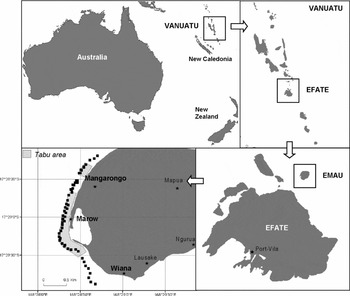
We studied a 3.7 km linear shallow fringing reef on the Western coast of Emau island, North Efate, Republic of Vanuatu (Fig. 1). Fishing activities were controlled by the villagers from Mangarongo and Marow over their traditional exclusive fishing grounds, though territory conflicts occurred at the boundaries between both villages. With support from local non-governmental organizations, village-based management has resulted in the implementation of two small customary reserves (tabu areas hereafter) with total fishing ban on all fish and invertebrates species (Fig. 1). The Mangarongo tabu area covers a 0.6 ha reef area and was established in 2005, three years before the present study. The Marow tabu area (2.3 ha) is located c. 350 m further along the same reef and its closure was effected in 2004, four years before the present study.
Location of the study area in west Emau island, North Efate, Vanuatu (south Pacific). Tabu area reef sampling stations are indicated by black squares.

Invertebrate sampling
In March 2008, we surveyed 50 shallow reef stations randomly located along the reef (29 inside and 21 outside tabu areas). Stations were at 1–3 m depth and c.50 m apart. We laid one randomly selected (50 × 4 m) transect belt on each station using a 50 m colour-marked survey tape attached to the substratum. Two snorkellers swimming simultaneously along the two sides of the transect line collected data, each surveying a 2-m wide corridor. We focused our study on the harvested invertebrates trochus (Trochus niloticus), giant clam (Tridacna spp.) and green snail (Turbo marmoratus). All individuals belonging to the target species that were detectable without disturbing the substratum were counted and measured. Individual sizes were recorded using simple easy-to-use field tools developed for this study and suitable for participative monitoring (for example Tawake et al. Reference Tawake, Parks and Radikedike2001). They consisted of two specific underwater PVC measuring devices: (1) a 35-cm calliper used for giant clams, graduated from 0 to 30 cm in 2-cm size intervals and (2) a 40 × 15 cm plate with four calibrated holes (6–8–10–12 cm in diameter) used to measure trochus and green snail diameters. Invertebrate sizes were recorded by ticking individual marks directly on the PVC devices. Abundance data per species were derived by simply counting the individual size marks written on the devices.
Participative monitoring
The invertebrate surveys involved both experienced scientists and trained local villagers; six different snorkellers (three scientists and three villagers) were selected for the study needs. Before starting, local people were trained for half a day in the sampling protocol and use of the PVC measuring tools. Each of the 50 stations was then randomly assigned to a unique team composed of two scientists or two villagers, so as to investigate individual and expertise-related effects on resource monitoring.
Habitat
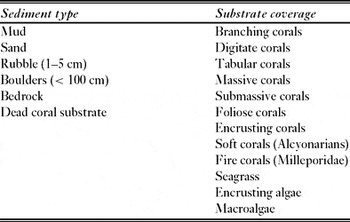
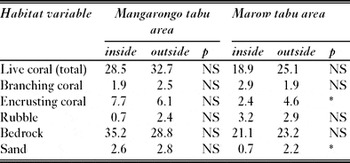
For each station, sediment type and substratum coverage variables were estimated using a photographic method developed to quickly and quantitatively describe contrasting reef habitats (Dumas et al. Reference Dumas, Bertaud, Peignon, Leopold and Pelletier2009). Pictures were taken from the surface along transects using a standard digital 8 megapixels Canon S80 camera in underwater housing, oriented perpendicular to the substratum; 25 pictures were taken per transect (namely one shot every two metres) and subsequently imported into an image analysis software including efficient user-friendly features for the estimation of sediment/substratum cover (CPCe [Coral Point Count with Excel extensions] software; Kohler & Gill Reference Kohler and Gill2006). Surface estimates expressed in per cent cover were derived from random stratified point count techniques using a nine points per m−2 ratio ensuring reliable habitat profiles with low bias and high precision. Eighteen local habitat variables were considered, related to sediment type and substratum coverage by large sessile organisms (Table 1). Percentage cover was then aggregated at the transect level (Dumas et al. Reference Dumas, Bertaud, Peignon, Leopold and Pelletier2009).
Habitat variables referring to sediment type and substratum coverage used for habitat characterization in the selected sites (west Emau, North Efate, Vanuatu).

Data analysis
We assessed the influence of expertise level on field observations using non-parametric Mann-Whitney U tests on abundance estimates from scientists versus those recorded by the trained villagers. Individual (between-diver) effects were also tested using non-parametric analyses of variance (Kruskall-Wallis ANOVAs).
We investigated the habitat-related effects of protection using a combination of univariate and multivariate techniques. The similarity of the habitat in tabu and non-tabu stations was assessed in each village using multivariate ANOSIM procedures on the 18 substratum variables (Clarke & Warwick Reference Clarke and Warwick2001). From the 18 sunstratum variables, we retained six variables with a potential protection-related effect (total live coral, branching coral, encrusting coral, rubble, bedrock and sand; see Leujak & Ormond Reference Leujak and Ormond2007, Reference Leujak and Ormond2008) for non-parametric Mann Whitney U tests, in order to check for differences between tabu and non-tabu areas.
We assessed the relationships between species spatial patterns and habitat using multivariate techniques; the 18 substratum variables (Table 1) were ordinated using non-metric multidimensional scaling (MDS), in order to establish a multifactorial typology of the habitat. We then plotted species abundances on the resulting diagrams.
We assessed the ecological effects of the Mangarongo and Marow tabu areas on invertebrate population structure by comparing total abundance and size variations both inside and outside tabu areas, using non-parametric Mann-Whitney U tests. Species spatial distribution patterns were addressed by plotting abundance data per species relative to distances from village centre; data were fitted using non-linear least square regressions.
RESULTS
Diver effects
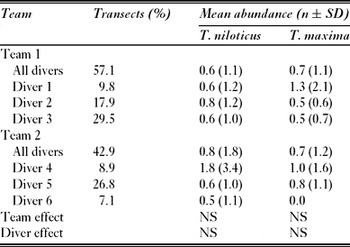
We were unable to identify expertise-related bias when comparing species abundance data between scientists and local fishers (Table 2). Both teams recorded extremely similar abundances regardless of the species considered (Mann-Whitney U tests, n = 100, p = 0.95 and 0.55 for T. niloticus and Tridacna spp., respectively). Similarly, we detected no individual effect when comparing data from the six snorkellers (Kruskall-Wallis ANOVAs, n = 100, p = 0.86 and 0.08 for T. niloticus and Tridacna spp., respectively).
Influence of training and individual effects on the invertebrate surveys in west Emau (North Efate, Vanuatu). Total transects surveyed (%) and mean abundances per transect (± SD) for Trochus niloticus and Tridacna spp. Associated tests for team- and diver-effects. NS = not significant.

Invertebrate assemblages
Abundances of harvested species were generally low, ranging from 0 to 700 individuals ha−1 (i.e. 0–14 individuals per transect). Giant clams (Tridacna spp.) and trochus (Trochus niloticus) exhibited similar mean densities of 74 and 81 individuals ha−1 (1.5 and 1.6 individuals per transect), respectively, while Turbo marmoratus was not observed in the survey transects.
Habitat
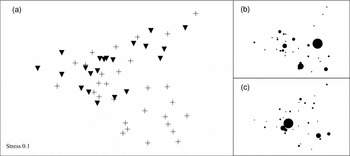
The 18 substratum variables did not reveal marked differences related to reserve status in the Marow or Mangarongo areas (Fig. 2). Only a few stations in Marow reserve indicated some habitat differences in terms of higher dead coral cover (Fig. 2a, lower right corner). Multifactorial analyses of similarity (ANOSIM) did not show any habitat differences between tabu and non-tabu areas (Marow, R = 0.09, p = 0.11; Mangarongo, R = 0.112, p = 0.13). Only encrusting coral cover and sand showed significant differences in the Marow tabu area, while other variables were similar both inside and outside the tabu area (Table 3). Protection status was not a major structuring factor for the studied reef habitats.
Two-dimensional MDS of the reef stations in west Emau (North Efate, Vanuatu) based upon habitat variables. (a) Station plot showing tabu (+) versus non-tabu (▼) stations. Same plots with black circles proportional to the abundance of (b) trochus shells (Trochus niloticus) and (c) giant clams (Tridacna spp.), respectively.

Comparisons of reef habitat variables between tabu (inside) and non-tabu (outside) areas in west Emau (North Efate, Vanuatu). Mann Whitney's U tests: *p < 0.05, NS = not significant.

Influence of tabu areas on invertebrate structure
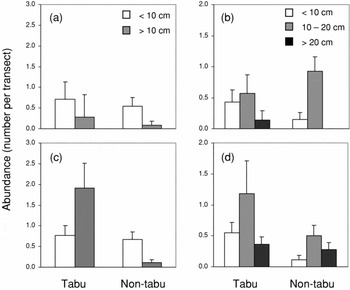
The surveyed reef species exhibited very patchy distributions. On the whole, the Marow tabu area exhibited larger invertebrate populations (mean 2.7 individuals transect−1 for T. niloticus and 2.1 individuals transect−1 for Tridacna spp.) than the Mangarongo tabu area (mean 1.0 individuals transect−1 for T. niloticus and 1.1 individuals transect−1 for Tridacna spp.) (Fig. 3).
Abundances (mean ± SE) of different size classes of target species in tabu versus non-tabu reef stations in Mangarongo (a, b) and Marow (c, d) villages (west Emau, Vanuatu). (a, c) Trochus shells (Trochus niloticus) and (b, d) giant clams (Tridacna spp.)

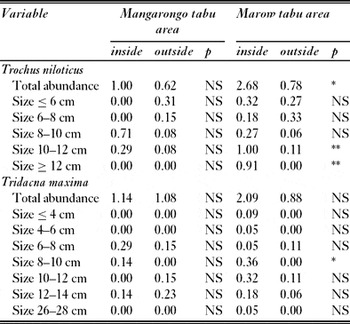
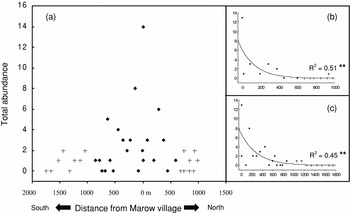
For Marow, T. niloticus total abundance was three times greater inside the tabu area than outside (2.7 and 0.8 individuals transect−1 for stations inside and outside the reserve, respectively; Mann-Whitney U test, p < 0.05, n = 40). Stations inside the tabu area harboured more large (> 10 cm) individuals of trochus (1.9 individuals transect−1 inside as opposed to 0.1 individuals transect−1 outside Marow reserve; Mann-Whitney U test, p < 0.01). However small to medium size trochus abundances did not differ inside and outside the reserve (Table 4). We observed a marked longitudinal structure for T. niloticus in the Marow area; abundances were at their greatest in reef stations located in front of the village, then decreased towards both edges of the tabu area (Fig. 4a). We found that non-linear least square regressions of abundance data against distance from the village centre (Fig. 4b, c) indicated a significant exponential decrease in trochus abundances northward and southward from the village centre (fitted simple exponential model accounting for 51% and 45% of total variance respectively, p < 0.01). We did not observe such spatial gradients for giant clams, although higher abundances were consistently found close to the north edge of the reserve (c. 500 m distance from the village centre). Giant clams of all sizes were generally more abundant inside the tabu area (Fig. 3; mean 2.1 and 0.9 individuals transect−1 inside and outside tabu area, respectively), but results were only significant for individuals in the 8–10 cm size class (Mann-Whitney U test, p < 0.05).
Comparisons of tabu (inside) and non-tabu (outside) areas on trochus shell (Trochus niloticus) and giant clam (Tridacna spp.) densities and sizes in west Emau (North Efate, Vanuatu). Means per transect and results of Mann Whitney's U tests. Levels of significance: *p <0.05; **p < 0.01, NS = not significant.

Longitudinal distribution pattern of Trochus niloticus along the reef stations of Marow (west Emau, Vanuatu). Abundance per transect plotted against distance (m) from the centre of Marow village for tabu (♦) and non-tabu (+) sites for (a) all transects, (b) north transects and (c) south transects. Exponential curve with associated coefficient and probability (*p < 0.05; **p < 0.01).

Total abundance or abundance per size class for T. niloticus did not differ significantly between tabu and non-tabu reef stations at Mangarongo (0.6 and 1.0 individuals transect−1 inside and outside tabu area, respectively; Mann-Whitney U tests, n = 20). Tridacna spp. also exhibited similar abundance values both inside and outside the Mangarongo tabu area (mean 1.1 individuals transect−1 in both). While large clams (namely those > 20 cm) were only found inside this area, no differences in abundance were detected for any of the 13 size classes (Table 4).
DISCUSSION
Effectiveness of small tabu areas on invertebrate resources
Our results suggest that, under certain conditions, even very small-scale tabu areas such as those implemented by village-based conservation initiatives can efficiently enhance reef invertebrate populations, at least at local scale. Yet, despite similar location and status, the benefits of the two tabu areas studied were strongly site-specific. Density and size estimates provide clear evidence of population enhancement in the Marow tabu area, in particular for the mother-of-pearl Trochus niloticus. The Marow tabu area also harboured large adult individuals, in contrast with the surrounding reef stations where they were virtually absent. We observed similar trends for giant clams Tridacna spp. (almost all individuals observed by scientist team belonging to Tridacna maxima), although tabu effects were less significant. The lack of a clear positive response for Tridacna spp. in Marow may also partially result from statistical issues related to generally low abundances in the study area (only 74 individuals were recorded across the 50 transects). On the contrary, the Mangarongo tabu area did not significantly affect trochus or giant clam populations. Despite historical evidence of the presence of green snails (Turbo marmoratus) in the area, we did not observe any specimens at the studied stations, regardless of their protection status; this supports the likely accuracy of reports by local fishers of a severe population collapse.
These results highlight different efficiencies in restoring harvested invertebrate populations occurring along the same reef at small spatial scales. Effects of reserves on assemblages can be modified or obscured by confounding habitat effects (Garcia-Charton et al. Reference Garcia-Charton, Perez-Ruzafa, Marcos, Claudet, Badalamenti, Benedetti-Cecchi, Falcon, Milazzo, Schembri, Stobart, Vandeperre, Brito, Chemello, Dimech, Domenici, Guala, Le Direach, Maggi and Planes2008), yet habitat may only partially account for the observed difference between Marow and Mangarongo tabu areas. Despite slightly higher dead coral cover inside the Marow tabu area, the habitat typology derived from the 18 sediment/substratum coverage variables emphasized strong similarity between the Marow and Mangarongo stations. Hydrological parameters (for example water current, temperature, salinity and nutrient loads) were not recorded in this study, but are unlikely to strongly differ at the scales involved, in particular given the closeness of the two tabu areas (only 350 m apart along one continuous reef). More likely, different stages of population recovery may be hypothesized as a result of species-specific responses to contrasted age or size characteristics of the studied areas and/or local management practices.
Ecological responses to protection
While our data support the conclusions of Halpern (Reference Halpern2003) that marine reserves can induce rapid increases in population densities over short periods of time, they also suggest that effect magnitude may be species size and time-dependent. Thus, population recovery was currently observed only within the older and larger Marow tabu area (2.3 ha, closed four years before our study), in contrast with the smaller more recent Mangarongo tabu area (0.6 ha, closed three years before our study). Under a certain threshold, reserve size may become a critical factor, by limiting the availability of suitable reef habitats for species reproduction/growth, in particular for species exhibiting ontogenic changes in their habitat preference such as in T. niloticus. Moreover, very small reserves may not enable a significant proportion of mobile trochus to remain protected from fishing if their displacement range exceeds the no-take zone (Chapman & Kramer Reference Chapman and Kramer2000). Purcell (Reference Purcell, Leber, Kitada, Blankenship and Svasand2004) recommended that MPAs should include a band of reef at least 0.5 km wide, including reef slope, crest and flats used by juvenile and adults trochus. Secondly, the rapidity of response to protection is also mediated by species life-history strategies, with quicker effects expected for fast-growing and early-mature species. Large benthic invertebrates do not usually fall into the latter category, therefore requiring more time before significant effects on population structure can be reached. This is more likely the case for slow-growing bivalve species, especially if they also experience highly variable temporal recruitment such as giant clams (Lucas Reference Lucas1994). These results therefore support the conclusions of Sale et al. (Reference Sale, Cohen and Danilowicz2005), highlighting the importance of framing any ecological assessment of reserve efficiency in a spatial (for example reserve size) and temporal (for example duration of protection) context.
Yet, the population increase observed in Marow tabu area for trochus (especially for large adult individuals >10 cm) may have different causes. Local (intra-reef) adult migrations may be discounted: our results clearly emphasize the absence of large individuals in adjacent non-tabu stations. Similarly, migration from remote reefs is unlikely, given the restricted displacement ability of adult trochus (Clarke et al. Reference Clarke, Komatsu, Bell, Lasi, Oengpepa and Leqata2003). If recruitment occurs across the area, natural population growth followed by the exclusion of large individuals outside Marow tabu area through fishing could occur. Tagging experiments partly support this hypothesis, as growth rates at this island make it theoretically possible for newly settled trochus to reach 10 cm inside the tabu area in less than four years (Bour Reference Bour1985). However, because the quality of trochus shell generally decreases with size owing to sun bleaching and deterioration by boring organisms, middle-sized trochus are also actively targeted by fishers throughout the Pacific (Nash Reference Nash, Wright and Hill1993) and, in Vanuatu in particular, regardless of the 9 cm minimum size limit set in 1983. Protection from fishing inside the Marow tabu area should therefore not only benefit large individuals; densities of 6–8 and 8–10 cm size-classes should also increase, and we did not observe such an increase.
Village-based management practices
So where do the large trochus come from? That observed size patterns may result from a combination of direct human intervention and natural biological processes, through the translocation of individuals from non-protected stations by the fishers themselves. Interviews with local fishers from Marow village indicated that they usually move middle and large trochus occasionally found outside the tabu area towards the centre of the protected zone. This is consistent with the trochus abundance peaking in front of the village and decreasing towards the edges of the tabu area. Similar translocation actions were reported by Marow fishers for adult individuals of Hippopus hippopus giant clams. According to the fishers, rationales for this primarily included the desire to avoid poaching at the boundaries of their village tabu area and to increase the stock of harvestable individuals with a view to future reopening of the tabu area. In contrast with conventional MPAs, definitive (with no time limit) fishing bans rarely occur in Vanuatu, and village-based reserves commonly experience partial or total openings, for example for customary-related events or when resource levels are considered sufficient by the community. While these translocation actions do not appear to be custom driven, they may have profound ecological consequences, in particular from the perspective of population recruitment. Indeed, fishers tend to associate breeding stock aggregation with fishery closure, in a similar way to government-supported restocking actions enforced throughout the country (Jimmy Reference Jimmy1995). The importance of gregarious behaviour for optimal reproduction and/or larval settlement is increasingly recognized for marine invertebrates including trochus, green snails and clams (Ettinger-Epstein et al. Reference Ettinger-Epstein, Whalan, Battershill and De Nys2008; Hadfield & Paul Reference Hadfield, Paul, McClintock and Baker2001). Since recruitment appears to be strongly density-dependent for these species, increasing their density inside the tabu areas through translocation/aggregation by the fishers themselves may indirectly enhance reserve effects. Even with the support of these informal village-based management practices, self-replenishment of such severely depleted populations remains uncertain. Given the low abundances of target mollusc species recorded across the area, threshold densities of adult conspecifics ensuring natural recovery may not be reached because of Allee effects (for example Stephens et al. Reference Stephens, Sutherland and Freckleton1999), at least in the present phase. In the case of fast-growing trochus, short-term stock rebuilding could still be expected inside the tabu area if juvenile growth counterbalances natural mortality. For slow-growing sessile giant clams that cannot actively aggregate for sexual reproduction, there is a risk that reduced reproductive success may cause the progressive decline and eventually the extinction of populations in the area, unless they are replenished by recruits from other populations and/or additional measures are taken by the community to protect and aggregate breeding stocks.
Resource surveys and monitoring
Beyond this brief study, periodic assessments are required to investigate whether and how rapidly invertebrate resources recover. For optimal results, monitoring should meet two particular criteria. Firstly, it should provide robust relevant ecological indicators of population size structure. The size data in this case helped to identify size-specific effects such as translocation. Secondly, monitoring should involve the local communities. Participatory monitoring is crucial to strong local support for conservation, therefore monitoring methods must be adapted to community education and equipment levels. In this study, we developed cheap, simple and easy-to-use devices that allowed local snorkellers to efficiently record and measure the size of trochus and giant clams, as accurately as trained scientists. A sampling design (including the location and the dimensions of transect stations) was also provided to the communities to improve their locally-based monitoring programme, with the support of both governmental and non-governmental agencies.
Restoring critical densities of spawning biomass is a challenge in coral reefs, where invertebrate populations may not easily recover from overfishing (Nash Reference Nash, Wright and Hill1993). In Vanuatu, as in other Pacific countries, further scientific work will be required to validate the ecological effectiveness of highly diverse community-led resource management initiatives, at relevant temporal and spatial scales. Keeping in mind that results tend to be site- and species-specific and therefore will require further testing before they can be generalized, small-scale village-based marine reserves show promising results for the management of reef invertebrates in the Melanesian context.
ACKNOWLEDGEMENTS
This work was funded by the Coral Reef Initiative in South Pacific (CRISP) programme and is dedicated to the people of Emau island, in particular to the villagers from Marow, Mangarongo and Wiana for their warm welcome and field assistance. Many thanks to Tevi Obed from FSP Vanuatu for his efficient support and help in the field. Official support was provided by the Fisheries Department of Vanuatu. We thank the reviewers for their helpful comments and suggestions, in particular during the final revision phase of the manuscript.