Introduction
This article focuses on the conducting polymer polyaniline and its potential for use in various applications, ranging from sensors and molecular memory devices to catalysis and actuators. The article presents findings on growing single crystals of the aniline tetramer, the basic building block of polyaniline. Surprisingly, single crystals of tetraaniline can exhibit electrical conductivity comparable to that of the polymer.
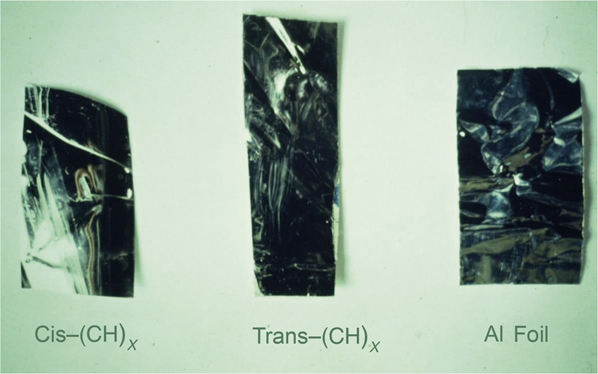
The first conducting polymer discovered, polyacetylene, can be synthesized in two forms: a cis-isomer and a trans-isomer. When compared to a piece of aluminum foil, this polymer looks metallic ( Figure 1 ). This metallic appearance is what originally excited the imagination of scientists around the world. In fact, both forms of polyacetylene are semiconductors; however, through doping with either electron acceptors (p-type) or electron donors (n-type), polyacetylene becomes a metallic-like conductor.
Images showing the metallic appearance of cis-polyacetylene (left) and trans-polyacetylene (middle) compared to aluminum foil (right). Reference Kaner and MacDiarmid1

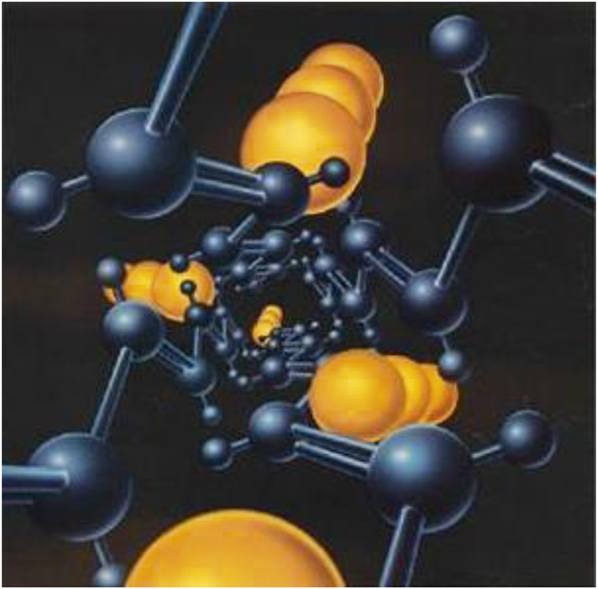
Figure 2 shows an illustration of the structure of polyacetylene showing bond angles and bond distances, with alternating double and single bonds. Reference Kaner and MacDiarmid1 To make a metal, you need two things: a pathway for electricity—this is provided by the π bonds in polyacetylene; and carriers of electricity—which are created by adding dopants. In Figure 2, iodine (I2) has been added, which extracts an electron from the polyacetylene chain to form I3 –, creating a hole that is essentially free to move along the chain. Doped polyacetylene thus becomes one of the most conducting substances known at room temperature. When doped with iodine, the conductivity reaches 10,000 Siemens per centimeter (S cm–1). If you stretch polyacetylene, the conductivity along the stretch direction increases to >100,000 S cm–1. For copper, silver, or gold, the conductivity is ∼650,000 S cm–1, but on a weight basis, polyacetylene is composed of just carbon, hydrogen, and a bit of iodine. Therefore, based on weight, polyacetylene is actually more conducting than most common metals. However, polyacetylene has a problem—it is air-sensitive.
An artist’s rendition of the structure of polyacetylene. The yellow molecules are I3 –. Reference Kaner and MacDiarmid1
Twenty years after I began my PhD, A. MacDiarmid and A. Heeger, along with H. Shirakawa, shared the 2000 Nobel Prize in Chemistry 2 for the discovery of conducting polymers. When I was invited back to speak at the University of Pennsylvania for a Nobel Prize symposium, I told the joke, “What’s the only true application for polyacetylene (knowing that it’s air-sensitive)?” The answer is “To produce PhDs.” However, I added that “on this occasion we now know it’s a dual-use material—PhDs and Nobel Prizes.”
Hardly anyone studies polyacetylene anymore. What we do study are air-stable conducting polymers, including polypyrrole, polythiophene, and polyaniline. What they all have in common is a conjugated backbone that can be doped to make them electrically conducting.
Nanostructured polyaniline
While my group was studying polyaniline, B. Weiller from Aerospace Corporation gave a seminar in which he mentioned that as people live closer and closer to launch sites, the Air Force needs to know where the plumes from space rockets go. Since rocket plumes contain hydrochloric acid, Weiller said he was looking for an inexpensive sensor that could detect HCl. When he finished, I told him about our work with polyaniline, which is electrically insulating with a conductivity of <10–10 S cm–1, but on doping with HCl increases it’s conductivity to >1 S cm–1—a change of greater than 10 orders of magnitude. Weiller agreed that this sounded ideal for the inexpensive resistive-type sensors he was constructing. He found that polyaniline worked; however, it was slow. One of my students, J. Huang then created a nanoform of the polymer.
We looked in the literature for previous methods for making nanostructured polyaniline. The main examples included templated synthesis in which T. Bein grew polyaniline in zeolites Reference Wu and Bein3 and C. Martin grew polyaniline in nanopore membranes. Reference Martin4 M. Wan explored functional self-assembly Reference Qiu and Wan5 and A. MacDiarmid working with F. Ko looked at electrospinning. Reference Norris, Shaker, Ko and MacDiarmid6
However, all of these techniques have difficulties; either you have the problem of removing the template from the product or you have challenges in scaling the process. J. Huang, in contrast, came up with a simple method in which he layered aniline dissolved in an organic solvent with an inexpensive oxidizing agent (ammonium peroxydisulfate) and some acid, HCl, dissolved in water. Thirty seconds after putting these together in a vial, you see the formation of a conjugated polymer at the interface between the organic and aqueous layers. The conjugated polymer that forms is colored, because it has a π to π* transition in the visible region. Note that since polyaniline forms in its doped state, it is a salt with a counterion, in this case Cl–, and therefore disperses in the aqueous phase. We chose an organic solvent that was denser than water, so as the polymer forms, it goes against gravity into the aqueous phase and moves away from the aniline in the organic phase. This can be seen in transmission electron micrographs taken after 30 s, 1 min, 2 min, and 3 min. Reference Huang, Virji, Weiller and Kaner7 Therefore, instead of getting agglomerates, which is what everyone else was producing at that time in reactions without an interface, we created nanofibers. These results were published in 2003, and since that time, this has become the most highly cited paper on polyaniline with more than 1400 citations. Reference Huang, Virji, Weiller and Kaner7
We do have some control over the polyaniline nanofibers. If we use hydrochloric acid, the nanofibers are approximately 30 nm in diameter and about a micrometer in length. If we switch to camphorsulfonic acid, the width increases to about approximately 50 nm, while using perchloric acid increases the diameter to approximately 120 nm. Reference Huang and Kaner8
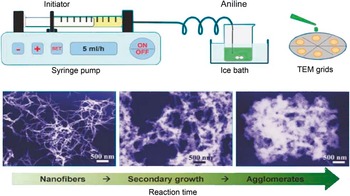
We then went back and examined how polyaniline is normally made and asked why the nanofibers are not visible. This is illustrated in Figure 3 . Reference Huang and Kaner9 Since aniline going to polyaniline is considered a radical polymerization, in order to get longer chains, theory suggested that slowing the reaction by cooling is a good idea. An initiator was added one drop at a time into an aqueous solution of aniline and acid, which produced agglomerated polyaniline. We then asked what happens after the first drop is injected. By stopping the reaction and imaging the product (Figure 3, lower left image) we found nanofibers. If you then add more drops of initiator, you renucleate fibers on top of each other and quickly achieve aggregation (Figure 3, lower right image). Aggregation is exactly what you don’t want, because then you can’t readily disperse the polymer in a solvent.
The formation of polyaniline nanofibers and agglomerates. Reference Huang and Kaner9 Note: TEM, transmission electron microscopy.

Once we discovered that the first drop in the synthesis of polyaniline forms nanofibers, it became obvious that if you could put a stoichiometric amount of initiator into aniline and acid, then you could directly make nanofibers even at room temperature. Reference Huang and Kaner10 In fact, if the reaction is stoichiometric, you use up all the reagents immediately and, therefore cannot renucleate any more nanofibers. This turns out to be a completely scalable process.
We originally formed a company called Fibron, Inc. to produce conducting polymers for industrial applications such as antistatic coatings and electromagnetic shielding. Fibron worked on scaling up the synthesis of nanostructured polyaniline with a Korean company called Kolon, known for its production of Nylon. We originally ran a 100-liter pilot test production of polyaniline nanofibers in Korea and the synthesis worked just like it does in a beaker in the lab. Therefore, this process is completely scalable.
Although Fibron was a casualty of the last economic downturn, our patents were recovered by UCLA. We then licensed our technology to Water Planet, Inc. in Los Angeles. Water Planet focuses on cleaning up the mess left from hydraulic fracturing. For every barrel of oil you pull out of the ground, you produce 7–10 barrels of oily water that needs to be cleaned up. Water Planet combines an efficient centrifuge with polyaniline-based membranes to produce clean water. Reference McVerry, Temple, Huang, Marsh, Hoek and Kaner11,Reference Guillen, Farrell, Kaner and Hoek12 This demonstrates how conjugated polymers can be used in unexpected ways to improve our quality of life.
Nanostructured polyaniline has many interesting properties. You can apply it to essentially any surface to form a completely smooth coating, as observed using scanning electron microscopy. Reference Li and Kaner13,Reference Li and Kaner14 In contrast, agglomerated polyaniline appears in comparable images to have mountains and valleys. If you image nanostructured polyaniline under a high-resolution transmission electron microscope, you’ll see the nanofibers. Thin coatings of polyaniline nanofibers are highly transmitting throughout the visible region with a green hue if doped and a blue hue when de-doped.
Another discovery that could impact anyone interested in forming uniform coatings of nanoparticles involves the use of interfacial surface tension gradients. The idea is to take two immiscible liquids like oil and water and add nanoparticles. After vigorous shaking, the oil and water try to separate (the Marangoni effect), forming a curved surface with a catenoid shape. Since nanoparticles go to the interface, they will be extruded as the oil and water break up. In a glass vessel, the nanoparticles will be forced up the walls of the vessel as they interact with hydroxyl groups in the glass surfaces, producing a uniform film. We first applied this effect to nanofibers of polyaniline. Reference D’Arcy, Tran, Tung, Tucker-Schwartz, Yang and Kaner15 However, it works with other nanostructured polymers as demonstrated with a red film of polythiophene, a green film of doped polyaniline, and a blue film of de-doped polyaniline. We have demonstrated uniform monolayer, bilayer, trilayer, and multilayer films of polyaniline and other conjugated polymers simply by drying out the previous film deposition and carrying out the process again. This method also works for graphene Reference D’Arcy, Tran, Stieg, Gimzewski and Kaner16 and most other nanoparticles.
Sensors
Our work on nanostructured polyaniline started because we wanted to make sensors that work quickly. Resistive-type sensors are simple and inexpensive. Simply take two electrodes with a space between them, add a drop of polyaniline, expose it to a vapor, and observe the change in resistance. Reference Huang, Virji, Weiller and Kaner17 If you’re going to publish in sensor journals, you need to use interdigitated electrodes and you often want to use an array of them. But if you’re going to do this for educational purposes, then you can take a piece of copper tape, cut it with a scissors, add a drop of polyaniline, expose it to a vapor of some acid, and you’ll observe a rapid change in resistance as a function of time. Reference Virji, Huang, Kaner and Weiller18
If you use a conventional material in a sensor and the response is slow, you need to make the electrode material thinner since the surface area is inversely proportional to thickness. However, if you have nanofibers—which we can model as cylinders of infinite length—when you look at the formula you see the surface area is now inversely proportional to the diameter of these fibers. It has nothing to do with the thickness, and this is interesting, because this suggests that any nonuniform coating should give similar results. Reference Huang, Virji, Weiller and Kaner17
Working with B. Weiller, we exposed conventional polyaniline to 100 parts per million of hydrochloric acid and, as expected, the resistance slowly dropped as the polyaniline became doped and electrically conductive. However, when we conducted the same experiment with polyaniline nanofibers, we observed a tremendous drop in resistance, about six orders of magnitude greater. We explored the thickness dependence of the polyaniline nanofibers on exposure to 100 ppm of HCl vapor. Reference Huang, Virji, Weiller and Kaner17 Even though we first doubled the thickness, and then increased it by a factor of 10, to a first approximation, there was no difference between the response curves at each thickness. Only the diameters of the nanofibers are important.
If we look at a cross-sectional view, conventional polyaniline is basically a chunk of dense material. When exposed to acid vapor, the top portion gets doped, but needs to send an electrical signal to the electrode, which can take time due to diffusion. Now consider the nanofiber film: A gas does not actually see a surface, as the film is completely porous. The gas comes in and wherever it hits, it sends a signal to the electrode producing a response. This response is fast and it does not matter whether you have a 0.2-μm-thick film or one 10× this thickness, it will still produce a fast response.
Now imagine taking HCl doped polyaniline nanofibers and exposing them to a base. We carried out this experiment with 0.9 parts per million (ppm) of ammonia and plotted the change in resistance as a function of time. The resistance goes up as the polyaniline is de-doped. This sensor is completely reversible. If you turn it off, the resistance falls back down. You can do this as many times as you like. The nose is sensitive to ammonia, but the best nose cuts out below 25 ppm in air. Therefore, you could not smell less than one part per million, but the sensor had no trouble detecting it. Reference Virji, Weiller, Huang, Blair, Shepherd, Faltens, Haussmann, Kaner and Tolbert19
Consider trying to detect a weak acid. Hydrogen sulfide Reference Virji, Fowler, Baker, Huang, Kaner and Weiller20 is a weak acid, so you really cannot detect it with either doped or de-doped polyaniline. Copper chloride should react with hydrogen sulfide to produce copper sulfide and the byproduct HCl. By putting copper chloride on the polyaniline nanofibers, we got a good response, with detection in less than two seconds. Reference Virji, Fowler, Baker, Huang, Kaner and Weiller20 How do you tell the difference between detecting HCl itself and detecting HCl produced from hydrogen sulfide and copper chloride? If you create a device with two sensor heads, one with copper chloride and the other without, one will respond only to HCl and the other to both. Using this concept, you can detect all sorts of things.
Our sensors have detected phosgene, Reference Virji, Kojima, Fowler, Villanueva, Kaner and Weiller21 arsine, Reference Virji, Kojima, Fowler, Kaner and Weiller22 hydrazine, Reference Virji, Kaner and Weiller23 and many other deadly gases. We worked with a company called Next Dimension who developed an electronic nose using 32 interdigitated sensors. They use several conventional materials to detect organic vapors and then add a few of our materials, including polyaniline and polyaniline doped with different salts, so they can detect acids and bases quite well. Since they obtain a differential response to different vapors, they use neural network programming and principle component analysis to distinguish one vapor from another.
Other applications
We have used polyaniline nanofibers as a scaffold for the growth of gold nanoparticles. Since polyaniline is a redox active polymer, as soon as it sees chloroauric acid (HAuCl4), it reduces Au3+ to Au0. Therefore, by controlling the concentration, temperature, and time, one can grow any size gold nanoparticles. These are quite uniformly dispersed because they grow by an Ostwald ripening mechanism.
We then grew 1-nm-diameter gold nanoparticles on 30-nm-diameter polyaniline nanofibers. Working with Y. Yang from UCLA, we constructed crossbar memory devices. Reference Tseng, Huang, Ouyang, Kaner and Yang24 We deposited the polyaniline with the gold nanoparticles on aluminum crossbar electrodes. A conducting polymer cannot be used, since that will make the entire device conducting. Therefore, we used the de-doped form of the polymer with the gold nanoparticles. At each aluminum crossbar point, one bit of information can be stored. This occurs because the device is bi-stable. When one constructs a current–voltage plot, at +3 volts, the material goes into a highly conducting state and at –5 volts falls back to a lower conducting state. The mechanism involves charge transfer from the polyaniline to the gold to create the highly conducting state and charge transfer back to the gold to produce the low-conductivity state. Reference Tseng, Baker, Shedd, Huang, Ouyang, Kaner and Yang25
Working with P. Diaconescu at UCLA, we grew palladium nanoparticles on our polyaniline nanofibers and she ran palladium-catalyzed Suzuki coupling reactions. Aryl halides reacted with boronic acid in a Suzuki coupling reaction in water at relatively low temperatures with a high yield. Reference Gallon, Kojima, Kaner and Diaconescu26 Here, the polyaniline nanofibers act as an effective scaffold for palladium catalysis.
There are other things we can do with polyaniline nanofibers. J. Huang wondered what would happen if we took our polyaniline nanofibers and exposed them to a camera flash at close range. What happens is remarkable—the polyaniline nanofibers absorb the light, convert it to heat, and melt, as seen from scanning and transmission electron micrographs. Reference Huang and Kaner27 We now use this to pattern doped and de-doped polyaniline. By flashing doped polyaniline nanofibers through a copper TEM grid and then removing the grid, one can see a significant contrast in color. Where the grid protected the doped polyaniline nanofibers, the color is bright green; however, where the grid did not protect the nanofibers, they melted and look golden brown. One can pattern almost anything using an inexpensive device called a LightScribe that was developed for labeling compact discs. Reference Strong, Wang, Patatanyan, Whitten, Spinks, Wallace and Kaner28 This device consists of a 780-nm laser with a magnifying glass and a computer program that enables one to raster any digital image. We have used the LightScribe to make interdigitated electrodes that produce the same sensor response as electrodes made by other more complex techniques.
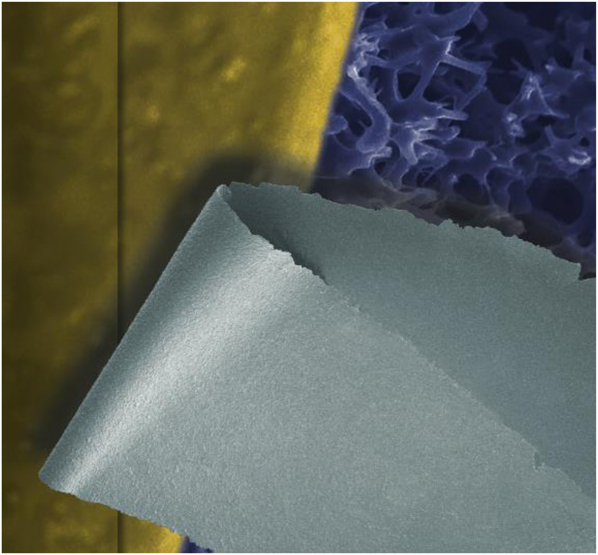
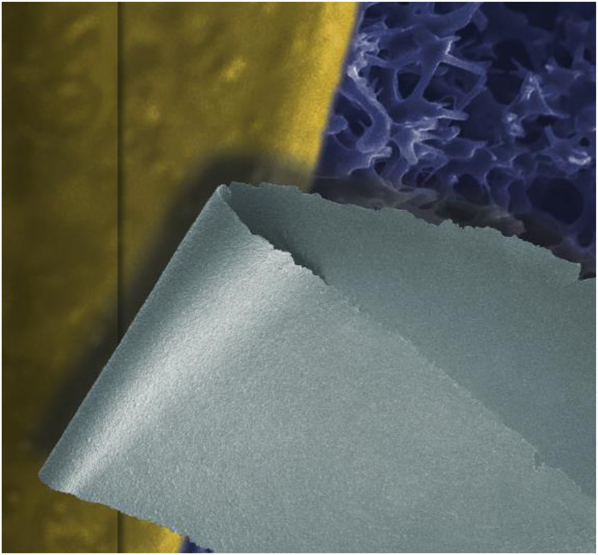
G. Spinks, an expert on mechanical actuators, wanted to know if we could make an asymmetric polyaniline film. Using a flash lamp, we melted the top surface of the polyaniline nanofibers and left the bottom surface in nanofiber form. On exposure to a strong acid, the nanofiber part gets doped and expands as the acid and water are driven into the nanofibers. The melted top portion cannot be doped so it does not expand, meaning the welded asymmetric structure must bend. Within 20 s it bends 720°, curling around itself twice. Reference Baker, Shedd, Innis, Whitten, Spinks, Wallace and Kaner29 On exposure to a base, the structure uncurls. In other words, it acts like an artificial muscle or a mechanical actuator. Reference Li, Huang and Kaner30 A picture of a piece of flash-welded polyaniline is shown in Figure 4 . One cannot tell which side is flash-welded and which side is not, but the TEM image shows that the welded side has melted, while the other side is still nano. For clarity, we colored the polyaniline nanofibers blue and the welded side gold in the figure.
A piece of flash-welded polyaniline. Reference Li, Huang and Kaner30
It is difficult to make nanofibers of derivatives of polyaniline until one understands the rate-limiting step in the polymerization reaction. Because these are radical polymerizations, the rate-limiting step is monomer going to dimer. If we add some dimer into the reaction, the reaction speed will increase by 100× to 1000×, and this produces nanofibers. Reference Tran and Kaner31 Without speeding up the reaction, you simply produce aggregates. Not only does this work for derivatives of polyaniline, Reference Tran, Norris, D’Arcy, Tsang, Wang, Mattes and Kaner32,Reference Wang, Tran and Kaner33 it also works for polythiophene, polypyrrole, and many of their derivatives. Reference D’Arcy, Tran, Tung, Tucker-Schwartz, Yang and Kaner15,Reference Tran, Hong, D’Arcy, Kojima, Weiller, Shin and Kaner34
Tetraaniline
We next consider the tetramer of aniline, which is the basic building block of polyaniline. It’s the smallest unit that can contain dopants that come in pairs and produce what’s called “bipolarons,” associated with two positive charges. If you want to understand how conjugated polymers conduct electricity, most people think that the longer the conjugated chains, the higher the conductivity. Yet, hopping of charge between chains is actually equally important.
To grow tetraaniline, we add the tetraaniline to a mixture of hydrochloric acid and ethanol and slowly precipitate out single crystalline rods of HCl-doped tetraaniline. Using nitric acid we grow “fettuccine”-like structures, with perchloric acid we produce planks, and with sulfuric acid, we grow flower-like structures. Reference Wang, Tran, Liao, Duan and Kaner35 With the assistance of X. Duan, we measured the conductivity of the nanoribbons by putting them across nanometer-size gold electrodes. We obtained a linear current–voltage curve, indicating metallic conductivity. Surprisingly, the conductivity was greater than 1 S cm–1, a value comparable to conventional polyaniline. This is quite remarkable because we are not talking about a polymer, only an oligomer that is four units long. This indicates that the limiting factor in conductivity is hopping charge between different chains.
We examined the growth of tetraaniline in some detail and found that one-dimensional nanofibers form first. These can then organize themselves into two-dimensional planks that can renucleate to form three-dimensional flowerlike structures. We collaborated with D. Martin at the University of Delaware to determine the structure of these materials. The tetramers actually formed single crystals and the lattice dimensions were obtained from fast electron diffraction experiments. Reference Wang, Liu, Tran, Mecklenburg, Guan, Stieg, Regan, Martin and Kaner36
In the literature, one finds some interesting work on growing molecules on graphene. For example, M. Hersam showed that if you took the molecule perylenetetracarboxylic dianhydride (PTCDA), it lays down nicely on graphene and organizes itself. Reference Wang and Hersam37 We wanted to know what would happen if we took tetraaniline and put it on graphene. We used the symmetric phenyl-capped tetramer, so it does not matter how it lands on the surface. The experiment involved adding a drop of solution to an infiltrating solvent and then placing this on top of graphene grown on a silicon wafer with a 300-nm native oxide. After 30 min, one can actually see the tetramer crystals growing on the graphene. Note that the tetramer only grows on the graphene and not on the blue oxidized silicon surface. The tetraaniline grows as single crystals. Diffraction experiments indicated that the tetraaniline lays down on the graphene surface as expected for organic molecules like PTCDA. Depending on the concentration, one can grow a lot of small crystals or a few larger ones. One can actually control the nucleation and therefore the crystal size by using solvents with different boiling points. With a lower boiling point solvent, taller crystals are grown, while a higher boiling point solvent grows more, but shorter crystals. We can pattern these crystals simply by patterning the underlying graphene. We can demonstrate this by growing tetraaniline crystals in the shape of the letters of the alphabet. Reference Wang, Torres, Stieg, Jiang, Yeung, Rubin, Chaudhuri, Duan and Kaner38
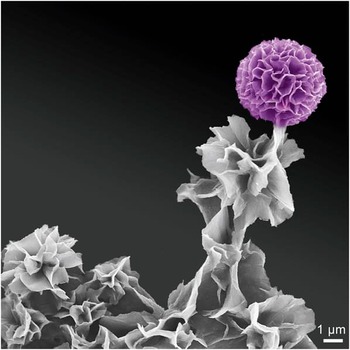
Using conductive atomic force microscope measurements, the conductivity of the single crystals along the stacked direction was >10 S cm–1. This is remarkable —a tetramer with conductivity fully comparable to that of the polymer. Theory suggests one can obtain extremely high conductivities if one can grow a single-crystal polymer. This would be a truly remarkable discovery if someone could figure out how to accomplish this. We do believe our method can be a general process. For example, we have synthesized a crystalline version of the octamer of aniline. We have also made crystals of hexylthiophene. Reference D’Arcy, El-Kady, Khine, Zhang, Lee, Davis, Liu, Yeung, Kim, Turner, Lech, Hammond and Kaner39 Also, using an idea developed by J. Wang, a solvent that likes to lie down on graphene (i.e., benzene) was placed. She added tetraaniline, which was then forced to grow vertically ( Figure 5 ). Reference Wang, Torres, Stieg, Jiang, Yeung, Rubin, Chaudhuri, Duan and Kaner38
“Tetraaniline in full bloom,” a transmission electron micrograph captured by Yue (Jessica) Wang. Note: false color is for visual effect only.

Summary
The aim of this article was to illustrate the ease of growing polyaniline nanofibers. One can use interfacial polymerization or just rapid mixing. The beauty of rapid mixing is that it is completely scalable; we have already demonstrated this at a 100-liter scale. Chemical sensors can be made from the nanofibers; the de-doped polymer rapidly senses acid vapors, while the doped polymer senses the vapors of bases. Nanocomposites with metals can be made that can be used for memory devices or catalysis. Flash welding by exposing the nanofibers to an intense beam of light was also demonstrated. This leads to actuators and artificial muscles. The article also discussed oligoanilines, how to orient them, and measuring conductivities of single crystals comparable to that of the polymer.
Acknowledgments
The author thanks J. Huang, S. Virji, R. Blair, D. Li, H. Tran, K. Shin, C. Baker, B. Shedd, V. Strong, R. Kojima, J. D’Arcy, Y.(J.) Wang, B. McVerry, Y. Liao, T. Farrell, K. Marsh, X.(W.) Huang, B. Weiller, G. Wallace, G. Spinks, D. Martin, Y. Yang, P. Diaconescu, E. Hoek, and S. Tolbert for their contributions. He also thanks their sponsors, including the National Science Foundation, the Microelectronics Advanced Research Corp., Homeland Security Advanced Research Projects Agency, Abraxis Bioscience, Boeing, and Water Planet.

Richard B. Kaner is a professor of chemistry and of materials science and engineering at the University of California, Los Angeles (UCLA). He received his bachelor’s degree in chemistry from Brown University in 1980 and his PhD degree in inorganic chemistry from the University of Pennsylvania in 1984. After completing postdoctoral research at the University of California, Berkeley, he joined UCLA in 1987 as an assistant professor. He has published more than 330 papers and holds 26 US patents. Kaner has received awards from the Dreyfus, Fulbright, Guggenheim, and Sloan Foundations along with an Exxon Fellowship in Solid State Chemistry, the Buck-Whitney Research Award, the Tolman Medal, and the Award in the Chemistry of Materials from the American Chemical Society. He has been elected a Fellow of MRS, the American Association for the Advancement of Science, the American Chemical Society, and the Royal Society of Chemistry. Kaner can be reached by email at kaner@chem.ucla.edu.