The unfolding debate about why Hillary Clinton failed to garner the support of a majority of White female voters in the 2016 elections exposes a disconnect in expectations regarding the “power” of descriptive representation. On the one hand, White women have voted in the majority for the Republican presidential candidate fairly consistently for decades (Junn Reference Junn2017). Why would we expect them to switch parties because “one of their own” is on the ballot? On the other hand, much of the rhetoric and energy behind Clinton's own messaging and that of her advocates was predicated on the possibility that a woman might finally be elected President.
Descriptive representation is not a “black box” mechanism (Lee Reference Lee2008), wherein members of a group see a candidate with a shared, salient feature and automatically, unthinkingly, support that person. Neither is it meaningless, particularly to those who are marginalized in society and politics. I argue that descriptive representation's role in voter behavior has at least two components. First, there is the desire to see someone like yourself in office. The second component is how much weight you give to that desire when you are deciding for whom to vote. Using data from the 2016 American National Election Survey (ANES), I show that the relationship between these two components varies across groups with distinct socio-political positions. The relationship between wanting a descriptive representative, and taking action to get one, is weakest among White women, in comparison to other women.
There are many reasons that Hillary Clinton lost the 2016 presidential election—this study does not attempt to settle that debate. Instead, by using an intersectional analytical framework, I demonstrate why our understanding of the failure of a widely presumed mechanism—descriptive representation—is incomplete. Until now, descriptive representation scholarship has typically considered how a single dimension of identity— e.g., partisanship, race, gender — shapes voter behavior. That analytical lens may be overly narrow when attempting to explain the actions of groups, like White women, that are simultaneously socially marginalized (as women) and privileged (as Whites).
Earlier research on women's descriptive representation as a psychological mechanism in voter behavior has explored whether descriptive representatives signal a set of likely policy responses (Schlozman, Burns and Verba Reference Schlozman, Burns and Verba2001), or serve primarily as a “symbol” that increases a sense of trust or efficacy among voters (Burrell Reference Burrell2014; Lawless Reference Lawless2004). This study departs from that research by beginning from the premise that the operationalization of descriptive representation—how the presence of a descriptive representative conditions or alters other considerations—is not necessarily uniform across subgroups (Dovi Reference Dovi2003). Political and social marginalization along multiple dimensions of identity can foster differences in the way descriptive representation functions as a factor in vote choice across groups.
A WOMAN, OR A MINORITY, ON THE BALLOT: DESCRIPTIVE REPRESENTATION AND VOTER BEHAVIOR
The empirical literatures investigating how, and whether, descriptive representatives on the ballot motivate or engage voters have largely proceeded in parallel tracks focused on race and ethnicity, or women in politics. The presence of elected officials and candidates color has repeatedly been shown to increase levels of trust, efficacy, and engagement among descriptively similar voters (Bobo and Gilliam Reference Bobo and Gilliam1990; Gay Reference Gay2001b; Reference Gay2004; Merolla, Sellers and Fowler Reference Merolla, Sellers and Fowler2012; Tate Reference Tate2003). However, other studies inject notes of caution and nuance into earlier findings: the presence of minority candidates may have varying effects on engagement across groups, and the racial and competitive context may condition those effects as well (Fraga Reference Fraga2016; Gay Reference Gay2001a; Henderson, Sekhon and Titiunik Reference Henderson, Sekhon and Titiunik2016; Keele, Shah and White Reference Keele, Shah and White2017).
The literature exploring the effects of having a woman on the ballot on voters of both genders is less conclusive, with a number of studies arguing that having a woman on the ballot is motivating, particularly for women (Rosenthal Reference Rosenthal2017; Sapiro and Johnston Conover Reference Sapiro and Johnston Conover1997) and others stipulating that what appear to be descriptive gender effects are actually evidence of party congruence between women in the electorate and women on the ballot (Dolan Reference Dolan2004; Lawless Reference Lawless2004). Reingold and Harrell offer a more nuanced analysis, arguing that “party matters, but rather than obscuring the role of gender…it enhances our understanding of how, and under what conditions, it works” (Reingold and Harrell Reference Reingold and Harrell2010). Aside from several exceptions in the study of Black women in politics (Gay and Tate Reference Gay and Tate1998; Philpot and Walton Reference Philpot and Walton2007; Stokes-Brown and Dolan Reference Stokes-Brown and Dolan2010), these studies—either of racial minorities or women—have not explored whether these findings and interpretations are accurate across descriptive subgroup populations. An intersectional analysis of how descriptive representation fits in with other factors in voter behavior may further clarify why the results in this subfield of scholarship have been mixed.
There are at least three reasons why we should suspect that descriptive representation based on gender may “work” in a distinct way for White women. First, the empirical reality at the heart of the present analysis—53% of White women in the 2016 presidential election had the opportunity to vote for a descriptive representative based on gender and race, and did not. As several scholars and journalists have noted, White women have voted in the majority for the Republican presidential candidate in most elections going back several decades (Dittmar Reference Dittmar2017; Junn Reference Junn2017). That observed history is insufficient reason to dismiss the voting choices of White women in 2016 as mere reflections of partisanship that are divorced from their identities as women.
The prospect of electing a descriptive representative of White women on the basis of race and gender had previously been hypothetical, and the prospect of electing the first woman—in an election where gender and misogyny were daily campaign topics—was palpable. The electoral and political context for White women voters who wanted a descriptive representative was different in 2016 than it had been in previous elections where they voted for the Republican candidate. Moreover, while many women who previously voted Republican continued in that vein in 2016, other considerations related to other identities aside from partisanship were highly salient in the 2016 election. Given the evidence that other identity-linked considerations may inform or modify partisanship in voter preferences (Klar Reference Klar2013), exploring how race and gender, via descriptive representation, fit in with other factors may shed new light on the processes that yield partisan choices.
Second, there is a historical basis for expecting that women's understandings and expectations of gender-based challenges, solidarity, and representation will be racially distinct. The roots of the White women's suffrage movement, before the Civil War and long after, were propelled by a desire for autonomy and independence from husbands and other male relatives (Glymph Reference Glymph2008; Newman Reference Newman1999), while still maintaining racial distance. Meanwhile, race-gendered (Hawkesworth Reference Hawkesworth2003) experiences of American social and political life produced a different set of understandings of the most urgent problems that needed to be addressed among women engaged in the Black freedom struggle, and anti-colonial and feminist movements in the 1960s and 1970s (Baca Zinn and Dill Reference Baca Zinn and T. Dill1996; Combahee River Collective (1977); Collins, Reference Collins2002; Harnois, Reference Harnois2016).
These select histories underscore that in previous moments where women's role in society and politics was an explicit topic of national debate, there was both solidarity and racial division, amongst women (Chisholm Reference Chisholm1983). While Hillary Clinton's campaign was not as socially encompassing as earlier movements for civil rights and suffrage, it repeatedly sparked national conversations about gender, politics, and public life. Earlier political struggles related to gender roles and norms suggest that racial differences in the way women conceive of their ties to each other, and the men in their racial groups, may be relevant to their political behavior.
Third, I expect that White women's operationalization of descriptive representation will be different from that of other women because of their socio-political positioning, and thus the vantage point from which they evaluate candidates and politics more broadly is distinct. Scholarship on Black women in politics has often made this point—that Black women's political activities, attitudes, and ambitions are a product not only of their individual experiences, but also as a result of the historical and current positioning of their race and gender groups (Darcy and Hadley Reference Darcy and Hadley1988; Gay and Tate Reference Gay and Tate1998; Smooth Reference Smooth2006). Although White women have rarely been studied as an explicit group in political science, it stands to reason that their political activities and attitudes are also shaped in part by their group's positioning.
White women's group positioning in American politics is often distinct from that of women of color. In a material sense, this is evidenced by a number of measures, including their numerical representation in elected office (Center for American Women and Politics 2017; Phillips Reference Phillips2017), differences in partisan leanings discussed earlier, and membership in a racial group that is economically dominant (Ahmad and Iverson Reference Ahmad and Iverson2013), among others (Smooth Reference Smooth2006). As such, while White women may share the view with women of color that more women should be elected, it follows that the weight they lend to that idea, and the way it fits in with other identities and factors in evaluating candidates, may be distinct from that of women of color.
Political and social contexts, including racial and gendered hierarchies, shape individuals’ senses of their group identities, and of how relevant they are to their lived experiences. A key part of that interplay between group consciousness and hierarchy is that the “incentives and costs” for adopting or prioritizing a particular identity are different among groups (Masuoka and Junn Reference Masuoka and Junn2013). Recent research has shown that Whites are cognizant of their status as a group, and that awareness can shape their desire for descriptive representation (Schildkraut Reference Schildkraut2017).
White women voting in the 2016 election may have felt that while they would have liked more descriptive representation as women, there were greater concerns or threats at stake related to their racial identity, which were also highly salient in the campaign. Moreover, Masuoka and Junn (Reference Masuoka and Junn2013) argue that White's position at the top of the racial hierarchy gives them the greatest degree of flexibility in their levels of group identity adoption.
Thus, while White women are members of an oppressed gender group, their racially privileged position may lead them perceive a greater distance between the interests of their group identities (as Whites and women) than women of color do (between, say, being Black and a woman) (Hancock Reference Hancock2007). As a result, they might more readily separate the desire for more representation as women, from the imperative to vote for a woman. This may especially be the case when the woman on the ballot is repeatedly characterized in the media as being particularly sympathetic to the concerns and policy agenda of people of color.
WHAT HAPPENED: WHITE WOMEN'S SUPPORT FOR ELECTING WOMEN
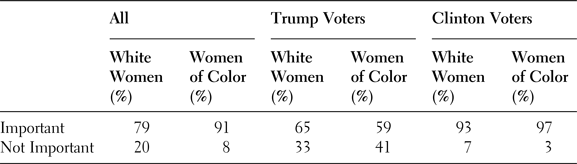
White women's espoused desire for increased descriptive representation is distinct from, but not unrelated to, their support for Hillary Rodham Clinton. The American National Election Survey is particularly well-suited to explore the differences and relationships between these concepts among Whites. In 2016, included a specific question about support for increasing the number of women in elected office (Table 1). Small sample sizes for individual racial groups that are not White preclude comparing White women to Latinas or African American women specifically, for example. However, given that the main concern is understanding how descriptive representation works among White women, and how gender representation functions distinctively for Whites, aggregating the responses of women of color into a single comparison group is an acceptable, if imperfect, research strategy.Footnote 1
How Important is it that More Women be Elected to Political Office?

Table 1 reports the weighted percentages of White women and women of color who stated that electing more women was important to some degree, or not at all important. More than three-quarters of White respondents said that it was important to some degree, including nearly two-thirds of voters who selected Trump. This reveals a striking level of support for what was often called “the gender card” among Republican and Independent White voters. Women's descriptive representation was a pervasive topic in the media in 2016, and in both of the top candidates’ messaging. Moreover, the Republican candidate's rhetoric frequently focused on disparaging the idea that women would vote for Clinton because of her gender.
For respondents, the inferred meanings of this question likely vary by group. As an example, among White men (not reported here), this question might be a statement of principle, or a fairly abstract assessment of how they think they might “fix” what is currently wrong with politics. For women, and possibly White women in particular, the presence of a White woman on the ballot may mean that an additional dimension is also highly salient. The importance of electing more women is also a reflection of the importance women ascribe to electing someone descriptively similar to themselves.
Clinton's candidacy was not necessarily that of “one of their own” for women of color in the same way that it may have been interpreted for White women. As one African American female writer put it, Clinton as the first female nominee for the Democratic Party ticket was a “fragmented reflection” of herself that was notable, if not celebration-inducing (St Felix Reference St Felix2016). Nevertheless, women of color's expressions of support in Table 1 for electing women are relevant for contextualizing the support espoused by White women.
Women of color who stated that electing more women was important voted for Trump much less frequently than White women who answered similarly. The drop-off in the percentage of women who voted for Trump, and also said they support electing more women, is nearly twice as large among women of color in comparison to White women. This suggests that for women of color, there was a disconnect between voting for Trump and stating support for electing more women. That disconnect is less evident among White women. Moreover, it raises the possibility that White women's operationalization of their support for electing more women in their voting decision may be quite distinct from that of other women in the survey. The differences between White women and women of color also underscore the likelihood that respondent race and gender simultaneously shape answers to a question that, prima facie, is solely concerned with gender.
One potential concern with a question about wanting to elect more women, especially in a highly polarized political environment where gender is a frequent topic, is that some respondents may be motivated to be less than honest in their responses. A social desirability bias (Tourangeau, Rips, and Rasinski Reference Tourangeau, Rips and Rasinski2000) on the importance of electing more women could run in at least two directions. The first is an upward bias. It is possible that the respondents worried that saying they did not think it is important to elect more women made them look sexist, or appear that they did not value their own status as a woman. The second is a downward bias—perhaps in a year wherein the “gender card” was so strongly associated with Clinton's campaign and feminist activists, some women who think electing more women is important may have downplayed that sentiment to avoid seeming like they were blindly voting based on gender identity.
Several studies have shown that for questions that are potentially socially sensitive, such as reporting whether or not you voted, or expressing opinions about racial minority groups, the interview mode and related techniques can mitigate social desirability bias (Holbrook and Krosnick Reference Holbrook and Krosnick2010; Tourangeau et al. Reference Tourangeau, Rips and Rasinski2000). Kreuter et al. found that completing socially sensitive survey questions through a self-administered web-based process can dampen the effects of social desirability bias (Kreuter, Presser and Tourangeau Reference Kreuter, Presser and Tourangeau2009). Indeed, the administration of the 2016 ANES reflects this body of research: in face to face interviews, when respondents complete questions that are socially sensitive, they are handed a tablet computer in order to indicate their responses somewhat privately.
The question reported in Table 1 about electing more women was both administered in face-to-face interviews and self-administered by respondents on a website. In order to test whether social desirability bias may be occurring in responses to that question, I used a t-test of the mean level of affirmative responses to the question about electing more women, and compared women who took the survey online with those who took it in person. I found that across all women, and within groups of White women and women of color aggregated together, the difference in means was not different from zero.
In order to further develop confidence that the question about electing more women is tapping into a distinct opinion about representation, and draw a more complete picture of women's attitudes on gender and power more generally, I also compare responses to questions that elicit opinions on traditional gender roles and identifying as a feminist. On these measures, women of color and White women generally express statistically indistinguishable levels of support.
Traditional conceptions of gender roles, and women's roles in particular, have been shown to have strong predictive effects on favorability for Hillary Clinton (McThomas and Tesler Reference McThomas and Tesler2016; Winter Reference Winter2000). The mean responses to the ANES question “Do you think it is better, worse, or makes no difference for the family as a whole if the man works outside the home and the woman takes care of the home and family?” among White women and women of color are not statistically significantly different; 33% of women in both groups responded that they believed it is better when men work outside of the home, and 61% of white women and 58% of women of color said it made no difference. This level of agreement suggests that overall attitudes toward traditional gender roles do not differ widely among between White and non-White women.
The 2016 ANES also asked respondents: “How well does the term ‘feminist’ describe you?” Using a t-test comparing the mean responses from White women and women of color, I again find no statistically significant difference: 51% of women of color report that the term feminist describes them well, and 49% of White women say the same. Taken together, these measures are not definitive, but give some insight into the degree of similarity in broad attitudes toward gender and power among White women and women of color. In this light, racial differences in responses to the question about electing more women suggest that this particular item is not simply reflecting a general racial group difference in attitudes toward feminist ideology or gender roles.
Most women, including those who did not vote for Hillary Clinton, think that electing more women is important. Similar percentages of women in both racial groups also espouse the view that gender roles in and out of the home make little difference, and identify as feminists. These patterns reflect a shared desire for descriptive representation as women, but further analysis is necessary to determine whether that desire is given equal weight by White women and women of color.
ANALYSIS: SUPPORTING, AND VALUING, DESCRIPTIVE REPRESENTATION
In order to assess whether White women's valuation of descriptive representation in their voting calculus is distinct, I perform a series of logistical regression analyses predicting the effect of wanting to elect more women on the likelihood that a respondent voted for Clinton. These models demonstrate that support for electing more women to political office has a comparatively weak effect on White women's likelihood of voting for Clinton. In contrast, the relationship between supporting the election of more women, and actually voting for the woman on the ballot, Clinton, is much more robust among women of color.
For the main analysis, I present three models that facilitate a comparison between White women and women of color. The dependent variable is one if the respondent voted for Clinton, and zero if they voted for Trump. The main explanatory variable of interest is a dummy variable indicating whether the respondent said they thought it was important to elect more women to elected office. I also include other independent variables that are often included in vote choice analyses, and which have come up frequently in debates over White women's voting behavior in the 2016 election. For example, I include a variable indicating whether the respondent is married. Marriage is a key variable in the gender and political socialization literature (Jennings and Stoker Reference Jennings and Stoker2000; Stoker and Jennings Reference Stoker and Jennings1995), and in this analysis, also references the primary explanation that Clinton herself has advanced to explain the outcome. Her claim is that women wanted to vote for her, but felt pressure from the men in their intimate lives, who (she asserts) were largely Trump supporters, to vote against her (Clinton Reference Clinton2017). In some respects, this is a view corroborated by earlier studies showing that married women's preferences move to align with their husbands’ views over the course of their lives.
As mentioned earlier, gender attitudes have been effective predictors in earlier studies of support for Clinton, so I also include two variables related to women's views on gender roles in the models. The categorical variable for gender roles is a scale for respondents’ views on whether having a man working outside the home and women staying at home is better for the family; higher values on the scale indicate more disagreement with that viewpoint. A variable indicating how well respondents stated the term “feminist” describes them is included as well. Evangelical Christians were also a group that was frequently in the spotlight during the campaign that has also been publicly associated with conservative views of gender roles, and social issues more broadly, so I include a dummy variable indicating whether a respondent described herself as Evangelical.
Race, racism, and immigration-driven changes in the composition of the U.S. population were also repeated themes in the 2016 campaigns and media coverage. To account for the heightened salience of those issues, I include a racial resentment scale variable in the model whose values, 0 through 4, indicate how many statements related to African American socio-economic achievement and institutional support the respondent agreed with.Footnote 2 Higher values in the racial resentment scale indicate higher levels of resentment toward African Americans as a group. I include the racial resentment scale in the models for White women and women of color, but do not expect that substantive interpretation of the results related to this scale will necessarily be the same across groups (Kam and Burge Reference Kam and Burge2017).
Educational attainment, another dividing line among 2016 voters that has frequently been cited by pundits and poll results alike, is also in the logit model. In order to account for socialization in different periods of American history and stages of the life course that may affect candidate preferences, variables for age and age-squared are also in the models. A categorical variable for party identification is also included, with increasing values indicating stronger identification with the Republican Party.
Finally, given the nature of Clinton's long tenure in the public spotlight, and the polarizing views many held of her and her candidacy, I include a categorical variable called HRC Trait. This variable indexes a candidate trait battery in the ANES questionnaire that asked respondents whether they agreed with positive statements about the traits of the Democratic nominee (such as “she is a strong leader,” “she is honest,” etc.). Women of color's mean rating for Clinton—3.7 out of 4—was significantly higher than that of White women—2.7. Clinton's candidacy, and the frequently gendered rhetoric of the campaigns make it difficult to imagine a variable that could perfectly isolate feelings toward Clinton as a person from broader ideas about women's roles in public, but the inclusion of the HRC Trait variable is a sufficient way to gain as much information from the model as possible.
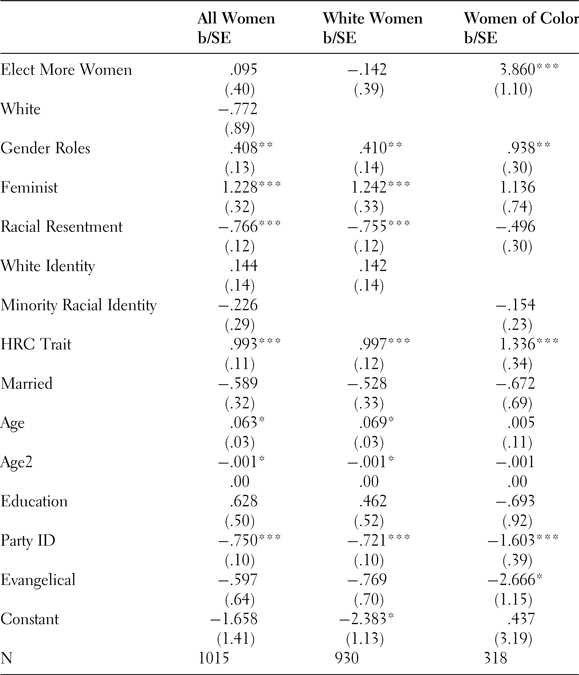
Table 2 reports the log odds results of all three logit models, including observations of all women, White women alone, and women of color alone. In Table 2, the Elect More Women coefficients are in the positive direction across all three models, but is only significant in the model for women of color. Formal tests of the differences in these reported log odds are in the Appendix.
Main Logit Models: Estimating Likelihood of Voting for Clinton

*p < .05, **p < .01, ***p < .001.
The positive sentiment for electing more women from Table 1 is significant in the voting decision of women of color, and not for White women, even after accounting for partisan and feminist ideological differences, and views toward Clinton as a candidate. The relationship between wanting to elect a woman, and giving that desire credence in your voting decision, is weakest among White women.
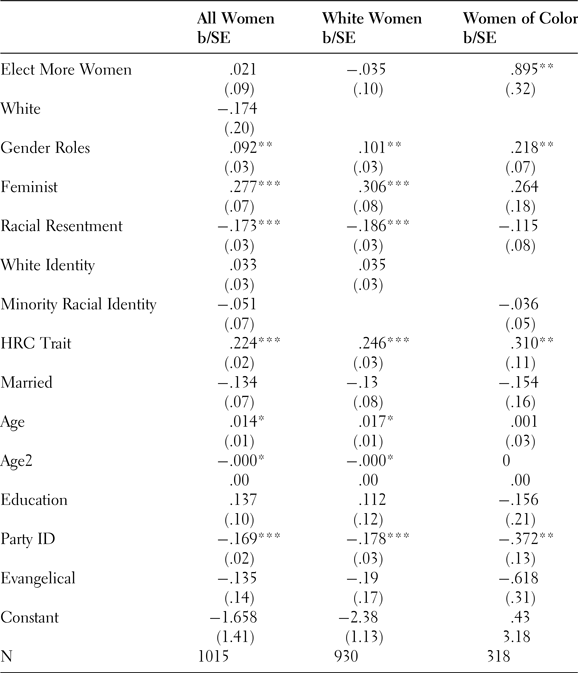
In Table 3, I report the conditional marginal effects of each variable for the models above, holding other variables at their means, in Table 3. This allows for a more straightforward comparison of the magnitude of effects that are significant for both groups of women. The variable elect more women reflects significant substantial differences across racial groups (Table 3). In comparison, most of the other variables that were included in all three of the models have log odds that are relatively similar in their significance and direction.
Marginal Effects at the Means for Main Logit Models

*p < .05, **p < .01, ***p < .001.
Conservative views of gender roles have a smaller impact on the likelihood of voting for Clinton among White women, as does stronger identification with the Republican Party. However, the number of observations of women of color who strongly identify with the Republican Party or who identify as Evangelical is very small, and these coefficients should be approached with due caution. The size of the marginal effect for the HRC Trait scale is nearly identical across racial groups—positive feelings about Clinton as a candidate appear to have similar effects across racial groups, on average.
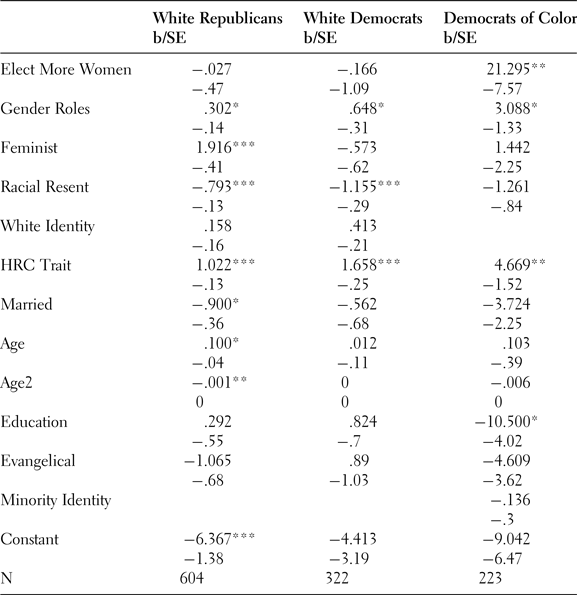
Among White women, partisanship does not make much difference in the strength of the effects for elect more women (Table 4). In Table 4, I report three models similar to those above with breakouts by race and partisanship. The first model, White non-Democrats, includes White women who reported a partisan identity other than Democrat. The second and third models include women who identified as Democrats, divided by racial group. There is an insufficient number of women of color who did not report identifying as Democrats to run a separate model for that group. As it stands, the main results of interest are the models of White women, and how similar they are in the reported results for elect more women (Table 4).
Estimating Women's Likelihood of Voting for Clinton, by Race and Party ID

*p < .05, **p < .01, ***p < .001.
The log odds for Elect More Women for White democrats and non-Democrats are not significant, and negative in direction. Other variables in the models encompass substantive differences across partisan groups of White women, such as identifying as a feminist, attitudes about traditional gender roles, marriage, and racial resentment. In contrast, the similarity between elect more women among groups of Whites suggests that the weak relationship between the desire for gender representation and vote choice is not an artifact of the partisan leanings of White women. The model for women of color who reported being Democrats bears little resemblance to that of White Democrats, particularly on the measure elect more women.
Across these sets of logistic regression models, elect more women is not significantly related to White women's support for Clinton, but is significantly and positively related to women of color's support for the same candidate. The weakness of that relationship is striking in light of the high levels of espoused support for the idea of electing more women. Among White women who voted for Clinton, 95% of Democrats and 91% of non-Democrats state that it is important to some degree to elect more women. Yet, the relationship between that support and vote choice was similarly insignificant for both partisan groups of White women.
Finally, it bears mentioning that Hillary Clinton was a uniquely high-profile candidate, and her long history in politics was often vilified by pundits and politicians of all ideological stripes. That status raises the possibility that women who otherwise may have wanted greater descriptive representation, and been willing to give it importance in their voting decision, did not, because it was Clinton, and not a more widely “likable” female candidate, on the ballot. Whether any female candidate on the national presidential ticket will be considered “likable” is a topic for future research, but for the analysis at hand, it appears that positive regard for Clinton's attributes as a leader, alone, had similar effects across both White women and women of color.
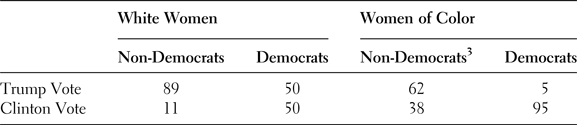
Did women who strongly disliked Clinton, but wanted to see more women get elected, “hold their noses” and vote for her? The ANES includes a “feeling thermometer” question that asks respondents to rate how favorably or warmly they feel toward the Democratic presidential candidate. While differences between individual ratings—say feeling 60° versus 65°—are difficult to interpret, respondents who chose measurements below 50° can reasonably be described as “cold” toward Clinton. Responses to the thermometer rating among women who said they want to elect more women are a helpful context for understanding how affect toward Clinton may have had a similar effect on vote choice, while interacting differently with the desire for electing more women. There is a clear racial difference in responses on the ANES—half of White women who identify as Democrats, and said they want to elect more women, were partisan defectors (Table 5). Among similar women of color, 95% held their noses and voted for Clinton.
Vote Choice: Women Who Dislike Clinton, and Want to Elect More Women, Percent

Across the results presented here, the relationship between wanting to elect more women and actually voting for the White woman on the ballot is the least robust among White women. The models predicting Clinton support among White women illustrate that wanting to elect more women is something that they affirm in large proportions, but its impact on their vote choice is readily mediated and mitigated by other factors.
DISCUSSION: MULTIDIMENSIONAL REPRESENTATION FOR A COMPLEX POLITY
The results of this analysis support my claim that there is a distinction between wanting a descriptive representative, and giving that idea actual value when deciding for whom to vote. There is variation among White women and women of color in the relationship between stating support for electing more women and actually voting for a woman, and that correlation is weakest among White women. As Tables 2–4 report, wanting to elect more women was not a significant factor for White women, while it was consistently sizable, positive, and significant for women of color. This difference is present even after controlling for partisanship, racial resentment, and other salient factors, and despite the observation that women of color do not appear to hold views on gender roles that are substantially less traditional than White women. These findings reveal an undertheorized dimension of descriptive representation based on gender; that it may function differently among women voters as an attitude, and a factor in vote choice.
The 2016 election was not the first time in American history that women had an explicit opportunity to advance a political cause specifically described as being, at least in some part, for and about women. For example, Mansbridge's account of public opinion on the Equal Rights Amendment (ERA) reveals a pattern similar to the one covered in the main analysis of this paper—survey respondents who supported the ERA in the 1970s, also supported retaining the status quo in terms of gender roles at home (Mansbridge Reference Mansbridge1986). That disconnect between wanting a political outcome, but acting conservatively on the attitude, is not limited to gender-related issues. However, it is overly narrow to attribute the differences between White women and women of color in the current analysis to the disorganized and sometimes ill-informed mind of the voter (Converse Reference Converse and Apter1964).
If we instead assess the findings in this study in the full context of the 2016 campaign and the prevalence of race and gender in American political discourse at that time, it seems likely that White women's distinct operationalization of their desire for descriptive representation is tied to their social-political group positioning (Masuoka and Junn Reference Masuoka and Junn2013; Schildkraut Reference Schildkraut2017; Tajfel Reference Tajfel1982). White women and women of color are members of two highly salient social groups, but White women's racially privileged position may enable White women to perceive a more flexible connection between how their multiple identities—as women and Whites—are linked to each other and to their everyday experiences.
Women of color, on the other hand, may understand their identities, as African Americans and women, for example, as more tightly linked, to each other and to their lived experiences (Simien and Clawson Reference Simien and Clawson2004; Collins Reference Collins2002; Gay and Tate Reference Gay and Tate1998). Thus, while White women may genuinely want more descriptive representatives—women—to be elected, they may sense that that concern is less urgent or salient, and not entirely related to, their concerns as Whites.
It is not that race simply trumps gender, but that the perceived connection between race and gender identities for White women embodies more flexibility than it does for women of color.
An illustrative data point on this perspective is the relationship between responses to the ANES question about electing more women, and responses to questions that ask how important racial identity is to the respondent. Taken together, these questions elicit attitudes about different dimensions of respondents’ identities. I ran a Spearman's correlation test on the relationship between saying it is important to elect more women, and the question “How important is being White to your identity?” Among White women respondents, there was a small negative correlation (Spearman's r = −.0826), which was statistically significant (p = .002). When I perform the same assessment of correlation among women of color, using questions corresponding to their racial identities, there is a larger, positive correlation (Spearman's r = .2182) between increasing importance of racial identity, and increasing importance of electing more women, significant at p = .000.
Explicit questions about the importance of White identity may trigger a social desirability bias in the downward direction among Whites. To address this possibility, I also test the relationship between wanting to elect more women and a more indirect measure of the salience of White racial group consciousness; the racial resentment scale. I ran the same test of Spearman's correlation between the racial resentment scale and wanting to elect more women. Among White women respondents, the negative correlation is stronger (Spearman's r = −.4810) at p = .000. On balance, these relationships suggest that for White women, attitudes more closely related to their gender identity are not strongly related to those more closely related to their racial identity. This is quite different from identity relationships exhibited by women of color, in this study and in the extant literature on intersectionality and women of color in politics. White women's social position, as women and Whites, may shape how they view the necessity of, and imperative for, descriptive representation based on gender in a way that is distinct from other women.
CONCLUSION: SIMULTANEITY AND GROUP IDENTITIES
Hillary Clinton's loss in the 2016 election is not merely the latest in a string of elections where a majority of White women chose to support the Republican candidate. Among the many factors that made the election distinctive, White women were in a position, for the first time, to elect a descriptive representative, of their race and gender, to the presidency. White women, as a political constituency, are unlike any other under-represented group, including African Americans voting in the 2008 presidential. They are consistently the largest block of voters in presidential elections, and they are members of the dominant racial group in politics. The prospect of White women electing a descriptive representative was not a flight of fancy or a longshot in the 2016 election—they arguably had the power and the candidate. Yet the majority chose Donald Trump.
This study uses that outcome to demonstrate that more complex, and intersectional, dynamics underlay voters’ desire for descriptive representation than have previously been considered. I use an intersectional framework to analyze White women's espoused desire for descriptive representation, and evaluate how it fits into their vote choice calculus in ways that are distinct from other women. In sharp contrast to other women, the attitude that electing more women to office is important and is not significantly related to support for Clinton among White women, even when controlling for partisanship, gender attitudes, and other relevant factors. Most White women say that they want increased descriptive representation based on gender, but the weight they give that attitude is minimal in comparison to other women who are not White. I argue that this is evidence of the complex processes that can be associated with descriptive representation; voters may want it, but operationalize descriptive representation in different ways across racial groups.
This empirical observation is facilitated by the methodological choice to consider White women as simultaneously women and White, and not treat the analysis of racially motivated and gender-motivated reasoning separately. While intersectional approaches have gained some traction in the literatures focused on women of color, this analysis shows that research designs that consider identities simultaneously, and account for the context and social-positioning of the subjects, can reveal new understandings of long-standing disciplinary questions across subfields. Extant literatures that are engaged with identity along a single dimension—such as scholarship on co-ethnic voting, linked fate, and feminist attitudes—have expanded our capacity to understand voters’ motivations in a diverse polity. However, they may yield an additional set of insights when the multiple dimensions of identity that shape voters’ everyday lives are accounted for.
Finally, my argument that the relationship between wanting a descriptive representative and acting on it are two distinct components in voter's choice calculus, exposes a new vein of group consciousness and group identity research that merits further exploration. The relationship between multiple group identities and their salience is contextually dependent, but most research on descriptive representation has proceeded along parallel tracks of gender or race. Comparisons between racial groups on this topic, which account for more than one identity, have been rare as well. By comparing groups that share one dimension of identity, but occupy distinct social positions, future investigations into how group consciousness informs voter attitudes may be able to enumerate more of the processes that link who voters are, and who gets their vote.
ACKNOWLEDGMENTS
I thank Marisa Abrajano, Lorrie Frasure-Yokley, Jane Junn, and Jennifer Merolla, and the anonymous reviewers, for helpful comments. I am also grateful to the participants of the 2017 Southern California Political Behavior Conference for their feedback on an earlier version of this paper.
Appendix: Formal Test of Significant Difference in Elect More Women Coefficients
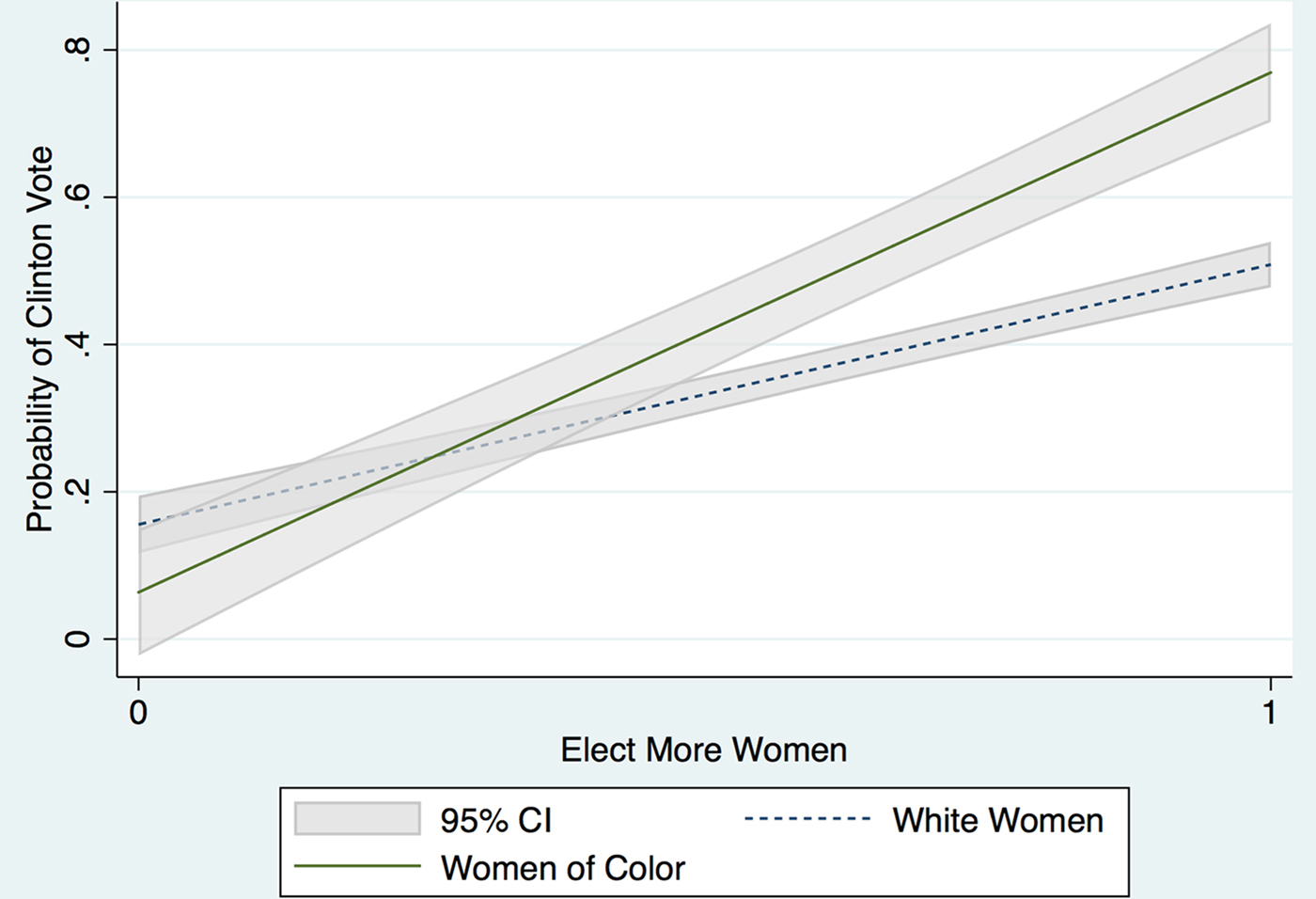
Since a single formal test of equality, like a Chow test, for example, does not work well for Maximum Likelihood Estimation, another alternative method for comparing coefficients across groups is to look at the predicted probabilities by group (Allison Reference Allison1999; Long Reference Long2009). Figure A shows the predicted probabilities of voting for Clinton, on the response to whether it is important to elect more women. The solid line is women of color, the dashed line is White women. For those women who said they wanted to elect more women, there is a clear racial gap. Thus, we can infer that the coefficients for elect more women are indeed, significantly different across groups.
Predicted Probability of Clinton Vote, on Elect More Women, by Race