1. Introduction
Effective legal institutions have been generally recognized in the growth and transition literature as crucial for economic progress, enabling various metrics of economic success such as investment or financial sector development (Castro et al., Reference Castro, Clementi and MacDonald2009; Garretsen et al., Reference Garretsen, Lensink and Sterken2004). Alongside the collapse of communism in Central and Eastern Europe and the then-Soviet Union, legal institutions also appear to have acquired an additional mandate, namely as the guarantors of rule of law within a country (Carothers, Reference Carothers1998). Although the judiciary has always been seen (perhaps hopefully) as the executors of legislative frameworks and the impartial arbiters of legislative intent, legal institutions have also been given the objective of sustaining the law ‘through interaction between private agents, courts and the legislative apparatus’ (Deakin et al., Reference Deakin, Gindis, Hodgson, Huang and Pistor2017: 188).
To this end, court-centric reforms (Jensen, Reference Jensen, Jensen and Heller2003) supported by foreign aid agencies and international financial institutions, focusing on creating or supporting these effective legal institutions, have been seen as the sine qua non for building the rule of law (Sannerholm, Reference Sannerholm2007). Indeed, justice sector reforms have been utilized as a proxy to transition from an arbitrary application of power toward the creation of an atmosphere of trust in the impartiality of the state to apply the law predictably. To this end, de jure indicators such as ‘judicial independence’ and procedural statistics have been utilized to measure the health of the rule of law in a country.
Unfortunately, like other institutions, legal institutions such as the judiciary are both chaotic and complex, in that they follow non-linear paths, are comprised of agents acting on locally available information and, perhaps most importantly, are highly dependent upon initial conditions, cultural norms, and a complex web of other institutions which can alter their evolution in crucial ways (Deffains and Fluet, Reference Deffains and Fluet2020). Despite the emphasis on judicial ‘independence’, judiciaries in reality are never truly ‘independent’, as external institutions, and paramount among these, political institutions, are instrumental in shaping their evolution (Basabe-Serrano, Reference Basabe-Serrano2012). In fact, legal institutions may be a necessary condition for ensuring rule of law, but they are by no means sufficient, as political institutions can shape whether or not legal institutions function as intended. In an environment where legal institutions are at odds with (or even slightly out of step with) political ones, can legal institutions still defend the rule of law?
This paper, utilizing and extending the framework of Avner Greif (Greif, Reference Greif2006; Greif and Laitin, Reference Greif and Laitin2004) and meshing it with the study of Lanzara (Reference Lanzara1998), examines these interdependencies of legal and political institutions to answer this question and understand how effective legal institutions actually are at protecting the rule of law. Focusing on Greif's frameworks on self-enforcement and self-reinforcement – and especially his emphasis on ‘quasi-parameters’ exogenous to legal institutions – we contrast two of the ‘star performers’ of economic transition in Central and Eastern Europe, Estonia, and Poland. Although both countries achieved high rates of growth and other impressive economic and institutional achievements as a result of their very similar economic transition strategy, the two countries diverged substantially in the development of their legal institutions almost from the outset and, subsequently, have seen different outcomes in the actual level of protection of the rule of law.
In particular, the upheaval of the Polish judicial system over the past 5 years, contrasted with the placid functioning of Estonia's formal legal institutions, suggests that Greif and Laitin's (Reference Greif and Laitin2004) assertion on the importance of quasi-parameters and the need for institutions to be self-reinforcing is an explanatory factor for this divergence. Greif and Laitin (Reference Greif and Laitin2004: 642) examined Genoa and Venice to exploit similarities (both had ‘initially developed political regimes that were sufficiently self-enforcing to sustain economic prosperity’) and contrasts, concluding that Genoa's institutions were self-undermining. Through our case study analysis, we conclude that a similar dynamic was at work in the case of Poland and Estonia, as Polish legal institutions were self-undermining due to their relationship to political ones. In fact, post-communist legal institutions in Poland were born from a political compromise which left many parties dissatisfied, impeding the judiciary from attaining the legitimacy which was created in Estonia. Thus, in Poland the rule of law was threatened by the political process, which undermined legal institutions, whereas in Estonia, the causality ran the other way, as the political process incentivized better institutional functioning and challenged parties to strengthen the rule of law.Footnote 1
The rest of the paper proceeds as follows: Section 2 offers a general theoretical framework synthesizing Greif's institutional analysis whereas extending it to legal institutions in particular, whereas Section 3 begins our examination of Poland and Estonia with a look at the cultural and historical factors leading up to 1989. Section 4 extends this analysis to describe the legal institutional reform in both countries post-communism, and Section 5 explores the outcomes from these diverging strategies beginning in 2015. Section 6 offers some concluding thoughts.
2. Legal institutions and the rule of law
2.1 Self-reinforcing institutions
In a series of seminal articles and books (Greif, Reference Greif1989, Reference Greif1994, Reference Greif1998, Reference Greif2006; Greif and Laitin, Reference Greif and Laitin2004), Avner Greif incrementally developed a theory predicated on understanding how endogenous institutional change is conditioned on external environments. At the heart of his approach is ‘historical comparative institutional analysis’ (HCIA), a ‘research strategy… based on evaluating and synthesizing micro-level historical and comparative evidence and insights from context-specific, micro theoretical models’ (Greif, Reference Greif1998: 80). Although his use of specific historical episodes is instructive (and an approach we will follow below), more important is the HCIA's emphasis on the all-important context in which institutions develop. In subsequent articles, Greif further elaborated this HCIA approach with an emphasis on the fact that institutions both influence and are influenced by their surroundings, a reality which gives rise to what Grief terms are ‘quasi-parameters’, variables which are ‘parametric – exogenous and fixed – [when] studying the self-enforcing property of an institution in the short run, but [are] endogenous and variable when studying the same institutions in the long run’ (Greif and Laitin, Reference Greif and Laitin2004: 639). It is important for Greif (and us) to understand how the internal workings of an institution make it self-enforcing, i.e. where ‘responding to the institutional elements implied by others’ behavior and expected behavior, each individual behaves in a manner that contributes to motivating, guiding, and enabling others to behave in a manner that led to the institutional elements to begin with’ (Greif, Reference Greif2006: 53). Perhaps more important, however, is examining the manner in which the institution reacts to the workings of quasi-parameters and whether or not they contribute to an institution being self-reinforcing. As Greif and Laitin (Reference Greif and Laitin2004: 639) describe it, ‘An institution reinforces itself when, over time, the changes in quasi-parameters it entails imply that the associated behavior is self-enforcing in a larger set of situations – other parameters – than would otherwise have been the case’.
Paramount among these quasi-parameters in a society would be political institutions, an institutional matrix which is both external to a specific institution such as the legal system but which is endogenous in society, conditioned on societal norms and beliefs, and which contribute to the creation of and influence the development of other institutions. Indeed, only with some sort of institutional complementarity between political institutions and their affiliated institutions (Brousseau et al., Reference Brousseau, Garrouste and Raynaud2011), many of which rely on political institutions for guidance and reaction (and this would of course include legal institutions), can these institutions be reinforced and self-reinforce themselves via legitimacy conferred by politics. Although political institutions may not be absolutely required for institutions such as legal systems to survive (there are numerous examples of law without the state) (Benson, Reference Benson1989; Leeson, Reference Leeson2007; Williamson and Kerekes, Reference Williamson and Kerekes2011), once the two institutions are in place together, they exist in a symbiotic relationship with political institutions occupying the top of the ‘hierarchy of institutions’ (Acemoglu et al., Reference Acemoglu, Johnson and Robinson2005); this is because political institutions determine the allocation of economic resources and the creation of economic institutions, as well as have a large hand in the creation of the organizations of the legal system, such as the judiciary.
However, political institutions are quasi-parameters because they too are influenced by other institutions – including the judiciary, which can emerge as a strong power pole in its own right (Martinsen, Reference Martinsen2015) – and recent literature has shed light on how political institutions are influenced by economic conditions (Hartwell, Reference Hartwell2018) or other institutions not part of the formal political system.Footnote 2 More importantly, given the incidence of voting, referenda, and other access points to a democratic system, political institutions are able to capture broader societal shifts more quickly than other rules-based institutions and, given their position at the top of the hierarchy, can then transmit these shifts to other institutions. Given the slow-moving nature of other institutions within an institutional web (Roland, Reference Roland2004), the manner in which such a transmission may occur need not be smooth but more likely will be similar to the process of change that Greif and Laitin (Reference Greif and Laitin2004: 639) describe, mainly ‘a quality of punctuated equilibria… where change is in actuality evolutionary but apparently abrupt, typically associated with a “crisis” revealing that the previous behavior is no longer an equilibrium’. In such an instance, gradual societal shifts translating into sudden political changes may lead to a prolonged tug-of-war between political and other institutions.
The outcome of such a tug-of-war usually favors political institutions, due to many reasons: first, as Dosi et al. (Reference Dosi, Marengo and Nuvolari2020) note in a sweeping review of the literature, the monopoly of violence that political institutions hold (even in low-income countries, political institutions control the army and the police) makes obedience to political institutions an exercise in survival for many individuals. Second, and closely related, the idea of ‘power relations’ (an explicitly Marxist approach but which need not be applied in a Marxist framework) also tends to color any clash between political and other institutions, as political institutions may be seen as the key authority in society to which deference must be paid (Dosi et al. [Reference Dosi, Marengo and Nuvolari2020] note this as part of a psychological short-cut of ‘recourse to authority’). The difference between power relations and the monopoly of violence is simply that, under a powerful political authority, the rules and authority have already been internalized (Weber, Reference Weber1978) and not driven by an external source. Finally, given the particular political institutional matrix within a country, the electoral process may either appear to confer legitimacy on the political process (but not on other institutions), or the fact that political institutions arise from deeply ingrained social roles (Lindblom, Reference Lindblom1977) can also make them appear more representative than other, non-political institutions.
However, it is not always the case that political institutions prevail. Indeed, how change in quasi-parameters can affect an institution depends substantially on the resilience of a particular institution to change and whether or not it can resist change, outlast societal turns, engage in a war of attrition with political institutions, or even influence politics in its own favor and turn back the tide. Given that institutions are highly path-dependent, chaotic, and complex, the intrinsic abilities of an institution to resist change must be heavily predicated on two specific aspects of that institutions: how an institution came to be (its initial conditions) and its flexibility in absorbing change but without altering its underlying values and norms (Pahl-Wostl, Reference Pahl-Wostl2009). With regard to institutional genesis, Prado and Trebilcock (Reference Prado and Trebilcock2009: 351) correctly note that ‘a simple model of path dependence would therefore emphasize three features of an arrangement: (1) an initial set of choices or random events that determine the starting position; (2) the subsequent reinforcement of those choices or events through “feedback effects”; and (3) the degree to which switching costs may preclude good alternatives from being explored in the long run’. Thus, any path of an institutional system begins with the initial set of choices which determine the institution's structure, choices which may grow in importance if there is not enough subsequent reinforcement of that particular institution; as Tsai (Reference Tsai2006: 120) asserts, ‘events that occur earlier in a particular sequence can have a much greater impact on the final outcome of events than later events’. Put another, more forceful way by David (Reference David1994: 219), ‘extraneous features of the initial conditions, the historical context in which institutions or organizations are formed, can become enduring constraints’. Faced with changes in their quasi-parameters, some institutions, by dint of their genesis, are simply less equipped to handle the shift and react accordingly. In the words of Greif and Laitin (Reference Greif and Laitin2004: 633), if exogenous ‘parameters change, therefore, there is a need to study the implied new equilibrium set and, hence, the new possible institution’ which may result from the intractability of the old institution.
Not all abilities of an institution to be both flexible and resilient can be traced back to their genesis, however, as this sort of historical determinism neglects the evolutionary nature of institutions (especially those which have existed for a long time). However, although much research has been carried out on institutional flexibility and resilience (Young [Reference Young2010] is an excellent example), the semi-permanent nature of institutions may make the required flexibility in any particular situation less than complete. As Lanzara (Reference Lanzara1998: 11) notes, within an institution ‘pressures to maintain the status quo also create conditions which make the status quo more and more suboptimal, hence less and less desirable to an increasing number of people, and consequently more difficult to legitimate and to maintain’. In Lanzara's (Reference Lanzara1998) formulation, this is a ‘self-destructive’ process which helps to undermine the particular institution, as existing competencies and processes are ill-equipped to deal with external change, associated as they are with previous external regimes. Although Lanzara is speaking specifically of institution-building, and in particular the difficulties in creating a new institution, this same insight holds true in any environment where a particular institution faces a change in its quasi-parameters.
This is especially true in an environment where there needs to be some pushback against prevailing political winds, as in the case of protection of rule of law. Under such a situation, a legal institution (for example) must be able to defend against threats to rule of law which emanate from the executive, meaning that it has to exhibit both the resilience to withstand attacks and the flexibility to formulate its own defense and – crucially – find sources of support elsewhere. It is only via subverting the quasi-parameter pushing for change (the political system) itself or via a strategy of diversity through reliance on other quasi-parameters (civil society, opposition parties, key members of the ruling elite, economic players, and the like) where such pushback can be given a chance of success. For an attribute such as ‘rule of law’ which requires broad-based support, institutions may find it difficult to go against broader societal shifts in order to protect it. Of course, this thus necessitates the question, what determines the demand for rule of law in a country?
2.2 Demand for rule of law and legal institutions
Although the concept of ‘rule of law’ has been utilized as a philosophical abstraction which supports ‘universal moral principles’ and, more commonly, an approach which is predictable and not arbitrary (Hayek, Reference Hayek1944), it is important to understand that rule of law is, at its heart, an institutional concept. Indeed, in order to operationalize the idea of rule law at least two specific institutional facets are required: namely, the legal institutions which serve as the executors of the law and, additionally, the political institutions which create the legislation and serve as the environment which both creates and is constrained by the rule of law.
The focus on legal institutions as guarantors of rule of law has been the most common focus of research into this area, for, as O'Donnell (Reference O'Donnell2004: 33) noted, rule of law's ‘minimal (and historically original) meaning is that whatever law exists is written down and publicly promulgated by an appropriate authority before the events meant to be regulated by it and is fairly applied by relevant state institutions including the judiciary’ (emphasis ours). Similarly, there is agreement that the rule of law needs to be comprised of both ‘procedural elements, such as legal supremacy, certainty and due process, but also important substantive elements, requiring an independent judiciary and laws consistent with international human rights norms’ (Khan, Reference Khan2017: 213). Practically, this conception of rule of law as being guaranteed by legal institutions has translated into an emphasis on building these institutions in environments where they are perceived as lacking; in fact, this was a key tenet of foreign aid programs such as those run by the American Bar Association in Central and Eastern Europe after the fall of communism, a proving ground which made legal institution-building a pet project of international financial institutions such as the World Bank (Decker et al., Reference Decker, Sage and Stefanova2005) and a huge component of post-conflict reconstruction efforts globally (Stromseth, Reference Stromseth2008).
Like with any institution, it is difficult to understand how a particular institution can be ‘built’ without understanding the environment in which the institution should exist. It has been acknowledged in the literature that cultural precepts shape laws (Djankov et al., Reference Djankov, Glaeser, La Porta, Lopez-de-Silanes and Shleifer2003), but they also shape legal institutions: as Licht et al. (Reference Licht, Goldschmidt and Schwartz2007) argue, culture can drive the norms of governance, with cultural affinity for autonomy being correlated with a rule of law which provides a contextual source for guidance (including past legal traditions). Such a reality was at the heart of Hayek's (Reference Hayek1973) argument against a reliance on legislation as a constructed order for specific ends (Bellamy, Reference Bellamy1994) and instead advocated for a common law-type model of predictability, with spontaneous emergence from precedence of principles and solutions.Footnote 3 It also underpins Scalia's (Reference Scalia1989: 1177– 1178) correct assertion that ‘every rule of law has a few corners that do not quite fit’, and the ‘search for perfection’ in a judicial ruling may need to balance against the competing interest of ‘the appearance of equal treatment’. In short, the prevailing social norms and informal institutions found within a country have a key role in creating the country's formal legal institutional institutions (Ellickson, Reference Ellickson1998), with ‘the best formal legal systems operat[ing] only at the margin, leaving most standards in a society to be internalized and “self-enforced” by society itself’ (Gray, Reference Gray1997: 15).
As van Veen (Reference van Veen2017: 10) argues, the emphasis on legal institutions as guarantors of rule of law also ‘does not take much account of the dense, interlocking and overlapping texture of social norms, beliefs and behaviors’ in which legal institutions operate. Ruhl et al. (Reference Ruhl, Katz and Bommarito2017: 1377) extend this further to correctly note that legal systems are ‘interconnected through stochastic processes… with feedback mechanisms… [and] embedded in hierarchical and nonhierarchical network architectures… that frequently produce self-organizing properties’ (all classic properties of a complex adaptive system, or CAS). As with other institutions and their attributes of resilience noted above, legal institutions also have a chaotic element to them, as they are highly sensitive to initial conditions (Rosser, Reference Rosser1999), both their own and the state of the world around them.
Indeed, as institutions embedded in a broader country institutional framework, legal institutions both rely on and influence the development of other factors in society; this has been acknowledged in the extant literature, as institutional reform in the legal sector is accepted to be ‘arduous and slow’ (Carothers, Reference Carothers1998: 96), and needs to be predicated on the reform of several other institutions within society, both formal and informal. As noted in the previous section, the most important quasi-parameter for legal reform would be political institutions, including both the executive and legislative branches of a national government. This relationship is already somewhat embedded in conventional notions of the rule of law, in that rule of law is assumed in some way to be a check on the arbitrary exercise of power by the executive. As Krygier (Reference Krygier and Wright2015: 780) notes, ‘the rule of law has to do with the relationship between law and the exercise of power, particularly public power’, whereas Khan (Reference Khan2017: 213) defines rule of law to be ‘a system of rules and institutions to constrain the arbitrary exercise of power. Laws must be clear, prospective, and capable of being followed, impartially applied, and equally enforced by institutions’.
However, political institutions remain a quasi-parameter for legal institutions as the endogeneity of the rule of law means that legal institutions influence political ones even as they are subjected to political whims. Political institutions are often responsible for the creation of formal legal institutions, and, as such, have the power to subvert the judiciary, bypass their rulings, pack the court or change the rules of the game, or, in an extreme example, disband the judiciary altogether.Footnote 4 Thus, to have effective legal institutions available to safeguard the rule of law, they must be embedded in political institutions which also perceive the net benefits of predictability and constraints (the idea of ‘institutional complementarity’ put forth by Pagano [Reference Pagano, Cafaggi, Nicita and Pagano2000] in a legal context). At the same time, as Lee et al. (Reference Lee, Lee and Yang2018: 1) explicitly describe it, legal institutions ‘provide a fundamental framework for political and economic structures… [but] as environments and societal norms change, laws are altered’. Moreover, Lee et al. (Reference Lee, Lee and Yang2018) also note, in the context of Korea, that legal networks are themselves unique endogenous political regimes, ones which shift along with society but also have the power to act in a political manner to create change.
In a final twist for understanding the rule of law, the same social norms which shape legal institutions must necessarily also shape political institutions (Deffains and Fluet, Reference Deffains and Fluet2020). As noted in the previous section, the relative accessibility of democratic levers of power mean that societal norms can have a much more direct influence on legal norms and institutions than if norms were to directly feed through to judicial functioning. Put another way, although social norms may feed into judicial functioning (i.e. specific court decisions influenced by shifting social norms, as in the case of gay marriage in the United States), it changes in norms fed through to politics which may lead to legal institutional change. And without a demand for rule of law made manifest to formal political institutions, these institutions will have little incentive to safeguard the institutions which are then charged with protecting the rule of law. Indeed, if a country's culture or its informal institutions are not aligned with the idea of a predictable, rules-based governance, it is unlikely that legal institutions themselves will be able to manufacture such a scenario (not least because the country's political institutions will not allow such an eventuality).Footnote 5 How this reality has played itself out in Poland and Estonia is the subject of the next section.
3. Evolution of rule of law in Poland and Estonia
3.1 Economic convergence, legal divergence
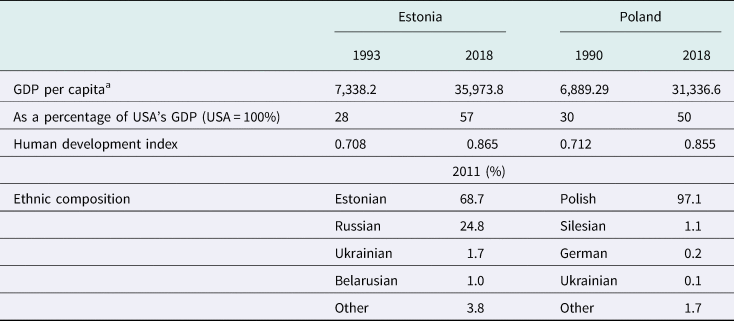
Poland and Estonia stand out as the ‘star performers’ of the post-transformation period (Norkus, Reference Norkus2007), with both countries following a similar economic transition strategy of fast and deep reforms sometimes caricatured as ‘shock therapy’. The radical reforms put in place in the early stages of transition paved the way for the rapid economic and institutional convergence to Western European structures which occurred in the years following the outset of transition (Gillies et al., Reference Gillies, Leimann and Peterson2002; Lehmann, Reference Lehmann2012 – see Table 1).Footnote 6
Summary of economic and development indicators for Poland and Estonia

Sources: FRED, United Nations Development Program, World Development Indicators, Eurostat.
a In current USD (PPP).
Somewhat surprisingly, reforms of legal institutions in the CEE countries have received much less attention, from both scholars and commentators, compared to economic issues (Anderson et al., Reference Anderson, Bernstein and Gray2005; Kolosky Reference Kolosky2014). Although the economic transition strategies of the two countries were incredibly similar and resulted in fairly similar economic performances over a quarter-century, the legal strategies and outcomes pursued by the two countries have diverged substantially. Indeed, the divergent performance of Estonia and Poland in the efficacy of the legal system (with the judicial branch of the government emphasized differently) and, correspondingly, the divergence in the level of the rule of law in each country has been particularity stark and, given the similarities in economic transition, cannot be blamed on different transition strategies. As noted by Hartwell (Reference Hartwell2013), Estonia is the only country from the former Soviet bloc in which the protection of the property rights has increased throughout the post-transformation period, whereas Poland has seen a diminution of property rights in recent years.
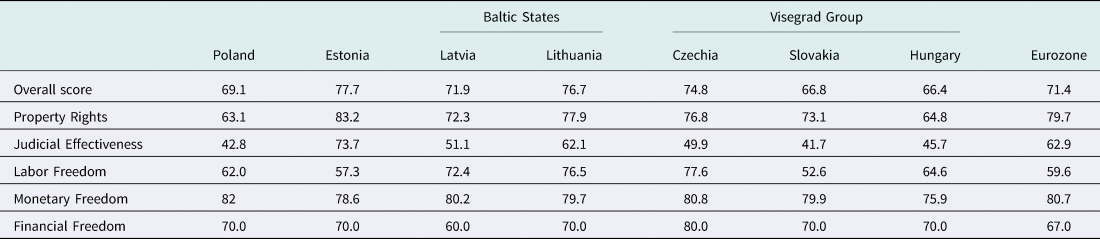
As an example of the differences between Poland and Estonia, Table 2 uses two proxies – the ‘Property Rights’ and ‘Judicial Effectiveness’ sub-indexes of the Heritage Foundation's Index of Economic Freedom – to illustrate a subjective interpretation of the level of rule of law in each country. As can be seen in the table, Estonia boasts an exceptional level of both judicial effectiveness and the protection of property rights as perceived by experts, especially when compared with Poland, the Baltics and even other Eurozone countries. Estonia's judicial effectiveness score of 82.8 is indeed the highest in the Eurozone, 42% higher than the corresponding index for Poland and 26% higher than the average score for Lithuania and Latvia.
Heritage foundation's index of economic freedom 2020 scores

Source: Heritage Foundation (2020).
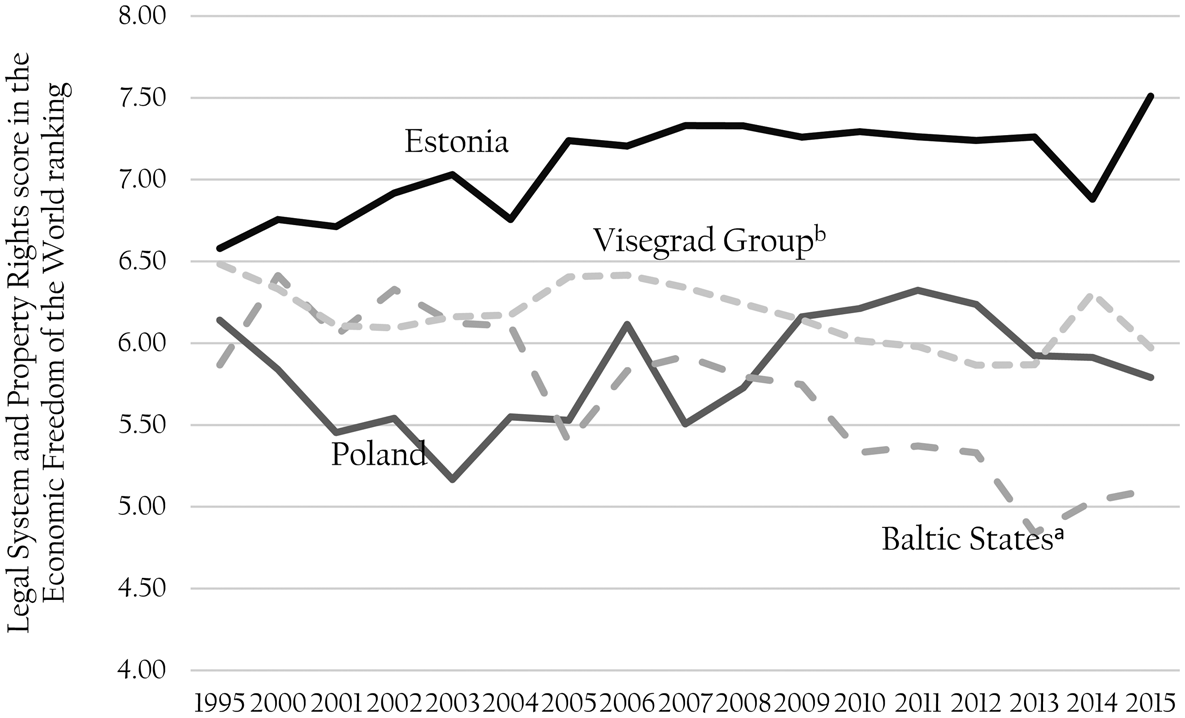
However, as noted above, it is the evolution of such measures rather than a static snapshot which is bound to be more telling in describing the divergence in the level of the rule of law. To this end, Figure 1 illustrates the ‘Legal System and Property Rights’ sub-index of the Fraser's Institute Economic Freedom Ranking for the same countries. Here, Estonia again emerges as a leader of the CEE region. Clearly, one can see an upward trend is the Estonia's performance, with its score in 2015 being roughly one point higher than that in 1995. In both institutional reform and legal policies, Estonia focused mainly on the credibility of their reforms and simplicity and coherence of the law (as an example, the move to a flat income tax), both of these features being mainly motivated by the willingness to establish a favorable business environment (Laar, Reference Laar2007; Padam, Reference Padam and Kiglics2007). Parna (Reference Parna2005: 221) confirms this view, noting that ‘no attempt was made to create a unique private property law system, rather lawmakers set modern rules that reflected European attitudes and were comprehensible to investors’. On the other hand, Poland (as well as other Visegrad Group countries) had a much more volatile performance, with its score being lower in 2015 than in its heyday in the mid-1990s. On the other hand, Poland did score similarly or better than Estonia on other institutional indicators such as labor freedom, monetary freedom, and financial freedom.
Legal system and property rights score in the economic freedom of the world ranking.
Source: Fraser Institute (2017).
aWithout Estonia – that is, the average for Lithuania and Latvia.
bWithout Poland – that is, the average for Czech Republic, Slovakia, and Hungary.

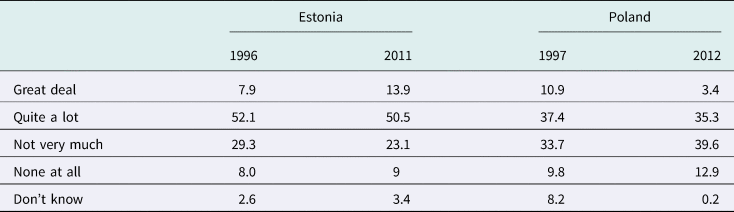
Although these illustrations use the subjective evaluations of experts, as in any market economy it is instructive to ascertain the perceptions of consumers of an institution for a more objective assessment, which in this case is the general public's perception of the effectiveness of judicial institutions. As the data in Table 3 show trust in the judiciary began to diverge significantly between Poland and Estonia already in 1996/7, when 60% of the Estonians and only 48.3% of Poles trusted in the judiciary a ‘great deal’ or ‘quite a lot’.Footnote 7 Crucially, however, the difference grew with time: in 2011/2, these figures stood at 64.4 and 38.7%, respectively. Indeed, in 2012 one in eight surveyed Poles had literally no trust in the judiciary whatsoever. The corresponding results for the employers, a subset of population with a vested interest in an effective and independent judicial system, paint a similar picture: in 1996/7 only 28.7% of Estonian employers did not trust the judiciary (with no answer indicating ‘no’ trust at all), with 57.9% of the Polish employers distrusting the judicial system.Footnote 8
Trust in judiciary for Estonia and Poland (in %)

Source: World Value Survey.
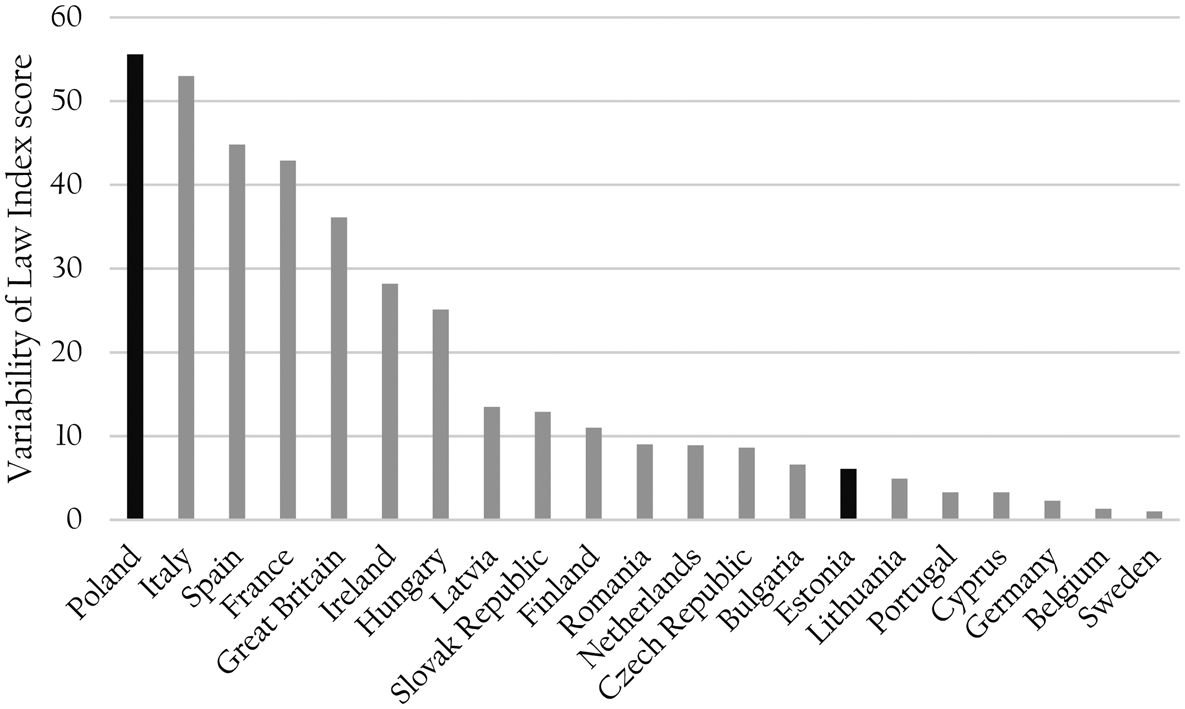
A related characteristic of the democratic regime characterized by the rule of law is the stability and predictability of legislation. The example of the Estonia administrative law reform described below (see Section 4) shows that Estonia has managed to create a remarkably stable legal environment, as evidenced by the Index of Law Variability (Grant Thornton, 2017) (Barometr Prawa shown in Figure 2). This stands in stark contrast to Poland, which, since the early 1990s has been plagued by the law that is ‘produced’ in haste and in an often ad hoc manner – ‘ill-conceived, accidental regulations’, in the words of Jasiewicz (Reference Jasiewicz2000: 115).
Variability of law in selected European countries.
Source: Grant Thornton (2017).
Note: The higher the score, the more variable the law.

4. The effects of different institutional reform strategies – the ‘Why’ of divergence
This divergence between Poland and Estonia is necessarily a product of several different factors, including historical legacy, cultural currents, and transition strategies, each of which may have contributed to the (lack of) development of self-reinforcing institutions. As we show in this section, each of these factors played a different role during the transition in terms of importance, combining to create a resulting political strategy – and, crucially, political institutions – which were then to influence the development of rule of law and its associated institutions.
4.1 The weight of history
As two very different countries, there were vast differences between Poland and Estonia in their historical legal legacies which necessarily conditioned the institutional starting points of their economic and political transformations. Poland, as a former power in Central Europe, boasted an indisputably richer tradition of past legislation, dating back to the early modern times (16th century), developing throughout the subsequent centuries, and culminating as a semi Western-type legal system established during the first years of the Second Commonwealth (1918–1939) (Mańko, Reference Mańko2013).Footnote 9 In contrast, Estonia's legal tradition was necessarily much less pronounced, with only one short period of independence (1919–1940) before being annexed by the Soviet Union. Indeed, as Havrylyshyn (Reference Havrylyshyn2006: 226) notes, ‘Estonia [at the outset of transformation] had little in terms of its own legislative heritage and experience to draw upon’.
These stark differences notwithstanding, it is important to note the influence of the German legal tradition on both countries, an influence which operated through different channels: in the case of Poland, geographical vicinity seemed to have played a key role, as the Magdeburg Law was widely used as a basis for commercial contracting (Hartwell, Reference Hartwell2016). In Estonia, the historical presence of German nobles on its territory resulted in partial cultural (and legal) ‘trickling down’ (Taylor, Reference Taylor2018), perhaps the reason why ‘Estonia's legal reform starting in 1991 drew on the laws of Germany, Austria, the Netherlands and Denmark’ (Havrylyshyn, Reference Havrylyshyn2006: 226). Furthermore, both countries were under Soviet rule (directly in case of Estonia and indirectly in case of Poland) for approximately 45 years, in contrast to virtually all other non-Baltic Soviet republics (who were subjected to Sovietization for much longer), allowing the memory of the past institutional systems to be kept alive in both countries (Hartwell, Reference Hartwell2016; O'Connor, Reference O'Connor2015). This was one of the main reasons why the transitions of Estonia, as well as Latvia and Lithuania, resembled to a great extent the transition of the other CEE countries such as Poland, Czechoslovakia and Hungary, as opposed to other former USSR republics (Raun, Reference Raun2010).
4.2 Legal institutions during the transition period in Poland
This common domination by the Soviet Union meant that both countries also shared, although to very different degrees, the influence of the Soviet legal tradition. However, Poland, despite its presence in the Soviet sphere of influence, maintained separate statehood, allowing some, even if minor, degree of institutional flexibility and independence. In fact, before analyzing the legal institutional dynamics during the transition period in Poland, this fact must be underlined, as Poland entered its transition with a relatively active set of institutions meant to secure ‘horizontal accountability’.Footnote 10 It was indeed specific to the Polish case that one of the preconditions for the successful construction of the Rechtsstaat was, at least to some degree, institutionalized even before the democratic transition started. The establishment of the Supreme Administrative Court in 1980 (which constituted the first step in the direction of bureaucratic accountability) and the Ombudsman in 1987 stand out as prominent legal reforms, along with the creation of a Constitutional Tribunal and the Tribunal of State (operating since 1986 and 1982, respectively, see below and Antoszewski [Reference Antoszewski2005]).
The pre-existence of a relatively developed institutional and legal environment was one of the reasons why the first non-communist Polish Prime Minister, Tadeusz Mazowiecki, after the spectacular victory of the opposition in the partly-free elections in June 1989, stated that his government would lead a ‘legal revolution’ within the framework inherited from the former regime rather than engage in a wholesale scrapping of previous laws (Sabados, Reference Sabados1998). Importantly, this approach eschewed ‘leapfrogging’ (Laar, Reference Laar, Åslund and Djankov2014: 86) in an institutional sense and chose to build on its already-existing structures in both an institutional and (even more importantly) a personal sense.Footnote 11 Consequently, most of the legal reform during Polish transition period (and, at least to some extent, beyond it) that was aimed at laying the groundwork for the emergence of a Western-type Rechtsstaat, consisted of a series of amendments to the existing acts and statues, with the Stalinist 1952 Constitution at the forefront (Brzezinski and Garlicki, Reference Brzezinski and Garlicki1995).Footnote 12 In this sense, Poland worked much more intensely on focusing on self-enforcement of judicial institutions, taking for granted that the self-reinforcing nature of such institutions would come about via the emergence of the Rechtsstaat.
Crucially from the perspective of the rule of the law, judicial independence was formally introduced by 1989 through a series of such amendments to the most fundamental legislative acts in the Polish legal system (including the 1952 Constitution). However, this approach effectively prevented a comprehensive and internally consistent reform of this part of the state apparatus. Indeed, although judicial independence was referenced to explicitly in the Small Constitution (1992) – an interim act that concerned mainly the executive branch of the government – it was only the ‘full’ 1997 Constitution that reorganized the Polish judiciary and reaffirmed the basic principles of the separation of powers and judicial independence, both in the individual and collective sense.Footnote 13
The slow pace of reform (the 1997 Constitution was adopted a full eight years after the transition began) was caused by the variety of factors, the detailed discussion of which is beyond the scope of this study (see Cole [Reference Cole1998] for an excellent summary). However, two main obstacles to crafting a new Constitution should be mentioned: first, the heterogeneity of the post-Solidarity movement hampered the creation of a consistent set of basic constitutional principles, upon which a final statue could have been based.Footnote 14 Second, political turmoil (which brought the successor party to the Communists back into the office in the wake of 1993 elections) and persistent and deep social cleavages (e.g. between Catholics and non-Catholics) further impeded the effective conclusion of the constitution-drafting processes (Osiatynski, Reference Osiatynski1995).
The issue of social cleavages in Poland deserves a deeper examination in this context, as the extant literature notes that countries with higher levels of polarization have less trust, weaker judicial institutions, and weaker rule of law overall (Bjørnskov, Reference Bjørnskov2008; Keefer and Knack, Reference Keefer and Knack2002; Touchton, Reference Touchton2013). Several theoretical frameworks have been used to model the post-war (and, for that matter, post-1989) cleavages in Poland, with Kitschelt (Reference Kitschelt1992) and Lipset and Rokan (Reference Lipset, Rokkan, Lipset and Rokkan1967) featuring most prominently.Footnote 15 Crucially, the main social cleavage that emerged in Poland in the wake of transformation was between the ‘Left’ and the ‘Right’, with both of these terms acquiring specific meaning in the Polish social context (Zarycki, Reference Zarycki2000): the ‘Left’ was associated with a secular and socially liberal set of values and the ‘Right’ with a belief in the fundamental role of the Catholic Church, nation-state, and conservative ideas in shaping national identity and institutions. Furthermore, a self-declaration as being on the ‘Right’ or on the ‘Left’ (and especially in terms of the attitude to religion and the Catholic Church) was a key determinant for the political choices in general and the attitude to post-communists in particular (Sosnowska, Reference Sosnowska1997).Footnote 16, Footnote 17 Consequently, the Left–Right conflict in post-transitional Poland played out predominantly along values (i.e. libertarian versus authoritarian) and cultural/religious axes in Kitschelt's (Reference Kitschelt1992) framework, with the interests axis being to a large extent orthogonal to the other two.Footnote 18
The ideologically-founded Left–Right social cleavage has ‘acquired a very emotional and persistent character’ (Zarycki, Reference Zarycki2000: 860), which has been to a large extent remained dominant in the Polish politics throughout the 21st century, but which also was a key reason for the evolving character of Poland's legislative institutions (Hartwell, Reference Hartwell2016); indeed, the social cleavages in Polish society, along with differing ideas on political power sharing, meant that the institution-building strategy across the board was to ‘to achieve consensus regarding not so much specific regulations (which could not be perfect)… but the general rules of the game, and to accept mutual commitment to play by these rules’ (Jasiewicz, Reference Jasiewicz2000: 108). With a lack of a specific vision on institutional changes underneath these general rules of the game, Polish reformers focused on exclusively on making judicial institutions self-enforcing, with the Roundtable talks of 1989 resulting in the creation of the independent National Council of the Judiciary (pol. Krajowa Rada Sądownictwa – KRS), formally set up via the constitutional amendment in April 1989. Playing the key role in the appointment and representation of the judges, its main duty was to recommend judicial nominations to the President. Crucially, the members of the KRS were to be chosen not only by the judges themselves (Magalhaes, Reference Magalhaes1999), but also by a number of key political institutions, including both chambers of the Polish parliament and the President. It was exactly that division (which guaranteed the presence of the representatives of all three branches of power) that was meant to secure its independence and shield it from the excessive influence of any of the aforementioned political bodies (Bodnar, Reference Bodnar, Kucharczyk and Zbieranek2009).Footnote 19
In addition to the KRS, there were other (institutional and legal) reforms during the initial phase of institutional transition that were aimed at strengthening judicial independence post-1989 and creating self-enforcing judicial bodies. These included limiting the Ministry of Justice's oversight over courts and strengthening the role of judges themselves (through the KRS and otherwise) in the appointment and representation of judges (Brzezinski, Reference Brzezinski1993), a plan which sought to guarantee self-enforcement. All of these reforms allowed Bodnar (Reference Bodnar, Kucharczyk and Zbieranek2009: 34) to conclude that two decades after the 1989 regime change, ‘the analysis of the daily practice of the judiciary shows that it is highly independent’.Footnote 20
Beyond the institutional arrangements, the reality of the post-communist transition was that judicial independence was also inextricably linked to personnel within the judiciary and Polish state institutions in general, and in particular the replacement of communist-era judges with new ones. In Poland, the view prevailed that a wholesale removal of personnel in the judiciary would compromise its independence and that, eventually, the judiciary will ‘purge’ itself (Magalhaes, Reference Magalhaes1999). In one sense this approach was ‘efficient’, in that continuity prevented paralysis in the judiciary and reduced the possibility of public unrest related to judicial institutions. However, once the moment of shock therapy passed, so too did the sense that continuity was the most important factor in legal institutions, but the subsequent attempts to remove personnel from the judiciary, directly (1992) and via institutional means (1993) failed, with the relevant acts eventually being declared unconstitutional by the Constitutional Tribunal (Walicki, Reference Walicki and McAdams1997). In later years, and especially after the post-communist coalition won the 1993 elections, no further direct attempts were made to reform the personnel of the judiciary; the period of ‘extraordinary politics’ (Balcerowicz, Reference Balcerowicz1995: 311) ended and ‘normal’ politics set in.
The view that the judiciary was left virtually untouched by the institutional transformation in Poland in the wake of 1989 transition hence remains strong, both in the public opinion and among some scholars (see e.g. Antoszewski, Reference Antoszewski2005: 96, who noted that judges have been ‘shielding themselves with the newly-established independence’). However, closer examination of this issue shows that some reforms in this area were indeed attempted, even if they were not well-popularized, deliberate, and (most importantly) did not shift public perceptions. Despite the lack of an institutionalized, planned, and highly publicized top-down purge of the judiciary and state agencies, the personnel turnover within the common courts still equaled 10–16% annually in the few years after the transition, as the ‘old guard’ voluntarily went into retirement (Sabados, Reference Sabados1998; Sabbat-Swidlicka, Reference Sabbat-Świdlicka1992). Furthermore, in the wake of the Roundtable talks, half of the Constitutional Tribunal judges were replaced with the Solidarity-nominated ones. Even more radical was the personnel shift in the Supreme Court, where no less than 75% of the judges were replaced (which happened both due to the political decisions and as a consequence of the changing role of this institution) (Sabados, Reference Sabados1998).
Finally, although no formal and public removal of personnel of the judiciary took place, lustration (lustracja) was chosen to be the main tool for ‘dealing with the past’ in Poland and securing at least ‘minimal transitional justice’ (David, Reference David2003: 394).Footnote 21 Unsurprisingly, however, and due to the reasons outlined above (vide legal continuity, unstable political situation, and so on) this process proved ‘lengthy, unregulated and wild’ (David, Reference David2003: 391): although Poland was the first country to overthrow communist rule via formal political means, it was the last to adopt a lustration law, which happened in 1997 alongside the Constitution. However, the law came into force only in 1999 and was watered down in 2002, when post-communist parties regained power. The vast controversies that arose over the issue of lustration also had a significant impact on the public opinion views of the transformation, and have contributed to political instability (lustration issues have directly led to the overthrow of Olszewski's government in 1992) and a general unwillingness to use these provisions on legal institutions.
4.3 Legal institutions during the transition period in Estonia
In contrast, Estonia, which had little autonomy as the Estonian Soviet Socialist Republic, faced the difficulty of not only creating self-enforcing judicial institutions from scratch (Purs, Reference Purs2012), but also the additional hurdle of creating self-reinforcing institutions in an environment which had little recent experience in politics reinforcing the rule of law. Estonian Prime Minister Mart Laar, the first to hold the office in an independent Estonia since 1940 and the leader during the crucial transition time from October 1992 to November 1994, saw this state of affairs as an opportunity rather than a crisis. This can be seen in his repeated explicit affirmation of the primacy of building the Rechtsstaat in a swift manner as a complement to the radical economic reform (Laar, Reference Laar, Åslund and Djankov2014), which stood in contrast to the gradual Polish experience. Indeed, despite sharing a similar socialist legal legacy as Poland, both the transition strategy and outcomes of Estonia's legal transformation were wildly different.
Unlike Poland, in the mind of Estonia's reformers, the re-creation of Estonia's legal system as a distinct and radically different being than its Soviet-imposed one, if meant to be successful, had to be enacted quickly (Laar, Reference Laar2002). In this goal, Estonia had a benefit that Poland did not have in 1989, mainly that the Soviet Union had already ceased to exist (and thus the threat of external intervention was exceedingly lower). But such an advantage had to be counterbalanced by the reality that Estonia was part of this collapsed state, meaning that institutional knowledge was limited. However, this, too, gave a reason for hastening institution-building, leading to prompt actions on fundamentals; Estonia's constitution was drafted within only 6 months after regaining independence and was adopted already in 1992, being the first of all the former Soviet republics to do so (Parna, Reference Parna2005; Purs Reference Purs2012).Footnote 22 The 1992 Constitution drew heavily from its 1938 pre-Soviet predecessor and attempted to almost entirely ignore the Soviet experience (although certain features of its pre-war constitution, including strong presidential power, were amended, see Raun [Reference Raun2010]). Consequently, Estonia, alongside Latvia (and in contrast to virtually all former Soviet republics), chose to adopt a parliamentary model of government (Auers, Reference Auers2015). The 1992 Constitution stressed the importance of individual rights and provided the general principles guiding the functioning of the country (Constitution of Estonia, 1992; Merusk, Reference Merusk2004).
The reform of the legal system in Estonia was undertaken in a rapid manner, but it also focused on deep institutional changes to enable the new independent judiciary to be self-enforcing. Here, a number of factors seem to have played a role, with the aversion to the Soviet past first and foremost. Indeed, Mart Laar (Reference Laar, Åslund and Djankov2014: 76) openly admitted that it was their ‘national sentiment [that] made them focus more on the reform of the state than most other radical reformers’, a reality which translated into building institutions which were absent during the Soviet era (i.e. an independent judiciary).Footnote 23 Crucially, Estonian institution-building and reforms were holistic, as its civil service reform, fundamentally merit-based and ‘one of the most comprehensive (…) in the region’ exemplifies (IMF, 2017: 46; see also Tõnnisson and Randma-Liiv [Reference Tõnnisson, Randma-Liiv, Bouckaert, Nemec, Nakrošis, Hajnal and Tõnnisson2008] and Sarapuu, Reference Sarapuu2012). Apart from bureaucracy, judiciary was stressed as key area to be reformed (Laar, Reference Laar, Åslund and Djankov2014), and a reappointment process was begun in 1992, forcing sitting judges to reapply for their position whereas at the same time new ones were also appointed. This process resulted in smaller numbers of attrition than anticipated (Annus and Tavits [Reference Annus and Tavits2004] note that only 29 judges did not return out of an initial total of 83, a loss of only 34%), but the remaining 54 judges were joined by additional appointees, bringing the number up to 206 by 1996 and comporting with Gallagher's (Reference Gallagher2003) assertion that effectively over 70% of judges were new or replacements. The immediate effect of this process was predictable, as the newly appointed judges were inexperienced, resulting in a general inefficiency of the judicial system (Gallagher, Reference Gallagher2003). However, prompt measures (such as 2-year re-training program conducted by the invited German judges and lawyers) mitigated the problem relatively quickly and increased public confidence in the nascent institution (Abrams and Fish, Reference Abrams and Fish2015). Finally, wage raises and introduction of a generous social benefits package for the judges attracted young law graduates and decreased the extent of corruption by making the judges financially independent (Gherasimov, Reference Gherasimov2015).
Furthermore, it seems important to notice that Estonia's leaders did not believe in the ability of the state to construct and impose the optimal set of legal institutions in a top-down fashion (Merusk, Reference Merusk2004); in Greif's framework, they also incorporated a view of making the judiciary self-reinforcing, as well as self-enforcing. To that end, a ‘significant early investment in the judiciary’ was instrumental, as it constituted a clear signal to the civil society that both judicial capacity and independence were being secured from the beginning of transition (IMF, 2017: 45). This, in turn, to a large extent determined the public approach to the judiciary (that is, an important quasi-parameter) in the early days of the transition; alongside continued reforms aimed at securing judicial independence (e.g. the 2002 Courts Act), it helped to generate the self-reinforcement property of judicial independence in subsequent years.
Another telling example in the attempt to create self-reinforcement relates to the reform of administrative law (post-1994). Merusk (Reference Merusk2004) highlights the fact that Estonia, though historically belonging to the German legal culture, did not blindly copy the solutions from German law (nor naively followed the advice of Western experts), specifically adjusting the solutions to fit into the specificity of Estonia's legal, economic, and societal structure. Furthermore, there was a strong conviction about the necessity of the law to be clear and understandable (‘by everyone who deals with it’) prevailed (Merusk, Reference Merusk2004: 57).
4.4 Charting the results
Although the next section explores the longer-term effects of these differing strategies, an immediate result could be seen from the Polish incremental policy versus the Estonian rapid transition, namely the lingering legal Soviet ‘mentality’ across legal institutions, most prominently displayed in overt formalism in adjudication (Mańko, Reference Mańko2013). Matczak et al. (Reference Matczak, Bencze and Kuhn2010) name two reasons why a formalist approach flourished under communism: first, the impossibility of applying legal acts of higher order in the adjudication process drastically limited the need to refer to the fundamental principles, such as equality or liberty. Second, the literal approach to the law (and treating the law in the narrow sense as a mere ‘set of rules’) allowed the judges to avoid incorporating ‘public values’ into the adjudication process, to some extent shielding them from the accusations of direct support for an authoritarian regime (Matczak et al., Reference Matczak, Bencze and Kuhn2010: 83).Footnote 24
This reliance on formalism has continued post-1989 and indeed remained pervasive: surveying 500 administrative court judgments from the period 1999–2004, Matczak et al. (Reference Matczak, Bencze and Kuhn2010) note that Polish judges used ‘internal values of law’ (the proxy for the formalist approach) 81.5% of the time, with ‘values external to the law’ and ‘constitutional law topics’ referred to only in 10.2 and 7.4% of cases, respectively. As the administrative court is supposed to protect the people (with entrepreneurs to the fore) from the arbitrary and unjust acts of the government and bureaucracy, the lack of a frequent reference to the general principles such as the importance (‘sacredness’) of property rights, as well as the concept of proportionality, is rather telling. More recently, the 2013 Constitutional Court's ruling denying the private status of the Open Pension Funds accounts (and allowing the government to effectively deny part of its former pension obligations) can be seen as the most radical example of the literal application of the law, with no reference to the aforementioned principles and consideration of wider social and political consequences.
By contrast, the Estonian approach may have mitigated somewhat the prevalence of legal hyperpositivism as in Poland. Although we lack comparable hard data from Estonia, it seems justified to say that hyperpositivism, despite being present to some degree, has not gained a firm foothold (Varga [Reference Varga2014] points to the case of the Estonian Supreme Court's approach to preliminary questions addressed to the European Court). In particular, through the reappointment procedure enacted at the outset of the transformation noted above, as well as the vast consultations conducted with top legal scholars and institutions in Europe and the USA (e.g. Georgetown University), seems to have countered the positivist tendencies in the Estonian legal system (Byrne and Schrag, Reference Byrne and Schrag1994; Gallagher, Reference Gallagher2003).
5. Burning the Rechtsstaat: the experience of 2015
The clear divergence in outcomes related to the rule of law in Poland and Estonia can be, we assert, traced back to the transition strategies pursued by the two countries. In particular, one of the most difficult issues to overcome in transition has been expectations: without an expectation that reforms were to be permanent, incentives for institutional change were muted and encouraged participants to take a ‘wait and see’ approach (a reason for institutional hysteresis in the former Soviet Union). With regard to the legal institutional transition in CEE, Estonia's ‘big bang’ altered the incentive structure at once while also altering the mechanisms by which those incentives were intermediated, creating both a self-enforcing institutions but one which was self-reinforced by expectations and the polity; by contrast, Poland's emphasis on incrementalism and continuity meant that its transition was incomplete even 20 years later, lacking a dimension of self-reinforcement, and subsequently it was much easier for public legitimacy to wane substantially.
Indeed, nowhere has the importance of strategy of legal institutional reform been more apparent than in the recent moves in Poland to alter the legal system and its institutions. The political turmoil that Poland has been witnessing from 2015 onward (with varying degrees of intensity) came to many external observers as a surprise. Indeed, Poland, held in high regard for its continuous economic expansion and relatively well-functioning political institutions, was seen as an increasingly stable and mature liberal democracy (Wiatr, Reference Wiatr2018). However, despite virtually all socio-economic indicators improving, the Law and Justice party (Prawo i Sprawiedliwość or PiS) embarked on a determined attempt to change the core institutions supporting the widely supported definition of rule of law (Kelemen, Reference Kelemen2017).
In its earlier turn in power in Poland (from 2005 to 2007), PiS had many of its policy designs thwarted by the Constitutional Tribunal (including striking down a new lustration law, see Uitz [Reference Uitz2007]) and spent a large portion of its time threatening the independence of legal institutions (Markowski, Reference Markowski2008). Much of this tactical maneuvering can be traced to its embrace of the aforementioned religion- and values-based Left–Right cleavage, but with the twist of incorporating the interest axis as well. This politically masterful yet oft-underappreciated move blended the religious, social, and ethical arguments voiced by the ‘Right’ from the 1990s, focusing on the alleged power that the post-communist nomenklatura had even after 25 years from the transformation; key among these power bases was the judiciary.
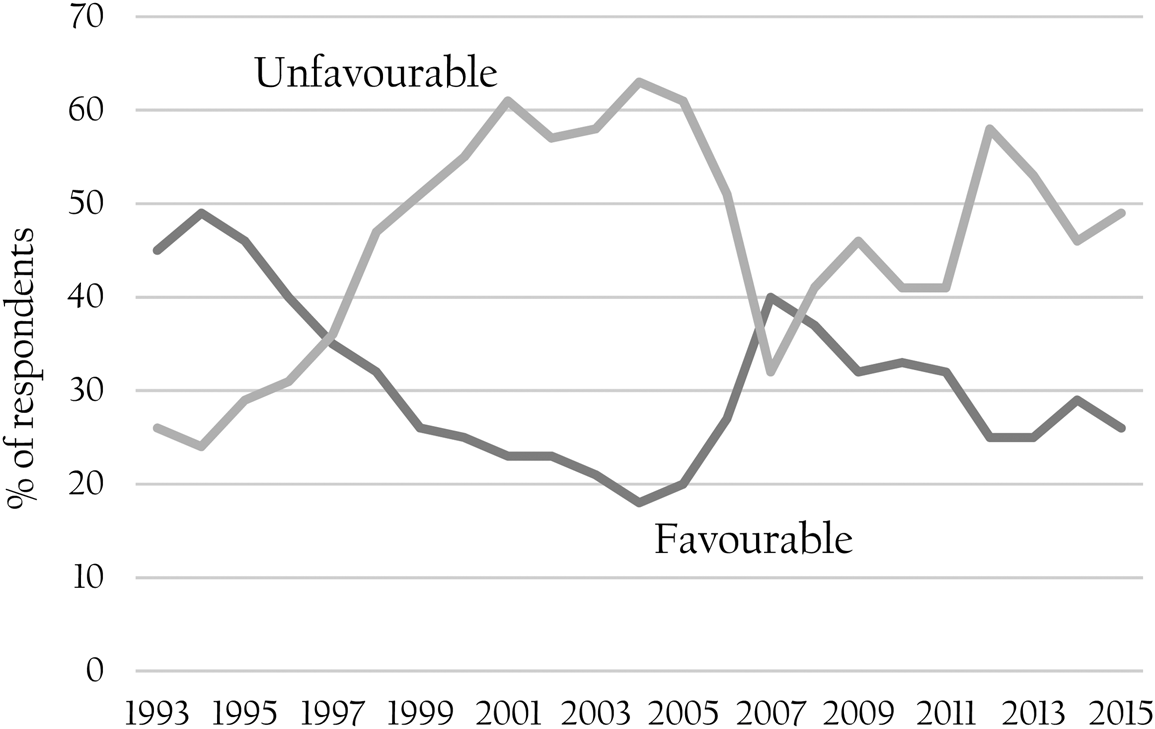
Upon ascending to power in 2015, this disapproval of the functioning of the judiciary immediately resumed, and the PiS majority (together with the support of President Duda) allowed it to effectively paralyze the Constitutional Tribunal and frame the discourse over the judiciary in a negative light (feeding into pre-existing public perceptions of the judiciary, see Figure 3). In the first instance, the government sought to greatly enhance the power of the Minister of Justice over the appointment (and dismissal) of regional court judges, severing their independence from political appointees.
Public opinion and the view of the Polish judiciary.
Source: Center for Public Opinion Research (CBOS 2016).

The institutional dynamics of the Constitutional Court seems especially informative. Despite the indirect threat of bias (as the Tribunal is entirely chosen by the Sejm, giving the majoritarian coalition a possibility to appoint their own candidates), the Tribunal has been widely considered as an independent, self-enforcing body, especially after seeing its power and independence extended by the 1997 Constitution (Kolosky, Reference Kolosky2014). However, the demise of its independence began when Civic Platform, during the last session of the parliament on 8th October 2015, appointed five instead of three judges to the Tribunal (the tenure of the two was elapsing 1 month after the parliament's end of term). Despite the legality of the appointment of the three judges, PiS made a use of its newly acquired parliamentary majority to declare all five judges unconstitutionally appointed and to elect their own candidates to replace them (Rytel-Warzocha, Reference Rytel-Warzocha2017). This started a full-fledged constitutional crisis, which escalated even more when, although the Tribunal declared the three judges appointed by PiS unconstitutional (claiming that their seats were already taken), President Andrzej Duda, despite being bound by law to swore in the judges that were lawfully appointed by the parliament, did so only in the case of the ones elected by PiS, including the three ‘quasi-judges’ (Sadurski, Reference Sadurski2019). Initially, due to the opposition from the then President of the Tribunal Professor Rzepliński, the ‘duplicate judges’ did not take an active part in the work of the court. This situation changed immediately after the (itself legally dubious) appointment of Julia Przyłębska as the President of the Tribunal in December 2016. The sum total of these moves was to create a state of ambiguity regarding the impartiality and legality of the Tribunal itself.
This ambiguity was exacerbated by two processes, outlined in detail by Sadurski (Reference Sadurski2019), which followed: (a) a ‘legislative bombardment’ meant to effectively paralyze the functioning of the Tribunal and hence to shield the constitutionally objectionable (or outright unconstitutional) reforms of PiS from judicial review (the most acute example being the proposed requirement of the Minister of Justice's (Prosecutor General) presence during the Tribunal's proceedings, giving him a de facto veto power in a certain types of cases); and (b) the government's rejection of publishing the Tribunal's judgments (including the aforementioned judgment declaring the election of the two judges in October 2015 unconstitutional). Not surprisingly, the legislative bombardment was nearly entirely abandoned when PiS gained a majority in the Tribunal (whereas the Tribunal's judgments from late 2015 and 2016 remain unpublished as of January 2019). This, however, marked a shift in the Tribunal's role as a check on executive power to act effectively an enabler, as its active role in the effective destruction of the independence of the National Council of Judiciary testifies (Sadurski, Reference Sadurski2019). The second offense, the refusing to publish judgments, has continued to this day; most egregiously, this action contravenes the direct requirement of the Article 190(2) of the Polish Constitution, which states that the government should publish judgments ‘immediately’ with no discretion or ambiguity whatsoever.
The Constitutional Tribunal was only the first of several legal institutions which have been the target of the government reforms, with others ‘captured by the PiS sinecural entrepreneurs and loyal apparatchiks, a phenomenon coupled with selective, yet widespread nepotism and corruption’ (Markowski, Reference Markowski2019: 10). The scale of damage to the rule of law inflicted by the PiS’ ‘legal blitzkrieg’ (Bugaric and Ginsburg, Reference Bugarič and Ginsburg2016: 74) is staggering given its slight majority (51%) in the lower chamber of the parliament, the Sejm. Indeed, as Markowski (Reference Markowski2019) demonstrates, these changes, with the determination to change Poland's legal institution in toto, have not been motivated by widespread public demand for such actions. However, if PiS’ policies have been on the one hand widely supported by only a small fraction of the general populace whereas simultaneously being aimed at comprehensively changing (if not paralyzing) the core of the Polish legal system, a follow-on question arises, namely: how did the government manage to sustain such reforms so rapidly and face only relatively muted popular protests? Furthermore, why have countries such as Estonia not witnessed similar processes, and, quite to the contrary, have strengthened their protection of the rule of law with time (especially, as Bugaric and Ginsburg (Reference Bugarič and Ginsburg2016) claim, when legal institutions are ‘weak and underdeveloped, as they are in CEE countries, there is always the potential danger of a drift toward “illiberal democracy”, and even authoritarianism’)?
As far as the first question is concerned, there are several (distinct, yet intertwined) explanations. What the majority of them have in common, however, is that they point to the evolution of informal institutions as the process that, although to a limited extent, popularly legitimized the attack on the judiciary (or at least dampened the resistance to these reforms). As Bucholc (Reference Bucholc2019) remarked, the demise of the Constitutional Tribunal in Poland happened due to its lack of ability to ‘defend itself as an institution (…) it failed, because the only valid defense it could mobilize was the constitution itself’. Nevertheless, this explanation merely shifts the fundamental question one level up, with the question now becoming: why was the constitution itself the only defender of the Constitutional Tribunal in Poland? Bucholc (Reference Bucholc2019: 2) does not leave this question unanswered, however, claiming that the ‘answers must be sought in culture, and more specifically in the interplay between norms, institutions and cultural resources, in particular the resources of collective memory’. In her study, she demonstrates that most of the debate surrounding the changes imposed on the judiciary (including the mentioned curbing of the judges' independence) has been framed into the rhetoric of ‘restorative justice, abolishing the legacy of post-communism supposedly embodied by the Tribunal’. Furthermore, Bucholc (Reference Bucholc2019: 13) points to the weak popular awareness of the role of the Constitutional Tribunal, as well as the fact that ‘constitutional provisions and norms failed to anchor themselves in any project of collective identity’ since the transformation of early 1990s (Hałas, Reference Hałas2005). Finally, and in apparent contrast to what has been described above, Bucholc (Reference Bucholc2019) highlights the fact that Poland did not have any ‘modern indigenous rule of law tradition (…) as an alternative’ to copying the German Rechtsstaat model, which hampered the popular identification with the legal system installed.
Furthermore, Markowski (Reference Markowski2019) stresses the importance of the mode of transition from authoritarianism to a liberal democracy, claiming that:
The classical assumption that the ‘pacted’ transitions are more likely to be conducive to successful consolidation of democracy might overlook however that the lack of a clear ‘critical juncture’ that separates the ancient regime from the new one causes confusion among the population as to the rules of the new game, creates a mood of temporariness, rules flexibility and consequently instrumentalization of politics that easily translates into volatility of institutions and disrespect for constitutional norms.
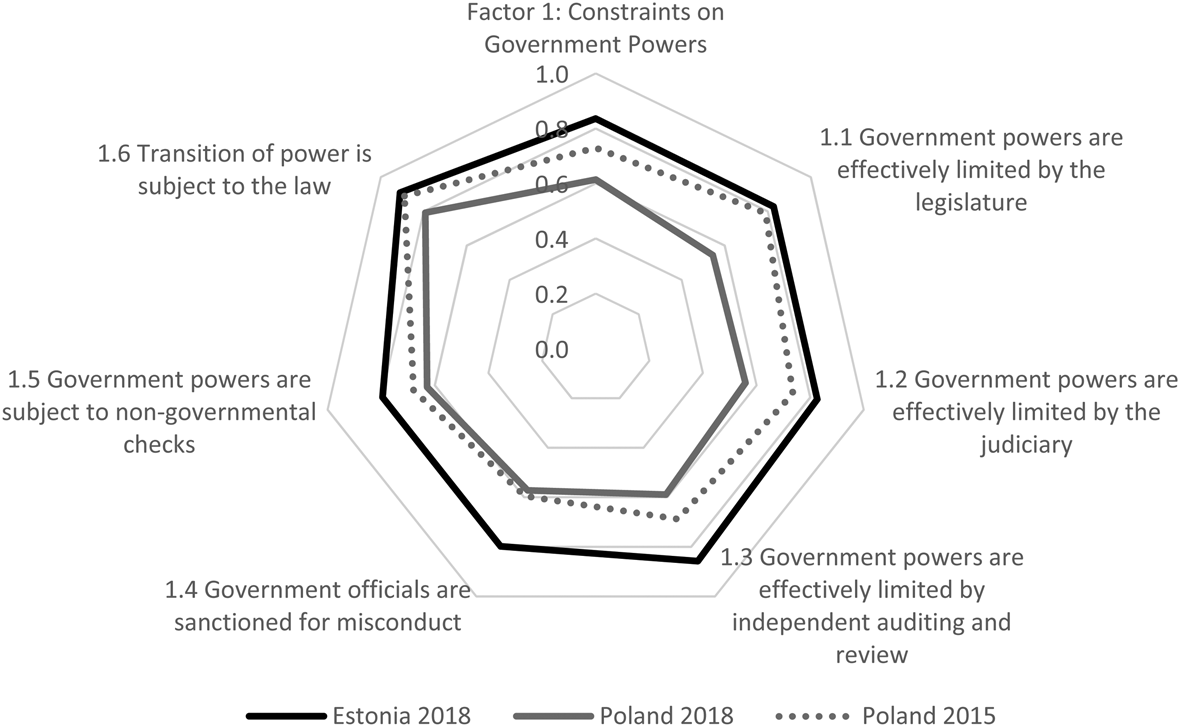
All of these accounts, at least to some extent, support our thesis that the Polish continuous mode of transformation, which granted ‘safe passage’ to many existing legal institutions (with the important exception of the Supreme Court), coupled with deficiencies in other supporting institutions (such as a perception of corruption persisting at the highest levels),Footnote 25 made Polish legal institutions perceived as less trustworthy by a sizable portion of the population, especially in the run up to 2015 elections. The subsequent improvement in the judicial accountability and effectiveness, however, proved insufficient to boost the moderate levels of popular association with the core legal institutions or notions, such as the rule of law, to generate robust resistance to the post-2015 ‘reforms’. On the other hand, the aggressive rhetoric of the PiS directed at the judiciary, coupled with the radicalization of their electorate and their lack of ‘moral approval’ (Tworzecki, Reference Tworzecki2018: 114) of the post-1989 stance of the Polish judiciary, paved the way for the Polish post-2015 ‘authoritarian backsliding’ (Kelemen and Orenstein, Reference Kelemen and Orenstein2016). Quite paradoxically, it was the relatively high level of judicial independence left in place at the end of communism which prevented deep-seated reforms of the judiciary under capitalism in the early 1990s. In particular, the reliance on hyperpositivism and lack of defense of broader values of executive constraint via judicial institutions paved the way for legal institutions themselves to be subverted (in line with Basabe-Serrano's [Reference Basabe-Serrano2012] examination of court changes in El Salvador). The rapid dismantling of the Polish Rechtsstaat and the gradual erosion of both independence and effectiveness of the judicial branch of Polish government is supported by the data, as Figure 4 shows the chosen indices and sub-indices of the World Justice Project's Rule of Law Index (see Appendix A for a full comparison of these scores).
The rule of law index scores for factor 1: constraints on government powers.

By contrast, and despite a wave of similar ‘reforms’ of legal institutions across the region (Bugarič and Ginsburg, Reference Bugarič and Ginsburg2016), Estonia appears to have been impervious. Indeed, recent indicators point to Estonia's unparalleled success in establishing a truly mature political system with the most trustworthy and efficient judiciary in the EU (World Justice Project, 2018). As we have argued throughout, this should be ascribed to the radical personnel and institutional changes in the judicial branch of government that had been carried out at the onset of the transition. The latter constituted a ‘critical juncture’, as it prevented the mental legacy of Soviet legal system to creep into the Estonian law and legal practice.
The early moves taken by Estonia had a much more important effect, however, which led to an inoculation of sorts against political maneuvering which could threaten the rule of law. Of course, and as noted earlier, there is a huge measure of endogeneity as regards the functioning of institutions, and legal institutions can influence democratic processes as much as democratic processes can influence legal institutions. Although in Poland the causality appeared to run from democratic processes to legal institutions, in Estonia the political process created incentives for strengthening the rule of law, showing the bidirectionality of influence. In particular, the strategy pursued by Estonia created a virtuous cycle of a fair and effective legal system, leading to the increased trust and popular association with it (as well as attracting foreign capital); by promoting legal institutions associated with the rule of law and which had broad popular support, there was a huge incentive for governing and challenging parties to strengthen, rather than weaken, the level of the rule of law in Estonia.Footnote 26
Indeed, as of 2018, Estonia ranks first out of 18 Eastern European Economics in the Democracy Index compiled by the Economist Intelligence Unit (2019), with an overall score of 7.97 (this figure stands at 6.67 for Poland, which comes only seventh). It boasts the highest regional scores in the ‘Electoral process and pluralism’ and especially ‘Functioning of government’ sub-indices, in the latter category beating the runner-up, the Czech Republic, by a substantial margin (8.21 to 6.79, with Poland scoring a mere 6.07). This success points to the unidirectionality and consistency of the economic and political reforms that effectively started in 1992 and have never been, even partly, reversed, despite a number of changes of incumbent parties (Laar, Reference Laar, Åslund and Djankov2014). Indeed, it was the consistency between the reforms across the economic and political spaces, through the number of channels we discussed above, that laid the foundation for the Estonian virtuous cycle of sound policies, liberal popular beliefs (although challenged recently by the inclusion of a populist party in government), and ever-stronger rule of law.
6. Conclusions
This paper has examined the link between legal institutions and development of respect for the rule of law, focusing on two specific high-performing transition countries and using an approach which accepted that ‘the sensitivity of [institutional] outcomes to specifications and the indeterminacy of equilibrium indicate the importance of integrating historical and comparative studies in pursuing empirical institutional analysis’ (Greif, Reference Greif1998: 80).
The divergent paths of Estonia and Poland, detailed extensively in Section 4, can be attributed to different long-term institutional legacies but also clearly to the different policy approaches taken in the transition specifically relating to the legal transition (which, themselves, may have been informed by cultural and historical legacies). Although Poland eschewed rapid change in its judiciary in favor of continuity with institutions incrementally assembled under (and, in the minds of at least one political party, associated with) its communist past, the relatively blanker slate that Estonia faced allowed for ‘leapfrogging’ older institutional arrangements in favor of building a legal system from the bottom-up. More importantly, the Estonian experience shows a continued strengthening of the rule of law after the transition period, where (using Greif's [Reference Greif2006] terminology), the institution of the rule of law has proven to be self-reinforcing. This occurred through a variety of mechanisms, notably the public's views on the judiciary and the willingness of politicians to maintain a favorable business climate; in reality, rule of law also gradually affected the quasi-parameters connected with the institution such as public opinion which, in turn, strengthened the institution itself.
In Poland, on the other hand, the rule of law has proven much more fragile and ironically has harkened back to the Soviet past which PiS so vigorously denounces. However, its demise was by no means linear: although there were clear signs of a lack of deep trust in the judiciary, the outright attack on the basic principles of the Rechtsstaat seemed unimaginable even a few years ago. Quite paradoxically, this non-linearity can also be captured by Greif's (Reference Greif2006) framework, in that the institution of the rule of law in Poland was self-enforcing, but it was not immune to shocks to the quasi-parameters (i.e. the formal political process) surrounding the institution. Indeed, in the Polish case, the ongoing dismantling of the Rechtsstaat has had a significant formal dimension, but this is only half of the story: these formal institutional moves would not be possible had informal mechanisms (such as public opinion) voiced its disapproval strongly enough. In understanding why was it so comparatively easy for PiS to steamroller legal institutions it is important to remember that, even meta-rules such as the Polish Constitution (the ultimate quasi-parameter that determines the evolution of the stance of the rule of law) have been undermined by changes in statutes which have shifted the overall legislative framework in the anti-Rechtsstaat direction; as Sadurski and Steinbeis (Reference Sadurski and Steinbeis2016) noted, ‘A de-facto change to the constitution without following the amendment procedure but through sub-constitutional laws is what I call a constitutional coup d'etat. The principle of supremacy of the constitution is that you cannot change the constitution by simple statutes. The Constitution [should] controls statutes, not the other way around’. Extreme polarization among political parties, breaking the elite consensus of 1989 – broadly based on the liberal democratic and market-friendly values (Baylis, Reference Baylis2012) – has only assisted this process.
The extensions to this research are many and varied and include, first and foremost, an econometric test of our thesis across all transition countries, to see if the Poland- and Estonia-specific traits we mention here are generalizable. Using various subjective and objective indicators to measure the functioning of legal institutions versus actual levels of rule of law (as shown in Section 4), we could attempt to observe the strength of the relationship between policy choice and subsequent performance in defense of the rule of law. Alternatively, the case study approach employed here can be deployed for other transition economies to understand what other institutional imperatives were necessary for the protection of rule of law. We do not purport to be the last word on this topic; instead, we hope to be the first word, opening up a potentially fruitful line of examination which cuts across economics, law, and political science.
Acknowledgements
The authors wish to thank the Editors, four anonymous referees, Georg Vanberg, Timur Kuran, Gerhard Schnyder, Ringa Raudla, and participants at the ‘Rule of Law in the 2030 Sustainable Development Agenda’ Conference organized by Loyola University Chicago, Rome, in January 2019 and the WINIR 2019 Conference in Lund, Sweden. This paper was started when Mateusz Urban was at Duke University in the Political Science Department.
Appendix A – World Justice Project Scores, Estonia versus Poland