Introduction
One of the main challenges of community ecology is to elucidate factors and mechanisms affecting variation in community structure; this knowledge is essential for applied problems relating to biodiversity conservation and future prediction of community structure in response to climate change (Mittelbach and McGill Reference Mittelbach and McGill2019). Recent progress in the studies of community assembly rules has highlighted the importance of macroecological processes even at the local level (Leibold et al. Reference Leibold, Holyoak, Mouquet, Amarasekare, Chase, Hoopes, Holt, Shurin, Law, Tilman, Loreau and Gonzalez2004; Ovaskainen et al. Reference Ovaskainen, Tikhonov, Norberg, Blanchet, Duan, Dunson, Roslin and Abrego2017; Ravelo et al. Reference Ravelo, Bluhm, Foster and Iken2020; Ricklefs Reference Ricklefs1987; Vellend Reference Vellend2010; Weigel et al. Reference Weigel, Kotamäki, Malve, Vuorio and Ovaskainen2023). A series of studies has suggested that interpreting local community organization requires consideration of biogeographic processes and the phylogenetic variation of component species. Global-scale distributional trends (i.e., biogeographic affinity) have been incorporated to understand community assemblies that reflect historical (geological and phylogenetic) limitations (Carrillo-Briceño et al. Reference Carrillo-Briceño, Carrillo, Aguilera and Sanchez-Villagra2018; Ravelo et al. Reference Ravelo, Bluhm, Foster and Iken2020; Wiens and Donoghue Reference Wiens and Donoghue2004). In terrestrial communities, examples have come from altitudinal zonation in montane ecosystems (Cadena et al. Reference Cadena, Kozak, Gómez, Parra, McCain, Bowie, Carnaval, Moritz, Rahbek, Roberts, Sanders, Schneider, VanDerWal, Zamudio and Graham2011; Jiménez-Alfaro et al. Reference Jiménez-Alfaro, Marcenó, Bueno, Gavilán and Obeso2014). In marine communities, however, the influences of biogeographic affinities of component species on local community structure have been poorly studied.
Gammaridean amphipods are small-bodied crustaceans and are principal components of macrobenthic communities as important primary consumers and decomposers (Bellan-Santini Reference Bellan-Santini and von Vaupel Klein2015; Conlan Reference Conlan1994). Among various types of animals in marine ecosystems, they are considered good bioindicators of coastal benthic environments because of their low dispersal ability and high sensitivity to various types of environmental stress (Conlan Reference Conlan1994; de-la-Ossa-Carretero et al. Reference de-la-Ossa-Carretero, Del-Pilar-Ruso, Giménez-Casalduero and Sánchez-Lizaso2012; Thomas Reference Thomas1993). Although the biogeography of amphipods has been studied at the global scale (Marques and Bellan-Santini Reference Marques and Bellan-Santini1990; Barnard and Karaman Reference Barnard and Karaman1991a; Arfianti and Costello Reference Arfianti and Costello2020, Reference Arfianti and Costello2021; Lörz et al. Reference Lörz, Kaiser, Oldeland, Stolter, Kürzel and Brix2021; Paz-Ríos et al. Reference Paz-Ríos, Pech, Carrera-Parra and Simões2021), information is still limited on their distribution and ecology in many marine environments worldwide. In Japan, more information on benthic amphipods is available from coastal southern Japan (Hirayama Reference Hirayama1983; Nagata Reference Nagata1965a, Reference Nagata1965b, Reference Nagata1966) and the freshwater environment (Tomikawa and Morino Reference Tomikawa and Morino2012) than from coastal northern Japan (Ishimaru Reference Ishimaru1984). Although some studies have reported on amphipod species’ occurrence in northern Japan (e.g., Ariyama et al. Reference Ariyama, Kodama and Tomikawa2020; Hirayama Reference Hirayama1986; Nagata Reference Nagata1961; Stephensen Reference Stephensen1932), information on their community structure is limited to one case study in unvegetated subtidal soft bottom of <10 m in two bays on Hokkaido Island (Takamaru and Ochiai Reference Takamaru and Ochiai1982).
The marine environment off eastern Hokkaido is unique relative to other locations in Japan because it is under the strong influence of the cold-water Oyashio Current (Isada et al. Reference Isada, Hattori-Saito, Saito, Kondo, Nishioka, Kuma, Hattori, McKay and Suzuki2019; Yasuda Reference Yasuda2003). In Akkeshi Bay, located in the middle part of the Pacific coast of eastern Hokkaido, boreal organisms are a major component of the marine fauna (Uchida et al. Reference Uchida, Yamada, Iwata, Oguro and Nagao1963). A series of studies have provided information on the community ecology of seagrass beds shallower than 5 m in Akkeshi Bay and Akkeshi-ko Estuary (Momota and Nakaoka Reference Momota and Nakaoka2017; Yamada et al. Reference Yamada, Hori, Tanaka, Hasegawa and Nakaoka2007); however, the amphipod community is largely unknown in deeper subtidal areas (5–35 m depth), which comprise a large part of Akkeshi Bay.
The aims of the present study are (1) to describe the species composition of amphipods in subtidal bottoms of Akkeshi Bay, and (2) to examine spatial variation in their community structure in relation to variation in the local environment and the biogeographic affinities of the component species, focusing explicitly on the linkage between macro- and local-scale ecological processes. To achieve these goals, we collected amphipods in different positions of Akkeshi Bay with different bottom types and depth and compared the similarity of these locations’ community composition. We then identified the biogeographic affinities of the identified species, comparing their global occurrence records to existing ecoregions, and tested whether species with different biogeographic affinities have different habitat occurrences or depth distributions in this local community.
Materials and methods
Study sites
Akkeshi Bay has an area of ∼102 km2, with a maximum depth of ∼25 m, and opens to the Pacific Ocean (Figure 1). At the innermost part, a narrow channel ∼500 m wide, connects to the brackish Akkeshi-ko Estuary (of ∼32 km2 area). Seagrass beds consisting of Zostera spp. cover soft-bottom areas shallower than 5 m (Watanabe et al. Reference Watanabe, Nakaoka and Mukai2005), but the deeper part of the bay are mostly unvegetated sandy and muddy bottoms (Akkeshi Fisheries Cooperative 1990a). Rocky bottoms occur continuously along the coastline and patchily in the middle part of the bay and are covered with macroalgae and the surfgrass Phyllospadix iwatensis (Kanamori et al. Reference Kanamori, Goshima and Mukai2004). Akkeshi-ko Estuary is mostly shallower than 2 m and covered with dense eelgrass beds, but it is deeper than 5 m around the channel; there, the bottom is primarily covered with gravel, with other areas consisting of sandy and muddy sediments (Figure 1, Akkeshi Fisheries Cooperative 1990a, 1990b). The estuary is characterized by fluctuating salinity (<20 to >30: Isada et al. Reference Isada, Abe, Kasai and Nakaoka2021).
Study sites in Akkeshi Bay and Akkeshi-ko Estuary, eastern Hokkaido, Japan Data on the sea-bottom type were derived from the Akkeshi Fisheries Cooperative (1990a, 1990b), and information on seagrass/seaweed beds from the Biodiversity Center Of Japan (2021) (https://www.Biodic.Go.Jp/moba).

Sample collection
Nine sampling sites were established in Akkeshi Bay and Akkeshi-ko Estuary (Figure 1). Two sites (AL2 and AL3) were located on the gravel bottom near the channel that connects the bay to the estuary. Six sites (AB2, AB7, AB12, AB13, AB17, AB19) were in soft-bottom areas of the bay. Based on the bottom map by Akkeshi Fisheries Cooperative (1990a), AB2 and AB12, AB13 and AB19 located on mud bottom, whereas AB7 and AB17 on sand bottom. Finally, one site (NK) was set in a rocky-bottom area of the bay. Animal collection was conducted in April 2020 for the AB sites, in June 2020 for NK, and in September 2020 for the AL sites. At the AL and AB sites, organisms were captured using epibenthic sledge and dredge nets designed to collect epibenthic animals, suprabenthos and near-surface infauna. We used a fine-mesh Hirota’s sledge (40 cm height, 60 cm width, 500 μm mesh, Hirota et al. Reference Hirota, Tominaga, Kamiharako, Kodama, Sadakata, Tanaka, Furuta, Kojima and Koshiishi1989; Yamada et al. Reference Yamada, Hori, Tanaka, Hasegawa and Nakaoka2007) in the shallow sites (AL2, AL3, AB2, AB7) because it is useful for the bottom with abundant algae litter, and a wide-mesh strong frame rectangular dredge with wire and a winch (31.5 cm height, 60 cm width, 1.6 mm mesh, similar to ‘Simple dredge’, Catalog number 5121, Rigo Co., Ltd.) in the deep sites (AB12, AB13, AB17, AB19) due to rough trawling conditions in deeper waters. At NK, we used a tough scallop dredge (35 cm height, 125 cm width, 5.0 cm mesh) with a steel frame and claws to trawl on rough, rocky bottom. The net trawling was conducted along a distance of ∼100 m, at a speed not exceeding 1 knot. Organisms larger than 1 mm were collected by sieving, with samples brought to the laboratory alive and then preserved frozen at −20℃. Because of the large number of organisms collected by trawling, subsamples of one-third or one-fourth of the total samples were chosen randomly for each site, defrosted, and identified morphologically to the lowest taxon possible using a binocular microscope.
Sediment conditions were investigated because the criteria used for the previous map on bottom sediments (Akkeshi Fisheries Cooperative 1990a) were unknown. Sediment sampling was conducted using a Smith–McIntyre grab sampler at the AB sites in May 2020. Sediments from the surface to 4 cm deep were extracted from the grab using a 3 cm diameter syringe and preserve frozen at −20℃. Each sediment sample was defrosted and well-stirred in the laboratory and the grain-size composition was examined by wet sieving (Robertson et al. Reference Robertson, Thomas, Caddy and Lewis1984; HCl treatment was skipped to retain any crushed shells as a component of the sediment). The sediment grain-size distribution on the φ scale was measured following the method of Holme and McIntyre (Reference Holme and McIntyre1984) by calculating the median (Mdφ), quartile deviation (Qdφ), and quartile skewness (Skqφ). Mdφ is the median of grain sizes, Qdφ indicates the dispersion of the grain-size distribution, and Skqφ describes its asymmetry.
Taxa identification and determination of biogeographic affinities
The present study targeted marine benthic amphipods of the suborders Amphilochidea and Senticaudata (Lowry and Myers Reference Lowry and Myers2013, Reference Lowry and Myers2017) to focus on the taxa historically comprised suborder Gammaridea. Therefore, the family Caprellidae of suborder Senticaudata was not included in this study. Taxonomic identification relied on the following: Gurjanova (Reference Gurjanova1938, Reference Gurjanova1951, Reference Gurjanova1972), Shoemaker (Reference Shoemaker1955), Mills (Reference Mills1960), Nagata (Reference Nagata1960, Reference Nagata1965b), Margulis (Reference Margulis1963), Dickinson et al. (Reference Dickinson, Wigley, Brodeur and Brown-Leger1980), Just (Reference Just1980), Hirayama (Reference Hirayama1983, Reference Hirayama1986), Dunbar (Reference Dunbar1984), Ishimaru (Reference Ishimaru1985), Tzvetkova and Kudrjaschov (Reference Tzvetkova and Kudrjaschov1985), Coyle and Highsmith (Reference Coyle and Highsmith1989), Jo (Reference Jo1990), Barnard and Karaman (Reference Barnard and Karaman1991a, Reference Barnard and Karaman1991b), Kim et al. (Reference Kim, Kim and Kim1992), Hirayama and Takeuchi (Reference Hirayama and Takeuchi1993), Bousfield and Hendrycks (Reference Bousfield and Hendrycks1994), Bousfield and Kendall (Reference Bousfield and Kendall1994), Bousfield and Chevrier (Reference Bousfield and Chevrier1996), Jarrett and Bousfield (Reference Jarrett and Bousfield1996), Krapp-Schickel and Jarrett (Reference Krapp-Schickel and Jarrett2000), Hendrycks and Bousfield (Reference Hendrycks and Bousfield2001), Ishimaru and Nunomura (Reference Ishimaru and Nunomura2001), Jansen (Reference Jansen2002), Bousfield and Marcoux (Reference Bousfield and Marcoux2004), Hendrycks and Bousfield (Reference Hendrycks and Bousfield2004), Chapman (Reference Chapman and Carlton2007), Krapp-Schickel (Reference Krapp-Schickel2008), Kim and Lee (Reference Kim and Lee2009), Sonoda et al. (Reference Sonoda, Chiba, Goshima, Yamazaki, Nunomura, Komai, Tomikawa, Ito and Nobetsu2009), Ren (Reference Ren2012), Lörz and Coleman (Reference Lörz, Coleman and Gordon2013), Labay (Reference Labay2016), Peart and Ahyong (Reference Peart and Ahyong2016), Fuchs et al. (Reference Fuchs, Coleman and Lörz2019), and Ariyama et al. (Reference Ariyama, Kodama and Tomikawa2020), Ariyama (Reference Ariyama2021). Identified taxa were confirmed as valid according to the latest taxonomic classification, based on the World Register of Marine Species (WoRMS, https://www.marinespecies.org/, accessed on 15 March 2025).
For the 16 taxa that could be identified to species level (including ‘cf.’ species), biogeographic affinity was estimated based on the occurrence records of each species and their correspondence to ‘provinces’ defined in Marine Ecoregions of the World (MEOW) (Spalding et al. Reference Spalding, Fox, Allen, Davidson, Ferdaña, Finlayson, Halpern, Jorge, Lombana, Lourie, Martin, McManus, Molnar, Recchia and Robertson2007). Distributional information was obtained from the Ocean Biodiversity Information System (OBIS, https://obis.org), the Global Biodiversity Information Facility (GBIF, https://www.gbif.org), and the above-mentioned literature (see Tables S1–S3). Duplicate removal, visualization and matching of the occurrence data and MEOW provinces were conducted using QGIS 3.24.1.
Statistical analyses
All statistical analyses were conducted and visualized using R version 4.0.3 (R Core Team, 2020) and specifically packages ‘beeswarm’ (Eklund and Trimble Reference Eklund and Trimble2021), ‘dendextend’ (Galili Reference Galili2015), ‘ggplot2’ (Wickham Reference Wickham2016), ‘SSP’ (Guerra-Castro et al. Reference Guerra-Castro, Cajas, Simões, Cruz-Motta and Mascaró2020), and ‘vegan’ (Oksanen et al. Reference Oksanen, Simpson, Blanchet, Kindt, Legendre, Minchin, O’Hara, Solymos, Stevens, Szoecs, Wagner, Barbour, Bedward, Bolker, Borcard, Carvalho, Chirico, De Caceres, Durand, Evangelista, FitzJohn, Friendly, Furneaux, Hannigan, Hill, Lahti, McGlinn, Ouellette, Cunha, Smith, Stier, Ter Braak and Weedon2022). Diversity indices, including Shannon’s diversity (H″) and Pielou’s evenness (J′), were calculated based on the relative abundance of amphipods. To examine community structure in the three different habitats, Jaccard dissimilarity matrices were calculated based on presence/absence data in order to avoid biases that can occur due to different sampling efficiency of multiple gear types, and then visualized by hierarchical clustering of unweighted pair group method with arithmetic mean (UPGMA). The superfamily Photoidea (except for Cerapus sp.) and family Corophiidae were excluded from the analyses because they could not be identified to either genus or species level.
The relationships between environmental variables and community structure were analysed using distance-based redundancy analysis (dbRDA), which performs multiple linear regression on principal coordinates derived from a dissimilarity matrix (Legendre and Anderson Reference Legendre and Anderson1999). We conducted dbRDA for the presence/absence data matrix of amphipods and the environmental data, namely depth and the sediment parameters obtained for the AB sites. The environmental data were checked for their multicollinearity based on the variance inflation factor; thereafter, depth, Mdφ, and Skqφ were used for the analysis. The sufficiency of the sample size to conduct dbRDA was assessed by calculating the ‘pseudo multivariate dissimilarity-based standard error’ (MultSE, Anderson and Santana-Garcon Reference Anderson and Santana-Garcon2015; Guerra-Castro et al. Reference Guerra-Castro, Cajas, Simões, Cruz-Motta and Mascaró2020; see Figure S1). Many of the species occurred at only one site, which could affect statistical conclusions (Chao et al. Reference Chao, Colwell, Lin and Gotelli2009; Lim et al. Reference Lim, Balke and Meier2012). To address this issue, we first conducted the above-mentioned analysis with the two datasets: one including all the species, and the other excluding each species occurring at just one site. The results were essentially the same in terms of classification of subgroupings and significance of the relationship between the amphipod community and the environmental variables, and therefore we present the results using the dataset with all species.
The summarized trends of the biogeographic affinities of the component species were estimated by UPGMA clustering based on the Jaccard dissimilarity of occurrences in MEOW provinces. Variation in habitat-specific occurrence patterns between species of different biogeographic affinities were tested by Fisher’s exact test, and variation in depth distribution by the Kolmogorov–Smirnov test.
Results
Environmental conditions
The depth of the sites ranged from 5.6 to 31.4 m (Table 1). For the AB sites, sediment composition was consistent with the previous report (Akkeshi Fisheries Cooperative 1990a), with <3.3 and ≥3.8 of Mdφ values obtained in this study for ‘sandy’ and ‘muddy’ sediment conditions, respectively. Mdφ ranged from 2.8 to 4.4 (Table 1). A particularly coarse Mdφ value of 2.8 was obtained for AB17. Fine but relatively coarse sands, which included minerals and crushed shells, dominated at sites AB7 and AB17. Qdφ was ≤1.1 for all AB sites. Values of Skqφ were near zero (between −0.1 and 0.1) for all sites.
Depth and sediment grain-size composition at the nine sampling sites in Akkeshi Bay, eastern Hokkaido, Japan

Sediment grain-size distribution on the φ scale was calculated according to the median (Mdφ), quartile deviation (Qdφ), and quartile skewness (Skqφ).
Community structure
In total, 40 species of amphipods from 21 families were collected and identified (Table 2). Cluster analysis showed that the amphipod communities could be divided into three groups: two AL sites, site NK, and six AB sites (Figure 2). Although the two estuarine sites (AL2 and AL3) formed a cluster, they had high dissimilarity (0.67). All soft-bottom sites could be subdivided into three subgroups: one subcluster consisted of the two shallowest sites (AB2 and AB7), the other subcluster consisted of two southwestern sites (AB13 and AB17), and the third subcluster consisted of two southeastern sites (AB12 and AB19). Shannon’s H′ and Pielou’s J′ determined from low abundance data (Table S4) were lower in the shallow marine sites (NK, AB2 and AB7) than other sites (Table 3).
Dendrogram showing the results of hierarchical clustering of the nine sites sampled in Akkeshi Bay, northeastern Japan, based on the presence/absence data of benthic amphipods, indicating the local community structures. UPGMA clustering with Jaccard dissimilarity was used for the dendrogram. The original occurrence data are given in Table 2.

List of amphipod taxa collected at nine sites in Akkeshi Bay, eastern Hokkaido, Japan

Sampling was conducted in April 2020 (AB sites), June 2020 (site NK), and September 2020 (AL sites).
(*) An asterisk denotes a superfamily instead of a family.
Diversity indices at the nine sites in Akkeshi Bay, eastern Hokkaido, Japan

Raw data on the numbers of collected individuals are shown in Table S4.
Relationship between environmental variables and soft-bottom community structure
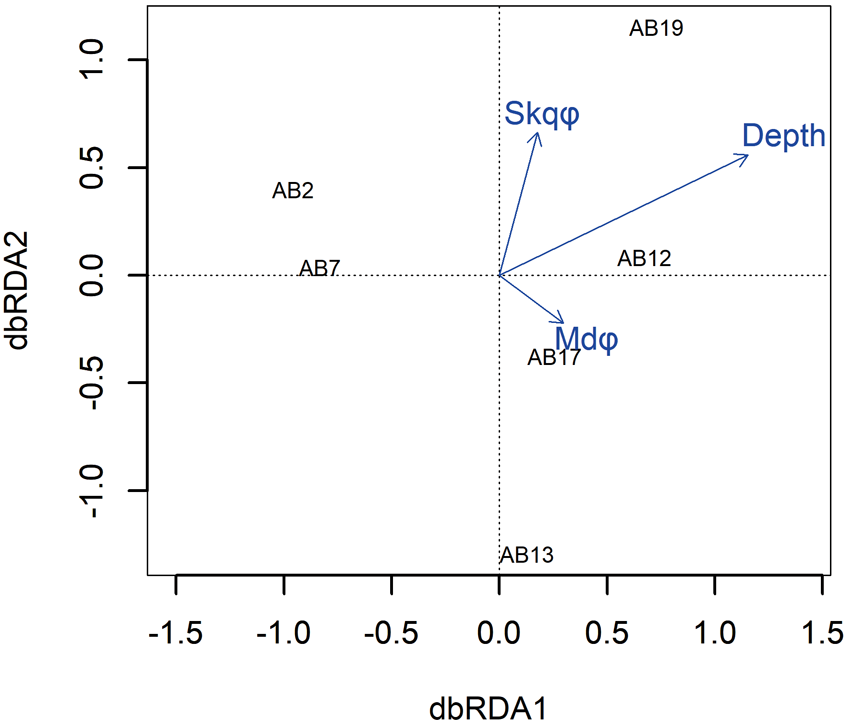
The dbRDA showed that depth and sediment variables explained 65.2% of the variation between the soft-bottom communities, although the relationships were not significant (p = 0.27, Figure 3). AB sites were ordered along the depth axis similar to the clustering results of UPGMA, with the lowest p-value among the parameters (p = 0.09, Table 4). Axes of the sediment parameters showed different directions from the depth axis, but were less related to the observed variation.
Results of distance-based redundancy analysis (dbRDA) showing similarity in the soft-bottom amphipod communities in relation to the variations in depth and sediment parameters. The dbRDA axes represent the primary and secondary gradients in community dissimilarity that are explained by regression against the environmental variables. Study sites are positioned based on their fitted values from this regression. Arrows indicate the correlations of environmental variables with the axes. The length of each arrow reflects the strength of correlation.

The results of distance-based redundancy analysis (dbRDA) for presence/absence data of benthic amphipods and the environmental variables depth and the calculated sediment grain-size distribution (φ) median (Mdφ) and quartile skewness (Skqφ)

Biogeographic affinities and relationship to community structures
A dataset consisting of 2289 global occurrence records with coordinates was also compiled (Tables S1–S3). Reported distributions of 16 of the identified species ranged from Arctic to temperate regions (Table 5, Figure 4). Eight species (Ampelisca erythrorhabdota, Atylus collingi, Pacifoculodes crassirostris, Pleusymtes glabroides, Rostroculodes schneideri, Syrrhoe crenulata, Tiron spiniferus, and Westwoodilla megalops) occurred in the Arctic and in several neighbouring provinces: Cold Temperate Northeast Pacific, Cold Temperate Northwest Pacific, Cold Temperate Northwest Atlantic, and Northern European Sea. Additionally, S. crenulata occurred in the Continental High Antarctic province. Seven species (Abludomelita rotundactyla, Eochelidium lenorostralum, Kamptopleustes kamui, Maera denticoxa, Neopleustes carinatus, Pleustes (Catapleustes) japonensis, and Synchelidium trioostegitum) occurred only in provinces of the Northwestern Pacific: Cold Temperate Northwest Pacific and Warm Temperate Northwest Pacific. Among them, two species (E. lenorostralum and S. trioostegitum) were from warm-temperate provinces: Warm Temperate Northwest Pacific and Warm Temperate Northeast Pacific. Ampithoe lacertosa occurred in all climates, from the Arctic to warm-temperate provinces, and thus it was excluded from the following analyses.
Global occurrence records of the benthic amphipod species found in Akkeshi Bay, northeastern Japan. The classification of the amphipod species shows the summarized biogeographic affinities of the species by different coloration, based on the clustering analysis (see Figure 5). Blue indicates ‘Arctic & surroundings’ affinity, and red indicates ‘Northwestern Pacific’ affinity. Polygons show the provinces of the Marine Ecoregions of the World (MEOW).

Global occurrences of 16 benthic amphipod species collected in Akkeshi Bay that could be identified to species level, by provinces of the Marine Ecoregions of the World (MEOW)

Arc, Arctic; CTNeP, Cold Temperate Northeast Pacific; CTNwP, Cold Temperate Northwest Pacific; CTNA, Cold Temperate Northwest Atlantic; NES, Northern European Sea; CHA, Continental High Antarctic; WTNeP, Warm Temperate Northeast Pacific; WTNwP, Warm Temperate Northwest Pacific. An ‘x’ indicates occurrence records in OBIS, GBIF or the literature; ‘+’ indicates occurrence records obtained in this study.
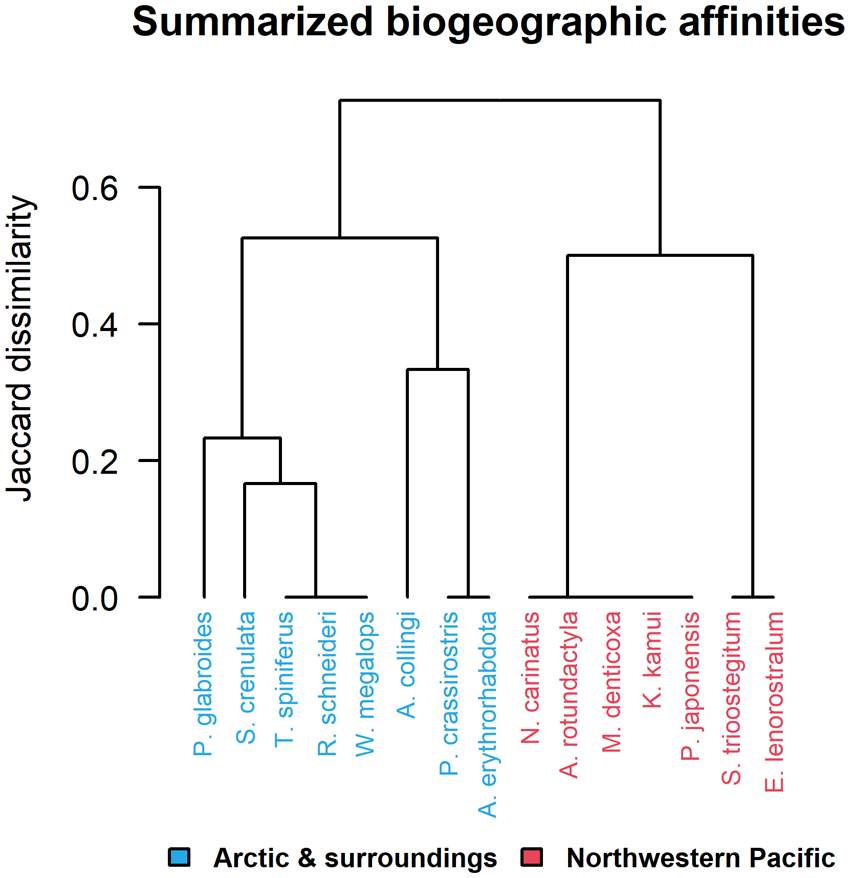
Distributions in MEOW categorized by UPGMA revealed two clusters: (1) in the Arctic and its neighbouring areas, and (2) only in Northwestern Pacific provinces. Therefore, we defined the groups as ‘Arctic and surroundings’ and ‘Northwestern Pacific’, respectively (Table 5, Figures 4 and 5).
Dendrogram showing the results of hierarchical clustering of benthic amphipod species based on their global occurrence records with the provinces of the Marine Ecoregions of the World (MEOW), indicating the summarized biogeographic affinities of the amphipod species found in Akkeshi Bay. UPGMA clustering with Jaccard dissimilarity was used for the dendrogram with the original data for each species given in Table 5.

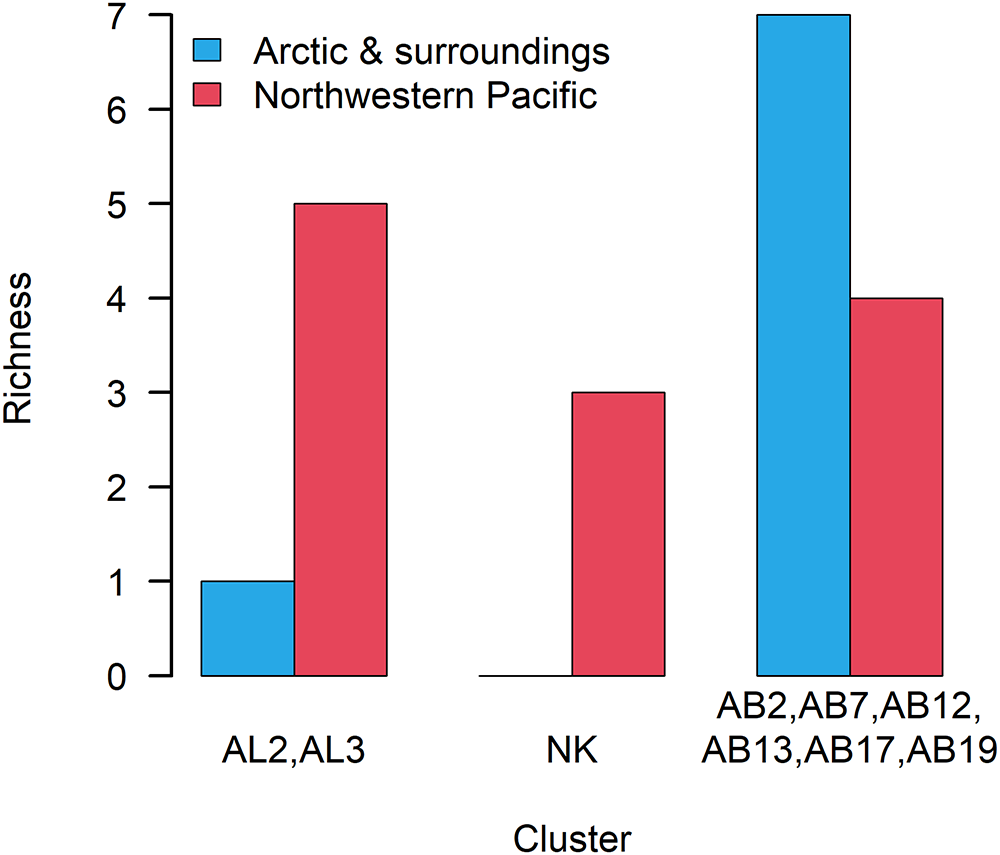
The biogeographic affinities showed a marginally significant relationship to the clusters of the local community structure (Fisher’s exact test, p = 0.083, Figure 6). Arctic and surroundings species occurred more often in AB sites than in the AL and NK sites, while Northwest Pacific species occurred evenly in the three habitat types. The biogeographic affinities were significantly related to the depth in the Akkeshi Bay sites (Kolmogorov–Smirnov test: D = 0.52, p = 0.0076, Figure 7). Arctic and surroundings species more often occurred at the deeper sites, while Northwestern Pacific species were observed mainly in the shallower sites.
Variation among habitat types in the occurrence of the two groups of benthic amphipod species according to their biogeographic affinities. Species richness of two affinity groups are shown across three site clusters corresponding to habitat types: AL2 and AL3 (gravelly estuarine substrate), NK (marine hard-bottom substrate), and the remaining AB sites (marine soft-bottom substrate).

Box plot showing depth-related variation in the occurrence of the two groups of benthic amphipod species according to their biogeographic affinities. Circles denote occurrence; crosses show the average depth of each species.

Discussion
Community structure
Amphipod communities in the subtidal bottoms of Akkeshi Bay were classified into three groups by different habitat types: gravelly estuarine (the AL sites), hard-bottom marine (site NK), and soft-bottom marine (the AB sites). The AL sites are near the Bekanbeushi River mouth and are affected by fluctuating salinities of <20 to >30 (Isada et al. Reference Isada, Abe, Kasai and Nakaoka2021). However, we did not find any freshwater species at those sites, such as members of the family Anisogammaridae, family Kamakidae or genus Awacaris (Tomikawa and Morino Reference Tomikawa and Morino2012; Tomikawa et al., Reference Tomikawa, Kyono, Kuribayashi and Nakano2017), and thus the observed community in that area is considered to be specific to an estuarine environment. In comparison to previous studies that reported amphipod communities from seagrass beds near the AL sites (i.e., Momota and Nakaoka Reference Momota and Nakaoka2017; Yamada et al. Reference Yamada, Hori, Tanaka, Hasegawa and Nakaoka2007), members of the families Ampithoidae, Aoridae, Pontogeneiidae and Stenothoidae occurred both in the seagrass beds and in the unvegetated AL sites, suggesting the association of the AL community to seagrass meadow communities. In addition to the seagrass bed species, we observed M. denticoxa and A. rotundactyla, which have been reported from gravel-bottom sites (Ariyama et al. Reference Ariyama, Kodama and Tomikawa2020; Labay Reference Labay2016), and the Najnidae, which is known to inhabit kelp beds (Chapman Reference Chapman and Carlton2007). Dead oyster shells and the large kelp Saccharina japonica were collected in the sledge net tows at the AL sites, which may provide the habitat for those additional species. It is likely that the habitat complexity is responsible for the high species richness of amphipods at site AL2.
The AB community comprised the Ampeliscidae, Oedicerotidae, and Protomedeiinae, which are commonly observed in soft-bottom habitat (Barnard and Karaman Reference Barnard and Karaman1991a; Barnard and Karaman Reference Barnard and Karaman1991b; Oliver and Slattery Reference Oliver and Slattery1985). In the AB community, predatory amphipods that generally prey on meiofauna and zooplankton were observed, namely five species of the Oedicerotidae and two species of the Synopiidae (Macdonald et al. Reference Macdonald, Burd, Macdonald and van Roodselaar2010). Shannon’s H′ and Pielou’s J′ were among the lowest in AB2 and AB7 (Table 3), where two species of Oedicerotidae (E. lenorostralum and P. cf. crassirostris) dominated the community (Table S4). This suggests a relatively simple community structure, linked to the availability of abundant faunal food resources (e.g., harpacticoid copepods, Guerra-García et al. Reference Guerra-García, Tierno de Figueroa, Navarro-Barranco, Ros, Sánchez-Moyano and Moreira2014; Yu et al. Reference Yu, Soh and Suh2002, Reference Yu, Suh and Shirayama2003) specifically in the shallow area of marine soft-bottom habitats. Additionally, some species occurred that were presumably plant litter-associated feeders, such as A. collingi (Gurjanova Reference Gurjanova1951) and cf. Allorchestes sp. (Macdonald et al. Reference Macdonald, Burd, Macdonald and van Roodselaar2010). Based on the habitat type of these component species, the AB community is considered to be associated with a soft-bottom marine environment where plant litter is provided from seagrass and macroalgal beds in coastal and rocky areas.
The NK community shared some species with the AL community, including M. denticoxa and A. rotundactyla, which occur on gravel-bottom sites (see above), but it lacked other species in the AL community that inhabit soft-bottom sites or seagrass beds. The diversity indices of the NK community were low due to higher dominance of Maeridae, Melitidae, and Photoidea compared to soft-bottom habitat (Tables 2, 3, and S4). These characteristics suggest that the dissimilarity between AL/NK and AB is attributable to the presence of coarse, hard-bottom substrate. This finding is consistent with previous studies that have similarly reported differences in amphipod community structure between hard- and soft-bottom habitats (Biernbaum Reference Biernbaum1979; Carvalho et al. Reference Carvalho, Cunha, Pereira, Pousão-Ferreira, Santos and Gaspar2012; Thomas Reference Thomas1993).
Identified species and biogeographic relationships
Compared with previous studies in Hokkaido, the present study found that community composition in Akkeshi Bay was different from the western region of the island, but similar to other eastern regions. Sakurai et al. (Reference Sakurai, Yamashita and Nakao2000, Reference Sakurai, Hayashi and Kuwahara2001) and Yamashita et al. (Reference Yamashita, Suganuma, Miyashita, Yoshida and Sakurai2000) investigated macrobenthic assemblages in coastal soft bottoms of western Hokkaido using grab samplers and reported that the major amphipod families comprised the Urothoidae, Phoxocephalidae and Ampeliscidae – a finding that differs from the present study. Takamaru and Ochiai (Reference Takamaru and Ochiai1982) reported on amphipod communities in subtidal soft bottoms of bays adjacent to Akkeshi Bay, in eastern Hokkaido, using grab sampler. The species they identified differed from those in our study, but the families were similar, namely the Ampeliscidae, Atylidae, Corophiidae, Haustoriidae, Ischyroceridae (i.e., Siphonoecetes tanabensis, formerly reported as a corophiid species), Lysianassidae, Oedicerotidae, Photidae, and Phoxocephalidae. Therefore, coastal amphipod communities differ greatly between western and eastern Hokkaido. A possible explanation is the difference in the dominant water mass that affects marine fauna (Kai Reference Kai, Kai, Motomura and Matsuura2022; Matsui Reference Matsui, Kai, Motomura and Matsuura2022; Ravelo et al. Reference Ravelo, Bluhm, Foster and Iken2020), as warm currents predominate off western Hokkaido in contrast to cold currents off eastern Hokkaido (Kai Reference Kai, Kai, Motomura and Matsuura2022; Matsui Reference Matsui, Kai, Motomura and Matsuura2022; Uchida et al. Reference Uchida, Yamada, Iwata, Oguro and Nagao1963).
In addition, grab samplers and sledge nets will yield different species (Gage Reference Gage1975; Matsumiya et al. Reference Matsumiya, Koguchi and Sudo1986). Variations in sampling methods among studies might have led to the differences in recorded community compositions, potentially resulting in underestimation of families such as Ampeliscidae, Phoxocephalidae, and Urothoidae (Matsumiya et al. Reference Matsumiya, Koguchi and Sudo1986; Sakurai et al. Reference Sakurai, Hayashi and Kuwahara2001, Reference Sakurai, Yamashita and Nakao2000; Yamashita et al. Reference Yamashita, Suganuma, Miyashita, Yoshida and Sakurai2000). Future studies should use both trawling nets and grab samplers to better detail the differences in community structure among different regions of Hokkaido.
The distributional regions of the identified species categorized them as Arctic and surroundings and Northwest Pacific species based on MEOW provinces (Spalding et al. Reference Spalding, Fox, Allen, Davidson, Ferdaña, Finlayson, Halpern, Jorge, Lombana, Lourie, Martin, McManus, Molnar, Recchia and Robertson2007). Overall, only three species are warm-temperate, and most species occurred either in the Arctic and boreal regions, or else only in the boreal region, suggesting that the benthic amphipod community in Akkeshi Bay generally has a boreal attribution, as noted for other taxa (Uchida et al. Reference Uchida, Yamada, Iwata, Oguro and Nagao1963). Our findings agree with Nishimura’s (1992) marine biogeographic classification, whereby the coastal area of eastern Hokkaido can be classified as ‘Subarctic’, defined by the presence of many Arctic and Subarctic species, but also some temperate species.
Community–biogeography–environment relationships
Depth explained the largest portion of the variation in community structure for the AB community (Table 5, Figure 3). Many studies have reported changes along a depth gradient for benthic macrofauna, attributable to various factors such as hydrodynamics (Dolbeth et al. Reference Dolbeth, Ferreira, Teixeira, Marques, Dias and Pardal2007; Martins et al. Reference Martins, Quintino and Rodrigues2013), temperature (Grebmeier et al. Reference Grebmeier, Feder and McRoy1989; Ravelo et al. Reference Ravelo, Bluhm, Foster and Iken2020), geological history (Ravelo et al. Reference Ravelo, Bluhm, Foster and Iken2020), and food resources (Piepenburg Reference Piepenburg2005; Dolbeth et al. Reference Dolbeth, Teixeira, Marques and Pardal2009). A notable finding of this study is that the depth-related change in community composition is associated with the biogeographic affinities of the component species. Arctic/Subarctic species tended to occur at deeper sites than the temperate species (Table 4, Figure 7). Water temperatures are higher in shallower areas of Akkeshi Bay, decrease toward the centre, and become colder but are relatively stable around the bay mouth (Isada et al. Reference Isada, Abe, Kasai and Nakaoka2021). Temperature is known to influence community structure at the macroscale (Belanger et al. Reference Belanger, Jablonski, Roy, Berke, Krug and Valentine2012; Clarke Reference Clarke2003), and water mass distribution can play a key role in determining the benthic communities (Ravelo et al. Reference Ravelo, Bluhm, Foster and Iken2020). The observed pattern of biogeographic affinity may be related to the temperature regime in our study area, where deeper sites may be more suitable for species from the colder biogeographic regions (Kai Reference Kai, Kai, Motomura and Matsuura2022; Matsui Reference Matsui, Kai, Motomura and Matsuura2022; Ravelo et al. Reference Ravelo, Bluhm, Foster and Iken2020; Uchida et al. Reference Uchida, Yamada, Iwata, Oguro and Nagao1963). However, we cannot rule out the possibility of a relationship between biogeography and habitat type because we did not collect any amphipod samples from estuarine or hard-bottom environments at depths greater than 10 m.
The present study showed that the sediment profile did not correlate with the community composition of the soft-bottom amphipod community in Akkeshi Bay. Conditions of the sediment were generally muddy and differed only marginally among sites with soft-bottom habitat, without drastic changes in the community composition. Site AB17, in which coarser Mdφ and Skqφ were recorded when compared with other AB sites, did not have any of the species recorded at the AL sites, which had more gravel in the substrate. Parallorchestes sp. and Ampithoe sp., which generally inhabit macroalgal beds or deposited litters, occurred only at site AB17 (Macdonald et al. Reference Macdonald, Burd, Macdonald and van Roodselaar2010) and therefore showed no affinity to habitat with coarse sediment.
Conclusions
We recorded 40 species belonging to 21 families of benthic amphipods in the subtidal community in Akkeshi Bay, northeastern Japan. Biogeographic affinity to the boreal region was suggested for most species based on a database survey of amphipod species distributions. The composition differed among estuarine, marine hard-bottom, and marine soft-bottom habitats, with depth explaining most of the variation in soft-bottom sites. Both community structure and the species-specific depth distribution were associated with the biogeographic affinity of amphipod species, as species of the cold-water origins tended to occur at deeper sites in the soft bottom. These results highlight the importance of incorporating macroecological and evolutionary processes to interpret local-scale community structures. Further studies across boundary zones of climatic bioregions are necessary to assess the generality of the findings in this study.
In addition to offering insight into community assembly rules, this study provides a baseline for conservation of marine biodiversity and sustainable use of marine ecosystems (SDG 14) in an era of rapid ecosystem change with ongoing climate changes. Understanding biogeographic affinities of component species will help predict future changes in community composition with temperature rises and other changes in marine environments. In our study sites, increases in temperate species and decreases in cold-water species are likely with predicted temperature increases along the coast of Hokkaido (Sudo et al. Reference Sudo, Watanabe, Yotsukura and Nakaoka2020). The predicted changes in amphipod community can therefore potentially be used as an indicator of marine ecosystem changes given that this taxon has been widely used as indicators of marine environments elsewhere (Bellan-Santini Reference Bellan-Santini and von Vaupel Klein2015; Conlan Reference Conlan1994; Thomas Reference Thomas1993).
Supplementary material
The supplementary material for this article can be found at https://doi.org/10.1017/S0025315425100544.
Acknowledgements
We thank Captain S. Hamano and H. Katsuragawa deeply for their important assistance with the field survey. We especially thank Dr H. Araki and K. Nishitani for the opportunity to conduct fieldwork with them in the Akkeshi-ko Estuary. Intern students S. Kawano, A. Mukai, T. Osanai, R. Ishida, K. Negoro, H. Kato, M. Watanabe, A. Yushima, Y. Kawahara, T. Kado, H. Hagiwara and K. Tsugane helped with fieldwork and laboratory work. We are grateful to all members of the Akkeshi Marine Station for their support. C. Kulongowski with Edanz (https://jp.edanz.com/ac) and Dr E.M.P. Madin edited the language of a draft of this manuscript.
Author contributions
Tomonori Sekioka: Conceptualization, Investigation, Methodology, Writing original draft, Reviewing & editing; Kazushi Miyashita: Conceptualization, Methodology, Supervision; Masahiro Nakaoka: Conceptualization, Methodology, Writing original draft, Reviewing & editing, Supervision.
Funding
This study was supported by the funds from the Japan Society for the Promotion of Science (KAKENHI 21K19854) and the Japan Science and Technology Agency (JPMJFS2101 and JPMJSP2119). The funder had no role in the study design, data collection and analysis, decision to publish, or preparation of the manuscript.
Competing interests
The authors declare that they have no competing interests.