Introduction
The early Miocene was a major epoch in the faunal transition in Caribbean coral species and their capacity for reef-building (Budd et al., Reference Budd, Stemann and Johnson1994; Edinger and Risk, Reference Edinger and Risk1994; Budd, Reference Budd2000; Johnson et al., Reference Johnson, Sánchez-Villagra and Aguilera2009), in which a loss of coral species diversity of 40% is estimated (Johnson et al., Reference Johnson, Jackson and Budd2008). The transition from prominent and diverse Oligocene reefs to depauperate and poorly developed middle Miocene reefs has been loosely tied to a combination of tectonic events (Hoorn et al., Reference Hoorn, Guerrero, Sarmiento and Lorente1995; Iturralde-Vinent and McPhee, Reference Iturralde-Vinent and MacPhee1999; Iturralde-Vinent, Reference Iturralde-Vinent2006), changes in ocean circulation due to the closing or narrowing of gateways (e.g., the emergence of the Isthmus of Panama and Drake passage) (von der Heydt and Dijkstra, Reference von der Heydt and Dijkstra2005, Reference von der Heydt and Dijkstra2006; Newkirk and Martin, Reference Newkirk and Martin2009), variations in sea level (Iturralde-Vinent, Reference Iturralde-Vinent2006) and temperature (Mutti et al., Reference Mutti, Droxler and Cunningham2005), increased regional productivity (Hoorn et al., Reference Hoorn, Guerrero, Sarmiento and Lorente1995; Mutti et al., Reference Mutti, Droxler and Cunningham2005; von der Heydt and Dijkstra, Reference von der Heydt and Dijkstra2005, Reference von der Heydt and Dijkstra2006), and enhanced upwelling events (Edinger and Risk, Reference Edinger and Risk1994). Understanding the relative importance of these factors requires a better understanding of coral species distribution through time and across the Caribbean region.
This paper represents a second contribution to the first comprehensive taxonomical work on fossil coral reefs in the continental formations in Colombia. We provide descriptions and classifications according to recent revisions to order Scleractinia (Fukami et al., Reference Fukami, Budd, Paulay, Solé-Cava, Chen, Iwao and Knowlton2004; Budd and Stolarski, Reference Budd and Stolarski2009, Reference Budd and Stolarski2011), as well as updates to the age and nomenclature of the Caribbean coral-bearing formations. The first part of this research included the descriptions of 18 morphospecies of the families Acroporidae, Agathiphylliide, Astrocoeniidae, Caryophylliidae, Diploastraeidae, Merulinidae, and Monstastraeidae (Flórez et al., Reference Flórez, Zaptata-Ramírez and Klaus2018). Here, 14 morphospecies of the families Mussidae, Pocilloporidae, Poritidae, Siderastreidae, and Milleporidae are described and illustrated in detail. We integrate the findings of both studies to summarize paleoenvironmental interpretations of the Siamaná and Jimol formations and assess reef-building capacity in the early Miocene of the southern Caribbean.
Geological setting
The Cenozoic formations of the Cocinetas Basin show fossiliferous horizons from diverse paleoenvironments (Hendy et al., Reference Hendy, Jones, Moreno, Zapata and Jaramillo2015; Moreno et al., Reference Moreno, Hendy, Quiroz, Hoyos, Jones, Zapata, Zapata, Ballen, Cadena, Cárdenas, Carrillo-Briceño, Carrillo, Delgado-Sierra, Escobar, Martínez, Martínez, Montes, Moreno, Pérez, Sánchez, Suárez, Vallejo-Pareja and Jaramillo2015; Carrillo-Briceño et al., Reference Carrillo-Briceño, Argyriou, Zapata, Kindlimann and Jaramillo2016; Silva-Tamayo et al., Reference Silva-Tamayo, Lara, Nana Yobo, Erdal, Sanchez and Zapata-Ramírez2017). The Siamaná Formation is a diachronic unit with shallow marine carbonates ranging from the late Oligocene to late early Miocene (Silva-Tamayo et al., Reference Silva-Tamayo, Lara, Nana Yobo, Erdal, Sanchez and Zapata-Ramírez2017). It is unconformably overlain by deep marine siliciclastic sediments of the Uitpa Formation, Aquitanian–Burdigalian in age (Silva-Tamayo et al., Reference Silva-Tamayo, Lara, Nana Yobo, Erdal, Sanchez and Zapata-Ramírez2017, p. 228, fig. 12). The Uitpa Formation is in turn overlain the by the Jimol Formation, with shallow marine mixed carbonate and siliciclastic deposits dating to the Burdigalian (Moreno et al., Reference Moreno, Hendy, Quiroz, Hoyos, Jones, Zapata, Zapata, Ballen, Cadena, Cárdenas, Carrillo-Briceño, Carrillo, Delgado-Sierra, Escobar, Martínez, Martínez, Montes, Moreno, Pérez, Sánchez, Suárez, Vallejo-Pareja and Jaramillo2015; Silva-Tamayo et al., Reference Silva-Tamayo, Lara, Nana Yobo, Erdal, Sanchez and Zapata-Ramírez2017). An extended description of the geological setting is provided in Flórez et al. (Reference Flórez, Zaptata-Ramírez and Klaus2018).
Materials and methods
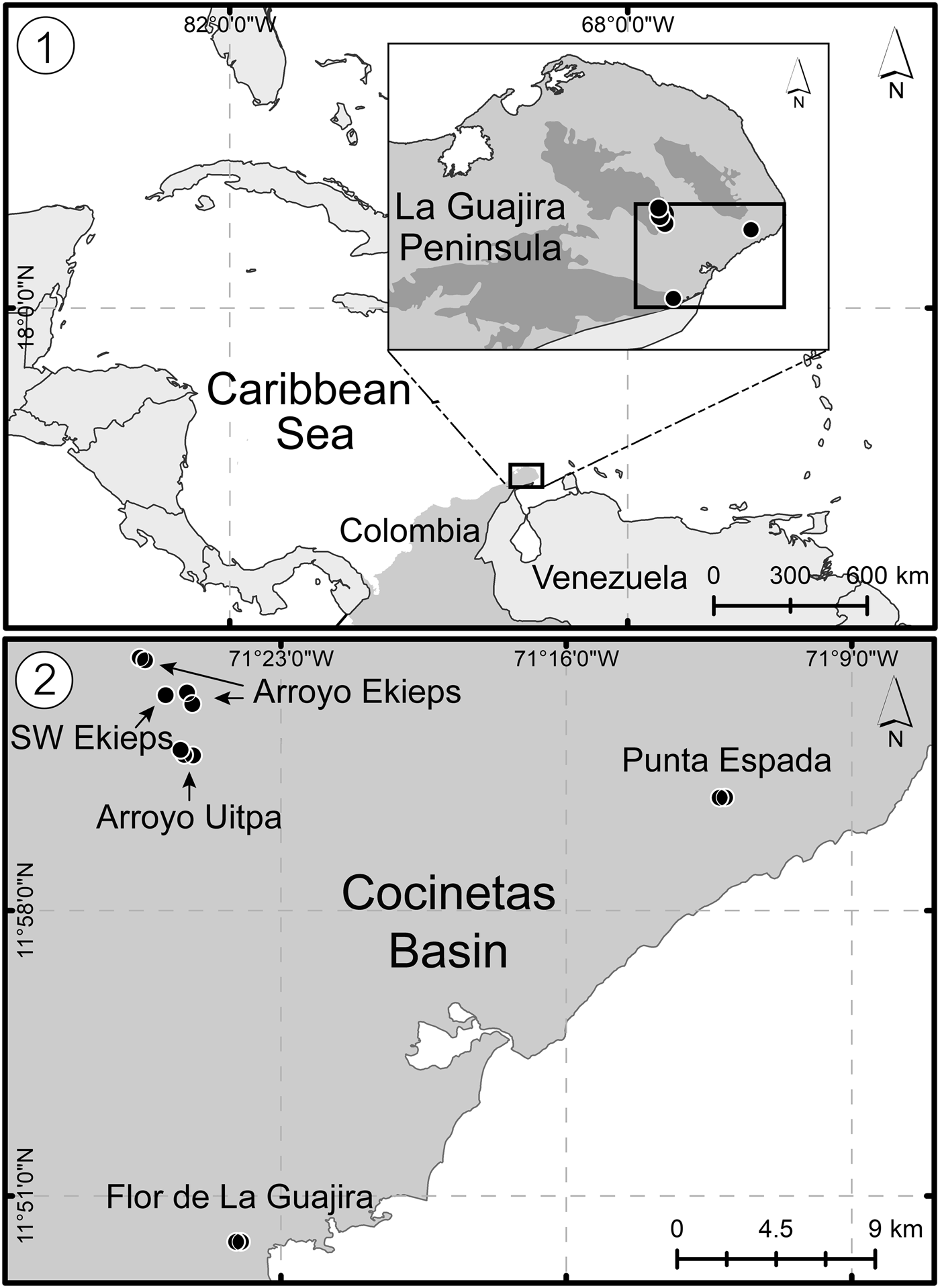
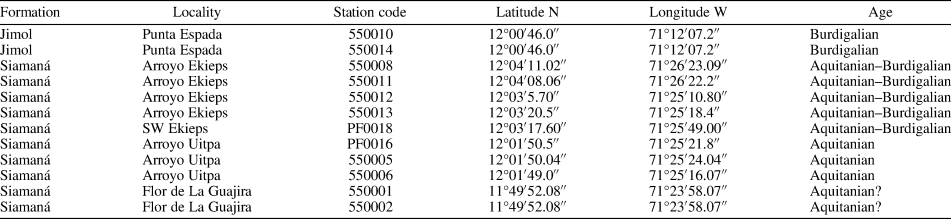
The samples studied were collected at the Arroyo Uitpa, Arroyo Ekieps, SW Ekieps, and Flor de La Guajira localities of the Siamaná Formation, and Punta Espada locality of the Jimol Formation (Fig. 1, Appendix 1) (Flórez et al., Reference Flórez, Zaptata-Ramírez and Klaus2018, fig. 2). The samples were analyzed using a combination of stereo microscopy, scanning electron microscopy, and thin section microscopy. A list of the collected samples with associated catalog numbers, station numbers, and geologic formations is provided in Appendix 2.
(1) Location of La Guajira Peninsula and the study area in the Caribbean region. (2) Position of the localities and stations in the Cocinetas Basin: Arroyo Ekieps, SW Ekieps, Arroyo Uitpa and Flor de La Guajira from Siamaná Formation, and Punta Espada from Jimol Formation.

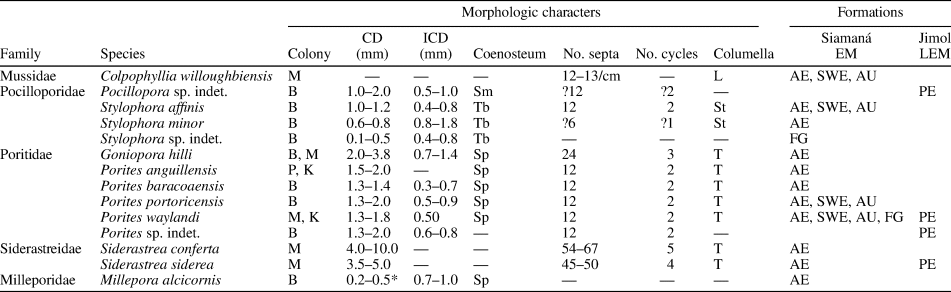
The systematic paleontology, including key morphometric data (Table 1), is presented in alphabetical order. Sources of occurrence information are compiled in Flórez et al. (Reference Flórez, Zaptata-Ramírez and Klaus2018, table 3). Taxonomic classifications were based on literature descriptions of the type material, and through comparisons with specimens housed at Rosenstiel School of Marine and Atmospheric Science.
Morphometric data of the corals recorded in this work. Colony growth: B, branching; M, massive; P, platy; K, knobby. CD: calicular diameter (*dactilopore in Millepora alcicornis). ICD: Intercalicular distance. Coenosteum: Tb, tubercles; Sp, spongy; Sm, smooth. Kind of columella: St, styliform; L, lamellar; T, trabecular. In all items (—) means not determined. Siamaná EM (early Miocene) localities: AE, Arroyo Ekieps; SWE, SW Ekieps; AU, Arroyo Uitpa; FG, Flor de La Guajira. Jimol LEM (late early Miocene): PE, Punta Espada locality.

Repositories and institutional abbreviations
The samples are deposited at the Mapuka Museum of the Universidad del Norte, with the acronym MUN-STRI. Other abbreviations: PIU, Paleontologiska Institutionene Uppsala, Uppsala, Sweden; NHMUK, The Natural History Museum, London, United Kingdom; USNM, U.S. National Museum of Natural History, Washington, D.C., USA, numbers preceded by ‘M’ are from Mollusk series.
Systematic paleontology
Class Anthozoa Ehrenberg, Reference Ehrenberg1834
Subclass Hexacorallia Haeckel, Reference Haeckel1896
Order Scleractinia Bourne, Reference Bourne and Lankester1900
Family Mussidae Ortmann, Reference Ortmann1890
Genus Colpophyllia Milne-Edwards and Haime, Reference Milne-Edwards and Haime1848
Type species
Meandrina gyrosa Lamarck, Reference Lamarck1816; by original designation (Milne-Edwards and Haime, Reference Milne-Edwards and Haime1848).
Colpophyllia willoughbiensis (Vaughan, Reference Vaughan1919)
Figure 2.1, 2.2
- 1919
Manicina willoughbiensis Vaughan, p. 422, pl. 104, figs. 2, 2a, pl. 105.
- 1974
Colpophyllia willoughbiensis; Frost and Langenheim, p. 248, pl. 88, figs. 1–6, pl. 89, figs. 1–7.
- 1992
Colpophyllia willoughbiensis; Budd et al., p. 585, fig. 7.1–7.3.
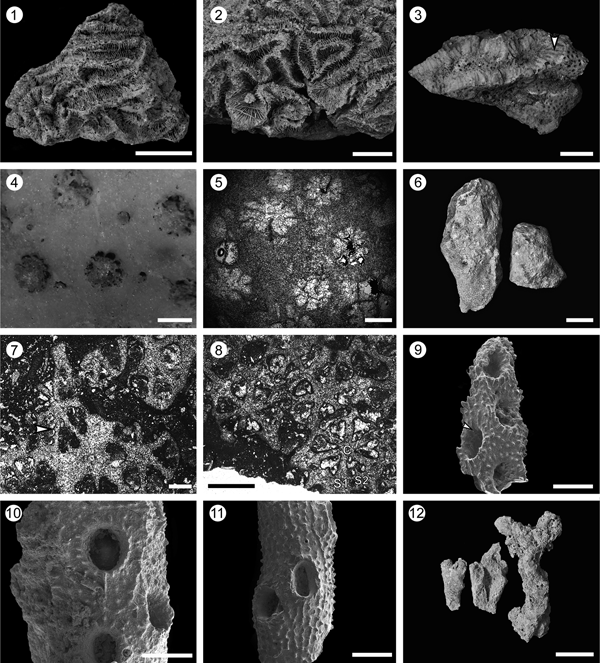
Colpophyllia willoughbiensis (Vaughan, Reference Vaughan1919) from the Siamaná Formation, Arroyo Ekieps: (1) colony fragment (MUN-STRI-17310); (2) detail of the septa and sinuous valleys (MUN-STRI-17318). Pocillopora sp. indet. from the Jimol Formation, Punta Espada: (3) transversal view of the branch fragment showing the trabecular dissepiments (white arrow) (MUN-STRI-43542); (4) detail of the surface of the colony and corallites (MUN-STRI-17345); (5) transverse thin section showing the septal arrangement (MUN-STRI-43542). Stylophora affinis Duncan, Reference Duncan1863 from the Siamaná Formation, Arroyo Uitpa (MUN-STRI-17608): (6) branching fragments; (7) transverse thin section showing the septal granules (white arrow); (8) transverse thin section showing the septal arrangement (S1, S2), and styliform columella location (c). Stylophora minor Duncan, Reference Duncan1863 from the Siamaná Formation, Arroyo Ekieps (MUN-STRI-43797): (9) pointed tip of branch, showing the granulated coenosteum and poorly developed septa (white arrow); (10) detail of the corallites and their costae, (11) coenosteum with rows of granules. Stylophora sp. indet. from the Siamaná Formation, Flor de La Guajira (MUN-STRI-43535): (12) branch fragments. Scale bars are (1) 3 cm; (2, 3, 6) 2 cm; (4, 9, 10, 11) 1 mm; (5) 500 µ; (7) 200 µ; (8) 400 µ; (12) 2 cm.

Holotype
USNM M325006, from Willoughby Bay, Antigua. Oligocene.
Occurrence
Late Eocene to Miocene. First occurrences from Gatuncillo Formation, Panama (Budd et al., Reference Budd, Stemann and Stewart1992). Early and late Oligocene in Rancho Berlín and La Quinta formations, respectively, Mexico (Frost and Langenheim, Reference Frost and Langenheim1974). Late Oligocene in Antigua Formation, Antigua and Barbuda (Johnson, Reference Johnson, Hubmann and Piller2007); Lares Formation, Puerto Rico (Frost et al., Reference Frost, Harbour, Beach, Realini and Harris1983). Early Miocene in Castillo Formation, Venezuela (Johnson et al., Reference Johnson, Sánchez-Villagra and Aguilera2009). Middle Miocene in Santa Ana Formation, Mexico (Frost and Langenheim, Reference Frost and Langenheim1974).
Description
Corallum massive to relatively flattened, meandroid, with intracalicular budding. Corallum attached to substrate by a central peduncle. Large and sinuous valleys, 10 mm wide and 0.5–10.0 mm deep. Walls usually single, but series could be separated by a furrow. Collines bear 12 or 13 septa per centimeter. Septa equally thick, 0.37–0.40 mm in width; septal face finely granulated. Trabecular columella discontinuous and poorly developed to absent. Endothecal dissepiments well developed and abundant.
Materials
Siamaná Formation, Arroyo Ekieps, station 550011: MUN-STRI-17276; station 550012: MUN-STRI-17301, MUN-STRI-43515, MUN-STRI-17310, MUN-STRI-17314, MUN-STRI-17318, MUN-STRI-17320, MUN-STRI-17300, MUN-STRI-37864; station 550013: MUN-STRI-43526. Arroyo Uitpa, station PF0016: MUN-STRI-37867. SW Ekieps, station PF0018: MUN-STRI-37924, MUN-STRI-37927.
Remarks
The samples from the Siamaná Formation are moderately preserved. Although the lower surface does not conserve the epitheca, the septal distribution, collines, and valleys are easily recognizable. They are building components of well-developed framework reefs and patch reefs. According to Frost and Langenheim (Reference Frost and Langenheim1974), specimens from different localities, from the same locality, and even in the same colony could show morphological variations. The genus Colpophyllia was traditionally included in the family Faviidae (Wells, Reference Wells and Moore1956), however, in accordance with recent genetic and morphologic studies, Budd et al. (Reference Budd, Fukami, Smith and Knowlton2012) transferred it into the family Mussidae.
Family Pocilloporidae Gray, Reference Gray1840
Genus Pocillopora Lamarck, Reference Lamarck1816
Type species
Pocillopora acuta Lamarck, Reference Lamarck1816; by original designation.
Pocillopora sp. indet.
Figure 2.3–2.5
Occurrence
Early Miocene in Jimol Formation, Colombia.
Description
Corallum branching and plocoid. Branches are thick and flattened in shape, 2.8 cm in minor diameter, up to 9 cm in major diameter. Corallites circular to oval, 1–2 mm in diameter, spaced 0.5–1.0 mm apart. Calices bear ~12 septa. Calicular fossa moderately deep. Columella absent or reduced. Tabulae present, spaced at 0.7–1.6 mm. Coenosteum covered by granules and circular perforations ~0.2 mm in diameter.
Materials
Jimol Formation, Punta Espada, station 550014: MUN-STRI-17345, MUN-STRI-43542.
Remarks
Samples are highly crystallized and poorly preserved; however, specimens resemble Pocillopora guantanamensis described by Vaughan (Reference Vaughan1919, p. 344). Both have robust and flat branches, as well as verrucae absent; nevertheless, the corallites in Pocillopora sp. indet. are bigger than those in P. guantanamensis. Samples also differ from other species of Pocillopora recorded for the Oligocene–Miocene, such as P. crassoramosa Duncan, Reference Duncan1864 and P. portoricensis (Vaughan, Reference Vaughan1919), which bear well-developed verrucae, as well as from P. arnoldi Vaughan, Reference Vaughan1919, which has thin branches and smaller corallites than Pocillopora sp. indet. (Vaughan, Reference Vaughan1919, p. 343). Most of the surface features were lost, which limited their identification at the genus level. In addition, the boundaries between Pocillopora species are overlapping, due to the high phenotypic plasticity and capacity of hybridization of the colonies (Schmidt-Roach et al., Reference Schmidt-Roach, Miller, Lundgren and Andreakis2014). Nevertheless, based on branch size and morphology, the presence of tabular dissepiments, as well as irregularity of the coenosteum, which suggests the presence of verrucae, we assign these specimens to the genus Pocillopora. The thick branches indicate a robust builder of patch reefs from the Jimol Formation, in occurrence with Orbicella imperatoris Vaughan, Reference Vaughan1919 and Porites waylandi Foster, Reference Foster1986.
Genus Stylophora Schweigger, Reference Schweigger1819
Type species
Madrepora pistillata Esper, Reference Esper1797; by unknown designation.
Stylophora affinis Duncan, Reference Duncan1863
Figure 2.6–2.8
- 1863
Stylophora affinis Duncan, p. 436, pl. 16, fig. 4.
- 1919
Stylophora panamensis Vaughan, p. 335, pl. 75, figs. 1, 1a.
Holotype
NHMUK R28788, from Nivajè Shale Formation, Dominican Republic. Neogene.
Occurrence
Late Oligocene to Pleistocene. First occurrences from Newport Formation, Jamaica (Stemann, Reference Stemann and Donovan2003). Early Miocene in Siamaná Formation, Colombia; Pedregoso, Castillo and Agua Clara (Cauderalito Member) formations, Venezuela (Johnson et al., Reference Johnson, Sánchez-Villagra and Aguilera2009); Culebra Formation, Panama (Johnson and Kirby, Reference Johnson and Kirby2006). Early–middle Miocene in Providencia Island, Colombia (Geister, Reference Geister1992); Tamana Formation, Trinidad and Tobago (Johnson, Reference Johnson2001). Middle Miocene in Seroe Domi Formation, Curaçao (Budd et al., Reference Budd, Petersen and McNeill1998). Late Miocene and early Pliocene in Cercado and Gurabo formations, Dominican Republic (Klaus et al., Reference Klaus, Budd, McNeill, Nehm and Budd2008). Pliocene in Mao Formation, Dominican Republic (Klaus et al., Reference Klaus, Budd, McNeill, Nehm and Budd2008); Quebrada Chocolate Formation, Costa Rica (Budd et al., Reference Budd, Johnson, Stemann and Tompkins1999). Pliocene–early Pleistocene in Tamiani Formation, Florida, USA (Klaus et al., Reference Klaus, Meeder, McNeill, Woodhead and Swart2017). Late Pliocene–early Pleistocene in La Cruz and Matanzas formations, Cuba (Budd et al., Reference Budd, Johnson, Stemann and Tompkins1999). Early Pleistocene in Old Pera Formation, Jamaica (Budd and McNeill, Reference Budd and McNeill1998); Curaçao Highest Terrace (Budd et al., Reference Budd, Petersen and McNeill1998); Isla Colón and Urracá formations, Panama (Klaus et al., Reference Klaus, McNeill, Budd and Coates2012).
Description
Corallum branching and plocoid. Branches robust, cylindrical to slightly compressed in shape, 3.0–3.5 cm in diameter. Branch tips blunt or flattened. Corallites circular, 1.0–1.2 mm in diameter, spaced 0.4–0.8 mm apart. Calices bear ~12 septa, hexamerally arranged in two cycles. S1 reach the columella, while S2 does not extend too far away from calicular wall. Fossa shallow and styliform columella. Coenosteum covered with granules.
Materials
Siamaná Formation, Arroyo Uitpa, station 550005: MUN-STRI-17608, MUN-STRI-17609; station PF0016: MUN-STRI-37873. Arroyo Ekieps, station 550011: MUN-STRI-37932. SW Ekieps, station PF0018: MUN-STRI-37921.
Remarks
Specimens of Stylophora affinis resemble Stylophora imperatoris Vaughan, Reference Vaughan1919 because both are branched species of large size recorded in the Oligocene and Miocene units. However, these can be differentiated because S. imperatoris exhibits contorted and lamellate branches, commonly ending in plates. Stylophora imperatoris also bears nodules in the older branches, as well as larger corallites and more prominent walls than S. affinis (Vaughan, Reference Vaughan1919, p. 334). In addition, in well-preserved specimens of S. affinis, a characteristic polygonal calicular margin is visible in the intercalicular space (Vaughan, Reference Vaughan1919, p. 336). The colonies from the Siamaná Formation are poorly preserved and highly recrystallized. They were associated with shallow patch reefs in occurrence with Antiguastrea cellulosa (Duncan, Reference Duncan1863) and Diploastrea crassolamellata (Duncan, Reference Duncan1863).
Stylophora minor Duncan, Reference Duncan1863
Figure 2.9–2.11
- 1863
Stylophora affinis var. minor Duncan, p. 436, not pl. 16, fig. 4.
- 1900
Stylophora minutissima Vaughan, p. 131, pl. 13, figs. 13–15.
- 1919
Stylophora goethalsi Vaughan, p. 338, pl. 75, figs. 2–4.
- 1973
Stylophora cf. minutissima; Weisbord, p. 18, pl. 1, fig. 1–5, pl. 4, fig. 1.
Holotype
NHMUK R28788, from Nivajè Shale Formation, Dominican Republic. Neogene.
Occurrence
Late Oligocene to early Pleistocene. First occurrences from Tabera Formation, Dominican Republic (Budd et al., Reference Budd, Stemann and Johnson1994). Late Oligocene–early Miocene in Arcadia Formation (Tampa Member), Florida, USA (Budd et al., Reference Budd, Stemann and Johnson1994). Early Miocene in Siamaná Formation, Colombia; Culebra Formation, Panama (Johnson and Kirby, Reference Johnson and Kirby2006). Early–middle Miocene in Baitoa Formation, Dominican Republic (Budd et al., Reference Budd, Stemann and Johnson1994); Tamana Formation, Trinidad and Tobago (Johnson, Reference Johnson2001); reaching the Pleistocene in Seroe Domi Formation, Curaçao (Budd et al., Reference Budd, Petersen and McNeill1998). Late Miocene in Cercado Formation, Dominican Republic; Old Bank Formation, Panama (Klaus et al., Reference Klaus, Budd, McNeill, Nehm and Budd2008, Reference Klaus, McNeill, Budd and Coates2012). Late Miocene–early Pliocene in Gurabo Formation, Dominican Republic (Klaus et al., Reference Klaus, Budd, McNeill, Nehm and Budd2008). Early Pliocene in Río Banano Formation (Brazo Seco), Costa Rica (Budd et al., Reference Budd, Johnson, Stemann and Tompkins1999); Mao Formation, Dominican Republic (Klaus et al., Reference Klaus, Budd, McNeill, Nehm and Budd2008). Late Pliocene in Quebrada Chocolate Formation, Costa Rica (Budd et al., Reference Budd, Johnson, Stemann and Tompkins1999); Layton Formation (Bowden Member), Jamaica (Budd and McNeill, Reference Budd and McNeill1998). Early Pleistocene in Old Pera and Hope Gate formations, Jamaica (Budd and McNeill, Reference Budd and McNeill1998); Isla Colón Formation, Panama (Klaus et al., Reference Klaus, McNeill, Budd and Coates2012).
Description
Corallum branching and plocoid. Branches thin with pointed tips, fragments 6.43–10.80 mm long, circular to slightly flat in cross-section, 1.6–3.7 mm in diameter. Corallites rounded to slightly oval, 0.64–0.65 mm in the smallest calicular diameter and 0.75–0.80 mm in the largest one. Corallites distributed irregularly at branch surface, sometimes in rows. Intercalicular space of 0.8–1.8 mm, which decreases in the branch tips. S1 are not preserved and S2 are poorly developed, formed by rows of granules. Fossa moderately deep, containing a styliform columella, which does not reach the height of the calicular edge. Calicular wall slightly exsert, bearing 18–24 blunt costae, from which project rows of round-pointed granules that cover the coenosteum, sometimes forming ridges along the branches.
Materials
Siamaná Formation, Arroyo Ekieps, station 550011: MUN-STRI-43797, MUN-STRI-43798, MUN-STRI-43799, MUN-STRI-43800, MUN-STRI-43801; station 550012: MUN-STRI-43802, MUN-STRI- 43881; station 550013: MUN-STRI-43803; station 550008: MUN-STRI- 43879, MUN-STRI- 43880.
Remarks
Samples from the Siamaná Formation are branch fragments that are recrystallized and poorly preserved. Despite the loss of septa, the size of corallites and characters of corallite rims and coenosteum allow specimen identification. Stylophora minor closely resembles S. granulata, but differs from it by the granule arrangement in the coenosteum, which in the latter species is rarely organized forming continuous ribs (Vaughan, Reference Vaughan1919, p. 340). In addition, S. granulata Duncan and Wall, Reference Duncan and Wall1865 shows a mostly smooth coenosteum and branches with blunt tips. In the Siamaná Formation, S. minor occurs in a well-developed reef with Siderastrea conferta (Duncan, Reference Duncan1863), Porites portoricensis, P. baracoaensis Vaughan, Reference Vaughan1919, Montastraea canalis (Vaughan, Reference Vaughan1919), Agathiphyllia tenuis (Duncan, Reference Duncan1863), and a member of the family Caryophylliidae.
Stylophora sp. indet.
Figure 2.12
Occurrence
Early Miocene from the Siamaná Formation, Colombia.
Description
Corallum branching and plocoid. Branches thin, terete to slightly compressed in shape, 7.4–14.0 mm in diameter. Corallites circular to slightly irregular of variable size, 0.1–0.5 mm in diameter, irregularly arranged in the coenosteum, spaced 0.4–0.8 mm apart. Septa and columella are not preserved. Coenosteum covered with granules or spines, and with frequent circular perforations of 0.20–0.42 mm in diameter.
Materials
Siamaná Formation, Flor de La Guajira, station 550002: MUN-STRI-43535.
Remarks
The sample consists of poorly preserved colony fragments with many characters missing. The specimen differs from Stylophora affinis and S. minor by the morphology and size of the branches, which in S. affinis are more robust, and in S. minor more slender and small. In addition, the specimen differs from S. minor by the irregular distribution of the corallites. However, the general pattern of corallum and coenosteum, as well as corallite size, indicate that it belongs to Stylophora. It was found in a patch reef with Montastraea cavernosa (Linnaeus, Reference Linnaeus1767) and Orbicella imperatoris.
Family Poritidae Gray, Reference Gray1840
Genus Goniopora Blainville, Reference Blainville and Levrault1830
Type species
Goniopora pedunculata Quoy and Gaimard, Reference Quoy and Gaimard1833; by subsequent designation. Holotype lost.
Goniopora hilli Vaughan, Reference Vaughan1919
Figure 3.1–3.3
- 1919
Goniopora hilli Vaughan, p. 488, pl. 142, figs. 1, 1a.
- 1919
Goniopora jacobiana Vaughan, p. 492, pl. 144, figs. 1, 1a, 2, 2a, 3, 3a.
- 1919
Goniopora canalis Vaughan, p. 494, pl. 146, figs. 1–3.
- 1973
Goniopora aucillana Weisbord, p. 30, pl. 33, fig. 1, pl. 34, fig. 1, pl. 35, fig. 1.
- 1973
Goniopora tampaensis Weisbord, p. 36, pl. 15, figs. 1, 2.
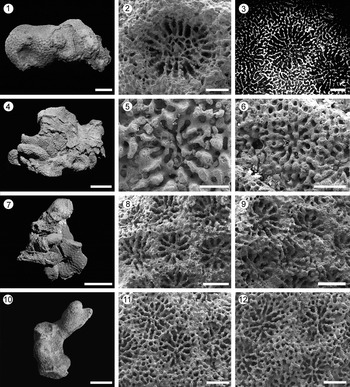
Goniopora hilli Vaughan, Reference Vaughan1919 (MUN-STRI-43521): (1) morphology of the colony; (2) detail of a corallite, showing the septal arrangement and columella; (3) transverse thin section showing the denticles in the septal faces and calicular wall. Porites anguillensis Vaughan, Reference Vaughan1919: (4) morphology of the colony (MUN-STRI-17285); (5) detail of the corallite (MUN-STRI-17240); (6) septal arrangement and columella (black arrow) surrounded by five elements of the palar crown. Porites baracoaensis Vaughan, Reference Vaughan1919 (MUN-STRI-43527): (7) branch fragments; (8, 9) detail of corallites showing septal arrangements, the fusion of triplets and lateral pairs, columella, palar crown, and calicular wall. Porites portoricensis (Vaughan, Reference Vaughan1919) (MUN-STRI-43486): (10) branch tip morphology; (11, 12) septal arrangement and columella of corallites, and coenosteum reticulate. All specimens are from the Siamaná Formation, Arroyo Ekieps locality. Scale bars are (1, 4) 2 cm; (2, 6, 8, 9, 11, 12) 1 mm; (3, 5) 500 µ; (7) 1.5 cm; (10) 1.8 cm.

Holotype
USNM M325058, from La Boca Formation, Panama. Middle Miocene.
Occurrence
Early Oligocene to early Pleistocene. Early Oligocene in Rancho Berlín Formation, Mexico (Frost and Langenheim, Reference Frost and Langenheim1974). Late Oligocene in Tabera Formation, Dominican Republic (Budd et al., Reference Budd, Stemann and Johnson1994); La Quinta Formation, Mexico (Frost and Langenheim, Reference Frost and Langenheim1974); Lares Formation, Puerto Rico (Frost et al., Reference Frost, Harbour, Beach, Realini and Harris1983). Late Oligocene–early Miocene in Arcadia Formation (Tampa Member), Florida, USA (Budd et al., Reference Budd, Stemann and Johnson1994). Early Miocene in Siamaná Formation, Colombia; Culebra Formation, Panama (Johnson and Kirby, Reference Johnson and Kirby2006); Anguilla Formation, Anguilla (Budd et al., Reference Budd, Johnson and Edwards1995). Early–middle Miocene in Tamana Formation, Trinidad and Tobago (Johnson, Reference Johnson2001); reaching the Pleistocene in Seroe Domi Formation, Curaçao (Budd et al., Reference Budd, Petersen and McNeill1998). Late Miocene–early Pliocene in Gurabo Formation, Dominican Republic (Klaus et al., Reference Klaus, Budd, McNeill, Nehm and Budd2008). Early Pleistocene in Matanzas and La Cruz formations, Cuba (Budd et al., Reference Budd, Johnson, Stemann and Tompkins1999).
Description
Corallum massive, sometimes with columnar projections or growing in contorted plates. Colonies subplocoid with extracalicular budding. Corallites hexagonal in shape, sometimes compressed, 2.9–3.8 mm in diameter. Calices bear 24 septa, hexamerally arranged in three cycles. Dorsal and ventral septa are free. S1 and S2 reach the columella, while S3 fuse to adjacent S2 close to the columella. Septal margins and faces with denticles. Columella trabecular, matted and wide, around 1.0 mm in diameter. Wall is synapticulothecal and prominent. Fossa is moderately deep.
Materials
Siamaná Formation, Arroyo Ekieps, station 550011: MUN-STRI-43511; station 550012: MUN-STRI-17312, MUN-STRI-17297, MUN-STRI-43521.
Remarks
Frost and Langenheim (Reference Frost and Langenheim1974) described a crown of six paliform knots circling the columella, at the fused end of S1 and S2. This character is not observed in the samples from the Siamaná Formation due to the preservation of the samples. This species is often confused with members of Porites, but they can be separated by corallite size and columella width, which are larger in the species of Goniopora, which also show three septal cycles instead of two, as occur in the species of Porites (Kitano et al., Reference Kitano, Benzoni, Arrigoni, Shirayama, Wallace and Fukami2014).
Genus Porites Link, Reference Link1807
Type species
Porites polymorphus Link, Reference Link1807 (= Madrepora porites Pallas, Reference Pallas1766 [in part]); by original designation.
Remarks
Although the morphology of the colonies helps to identify the samples at the species level, the Neogene Porites species can often be confused, in particular if the samples are not well preserved. Several morphological characters of corallites could overlap or show high variability even in the same colonies. The genus has been an important building component of reefs since the early Miocene (Foster, Reference Foster1986). Porites diversified and thrived in clear and turbid shallow waters around the world (Foster, Reference Foster1986; Braga et al., Reference Braga, Martín and Alcala1990; Santodomingo et al., Reference Santodomingo, Novak, Pretković, Marshall, Di Martino, Giudice-Capelli, Rösler, Reich, Braga, Renema and Johnson2015a), inhabiting all reef zones, from near shore, to reef crest, to deep forereef (Goreau, Reference Goreau1959; Geister, Reference Geister1983; Foster, Reference Foster1986).
Porites anguillensis Vaughan, Reference Vaughan1919
Figure 3.4–3.6
- 1919
Porites anguillensis Vaughan, p. 504, pl. 149, figs. 1a, 1b (type), pl. 150, fig. 5.
Holotype
PIU WI43, from Anguilla Formation, Anguilla. Early Miocene.
Occurrence
Late Oligocene to early Miocene. First occurrence in La Quinta Formation, Mexico (Frost and Langenheim, Reference Frost and Langenheim1974). Late Oligocene–early Miocene in Browns Town Formation, Jamaica (Stemann, Reference Stemann and Donovan2003). Early Miocene in Siamaná Formation, Colombia; Culebra Formation, Panama (Johnson and Kirby, Reference Johnson and Kirby2006); and Anguilla Formation, Anguilla (Budd et al., Reference Budd, Johnson and Edwards1995).
Description
Corallum encrusting and multilaminar with knobs. Laminae flat and undulate, 1.0–2.5 mm thick, separated by spaces filled with sediment or cryptic fauna. Colonies subplocoid in form. Corallites circular to polygonal in shape, 1.5–2.0 mm in diameter, spaced 0.3–0.5 mm apart. Corallites bear 12 septa comprising a free dorsal directive, a fused ventral triplet, and four lateral pairs. Well-developed trabecular columella, formed by a single trabecular blunt, at the same level of the palar crown. Palar crown of five or six pali. Wall formed by one or two trabecular rings. Coenosteum reticulate.
Materials
Siamaná Formation, Arroyo Ekieps, station 550008: MUN-STRI-17237, MUN-STRI-17239, MUN-STRI-17240, MUN-STRI-17241, MUN-STRI-17244; station 550011: MUN-STRI-17256, MUN-STRI-43506, MUN-STRI-43507, MUN-STRI-17271, MUN-STRI-17277, MUN-STRI-17278, MUN-STRI-17279, MUN-STRI-17285, MUN-STRI-17288, MUN-STRI-17289; station 550012: MUN-STRI-17308, MUN-STRI-17313, MUN-STRI-43520, MUN-STRI-17315, MUN-STRI-17316, MUN-STRI-43523.
Remarks
Porites anguillensis can be differentiated from other poritids from the Siamaná Formation by the morphology of the colonies, which are flexed laminar plates, the relatively large size of the corallite and a robust and well-developed columella and palar crown. Within the Siamaná Formation P. anguillensis was associated with Antiguastrea cellulosa, Alveopora tampae Weisbord, Reference Weisbord1973, Agathiphyllia tenuis, Colpophyllia willoughbiensis, Porites waylandi, P. portoricensis, P. baracoaensis, Montastraea canalis, M. endothecata Duncan, Reference Duncan1863, and Siderastrea conferta in well-developed reefs.
Porites baracoaensis Vaughan, Reference Vaughan1919
Figure 3.7–3.9
- 1919
Porites baracoaensis Vaughan, p. 499, pl. 147, figs. 1, 1a.
- 1919
Porites baracoäensis var. matanzasensis Vaughan, p. 500, pl. 147, figs. 2–4.
- 1919
?Porites douvillei Vaughan, p. 501, pl. 149, figs. 2, 2a, pl. 151, figs. 1, 1a.
- 1919
Porites toulai Vaughan, p. 501, pl. 150, figs. 1–4.
- 1986
Porites baracoaensis; Foster, p. 75, pl. 16, figs. 1–13, pl. 17, figs. 1–7, pl. 18, figs. 1–4, text-figs. 2–5, 10, 12, 14, 16, 17.
Holotype
USNM M325069, from Baracoa, Cuba. Miocene.
Occurrence
Late Oligocene to early Pleistocene. First records from late Oligocene in Tabera Formation, Dominican Republic (Budd et al., Reference Budd, Stemann and Johnson1994); Anahuac Formation, Texas, USA (Frost and Schafersman, Reference Frost and Schafersman1978); Antigua Formation, Antigua and Barbuda (Johnson, Reference Johnson, Hubmann and Piller2007); Lares Formation, Puerto Rico (Frost et al., Reference Frost, Harbour, Beach, Realini and Harris1983). Late Oligocene–early Miocene in Browns Town and Newport formations, Jamaica (Stemann, Reference Stemann and Donovan2003). Early Miocene in Siamaná Formation, Colombia; Agua Clara (Cauderalito Member) and Castillo formations, Venezuela (Johnson et al., Reference Johnson, Sánchez-Villagra and Aguilera2009); Culebra Formation, Panama (Johnson and Kirby, Reference Johnson and Kirby2006); Anguilla Formation, Anguilla (Budd et al., Reference Budd, Johnson and Edwards1995); Santa Ana Formation, Mexico (Frost and Langenheim, Reference Frost and Langenheim1974). Early–middle Miocene in Providencia Island, Colombia (Geister, Reference Geister1992); Tamana Formation, Trinidad and Tobago (Johnson, Reference Johnson2001). Middle Miocene in Valiente Formation, Panama (Klaus et al., Reference Klaus, McNeill, Budd and Coates2012). Middle–late Miocene in San Andrés Formation, Colombia (Geister, Reference Geister1975). Middle Miocene–early Pleistocene in Seroe Domi Formation, Curaçao (Budd et al., Reference Budd, Petersen and McNeill1998). Late Miocene in Cercado Formation, Dominican Republic; Old Bank Formation, Panama (Klaus et al., Reference Klaus, Budd, McNeill, Nehm and Budd2008, Reference Klaus, McNeill, Budd and Coates2012). Late Miocene–early Pliocene in Gurabo Formation, Dominican Republic (Klaus et al., Reference Klaus, Budd, McNeill, Nehm and Budd2008). Early Pliocene in Río Banano Formation (Brazo Seco), Costa Rica (Budd et al., Reference Budd, Johnson, Stemann and Tompkins1999); Mao Formation, Dominican Republic (Klaus eta al., Reference Klaus, Budd, McNeill, Nehm and Budd2008). Late Pliocene in Quebrada Chocolate Formation, Costa Rica (Budd et al., Reference Budd, Johnson, Stemann and Tompkins1999); Layton Formation (Bowden Member), Jamaica (Budd and McNeill, Reference Budd and McNeill1998). Late Pliocene–early Pleistocene in Matanzas and La Cruz formations, Cuba; Moin Formation, Costa Rica (Budd et al., Reference Budd, Johnson, Stemann and Tompkins1999). Early Pleistocene in Old Pera Formation, Jamaica (Budd and McNeill, Reference Budd and McNeill1998); Isla Colón Formation, Panama (Klaus et al., Reference Klaus, McNeill, Budd and Coates2012).
Description
Corallum branching and cerioid. Branches thin, circular to flattened. Circular branches 5.7–8.9 mm in diameter, and flat branches 11.0–17.0 mm in maximum dimension, by 5.0–6.0 mm in width. Corallites polygonal in shape, 1.3–1.4 mm in diameter, spaced 0.3–0.5 mm apart. Corallites bear 12 septa including a free dorsal directive, a fused ventral triplet, and four lateral pairs. Columella poorly developed or absent; when present, constituted by a small trabecula. Palar crown prominent, bearing five pali. Wall formed by one trabecular ring.
Materials
Siamaná Formation, Arroyo Ekieps, station 550008: MUN-STRI-43505; station 550011: MUN-STRI-43510, MUN-STRI-43514; station 550012: MUN-STRI-17302, MUN-STRI-43516, MUN-STRI-43519, MUN-STRI-17299, MUN-STRI-43522, MUN-STRI-17324, MUN-STRI-43527, MUN-STRI-17326, MUN-STRI-43530.
Remarks
According to Foster (Reference Foster1986), Porites baracoaensis is characterized by small colonies, with thin branches, and their corallites have shallow fossa, solid walls, and conspicuous pali. In the Simaná Formation, P. baracoaensis was found building well-developed reefs with Acropora panamensis Vaughan, Reference Vaughan1919, Antiguastrea cellulosa, Agathiphyllia tenuis, Colpophyllia willoughbiensis, Porites waylandi, P. portoricensis, P. anguillensis, Alveopora tampae, Montastraea canalis, M. cavernosa, Siderastrea siderea (Ellis and Solander, Reference Ellis and Solander1786), and Caryophylliidae.
Porites portoricensis (Vaughan, Reference Vaughan1919)
Figure 3.10–3.12
- non 1859
Alveopora fenestrata; Dana, p. 98.
- 1863
Alveopora fenestrata; Duncan, p. 437.
- 1919
Goniopora portoricensis Vaughan, p. 495, pl. 146, figs. 4, 5.
- 1919
Goniopora clevei Vaughan, p. 496, pl. 145, figs. 1, 3–6a, ?pl. 145, figs. 2, 2a.
- 1919
Goniopora cascadensis Vaughan, p. 497, pl. 146, figs. 6–9.
- 1919
?Portites (Synaraea) howei Vaughan, p. 505, pl. 151, figs. 2–4.
- 1973
Goniopora ballistensis Weisbord, p. 32, pl. 10, figs. 4, 5, pl. 11, figs. 1–3, ?pl. 12, figs. 1, 2.
- 1973
Goniopora matsoni Weisbord, p. 34, pl. 12, fig. 3–6, ?pl. 14, figs. 1–3.
- 1986
Porites portoricensis; Foster, p. 79, pl. 24, figs. 1–15, pl. 25, figs. 1–6, pl. 26, figs. 1–6, pl. 27, figs. 1–4, pl. 28, figs. 1–4, text-figs. 2–5, 10, 12, 14, 16–19.
Holotype
USNM M325061, from Lares Formation, Puerto Rico. Late Miocene.
Occurrence
Late Oligocene to early Pleistocene. Oldest occurrences in La Quinta Formation, Mexico (Frost and Langenheim, Reference Frost and Langenheim1974); Antigua Formation, Antigua and Barbuda (Johnson, Reference Johnson, Hubmann and Piller2007); Lares Formation, Puerto Rico (Frost et al., Reference Frost, Harbour, Beach, Realini and Harris1983). Late Oligocene–early Miocene in Browns Town and Newport formations, Jamaica (Stemann, Reference Stemann and Donovan2003); Arcadia Formation (Tampa Member), Florida, USA (Budd et al., Reference Budd, Stemann and Johnson1994). Early Miocene in Siamaná Formation, Colombia; Agua Clara (Cauderalito Member) and Castillo formations, Venezuela (Johnson et al., Reference Johnson, Sánchez-Villagra and Aguilera2009); Culebra Formation, Panama (Johnson and Kirby, Reference Johnson and Kirby2006); Anguilla Formation, Anguilla (Budd et al., Reference Budd, Johnson and Edwards1995). Middle Miocene in Baitoa Formation, Dominican Republic (Budd et al., Reference Budd, Stemann and Johnson1994); Valiente Formation, Panama (Klaus et al., Reference Klaus, McNeill, Budd and Coates2012). Middle Miocene–early Pleistocene in Seroe Domi Formation, Curaçao (Budd et al., Reference Budd, Petersen and McNeill1998). Late Miocene in Cercado Formation, Dominican Republic; Old Bank Formation, Panama (Klaus et al., Reference Klaus, Budd, McNeill, Nehm and Budd2008, Reference Klaus, McNeill, Budd and Coates2012). Late Miocene–early Pliocene in Gurabo Formation, Dominican Republic (Klaus et al., Reference Klaus, Budd, McNeill, Nehm and Budd2008). Early Pliocene in Mao Formation, Dominican Republic (Klaus et al., Reference Klaus, Budd, McNeill, Nehm and Budd2008). Late Pliocene in Quebrada Chocolate Formation, Costa Rica (Budd et al., Reference Budd, Johnson, Stemann and Tompkins1999). Late Pliocene–early Pleistocene in Moin Formation, Costa Rica (Budd et al., Reference Budd, Johnson, Stemann and Tompkins1999). Early Pleistocene in Old Pera Formation, Jamaica (Budd and McNeill, Reference Budd and McNeill1998).
Description
Corallum branching to columnar and cerioid. Branches are thick oval to flattened. Oval branches 1.5–2.5 cm in major diameter; flat branches 2.5–3.0 cm long and 1.0–2.0 cm wide. Corallites polygonal in shape, 1.3–2.0 mm in diameter, spaced 0.5–0.9 mm apart. Corallites bear 12 septa arranged with a free dorsal directive, a fused ventral triplet, and four lateral pairs. Trabecular columella well developed, formed by a single trabecular blunt, at the same level of the palar crown. Palar crown of six pali. Wall formed by one or two trabecular rings. Coenosteum reticulate.
Materials
Siamaná Formation, Arroyo Uitpa, station 550006: MUN-STRI-17200, MUN-STRI-43485, MUN-STRI-37880; station PF0016: MUN-STRI-37868. Arroyo Ekieps, station 550008: MUN-STRI-17226, MUN-STRI-17220, MUN-STRI-17223; station 550011: MUN-STRI-17272, MUN-STRI-17273, MUN-STRI-43484, MUN-STRI-43486, MUN-STRI-17258, MUN-STRI-17259, MUN-STRI-37857, MUN-STRI-37862; station 550012: MUN-STRI-43487. SW Ekieps, station PF0018: MUN-STRI-37898, MUN-STRI-37899.
Remarks
This species shows high morphological variability. For this reason, several authors have established numerous younger synonyms (Foster, Reference Foster1986). The specimens from the Siamaná Formation can be separated from other Porites by having branching colonies and large corallites. Porites portoricensis was found building well-developed framework reefs and patch reefs with Alveopora tampae, Antiguastrea cellulosa, Colpophyllia willoughbiensis, Montastraea endothecata, Porites waylandi, P. baracoaensis, and P. anguillensis.
Porites waylandi Foster, Reference Foster1986
Figure 4.1, 4.2
- non 1843
Porites collegniana Michelin, p. 65, pl. 13, fig. 9.
- 1863
Porites collegniana; Duncan, p. 437.
- non 1866
Porites panamensis Verrill, p. 329.
- 1919
Porites panamensis Vaughan, p. 503, pl. 148, figs. 1–3a.
- 1986
Porites waylandi Foster, p. 81, pl. 29, figs. 1–4, pl. 30, figs. 1–7, pl. 31, figs. 1–4, text-figs. 2–5, 10, 12, 14, 16, 17.
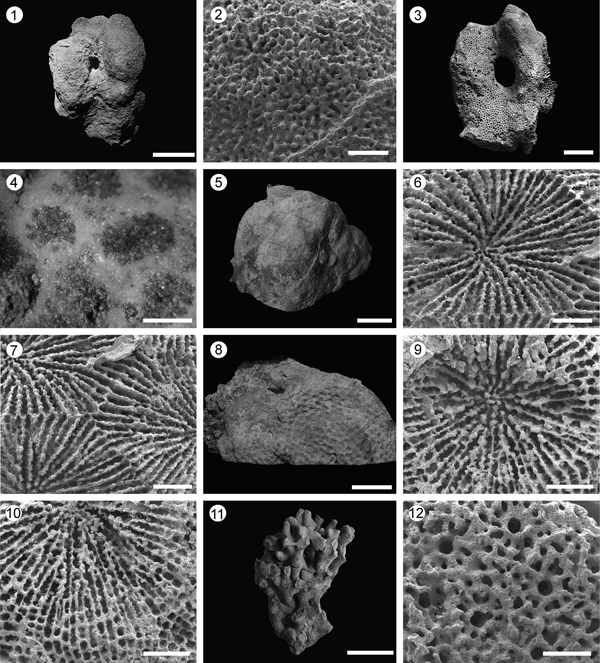
Porites waylandi Foster, Reference Foster1986 from the Siamaná Formation, Arroyo Ekieps (MUN-STRI-17222): (1) morphology of the colony; (2) detail of the corallites, showing the septal arrangement, columella, palar crown, and calicular wall. Porites sp. indet. from the Jimol Formation, Punta Espada (MUN-STRI-17254): (3) branch fragment; (4) crystallized corallites. Siderastrea conferta (Duncan, Reference Duncan1863) from the Siamaná Formation, Arroyo Ekieps (MUN-STRI-17270): (5) morphology of the colony; (6) detail of the corallites showing septal arrangement, ornamentation, and the columella elements; (7) detail of the calicular walls and the fusion with the adjacent septa. Siderastrea siderea (Ellis and Solander, Reference Ellis and Solander1786) from the Siamaná Formation, Arroyo Ekieps (MUN-STRI-17269): (8) morphology of the colony; (9, 10) detail of the corallite and calicular walls, respectively. Millepora alcicornis Linnaeus, Reference Linnaeus1758 from the Siamaná Formation, Arroyo Ekieps (MUN-STRI-17286): (11) morphology of the colony; (12) detail of the dactilopores and coenosteal texture. Scale bars in (1) 2 cm; (2, 4, 6, 7, 9, 10, 12) 1 mm; (3, 5) 3 cm; (8) 2.5 cm; (11) 4 cm.

Holotype
USNM M325063, from La Boca Formation, Panama. Middle Miocene.
Occurrence
Late Oligocene to early Pleistocene. First records from late Oligocene in Tabera Formation, Dominican Republic (Budd et al., Reference Budd, Stemann and Johnson1994); Anahuac Formation, Texas, USA (Frost and Schafersman, Reference Frost and Schafersman1978); La Quinta Formation, Mexico (Frost and Langenheim, Reference Frost and Langenheim1974); Lares Formation, Puerto Rico (Frost et al., Reference Frost, Harbour, Beach, Realini and Harris1983). Late Oligocene–early Miocene in Browns Town and Newport formations, Jamaica (Stemann, Reference Stemann and Donovan2003); Arcadia Formation (Tampa Member), Florida, USA (Budd et al., Reference Budd, Stemann and Johnson1994). Early Miocene in Siamaná Formation, Colombia; Agua Clara (Cauderalito Member), San Luis and Castillo formations, Venezuela (Johnson et al., Reference Johnson, Sánchez-Villagra and Aguilera2009); Culebra Formation, Panama (Johnson and Kirby, Reference Johnson and Kirby2006); Anguilla Formation, Anguilla (Budd et al., Reference Budd, Johnson and Edwards1995). Early–middle Miocene in Providencia Island, Colombia (Geister, Reference Geister1992); Tamana Formation, Trinidad and Tobago (Johnson, Reference Johnson2001). Latest early Miocene in Jimol Formation, Colombia. Middle Miocene in Valiente Formation, Panama (Klaus et al., Reference Klaus, McNeill, Budd and Coates2012). Middle Miocene–early Pleistocene in Seroe Domi Formation, Curaçao (Budd et al., Reference Budd, Petersen and McNeill1998). Late Miocene in Cercado Formation, Dominican Republic; Old Bank Formation, Panama (Klaus et al., Reference Klaus, Budd, McNeill, Nehm and Budd2008, Reference Klaus, McNeill, Budd and Coates2012). Late Miocene–early Pliocene in Gurabo Formation, Dominican Republic (Klaus et al., Reference Klaus, Budd, McNeill, Nehm and Budd2008). Early Pliocene in Mao Formation, Dominican Republic (Klaus eta al., Reference Klaus, Budd, McNeill, Nehm and Budd2008). Late Pliocene in Quebrada Chocolate Formation, Costa Rica (Budd et al., Reference Budd, Johnson, Stemann and Tompkins1999). Early Pleistocene in Moin Formation, Costa Rica (Budd et al., Reference Budd, Johnson, Stemann and Tompkins1999).
Description
Corallum columnar to massive with knobs. Colonies subplocoid. Corallites polygonal in shape, 1.3–1.8 mm in diameter, spaced 0.5 mm apart. Corallites bear 12 septa comprising a free dorsal directive, a fused ventral triplet, and four lateral pairs. When present, the columella is trabecular, formed by a single trabecular blunt, at the same or lower level of the palar crown. Wide palar crown of four or five pali. Wall formed by one or two trabecular rings. Coenosteum reticulate.
Materials
Siamaná Formation, Flor de La Guajira, station 550001: MUN-STRI-17183, MUN-STRI-17184, MUN-STRI-17186. Arroyo Uitpa, station 550005: MUN-STRI-17604, MUN-STRI-43492, MUN-STRI-43495, MUN-STRI-17639, MUN-STRI-17601; station 550006: MUN-STRI-43502, MUN-STRI-43503; station PF0016: MUN-STRI-37871, MUN-STRI-37872. Arroyo Ekieps, station 550008: MUN-STRI-17242, MUN-STRI-17245, MUN-STRI-17221, MUN-STRI-17222; station 550011: MUN-STRI-37857, MUN-STRI-37860, MUN-STRI-37861; station 550012: MUN-STRI-17317, MUN-STRI-17319. SW Ekieps, station PF0018: MUN-STRI-37889, MUN-STRI-37891, MUN-STRI-37896. Jimol Formation, Punta Espada, station 550010: MUN-STRI-17248, MUN-STRI-17249; station 550014: MUN-STRI-17336, MUN-STRI-17348, MUN-STRI-17349.
Remarks
The samples from the Siamaná Formation can be differentiated from other Porites species by their massive colonies, small calicular diameters, and palar crown at a low level. In the Simaná Formation Porites waylandi built well-developed framework reefs and patch reefs with Antiguastrea cellulosa, Colpophyllia willoughbiensis, Diploastrea crassolamellata, D. magnifica, Porites anguillensis, P. portoricensis, Montastraea canalis, M. cavernosa, and Orbicella limbate (Duncan, Reference Duncan1863). In the Jimol Formation it was found with Orbicella imperatoris, Siderastrea siderea, and Pocillopora sp. indet.
Porites sp. indet.
Figure 4.3, 4.4
Occurrence
Middle Miocene from the Jimol Formation.
Description
Corallum branching, plocoid to subplocoid. Branches much compressed, 23.0–29.0 mm wide, 37.0–110.0 mm in length, and 155 mm high, with anastomosing growth pattern. Corallites rounded to slightly compressed, 1.3–2.0 mm in diameter, spaced 0.6–0.8 mm apart. Septa arranged in two complete cycles. Fossa deep. Columella not evident. Coenosteum with circular perforations, 0.3–0.4 mm in diameter.
Materials
Jimol Formation, Punta Espada, station 550010: MUN-STRI-17254.
Remarks
The preservation is very poor. The sample consists of two recrystallized broken branches, whereby several characters cannot be observed, such as coenosteum characters, presence of tertiary septa, as well as differences between primaries and secondary. Porites sp. indet. differs from P. baracoaensis and P. portoricensis, the other branching species of Porites found in the Siamaná Formation, by its robust branches, which exceed the dimensions of P. portoricensis, the larger of the two. The sample was found in a patch reef with Orbicella imperatoris, Porites waylandi, and Siderastrea siderea.
Family Siderastreidae Vaughan and Wells, Reference Vaughan and Wells1943
Genus Siderastrea Blainville, Reference Blainville and Levrault1830
Type species
Madrepora radians Pallas, Reference Pallas1766; by original description.
Siderastrea conferta (Duncan, Reference Duncan1863)
Figure 4.5–4.7
- 1863
Isastrea conferta Duncan, p. 422.
- 1919
Siderastrea conferta; Vaughan, p. 451, pl. 117, fig. 3, pl. 120, figs. 1–4, pl. 121, figs. 1–2a.
- 1929
Siderastrea conferta; Coryell and Ohlsen, p. 213, pl. 38, fig. 2.
- 1974
Siderastrea (Siderastrea) conferta; Frost and Langenheim, p. 206, pl. 66, figs. 1–6.
Holotype
NHMUK R28740, from Antigua Formation, Antigua. Late Oligocene.
Occurrence
Early Oligocene to late Miocene. First records in Rancho Berlín Formation, Mexico (Frost and Langenheim, Reference Frost and Langenheim1974). Late Oligocene in Anahuac Formation, Texas, USA (Frost and Schafersman, Reference Frost and Schafersman1978); La Quinta Formation, Mexico (Frost and Langenheim, Reference Frost and Langenheim1974); Antigua Formation, Antigua and Barbuda (Johnson, Reference Johnson, Hubmann and Piller2007); Lares Formation, Puerto Rico (Frost et al., Reference Frost, Harbour, Beach, Realini and Harris1983). Late Oligocene–early Miocene in Browns Town and Newport formations, Jamaica (Stemann, Reference Stemann and Donovan2003). Early Miocene in Siamaná Formation, Colombia; Agua Clara (Cauderalito Member), San Luis and Castillo formations, Venezuela (Johnson et al., Reference Johnson, Sánchez-Villagra and Aguilera2009); Culebra Formation, Panama (Johnson and Kirby, Reference Johnson and Kirby2006); Anguilla Formation, Anguilla (Budd et al., Reference Budd, Johnson and Edwards1995). Early–middle Miocene in Providencia Island, Colombia (Geister, Reference Geister1992). Late Miocene in San Andrés Formation, Colombia (Geister, Reference Geister1975).
Description
Corallum massive and cerioid, with extratentacular budding. Corallites tetra-, penta- or hexagonal in shape, 4.0–10 mm in diameter. Calices bear 54–67 septa, which could be confluent or not with adjacent corallites. Septa hexamerally arranged in five cycles always incomplete. Septa uniformly spaced, S1 are free and reach the columella, while the rest are fused to adjacent systems. S3 fused to adjacent S2 close to the columella, S4 fused to S3 at a half or 3/4 of the width of S1, and, when present, S5 fused to S4 close to the calicular wall. Septal margins curving and falling gently towards the columella, which bear acute teeth, 6–7 per millimeter. Septal faces granulate with thick trabeculae, generally fused to the adjacent septa. Fossa shallow. Paliform lobes absent. Trabecular columella with few elements or weakly developed. Synapticulothecal wall.
Materials
Siamaná Formation, Arroyo Ekieps, station 550011: MUN-STRI-17265, MUN-STRI-17270, MUN-STRI-43512, MUN-STRI-17291.
Remarks
Siderastrea conferta can be differentiated from S. siderea by the size of the corallites, which are greater in S. conferta, and despite both having a septal arrangement of four cycles with additional elements of S5, S. conferta bears more septa than S. siderea. The samples from the Siamaná Formation are well preserved and built well-developed reefs in association with Alveopora tampae, Agathiphyllia tenuis, Montastraea canalis, Porites anguillensis, and P. portoricensis. This species is common in Oligocene and Miocene reefs and lagoons.
Siderastrea siderea (Ellis and Solander, Reference Ellis and Solander1786)
Figure 4.8–4.10
- 1786
Madrepora siderea Ellis and Solander, p. 168, pl. 49, fig. 2.
- 1919
Siderastrea siderea; Vaughan, p. 443, pl.114, figs. 2, 3, pl. 122, figs. 1–3a.
- 1974
Siderastrea (Siderastrea) siderea; Frost and Langenheim, p. 208, pl. 67, figs. 1–6.
Holotype
Lost.
Occurrence
Early Miocene to present. First occurrences from early Miocene in Siamaná Formation, Arroyo Ekieps locality, Colombia. Late early Miocene in Jimol Formation, Colombia. Early–middle Miocene in Santa Ana Formation, Mexico (Frost and Langenheim, Reference Frost and Langenheim1974); Tamana Formation, Trinidad and Tobago (Johnson, Reference Johnson2001). Middle Miocene in Valiente Formation, Panama (Klaus et al., Reference Klaus, McNeill, Budd and Coates2012). Middle Miocene–early Pleistocene in Seroe Domi, Curaçao (Budd et al., Reference Budd, Petersen and McNeill1998). Late Miocene in Cercado Formation, Dominican Republic; late Miocene–early Pliocene in Gurabo Formation, Dominican Republic (Klaus et al., Reference Klaus, Budd, McNeill, Nehm and Budd2008). Early Pliocene in Mao Formation, Dominican Republic (Klaus et al., Reference Klaus, Budd, McNeill, Nehm and Budd2008). Late Pliocene in Quebrada Chocolate Formation, Costa Rica (Budd et al., Reference Budd, Johnson, Stemann and Tompkins1999); Layton Formation (Bowden Member), Jamaica (Budd and McNeill, Reference Budd and McNeill1998). Late Pliocene–early Pleistocene in Matanzas and La Cruz formations, Cuba; Moin Formation, Costa Rica (Budd et al., Reference Budd, Johnson, Stemann and Tompkins1999). Early Pleistocene in Old Pera, Hope Gate and Manchioneal formations, Jamaica (Budd and McNeill, Reference Budd and McNeill1998); Caloosahatchee and Glades formations, Florida, USA (Budd et al., Reference Budd, Stemann and Johnson1994); Isla Colón and Urracá formations, Panama (Klaus et al., Reference Klaus, McNeill, Budd and Coates2012). Middle–late Pleistocene in San Luis Formation (San Andrés Terraces), Colombia; Key Largo Formation, Florida, USA; Santo Domingo Terraces, Dominican Republic; late Pleistocene in Falmouth Formation, Jamaica (Budd and McNeill, Reference Budd and McNeill1998). At present this species is widespread in the Caribbean and remains as a “secondary contributor” of reef building in the region (Foster, Reference Foster1980, p. 442). In La Guajira Peninsula (Colombia) it inhabits patch reefs in protected bays (Díaz et al., Reference Díaz, Barrios, Cendales, Garzón-Ferreira, Geister, López-Victoria, Ospina, Parra-Valencia, Pinzón, Vargas-Ángel, Zapata and Zea2000; Reyes et al., Reference Reyes, Santodomingo and Flórez2010).
Description
Corallum massive and cerioid, with extracalicular budding. Corallites pentagonal or hexagonal in shape, 3.5–5.0 mm in diameter. Calices bear 45–50 septa, which could be confluent or not with adjacent corallites. Septa hexamerally arranged in four cycles. Septa uniformly spaced, which go down into the fossa in a gentle slope. S1 are free and usually reach the columella, while the rest are fused to adjacent systems, generally S4 to S3 and S3 to S2, forming trident patterns. Septal margins bear acute teeth, about six per millimeter. Septal faces granulate with thick trabeculae, sometimes fused to the adjacent septa. Paliform lobes absent. Trabecular columella with several and robust elements. Synapticulothecal wall.
Materials
Siamaná Formation, Arroyo Ekieps, station 550011: MUN-STRI-17260, MUN-STRI-17269, MUN-STRI-17263; station 550012: MUN-STRI-17292. Jimol Formation, Punta Espada, station 550010: MUN-STRI-17250, MUN-STRI-17251.
Remarks
See Remarks under Siderastrea conferta. Despite the inside recrystallization of most of the colonies, the surface of the corallites is preserved. In the Siamaná Formation, S. siderea was found in well-developed reefs with Porites baracoaensis, P. anguillensis, Alveopora tampae, Agathiphyllia tenuis, Montastraea canalis, and M. cavernosa. This species was in a patch reef in the Jimol Formation with Porites waylandi, Orbicella imperatoris, and Porites sp. indet.
Class Hydrozoa Owen, Reference Owen1843
Order Anthoathecata Cornelius, Reference Cornelius, Bouillon, Boero, Cicogna, Gili and Hughes1992
Family Milleporidae Fleming, Reference Foster1828
Genus Millepora Linnaeus, 1758
Type species
Millepora alcicornis Linnaeus, Reference Linnaeus1758; by subsequent designation (Apstein, Reference Apstein1915).
Millepora alcicornis Linnaeus, Reference Linnaeus1758
Figure 4.11, 4.12
- 1758
Millepora alcicornis Linnaeus, p. 791.
- 1834
Palmipora alcicornis; Blainville, p. 391, pl. 58, fig. 2.
- 1948
Millepora alcicornis; Boschma, p. 18, fig. 6, pl. 14, fig. 3.
- 1974
Millepora alcicornis; Weisbord, p. 276, pl. 21, fig. 1.
- 1988
Millepora alcicornis; Calder, p. 73, figs. 53–55.
Holotype
Lost.
Occurrence
Early Miocene to present. First occurrences in Siamaná Formation, Arroyo Ekieps, Colombia. Pleistocene in Buckingham (Petuch, Reference Petuch1986) and Key Largo (Weisbord, Reference Weisbord1974) formations, Florida, USA; Dominican Republic (Vaughan et al., Reference Vaughan, Cooke, Condit, Ross, Woodring and Calkins1921; Weisbord, Reference Weisbord1974). At present this species is widespread in the shallow waters of the Caribbean region (Weisbord, Reference Weisbord1974; Weerdt, Reference Weerdt1984, Reference Weerdt1990).
According to Woodring (Reference Woodring1957, p. 21), J.W. Wells identified samples from the Gatuncillo Formation (late Eocene) as Millepora aff. alcicornis. However, further studies conducted by Budd et al. (Reference Budd, Stemann and Stewart1992) neither described specimens of this genus nor recorded it in the species-list of the middle to late Eocene from the Caribbean region.
Description
Corallum ramose. Branches cylindrical to flattened, with anastomosis, 8.0–16.0 mm in diameter at the middle of the branch. Branch tips rounded and bifurcated, 6.0–9.0 mm in diameter. Corallum surface reticulate, composed of a meshwork of rods with 25–37 rounded pores per cm2. One or two gastropores per cm2, 0.4 mm in diameter. Dactylopore diameters are 0.29–0.30 mm. Ampullae and arrangements of cyclosystems cannot be distinguished.
Materials
Siamaná Formation, Arroyo Ekieps, station 550008: MUN-STRI-17218; station 550011: MUN-STRI-17286.
Remarks
Poorly preserved samples could be confused with species of Porites, and the octocoral Heliopora sp., due to the similarity of the coenosteum surface, which is a meshwork. Millepora alcicornis, however, can be distinguished by its branching growth form, which could range from coarse to fine, by the smooth texture of the surface, as well as by the size and density of the dactylopores (Weerdt, Reference Weerdt1984). In modern samples, the morphology of M. alcicornis is highly variable, from branching, to encrusting, to hemispheric colonies (Amaral et al., Reference Amaral, Steiner, Broadhurst and Cairns2008). According to Weerdt (Reference Weerdt1984), at present, M. alcicornis and Millepora complanata Lamarck, Reference Lamarck1816 are closely related species, sometimes difficult or impossible to differentiate from one another. The robust colonies of M. alcicornis could be easily confused with the delicate forms of M. complanata. However, M. complanata is not yet known from the fossil record. The samples found in the Siamaná Formation have a characteristic upright and delicate form that differs from the honeycombed form of M. complanata. Samples from the Siamaná Formation occur in well-developed reefs with Porites spp.
Discussion
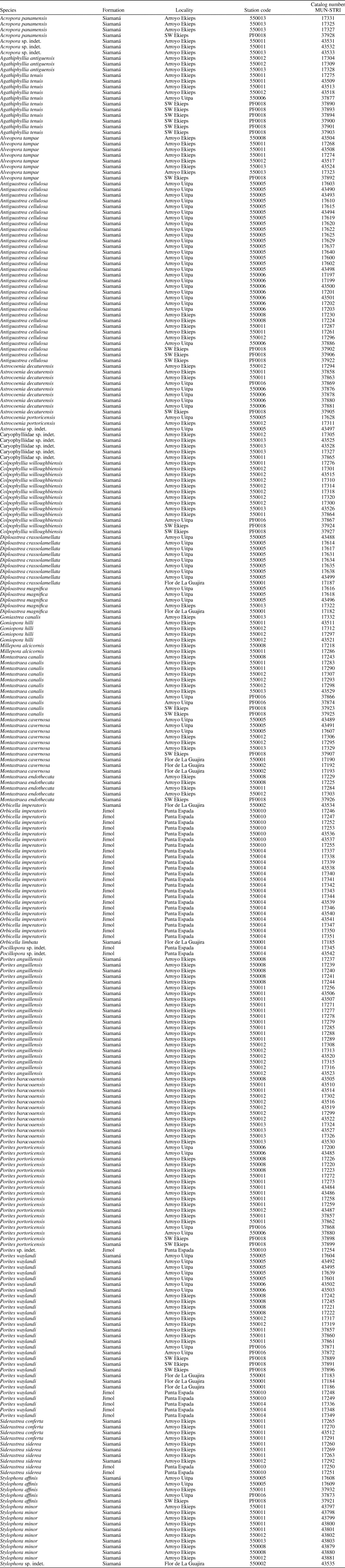
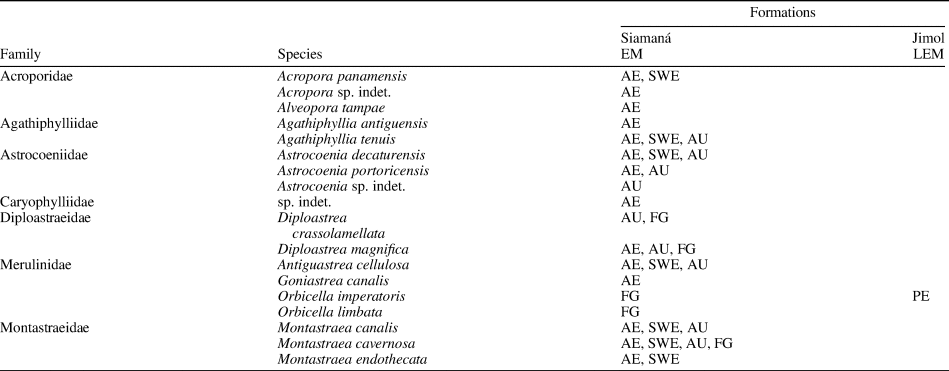
Integrating the information of Flórez et al. (Reference Flórez, Zaptata-Ramírez and Klaus2018) (species list Appendix 3) and that reported in this study, 272 total lots were collected from the Siamaná (239 lots) and Jimol (33 lots) formations (Appendix 2). The specimens were classified into two orders (Scleractinia and Anthoathecata), 12 families, 15 genera, and 26 species. Of the 32 total morphospecies, 81% were identified at the species level with the remainder left unidentified due to recrystallization and poor preservation of the coral skeleton.
Overall, the faunal composition was dominated by species of Porites, Montastraea, Orbicella, and Antiguastrea. They were common species in shallow-water paleoenvironments, 2–30 m of depth, in protected and low-energy environments, during the late Oligocene to early Miocene in the Caribbean region (Budd et al., Reference Budd, Johnson and Edwards1995; Budd, Reference Budd2000; Johnson et al., Reference Johnson, Sánchez-Villagra and Aguilera2009).
From the Siamaná Formation (Aquitanian–Burdigalian), the Arroyo Ekieps locality, one of the youngest (Flórez et al., Reference Flórez, Zaptata-Ramírez and Klaus2018, fig, 2), exhibited the highest number of morphospecies (25) (Table 1, Appendix 3). The assemblages were made up by species of massive colony shapes such as Porites, Montastraea, Siderastrea, and Agathiphyllia, which built extensive structures, often accompanied by Colpohyllia willoughbiensis and Alveopora tampae. In addition, there were other non-frame-building species, such as Caryophylliidae sp. indet. and Stylophora minor. Flor de La Guajira, the oldest locality studied in the Siamaná Formation, had the lowest species richness of the formation, and was constituted by the species Orbicella limbata, O. imperatoris, Diploastrea crassolamellata, D. magnifica, Montastraea cavernosa, Porites waylandi, and Stylophora sp. Within the Jimol Formation (Burdigalian), low-diversity patch reefs were common, with assemblages dominated by the species O. imperatoris, Siderastrea siderea, Porites sp. indet., P. waylandi, and Pocillopora sp. indet.
Coral species from the Siamaná Formation show affinities with Caribbean late Oligocene formations, such as the Antigua Formation of Antigua (Johnson, Reference Johnson, Hubmann and Piller2007) and the Lares Formation of Puerto Rico (Frost et al., Reference Frost, Harbour, Beach, Realini and Harris1983). Sixteen species were common in the three formations (Flórez et al., Reference Flórez, Zaptata-Ramírez and Klaus2018, table 4), while Alveopora tampae, Diploastrea magnifica, Montastraea cavernosa, Orbicella limbata, Porites anguillensis, Siderastrea siderea, Stylophora affinis, Stylophora minor, and Millepora alcicornis were exclusive to the Siamaná Formation. Other units with similar coral composition include the early Miocene Castillo and San Luis formations of the Falcón Basin in Venezuela (Johnson et al., Reference Johnson, Sánchez-Villagra and Aguilera2009), in which seven species were common (Flórez et al., Reference Flórez, Zaptata-Ramírez and Klaus2018, table 4). Acropora panamensis, Astrocoenia decaturensis Vaughan, Reference Vaughan1919, Goniopora hilli, Montastraea endothecata, Porites anguillensis, Siderastrea siderea, Stylophora minor, and Millepora alcicornis were only present in the Siamaná Formation. In addition, despite the geographic and temporal proximity of the Culebra Formation from Panama (Johnson and Kirby, Reference Johnson and Kirby2006), the species composition differs (Flórez et al., Reference Flórez, Zaptata-Ramírez and Klaus2018, table 4). Although both have 13 species in common, 19 were exclusive to the Culebra Formation, and 13 to the Siamaná Formation. Only a few similarities can be found at the species level with early Miocene shallow-water corals from the Indo-Pacific and the Mediterranean Sea. Only Porites cf. baracoaensis is reported in the Indo-Pacific (Bromfield, Reference Bromfield2013, p. 21), while at the genus level, Porites and Acropora occur in the Mediterranean and in the Indo-Pacific (Bromfield, Reference Bromfield2013; Santodomingo et al., Reference Santodomingo, Wallace and Johnson2015b).
The low diversity in the Jimol Formation is in part due to scant sampling. More collections of this formation are needed in order to improve the data of the late early Miocene. This will help to increase understanding of the patterns of the faunal change during the early Miocene.
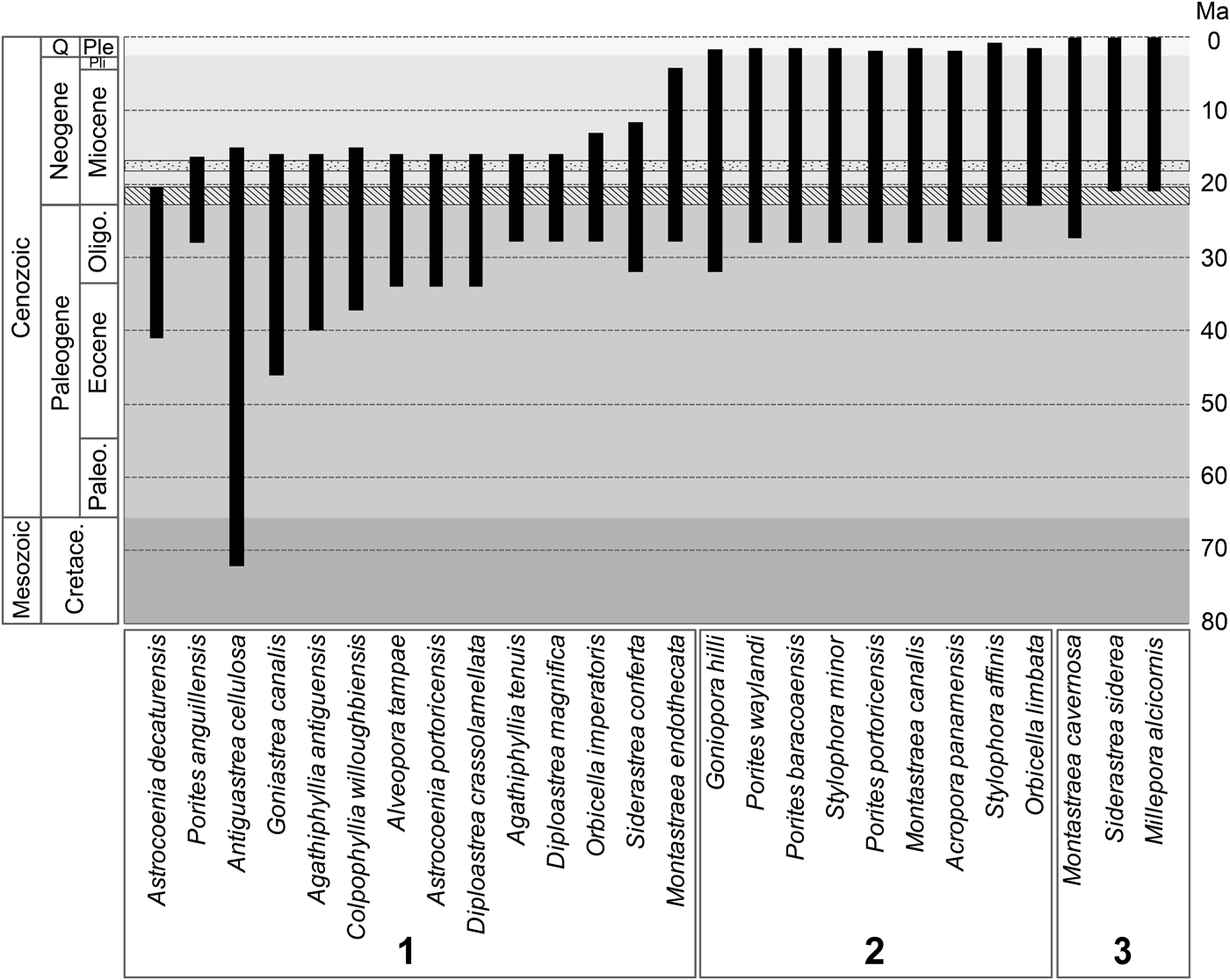
The majority of identified species of the Siamaná and Jimol formations appeared in the Eocene and Oligocene (Fig. 5), with the possible exception of Antiguastrea cellulosa, which is reported from the late Cretaceous (Baron-Szabo et al., Reference Baron-Szabo, Schafhauser, Götz and Stinnesbeck2006), and Orbicella limbata, Siderastrea siderea, and Millepora alcicornis, which first occurred in the early Miocene (Jung, Reference Jung1971; Frost and Langenheim, Reference Frost and Langenheim1974; Weisbord, Reference Weisbord1974; Geister, Reference Geister1975; Johnson et al., Reference Johnson, Sánchez-Villagra and Aguilera2009), and were components of the coral fauna turnover after the extinction of the late Oligocene. The finding of Siderastrea siderea and Millepora alcicornis in the Siamaná Formation extends their temporal record to early Miocene, as well as confirms their presence in the southern Caribbean. In general, the species of the Siamaná and Jimol formations were common in the Caribbean region during the Oligocene to Miocene transition, and most of them are now extinct (Budd et al., Reference Budd, Stemann and Johnson1994) (Fig. 5).
Range chart of first and last occurrence in the Greater Caribbean of species recorded in this study and in Flórez et al. (Reference Flórez, Zaptata-Ramírez and Klaus2018). The interval of sloping lines indicates the estimated stratigraphic range for the reef units studied in the Siamaná Formation, ca. 23.03–20.44 Ma (Silva et al., Reference Silva-Tamayo, Lara, Nana Yobo, Erdal, Sanchez and Zapata-Ramírez2017), and the interval of dotted fill indicates the Jimol Formation, ca. 16.7–17.9 Ma (Hendy et al., Reference Hendy, Jones, Moreno, Zapata and Jaramillo2015; Moreno et al., Reference Moreno, Hendy, Quiroz, Hoyos, Jones, Zapata, Zapata, Ballen, Cadena, Cárdenas, Carrillo-Briceño, Carrillo, Delgado-Sierra, Escobar, Martínez, Martínez, Montes, Moreno, Pérez, Sánchez, Suárez, Vallejo-Pareja and Jaramillo2015). Boxes: (1) Species extinct at the end of the early Miocene and in the middle Miocene, (2) species extinct in the late Pliocene and Pleistocene, and (3) extant species. Source references of stratigraphic units, countries and ages are provided in Flórez et al. (Reference Flórez, Zaptata-Ramírez and Klaus2018, table 3).

Fourteen of the 26 species identified in the Siamaná and Jimol formations (Fig. 5) became extinct at the end of the early Miocene (Burdigalian) and in the middle Miocene (Fig. 5, box 1), nine persisted until the Pliocene and the Quaternary (Fig. 5, box 2), and the remaining three, the scleractinians Montastraea cavernosa and Siderastrea siderea, and the hydrocoral Millepora alcicornis (Fig. 5, box 3), are extant and widespread in the Caribbean (Foster, Reference Foster1980; Calder, Reference Calder1988; Budd et al., Reference Budd, Stemann and Johnson1994). These peaks of extinction were highly significant to the coral biodiversity in the Caribbean region during the Cenozoic (Budd, Reference Budd2000; Johnson et al., Reference Johnson, Jackson and Budd2008; Budd et al., Reference Budd, Klaus and Johnson2011). Johnson et al. (Reference Johnson, Jackson and Budd2008) estimated reductions of 40% of species during the early Miocene, and 50% in the Pliocene–Pleistocene transition. According to Edinger and Risk (Reference Edinger and Risk1994) and von der Heydt and Dijkstra (Reference von der Heydt and Dijkstra2006), the causes of the earlier extinction were changes in water quality, such as a drop in temperature and increased turbidity and nutrients, due to increased upwellings. The second peak coincides with changes in oceanic circulation patterns and climate in the Caribbean, promoted by the uplift and closing of the Central American Isthmus, which caused a rise in surface productivity, and the inception of the Northern Hemisphere glaciation (Jackson et al., Reference Jackson, Budd, Pandolfi, Jablonski, Erwin and Lipps1996; Allmon, Reference Allmon2001; Budd et al., Reference Budd, Klaus and Johnson2011), as well as new events of upwelling (Prange and Schulz, Reference Prange and Schulz2004).
The low species richness, 32 morphospecies and 15 genera found in the Siamaná and Jimol formations, agrees with the low diversity described by Budd (Reference Budd2000), Budd et al. (Reference Budd, Johnson and Edwards1989, Reference Budd, Johnson and Edwards1995), Johnson and Kirby (Reference Johnson and Kirby2006), and Johnson et al. (Reference Johnson, Jackson and Budd2008) for the early to middle Miocene interval in the Caribbean. However, the capacity to develop reefs does not depend on high species diversity of reef-building corals (Johnson et al., Reference Johnson, Jackson and Budd2008). As was observed in the Arroyo Ekieps locality, a significant coral framework was developed, built by relict species from the late Oligocene, and the new fauna from the early Miocene.
Acknowledgments
Financial support of this research was provided by grants from Colciencias, project code 7277-569-33195. PF is supported by the scholarship ‘Doctorados en el Exterior 2015-Colciencias’. We acknowledge the additional financial support of Ecopetrol S.A., Smithsonian Tropical Research Institute, University of Zurich, Universidad del Norte, Universidad de Granada, NSF (Grant EAR 0957679), National Geographic Society, Anders Foundation, 1923 Fund, and G.D. and J. Walston Johnson. Special thanks to J.C. Braga, C. Jaramillo, and the anonymous reviewers. Thanks to A. Budd for sharing the species distribution information with us, I. Sánchez for her help with the SEM image acquisition, and S. Montes for thin section preparations. We also thank the Wayúu community, ARES, V. Pretković, C. Montes, and their students for their help in the field.
Appendix
Geographical coordinates of the localities and stations studied. Estimation of the age of the Siamaná Formation was carried out by Silva-Tamayo et al. (Reference Silva-Tamayo, Lara, Nana Yobo, Erdal, Sanchez and Zapata-Ramírez2017) based on strontium isotopes in coralline algae. Age determination of the Jimol Formation was performed by Hendy et al. (Reference Hendy, Jones, Moreno, Zapata and Jaramillo2015) and Moreno et al. (Reference Moreno, Hendy, Quiroz, Hoyos, Jones, Zapata, Zapata, Ballen, Cadena, Cárdenas, Carrillo-Briceño, Carrillo, Delgado-Sierra, Escobar, Martínez, Martínez, Montes, Moreno, Pérez, Sánchez, Suárez, Vallejo-Pareja and Jaramillo2015) through biostratigraphic analysis and strontium isotopes in mollusk shells. Samples of Flor de La Guajira are reworked material.

Coral specimens collected in the Siamaná and Jimol formations, from Cocinetas Basin in La Guajira Peninsula, northern Colombia.

Species list recorded by Flórez et al. (Reference Flórez, Zaptata-Ramírez and Klaus2018) in the Cocinetas Basin, and localities where they were found. Siamaná EM (early Miocene) localities: AE, Arroyo Ekieps; SWE, SW Ekieps; AU, Arroyo Uitpa; FG, Flor de La Guajira. Jimol LEM (late early Miocene): PE, Punta Espada locality.