Introduction
Depression is a common mental disorder. According to the World Health Organization, in 2012 approximately 350 million people suffered from depression worldwide. Mental disorders and the psychological effects of substance abuse accounted for 183.9 million disability-adjusted life years (DALYs), or 7.4% of all DALYs globally (Whiteford et al., Reference Whiteford2013). Depressive disorders represented 40.5% of DALYs caused by mental and substance use disorders (Whiteford et al., Reference Whiteford2013). Depression is a serious public health problem with increasing prevalence, and is a major contributor to the global burden of disease (Yang et al., Reference Yang2013).
Depression is commonly associated with a number of chronic diseases, and is most strongly linked with diabetes (Thomas et al., Reference Thomas, Jones, Scarinci and Brantley2003; Kalantari et al., Reference Kalantari, Jafarinezhad and Zohrevand2014). People with diabetes have twice the risk of having depression or serious psychological distress as those without diabetes (Anderson et al., Reference Anderson, Freedland, Clouse and Lustman2001; Li et al., Reference Li2009). Patients suffering from diabetes combined with depression have significantly more sick days, longer hospital stays and more frequent hospital admissions compared to people with diabetes alone (Vamos et al., 2009). In addition, people with co-morbid diabetes and depression have significantly reduced quality of life (Liu et al., Reference Liu, Maier, Hao, Chen, Qin and Huo2013; Shah et al., Reference Shah, Mezzio, Ho and Ip2015). Compared to people with either diabetes or depression, people with co-morbid diabetes and depression are at a higher risk for all-cause mortality (Katon et al., Reference Katon2005; Zhang et al., Reference Zhang, Norris, Gregg, Cheng, Beckles and Kahn2005).
The prevalence of people with diabetes is estimated to increase from 382 million (8.3%) in 2013, to 592 million (10.1%) in 2035 (International Diabetes Federation, 2015). Diabetes can cause premature morbidity and mortality, reduce life expectancy, and increase financial and other costs at the individual and government levels. China faces a diabetes epidemic, with 11.6% of the adult population (113.9 million Chinese adults) having the disease. The prevalence is highest in the middle aged and older population (Xu et al., Reference Xu2013).
The relationship between diabetes and depression is bidirectional and complex (Renn et al., Reference Renn, Feliciano and Segal2011). One line of research suggests that depression is a risk factor for the development of diabetes (Engum, Reference Engum2007). Another line of study indicates that depression is a consequence of diabetes (Maraldi et al., Reference Maraldi2007; Golden et al., Reference Golden2008). Furthermore, known diabetes has significantly higher depression scores than unknown diabetes (Olvera et al., Reference Olvera, Fisher-Hoch, Williamson, Vatcheva and McCormick2015). A diabetes diagnosis may be associated with depression in diabetic patients (Mezuk et al., Reference Mezuk2013; Olvera et al., Reference Olvera, Fisher-Hoch, Williamson, Vatcheva and McCormick2015). The incidence of depression is elevated in subjects undergoing treatment for diabetes compared to subjects with normal fasting glucose and those with untreated diabetes (Golden et al., Reference Golden2008). Treatment could be associated with the difference in depression between known and unknown diabetes. However, another study shows no significant difference in depression is observed between known and unknown diabetes (Meurs et al., Reference Meurs, Roest, Wolffenbuttel, Stolk, de Jonge and Rosmalen2015). There are inconsistent findings as to depression between known and unknown diabetes.
Recent studies show that the prevalence of depression is 28.8% among diabetic patients in Korea (Park et al., Reference Park, Kim, Gil, Park, Park and Kim2015) and 49.6% in Saudi Arabia (EI Mahalli et al., Reference El Mahalli2015). In China, the prevalence of depression in people with diabetes was 44.2% in Beijing (Liu et al., Reference Liu, Maier, Hao, Chen, Qin and Huo2013), and 35.1% in Shanghai (Wang et al., Reference Wang, Song, Chen, Wang and Ling2015). However, these studies focused on the prevalence of depression among patients who know that they have diabetes, also were focused on one city in China. A better understanding of differences and associated factors of depression between patients with unknown diabetes and known diabetes could draw more attention to possible development in depression among people with unknown diabetes.
The aims of this study were to observe the differences in prevalence of depression between people with unknown diabetes and known diabetes in a nationally representative sample from China, and explore factors associated with the differences in depression.
Methods
Study design
Data were from the CHARLS, which collected high quality data on a nationally representative sample of Chinese residents aged 45 and older to enable research on older adults. CHARLS is based on the Health and Retirement Study (HRS) in US and related aging surveys such as the English Longitudinal Study of Aging (ELSA) and the Survey of Health, Aging and Retirement in Europe (SHARE). The pilot survey of CHARLS was conducted in two provinces (Gansu and Zhejiang) in 2008, and returned high quality data (Strauss et al., Reference Strauss2010; Zhao et al., Reference Zhao, Strauss, Park and Sun2013), and was subsequently expanded to the national baseline survey, conducted in 2011. Our analysis uses data from the national baseline survey. Ethics approval for the baseline data collection was obtained from the Biomedical Ethics Review Committee of Peking University (IRB00001052-11015).Ethics approval for the use of CHARLS data was obtained from the University of Newcastle HREC (H-2015-0290).
CHARLS adopts a multi-stage stratified PPS (probability-proportional-to-size) sampling. The sample was stratified by province and within province by urban districts or rural counties, and by per capita gross domestic product. Included were 150 counties and 450 villages/resident committees in 28 provinces, and 17,708 individual participants were personally interviewed using a face-to-face computer-assisted process. Each participant signed an informed written consent form before the survey was administered. The survey has been described in detail elsewhere (Strauss et al., Reference Strauss2010; Zhao et al., Reference Zhao, Strauss, Park and Sun2013; Zhao et al., Reference Zhao, Hu, Smith, Strauss and Yang2014).
Primary variables measure and definition
Blood sample collection
After completing the individual interviews, respondents were invited to attend either a township hospital or a local office of the China Center for Disease Prevention and Control (CDC) for collection of venous blood by a medically-trained nurse. Respondents were asked to fast overnight before blood collection; if they had not been fasting, this was recorded. Blood samples of 11,847 individuals were collected, separated into plasma and red blood cells, stored and transported to the China CDC at −20°C, where they were kept at −70°C. The blood was analyzed for glucose concentration via an enzymatic colormetric test at the Youanmen Center for Clinical Laboratory of Capital Medical University. The limit of detection was <2 or >450 mg/dL, and the coefficient of variation (CV) was 0.90% within assay and 1.80% between assays.
Definition of diabetes
Participants who reported a history of physician-diagnosed diabetes were considered to have known diabetes, and those without a history of physician-diagnosed diabetes or use of anti-diabetic medication but had a fasting plasma glucose of 7.0 mmol/L (126 mg/dL) or higher, or 2-hour plasma glucose of 11.1 mmol/L (200 mg/dL) or higher were considered to have unknown diabetes.
Depression assessment
Depression was evaluated using the 10-item Center for Epidemiologic Studies Depression Scale (CESD-10), which has been identified as a valid, reliable, and useful mental health assessment tool for older people in China (Boey Reference Boey1999; Chen and Mui, Reference Chen and Mui2014). Participants were asked about the number of days they experienced every item during the previous week. Respondents reported the frequency of occurrence of each negative effect item on a four-point scale: 0 (rarely or none of the time; less than 1 day), 1 (some of the time; 1–2 days), 2 (much or a moderate amount of the time; 3–4 days), or 3 (most or all of the time; 5–7 days). The two positive effect items were reversed when using the four-point scale. The scores of the CESD-10 range from 0 to 30 (Cronbach's alpha = 0.809 in this study). Previous studies show that a score of 10 on the CESD-10 had reasonable levels of sensitivity (0.85) and specificity (0.80) in Chinese older adults (Boey, Reference Boey1999). Hence, a score of 10 on the CESD-10 was used as the cut-off point to identify those who were depressed and not depressed (Andresen et al., Reference Andresen, Malmgren, Carter and Patrick1994). The CESD-10 has been described in detail elsewhere (Boey, Reference Boey1999; Chen and Mui, Reference Chen and Mui2014).
Other variables
Education level was allocated into three categories: primary school and below (illiterate, did not finish primary school but capable of reading and/or writing, Sishu/home school, elementary school), high/vocational school (middle school, high school, vocational school), and college and above (two-/three-year college/associate degree, four-year college/bachelor's degree, master's degree, and doctoral degree). Gender includes male and female. Marital status was allocated into two categories: married and other marital status (separated, divorced, widowed, or never married). Body Mass Index (BMI) was defined as weight in kilograms divided by height in meters squared (kg/m2). In this study, participants were classified as underweight, normal weight, overweight, or obese based on WHO suggestions for Chinese people (underweight: ≤18.5 kg/m2, normal: 18.5 kg/m2–24 kg/m2, overweight/obese≥24 kg/m2, respectively). We categorized patients with known diabetes into six groups based on medication treatments (none of medication treatment, TCM alone, oral WM alone, insulin alone, TCM plus WM and/or insulin, and WM plus insulin). Data were also collected on non-communicable chronic diseases (NCDs) or chronic conditions other than diabetes, namely hypertension, dyslipidemia, cancer, or malignant tumor, chronic lung diseases, liver disease, heart attack, stroke, kidney disease, stomach or other digestive disease, emotional or psychiatric problems, and arthritis or rheumatism. Total number of NCDs except for diabetes was used as a predictor variable for further analysis. None of other NCDs refers to participants have no any NCDs except for diabetes.
Statistical analysis
Statistical analyses were performed with SPSS 17.0. The Pearson χ2 test was used for the comparison of categorical variables. Multiple logistic regression analysis was applied to estimate the OR for depression in different treatments. A p value less than 0.05 was considered statistically significant.
Results
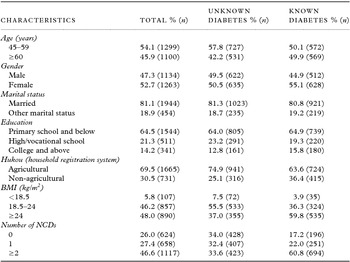
Overall, of 17,708 total participants, 2,399 individuals with diabetes aged ≥45 years were included in the analysis. Among these, 47.6% individuals were known to have diabetes and 52.4% individuals were unaware of their diabetes; 47.3% of participants were men and 52.7% were women; and 81.1% of participants were married. There were 65.4% participants with primary school and below education, 21.3% with high/vocational school education, and 14.2% with college or higher education. The average age was 60.1 years ranging from 45 years old to 101 years old. Specific characteristics classified by unknown diabetes and known diabetes, are summarized in Table 1.
Characteristics of the participants classified by unknown and known diabetes groups

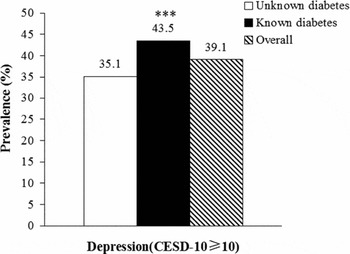
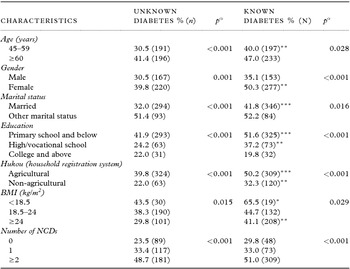
Of participants with diabetes, 39.1% met the CESD-10 criteria for depression (Figure 1). The prevalence of depression was significantly higher (p < 0.001) in people with known diabetes (43.5%) than those with unknown diabetes (35.1%). The prevalence of depression in participants grouped according to different characteristic among patients with unknown diabetes or known diabetes is shown in Table 2. Regardless of their diagnosis status, diabetic participants who were older, women, underweight, of other marital status, of lower education level, of agricultural Hukou and had other NCDs reported higher levels of depression than those who were young, man, overweight or obese, married, of higher education level, of non-agricultural Hukou and had no other NCDs. Furthermore, we examined the differences between unknown diabetes and known diabetes by age, gender, marital status, education, Hukou, BMI, and NCDs status. As shown in Table 2, the significant differences between unknown and known diabetes were found in the middle aged, in women, in the less educated, in married people and in those with abnormal BMI. People with known diabetes had a slightly greater prevalence of depression than those with unknown diabetes (29.8% vs. 23.5%) in none of other NCDs, but differences failed to reach statistical significance (p = 0.076).
Prevalence of depression among people with unknown diabetes and known diabetes. There were significant differences in depression for known diabetes in comparison with unknown diabetes. ***p < 0.001.

Prevalence of depression in participants grouped according to different characteristics (N = 2399)

NCDs: non-communicable chronic diseases; other marital status: separated, divorced, widowed, never α p value is for the comparison between characteristics
* p < 0.05.
**p < 0.01.
***p < 0.001 for known diabetes versus unknown diabetes.
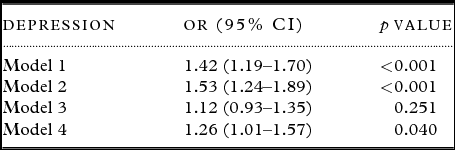
To account for the role of different socio-demographic factors or number of NCDs between unknown and known diabetes in group opportunities for depression, we estimated a multivariate logistic model for depression. Table 3 shows the association of depression according to different diabetic groups. People with known diabetes had significantly greater odds of depression (OR = 1.42, 95% CI 1.19–1.70) compared with those with unknown diabetes in a crude model (Table 3). Difference became big after adjusting for age, gender, marital status, education, Hukou and BMI (OR = 1.53, 95% CI 1.24–1.89), but it became small after adjusting for number of NCDs (OR = 1.12, 95% CI 0.93–1.35). In the final model, Differences were attenuated, but remained significantly greater after adjustment for age, gender, marital status, education, Hukou, BMI, and number of NCDs (OR = 1.26, 95% CI 1.01–1.57).
Logistic regression models for depression classified by unknown and known diabetes groups

Multiple logistic regression analysis was applied to estimate the odds ratio (OR) for depression in diabetes groups, unknown diabetes as reference. Model 1: crude model. Model 2: adjusted for age, gender, marital status, education, Hukou and BMI. Model 3: adjusted for number of NCDs. Model 4: adjusted for number of NCDs based on model 2.
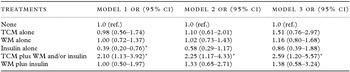
Additionally, we examined whether treatments received can affect depression levels in people with known diabetes. As shown in Table 4, compared with participants without medication treatment, those who received insulin alone had a significantly lower prevalence of depression (OR = 0.39, 95% CI 0.20–0.76). However, the association no longer applied after controlling for age, gender, marital status, education, and Hukou (OR = 0.58, 95% CI 0.29–1.17). Participants who received TCM alone or WM alone had no significant difference in depression (OR = 0.98, 95% CI 0.56–1.74; OR = 1.00, 95% CI 0.72–1.37, respectively). Nevertheless, participants treated with TCM coupled with WM and/or insulin were at higher odds of having depression compared to those without treatment (OR = 2.10, 95% CI 1.13–3.92). Further adjustment for age, gender, marital status, education, Hukou, BMI, and the number of other NCDs did not affect the associations.
Effects of medication treatment on depression of Chinese middle aged and older adults with known diabetes

TCM: Traditional Chinese Medicine; WM: oral Western Medicine. Multiple logistic regression analysis was applied to estimate the odds ratio (OR) for depression in predictor variables. Model 1: crude model. 2: adjusted for age, gender, marital status, education and Hukou. Model 3: adjusted for BMI and number of NCDs based on model 2.
*p < 0.05.
Discussion
This study is an analysis of the differences in depression between participants with unknown diabetes and those with known diabetes aged 45+ in a nationally representative population sample in China. Findings indicated that 39.1% of participants with diabetes had depression. This result is similar to the prevalence reported in other studies (Liu et al., Reference Liu, Maier, Hao, Chen, Qin and Huo2013; Niraula et al., Reference Niraula2013; Wang et al., Reference Wang, Song, Chen, Wang and Ling2015). Compared to those with unknown diabetes, people with known diabetes had significantly higher prevalence of depression (43.5% vs. 35.1%, p < 0.001).
People with known diabetes had been diagnosed and were aware of their clinical condition before the study. The diabetes label could be associated with an increase of depression in those with known diabetes. Although there is no evidence that a clinical diagnosis of depression in patients with diabetes is a reaction to the knowledge rather than the disease itself (Lustman et al., Reference Lustman, Griffith and Clouse1988), the assumption of the illness label and sick role has been associated with depression in other studies of chronic diseases (Cohen and Lazarus, Reference Cohen, Lazarus, Stone, Cohen and Adler1979; Mishler, Reference Mishler, Amarasingham and Osherson1981). Diabetes is one of the most common NCDs globally, cannot be cured and requires lifelong treatment. People with diabetes often report feelings of fear, anger, resentment, depression, and devastation at the time of diagnosis (Gazmararian et al., Reference Gazmararian, Ziemer and Barnes2009). Taken together, knowledge of having diabetes may contribute to developing depression in Chinese middle aged and older adults.
Among people with diabetes, women had higher prevalence of depression than men; and depression differed between unknown and known diabetes for women but not for men. An eight year prospective study shows that worsening of depression was associated with female gender among diabetes (Trento et al., Reference Trento2015). Gender may be a risk factor for psychological distress among diabetic patients and special attention is required for women diabetics to prevent depression. Low level of education is correlated with high depression in diabetes. This is consistent with an earlier study (Engum et al., Reference Engum, Mykletun, Midthjell, Holen and Dahl2005). Recently, Trento et al., (Reference Trento2015) also demonstrate that lower education level at baseline is associated with significantly higher depression scores among diabetes. When the subjects are newly diagnosed as diabetes, screening, and specific intervention for depression should be provided to women and those with low educational level.
Diabetes often results in an isolating lifestyle and conflicts within the family (Gazmararian et al., Reference Gazmararian, Ziemer and Barnes2009). However, subjects with known diabetes who were married had less depression compared to those with any other marital status. We also observed that married people had higher prevalence of depression in known diabetes compared with unknown diabetes, but knowledge of diabetes was not related to depression for any other marital status. There might be some changes in behaviors in family life or attitudes towards family life for middle aged and older people in China when adjusting to a diagnosis of diabetes, and these changes could bewilder the patients and lead to higher risk of depression. For example participants with known diabetes acknowledged that the diabetes diagnosis resulted in a change in the types of food eaten (Gazmararian et al., Reference Gazmararian, Ziemer and Barnes2009) so that they may no longer be able to enjoy meals with family. Compared to married participants, unmarried participants may live alone and don't need to accommodate their spouses. Therefore, it may be easier for this group to make changes in their lifestyle, leading to lower levels of depression.
We also found significant differences in depression between participants with unknown diabetes (35.1%) and participants with known diabetes who did not receive any medication treatment (42.9%; p = 0.027). The present study shows that participants who received TCM alone, or WM alone had no significant difference in depression. However, treatment with insulin alone had a lower risk of depression in an unadjusted model. This effect may be associated with the demographic characteristics (e.g. there are more male and more non-agricultural Hukou in the group receiving insulin alone than other groups, indicating less depression). Therefore, the association vanished after further controlling for demographic variables. A recent study in Palestine showed that insulin use and number of anti-diabetic medications taken were not associated with a higher risk of depression (Sweileh et al., 2014). However, a study from USA reported that insulin (including insulin alone or in addition to oral hypoglycemic medication), rather than oral medicine was associated with a higher risk of depression (Katon et al., Reference Katon2004). It is worth noting that patients who received TCM coupled with WM and/or insulin treatments had higher odds of depression than those without any treatment in known diabetes in the present study. Integrated strategies incorporating both TCM and WM for treating diabetes could be associated with an increase in the risk of depression. Early and intensive treatment can influence patients' psychological outcomes, causing relatively more anxiety in the first year after diagnosis (Thoolen et al., Reference Thoolen, de Ridder, Bensing, Gorter and Rutten2006).
Depression is commonly associated with a number of chronic diseases (DeJean et al., Reference DeJean, Giacomini, Vanstone and Brundisini2013; Kalantari et al., Reference Kalantari, Jafarinezhad and Zohrevand2014; Ma et al., Reference Ma2015) and this in turn may affect the self-management of the conditions (DeJean et al., Reference DeJean, Giacomini, Vanstone and Brundisini2013).In this study, we also observed that a significantly higher prevalence of depression was accompanied by an increased number of NCDs in participants with unknown diabetes and known diabetes. After controlling for the number of NCDs, differences between unknown diabetes and known diabetes were also attenuated. Compared with those with unknown diabetes, people with known diabetes had greater proportion of having NCDs in this study. However, significant differences in depression were not observed between unknown diabetes and known diabetes in those with NCDs. Participants with known diabetes had slightly greater prevalence of depression than those with unknown diabetes (29.8% vs. 23.5%) in none of other NCDs, but differences failed to reach statistical significance. This could be associated with limitation of sample size without other NCDs. People who are newly diagnosed as having diabetes without NCDs should be considered for strategies prevent depression.
A limitation of our study is that the analysis was made using cross-sectional data; therefore a causal relationship between various variables and depression in diabetic patients cannot be established. A further longitudinal study is needed to ascertain the effects of these factors on depression in middle aged and older Chinese adults with diabetes.
In conclusion, the prevalence of depression is significantly higher for people with known diabetes than those with unknown diabetes, especially the middle aged, women, and the less educated. This difference may be associated with the knowledge of having diabetes, treatments and other NCDs.
List of abbreviations
CHARLS: China Health and Retirement Longitudinal Study; CESD-10: the 10-item Center for Epidemiologic Studies Depression Scale; BMI: Body Mass Index; NCDs: non-communicable chronic diseases; TCM: Traditional Chinese Medicine; WM: oral Western Medicine; OR: Odds Ratio; CDC: Center for Disease Prevention and Control.
Conflict of interest declaration
None.
Description of authors’ roles
HL and MZ conducted the analyses and wrote the manuscript; MZ and JH conceived the study and were involved in the discussions of the results of the data analysis. XX and XW provided guidance to carry out the data analysis and reviewed the manuscript. All authors read and approved the final manuscript.
Acknowledgments
Collection of the CHARLS data was supported by funding from Peking University, the National Natural Science Foundation of China, the Behavioral and Social Research Division of the National Institute on Aging, and the World Bank. We acknowledge the CHARLS research team for collecting high quality, nationally representative data, and for making the data public. We acknowledge Ms Claudia Koller for editing this article. The work was supported by National Natural Science Foundation of China (81373100).