Introduction
This article examines Britain's policy towards the welfare and comforts of its Nigerian forces deployed for service overseas during the Second World War, up to their demobilisation in 1947. It is a neglected theme in the historiography of Africa and the Second World War. Indeed, much has been written about Africa and the war, both in terms of the general treatment of the issue and local studies of military recruitment in individual colonies, particularly British colonies in Southern and East Africa.Footnote 1 However, studies of the war, with a focus on Nigeria, emphasise economic and win the war exertions, including fund-raising efforts dedicated to the victory of Britain and its allies. Some of the efforts were focused on war charities for the comfort of European troops and civil populations displaced by the German blitzkrieg.Footnote 2 Nigerian scholars thereby neglect the equally important issue of troops’ morale, which comes under the rubrics of comforts and welfare. Among these could be mentioned the provision of entertainment, refreshments, including cigarettes and alcohol, and games, healthcare, religious and spiritual care; rations, allowances, access to sex, periodicals and newspapers conveying news about home, and other mundane things that psychologically equip soldiers to fight and win battles far away from home. These assorted comforts for troops transcended national borders and were sometimes delivered to soldiers, even by women and voluntary groups.Footnote 3 To this end the Nigerian government constituted a Nigerian Forces Comforts Fund in 1940. The discharge of this responsibility, however, often entailed a struggle for supremacy between the military and civilian authorities over the funding and control of the comforts and welfare of servicemen, particularly during their overseas service.
The struggle reflected the fluid coordination between civilian colonial governors and the military authorities of the West Africa Command, based in the Gold Coast, under the leadership of General Sir George Giffard. It further reflected the policy differences between the Colonial Office and the War Office, which the two authorities were separately answerable to. Consequently, the War Cabinet established the office of the Resident Minister for West Africa in May 1942, “for purely temporary purposes.” Lord Swinton assumed the position in July 1942, with headquarters at Achimota College, Gold Coast. Ashley Jackson notes that “he was to provide top level coordination of the region's variegated war effort, liaising with the region's civilian and military commanders and communicating directly with London, cutting delays and overcoming difficulties among the various civil and military headquarters as they all sought to pull in a war-winning direction.”Footnote 4 He constituted the West African War Council, comprising West Africa's four governors and three service chiefs, to facilitate his assignment.
David Killingray shows that by the end of hostilities in 1945, altogether at least 121,652 Nigerian soldiers had served in the 164,850-strong British West African colonial armed forces.Footnote 5 Yet, as elsewhere in Africa, the important issue of the comforts and welfare of these troops in active service in various theatres, far away from their families and country of origin, has not received its deserved scholarly attention. On the other hand, the issue of soldiers’ high morale in the critical frontlines, especially when fighting prolonged battles far away from home, has received some scholarly attention outside Africa, such as the United States and Japan. For instance, an American study establishes a nexus between low morale, combat exhaustion, and battle outcomes among US ground combat troops in the European theatres during the Second World War. Consequently, the US Army liberally provided cigarettes and turned a blind eye to soldiers who were found drinking alcohol. Alcohol and smoking are said to have had a great impact on the soldier's morale, so “vital to his performance and survival.”Footnote 6
With respect to Japan, Hsu has suggested that about two hundred thousand comfort women from all over Asia were forced into prostitution by the government of Japan in comfort stations established as avenues for satisfying the sexual cravings of its soldiers.Footnote 7 Scholars note that comfort stations, first established in Shanghai by the Japanese government in 1932, served as “dens of government-licensed rape,” around Japanese military stations throughout Asia. The Japanese army treated sex like food and munitions, and used it to relieve its soldiers of stress. Comfort stations around soldiers’ operational bases afforded avenues for medical tests for comfort women who were treated to minimise incidences of debilitating sexually transmitted diseases among servicemen. They were expected to minimise the incidence of sexually transmitted diseases and rape of women in operational areas by soldiers denied the luxury of vacations.Footnote 8 However, the evidence shows that the comfort women system satisfied soldiers’ sexual pleasures but failed to prevent rape and the spread of sexually transmitted diseases among them.Footnote 9
For his part, Lieutenant-General Sir Oliver Leese, Commander-in-Chief, Allied Land Forces, South East Asia (ALFSEA), 12 November 1944 to the Japanese surrender on 15 August 1945, specifically mentions that “the introduction of the various women's services was both popular and successful.” In his view, the work done by different voluntary women's groups “was greatly appreciated by the troops of all the Allies.” This was “particularly owing to the total lack of amenities or even civilization to be found in the majority of the operational areas.” The issue was critical, given that the soldiers were not granted short leave because of the “length of time it took to send parties to and from India.” Discipline broke down over the delayed “repatriation and home leave” of the troops who “gave a good account of themselves in action.”Footnote 10
Kaushik Roy corroborates the breakdown of discipline among troops of the “British units stationed in Burma and India” due to their morale that “was on a downslide.” He makes the point that “rather than grand ideas like nationalism and anti-fascism, mundane factors like the supply of good rations, access to sex and service conditions, influence the morale and discipline of soldiers, and hence their combat-worthiness.”Footnote 11 Jackson, however, notes that tensions and unrest, including disobedience and riots, attended the demoralising, shabby treatment meted out to troops of Britain's Southern African High Commission Territories (HCT), both during their war service and prior to their delayed postwar demobilisation.Footnote 12
In his general survey, Timothy Parsons observes general frustrations and tensions among British African soldiers from their engagement in the East African campaign through their wartime services in Southeast Asia, up until their delayed repatriation at the end of hostilities. Poor rations and pay, restricted or denial of access to women for sex, racial discrimination (even against African prisoners of war [POWs] vis-à-vis their Italian counterparts in East Africa), racial insults, poor food and housing, unfulfilled promises of speedy postwar repatriation, nonpayment of pensions, including disability pensions, and unemployment of discharged soldiers were issues that promoted indiscipline among both service personnel and ex-servicemen. British African troops were worse hit in Burma where there was “mass insubordination.” As Parsons notes, “British military officers flatly denied that they had ever promised service pensions, and civil officials initially resisted making disability payments on the grounds that ‘tribes’ had a collective responsibility to look after their injured men.” In general, colonial French soldiers “fared substantially better than their English-speaking counterparts,” with some of the ex-servicemen winning “reserved civilian jobs, loans, subsidized housing, and more generous pensions.” On the other hand, British officials claimed that “ex-servicemen were not entitled to special benefits and cited higher metropolitan casualty rates and the German bombing of Britain to rebut claims that the empire owed a special debt to African soldiers.”Footnote 13
Other studies emphasise the role of chaplains in the provision of comforts for servicemen. In the absence of psychiatrists, chaplains constituted the soldier's only recourse for psychological problems. For instance, during the Second World War, the British Army introduced padre's hour, which afforded deployed soldiers the opportunity and avenue to have chaplains address their pressing problems. In fact, chaplains of various faiths helped in the maintenance of the psychological health of military personnel, as well as their spiritual and religious needs, in collaboration with medical officers.Footnote 14
The literature thus focuses on troops’ welfare and comforts, notably sexual services, health care, rations, mundane psychological boosts, including alcohol and cigarettes, religious and spiritual care, financial support as well as post-service benefits after delayed repatriation, with attendant tensions, riots, mutinies or threats of mutinies. What is missing in the literature, at least with respect to Nigeria, is a study that identifies and explains the nexus between the outward manifestations of troops’ comforts and welfare, and behind-the-scenes policy disagreements and frictions over funding in a wartime colonial society between the military and civilian authorities. This study addresses the issue, by examining imperial Britain's comforts and welfare policy towards its Nigerian soldiers on overseas service from 1940 to 1947. The study terminates in the first quarter of 1947, following demobilisation, when the Nigerian government questioned any further justification for continued welfare grants to the military from Nigerian taxpayers. It explains the genesis, objectives, contents, sources of funding, policy orientations, and the impact of the comforts and welfare scheme on Nigerian servicemen during the period. The study posits the argument that constant disagreements and, indeed a supremacy struggle between the military and the civil power adversely affected troops’ comforts and welfare. While the former tended to exert its authority, with attendant incessant demands for funds in disregard of due process and accountability, the latter was obsessed with transparency and financial prudence. As a consequence, disgruntled Nigerian forces, like their compatriots from other parts of the British Empire, became prone to postwar mutiny outside the shores of Nigeria. Their reaction elicited questions in the Commons, stretched the skill, patience, and diplomacy of their white officers, and lowered the prestige of the colonial power in the estimation of Nigerian servicemen. Even so, demobilised and disabled ex-servicemen were largely neglected by the colonial state.
The Genesis and Objectives of Nigerian Forces Comforts and Welfare Scheme
The Nigerian Forces Comforts Fund was inaugurated in 1940, on the heels of war funds devoted to the comforts of Britons and their allies, as well as the purchase of munitions of war. It was inspired by criticisms of the official obsession with Nigerian contributions to charities devoted to Europeans to the neglect of Nigerian forces serving overseas. For instance, the Nigeria War Relief Fund, inaugurated by Governor Bourdillon shortly after the outbreak of war in September 1939, had collected £210,999 before winding up in 1946.Footnote 15 Similarly, the Nigeria Win the War Fund was inaugurated in June 1940 after the Dunkirk evacuation, with attendant tremendous losses in men and material by the Allies, which preceded the capitulation of France.Footnote 16 France's capitulation to Germany, barely two weeks after the Dunkirk debacle, when the need for weapons was acute, had led the Nigerian Daily Times, with active government encouragement, to inaugurate the Nigeria Win the War Fund, on June 15, 1940. The objective of the fund was declared to be the purchase of a tank, or an airplane, for donation to the British Army. It was preceded by similar schemes in other parts of the British Empire, especially the Gold Coast, Nigeria's neighbour, as well as Malaya, Hong Kong, and Jamaica, which had made huge monetary contributions to the Imperial Government to purchase military equipment. Not only did Governor Bourdillon make regular broadcasts to urge support for war efforts, he also toured Nigerian provincial towns and publicised fund-raising activities by different communities and groups towards winning the war. Other colonial officials as well as the emergent Nigerian elite emulated him. Not even school pupils were exempt from fund-raising activities in support of the Win the War Fund. It had generated over £150,000 by October 1945, when it wound up. Dedicated to the purchase of munitions of war, the fund, among other accomplishments, fully equipped a Nigeria Air Squadron with twenty-five airplanes, which bore the names of Nigeria's twenty-three provinces, as well as Lagos and colony, namely Lagos Township and the Districts of Badagry, Epe and Ikeja.Footnote 17
Against this background, the Nigerian Troops Comforts Fund was inaugurated on 21 June 1940 on the heels of war funds devoted to the comforts of Britons and their allies, as well as the purchase of munitions of war. Nonetheless, the fund drew its initial impetus from concerns about the comforts and welfare of Nigerian troops deployed to Kenya, the troops’ operational base for the East African campaign. In the aftermath of Italy's entry into the war on the side of Nazi Germany on 10 June 1940, war erupted in East Africa. Italy had massed a large army of eighty thousand European troops and local African soldiers in East Africa, in all numbering about three hundred thousand. The large Italian army was armed with modern ammunition and munitions of modern warfare, including tanks and a large number of aircraft.Footnote 18 British manpower was thus stretched.Footnote 19 Due to the exigencies of the military situation in Italian East Africa, it was decided to engage Nigerian troops in the tropics and semitropical zones, ostensibly because they were accustomed to such climates. Nigerian forces “played a leading part in the defeat of the Italians,” and the return of Emperor Haile Sellasie to his throne in liberated Abyssinia “was marked by a guard of honour supplied by colonial Nigerian soldiers.”Footnote 20 Major Hennessy credits soldiers of the Twenty-Third Nigerian Infantry Brigade with “one of the most spectacular achievements of the Royal West African Frontier Force” during the East African campaign in March 1941. The Brigade, which comprised the First, Second, and Third Nigerian Battalions, commanded by Brigadier G. R. Smallwood, along with their Gold Coast counterparts, disembarked in July 1940 at the port of Mombasa, Kenya, from Lagos, Nigeria. Their first encounter with the Italians occurred at Mabungo bridgehead, which they successfully defended on 22 February 1941. On 26 February 1941, the Brigade entered Mogadishu without incident, taking two hundred and fifty prisoners. Fighting on the six hundred-mile Mogadishu-Harrar sector, the Brigade captured a complete Italian battalion, a number of machine guns, and altogether took about 1,100 prisoners. They subsequently constituted the vanguard of the Eleventh Division advance to Diredawa, as they did in the march on Addis Ababa, capital of Abyssinia. Ten thousand Italian soldiers were rounded up in the city in the aftermath of the formal surrender of General Mambuni, the Italian governor of the city, to General Wetherall, the Divisional Commander, on 6 April 1941. Even with the fall of Addis Ababa, which marked “the end of the Nigerians’ campaign in East Africa,” the “task of assisting the Emperor's forces to take over” in Addis Ababa still fell on the Nigerian Brigade.Footnote 21 In 1940–1941, Nigerians were, therefore, among the troops from West Africa who, in collaboration with their counterparts from East and South Africa, “drove back the Italians from the Kenyan border, conquered Italian Somaliland, took Addis Ababa and crushed Italian resistance in Abyssinia.”Footnote 22
Nigerian troops in East Africa, like their counterparts elsewhere, were availed the services of chaplains. Thus, it was the Archdeacon of Nairobi and Senior Chaplain to the Forces in East Africa, who disclosed that Nigerian troops were anxious for and especially desirous of district news from Nigeria, in African language newspapers and illustrated papers, as well as gramophone records.Footnote 23 They were also not satisfied with the quality of amenities provided for their comfort and recreation,Footnote 24 in a war situation in which it was impossible to grant leave to servicemen “to be spent beyond a certain distance from the theatre of operations.”Footnote 25 By the close of 1940, therefore, the Nigerian government had made a monthly remittance of £300 “for Red Cross purposes and comforts.” Yet, the General Officer Commanding requested for an initial contribution of a minimum of £2,500 to a welfare fund, to enable him to provide amenities that would “make the camp both attractive and useful as a place of recuperation.”Footnote 26 The Nigerian government made the payment promptly.Footnote 27
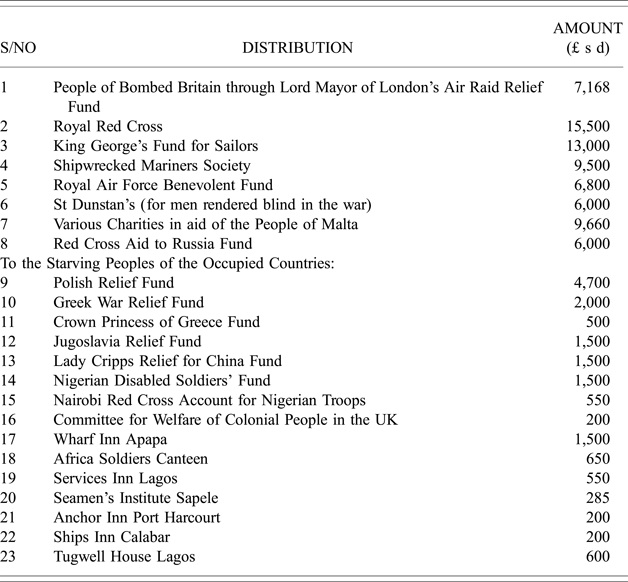
The comforts and welfare of Nigerian servicemen were centrally coordinated by the Nigerian Comforts Fund Committee (NCFC). However, it received unenthusiastic public support and subscription due to minimum publicity. Thus over one year after its inauguration, Nnamdi Azikiwe's influential nationalist West African Pilot of 4 September 1941 regretted that the fund had only received a paltry £6,181: 16s: 83d. This apparent lack of official enthusiasm for the fund caused the newspaper on 29 May1941, to urge “a Committee of African and European ladies and gentlemen to take up the challenge about funds for these dusky sons of Africa.” In its view, the brave troops, having distinguished themselves in East Africa “too, are worthy of the sympathy and charity which the people of Nigeria can afford to give.” Britain was awash with voluntary charities dedicated to the relief of suffering caused to Europeans by the war to which Nigerians had generously subscribed over £85,000 by 1943, as shown in Table 1.
Beneficiaries of Nigerian Contributions to Various War Relief Organisations, 1943.

Total 85,363. Source: Nigerian Daily Times, 23 October 1943, p.1.
A belated British response to the comforts and welfare challenge of Nigerian troops in East Africa came in March 1942. Norman King had introduced to Alan Burns, Officer Administering the Government of Nigeria, a Colonial Comforts Fund (CCF) launched in London on 1 December 1941, with him as honorary secretary. He had sought the approval and support of Nigeria for the objects of the CCF, which had Lord Trenchard, Marshall of the Royal Air Force, as president. It had been set up “to assist in providing comforts and amenities for the African troops in Africa and elsewhere.”Footnote 28 Burns, later governor of the Gold Coast (29 June 1942 to 2 August 1947), informed the honorary secretary of the existence of the local Nigerian Forces Comforts Fund, which since its inauguration in June 1940 had collected £7,300. He noted that subscriptions were “falling off,”Footnote 29 and advised that contributions from the Colonial Comforts Fund be paid into the local fund in Nigeria. Obviously, this “falling off” of subscriptions to the NFCF explains the CCF's contribution in 1942.
Funding the Comforts and Welfare of Nigerian Forces
The Kenya Women's Emergency Organisation (K.W.E.O.), led by Lady Daphne Moore, wife of the Kenyan governor, conducted “the business of dispatching comforts of all descriptions” to the troops. The government of Nigeria increased its monthly subscription towards the provision of its troops’ comforts to £600, paid through the secretary, East African Governors’ Conference. As the battleground shifted further afield, however, it became very difficult to attend to the comforts and welfare of the soldiers. The situation undermined Nigeria's provision of £2,500 for the establishment of rest camps for the Brigades in East Africa, and some unspent fund in the custody of Lady Moore.Footnote 30 Nigeria, in the circumstance, expected a refund from East Africa of an estimated £3,000, to facilitate accountability. This was because the monthly remittances to East Africa were made by a “Committee of the Nigerian Troops Comforts Fund from funds received by public subscription.” It thus demanded that its unutilised remittances “be returned to the Comforts Fund Account,” to enable the latter to expand the scope of its activities. This included its better equipment to cater for Nigerian soldiers on local duties in Nigeria, under the guidance of a military adviser. To be provided for the local soldiers were additional clothing, including pullovers, socks, as well as wireless sets and gramophones, local newspapers, sports requirements, and native games.Footnote 31
In furtherance of a consequential new policy that each colony funds the welfare of its troops wherever they were stationed, the West Africa Command directed the Nigerian government to (a) appoint a chief welfare officer who would disburse £1,000 of the fund, and keep it informed of the details of expenditure; (b) allow the committee of the Comforts Fund to control the expenditure of the balance of £2,000, with the responsibility for organising the actual welfare work resting with the welfare officer, and (c) indicate its approval or otherwise of any of the options.Footnote 32 The two options amounted to a rejection of Nigeria's demand for the refund of its unspent welfare grant meant for its troops who “have now returned to Nigeria.” Nigeria, therefore, insisted that the balance of £1,000 be paid over to the account of the Nigerian Troops Comforts Fund for the benefit of Nigerian rank and file in the colony. With respect to the new role of a chief welfare officer, Nigeria decided that the Troops Comforts Fund was the most convenient medium to provide funds to him.Footnote 33 The refund of the unspent grants, including Lady Moore's refund of £2,879: 18: 3d, was made to Nigeria.Footnote 34
One consequence of the refund was the inability of the Commander, Nigeria Area Col. A. J. Turner, to obtain more than “only about one-third of the monthly sum of £450 required for the welfare of the troops in Nigeria … from private subscription through Comforts Fund.” He, therefore, proposed to “Officers Commanding troops throughout Nigeria” to implement a new scheme by which “officers and other ranks down to and including the rank of sergeant should make voluntary monthly subscriptions towards the upkeep of sports gear used by units.”Footnote 35 This would entail monthly contributions of £100, deductible from the £450, thereby leaving a balance of £200, which could only be obtained from the government of Nigeria. Given that the troops would be garrisoned in Nigeria, their welfare and comforts were expanded to include “sports grounds, purchase and upkeep of sports gear, furnishings of all kinds for Messes of British privates, British and African canteens.” The supply of games and other indoor amenities, books and periodicals, “wireless sets, gramophones and records, and miscellaneous welfare requirements,”Footnote 36 also became imperative. Consequently, Nigeria reorganised the Nigerian Troops Comforts Fund, and renamed it the Nigerian Forces Comforts Fund in October 1941,Footnote 37 to reflect the new reality.
It is noteworthy that the Nigerian contingent to East Africa, returned to Nigeria in September 1941, was deployed overseas again in 1943–1944 to fight as part of the Eighty-First and Eighty-Second (West Africa) Divisions in Burma. The two divisions had been formed in the first quarter of 1943 to fight for Britain in Southeast Asia, where the Japanese challenge was daunting. Each division, consisting of 28,000 men split into three brigades, was deployed in action against Japanese troops between February and August 1945.Footnote 38 They distinguished themselves in battle against the Japanese who had put imperial Britain to flight in the most terrible jungle terrain in the world, in May 1942.Footnote 39 After the war in 1945, the Eighty-Second (West Africa) Infantry Division was retained for garrison duties in Burma, until its disbandment by September 1946.Footnote 40
Given that the troops were still in Nigeria up to 1943 it is intriguing that in May 1942, the General Headquarters of the West Africa Command sought Nigeria's assistance towards “the cost of welfare work among the Nigerian units who were serving in the Middle East.” The Resident Minister, Lord Swinton, based at Achimota, had asked the Nigerian government, which had acceded to the request, to advance Lt. Col. G. G. Feasey, the “amount required for the purpose.” Feasey, who was newly appointed to look after the troops’ interests, needed £1,080.15s to open a bank account at one of the banks in Cairo. He needed to “purchase in South Africa sports and other equipment which is unobtainable in the Middle East.” The request was made in September 1942 when the Resident Minister's Office intimated that “7,000 Pioneers and 205 Hospital Orderlies are due to proceed to the Middle East so soon as shipping for the transport of them is available.”Footnote 41
The Nigerian Auxiliaries, later known as Pioneers, made up of carriers, labourers, and nursing orderlies, were not deployed in the Middle East until April 1943, when they arrived in Egypt, headquarters of the Middle East Command, via the Suez, where they were joined by other Pioneer companies in November 1943. They had been assembled by Lt. Col. Lilley-Green between February and May 1942, and utilised for road making and guard duties in Northern Nigeria, breaking a workers’ strike at a fuel dump in Lagos, and construction works at the Kano and Ikeja aerodromes in Nigeria, until February 1943 when they embarked for the Middle East, via the Suez.Footnote 42 The Suez Canal had been a strategic line of communication in British interests in North Africa and the Middle East since the second half of the nineteenth century. It connected the imperial power to its East African colonies, India, Australia, and New Zealand. Its strategic importance as “a vital supply line to Allied forces in Egypt”Footnote 43 was enhanced between 1940 and 1943 when the Indian Ocean and the Mediterranean became hazardous to merchant and naval shipping due to hostile Axis submarine actions against Allied shipping.Footnote 44 But it was in December 1942 that imperial Britain sanctioned the use of Nigerian troops as combatants in Southeast Asia. Their deployment was, however, to take effect from June 1943.Footnote 45 The requests by the General Headquarters of the West Africa Command and Resident Minister's Office for welfare funds to cater for Nigerian troops were thus curiously anticipatory. The requests were designed to cater to the troops’ comforts while they were in Nigeria and during the course of their anticipated overseas trip.
The Nigerian government, in the circumstance, limited its commitment to the provision of “3s per man per year in respect of Nigerian personnel serving in the Middle East” through the Comforts Fund. It also agreed to “make good to the Fund whatever sums the latter cannot provide.” It, however, could not commit itself to provide £1,080 for Feasey's use, except the proposals were understood to be that a sum, as yet undetermined, should be made available for the purchase of sports gear, among other items in Lagos and a further sum, for a similar purpose, in the Union of South Africa. The balance of the grant would thus be transferred to Cairo on the departure of the labour contingent.Footnote 46 The Nigerian government seemed to have been guided by a commitment to the principle of transparency and accountability in the management of public finances, given its lack of enthusiasm to directly fund the comforts and welfare of its troops. Thus it peremptorily waved off a subtle pressure from the secretary of state for the release of fund to Feasey in November 1942.Footnote 47
The governor of Nigeria had claimed that the Nigerian Forces Comforts Fund led by Lady Bourdillon was “in very low water and unable to meet many urgent calls, particularly in connection with canteens for African troops.”Footnote 48 Instead, it sought the assistance of the Colonial Comforts Fund, which responded positively with a donation of £100 to the Nigerian Forces Comforts Fund.Footnote 49 Even so, the Nigerian Forces Comforts Fund remained in dire straits, unable to “provide the full amount required by the Military for Welfare.” Thus it resolved that as from 1 Apri1 1943 it would focus on making grants for the welfare of European and African troops at its own discretion, “as and when funds” were available.Footnote 50 This entailed direct government grants to the military and not through the Nigerian Forces Comforts Fund.
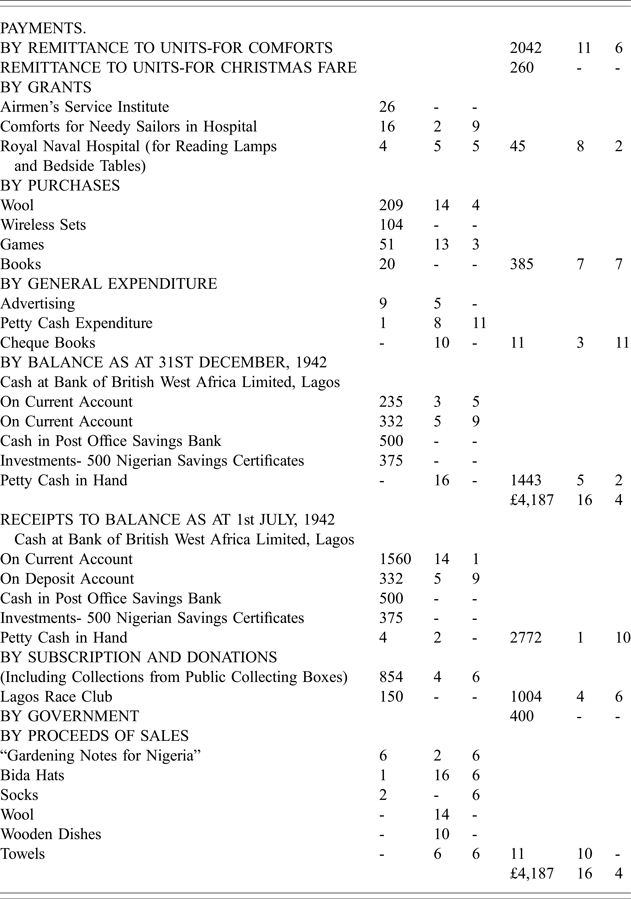
Obviously, the colonial government of Nigeria was not convinced that the request for funds, ostensibly for the comforts of Nigerian personnel serving in the Middle East theatre of operations in 1942, was altruistic. Expenses during the period were, in fact, incurred in relation to the comforts of European troops, as shown in Table 2.
Balance Sheet of the Nigerian Forces Comforts Fund, 1 July–31 December 1942.

Source: “The Nigerian Forces Comfort Fund Summarized Accounts of Receipts and Payments for the Period from 1st July 1942 to 31st December 1942,” NAI, CS038208, Vol. I.
Items provided included books to the ships of HM Navy and Merchant Service, four wireless sets, one of which went to RN Hospital and three to the RAF. In addition, eighty-five pairs of socks and ten pullovers were given to some shipwrecked mariners who were landed in Lagos, while 120 pairs were kept in Nigeria in case of need. With respect to the Reserve Fund of £1,200 for African troops, being the amount in hand at the time of their return from East Africa, “it was decided that it must be put on one side for their special use.” The committee thus considered that barring any special circumstances “this money should be used to build up a fund to assist the African soldiers after the war on their return to civil life.” It was thus to be “invested in (a) Nigerian Savings Certificates, (b) the Post Office, and (c) on Deposit in the Bank” to which the servicemen had no access.Footnote 51 Indeed, the colonial government through its Crown Agents made the investments and accumulated accrued interest for the years ended August 1943 through August1946. These were not “disbursed for the benefit of ex-members of Colonial forces and their dependents,” until 1949. Nigeria received £29,635. 12. 4d., which reflected its military strength of 86,875. The colonial government of Nigeria decided to pay £10,000 of the money to the Nigerian Ex-Servicemen's Welfare Association (N.E.W.A.), and to invest the balance for future use by the association.Footnote 52
The policy of the Nigerian government against the direct funding of its troops’ comforts resulted in dwindling comforts and welfare finances from the Nigerian Forces Comforts Fund. Between April and December 1942, the fund provided £2,250 by way of a monthly contribution of £220 to the Nigeria Area. A separate monthly contribution of £60 further provided by the fund to the welfare officer was to be disposed of by the latter in the proportion of £45 per month to the Welfare Officer Sierra Leone and £15 per month to the Welfare Officer Gambia. It was to be spent by those officers on the Nigerian troops serving in their areas. These payments fell far short of the “minimum amount” exclusive of War Office funds which the General Officer Commanding-in-Chief (GOC in C) had requested from Nigeria, with effect from 1 November 1941. The reorganised Nigerian Forces Comforts Fund thus chafed under its new structure, which was devoid of that personal touch so essential to win public sympathy. It was made, willy-nilly, to cough up funds in aid of flexible welfare schemes. Yet, the West Africa Command in 1942–1943 provided a paltry £2,638 to Nigeria. The latter was thus constrained in the discharge of its welfare obligations by the shortage of funds, given “the fact that the Government has so far not contributed any funds directly for the welfare of its Troops.” The military, therefore, backed the view of the Nigerian Forces Comforts Fund Committee “that it should be the responsibility of the Nigerian Government to provide funds for Expenditure on the welfare of its soldiers.” It urged Nigeria to emulate the Gold Coast, which provided a monthly grant of £400 to be spent “on the welfare of its Troops stationed in the Gold Coast,” regardless of what was collected by voluntary subscription.Footnote 53
In a clear backlash, the military took over the total control of funds privately subscribed to the Comforts Fund. The Comforts Fund Committee was thereby “unable to contribute, as they wished, to certain schemes for the benefit of African Troops” (emphasis in original). In the circumstance, the Nigerian government succumbed to the dictates of the military authorities, and refunded to the Nigerian Forces Comforts Fund its excess expenses, totalling £876.11.1d, between April and December 1942. On the other hand, the Colonial Comforts Fund allocated £100 to the Nigerian Forces Comforts Fund for the benefit of African troops in Nigeria.Footnote 54 The military authorities insisted on the £450 monthly remittance it had set for the Nigerian government, adjusted to be paid from the new financial year, effective 1 April 1942. The remittance had fallen in arrears of £1,390; its payment was made conditional for the possible waiver of a new amount of £400 imposed in 1943 for separate African canteens.Footnote 55
Nigerian Forces’ comforts, however, encountered a major challenge in April 1943 when the first contingent of only Nigerian troops arrived in Egypt with a chicken pox infection. The troops were, consequently, quarantined. They were anxious to receive “letters from home,” given that “home mail plays a great part in keeping up the morale of all troops.”Footnote 56 But more pressing to the officials was the release of the 3s per man per annum, the official grant approved for African troops in August 1942. Even so, the Nigerian government and the Comforts Fund were satisfied with the arrival of the first contingent in Egypt, and discharged all their outstanding financial obligations for comforts, as well as the welfare grant of £1,090, at the rate of 3s per man for the financial year 1943/44.Footnote 57 Curiously, however, the West Africa Command General Headquarters demanded more funds towards the welfare of troops in India. The Nigerian government found the situation awkward because of its perspective that “when our troops have gone as far afield as India it is not unreasonable to expect that expenditure on welfare work incurred in that country should be borne either by the Imperial Government or by the Government of India.”Footnote 58
The demand for more funds was due to the need to cater to further reinforcements sent overseas. For instance, in December 1943, 350 Nigerian troops arrived in the Middle East to reinforce the 3,386 that had preceded them by the end of October 1943. H. A. Lilley posits “the highest standard” of troops’ welfare throughout the Middle East. He attributes it to “well-stocked” canteens that had wireless sets and gramophones, for troops’ entertainment as well as cigarettes, “certain ration of beer” for sale, and “information room” that provided periodicals and newspapers from West Africa, notably the popular R.W.A.A.F. News. Furthermore, troops’ companies maintained drum and bugle bands that were well known throughout the Middle East, having taken part in parades in Cairo, Alexandria, Alamein, and the Delta where they performed creditably at many public functions. The bands “were originally enlisted en bloc at Calabar with their instruments.” In addition, leave camps in Cairo, Ismailia, Derna in Cyrenaica as a rest camp for troops in Tobruk, and Jerusalem, for “tours throughout the Holy Land,” provided avenues for servicemen to spend “two separate leaves of 7 days duration, per year.” The military further commissioned a scheme for troops’ education, largely through the initiative of Major A. J. Carpenter, who was originally posted from the Education Department in Nigeria. Its objectives were to provide prevocational training for servicemen and enhance their knowledge of spoken English as well as the understanding of rural settlement and civic responsibility. The success of the scheme was constrained by “the poor educational attainments” and heavy workloads of instructors as well as the high cost of prevocational tools for servicemen. This notwithstanding, it is estimated that “4,500 West African Pioneers learned to read and write in the Middle East.” In contrast, the infantry companies achieved little despite their competent, well-trained instructors. Due largely to “heavy Guard commitments,”Footnote 59 the infantry units which were recruited with 85 percent illiteracy rate left service with not more than 800, about 21%, made literate.
Nor did the troops’ health care receive adequate attention. Not only were servicemen exposed to high incidences of pneumonia and cases of trench foot in Cyrenaica, but dysentery also constituted “the usual cause of sickness during the hot weather.” This was in addition to venereal diseases “contracted in the Leave Camp in CAIRO, and by units on Guard duties in the slums of Alexandria and CAIRO.” Unlike the Pioneers who arrived in the Middle East with minimum cases of venereal diseases, the infantry units had “an undue proportion of cases contracted in West Africa.” Where health care was inadequate, religious and spiritual provisions could not fare considerably better. There were only two chaplains, including one Church of England chaplain from West Africa, to “look after 5,000” servicemen “of that denomination scattered throughout Middle East from Beirut in Syria to Rabat in French Morocco.”Footnote 60 To ameliorate the situation, the Assistant Bishop of the Sudan and Egypt, Rt. Rev Galthorpe, who had spent many years in Nigeria and spoke Igbo fluently, on several occasions toured troops’ units in the Middle East. So, too, did the Roman Catholic Bishop of Onitsha, Nigeria, Bishop Heerey, who comprehensively toured units in the Middle East during which he administered the sacrament of confirmation to a large number of troops.
By early 1944, Nigerian troops of the Eighty-First and Eighty-Second (W.A.) Divisions were overseas for the Southeast Asian campaign. What was left for expenditure in Nigeria after providing for these troops from the monthly grant of £450 was £254, which the military considered “totally inadequate.”Footnote 61 The military, therefore, asked that the grant be increased to £600 monthly. This request, however, elicited further questions from Nigeria to the Resident Minister, Accra, about the need to reduce Nigerian contributions.Footnote 62 The General Officer Commanding (GOC) Nigeria Area was miffed at the Nigerian government's referral of the matter to the Resident Minister. More offensive to him was Nigeria's request for the reduction of its contributions “on the grounds that it is the responsibility of the Government of India to provide” such funds. To the GOC, “it should be the duty of the Government of Nigeria to provide such funds regardless of any other funds provided by the Imperial or any other Governments wherever the Troops may be serving.” In his view, “a good deal of the money intended for troops abroad” was spent in Nigeria for the purchase of “local products for the men such as Chewing Sticks, Draught and Ludo Boards made locally, local snuff, etc.”Footnote 63 The Nigerian government, countered, however, that “while in theory, we do not pay for this service, the surplus of our contribution of £450 a month for Forces in West Africa is diverted to India.”Footnote 64 This was a veiled reference to a memorandum issued by the West Africa Command General Headquarters to Area Commanders in October 1941. Nigeria was already complying with its recommendation that it provide “£450 per mensem of which 10% is required for expenditure in other colonies,”Footnote 65 by the General Headquarters. Implicit in the Nigerian government claim of diversion of funds to India was a brewing loss of confidence in the records of its troops provided by the military upon which its financial contributions were based. This accounts for the reticence and great difficulties with which Nigeria acceded to new demands for increased welfare contributions for the welfare and comforts of its troops. It had the largest contingent of West African troops on foreign soils. Indeed, compared with the huge amount Nigeria was obliged to provide, vis-à-vis contributions from other British West African colonies, the latter paled into relative insignificance. This was due to the fact that contributions were based on the proportion of the number of troops recruited from each colony, namely 54 percent from Nigeria, 28 percent from the Gold Coast, 15 percent from Sierra Leone, and 3 percent from the Gambia.Footnote 66 For instance, in February 1944, Nigeria contributed £2,000 of the £3,000 demanded for the comforts of the Eighty-Second Division, and bore the brunt of the £7,001 demanded from the colonies during the period.Footnote 67 Even so, comforts and welfare funds were generated through public subscription by Nigerians, who also paid their taxes diligently. This was in addition to their subscription to numerous other war funds, accepting low prices for their commodities, and paying higher prices for imported goods, which were in short supply.
The evidence suggests that Nigerian authorities queried and vigorously scrutinised arbitrary demands from the military for welfare funds. Problems partly arose from inaccuracies and discrepancies in the records of troops’ strengths, which meant that earlier remittances had to be augmented. For instance, the remittance of the cumulative sum of £1,650 at 3s per man per annum for Nigerian troops in the Middle East for the 1944/45 fiscal year was acknowledged in July 1944. But the strength of Nigerian troops in the Mediterranean area on 1 Apri1 1944 was 12,340, representing “a sum of £1,851” in grant payable.Footnote 68 Besides, 2,475 more Nigerian troops were deployed to the area, thereby further increasing their number to 14,815, and raising the grant payable to about £2,222. This left an outstanding balance of £572. This outstanding balance was further adjusted to £646, with records provided by the military, which claimed that as at August 1944, there were 15,306 Nigerian troops serving with the Middle East Forces (MEF), instead of 12,914 recorded by 1 April 1944. The difference of 2,392 was attributed to additional troops that embarked from 1 Apri1 to 30 August 1944.Footnote 69 The Nigerian government questioned these conflicting figures, to ascertain “which is correct.” It had sought to know “the actual dates and numbers on each occasion the 2,392 men left Nigeria so that the correct grant can be computed.”Footnote 70 A reconciled account, based on 17, 257 troops serving in the Middle East by 23 October 1944 was agreed.Footnote 71
Yet, the military further betrayed arbitrariness in its incessant demands for funds, based on increased rates, at short notice. For instance, the military proposed increased new rates for the comforts of troops, from 3s to 4s for those in the Middle East, zero to 4s for those in India, and a reduction for troops in West Africa to 2s/3d. Despite misgivings, the Nigerian government acquiesced with governments of other West African colonies in accepting the principle of contributing to the welfare of its troops in all war theatres. The Nigerian Forces Comforts Fund, therefore, remitted £400 quarterly to New Delhi for the troops in India and Burma, and £70 monthly to the welfare officer, Area Headquarters, for troop ships going abroad. All of this amounted to £2,440. This was in addition to disbursements of £1,000 to troops based in Nigeria, £800 to those based in the Middle East, and £2,580 to troops serving in India and the Middle East.Footnote 72 Indeed, the Nigerian government accepted that “it has an obligation to make such contributions … as will enable Nigerian troops to enjoy welfare facilities on the same scale as those afforded to Indian troops in the same theatres of War.” In its view, “it is necessary to increase the rate of contribution from £7,550 to £16,180 per annum … at the new rate with effect from the 1st of January, 1945.”Footnote 73
The military authorities directed that such payments be made in advance, with effect from 1 January 1945, including quarterly remittances of £ 2,375 and £925 to India and the Middle East, respectively. These were in addition to an annual grant of £2,980, in respect of troops serving in West Africa. Nigeria had troops numbering 17,257 to provide for in the Middle East by January 1945. By the end of hostilities, eleven Garrison Companies from Nigeria had arrived to increase the strength of Nigerian Forces in the Middle East to 17,489.Footnote 74 This notwithstanding, by December 1944, the military did not seem to appreciate the need for financial prudence. It tended to emphasise expenditures on such fleeting social engagements as Christmas entertainment for troops that would not enhance the long-term morale of servicemen. Thus it quickly seized the sum of £13,000, donated “for the Welfare of Nigerian Troops serving in India and Burma” by the Mgbaji-Ugwuochi Native Treasury. The military adopted the view that the money “arrived at a most opportune moment,” and “should be used for providing XMAS CHEER for the troops.”Footnote 75
Evaluating the Nigerian Forces’ Comforts and Welfare
Indeed, in the management of the forces comforts and welfare funds the military tended to be a law unto itself, not subject to due process and accountability. After the Japanese surrender in August 1945, the Committee of the Nigerian Forces Comforts Fund decided to close down the fund “as from the 31st October next.” A previously unknown temporary secretary signed the casual statement to that effect. Consequently, all donations received after 31October 1945 “will automatically be handed over to the Nigerian Ex-Servicemen's Benevolent Fund.”Footnote 76 The peremptory nature of the closure of the Comforts Fund elicited searching questions from the Nigerian government:
(a) Had Government any responsibility for the fund administered by the committee or was the fund entirely “private” in character? (b) How the committee was constituted, and by whom was it appointed? (c) Was the committee's fund complementary to the substantial monies voted by Government for the same purpose? (d) Would the winding-up of the fund necessitate an increase in the Government Vote?Footnote 77
The Deputy Financial Secretary answered with the cynical minute that “This Fund is in the nature of a windfall and they could not, of course, depend upon its continuance or even if it continues, upon any specific account. There is now a general decision of the Fund as to its future which is … that it will close down this month.”Footnote 78
Yet Nigerian troops were on the verge of a mutiny in India over their delayed repatriation at the end of hostilities. It was preceded by the mutiny of two companies of the Sierra Leone contingent at Karvetnaga, on the night of 15/16 September 1945, which ended when “British troops were called in to quell the disturbances.” One hundred and twenty participants were arrested, eighty of whom “were court-martialled” and sentenced to terms of “imprisonment from one to four years.”Footnote 79 The main problem was delayed troops’ repatriation in breach of earlier promises of speedy repatriation. It put a strain on soldiers’ “discipline and morale very highly indeed.” Brigadier Peter Jeffreys unofficially informed Lord Devonshire of the Colonial Office about the problem, as “someone on the spot and in very close touch with the African soldier” of the Eighty-First Division in Arakan, Burma. At the end of hostilities, the troops had been kept in India preparatory to their engagement “in operations in Malaya.” The operations were eventually cancelled when other troops became available. Their European counterparts whom they had preceded in India were released earlier. In addition, the Nigerian troops were “billeted in most unattractive conditions of weather and accommodation” in India.Footnote 80 The Commander-in-Chief (C-in-C) India, Gen. Sir Claude Auchinleck, who aligned himself with the view of General Officer Commanding-in-Chief (GOC-in-C), Southern Army and Commander, Eighty-First (W.A.) Division about the seriousness of the situation, was panicky. He contemplated the violent suppression of the brewing mutiny among the Nigerians with British troops, who he moved “unobtrusively into area of 81 WA DIV in case extreme measures should be necessary.” He jettisoned the idea of British troops having to fire on African troops because he was persuaded that “any such action is likely to have a bad effect on public opinion in India,” and on “the stability of the Indian troops themselves,”Footnote 81 who were prone to mutiny.
Indeed, Duncan has shown that mutiny and strikes among several thousand British servicemen over delayed postwar repatriation and demobilisation bred widespread disaffections among Indian servicemen.Footnote 82 David Killingray notes that even among West African troops there occurred “very near mutiny” aboard the ship with which they were repatriated home. They had “removed their badges and manhandled British Officers and NCOs.”Footnote 83 The troops from Nigeria had spent a minimum of two years overseas, away from home, without the benefit of short leave, unlike their British counterparts, who were granted twenty-eight days’ home leave. They were, therefore, understandably homesick, anxious to return to Nigeria after the war. They were left idle and bored, without wireless sets or reading material. As Leese notes, “gramophones, wireless sets … and musical instruments were always in short supply and were many thousands below the target figure laid down.”Footnote 84
The Nigerian troops’ experience differed markedly from that of their British counterparts, as well as from what obtained elsewhere, among the Canadian overseas contingent, for instance. Oliver notes that many troops of the Canadian contingent “viewed the fall of Hitler's Germany simply, unashamedly, as the end of their mission … closure on their military lives,” which entitled them to “go home and, presumably, resume their normal lives.” In the circumstance, while awaiting repatriation, efforts were made to occupy their idle minds through a morale management founded on generous auxiliary and special services. These emphasised recreation and entertainment, rehabilitation seminars, field trips, tours, in fact, everything necessary “to keep them busy and out of trouble in the meantime.” They thus had “neither the time nor the inclination to resist military discipline.” Even when tempers, including mutiny, flared as a result of broken promises “the GOC spent much of his time imploring soldiers whose faith in the system had been shaken to remain patient and await their turn.”Footnote 85
It is significant that the General Headquarters of the West Africa Command, amidst Nigerian troops’ low morale, remained fixated on its demand for troops’ welfare grants for the first quarter of 1946, based on the relative strengths of troops serving in West Africa, the Middle East, and India. Nigeria had 36,757 and 16,814 troops in India and the Middle East, respectively. There were also 22,322 troops in West Africa. These consisted of 19, 567 in Nigeria, 1,489 in the Gold Coast, 1,153 in Sierra Leone, and 113 in the Gambia.Footnote 86 However, despite the increased pace of demobilisation, with attendant drastic downsizing of Nigerian troops’ strength in the Middle East to 3,008 during the first quarter of 1947, the West Africa Command, Accra, insisted that their welfare grants be made. Similarly, Nigerian troops serving in West Africa would continue to be entitled to their welfare grants for the provision of certain welfare amenities, “even though conditions are returning to a peacetime basis.”Footnote 87
During this period 16,513 of 17,277 troops from Nigeria remained concentrated in the colony.Footnote 88 In the circumstances, Nigeria contended that the normal practice was only for it to supplement His Majesty's Government (HMG)’s grants to serving soldiers. Consequently, Nigeria adopted the position that “until complete return to peace-time basis, when we again take over the responsibility for the financing of the Army … H.M.G. should … remain responsible for troops’ welfare, and… . it ought [not] … be necessary for us to supplement their grant after 31st March 1947.”Footnote 89 The latter position rested on the rationale that “the Army justification for expecting assistance from the Nigerian taxpayer in respect of troops in W.A., on top of the £400,000” budgeted for it “is very difficult to discover.”Footnote 90
The emphasis thus shifted to Nigerian ex-servicemen's welfare,Footnote 91 which the government seemed unprepared to tackle seriously. In fact, after the defeat of Germany, the headquarters of the Supreme Allied Commander, South East Asia, observed that “it will be impossible to replace 82 (WA) Division in this theatre after it becomes due for repatriation, and that all West African troops must leave the theatre by early 1947.”Footnote 92 The decision did not take into account the low morale of soldiers who were anxious to be repatriated to Africa but was guided solely by the War Office's policy and terms of the soldiers’ recruitment of two and a half to three years’ service. For those recruited in July 1944, it implied that they would be retained overseas till July 1947, irrespective of the early end of the war. It was thus a deliberate policy, which demanded appropriate measures to keep the soldiers engaged with recreation, seminars, and other activities that would leave them no room for acts of indiscipline. But this was not the case. Nor were they granted leave, despite the fact that by February 1945, “leave home has already been openly promised to African personnel” of the ALFSEA.Footnote 93 Instead, the focus of policy was to repatriate the servicemen home, where demobilisation would be effected. The latter was declared to have been completed by 1 February 1947, except for “approximately 4,000 Nigerian Troops to be repatriated from the Middle East.” Even so, “Resettlement in Civilian life has not been as easy as the African Soldiers expected and consequently many of them are trying to re-enlist in the Army.”Footnote 94
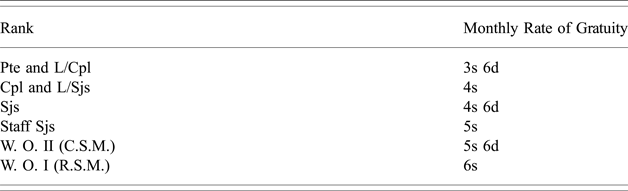
This was largely due to unimpressive “release benefits.” They were not granted leave on discharge, but fifty-six days’ pay and allowances, “as from the date of discharge.” Yet soldiers whose accounts were in debt had their pay restricted to 6d per diem for sergeants and 4d for those below the rank of sergeants. Besides, overseas service grant covered only the service outside West Africa for a minimum of six months “at the rate of 000 day's pay and allowance for each complete month's ‘overseas’ service.” This meant that the total pay was dependent upon rank, level of indebtedness and length of service outside West Africa. Service was reckoned in years and days, provided that “Periods of less than 30 days will [be] ignored.”Footnote 95 Furthermore, gratuity was paid at a monthly rate as follows:
Monthly Gratuity for Discharged African Other Ranks (AORs).

Source: TNA W0172/9667, 9th (W.A.) Field Park Coy W.A.E. (Ind.), 1945.
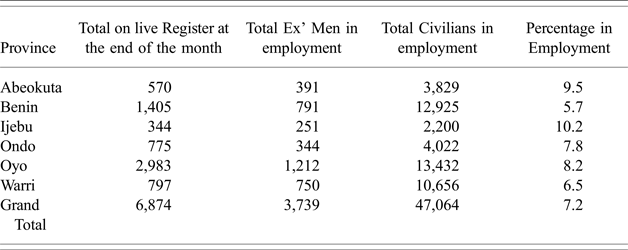
It is noteworthy that there was no serious attention to the issue of the employment of ex-servicemen, including medically challenged ex-servicemen. In fact, in 1943, when the problem reared its head in Lagos, the government took the position that soldiers discharged on medical and other grounds, at the rate of forty weekly, merely added to the “burden of unemployment” in the city. In its view, “Even if they were physically fit it would be very difficult to find work for them; as it is, it is quite impossible.”Footnote 96 With respect to all ex-servicemen, Governor Richards insisted that their reabsorption to civil life had to be a jointly shared responsibility. This would require the Native Administration and private sector employers to partner with the “Government [which] alone cannot find employment for them all.” The governor, however, contended that they were mainly farmers before enlisting in the army “and many of them must return to their farms,” given that “Nigeria is mainly an Agricultural country.”Footnote 97 Thus, the Eastern Provinces proposed that demobilisation be done twice yearly, in January to March during the planting season and August to October during the harvest season.Footnote 98 Indeed, the government deemphasised the employment of its ex-servicemen. For instance, the provincial employment statistics of ex-servicemen for the six provinces in the Western Provinces averaged 7.2 percent by April 1948, as shown in Table 4.
Provincial Employment Statistics of Ex-Servicemen as of 30 April 1948.

Source: NAI Asa Div I, AD.880-II, J. R. Leeming, Area Resettlement Officer, Western Provinces to Senior Residents, no IA/170/228, 15 June 1948.
The evidence shows, in fact, that throughout Nigeria only an insignificant number of ex-servicemen who registered for employment could be employed vis-à-vis the total number of demobilised soldiers. For instance, only 3,096 of 30,498 demobilised soldiers made up of 6,923 tradesmen and 23,575 non-tradesmen could be employed by November 1945. The situation did not change significantly by 31 October 1946. During the period, 89,761 soldiers had been demobilised, with 56,137 of them registered for employment. Only 17,056 of the latter could be employed, while 39,081 were on the unemployment queue. By the quarter ending 1 February 1947 the Headquarters, Nigeria Area, West Africa Command reported the completion of demobilisation of the all Nigerian units of Eighty-First and Eighty-Second (W.A.) Divisions on their return from Burma, as well as of the Garrison Companies returning from the Middle East.Footnote 99
Nor did the government subsequently grant any assistance to prospective or actual ex-servicemen with access to funds to set up on their own. Instead, permanently disabled ex-servicemen were neither assisted with funds,Footnote 100 nor medically rehabilitated or reabsorbed into civil life. In fact, the government sought every subterfuge to shirk its responsibility to them. For instance, Ex-NA/218736 Samuel Ekinpelu, who enlisted for service in October 1943, was discharged in December 1945 because of disability due to chronic suppurative otitismedia. His application for pension was turned down in 1949 by the Pensions Assessment Board because “the disability did not originate during Military Service nor did military conditions hasten its progress.”Footnote 101 Rather, the military took meticulous steps to contact the next-of-kin of deceased soldiers for the payment of death benefits and collection of scanty personal belongings of the deceased. Yet it did not hesitate to deduct postage fee from monies found on the deceased at the time of death.Footnote 102
Conclusion
Nigerians fought for Britain in East Africa, the Middle East, and Burma during the Second World War. Scholars have not paid adequate attention to the high morale of the troops from Nigeria so vital to their sanity and success on the battlefield, and beyond. This current study has attempted to fill the gap with an examination of the comforts and welfare of Nigerian servicemen up to the period of demobilisation. The evidence shows that the colonial regime appreciated the need for a framework within which to maintain the high morale of the forces, but placed undue emphasis on philanthropy and charity in achieving it. In doing so, it failed to take into account the vast differences between a dependent, colonial state without voluntary organisations dedicated to charity and philanthropy and a metropolitan country awash with such organisations. Even so, Britain directed exuberant Nigerian philanthropic energy towards subscriptions to sundry British charities devoted to alleviating the hardships caused Europeans by the war. On the other hand, the Nigerian Forces Comforts Fund was virtually left in the lurch as the government funded its affairs with public subscriptions and occasional paltry contributions from the London-based Colonial Comforts Fund.
Be that as it may, the colonial government of Nigeria placed a high premium on due process, transparency, and accountability in the expenditure of the funds for the forces’ comforts and welfare. The military, which was antagonistic to accountability, demanded and eventually obtained from civil powers funds provided by Nigerian taxpayers towards the comforts and welfare of Nigerian servicemen up to 1947. The military did not thereby demonstrate any sense of responsibility and empathy in the disbursement of the funds. Delayed postwar repatriation of the servicemen thus made them susceptible to mutiny in India.
In the postwar years, disabled and unemployed ex-servicemen who sought assistance were treated to a raw deal, uncared for and left to their own devices. Some ex-servicemen were employed in menial jobs, but the number was insignificant. The government adopted the position that most of the ex-servicemen were farmers before joining the army and had to return to the same vocation, unassisted, upon their demobilisation. Postwar demobilisation of Nigerian servicemen must await its detailed study. The evidence thus far shows, however, that they were little provided for by the colonial state.
Acknowledgements
I am grateful to Nigeria's Tertiary Education Trust Fund for the grant that funded the research for this paper, including a trip to the National Archives of the United Kingdom, Kew. I equally owe an immeasurable debt of gratitude to the two anonymous reviewers for their thorough reviews, suggestions, and insightful comments, which have enhanced the quality of the paper.