Introduction
With declining fertility rates and increasing life expectancy, the population of Sri Lanka is rapidly ageing (De Silva Reference De Silva1994; Gaminiratne Reference Gaminiratne2004). Elderly Sri Lankans (aged ⩾60 years) constituted 9.4 per cent of the population in 2006, up from 9.1 per cent in 2001 and from 6.9 per cent in 1998 (Department of Census and Statistics Sri Lanka 2008a, 2008b). This proportion of elderly is the highest in South Asia (Siddhisena Reference Siddhisena and Leeson2005). Care of elders in Sri Lanka remains the responsibility of their adult children, but migration patterns, increasingly common dual-earning households and a shift from the extended family structure to a nuclear family structure, all contribute to a reduction in the availability of care-givers (Gaminiratne Reference Gaminiratne2004). A better understanding of the experiences and concerns of elder–care-giver dyads is essential to formulate policies and programmes to benefit elderly people. However, to date, little research has been done to explore different facets of elder-care by family care-givers in Sri Lanka.
As Sri Lanka's population lives longer, a larger proportion of the elderly will require help and care, either from formal (paid) or informal (family and friends) care-givers. Like other resource-poor Asian countries, institutional care is very limited in Sri Lanka (De Silva Reference De Silva1994), and the provision of elder-care is not only considered, but is in fact also legally, the responsibility of family members, especially adult children (Chan Reference Chan2005; De Silva Reference De Silva1994; Knodel, Chayovan and Siriboon Reference Knodel, Chayovan and Siriboon1992; Ministry of Justice and Law Reforms in Sri Lanka 2000; Ministry of Law and Justice 2007; Yap, Thang and Traphagan Reference Yap, Thang and Traphagan2005). Sri Lanka, like many Asian countries, boasts a strong family social support system, and this system of intergenerational care is widely believed to be acceptable to all members of the family, including the elderly. Most households are multigenerational, and the majority of elderly live with their adult children (De Silva Reference De Silva1994; Østbye et al. Reference Østbye, Chan, Malhotra and Kothalawala2010). Typically, children live in the family home until marriage, at which time the daughter moves in with her husband's family; however, research has found that elders' preferences to co-habit with an adult son or daughter depends on numerous factors, including number of children and employment status (Uhlenberg Reference Uhlenberg and Hareven1996). Regardless of housing arrangments, it is generally the female (i.e. daughter or daughter-in-law) who provides the majority of direct care for the elderly. Children who are not co-residing with the family typically provide material support to the aged parents, suggesting that all children feel a responsibility to support the elder parents (Uhlenberg Reference Uhlenberg and Hareven1996). Families show an active interest in the care of the elderly (Mendis and Illesinghe Reference Mendis and Illesinghe1989), indicating the importance of social and cultural factors in caring and planning services for elderly people .
Theoretical frameworks on care-giving suggest multiple and overlapping motivations for adult children to care for their ageing parents. These motivations have been classified into four themes: reciprocity, a sense of obligation, altruism and feelings of intimacy (Klaus Reference Klaus2009). Caldwell's theory of intergenerational transfers suggests that resources flows within the household unit shift over the lifecourse (Caldwell Reference Caldwell2005), which reflect motivations of reciprocity and obligation. Resources, including both time and money, initially flow from parents to their children, and then reverse direction as the parents age and receive care from their adult children. Participating in the care-giving of ageing parents is both a pay-back for resources acquired as a child, as well as a societal obligation. In addtion, care-giving in the intergenerational transfers framework may serve as a type of insurance, with care-givers setting an expectation to their own children that they should take care of them in time of need (Ikkink, van Tilburg and Knipscheer Reference Ikkink, van Tilburg and Knipscheer1999), a motivation that has been supported with data in Asia (Frankenberg, Lillard and Willis Reference Frankenberg, Lillard and Willis2002). However, even in the event that few resources have been transferred from the ageing parent, and where resources are not expected from children in the future, altruism or feelings of intimacy or attachment may still motivate adult children to care for their parents (Cicirelli Reference Cicirelli1983; Silverstein, Parrott and Bengtson Reference Silverstein, Parrott and Bengtson1995).
Care-giving is a dyadic process, where the wellbeing of both the elder and the adult care-giver has an impact on the wellbeing of the other member of the dyad (Lyons et al. Reference Lyons, Zarit, Sayer and Whitlatch2002). A large body of literature suggests that care-giving can be a source of stress and anxiety on both parties (Pinquart and Sorensen Reference Pinquart and Sorensen2003), and that distress in one party precipitates problems for the other (Davis et al. Reference Davis, Gilliss, Deshefy-Longhi, Chestnutt and Molloy2011; Mitrani et al. Reference Mitrani, Lewis, Feaster, Czala, Eisdorfer, Schulz and Szapocznik2006). The care-giving dyads themselves develop and are situated in a wider family and social setting, and changes in this setting have an influence on the dyadic relationship. In Sri Lanka, stressors on the elder–care-giver relationship are likely to increase with changes in family roles and economic and social context. These changes include more women entering the paid workforce, children migrating within Sri Lanka or abroad for work, a transition away from a land-based economy and increasing household costs. Stressors on the elder–care-giver dyad may result in suboptimal care, which in turn may lead to depression and poor quality of life for both the elder and the care-giver, which over time may undermine the model of home-based care. The way a care-giver copes with these stressors likely influences the impact of the stressors on the care-giver and the dyad. A meta-analysis (Li et al. 2012) based on Carver's typology of problem–solution-focused coping, emotional support coping and dysfunctional coping (Carver, Scheier and Weintraub Reference Carver, Scheier and Weintraub1989), suggests that dysfunctional coping strategies, such as denial or avoidance, are more likely to lead to care-givers experiencing depression and anxiety. Coping strategies based on acceptance and seeking emotional support were less likely to lead to this psychological morbidity, and may even decrease anxiety and depression (Cooper et al. Reference Cooper, Katona, Orrell and Livingston2008).
At the same time that providing care-giving has the potential for deterimental effects, there is evidence that home-based care-giving may also provide benefits to the care-givers, including better psychological and cognitive health and social status in a culture where care-giving is highly valued, especially if the burden of care is not too high (Bertrand et al. Reference Bertrand, Saczynski, Mezzacappa, Hulse, Ensrud and Fredman2012; Buyck et al. Reference Buyck, Bonnaud, Boumendil, Andrieu, Bonenfant, Goldberg, Zins and Ankri2011), and that positive aspects of care-giving are associated with lower levels of depression and lower perception of burden (Cohen, Colantonio and Vernich Reference Cohen, Colantonio and Vernich2002). The benefits derived from care-giving strengthen families as units of safety and support and should be areas of focus in supporting the resiliency of families and wellbeing of both elders and their care-givers.
As Sri Lankan society continues to age and family and socio-economic structures change, it is important to examine the arrangements of elder care-giving and to identify opportunities to support this arrangement. The aim of this study was to explore the dynamics of elder–care-giver relationships among a sample of elders and their adult children in the Galle District of South Sri Lanka. By including the perspectives and experiences of both elders and their child care-givers, we aimed to capture a holistic picture of the dynamic of elder care-giving in the household and point to opportunities to support the elder–care-giver relationship.
Methods
This study took place in the Galle District, one of three districts in Sri Lanka's Southern Province. Galle District covers an area of 638 square miles and has a population of just over one million. About 10 per cent of the district's population lives in the city of Galle, the capital of the Southern Province, with the majority living in small towns and villages scattered throughout the district. The socio-economic profile of Galle District is similar to that of other districts in Sri Lanka.
The data presented here are part of a multi-method study that aimed to describe the epidemiology of depression and cognitive impairment among elderly Sri Lankans and included a household survey of 240 elders and their care-givers. As a first phase of the larger study, we used qualitative methods (presented here) to explore beliefs about depression and cognitive impairment in elderly people, and care-giving needs and arrangements, including the community norms and perspectives around care-giving, and how these are shaped by a dynamic social context. The qualitative phase of the study helped to inform the household data collection, but also provided unique insight into the study's topic that was best captured by the flexibility and narrative approach of qualitative methods. The qualitative phase was conducted in September and October 2011, and included four focus group discussions (FGDs) with elderly males and females, five in-depth interviews with elders, and ten in-depth interviews (IDI) with care-givers of elders, described below.
Focus group discussions with elders
Elders were defined as individuals between the ages of 60 and 85. Purposive sampling was used to recruit a diverse group of elders from the community. In each setting, a local public health nurse assigned to the area was engaged to help identify and recruit participants. Public health nurses serve as basic health outreach workers in Sri Lanka and have very good knowledge and understanding of the families living in the area; they were therefore deemed most suitable for facilitating recruitment. The recruiters were instructed to identify participants with a variety of backgrounds in order to have representation of elders from different socio-economic backgrounds in the area. The groups were held separately for men and women, for a total of four groups (male and female groups in both the rural and urban settings). Eight individuals were invited to participate in each group.
The FGDs centred around the process of ageing in Sri Lanka, including culturally grounded ideas of care-giving arrangements (the topic of this paper), successful ageing and perspectives around mental health distress among the elderly. A discussion guide that included opening questions and follow-up probes assisted the moderator to facilitate a group conversation on these topics. The guide was prepared through a collaborative process by a multidisciplinary team consisting of three researchers in Sri Lanka and three from the United States of America (USA), with expertise spanning geriatric psychiatry, public health, social work, geography and health behaviour. The guide was piloted with five elders living in the research area. Complex, biased and threatening questions were either removed or modified after the pilot test. The discussion guide allowed the moderator to discuss any relevant new issues generated during the discussion.
Each FGD had a moderator who was gender-matched to the group and a note-taker. The moderator guided the participants through the discussion and encouraged participation from all members, while the note-taker took notes on both verbal and non-verbal content. All FGDs were audio-recorded, lasted 60–90 minutes and were conducted in the local majority language, Sinhala.
In-depth interviews with elders and care-givers
From each FGD, three to five participants were randomly selected and asked to refer for an interview the individual they would identify as their primary care-giver (or potential care-giver as they aged). For five of the 15 elders, the care-giver initially identified was a spouse (four men identified a wife and one woman identified a husband). The spouses participated in in-depth interviews, but the content of these interviews revealed a son or daughter who also provided care-giving support to the couple and/or who was identified as the individual who would provide the primary care-giving to the couple as they age. The decision was then made to also interview the son or daughter in these households. For the purpose of this analysis, therefore, the five spouse interviews were treated as providing the elder perspective on the relationship with the adult child care-giver. Two of the elder spouses were in their late fifties, but were still included even though they did not meet the original definition of elders that was established for the FGDs. A total of ten care-givers, all children or children-in-law of the referring elder, also participated in in-depth interviews.
All in-depth interviews were conducted in the respondents' homes. A discussion guide included questions and follow-up probes on the arrangements and experiences of care-giving, and the benefits and burdens of the care-giving relationship (e.g. living situation, financial contributions/burden, communication, etc.). The interviews were conducted in Sinhala, audio-recorded with the participant's permission and lasted 30–60 minutes.
Data management and analysis
The FGDs and IDIs were transcribed verbatim in Sinhala and translated into English. Random checks were done by local members of the research team to assess for accuracy, and handwritten notes from the discussions and interviews were used to identify missing information and assign respondent IDs to speakers in the FGDs.
Data analysis was conducted by all six authors (three Sri Lankan and three American), and included individuals who directly participated in the data collection as moderators and/or interviewers (BP and HR). All members of the research team initially read the transcripts, and participated in conference calls to discuss and identify common themes related to the topic of interest. Using a grounded theory approach (Charmaz Reference Charmaz2006), the lead author prepared a detailed analytic memo to elaborate the themes and identify exemplary quotes. The memo was discussed among all authors and further refined through discussions. Multiple drafts of the paper were shared among the research team for feedback. Ethical approval for the research project was obtained from the Schools of Medicine at Duke University and the University of Ruhuna.
Results
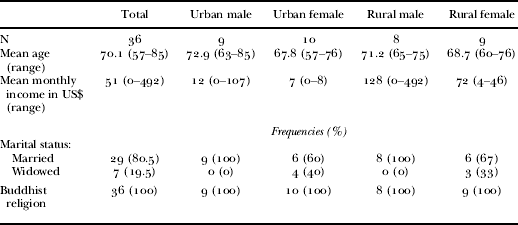
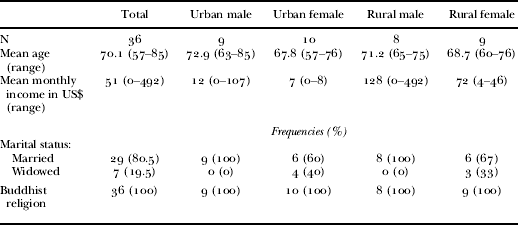
The characteristics of the 31 elders who participated in the FGDs and the five elders who participated in the in-depth interviews are shown in Table 1. The sample ranged in age from 57 to 85, with a mean age of 70.1. Male participants were significantly older than female participants (72.1 versus 68.2, p < 0.05) and more likely to have a spouse who was still alive (100% versus 63%, p < 0.05). Half of the sample (18/36) reported some monthly income. Rural participants were much more likely to report an income, compared with urban participants (83.3% versus 16.7%, p < 0.001). Rural participants' income came largely from land-based agriculture, in particular the cultivation of tea. The ten care-giver interviews included nine female and one male care-giver. The female care-givers included six daughters and three daughters-in-law, and the one male care-giver was a son. All care-givers reported that they lived in the same home as the elder.
Description of the sample of elders
Themes related to the care-giving–elder dynamic focused on the following areas: (a) family-based care-giving as a moral duty, (b) co-operative care-giving arrangements, (c) elders' desire for autonomy and independence, (d) freedom from household contributions, and (e) avoidance of conflicts in the elder–care-giver relationship. Below we elaborate on each of these themes with supporting quotes from elders and care-givers.
Family-based care-giving as a moral duty
Both elders and care-givers uniformly saw in-home care-giving as the ideal. Both parties considered the duty to provide care to an ageing parent as an unquestioned moral obligation. The family was seen as a reciprocal unit, with a recognition that parents make sacrifices for their children when they are young, and that children in return make sacrifices for their parents as they age. This sentiment was expressed by care-givers as a sense of paying back their parents for their efforts and labour, and by elders as a return on the investments they made in their children's lives.
They have exerted themselves to bring us up with their sweat and blood to be what we are now. Quite correctly then, it is our obligation to look after them when they grow old. (Daughter-in-law, care-giver of urban female)
Children should understand how we brought them up, how well we educated them. That is enough for them to treat us back. (Urban female elder)
The model of care-giving in the home was normative and passed down through the generations, as many adult children had grown up with their grandparents in the home, and observed their parents as care-givers. Some care-givers looked towards the future and spoke about how they expected that taking care of their parents would provide a role model for their own children, who would someday care for their needs when they age. As one care-giver said, ‘When I am helping my mother-in-law, one day my children too will take care of me by seeing that.’
An implication of the expected obligation of care-giving was that elders wanted to receive support without having to ask for it directly, because asking implied to them that it was not done from a sense of obligation. This desire to get support without explicitly asking for it related to a larger feeling that actions of respect (such as being given a seat on a bus or being taken care of) are ‘no good’ if they must be explicitly requested. As a result, elders did not generally express their needs and expectations to their children in a direct way; this had the potential to create miscommunication in relationships.
Overwhelmingly, the care-givers said that they performed their role willingly and that it gave them great rewards. The adult children spoke about getting ‘advice’ from the elders and direct support, most often in the form of assistance with grandchildren. However, more than direct benefit, children and children-in-law spoke about receiving personal satisfaction from serving and assisting their parents.
Co-operative care-giving arrangements
In most households, care-giving was a co-operative arrangement, with multiple adult children providing care-giving to the ageing parents as the elders' needs increased and the children's resources (time and money) allowed. In rural settings in particular, neighbours and community members provided additional support and services to elders. The shared burden was discussed as helping to relieve the stress on any one individual, especially as the elder's health fails and care-giving needs increase. As a daughter and daughter-in-law who provide direct care-giving said, ‘There are enough people to take care of them [parents]’ and ‘All four of us [children] should have equal responsibility, everyone can help him [our father]’. Care-giving responsibilities typically differed along gender lines, with female children providing direct instrumental support to elders and males providing financial support to meet elders' daily needs and health-care costs. Many households had children who had migrated within Sri Lanka or abroad, leaving at least the direct care-giving responsibility to those children who stayed behind, while the distant children contributed financial support.
Both elders and care-givers overwhelmingly felt that daughters and daughters-in-law were best positioned to provide the daily, direct care-giving to elders. Respondents expressed that daughters made better care-givers because of the ‘natural instinct’ of mothering, and the stronger loyalty that women felt toward their parents (e.g. one elder said that ‘a daughter's heart melts for parents’). Many daughters spoke about the care they provided to their parents with a sense of pride. The sense of satisfaction and pride that women received from taking care of an elder was reinforced by others in the community.
They [community members] say that it is good that mother is with me. ‘A mother should be with her daughter’, that is what people say. I get a lot of support from them to look after my mother. (Daughter, care-giver of urban female)
At the same time as daughters both expected and desired to be responsible for and engaged in care-giving, there were indications of the burden and sacrifices this entailed, particularly as women were increasingly educated and active members of the labour market. One young woman who lived at home with her parents while attending university spoke about how she planned to take care of her parents into their old age, but failed to grapple with the potential contradictions of getting the job she desired after her education and the attention and time that her parents would require as they aged. Another woman spoke about how she had quit her job as a cashier in order to take care of her mother-in-law. Although she had done that willingly, she expressed regret at no longer being able to make a financial contribution to the household.
Women's engagement in activities outside the household, combined with families' attention to young children and their desire to provide their young children with both education and material goods, created stressors for care-giving arrangements, and concerns about what the care-giving arrangement would look like in the future. Many elders spoke about the busy lives their children lived, and asked how these children would be able to provide the type of care for the elders that they had provided for their own parents. For example, one elderly woman spoke about how her son and daughter-in-law were ‘caring and loving,’ but anticipated that they would not be able to provide sufficient care for her and her husband. ‘Both of them are doing their own jobs. Therefore, they don't have enough time to spend with us except on weekends.’ Similarly, a woman who takes care of her mother-in-law spoke about how she anticipated both financial and time-related challenges as the mother-in-law ages and becomes more dependent.
Someone should be there [at home] … We do government jobs, we have two children. We keep helping her as best we can do. Now then, what we say is that we are finding it difficult to do as such, when we have to educate two children. Yes, it is difficult. (Daughter-in-law, care-giver of urban woman)
As such, there was a suggestion among elders that a good care-giver was someone who was able to provide time and attention to the elders, and therefore might be someone who was in ‘an innocent situation’ or ‘the poorest person’. People implied that this ideal care-giver would not only be someone who does not have a job or responsibilities outside the home, but would also be someone who holds traditional values that support taking care of an ageing parent. When asked what type of families do not take care of their elder parents, elders often pointed to families where children are ‘well to do’ and overly consumed with their own advancement and economic wellbeing. Elders feared that they would become secondary to the monetary pursuits of their children. Although financial stressors were mentioned frequently, there was also a consensus that acts of kindness and time spent with the elder was far more important in the care-giving arrangement than the provision of commodities or cash.
Elders' desire for autonomy and independence
Despite a strong ethic of care-giving and inter-dependence, there was also a dominant sentiment from both male and female elders that they desired and needed autonomy and independence, especially in the period before their declining health made them fully dependent on care. Elders' desire for independence emanated from: (a) wanting to avoid placing undue burden on their children, and (b) wanting to retain a role as provider in their relationships with their children. Elders feared becoming fully dependent, and therefore burdensome, on family members. They acknowledged the competing priorities of their children, and felt that they should not be ‘selfish’ in asking for more than their children are able to provide. They said, for example, that their children ‘have more worries than ourselves’ and ‘have their own problems and needs’. For some, the desire to not be burdensome was so strong that they said they would prefer to die early than to become fully dependent on their children. At the same time, elders wanted to retain a role as provider by continuing to support their children and grandchildren. Elder men in particular pointed to their financial support to their children as a sense of ‘duty.’
A key to a sense of independence was financial autonomy. By having their own income or savings, elders felt they could reduce the burden and hardship on their children and continue to play a role as provider, even through symbolic gestures like gift-giving. Elders who received pensions from previous employers expressed how meaningful this was for them: ‘Had we not been getting these pensions, then we would have fall into … we would have fallen slave to our children.’ Most elders, however, did not have sufficient independent income or savings, which for many served as a source of distress. This was particularly the case in urban areas, where a lack of income was combined with greater economic needs compared to rural areas, in particular the need to purchase food and household goods and to access Western medical care.
Freedom from household contributions
Both elders and their children spoke about the role that elders could and should play in the household. Elders spoke about this with some contradictions. On the one hand, elders talked about how doing household chores made them feel useful and how taking on responsibilities for caring for grandchildren gave them great joy and satisfaction. They also talked about how housework was a form of ‘exercise’, which helped them to stay healthy in both mind and spirit, and something that kept boredom at bay (e.g. ‘I don't like to remain doing nothing’). When asked about not working, one woman said, ‘If you do that, then the aches and pains will worsen.’
On the other hand, ‘freedom’ ran as a theme throughout the interviews as an ideal characteristic of ageing, and being responsible for household activities was seen as curtailing this ideal experience of ageing. This was particularly the case among women, who carried a greater responsibility for contributing to household activities and caring for grandchildren. While men's contributions to household activities were perceived as generally optional and a great service, women's contributions were perceived as an obligation and an extension of the role they have long held in the household. Although female elderly expressed that they enjoyed making a contribution to the household and being part of their grandchildren's lives, the responsibility was often reflected as a burden.
I of course think I should be free of my children's responsibilities when I grow old. But even though they are married and have left home, there is no freedom for me. I have to look after my children's kids, I do my children's work… (Urban female elder)
The distinction between household contributions as a joy versus a burden was in part a distinction of whether the labour was given freely as a contribution, or was expected by the care-giver. Elders wanted to be able to work and contribute, but not to be expected to work. Elders felt that in old age, their labour (e.g. gardening, cooking, playing with grandchildren) should be a form of leisure and a sense of productivity, but not necessarily an obligation. An ideal situation was when an elder was able to contribute to household activities, but the children did not expect it, and in some cases discouraged it. This elder man expressed pride in this type of situation:
I like to be doing work. I sweep the garden every day, and I do the weeding too. [My] family members object to my working. My son wants me to stop working … They look after us well. They shout at us when they see us doing any work. (Urban male elder)
Care-givers for their part recognised that old age was a time for freedom from activities, but at the same time they appreciated, and in many cases relied upon, the household contributions of the elders. They echoed the same sentiment of elders that old age should be a time of freedom, and spoke about their role as protecting the elder from stressors and burdens.
After many responsibilities of the children, it's the time they need relaxation. They should do only the things possible to their age, without taking serious responsibilities. Then they have more free time. (Daughter, care-giver to urban parents)
At the same time, however, many of them relied on their ageing parents for their help and contributions, especially in the face of stretched resources and busy lives. This was particularly the case in households with dual-income earners, where the elder played an essential role in taking care of young (grand)children.
Avoidance of conflicts in the elder–care-giver relationship
Despite potential areas of stress and disagreement in elder–care-giver relationships, there was very little mention of direct conflicts that arose in the relationships. Both elders and care-givers said the burden was on themselves to acquiesce and be flexible and patient when conflicts arose. An urban woman described how she and her father had disagreements: ‘Father is a little short-tempered at times. I get a little annoyed too. So I yell back at him. But I listen to him (smiling).’ However, she later put the responsibility on herself to make the relationship as conflict-free as possible, which includes tolerating his short temper: ‘Even if he gets angry, I don't scold him. I listen to him patiently.’
The same approach was taken on the side of the elderly, who expressed that even if they felt unhappy with the care they were receiving from their children, they would be careful not to let it be known. This seemed to come from both a sense of gratitude for care that their children are giving them, as well as a fear that the care may be compromised if they were to complain.
We should eat anything according to their choices without rejecting them. Even at a little mistake, we shouldn't shout at them. If we are doing that [shouting], we cannot assure whether they will treat us well or not. We should obey them. (Urban female elder)
Both elders and care-givers spoke about dealing with conflicts in the household and with their care-givers in very non-confrontational ways. Conflicts were viewed as matters that must be dealt with internally, regulating one's reactions, instead of changing the circumstances themselves. Religious beliefs and practices were used as important ways to deal with the stress of the care-giving relationship.
When I get angry, I usually keep quiet without talking to anybody, and keep thinking what should I do to become normal again. Then I do meditation to forget what happened. (Urban male elder)
For me, religion is a great help. When I am in sorrow or in difficulty, I worship Buddha and chant … Somehow, I know these things helped me a lot. (Rural female elder)
In general, people didn't talk about conflicts in the household to others, because they don't want to bring shame or disrepute to the home, as this elder woman expressed:
We should solve our problems on our own without telling anyone … it's not good for our children if we share our problems with others. We shouldn't disgrace their reputation. (Urban female elder)
However, the priest seemed to be an exception, and someone whom elders felt they could speak with about problems. No one described going to the priest themselves for a household conflict, but this man described the role that the priest can play.
When there is a quarrel at a house, the priest looks into it, intervenes and resolves the disputes. That quarrel known by father and son, the priest looks into such matters, applying the Buddhist precepts. For us as elders, it is our priest who is helping us a lot. (Rural male elder)
Discussion
This qualitative study explored the dynamics of elder–care-giver relationships in Southern Sri Lanka. By including the perspectives and experiences of both elders and those who care for them, we were able to capture a holistic understanding of the elder–care-giver dynamic in this setting. Overall, we found strong commitment to in-home care-giving of elders, and positive experiences of being cared for by adult children. The elders in our study were for the most part mobile and self-sufficient, and so the significant challenges of care-giving may increase or only be realised in the future. Much of the existing literature on elder care-giving is in the context of greater dependence and disability, making this paper novel in its focus on family dynamics early in the ageing process and individuals' perspectives on anticipated challenges ahead. Challenges, both expressed and implicit, hinged primarily on the absence of full-time care-givers in the home as adult children were busy with their jobs and the activities of their own children, and the sacrifices that would need to be made, particularly by adult female children, as elders continued to become more dependent. Elders seemed to be aware of these challenges, and were determined to minimise the burden on their adult children. However, they expressed concern about whether they would receive adequate attention and care from their children in the future. Financial stressors were mentioned by respondents in both rural and urban areas. Economic development contributed to financial stressors because of a move away from a land-based economy, and because of increasing expenses related to both the desire for and availability of Western medicine. Financial autonomy was seen as a key way that elders can alleviate burden on care-givers, but few elders had sufficient independent income or savings, particularly in urban areas. Given potential stressors in the relationship between elders and care-givers, it is of concern that communication to deal with conflict between elders and their care-givers was largely suppressed.
The care-givers we interviewed were all strongly committed to providing care to their elder parents in the future, and expressed a sense of pride in the role they currently played in caring for their parents. These commitments had a basis in moral and religious obligation, societal expectations and affection towards the elder, as has been highlighted in other qualitative work in Sri Lanka (Uhlenberg Reference Uhlenberg and Hareven1996). This concept of ‘filial piety’ has been argued to be stronger in Asian than in Western societies (Laidlaw et al. Reference Laidlaw, Wang, Coelho and Power2010), and in Sri Lanka must be understood within the framework of Buddhism, where self-sacrifice and good moral conduct leads to spiritual enlightenment and positive karma (i.e. consequences in the current life and after-life). Characteristics of care-givers in our sample echo those identified among strongly committed care-givers in Sri Lanka (Østbye et al. Reference Østbye, Chan, Malhotra and Kothalawala2010) and other settings (Piercy Reference Piercy2007). Care-givers reflected on the positive gains they got from care-giving. These gains included a personal sense of satisfaction in being able to give back to their parents; a close relationship with the elder that included receiving advice and guidance; a sense that they were providing a role model to their children and therefore ‘investing’ in their own future care; and positive feedback from the community that might have an impact on their perceived status. Literature from both Western settings (e.g. Cohen, Colantonio and Vernich Reference Cohen, Colantonio and Vernich2002) and Asian settings (e.g. Liu et al. Reference Liu, Insel, Reed and Crist2012) have documented similar personal gains of care-giving.
Even as elders desired to be taken care of by their children, they also feared losing their independence and autonomy. Financial hardship associated with ageing, and the expenses associated with caring for an ageing relative, was a common refrain, and contributed to strain on both elders and their care-givers. Financial strain was particularly salient in urban areas because of both limitations of financial income and expenditure demands. In rural areas, elders and their families were able to rely upon land-based agriculture for regular income, and they lacked some of the expenditure pressure related to Western health care, food expenses and other costs of daily living. Caring for an elder in the home may make one more vulnerable to future poverty, as has been seen in other settings (Wakabayashi and Donato Reference Wakabayashi and Donato2006). Opportunities to ease the financial strains within the elder–care-giver dyad may include early intervention with people in their economically productive years to help support savings plans, increased government pension programmes as well as incentives to employers to provide workplace pension plans.
Most of the care-givers in our study spoke about their role being supported by other people in the family and community, so that care-giving was a shared responsibility. It was common to have a division of labour in providing care-giving to the parents, with some individuals (usually sons or sons-in-law) providing financial support and others (usually daughters or daughters-in-law) providing more direct care-giving. Research has shown that social support for the care-giver, and a shared responsibility in care-giving, is important for care-givers' wellbeing, and may therefore contribute to the sustainability of the care-giving role (Smerglia et al. Reference Smerglia, Miller, Sotnak and Geiss2007). Future research and intervention should therefore extend beyond care-giving as a dyadic process to conceptualise and support care-giving as a familial and community process.
Consistent with other Asian settings, daughters and daughters-in-law were identified as having the primary responsibility for providing direct care to ageing parents (Chiou, Chen and Wang Reference Chiou, Chen and Wang2005; Gallicchio et al. Reference Gallicchio, Siddiqi, Langenberg and Baumgarten2002; Kaushal and Teja Reference Kaushal and Teja1999; Mehta Reference Mehta2005; Miller and Cafasso Reference Miller and Cafasso1992; Ory et al. Reference Ory, Hoffman, Yee, Tennstedt and Schulz1999; Yee and Schulz Reference Yee and Schulz2000). The current care-giving model is potentially in conflict with advances in gender equality that have been made in Sri Lanka, and may therefore create tensions in the future. Elders spoke about their pride in educating all their children, including their daughters, and getting them settled in jobs, while at the same time both elders and care-givers talked about daughters having a natural role of being the primary direct care-giver for an elder parent. This arrangement may perpetuate gender inequalities, as has been seen in other settings, reducing opportunities for education, employment and advancement among women (Zhan Reference Zhan2005), and contributing to greater levels of poverty among women (Wakabayashi and Donato Reference Wakabayashi and Donato2006).
Looking to the future, changes in both work and family life may complicate families' efforts to care for ageing parents, as has been observed in the USA and elsewhere (Pitsenberger, Reference Pitsenberger2006). As elders become older, they may require more direct care-giving. This is challenging in households where women have entered the paid labour market and where households become more focused on production and consumption. Respondents pointed to more affluent households doing a worse job in taking care of elderly people, suggesting that it is in those affluent households where elders are often neglected. Surprisingly, no respondents spoke about ‘outsourcing’ labour (e.g. to paid, non-family members), but this may become a necessary reality in the future as the elder–care-giver dynamics adjust to a new economic environment.
In coping with stressors in the elder–care-giver dyad, individuals used a limited range of coping mechanisms, preferring avoidance and internal regulation to direct communication. While this preference for self-regulation strategies may have been effective in the current relationships, where the care-giver burden was relatively low, a broader range of coping strategies would likely be useful as elders become increasingly dependent. In particular, both elders and their adult care-givers may benefit from developing additional adaptive coping strategies, including those that help them to proactively change and manipulate their environment, to replace dysfunctional coping strategies such as avoidance and denial. The use of adaptive coping strategies may help to minimise stressors and promote wellbeing in the future (Carver, Scheier and Weintraub Reference Carver, Scheier and Weintraub1989; Cooper et al. Reference Cooper, Katona, Orrell and Livingston2008). Community support groups may be appropriate interventions to build these skills and tailor them to the cultural setting.
Religion played an important role among both elders and their care-givers in supporting the elder–care-giver dynamic. Both parties used religious beliefs and practices to cope with potential conflict. Further, religious leaders and the religious community were seen as playing an important role in providing social support to elders, which in turn may relieve burden on the care-givers. Interventions to support both elders and care-givers should therefore closely engage the religious community, whose legitimacy in providing compassionate care and support to the family dynamic has already been established.
The findings of this study must be interpreted in light of their limitations. Elders in our study were for the most part mobile and independent, and so the findings therefore may not reflect the views and experiences of elders who are most dependent on their care-givers and where one would likely see the greatest challenges in the care-giver–elder dynamic. It is also possible that expectations of future care-giving needs are not realistic among both elders and care-givers, leading them to underestimate future burden (Walz and Mitchell Reference Walz and Mitchell2007). Social desirability is a concern in any study, but may be particularly relevant in qualitative data collection, where the direct encounter with other participants (in focus group discussions) or an interviewer (in in-depth interviews) may make it difficult to raise or discuss issues that are typically associated with shame or judgement. The care-givers had very little to say about areas of stress and distress in care-giving, or about family conflicts. This may be in large part because of societal norms that value care-giving, and cultural norms, rooted in the Buddhist tradition, of accepting one's situation without complaint. In the USA, studies have found that care-givers experience considerably more stress and are at higher risk for poorer mental and physical wellbeing than non-care-givers (Pinquart and Sorensen, Reference Pinquart and Sorensen2003). It is possible that our study missed areas of strain on both elders and care-givers because of social desirability bias. Additionally, care-givers referred to this study were likely to be individuals who had strong commitments to care-giving and whom elders considered to be good care-givers. In that sense, our sample may be biased towards the more positive end of the spectrum of elder–care-giver dynamics. We also recognise that our data miss the perspectives of elders who do not have children, and elders who may be cared for by more formal structures provided by charitable organisations (e.g. elderly homes) or private funds (e.g. live-in maids).
This study presents the perspectives of care-giving arrangements among elders and their adult children in Southern Sri Lanka. The unique socio-cultural and economic context in which Sri Lankans are ageing necessitates collaborative efforts to support the care of elders in this setting. Sustaining a model of in-home care-giving will require co-ordinated support from government, private employers and non-governmental organisations. In homes where all adult children work, systems of elder daycare or paid in-home assistance may be increasingly necessary. Further, workplace policies should be conducive to employees balancing responsibilities of work and care-giving (Pitsenberger Reference Pitsenberger2006). Given the importance of religion in dealing with both chronic and acute stressors, and of religious communities in providing support to elderly and their families, religious institutions and organisations can be further empowered, through training and funding, to support elders living in the home and their adult children who play a care-giving role. In particular, they might assist in facilitating communication among elders and their care-givers to deal with stressors as they arise. Institutional residences for the elderly are rare and not considered desirable, suggesting that the immediate focus should be on services in the homes (e.g. home health services) and community (e.g. respite services, elder daycare). However, future research should investigate long-term resilience in care-giver commitments to care for elders in their homes across a range of family structures and situations. Culturally grounded measures of care-giver commitment that are unique to the Sri Lankan context would be useful for longitudinal studies that examine changes through the elders' ageing process and care-giving for elderly with more severe activity limitations. In addition, research should examine the situation of elderly who are either childless or whose adult children have either moved abroad or abandoned them. These ‘elder orphans’ are particularly vulnerable and likely have unique needs and their experiences also need to be understood.
Acknowledgements
We are grateful to all the men and women who participated in this study. We appreciate the support of the following individuals for their contributions to the collection and management of data: Mahesha Suwimalee Pathirana, Ruvini Kurukulasooriya and Jill Ahs. Ethical approval for the research project was obtained from the Ethics Committee at the University of Ruhuna in Sri Lanka and the Institutional Review Board of the Duke University Medical Center in the USA. This project was supported by a grant from the Fogarty International Center of the National Institutes of Health (R21 TW009151). All authors have made substantial contributions to both the conception of the research project and the analysis and interpretation of data. All authors have contributed to the drafting of the article and approved the submitted version.