Introduction
The complex and austere postdisaster environment poses a multitude of hazards to both victims and response workers.Reference Mitchell 1 Regardless of apparent severity, when an injury is sustained by a disaster responder, it is likely to impede the responder's ability to perform assigned tasks, and often impacts the broader response efforts already taxed by limited resources and personnel.Reference Freitas 2 Even minor or superficial cutaneous injuries present real risks of complications, including impaired healing and wound infection, resulting in decrease or loss of job function.
Report
Following the April 2013 fertilizer plant explosion in West, Texas USA, an onsite medical team, consisting of specially trained emergency medical technicians and physicians supporting the law enforcement investigative efforts, encountered a 52-year-old male disaster worker with an injury to his dominant hand. The patient had come in contact with a piece of sharp metal and sustained a laceration to the dorsal aspect of the middle phalanx of his ring (fourth) finger. The patient had a remote history of reconstructive surgery to this finger following a construction accident and had residual orthopedic hardware in place. Initial assessment revealed the wound itself to be hemostatic. Neurovascular and tendon function were at baseline and the patient's tetanus immunization status was up to date. There were no physical exam findings suggestive of immediate wound infection.
Given the patient's overall clinical stability, consensus was reached by the medical staff that urgent evacuation was not necessary, nor did he need to be placed in a nonoperational capacity. The medical team formulated a plan to manage his injury onsite and re-evaluate him closely at very short intervals. The wound was initially irrigated and managed conservatively with topical antibiotic ointment and dry sterile nonadherent dressings. Both the patient and the medical team recognized that the prior history of extensive reconstructive surgery to the injured finger was cause for elevated concern for the development of complications, such as soft tissue infection, or even osteomyelitis. The patient was counseled extensively regarding signs and symptoms of wound infection and instructed to re-present to the medical team on a regular basis, or sooner as needed.
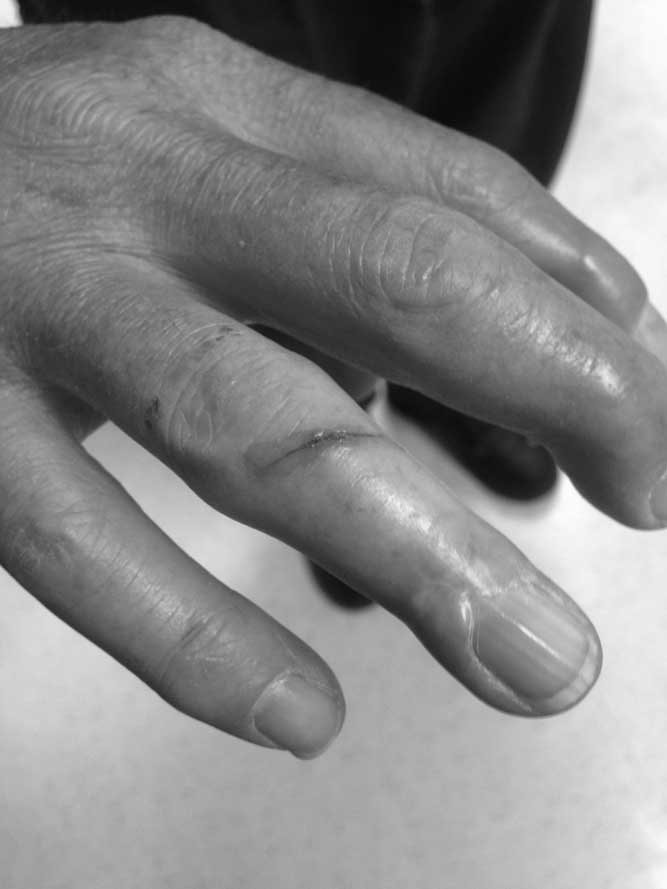
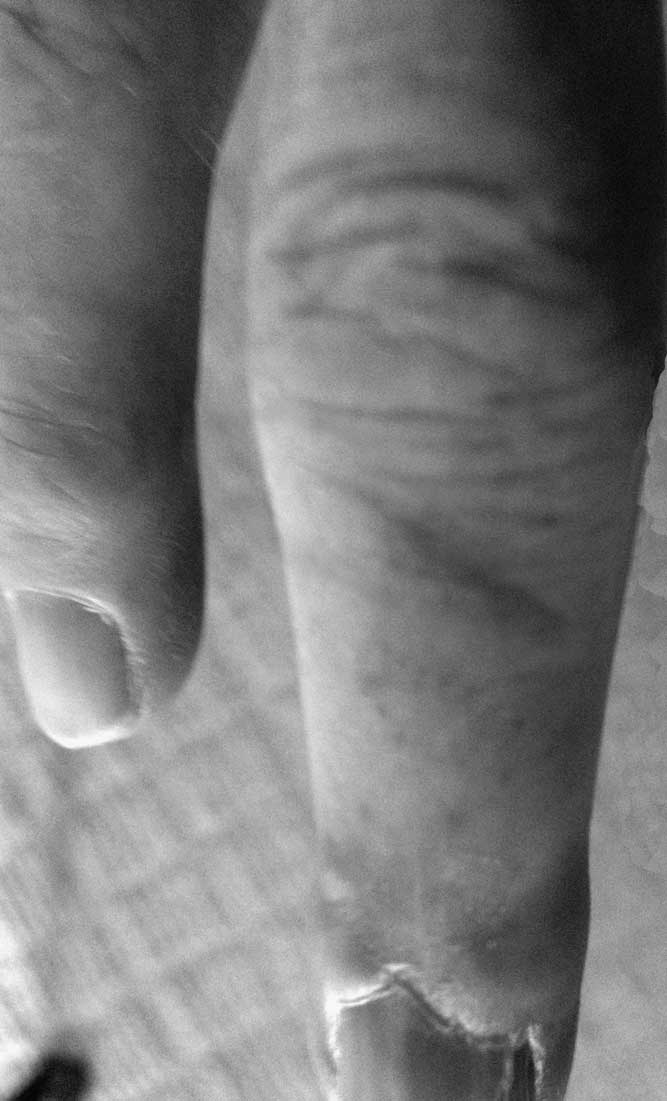
Approximately 24 hours after initial presentation, it became clinically apparent that measures to keep the wound clean and dry would be more difficult than anticipated. Adhesive bandages continuously failed to adhere to surrounding skin, which was persistently moist due to perspiration or hand washing. Additionally, the need to wear personal protective equipment and heavy-duty work gloves over the injured finger made it impossible to maintain bulkier barrier dressings. There remained no evidence of wound infection. The decision was made to use tissue adhesive (Dermabond Advanced, Ethicon Inc., San Lorenzo, Puerto Rico) to create a functional, flexible, and waterproof barrier dressing. Wound adhesive was applied and allowed to air dry using standard application technique. The patient returned to work on scene and was serially reassessed. After 72 hours, the wound adhesive remained intact and functional (Figure 1). There were no exam findings suggestive of wound infection. At 30 days following the event, the wound had achieved complete healing without complications (Figure 2).
Wound at 72 Hours Following Event

Wound at 30 Days Following Event
Discussion
The management of wounds sustained during or after a disaster must include consideration of the mechanism of injury, environmental circumstances surrounding the injury, the time interval from injury until patient presentation, and the patient's underlying medical history.Reference Simon and Hern 3 The World Health Organization's statement on the prevention and management of wounds acknowledges that open injuries have a potential for serious bacterial wound infections and may lead to long term disabilities, chronic infection, and even death. 4 This is noted to be of particular concern in disasters in which patients present late for definitive care or in resource-constrained environments. Appropriate field management of injuries is important to reduce the likelihood of wound infections. The Centers for Disaster Control and Prevention similarly recognizes that the potential for injury following disasters is high, and that prompt management can help small wounds heal and can prevent infection. 5
Standard practice for the management of wounds includes thorough irrigation, decontamination, exploration, debridement as necessary, and appropriate closure.Reference Lammers 6 Wound closure practices often are divided into primary and secondary intention methods. Primary intention wound closure consists of some means of surgical apposition of the wound edges, which facilitates the biological process of healing. Methods of primary wound closure include suturing, stapling, and gluing. Typically, whenever possible, wounds should be closed primarily to allow for effective functional and cosmetic healing. However, clinical best practices preclude primary closure of wounds that are contaminated, including punctures/bites, and those exposed to standing water, sea life, and ocean water, due to the high risk of infection.Reference Simon and Hern 3 – 5 The secondary intention method of wound closure (spontaneous healing) is well established and is the approach of choice for contaminated wounds and those with a delayed presentation. Secondary intention allows wounds to heal through the formation of granulation tissue, takes considerably longer, and is often associated with generally poorer cosmetic and functional outcomes.
Wound adhesives have been well described as an alternative to longer-standing primary closure methods for simple lacerations, such as suturing or stapling. Cyanoacrylate has been used for over 25 years and easily forms a strong, flexible bond.Reference Simon and Hern 3 A Cochrane Review of wound adhesives found no significant difference in cosmetic outcome between tissue adhesives and standard wound closure, or among different types of tissue adhesives.Reference Farion, Osmond and Hartling 7 Wound adhesives are noted to offer the benefits of decreased procedure time and less pain, compared to standard wound closure techniques. It has been further suggested that the antimicrobial properties of wound adhesives may decrease the rate of wound infections.Reference Quinn, Osmund, Yurack and Moir 8
Conclusions
In all instances of wound management, clinicians must weigh the risks and benefits of closing lacerations. Caution always must be exercised when confronted with contaminated wounds or those with a high risk of complications. In the postdisaster environment, wounds encountered in the field further complicate all of these considerations. In this case, tissue adhesive was not used for the purposes of primary wound closure, but rather as a versatile barrier dressing due to its waterproof, flexible, and antimicrobial properties. Cyanoacrylate functioned well in this setting, allowing field expedient application and serving to keep the wound dry, approximated, and uninfected. Serial examinations and close follow-up care permitted the use of tissue adhesive to be used in this novel setting. Based upon this experience, the authors believe this technique to be worthy of further consideration for wound management in similarly complex field environments.