In the economic history of the North Atlantic region, the part played by the medieval Norse in Greenland is poorly understood and often overlooked, especially by those who prefer to grapple with issues directly related to Britain and continental Europe. It is also a problem that so many concepts about Norse Greenland were formulated in the nineteenth century, based on literal interpretations of a limited number of written sources, at a time when it was taken for granted that the authority of church and crown also prevailed at Norway’s most distant outpost. A lasting consequence of those early analyses is that the Greenland Norse are usually cast in the role of passive or obtuse victims of isolation and a hostile environment, although they developed a viable society that lasted for half a millennium. Fresh instances of this attitude’s seemingly firm anchor appear regularly.Footnote 1
Recent research has provided much valuable new information about the Norse Greenlanders’ existence and history and suggests a need to re-evaluate earlier conclusions about the rise and fall of that small Norse community. For example, modern archaeologists have now demonstrated that Ívar Bárdarson’s ‘Description of Greenland’ is an unreliable source for judging mid-fourteenth-century conditions in the two Norse Greenland settlements, nor does it explain why the northernmost colony, the Western Settlement, was abandoned. Equally important to understanding the final phase in both the Western and Eastern Settlements are the recently completed excavations at the ‘Farm Beneath the Sand’ in the Western Settlement, which show that this site maintained good contact with the outside world right up until the farm’s final abandonment around 1400, and that walrus were hunted for local purposes throughout the entire final phase.Footnote 2
It remains unclear why the Eastern (main) Settlement in Greenland was abandoned some five centuries ago, and the Western Settlement perhaps a hundred years earlier, but in both cases the inhabitants evidently left their farms voluntarily and were not coerced by threats and force from outsiders. It should also be noted that, despite the existence of archaeological artefacts from the approximate final phase of the Norse Greenland settlements, radiocarbon dating cannot by itself determine the actual dates of such items. Many Norse churchyards in Greenland have either not been examined or were excavated before the advent of modern archaeological methods, and parts of the churchyards at Herjolfsnes in the Eastern Settlement and at Sandnes in the Western Settlement have been washed away (the sea has risen several metres in south-western Greenland during the past five hundred years). Therefore nobody knows when the last Norse burials took place in Greenland.
There is no evidence for such grim explanations of the colony’s end as that the Norse Greenlanders were unable to adjust to their surroundings and lacked the wits to copy the Thule Eskimos’ hunting methods and clothing.Footnote 3 Similarly, it does not seem that they became passive victims of Mother Nature’s whims, of separation from Norwegian ecclesiastical and secular authorities, or of murderous Inuit. Evidence is also lacking for the theory that the disconsolate Greenlanders turned their backs on their farms in order to ‘return’ to Iceland or to Norway.Footnote 4 Instead, there are several arguments against such an eastward retreat.
First of all, the more prosperous free farmers – the social class that experience has shown most likely to initiate such migrations – would scarcely have found either Norway or Iceland a tempting destination in the fifteenth century, given successive monarchs’ ham-fisted economic policies and unstable ecclesiastical and secular authorities. Without farms and land of their own, and without powerful connections able to protect them against abuse, immigrants from Greenland could expect a wretched existence as hired hands, whether they ended up in Iceland or in Norway. Second, the history of Norse colonization in the Atlantic demonstrates that the settlers soon regarded themselves as belonging to their new homeland and not to Norway, although the cultural affinity among the various Norse societies remained. Third, not a single document indicates that Icelanders who inherited a considerable number of farms after the ravages of the Black Death there, in 1402–04, turned over their properties to people from outside their country. Indeed, there is no evidence for perceptible contact between Iceland and Greenland after the mid fifteenth century. Fourth, it is highly unlikely that a determined and final exodus eastward from Greenland would have passed unnoticed by ombudsmen and other representatives of the Dano-Norwegian crown, of whom there were a good many in both Iceland and Norway by the second half of the fifteenth century.
It is clear that neither Danish and Norwegian nor Icelandic public functionaries were aware that the Norse Greenland colony had ceased to exist. Around 1514, the Norwegian archbishop Erik Valkendorf (Danish by birth, and still loyal to Christian II) planned an expedition to Greenland, which he believed to be part of a continuous northern landmass leading to the New World with all its wealth, and which he fully expected still to have a Norse population, whose members could be pressed anew to the bosom of church and crown after an interval of well over a hundred years.Footnote 5 Presumably, the archbishop had better archives at his disposal than most people, and yet he had not heard that the Greenlanders were gone.
Else Roesdahl’s explanation for why the Norse Greenland colony ended
The above issues are relevant to the Danish archaeologist Else Roesdahl’s hypothesis that, right from the beginning of the fourteenth century, a surplus of reasonably priced elephant ivory from Africa caused ivory from walrus tusks to lose its market share, with economic consequences for the Western Settlement so catastrophic that they contributed to the final collapse of the entire Norse Greenland colony.Footnote 6
As Roesdahl is undoubtedly correct in assuming that the Norse Greenlanders felt the effects of economic and cultural developments far from home, an evaluation of her hypothesis calls for examining what circumstances – both in Greenland and abroad – may have affected the medieval trade in elephant and walrus tusks. It is also necessary to consider some long-term economic, social, and political developments in Europe, Asia, and Africa that may have influenced the supply, price, and use of ivory from various animal species. Finally, one must ask when elephant ivory might have been in significantly better supply in Europe, whether increased availability came before or after increased demand, and what consequences this development might have had for the price of the raw material in Europe.
The challenge of medieval concepts
The scholar’s path is not always clearly marked. Medieval written sources indicate that some animal substances were accorded magical or medicinal properties (examples are horns of narwhal and rhinoceros), and they suggest that most people had little knowledge about the exotic creatures whose horns or tusks artisans used in their work.Footnote 7 It is therefore safe to say that medieval taxonomy represents a challenge. Uncertain or unclassifiable geographical concepts may also cause problems for modern researchers using medieval sources for the trade in Arctic products, especially given that Eurasia’s northern regions were almost unknown to anyone who did not live and work there. The notion that the western corner of northern Eurasia (Norway included) was directly connected to Greenland, which itself linked up with north-eastern Asia, endured far into the seventeenth century, and it was even longer before realistic information about Greenland became usefully absorbed by learned minds. It is not difficult to see why this was so, because the few reports available about Arctic regions came from sailors and hunters operating in a desert of ice and snow, where it can be nearly impossible to distinguish between sea and terra firma. Nor did it help the geographical concepts of the time that the area of the Atlantic walrus (which is distinct from that of the Pacific subspecies) reaches westward from the districts around the Barents Sea clear across the Greenland Sea and northernmost Greenland to the cold waters shared by Greenland and Arctic Canada. From Smith Sound and Baffin Bay, the animal then follows the coasts south along Greenland and Canada as far as its dietary needs and breeding habits permit.
Imprecise or ambiguous vocabulary is another problem in medieval documents. There is little doubt that the dentes centinos (whalefish teeth) that Bishop Hákon of Bergen sent to a merchant in Bruges in 1338 were walrus tusks. However, there are difficulties with the will that Henrik Ludvigsson, a canon in Uppsala, wrote in 1346. His list included a chessboard with gaming pieces made of ivory, described as tabulas eburneas.Footnote 8 The difficulty here is that eburnus merely indicates the material’s colour, without specifying the species from which it came, as the word means ivory, ivory-like, or ivory white. It had its origin in classical Latin, when there was no thought of walrus tusks, although the trade in other luxury goods from the far north, such as amber and fur, was well established in the Mediterranean region before the Roman empire.Footnote 9
Sources of elephant ivory
Elephant ivory was highly valued in Asian and European cultures, and large quantities were consumed in ancient Rome. African ivory reached Egyptian harbours by transport on the Nile or by camel caravans, and large amounts of Indian elephant ivory were also imported through Egypt, especially after the country became a part of the Roman empire. From Egypt, some of the ivory was sent through the Middle East and Cyprus to Roman and Greek harbours, and from Rome it trickled out across Europe to distant corners of the Roman empire. After the sack of Rome in 410, however, the demand for luxury goods fell both there and in the Roman provinces, and ivory (in greatly reduced quantities) subsequently reached the European market primarily via Byzantium.Footnote 10
At first, the ivory came primarily from India, Syria, and north Africa. However, the elephants were so mercilessly exploited for their tusks that, by 500 BCE, there were no more wild elephants in the Middle East, and towards the end of the fourth century CE the African elephant had ceased to exist north of the Sahara. During the seventh and eighth centuries, Muslim Arabs secured a trade monopoly in the Maghreb – essentially the north African countries of Morocco, Algeria, and Tunisia between the Atlas Mountains and the Mediterranean – and soon established trade in gold and ivory with the peoples south of the Sahara. By the beginning of the year 1000, they were also engaged in regular trade with western Sudan. Indian and Chinese demand for ivory increased in the seventh century and pulled the fulcrum of the African ivory trade over towards the east coast, also through a Muslim trade system. The merchants supplying ivory to Egypt via harbours in the Red Sea region sought new resources ever farther south along the African east coast but, despite this expansion, neither then nor later did the Muslim ivory traders manage to obtain enough of their product to satisfy demand.Footnote 11
Late in the eighth century and at the beginning of the ninth, small quantities of elephant ivory were finding their way from north African harbours to the other side of the Mediterranean, aboard ships from Constantinople, Venice, and Genoa. The Swiss art historian Gabrielle Gaborit-Chopin reasons that the Italian connection explains why good-quality elephant ivory was available in Lorraine workshops in the second half of the ninth century and in the Rhine region around the year 1000. As she observes, the material nevertheless continued to be in such short supply in Europe that it was used only in workshops connected with Charlemagne and his descendants, and was reused later, even by artisans who also had access to walrus ivory.Footnote 12
Gaborit-Chopin notes that the number of European works executed in elephant ivory increased substantially during the thirteenth and fourteenth centuries, and it is her opinion that the transition to the gothic style in elephant ivory carvings (as well as in marble and alabaster works) was due partly to relatively good access to this raw material and partly to a fashion that required larger pieces of material than walrus ivory could provide. She stresses that elephant ivory was still costly nonetheless, although it was now evidently within the reach of rich city burghers as well as secular and ecclesiastical princes, and she observes that the supply of elephant ivory did not become plentiful until after 1500. The only problem with her account of these developments is that she takes falling prices for granted, when the supply of elephant ivory increased during the thirteenth and fourteenth centuries, creating a relative plenty, which she assumes was due partly to the above-mentioned increase in the number of Italian harbours with Egyptian connections and partly to a new trade route between harbours in the St Malo district in Normandy and those on the African coast.Footnote 13
However, these French merchants would also have come up against the Muslim trade monopoly in the Maghreb, whose representatives were in a position to exact the highest possible prices for the luxury goods that had reached the north African coast via long and risk-filled overland routes, involving huge losses of both human and animal lives, as well as numerous middlemen who expected a profit. Over long distances, freighting a cargo by ship was much cheaper than land transport, but the relatively short sea transport from north Africa across the Mediterranean would have had comparatively little influence on the final price of ivory in Europe. Only towards the close of the fifteenth century, when the Portuguese had obtained a solid foothold in west African harbours running down to the Gulf of Guinea, did the Muslim trade monopoly end on goods going north overland, which made European sea transport possible all the way from African west coast ports.Footnote 14 Direct trade between Europe and Africa’s east coast could only begin after the Portuguese occupied Sofala in 1505–07. Both developments were a direct consequence of the Portuguese desire to load gold, slaves, ivory, and other African produce directly onto their own ships and freight the treasure to Europe, where they could sell their goods in quantities and at prices reflecting the fact that the importers were no longer subject to the Muslim hold on exports from the Maghreb.Footnote 15
Competing with walrus ivory for market share?
During the thirteenth and fourteenth centuries, when European ships could only reach north African ports, not even increased availability of African elephant ivory could have resulted in appreciably lower prices for European consumers. Roesdahl, like Gaborit-Chopin, nevertheless takes it for granted that increased supplies of any commodity necessarily translate into a drop in price, and so do the Norwegian art historians Martin Blindheim and Haakon Andersen. In detailed descriptions of Norwegian artefacts executed in walrus ivory (particularly works made in Trondheim after the establishment of a separate Norwegian archbishopric in 1152), both scholars additionally assume that the Norse Greenlanders supplied most of the walrus tusks that found their way through Norway from the eleventh century until sometime in the fourteenth, by which time there was insufficient continental demand for this material. Andersen notes, furthermore, that the devastating effects of the Black Death in Norway (1349–50) brought considerable economic dislocations to the Trondheim archdiocese and the artisanal industry there.Footnote 16
Like Blindheim, Andersen believes that the reduction in imported walrus tusks was due to better access to African elephant ivory, coupled with diminishing European interest in walrus ivory once the gothic style was introduced,Footnote 17 an idea they have in common with Gaborit-Chopin. Sharing Blindheim’s and Andersen’s views, Roesdahl suggests that, by the later Middle Ages, western Europeans had only a limited, albeit fashionable, preoccupation with works that used entire walrus tusks, many examples of which she describes. Among them are an exquisitely carved walrus tusk from the mid fourteenth century, embellished with the coat of arms of Christian I and Queen Dorothea, and a richly decorated tusk apparently made for the boy king Eric of Pomerania around 1397, when the Kalmar Treaty uniting Norway, Sweden, and Denmark was signed.Footnote 18 Blindheim’s examples of works from this period include a beautiful pyxis with eight panels carved in walrus ivory; it came to Lund in Scania as the property of Aslak Bolt (Norwegian archbishop 1428–50) or of one of his men.Footnote 19
These magnificent works may just as easily be interpreted as evidence that walrus ivory had become so scarce and prestigious in western Europe that commissioning the carving of an entire tusk was a gesture worthy of profligate monarchs – a description that fits both Christian I and Queen Margrethe, Eric of Pomerania’s aunt. In any event, it is clear that, in the Nordic countries, walrus ivory was still appreciated in 1479, when the powerful Icelander Thorleif Björnsson gave the royal governor of Iceland a large sum of silver and a horn made of walrus ivory to be passed on as a gift to King Hans of Denmark, in order to obtain a licence for Thorleif to marry his cousin Yngvild and legitimize his many children by her.Footnote 20
Putting a price on luxury
No price tag is ever supplied for any of these precious objects. It is hopeless to try to trace the actual prices paid for any kind of ivory during the Middle Ages, either at its source or at its artisanal destination. However, as an example of the lengths to which medieval Europeans might go in order to obtain precious articles, Gaborit-Chopin notes that, in the early eleventh century, elephant ivory was so rare in France that the Abbot of Fleury purchased (evidently in Italy) an ivory diptych of ‘Indian’ ivory, for a sum five times more than he had paid for a vineyard.Footnote 21 During the subsequent period of increasing prosperity in medieval Europe, which lasted with some interruptions until the Black Death of 1348–49, both secular and ecclesiastical princes engaged in unabashed conspicuous consumption. People who wanted to appear wealthy and influential also commissioned lavish art works both for themselves and as gifts with which to curry favours. For as long as demand outstripped supply, such a trend would favour traders in luxury commodities, whether these were rhinoceros horns, narwhal horns, walrus tusks, and lustrous furs from the far north, or precious metals, pearls, gems, and elephant ivory from Africa and Asia.
Even in our own time, the price of luxury goods is usually determined by an estimate of what the market will bear. In the Middle Ages, the mark-up on luxury wares – particularly on those in very short supply – was often many times that placed on ordinary consumer goods. One cannot take it for granted, therefore, that the price of a luxury commodity such as elephant ivory rose and fell in the same way as for plain merchandise. Buyers would have had to register a surplus of a luxury commodity in order for its value to fall, and at no time was there a discernible surplus in the medieval trade with African elephant ivory, which was not dependent on European markets for its survival. As already mentioned, neither in the Maghreb nor in east Africa were the Muslims able to obtain sufficient quantities of elephant ivory during the whole period that their trade monopolies lasted, that is, until around 1500. For as long as the demand for a luxury commodity exceeded the available supply, the situation favoured those who were in command of the trade in that merchandise.
Prior to 1500, it is highly unlikely that there was a drop in the price of elephant ivory capable of displacing walrus tusks in the market, even in periods when more African ivory appears to have been reaching European workshops. It is far more likely that, during periods of increased supply in response to European demand, the price of African ivory would have risen in step with the available quantities, because the transportation costs arising from Africa’s immense distances, in an extremely challenging terrain, would have prevented the exploitation of any sources of elephant ivory that were unlikely to produce a profit unless the price increased enough to compensate for greater transportation costs. During times of prosperity, both secular and ecclesiastical European princes participated in an undisguised and increasingly competitive consumption of luxury goods. If rising demand for African ivory produced an increase in exports to Europe, it would have been possible to satisfy that demand only by raising the price enough to compensate for transportation over longer inland distances than before. Just such a development took place in the nineteenth century, when renewed European prosperity led to an expanded demand for African ivory and caused a dramatic rise in both the amounts exported and the costs to the consumer. Because higher prices then made it profitable to transport considerable quantities of ivory from the deep interior, the ivory trade grew enormously in the central Zaire basin, where the hunters’ ignorance of the commodity’s actual market value gave extravagant profits to the middlemen. In Luanda, the price of ivory shot up 300% in 1836, after the Portuguese government had relinquished its monopoly, at the same time as the export of ivory rose from a ton and a half in 1832 to more than eighty tons in 1859. In east Africa, the price of ivory rose 400% between 1823 and 1873.Footnote 22
Evidence for the retention of ivory’s value
It is hard to believe that a noticeable price fall took place in Europe in the mid fifteenth century, because elephant ivory was still regarded as exclusive and valuable. For example, among the gifts brought back from Africa to Prince Henry ‘the Navigator’ in the 1440s were an elephant’s foot and an elephant tusk twelve hand’s-breadths long – the latter a treasure that the prince gave as a present to his sister, the Duchess of Burgundy.Footnote 23 If this was the situation on the Iberian Peninsula as late as the middle of the fifteenth century, it is rather unlikely that artisans farther north, who for some centuries had primarily worked with walrus tusks because they were easier and cheaper to obtain than elephant ivory, would have forsaken walrus tusks in favour of elephant ivory, if walrus ivory had still been accessible in sufficient quantities.Footnote 24 Moreover, long after 1500, many artisans in the Near and Middle East continued to prefer walrus tusks to other kinds of ivory for decorating knives and other weapons, because walrus ivory exhibits a delicate flame pattern when the tusk is cut in thin slices lengthwise. These artisans obtained the merchandise through the same Novgorod and Bulgar trade network that conveyed furs from the Far North.Footnote 25
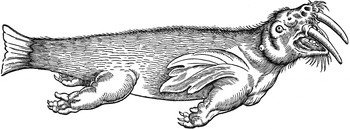
Furthermore, in Europe – where there was widespread interest in exotic animals quite apart from any commercial value they might have – the walrus was an object of appreciation after 1500 as well. The animal’s enduring reputation for precious teeth is obvious from the elephant-like morsus that Martin Waldseemüller placed above north Norway in his 1516 Carta marina. Both his drawing and the accompanying text make it clear that he associated elephant-like tusks with an animal living in herds in northernmost Norway, and that it was as alien to him as to his friend Albrecht Dürer who, around 1520, drew a salted walrus head, which the Norwegian archbishop Erik Valkendorf had recently sent to Pope Leo X. A Vatican artist recording the wonder before it was sent out on tour, equipped the animal with both shoulder wings and four stubby arms ending in chubby little hands (see Figure 1). Dürer drew only what he was personally able to observe.Footnote 26
Vatican artist’s depiction of the salted walrus head that Archbishop Erik Valkendorf of Norway sent to Pope Leo X c.1520. The artist added his own conception of the complete animal to the sketch, which was later reproduced in Konrad Gesner’s four-volume illustrated work Historia Animalium in the sixteenth century. From Gesner’s curious and fantastic beasts, Minneola, NY: Dover Publications, 2004, sketch 260.

The walrus head came accompanied by a letter from Archbishop Valkendorf, in which he gave dramatic descriptions of the dreadful monsters lurking in the northernmost seas. Valkendorf’s younger friend, the exiled Swedish catholic archbishop Olaus Magnus (1490–1557), placed fantastic creatures with enormous tusks and horns in the northern seas on his own Carta marina (1539), which began a tenacious tradition of sea monsters. Whether tusked or armour-plated, sea monsters continued to fascinate the public on the continent, not least because their tusks could reportedly do away with anyone and were as valuable as pearls and precious metals.Footnote 27
Walrus ivory from Greenland
Because there is little to suggest that the sixteenth century saw decidedly less European interest in walrus tusks than when the Greenland Norse began their walrus hunts around the year 1000, it seems fair to ask if the decreasing use of walrus ivory in Europe after the mid fifteenth century may have been due to a lack of imports, rather than to a lack of artisanal interest. Prior to a look at the trade routes that may have played a part in the supply of walrus ivory once it reached the rest of Europe, a review of Greenland’s exports of walrus tusks seems in order.
Eirik the Red Thorvaldsson, the founder of the Greenland colony, came from an old trading culture and would have known that his new enterprise needed acceptable trade goods to pay for imported goods. Surplus farm products – butter, cheese, hides, and wool – were always reliable export goods, but Eirik would also have been aware of the established trade connections in Europe for Arctic products such as furs, blubber, eiderdown, narwhal horns, walrus ropes, and, last but not least, walrus tusks.Footnote 28 Non-perishable and taking up little space relative to their market value, the tusks were particularly well suited to the luxury trade and to long-distance transportation by ship, and they were already an accepted raw material in articles for everyday use, as well as for decorative objects.
Written evidence for voyages far north along the Greenland shore of the Davis Strait begins with the late twelfth-century work Historia Norvegiæ, and the received wisdom has therefore been that the Norse colonists waited a few generations before they engaged in far northern hunts.Footnote 29 The historical and archaeological record does not support that view. Instead, it is clear that Eirik already had northern hunts in mind when he founded his Greenland colony. The ‘Saga of the Greenlanders’ says that, when the southernmost main colony (the Eastern Settlement) was founded, there were also some colonists who continued to the north-west and created a smaller community, the Western Settlement (so-called because Greenland’s west coast veers west as it runs north). Modern archaeological investigations confirm that both of these settlements on Greenland’s south-west coast were established around the year 1000, thus supporting the saga’s claim that, during the three years that Eric had spent exploring Greenland before he decided to settle there, one of the regions he accessed was the inner reaches of the present Nuuk district.Footnote 30
Neither the ‘Saga of the Greenlanders’ nor the ‘Saga of Eirik the Red’ report any land claims during that initial investigation. Only in conjunction with the arrival of the first settlers are a few specific land-takes noted, which, together with remarks made elsewhere in the text, tell the reader that the four most important land claims were for sites that remained the chief farms and trading sites throughout the colony’s existence, namely Brattahlid (Eirik the Red’s seat), Gardar, Hvalsey, and Herjolfsnes. The story in the ‘Saga of the Greenlanders’ of how Bjarni, the son of the settler at Herjolfsnes, eventually tracked down his father’s Greenland farm, reveals that Herjolf must have left directions in Iceland before he emigrated. This means that he had accompanied Eirik on his reconnaissance voyage and made his land claim then. It is very likely that the owners of the two other choice land-takes had been present as well, but that is a different matter. The point is that the oblique saga style relies on each listener or reader to contribute other scraps of information, common knowledge, and common sense. Thus, when the ‘Saga of Eirik the Red’ says that Eirik’s son Thorstein owned part of a farm in Lysufjord (now Ameralik) in the Western Settlement, the underlying assumption is that this was a site that Eirik had claimed for himself and his family when he realized the importance of having a settlement there, for, as the colony’s leader, he would expect to control important resource exploitation. His land claim would have been for the best possible location, namely Sandnes, the most advantageously and strategically located property in those parts.
The Western Settlement lay halfway between the Eastern Settlement and Disko Bay, the centre of the northern hunting grounds that the Norse called Norðrseta, which apparently included both the Lancaster Sound area in north-eastern Canada and the West Greenland coast to at least 73° north. In contrast to the inner fjord systems in the Eastern Settlement, where ice blocks the entrance to the outer coast until late in the summer season, the Ameralik fjord has no calving glaciers in the fjord and no icebergs enter the fjord from the open sea. In recent times, sea ice has formed only for brief periods during the coldest winters and with favourable wind.Footnote 31 Colonists in the Western Settlement would therefore have had a significant head start on the Arctic spring and summer hunt. That would have been reason enough to settle a district that did not offer the same farming advantages as the Eastern Settlement, and for Eirik and his family to maintain a base there.
Marketing medieval Greenland’s produce
No extant sources tell us how the Greenland Norse marketed their export goods from their colony’s inception until 1123, when the Greenlandic chieftain’s son Einar Sokkason used walrus tusks as his chief bait to persuade the Norwegian authorities to make Greenland a separate bishopric.Footnote 32 It is notable that Einar’s errand took place when there was a consolidation of trading centres and trade routes in Europe.Footnote 33 Previously, merchants had carried their goods to various small trading centres around the North Sea, for example to England. A change in this pattern is probably connected to the fact that, judging from the Coppergate excavations in York (Norse Jörvík), there was significantly less local use of walrus tusks from the end of the twelfth century, although the raw material continues to appear in York sites throughout the medieval period.Footnote 34
The sparse primary sources about the earlier Middle Ages in the north hint at trade connections between Norway and England at an early date. For example, in 789 a local reeve rode down to the shore to greet Vikings who arrived on the English south coast with three ships. They killed the reeve on sight, but the official had clearly acted in good faith, which suggests that there had been previous, peaceful visits by Norse traders.Footnote 35 When the poet Egil Skallagrimsson’s uncle, Thorolf Kveldulfsson, helped himself to the so-called Finn tax in north Norway, his enemies reportedly took it for granted that this considerable treasure would be brought straight to England for sale there.Footnote 36 Similar clues are found in the story about the trader Ohthere from north Norway, who visited the English court of King Alfred late in the ninth century and described a voyage he had taken beyond the North Cape into the White Sea region. Walrus tusks were among the gifts that the foresighted Ohthere had brought along for the English monarch.Footnote 37 One may reasonably suppose that Ohthere had several more tusks in his cargo, intended for sale in England, and that this was the real reason for his long voyage south. Collecting tribute with a view to subsequent trade had undoubtedly been part of his reason for sailing around the North Cape, because he did not boast of having personally felled walrus and fur animals during his journey. Later (but still before Einar Sokkason purchased a bishop for his fellow Greenlanders), there are also examples of continued Norwegian trade connections with England. Around 1115–20, for example, the Orkney earl Rognvald Kali returned to Norway after a trading voyage to Grimsby in England, and King Henry II of England took it for granted that, during his father’s reign (1100–35), Norwegian merchants had paid customs duties in Grimsby.Footnote 38
Norse trade during the Viking era had consisted mostly of luxury articles that required relatively little space during transportation, promised the merchant a good return on his labours, and brought prestige to the buyer. After about the year 1000, however, there was also an increase in trade in ordinary consumer goods. For a while, furs, walrus tusks, and other Arctic produce – sent south to Bergen or east to the Baltic – shared trade routes with more prosaic Hanseatic goods, but German merchants were already so firmly established in Novgorod in the second half of the thirteenth century that they soon controlled most of the fur trade from the far north.Footnote 39
Changes in the distribution pattern of walrus ivory were probably unavoidable when its traditional travelling companion, fur, no longer comprised only the precious pelts coveted by prestige-conscious people all the way down to the Mediterranean but had also come to include cheaper sorts intended for colder regions, where even nightclothes might be lined with hare skins, cat skins, or squirrel fur (miniver). Soon, the trade in large quantities of plain consumer goods became the anchor of Hanseatic commerce and of its increasing centralization, and special commodities such as walrus ivory risked being marginalized. Compared with walrus tusks and other luxury items, the fur trade acquired a huge volume, a wide circle of consumers, and a well-organized distribution network similar to that enjoyed by stockfish, salt fish, cloth, and grain. This high-volume trade moved increasingly through Novgorod, Lübeck, and Bruges. As far as England and the rest of western Europe were concerned, it appears that, late in the thirteenth century and for a couple of centuries more, Bruges, not Novgorod, was the most important intermediary for furs from Sweden, Russia, Poland, Bulgaria, Navarre, Castile, Andalusia, Galicia, Portugal, Fez, Bougie, Tunisia, Sardinia, and Tartary beyond the Black Sea.Footnote 40
There is plenty of evidence that trade between Flanders and Bergen also flourished during the first decades of the fourteenth century, in exchanges that mostly involved common consumer goods.Footnote 41 The 1308 trade agreement between the Duke of Flanders and the Norwegian king, Hákon V Magnusson, suggests that this commercial connection was important to both parties.Footnote 42 What is not made clear in this document, however, is whether the Hanse, too, benefited directly from this agreement, nor does it say how wide a spectrum of trade goods was involved. A stern tone colours a 1316 decree determining the tax on a long list of commodities exported from Bergen to other Hanseatic trade centres. It prohibits the export of stockfish and butter unless the foreign merchants bring in malt, meal, and other desirable wares, and the large variety of goods included in the decree runs the gamut from stockfish and whale meat to furs, wool, and wool cloth. Walrus tusks are placed in the same tax category as wool cloth and the furs of beaver, otter, fox, and seal. It is evident that the list also includes goods to be re-exported from the Atlantic colonies, because the Icelandic speciality commodity of sulphur is included.Footnote 43
There is far less detail in the correspondence between Bishop Audfinn of Bergen (who was less than pleased with the king’s share in tax-collecting) and Archbishop Eilif concerning the payment of tithes, including from Greenland.Footnote 44 Their exchange of letters in 1325, regarding a knarr that had just arrived in Bergen with goods from Greenland, has been discussed often enough, but it is rare for anyone to remark on the fact that neither Bishop Audfinn’s query nor the archbishop’s response mentions what sort of goods the merchants had in their cargo.Footnote 45
The last known document specifically noting the Norwegian import of Greenland walrus ivory in payment of church taxes dates from 1327.Footnote 46 Both in Norway and Sweden, this was a period of widespread reluctance to pay church taxes, following several years of very poor harvests in large parts of Europe. However, the Greenlanders cultivated grain only on an experimental basis and strictly for domestic purposes, not for trade or for the payment of tithes. Therefore, any resistance they may have shown towards paying church taxes must have had a different cause from the poor conditions affecting agriculture elsewhere. Even when weather conditions in Europe improved, the export of goods from Greenland did not pick up sufficiently to satisfy the Bergen bishop officially.
This does not mean that a lack of demand had made it difficult to market Arctic luxury produce abroad, however. For one thing, it needs noting that, in 1338, Bishop Hákon of Bergen sent a polar-bear skin to a contact in Bruges, accompanied by seven walrus tusks and other prestigious Arctic commodities. The bishop’s accompanying letter described these articles as gifts to Herr Correnbitter, but one might just as easily regard them as a consignment to be sold, on the bishop’s behalf, by an experienced Flemish merchant.Footnote 47
Deteriorating relations with the Norwegian Church
Shortly before the Black Death hammered Norway, the Bergen bishop sent his priest Ivar Bárdarson to Greenland in 1341, in order to regulate the collection of tithes through well-defined parish boundaries – a step the bishop is unlikely to have taken if the European market for walrus ivory and other Greenland wares had disappeared. There is nothing to suggest that the plague ever reached the Norse in Greenland (in Iceland it did not strike until 1402) but, when Ivar returned to Norway after a couple of decades in Greenland, the Black Death had irrevocably changed the world he left in 1341. Changes had clearly taken place in Greenland also, because it emerges from Ivar’s Greenland report (in the form we know it) that he no longer included the Western Settlement in the ledger for church taxes.Footnote 48 Considering that the community still had inhabitants and that walrus imports to the Norwegian Church appear to have stopped around 1327, the most likely reason for this omission would be that the Norse Greenlanders were balking at church taxes, and that Ívar could no longer count on walrus tusks for payment of tithes. His reference to the ‘end’ of the Western Settlement has traditionally been taken quite literally, but the recent archaeological evidence that Norse people still lived in that area as late as about 1400, hunting walrus for their own use, demands a more nuanced interpretation of Ívar’s ‘Description of Greenland’.
Ivar’s economic assessment of the Eastern Settlement was sufficiently encouraging that, shortly after his return home, the Greenland bishopric was provided with a new incumbent, the former Brother Alf from the Munkeliv monastery in Bergen. When Bishop Alf arrived at Gardar in 1368, the Greenlanders had been without a resident bishop for nineteen years.Footnote 49
To a greater degree than their contemporaries in other countries, the Greenlanders would have had reason to think that they received few advantages in return for their payments to the Church. It should come as no surprise, therefore, that the few sources we have about Greenland after the first quarter of the fourteenth century do suggest that the inhabitants there, as elsewhere in the Nordic countries at that time, objected to the Church’s ever-increasing taxes. Even before the economic, political, and social watershed of the Black Death, the Norse Greenlanders’ exports to Norway of both walrus tusks and hunting falcons had decreased, with the result that Greenland luxury goods channelled through the Bergen bishop were in short supply when the already loose administrative connections between Greenland and Norway effectively ceased, shortly after the plague’s devastation in Norway and the death of the last resident Greenland bishop, Bishop Alf, around 1376–78.Footnote 50
As far as can be judged, the Greenlanders had managed well without care and concern from the Norwegian authorities. Nor was it necessarily a misfortune to make do without Norwegian supervision. Although the intermittent connection with Norway may have been useful for trade, at no time did it ease the Greenlanders’ daily struggle for existence. Both inside and outside of Norway, the authority of the Roman Church had been unstable long before Bishop Alf’s death, and had little to offer the Greenland Norse. Meanwhile, the royal trade privileges governing the Atlantic colonies had been tightened under King Hákon VI and his son Olaf, and the policies of Olaf’s Danish mother, Margrethe, who became the reigning Norwegian monarch in 1388, showed little concern with Norway and the Norwegian colonies. Not much more than a decade after Alf’s demise in Greenland, which passed mostly unnoticed in Norway, the 1397 Kalmar union of Denmark, Norway, and Sweden was a reality, and Eric of Pomerania had been chosen as Queen Margrethe’s heir, with all the problems that that created, not only for Norway proper but for the country’s Atlantic colonies, fisheries, and fish trade.Footnote 51 At that point, the Norse Greenlanders would have been well advised to take part in the developments occurring elsewhere in the North Atlantic region, to whose economic engine they had contributed since the tender beginnings of their new community.
The growth of the codfish trade
When the Norwegian Church became the channel for many – but not all – of Greenland’s export goods, the marketing methods for such produce had already undergone several changes. As Greenland’s contact with Norway gradually disappeared, yet another change is likely to have taken place, now favouring marketing through England again. This was a consequence of an economic development similar to the one in Iceland, with stockfish (unsalted, wind-dried cod) as the major draw.
As European populations began to recover from the Black Death, all kinds of fish, especially stockfish, became increasingly important in meeting the growing need for protein. In the fifteenth century, the English led the quest for stockfish in both Norway and Iceland, and soon they were willing to pay twice as much as the Norwegians for this commodity. Excellent keeping qualities and modest transportation requirements promised a reliable profit on a commodity that was also a relatively cheap food source for consumers.Footnote 52
Several years ago, the American palaeozoologist Thomas McGovern, a recognized expert on Norse middens, was struck by the shortage in Norse Greenland middens of fish-hooks and sinkers, as well as by a comparative lack of codfish crania and backbones. He therefore argued that the Norse had made strangely little use of the fish swimming right along their shores.Footnote 53 This claim has since been disproved by sophisticated recent archaeological investigations in the Western Settlement, which have revealed plenty of fish-bone fragments from a number of species, including from large cod. Moreover, Norse traditions in fishing and curing cod usually called for removing heads and spines before the cod were hung across wooden poles to dry. Fish entrails other than the valuable livers were prized as fertilizer for their home fields, and other fish scraps – dried and crushed heads and spines included – were food supplements for both people and animals.Footnote 54
The Norse everywhere depended on fish for their food, and they knew how to cure codfish by wind-drying so that it would last them through the winter and also keep them in provisions on long voyages. They would have been insane not to carry the custom and the skills with them to Greenland. Rich codfish banks were located directly outside both the Eastern and Western Settlement coasts, where the climate conditions would have been favourable for curing a food resource on which the Greenlanders would have been dependent from the beginning of their colony.Footnote 55 They had the same access as the Icelanders to cod and to the conditions and skills for making stockfish, and English fishermen and fish merchants would have known where to find Greenland as easily as Iceland.
Icelandic stockfish exports became a source of conflict not only between Norway and Iceland but, by extension, between the English and Hanseatic fish merchants, who were vying for a product that was in increasing demand. For a while, at least, supplies were also compromised by the plague of 1402–04 in Iceland, which killed so many people that the country was short of fishermen and other labourers, and was poorly positioned to defend its fishing grounds when the English decided to catch and salt down much of the fish themselves off Iceland’s shores. The English also continued to buy as much stockfish as the Icelanders could provide, but the competition for cod soon became so fierce that some of the English visitors resorted to outright violence, while others looked for new fishing grounds farther and farther west, towards Greenland and beyond.Footnote 56
Just at the beginning of the period described here, an event took place that probably had important consequences for the Eastern Settlement throughout the fifteenth century. In 1411, several high-born North Icelanders returned home via Norway after spending four years in the Eastern Settlement, where the conditions were normal, according to an affidavit issued in connection with a marriage that took place at Hvalsey in September 1408.Footnote 57 The wedding party’s departure from Hvalsey in 1410 was the last documented voyage between Greenland and Norway. Among the travellers were the Hvalsey bridal pair – Sigrid Björn’s daughter and the Icelandic chieftain’s son, Thorstein Olafsson. Sigrid was also from North Iceland originally, and she now returned to Iceland as the wealthy heiress to a number of North Iceland farms because her rich father and her siblings had clearly died in the Black Death. Supported by his wife’s wealth and his own pedigree, Thorstein soon became an important participant in the political and economic development brought by the English fishermen and merchants who flocked to Iceland shortly after 1400. Not only Thorstein and his close relatives, but also the other young chieftains who had accompanied him to Greenland, were soon deeply involved with these English visitors. In Greenland, the trading centres at Herjolfsnes, Hvalsey, and Gardar show evidence of an economic upswing early in the fifteenth century – an upswing that obviously could not have been based on a major export of walrus tusks. Moreover, in those same sites archaeologists have found a few artefacts of English origin ascribable to the early part of the fifteenth century.Footnote 58
What were the English doing in Greenland in the fifteenth century?
Thorstein and his friends knew the Eastern Settlement to be a normal, viable Norse community when they left it. Returning home in 1411 and learning that the English merchants paid twice as much as the Norwegians for dried cod, Thorstein, at least, may have found it natural to encourage one or more English merchants to become middlemen for trade in Greenland stockfish and other export goods, bypassing King Eirik’s tax collectors altogether. Greenland was probably too distant to have benefited from the Norwegian codfish trade when it began its rapid expansion in the early fourteenth century, but English ships already in Icelandic waters could easily and safely provide a fifteenth-century link between Greenland and the growing English market for cod.
It is also possible, of course, that English merchants found their way to the Eastern Settlement on their own, because scattered Norwegian documents show that ancient connections with the British Isles had been maintained, and maps from just before and just after 1500Footnote 59 bear witness to the English demand for fish and to the use of southern Greenland as a navigational marker for European mariners continuing westward in the Atlantic. Regardless, it is unlikely that the powerful forces behind the European voyages of trade and discovery that so strongly affected Iceland, Greenland’s nearest neighbour to the east, failed to pull the Greenlanders into the economic changes that were taking place in the Atlantic and North Sea trade network.
In Iceland, personal wealth, tithes, and taxes were soon counted in lasts of stockfish, while butter and other agricultural products became increasingly scarce as labour was deflected from farming to fishing.Footnote 60 There is good reason to believe that a similar shift took place in Norse Greenland, where home fields appear to have received less care as the fifteenth century wore on.Footnote 61 In that connection, it is also important to note the Icelandic biologist Ingvi Thorsteinsson’s observation that land deterioration in south-west Greenland in the Middle Ages was not nearly as severe as in Iceland, which experienced similar effects of human habitation and cooling climate. He also wrote that, while soil erosion has been demonstrated in some areas in south-western Greenland, the physical properties of the soils in the region make it seem unlikely that large areas were damaged in Norse times. In the former Eastern Settlement, he had found undisturbed areas with a rich natural vegetation – ‘grazing lands of the highest quality’.Footnote 62
Studies of Norse Greenland skeletal and midden material suggest that medieval Greenland may have undergone similar economic changes, tilting the available labour towards increased maritime exploitation and away from activities on land. During the final phase of the Eastern Settlement, in some locations there was a substantially greater reliance on marine food resources. Radioisotope readings on skeletons have confirmed the dietary change, while midden evidence primarily shows an increased proportion of seal bones relative to terrestrial mammal bones.Footnote 63
Such an alteration in the diet suggests that there would have been a corresponding change in animal husbandry. The Icelandic historian Axel Kristínsson observes that Icelandic pastoralist farmers have always had to weigh the labour invested in caring for cows against the work of keeping sheep, a far less demanding animal.Footnote 64 One cannot suppose that the Norse Greenlanders were less able than the Icelanders to balance needs against resources. In their domestic economy, too, cows were expendable but sheep were not. If, towards the end of their colony, it required a disproportionate amount of labour to fertilize and harvest home fields for the sake of keeping cows, those home fields would soon have shown neglect of the kind suggested by Fredskild’s pollen analyses. Nevertheless, if the Norse reduced the number of cows and neglected their home fields, it would not signify that they also eliminated their flocks of sheep. Instead, Eastern Settlement farmers may well have decided to keep those tough animals producing meat, milk, and wool, and to use the freed-up labour elsewhere. Whatever the reason for Norse Greenland home fields falling into disuse, neglect would, at the very least, signal a changing economy.
If the Norse Greenlanders, in common with their Icelandic neighbours, were now concentrating on acquiring dried fish, blubber, cod-liver oil, and hides for trade elsewhere in Europe with the help of English middlemen, that decision would have put an end to the original reason for the Western Settlement’s existence, which was to be the gateway to the pursuit of walrus and other Arctic resources. But ending the Western Settlement does not in itself explain why the Eastern Settlement closed down.
Leaving Greenland
Greenland was so rich in resources that it is senseless to assume that the Norse colonists lived so far out on the edge of an economic precipice that the price of walrus tusks in Europe could dictate the colony’s fate. Fish and fish products, furs, falcons, wool, and animal hides would have had a market abroad as before, but isolation from foreign markets would have been a difficulty the Norse Greenlanders had reason to dread. And isolation is what they would have been facing sometime during the last couple of decades in the fifteenth century.
The objects of late medieval English origin found in the Eastern Settlement’s Norse strata suggest that English vessels called in at Greenland while the Norse were still there and that the English gradually explored opportunities beyond Greenland and Iceland. They nevertheless continued to buy stockfish from both Iceland and Norway during the later part of the fifteenth century, and the friction this caused between the English and the Germans in both places triggered the only hint of documentary evidence for English trading voyages to Greenland as late as in the 1480s. In Copenhagen, the learned Ole Worm (1588–1655) told the Frenchman Isaac de la Peyrère (1596–1676) that he had read an old Danish document (since lost), which stated that, in Bergen in 1484, some forty sailors had claimed that they made voyages to Greenland every year and obtained valuable merchandise. Hanseatic merchants reportedly invited all forty to supper and killed them. De la Peyrère discounted Worm’s tale on the grounds that the Norwegians had long since stopped sailing to Greenland, which was indeed the case, but there is good documentary evidence of bad German–English relations in Bergen in both 1475 and 1476, when merchants from Hull and Bristol were accused of plundering Hanseatic merchants there. At that time, only the English would have been sailing to both Greenland and Norway; therefore Worm’s story may reflect a squabble between English mariners and German merchants in Bergen.Footnote 65
Any English visits to Greenland would have become markedly less frequent by 1480 or so, when Bristol mariners had learned how to navigate directly from western Ireland to the Newfoundland–Labrador banks without sailing the familiar outward route by way of Iceland or Greenland, or both.Footnote 66 Without their remaining foreign contact, the Norse Greenlanders would have faced complete isolation for the first time in their history, and that is the most likely reason why they decided to move on, as Eirik and his Icelandic settlers had done half a millennium earlier.
A harsh life may kill individuals but it is unlikely to wipe out an entire population, otherwise we would not still have Icelanders, Faeroese, and Norwegians. It has often been suggested that climate deterioration caused the Norse Greenlanders’ ultimate failure to survive, but that argument is not backed by reliable data about fluctuating local climate conditions, nor does it allow for the demonstrable fact that the Norse Greenlanders had, in fact, survived any number of climate changes during their tenure on the island. However, the combined distress of another period of inclement weather, increasing isolation, and deteriorating farm conditions after years of deflecting labour towards fishing and foreign trade, would certainly have been an incentive to consider relocation if an opportunity was offered.
It is not possible to estimate how many people were left in the Eastern Settlement at that point, but there is a general and reasonable assumption among scholars that there had been a gradual attrition for some years. It is also likely that a few stayed when the rest left, as has been seen in efforts to integrate inhabitants of remote Scottish and Norwegian islands with mainland society. However, the Greenlanders had obviously been able to function both individually and as a society until they abandoned their farms. We do not know what prompted them to leave and where they went, but both common sense and the historical record suggests that they would have opted for an opportunity to continue with their way of life, using their traditional skills, and that they would have gone west, for reasons already noted. Moreover, we know that the Norse Greenlanders disappeared during a period when the wave of European expansion washed against their shores.
Well before 1500, Portuguese and English mariners were aware of Greenland and knew that many areas along the Labrador–Newfoundland coasts had resources that Europe needed. However, systematic exploitation depended on permanent settlements with skilled workers. Finding European settlers with the right skills for a northern undertaking would have been a challenge in the early sixteenth century, the first period for which there are moderately reliable population figures. Portugal’s expanding maritime empire was already draining off people to Asia and Africa from its population of barely one and a quarter million. England, with four million inhabitants, was in no better position to provide colonists for overseas ventures. The Norse Greenlanders, however, had all the necessary skills to exploit game on land and at sea, to fish in fresh and salt water, to prepare stockfish and other fish products, and to survive tough conditions. Their domestic animals were equally sturdy and would have been a desirable addition to any new settlement, and shipping both animals and people across the Davis Strait would have involved a relatively short journey. They would have had to be persuaded that they were going to something better than what they would leave behind, but conditions in the Eastern Settlement would not have had to be unspeakable for a new colonizing venture to appeal. After all, the first Greenland colonizers had not been the most desperate people in Iceland.Footnote 67
The Portuguese and English who first probed the northern Labrador coast for new economic opportunities returned to Europe for the winter and therefore could not foresee the disasters that awaited the first Europeans attempting to establish themselves year-round on those alien shores. They did not know that the isotherm in that region dips far to the south, so that winter temperatures are substantially lower than at a corresponding latitude in Greenland and continental Europe. If the Norse Greenlanders migrated west to a stretch of Labrador chosen by others, as it appears likely that they did, they may have ended up on the bottom of the Davis Strait before even reaching the other shore, or they may have perished during their first winter in the new land from new diseases, from starvation, or simply from the bitter cold. Whatever happened, they were gone – and their demise had nothing to do with the price of walrus ivory.