INTRODUCTION
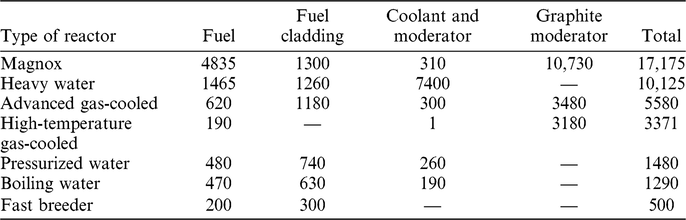
Radiocarbon (14C) is a pure β emitter with a relatively long half-life of 5730 yr, which has been widely used as a dating tool for materials and is considered as an important nuclide for source term analysis in nuclear power plants (IAEA 2004). The United Nations Scientific Committee on the Effects of Atomic Radiation (UNSCEAR) has estimated that the quantities of radionuclides produced by 423 atmospheric explosions generated an atmospheric amount of 14C of approximately 2.3 × 10¹⁷ Bq (Dubourg Reference Dubourg1997). Subsequently, the integrated dose of 14C over the average human lifetime owing to 14C exposure from nuclear tests was calculated to be approximately 0.3 mSv. After atmospheric nuclear tests were prohibited, anthropogenic nuclear facilities, especially nuclear power plants, were identified as another important source of 14C (Yim and Caron Reference Yim and Caron2006). The production rates of 14C depend on the type of reactors and their capacities. The amount of 14C in waste produced by nuclear facilities varies depending on reactor type, operational mode, fuel reprocessing method, material properties, etc. (Davis Reference Davis1977). Typical 14C production rates for various types of reactors have been calculated and listed in Table 1 along with their total amount (Haag Reference Haag, Goossens, Eichholz and Tedder1991). Since 14C exists widely in the fuel, primary system, gaseous effluent, and wastes of a nuclear facility, conducting a comprehensive study on 14C is very important for source term analysis, radiation protection, and decommissioning work.
Calculated 14C production rates (GBq·GW(e)−1·a−1) for various types of reactors (Haag Reference Haag, Goossens, Eichholz and Tedder1991).

Over the past five decades, graphite has been widely used as fuel matrix, moderator, and reflector in various types of gas-cooled reactors worldwide. This has led to the generation of approximately 250,000 metric tons of irradiated graphite waste (Fachinger et al. Reference Fachinger, Lensa and Podruhzina2008). The very-high-temperature gas-cooled reactor (VHTR), which is a further development of the current high-temperature gas-cooled reactors (HTGRs), has been identified as the one of six Generation IV concept reactors by the Generation IV International Forum (GIF) (NERAC and GIF 2002). Since the VHTR uses coated fuel particle embedded in matrix graphite, graphite reflectors, and other graphite core structural components, its operation will lead to a dramatic increase in the present quantity of irradiated graphite waste. Previous research on irradiated graphite indicated that 14C was the most significant long-life radionuclide produced in graphite (Dunzik-Gougar et al. Reference Dunzik-Gougar and Smith2014). Since it can readily migrate into groundwater and the atmosphere, much attention is being paid to 14C from irradiated graphite disposed in deep landfills. However, to optimize the removal and disposal of 14C, it is essential to analyze its sources, distribution, release routes, and concentrations.
Since the 1980s, numerous studies have been performed on the 200 MWth HTR-Module in Germany, the 350 MWth Modular High Temperature Gas-Cooled Reactor (MHTGR) in the USA, and the Pebble-Bed Modular Reactor (PBMR) in South Africa. Later, the High Temperature Engineering Test Reactor (HTTR) was designed and constructed, achieving first criticality in 1998 in Japan (Shiozawa et al. Reference Shiozawa, Fujikawa, Iyoku, Kunitomi and Tachibana2004). In China, the Institute of Nuclear and New Energy Technology (INET) at Tsinghua University led the research and development program for HTGRs, which included the successful construction and operation of the 10 MW high-temperature gas-cooled test reactor (HTR-10), design and construction of a commercial-scale high-temperature gas-cooled pebble-bed modular reactor (HTR-PM), and preliminary design of a multi-modular HTR-PM nuclear power plant (HTR-PM600) (Xu et al. Reference Xu and Zuo2002; Zhang et al. Reference Zhang, Wu, Wang, Xu, Sun, Li and Dong2009, Reference Zhang, Dong, Li, Zhang, Wang, Huang, Li, Liu, Wu, Wang, Diao, Zhang and Wang2016).
The HTR-10 is the first pebble-bed gas-cooled test reactor in China that adopted helium as the primary coolant and graphite spheres containing tristructural-isotropic (TRISO) coated particles as fuel elements (Xu et al. Reference Xu and Zuo2002). Furthermore, the HTR-10 is the only pebble-bed HTGR currently operating in the world. The research, especially experiments performed in the actual HTR-10 reactor to date have provided important and direct knowledge and experience for the development of HTGRs. A series of experiments on radioactive source terms in HTR-10 have been conducted, which include (1) measuring the concentration of radioactive dust in the primary loop (Xie et al. Reference Xie, Cao, Feng, Liu, Tong, Wang, Dong, Zhang and Loyalka2017), (2) measuring the activity concentration of 3H in the primary loop (Xie et al. Reference Xie, Cao, Feng, Tong, Dong, Zhang and Scarlat2018a), (3) measuring the activity concentration of 14C in the primary loop (Xie et al. Reference Xie, Peng, Cao, Feng, Wei, Tong, Li and Sun2019), and (4) measuring the specific activity and distribution of typical nuclides in irradiated graphite spheres from the reactor core (Li et al. Reference Li, Liu, Xie and Jia2017; Liu et al. Reference Liu, Huang, Xie, Jia, Feng and Li2017; Xie et al. Reference Xie, Li, Liu, Chen, Li, Chen and Verfondern2018b). 14C has been identified as one of the most important nuclides in the primary coolant and irradiated graphite in HTR-10. A theoretical model has been proposed to predict the distribution of 14C in the reactor core and its concentration in the primary coolant. The model predictions showed good agreement with the experimental values obtained for HTR-10 in 2015 (Xie et al. Reference Xie, Peng, Cao, Feng, Wei, Tong, Li and Sun2019). The main uncertainties in calculating the 14C source term are the activation from 14N in the core and the porosity of graphite materials when irradiated. In this study, which is based on the previously developed theoretical model in Xie et al. (Reference Xie, Peng, Cao, Feng, Wei, Tong, Li and Sun2019), we calculate the distribution of 14C in HTR-10, provide a balance diagram of 14C in HTR-10, and compare the results with experimental values available for irradiated graphite spheres, primary coolant, and gaseous effluent. The porosity of graphite and its behavior under irradiation, which could affect the production of 14C from the activation reaction of 14N, are discussed using a sensitivity study. Current theoretical calculations along with the newly measured data could promote the 14C source term research in HTGRs.
MATERIALS AND METHODS
Theoretical Model and Analysis
A series of studies have discussed the mechanisms for generating 14C in the reactor core and primary coolant in HTGRs (Brooks et al. Reference Brooks, Heath, Kirstein and Roberts1974; Davis Reference Davis1977; IAEA 2004; NDA 2012). Five neutron-induced reactions can generate the 14C in the reactor, as follows: (1) 17O(n, α)14C; (2) 13C(n, γ)14C; (3) 14N(n, p)14C; (4) 15N(n, d)14C; and (5) 16O(n, 3He)14C. Reactions (4) and (5) can be neglected when performing source term calculations owing to their small cross-sections of 2.5 × 10⁻⁷ and 5.0 × 10⁻⁸ barn, respectively. Therefore, reactions (1), (2), and (3) will contribute the most to generating 14C in HTGRs. 14C can also be produced by ternary fission reactions of heavy metals (IAEA 2004; Frolov Reference Frolov2002; Vorobyov et al. Reference Vorobyov, Seleverstov, Grachov, Kondurov, Nikitin, Smirnov and Zalite1972; Val’skii Reference Val’skii1976). However, the amount of 14C thus generated is negligibly small (IAEA 2004; Liu Reference Liu2004; NDA 2012; Hou Reference Hou2018).
In a previous study, we presented the production mechanism of 14C in HTR-10 (Xie et al. Reference Xie, Peng, Cao, Feng, Wei, Tong, Li and Sun2019). We briefly described the theoretical model for producing 14C which was proposed in Xie et al. (Reference Xie, Peng, Cao, Feng, Wei, Tong, Li and Sun2019). The three main production routes of 14C in the core of the reactor are (1) the activation reaction of 17O in the UO2 fuel kernel, (2) the activation reaction of 13C in the fuel elements, graphite reflectors, and carbon bricks, and (3) the activation reaction of 14N in the fuel elements and primary coolant.
The production rate for the activation reaction of 17O in the UO2 fuel kernel,  $R_{^{14}C}^{^{17}O}$, can be expressed as:
 $$R_{^{14}C}^{{}^{17}O} = {\sigma _{{}^{17}O}}\phi {N_{{}^{17}O}}$$
 $${{d{N_{{}^{17}O}}} \over {dt}} =- {\sigma _{{}^{17}O}}\phi {N_{{}^{17}O}}$$
where  ${\sigma _{{}^{17}O}}$ is the cross-section of the 17O(n, α)14C activation reaction (cm2), φ is the average thermal neutron fluence rate in the core of HTR-10 (cm–2·s–1), and
 ${N_{^{17}O}}$ is the number of 17O atoms in the fuel elements.
The production rates for the activation reactions of 13C in the fuel elements, graphite reflectors, and carbon bricks,  $R_{{}^{14}C}^{{}^{13}C - i}$ (i = 1, 2, and 3), can be expressed as:
 $$R_{{}^{14}C}^{{}^{13}C - i} = {\sigma _{{}^{13}C}}{\phi _i}{N_{{}^{13}C - i}}$$
 $${{d{N_{{}^{13}C - i}}} \over {dt}} =- {\sigma _{{}^{13}C}}{\phi _i}{N_{{}^{13}C - i}}$$
where  ${\sigma _{{}^{13}C}}$ is the cross-section of the 13C(n, γ)14C activation reaction (cm2), φi (i = 1, 2, and 3) are the average thermal neutron fluence rates in the core, graphite reflectors, and carbon bricks, respectively (cm–2·s–1), and
 ${N_{{}^{13}C - i}}$ (i = 1, 2 and 3) are the number of 13C atoms in the fuel elements, graphite reflectors, and carbon bricks, respectively.
The production rate of 14C for the activation reaction of 14N in the primary coolant,  $R_{{}^{14}C}^{{}^{14}N - P}$, can be expressed as:
 $$R_{{}^{14}C}^{{}^{14}N - P} = {\sigma _{{}^{14}N}}g\phi {N_{{}^{14}N - P}}$$
 $${{d{N_{{}^{14}N - P}}} \over {dt}} = {R_{^{14}N}} - ({\sigma _{^{14}N}}g\phi+ {L_R} + {P_U}) \cdot{N_{{}^{14}N - P}}$$
where  ${\sigma _{{}^{14}N}}$ is the cross-section of the 14N(n, p)14C activation reaction (cm2), g is the ratio of the helium volume in the core to that in the primary loop, which is approximately 2%,
 ${N_{{}^{14}N - P}}$ is the number of 14N atoms in the primary coolant,
 ${R_{^{14}N}}$ is the rate of 14N atoms entering the primary coolant (s−1), LR is the release rate of the primary coolant (s−1), and PU is the purification rate of the helium purification system (HPS) (s−1). In the equilibrium core of HTR-10, 25 spent-fuel elements are replaced with fresh fuel elements every day. Before loading them into the core, a pumping process is carried out to reduce the amount of air imported into the core along with the fresh fuel elements. Approximately 79 Pa of nitrogen is estimated to remain in the open pores of the fuel elements.
The production rate of 14C for the activation reaction of 14N in the fuel elements  $R_{{}^{14}C}^{{}^{14}N - F}$, and the release rate of 14C from the fuel elements to the primary coolant
 $R_{{}^{14}C}^{{}^{14}N - R}$ can be expressed as:
 $$R_{{}^{14}C}^{^{14}N - F} = Z{\sigma _{{}^{14}N}}\phi (N_{{}^{14}N}^{CP} + N_{{}^{14}N}^{OP})$$
 $$R_{{}^{14}C}^{^{14}N - R} = Z{\sigma _{{}^{14}N}}\phi (xN_{{}^{14}N}^{CP} + N_{{}^{14}N}^{OP}) \cdot k$$
 $$k = {\raise0.7ex\hbox{${N_C^P}$} \!\mathord{\left/ {\vphantom {{N_C^P} {(Z \cdot {N_C})}}}\right.}\!\lower0.7ex\hbox{${(Z \cdot {N_C})}$}}$$
 $$N_C^P = {T_E} \cdot{C_{CO}} \cdot{V_{He}} \cdot{P_U} \cdot{N_A}/R$$
 $${N_C} = ({r_{OP}} + x \cdot {r_{CP}}) \cdot M \cdot {S_0}/({\raise0.7ex\hbox{${3\sqrt 3 }$} \!\mathord{\left/ {\vphantom {{3\sqrt 3 } 4}}\right.}\!\lower0.7ex\hbox{$4$}} \cdot {A^2})$$
where Z is the total number of fuel elements in the reactor (27,000 for the HTR-10 equilibrium core),  $N_{{}^{14}N}^{CP}$ and
 $N_{{}^{14}N}^{OP}$ are the numbers of 14N atoms in the closed and open pores of the fuel element, respectively, x is the percentage of closed pores in the matrix graphite that would become open when a fuel element achieves its final burn-up, k is the ratio of the number of 14C nuclides released into the primary coolant to the total number of 14C nuclides from the activation of 14N in the fuel element,
 $N_C^P$ is the number of C atoms purified in the HPS during the time TE, TE is the residence time for a fuel element to achieve final burn-up in the core of HTR-10, which is 1080 days, C CO is the concentration of CO in the primary coolant (vpm), V He is the volume of primary helium (m3) at standard temperature and pressure (STP), N A is Avogadro’s constant (6.02 × 10²³), R is the volume of one mole of ideal gas at STP (0.0224 m3), NC is the number of C nuclides on the surface of the microscopic pores in a fuel element, rOP and rCP are the ratios of open and closed pores to the total pores in a fuel element, respectively, M is the mass of a fuel element (g), S0 is the specific surface area, which is 11 m2·g−1 for the fuel element of HTR-10 (Lu et al. 2013), and A is the lattice constant of graphite (2.46 × 10⁻¹⁰ m).
When analyzing the activation reaction of 14N in the fuel elements and the release of 14N into the primary coolant, we made the following assumptions: (1) N impurities are concentrated in the open and closed pores of the matrix graphite. The concentration of N in the open pores that are accessible from the surrounding areas quickly reach equilibrium in the primary loop when fresh fuel elements are loaded into the core of HTR-10, while the nitrogen pressure in the closed pores remained 7.9 × 10⁴ Pa. (2) The partial pressure of CO can be used as an indicator of the degree of corrosion of graphite since the radiolytic oxidation of graphite produces CO (Marsden et al. Reference Marsden, Hopkinson and Wickham2002; Smith et al. Reference Smith, Mccrory and Dunzik-Gougar2013). (3) While irradiating the core, some of the closed pores in the matrix graphite will become open (Hoinkis et al. Reference Hoinkis, Eatherly, Krautwasser and Robens1986).
Considering the possible sources able to generate 14C, including the activation reaction of 14N in the primary coolant and the release of 14C from the fuel elements, and the reduction routes including the leakage of the primary helium, purification of the HPS and decay of 14C, the number of 14C atoms in the primary coolant,  $N_{{}^{14}C}^{PC}$, can be given by:
 $${{dN_{{}^{14}C}^{PC}} \over {dt}} = {\sigma _{{}^{14}N}}g\phi {N_{{}^{14}N - P}} + R_{{}^{14}C}^{^{14}N - R} - ({L_R} + {P_U} + \ilambda })N_{{}^{14}C}^{PC}$$
where λ is the decay constant of 14C (3.84 × 10⁻¹² s−1).
RESULTS AND DISCUSSION
Theoretical Results
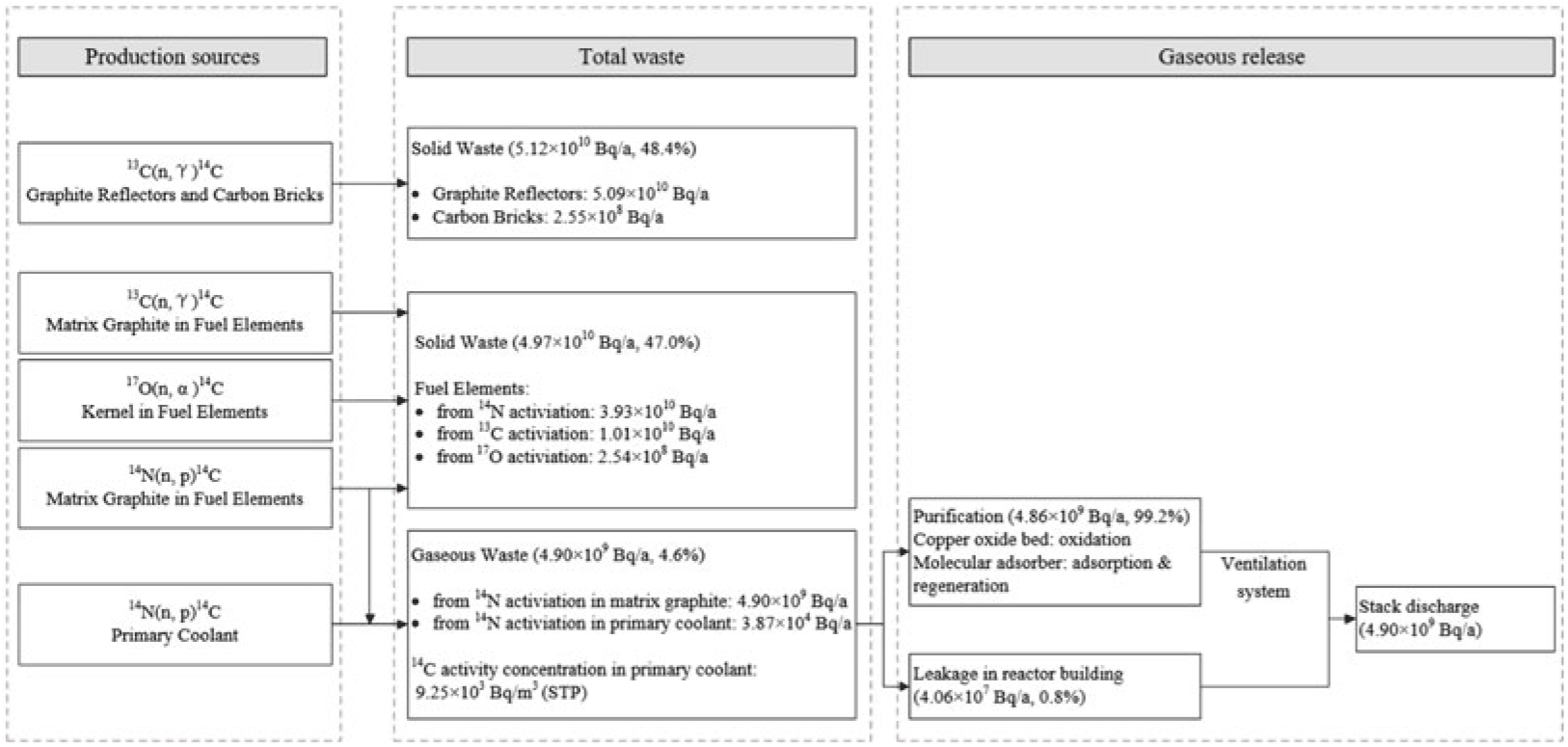
For most of the parameters for the 14C source term calculations in HTR-10, the same values as those used in one of our previous papers (Xie et al. Reference Xie, Peng, Cao, Feng, Wei, Tong, Li and Sun2019) were adopted. However, we set the percentage of open pores in the matrix graphite as 50% and the percentage of closed pores in the matrix graphite that would become open during irradiation as 30%, compared with our previous values of 80% and 33%, respectively. The results of our calculations are illustrated in Figure 1, which presents the balance diagram of 14C in HTR-10 upon reaching equilibrium core at full power operation.
Calculated balance diagram of 14C source term in HTR-10.

The pore structure of nuclear graphite plays a significant role in the irradiation performance during the operation of the reactor. Zheng et al. (Reference Zheng, Xu, Sridharan and Allen2011) analyzed the pore structure of different nuclear graphite grades, and concluded that the total, open, and closed porosities of IG-110 and NBG-18 were 22.26, 13.59, and 8.67%, and 17.27, 6.77, and 10.50%, respectively. Hoinkis et al. (Reference Hoinkis, Eatherly, Krautwasser and Robens1986) studied the corrosion and irradiation-induced porosity changes of the A3 matrix graphite and demonstrated that the total porosity of the graphite remained nearly the same, and approximately 28% of the initially closed pores became open after irradiation. Fachinger et al. (Reference Fachinger, Den Exter, Grambow, Holgersson, Landesman, Titov and Podruhzina2006) indicated that neutron irradiation can increase the open porosity of the matrix graphite. McDermott et al. (Reference McDermott, Jones, Marsden, Marrow and Wickham2008) investigated the structure of irradiated graphite from the British Experimental Pile Zero reactor and indicated the presence of a certain percentage of closed pores in the graphite even after 20 years of irradiation in the pile.
The porosity of matrix graphite including the total, open, and closed porosities, and the percentage of closed pores that become open during irradiation can affect the amount of 14C generated in the fuel elements, especially the activity concentration of 14C in the primary coolant. A sensitivity analysis was carried out using these factors, which is described in the following section.
Experimental Setup and Results
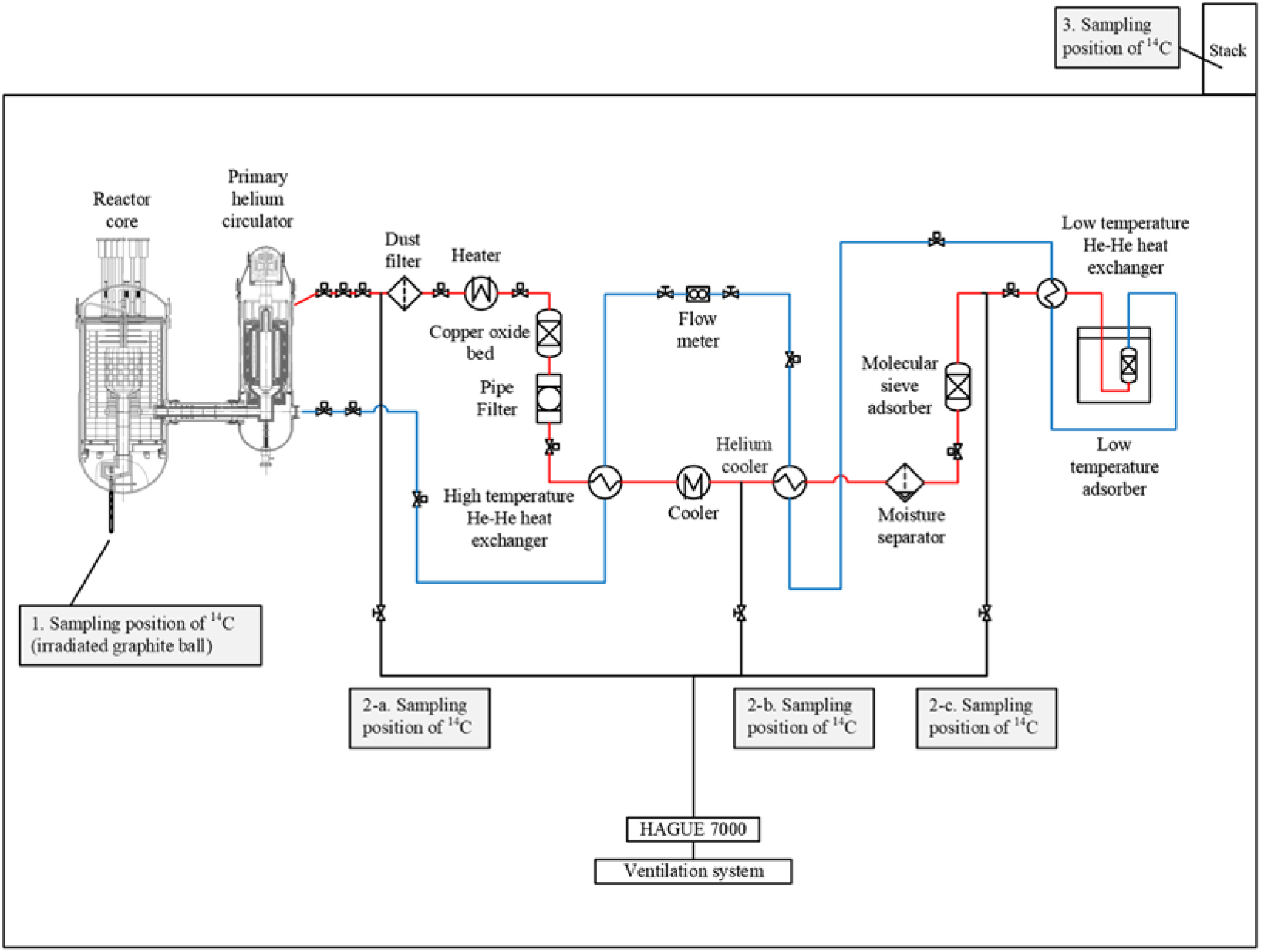
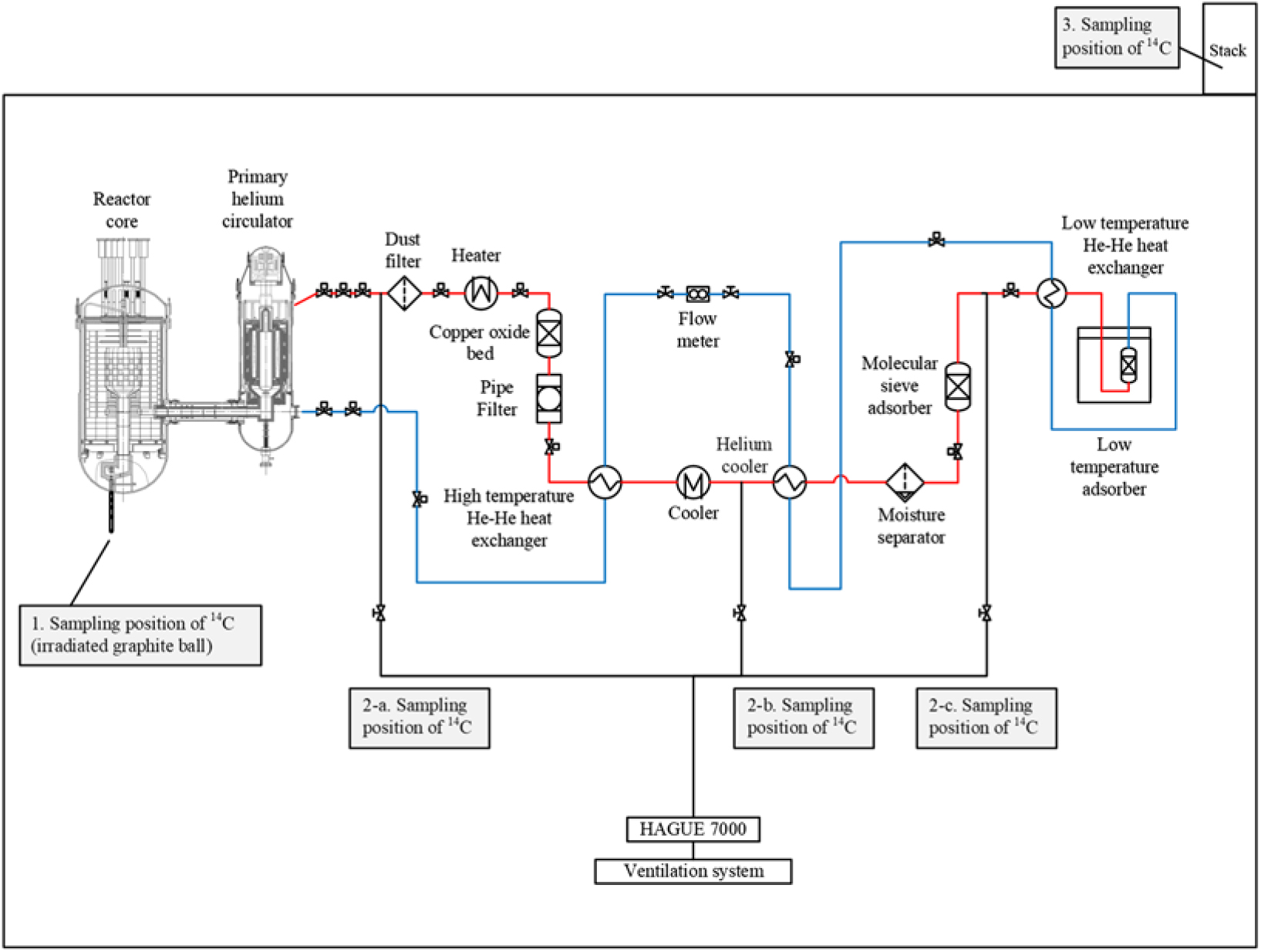
Three measurements related to the 14C source term were conducted in the HTR-10: measurement of the specific activity and distribution of 14C in the irradiated graphite spheres; measurement of the activity concentration of 14C in the primary loop; and measurement of the activity discharge of 14C from the stack. Figure 2 shows the relative sampling positions of 14C in HTR-10.
Sampling positions for 14C source term study in HTR-10.
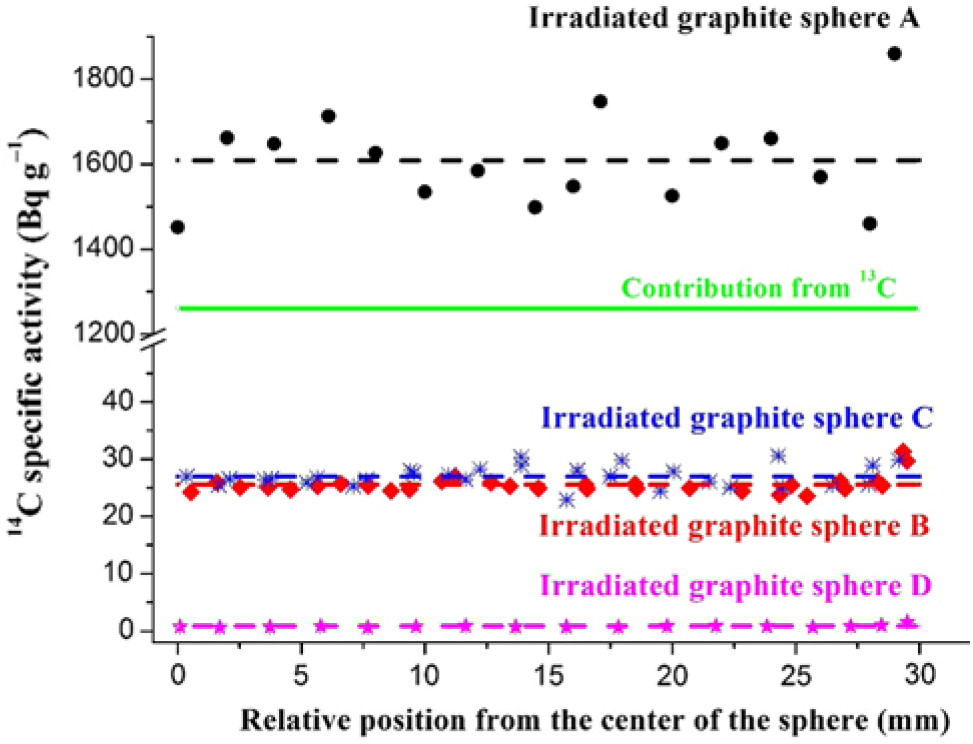
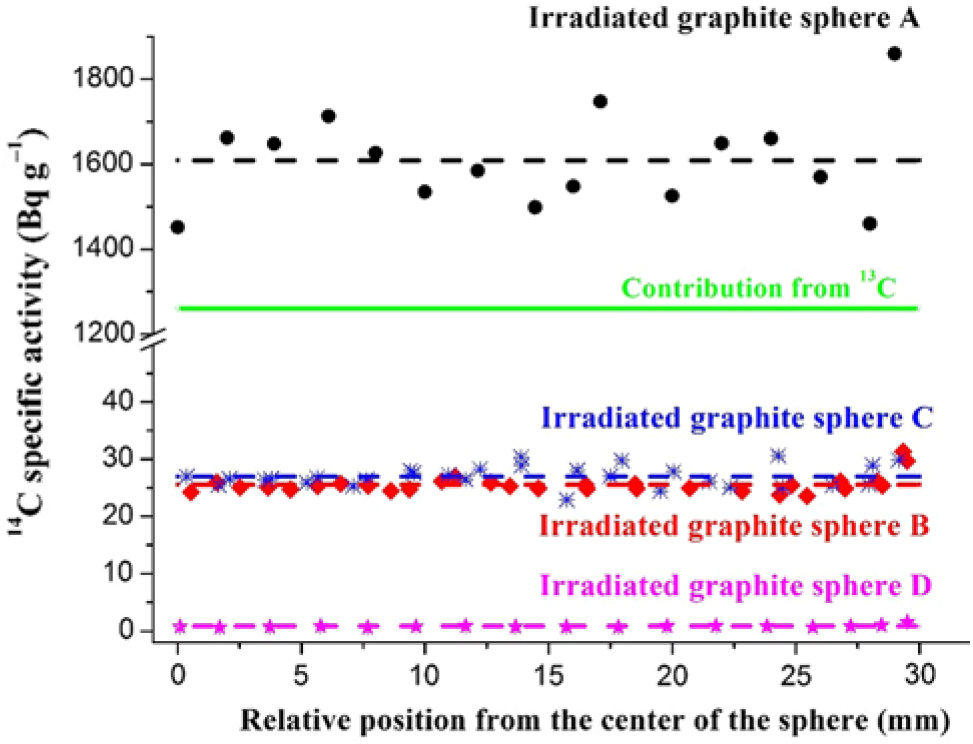
Details on the experimental measurement of the source terms in the irradiated graphite spheres of HTR-10 are provided in our previous studies (Li et al. Reference Li, Liu, Xie and Jia2017; Liu et al. Reference Liu, Huang, Xie, Jia, Feng and Li2017; Xie et al. Reference Xie, Li, Liu, Chen, Li, Chen and Verfondern2018b). In the current study, we focused on the experimental aspects of the specific activities and distributions of 14C in four irradiated graphite spheres. Figure 3 exhibits the radial distributions of the specific activity of 14C from the center of each sphere and the experimental average specific activities of 14C for each sphere (dashed line). The calculated results of the contribution of the activation reaction of 13C in the matrix graphite are indicated by the green line (1261 Bq·g−1 on average). The specific activity of 14C generated from the activation reaction of 14N was calculated to be 5082 Bq·g−1 on average. It appears that the experimental results for different spheres are significantly different. This can be attributed to the large uncertainties concerning the amount of impurities in different batches of graphite spheres and the circulation routes of individual spheres. The activity concentration of 14C slightly increases towards the surface of the spheres. This phenomenon has been observed in spent fuel elements in the Arbeitsgemeinschaft Versuchsreaktor (AVR) and irradiated graphite from other nuclear reactors (Wenzel et al. Reference Wenzel, Herz and Schmidt1979; Dunzik-Gougar et al. Reference Dunzik-Gougar and Smith2014). It occurs because the 14N in the primary coolant could be adsorbed onto the surface of graphite, which leads to increasing concentration of 14C on the surface of the graphite spheres, or because the 14C in the primary helium could be adsorbed directly onto the surface of graphite (Marsden Reference Marsden, Hopkinson and Wickham2002; NDA 2012). The 13C content of graphite is constant; however, the 14N content of graphite can vary significantly owing to the porosity of graphite.
Experimental specific activity distribution of 14C of irradiated graphite spheres compared with theoretical calculation (solid line).
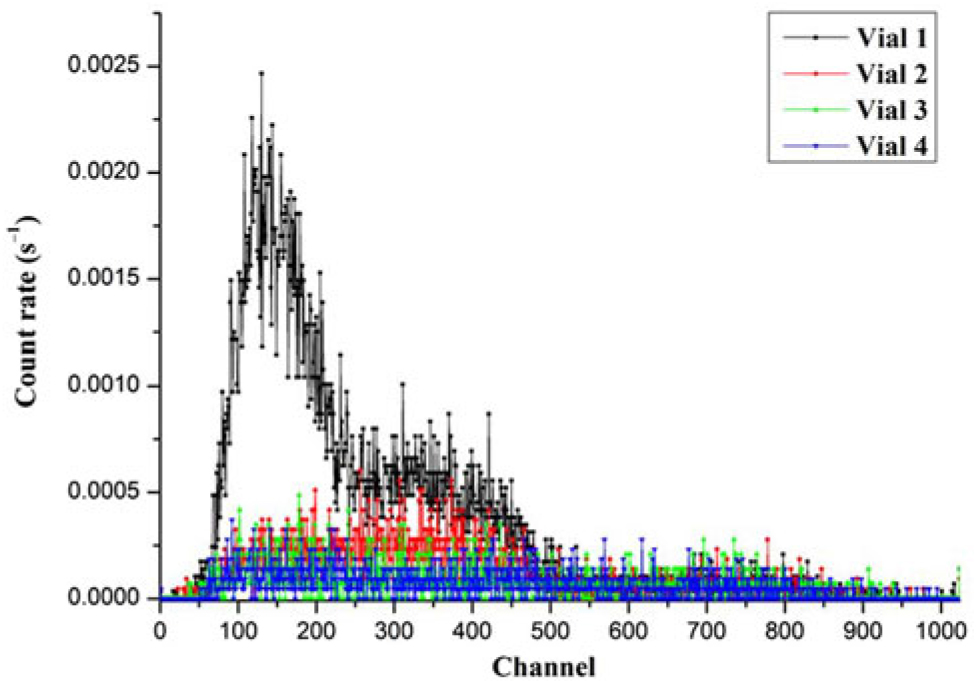
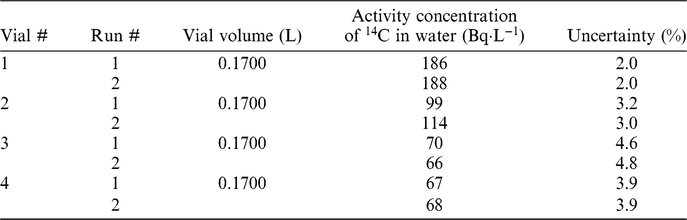
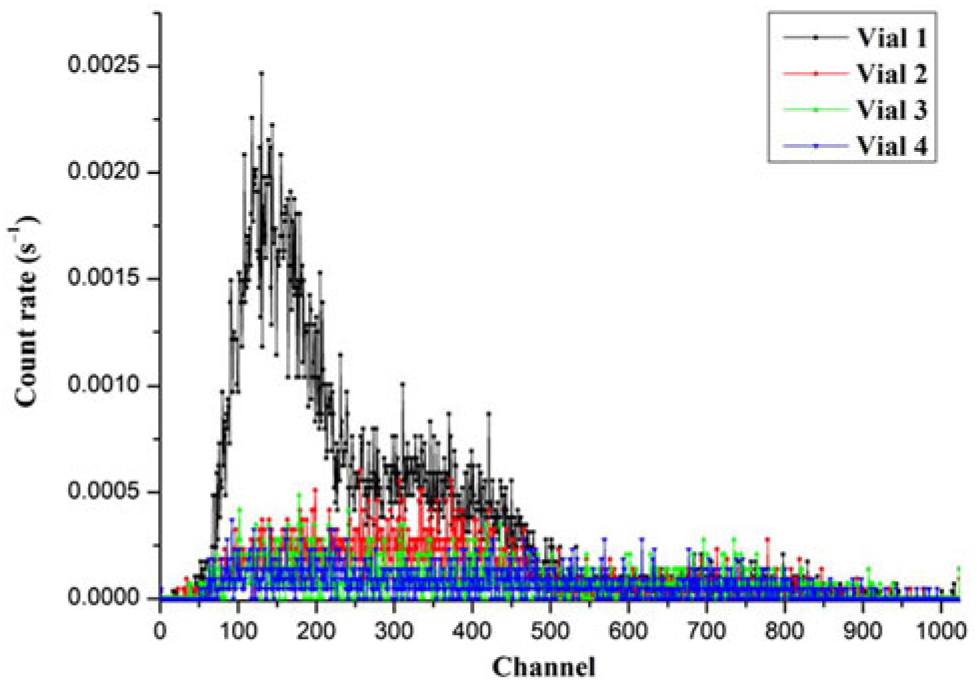
A sampling loop designed to measure the activity concentration of 14C has been set up in the primary loop of HTR-10, and the first experiment using this newly built sample loop was successfully conducted in 2015 (Xie et al. Reference Xie, Peng, Cao, Feng, Wei, Tong, Li and Sun2019). In December 2017, the HTR-10 was restarted and operated at an approximate thermal power of 3 MW, to investigate the maximum temperature of fuel elements in the core using specially prepared monitor pebbles (Wei et al. Reference Wei, Ma, Zhang, Xie, Liu, Fang, Li, Xia, Cao and Chen2018). The maximum pressure of the primary helium was 1.67 MPa. The maximum temperatures of the helium inlet and outlet of the core were 194 and 570°C, respectively. The total operating time was approximately 30 hr. The activity concentration of 14C in the primary loop of HTR-10 was obtained by gathering helium samples at the location downstream of the copper oxide bed for approximately 5 hr, when approximately 124.6 L of primary helium was used. Samples in four vials were analyzed using the 1220 Quantulus (PerkinElmer, Inc.) liquid scintillation counter (LSC). The spectra and measured 14C activities are presented in Figure 4 and Table 2.
LSC spectra of 14C samples measured in 2017.
Activity concentration of 14C for each liquid sample measured in 2017.

The experimental activity concentration of 14C in the primary loop of HTR-10 was approximately 590 ± 9 Bq·m−3 (STP), which is larger than the value measured (120 ±10 Bq·m−3 (STP)) in 2015, and similar to the result of previous theoretical calculations: 516 Bq·m−3 (STP) (Xie et al. Reference Xie, Peng, Cao, Feng, Wei, Tong, Li and Sun2019). The increased activity concentration of 14C in the primary loop could be attributed to the diffusion of nitrogen into the core which could have occurred while loading the temperature measuring pebbles. Although a pumping process for reducing the nitrogen content was conducted before fresh pebbles were loaded into the core, an increase in the amount of nitrogen in the primary loop could still be expected.
During the operation of HTR-10 in 2017, a domestic 14C sampler from Shanxi Weifeng Co., China was installed near the stack of HTR-10, and a part of the gaseous effluent was pumped into this newly installed 14C sampler. We analyzed four vials that the sampling gas passed through, with each vial containing 170 mL of 0.1 mol·L−1 NaOH solution. The activity concentration of 14C in the samples was measured using the LSC device; the measurement method and procedure were similar to those of the primary coolant. Activity concentration measurements, however, were below the detection limit of the LSC instrument. Therefore, the detection limit of the LSC instrument was adopted to estimate the upper level of the total activity of 14C discharged from the stack. Assuming that the HTR-10 operated at current conditions for a year, the total amount of gaseous 14C discharged from the stack was approximately 4 × 10⁷ Bq·a−1, which is significantly lower than the regulation limit for 14C for a nuclear power station, according to the Chinese National Standard GB2011-6249 (7 × 10¹¹ and 1.6 × 10¹² Bq·a−1 for light and heavy water reactors, respectively).
Sensitivity Analysis
Theoretical predictions are only as accurate as the input parameters of the model. The sensitive parameters in our model are the porosity characteristics of graphite, impurity concentrations, capture cross sections, neutron fluxes, and reactor operation history. The contributions of 13C in the nuclear graphite and 17O in the fuel elements to 14C generation can be calculated with high certainty using activation modelling, since their amount in graphite can be determined with sufficient precision. However, large uncertainties in the contribution from the activation reaction of 14N exist. The porosity, ratio between the open and closed pores in the graphite, and the fraction of closed pores that become open after irradiation, can affect the generation of 14C from the activation reaction of 14N. Thus, a sensitivity analysis was performed to explain the influence of these factors on the theoretical predictions. The calculations were performed by combining the following parameters: (1) porosity of the matrix graphite: 15, 25, and 35%; (2) percentage of open pores in the matrix graphite: 20, 35, 50, 65, and 80%; and (3) percentage of closed pores in the matrix graphite that became open after irradiation: 10, 20, 30, 40, and 50%.
Impact of Total Porosity
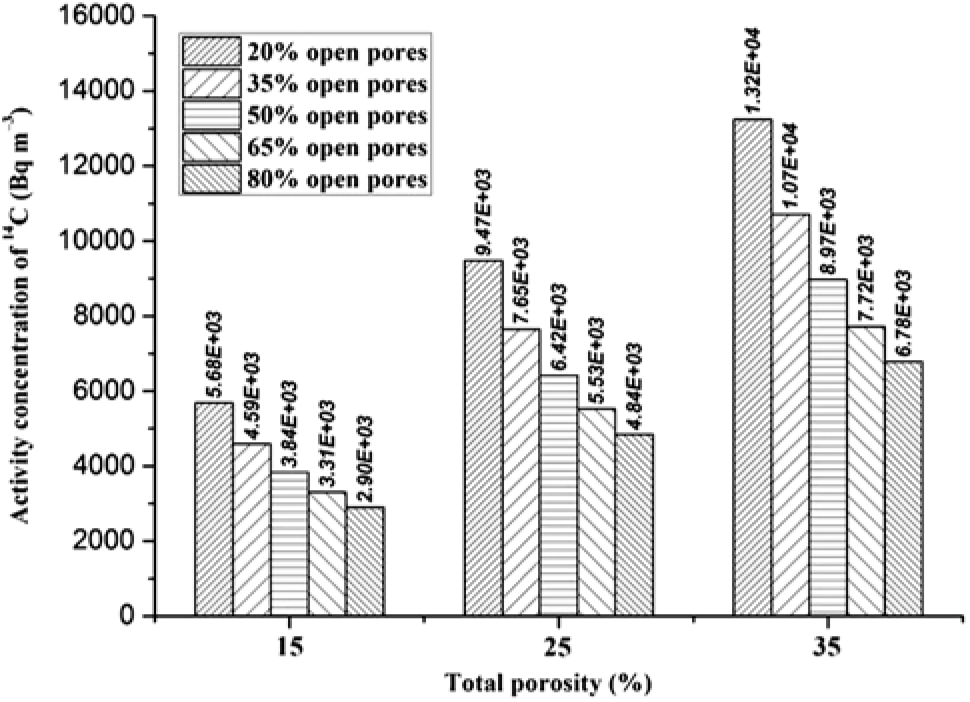
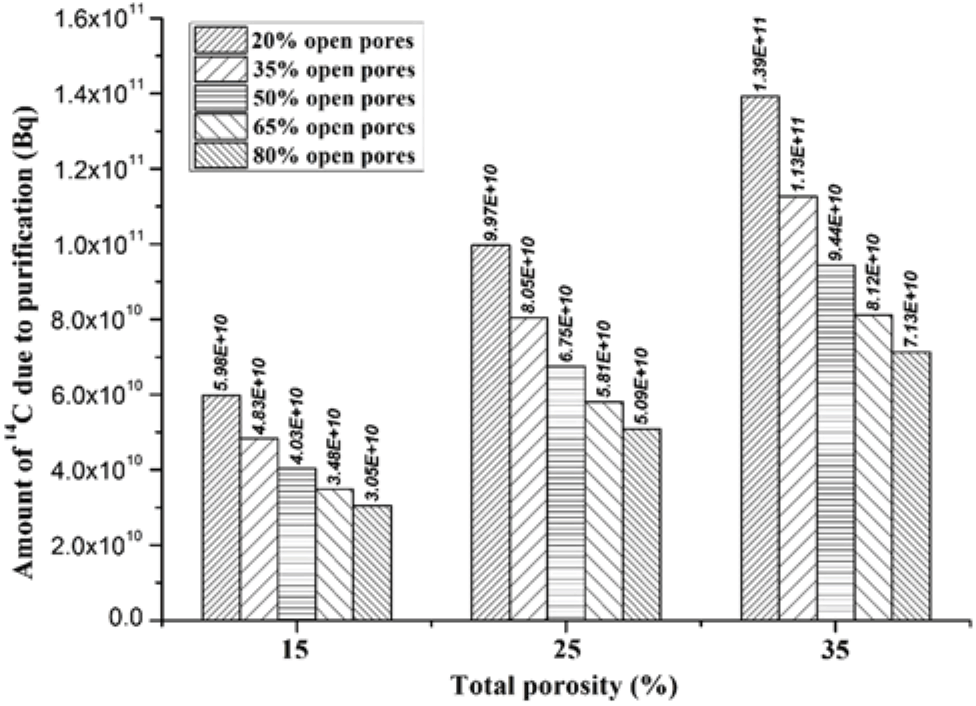
Given that the percentage of closed pores in the matrix graphite that becomes open after irradiation was set to 30%, Figures 5 and 6 illustrate the comparison of the calculated activity concentrations of 14C in the primary coolant and amount of activity of 14C in the primary coolant due to purification over 20 years, based on different total porosities (15, 25, and 35%) and percentages of open pores (20, 35, 50, 65, and 80%) in the matrix graphite. As the porosity of the matrix graphite increases, the 14C source term in the reactor also increases, overall, including not only the generated amount and activity concentration of 14C in the primary loop but also the amount deducted due to purification. The higher the total porosity, the higher is the amount of 14N in the matrix graphite and primary loop, which results in increasing the sources capable of generating 14C. For a given porosity value, the activity concentration of 14C in the primary coolant and activity amount of 14C in the primary coolant due to purification over 20 years decrease as the percentage of open pores in the matrix graphite increases, as can be seen in Figures 5 and 6, respectively. Therefore, it can be concluded that the closed pores contain more nitrogen, which is the main contributor to 14C generation in the primary coolant. The higher the percentage of open pores, the lower is the activity concentration of 14C in the primary loop, thus the lower is the amount of 14C in the primary loop due to purification over 20 years. Porosity influences the amount of 14N stored in graphite materials, which significantly affects the activity concentration of 14C in the primary coolant and activity amount of 14C generated in the matrix graphite. A 10% increase in the total porosity of the matrix graphite would lead to an approximately 30% increase in the activity concentration of 14C in the primary coolant.
Comparison of calculated activity concentration of 14C in the primary coolant as function of total porosity and percentage of open pores in the matrix graphite.

Comparison of calculated activity of 14C in the primary coolant due to purification as function of total porosity and percentage of open pores in the matrix graphite over 20 years.

Impact of the Ratio between Open and Closed Pores
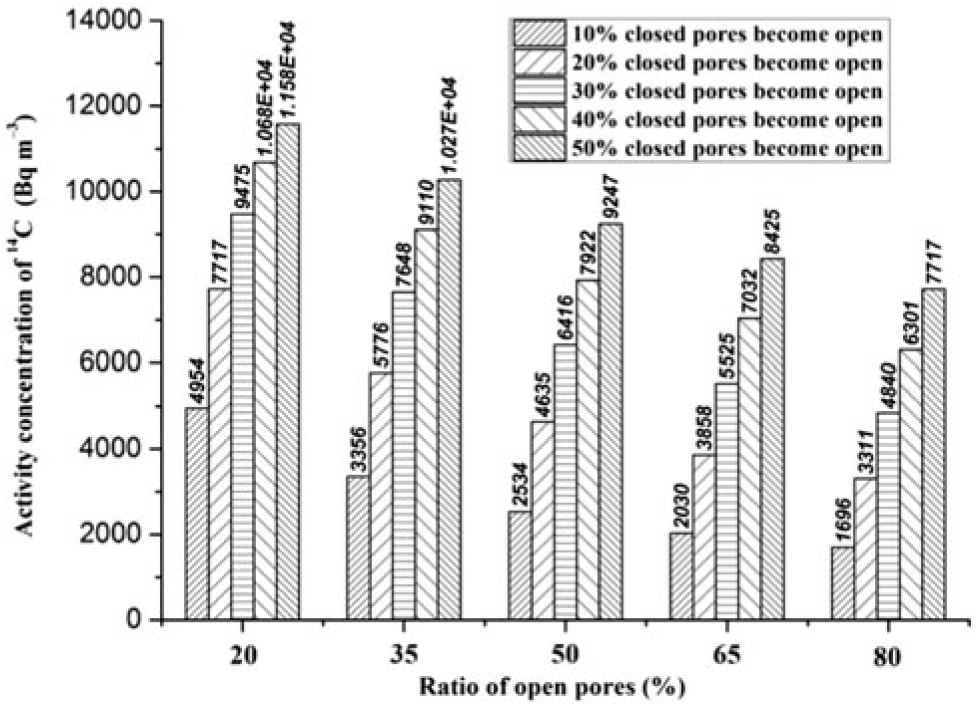
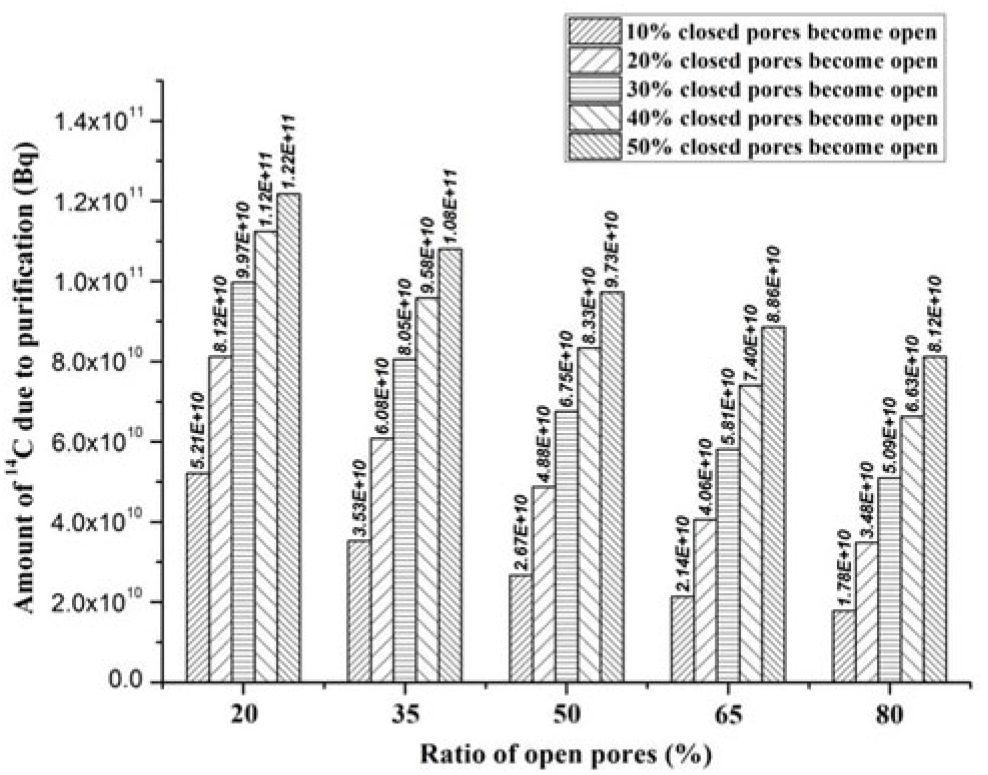
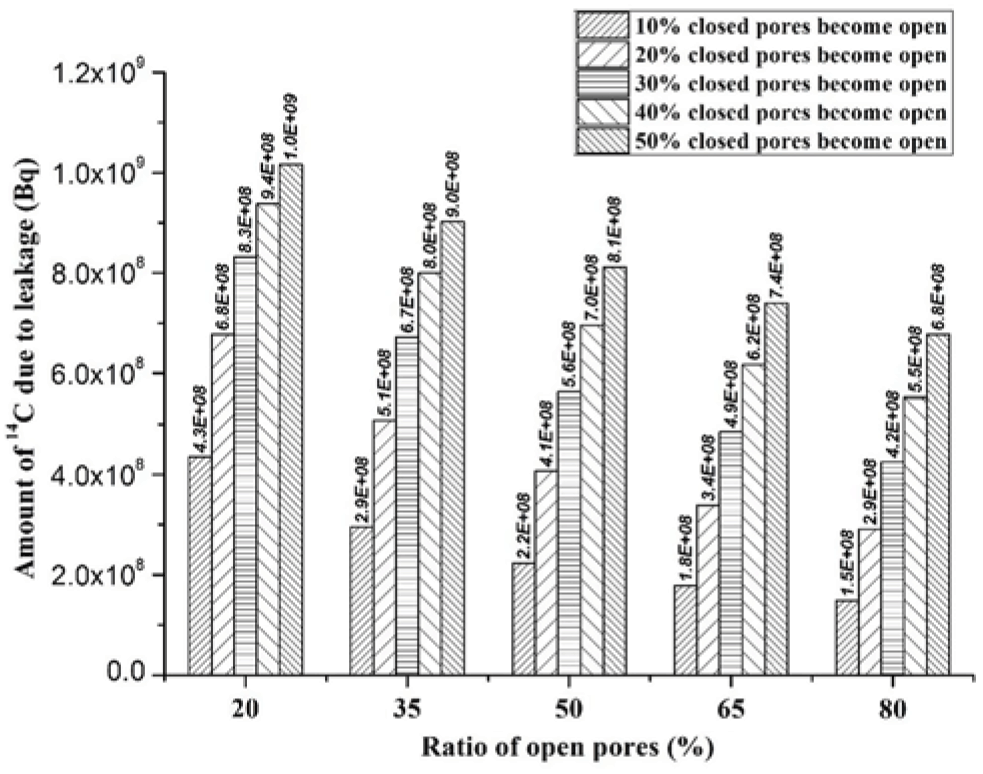
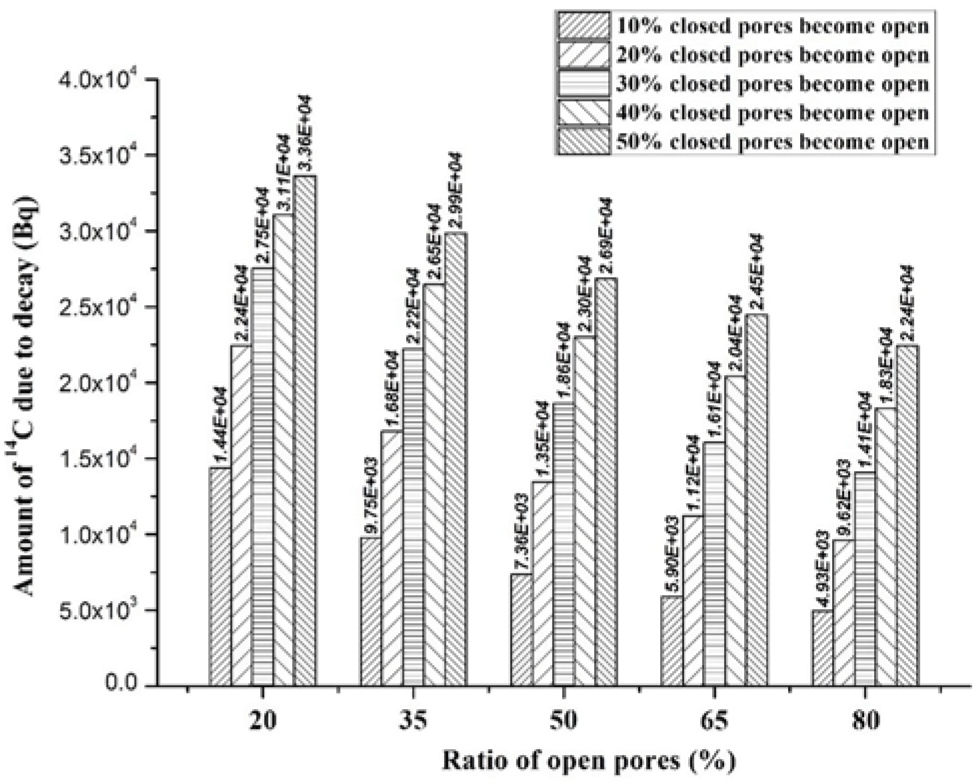
Given a total porosity of 25% in the matrix graphite, Figures 7–10 show the comparison of the calculated activity concentration of 14C in the primary coolant, activity amount of 14C due to purification in the primary coolant over 20 years, activity amount of 14C due to leakage in the primary coolant over 20 years, and activity amount of 14C due to decay in the primary coolant over 20 years, respectively, based on different percentages of open pores (20, 35, 50, 65, and 80%) and different percentages of closed pores in the matrix graphite that become open during irradiation (10, 20, 30, 40, and 50%). Figure 7 shows that the activity concentration of 14C in the primary coolant decreases as the percentage of open pores in the matrix graphite increases. However, for a given percentage of open pores, the activity concentration of 14C increases as the percentage of closed pores that become open during irradiation increases. For a given initial percentage of open pores in the matrix graphite, the percentage of closed pores that become open during irradiation significantly affects the activity concentration of 14C in the primary coolant. Take the 20% ratio of initially open pores in the matrix graphite for example. If the percentage of closed pores in the matrix graphite that become open during irradiation changes from 10 to 30%, an increase of approximately 90% in the activity concentration of 14C in the primary coolant could be expected. However, if this percentage changes from 30 to 50%, an increment of approximately 22% in the activity concentration of 14C in the primary coolant would occur. The overall activity concentration of 14C in the primary coolant decreases as the percentage of initial open pores in the matrix graphite increases. However, as the percentage of closed pores that becomes open during irradiation increases, the magnitude of the increase in the activity concentration of 14C in the primary coolant will become significant. Similar variation tendencies in the activity amount of 14C due to purification, leakage, and decay are illustrated in Figures 8–10, respectively.
Comparison of calculated activity concentration of 14C in the primary coolant as function of the percentages of open pores and closed pores in the matrix graphite that become open during irradiation.

Comparison of calculated activity amount of 14C due to purification in the primary coolant as function of the percentages of open pores and closed pores in the matrix graphite that become open after irradiation over 20 years.

Comparison of calculated activity amount of 14C due to leakage in the primary coolant as function of the percentages of open pores and closed pores in the matrix graphite that become open during irradiation over 20 years.

Comparison of calculated activity amount of 14C due to decay in the primary coolant as function of the percentages of open pores and closed pores in the matrix graphite that become open during irradiation.

CONCLUSION
We have summarized the 14C source terms-related experiments in HTR-10, including measurements of the specific activity and distribution of 14C in irradiated graphite spheres, measuring the activity concentration of 14C in the primary coolant and the amount of 14C discharged in the gaseous effluent. Compared with the theoretical calculations and gaseous discharge regulations in China, the experimental values showed that the amount of 14C generated is rather low for HTR-10 (approximately 1.1 × 10¹¹ Bq·a−1). Given a previously developed theoretical model, the balance diagram of the 14C source term of HTR-10 was provided, which indicates that most of the 14C in solid waste originates from the activation of 13C in fuel elements, graphite reflectors, and carbon bricks; the major contributor of 14C in the primary coolant and gaseous effluent is the activation of 14N in the matrix graphite.
A sensitivity study was performed to illustrate the effects of total porosity, percentage of open pores, and fraction of closed pores in the matrix graphite that became open after irradiation on the generation of 14C in the primary coolant and on various deduction routes. The results indicate that the overall 14C source terms, including the activity concentration of 14C in the primary coolant and activity amount of 14C produced in the matrix graphite of HTR-10, increase as the total porosity of the matrix graphite increases, since more nitrogen is stored in the pores. The percentages of open pores and closed pores that become open during irradiation play a significant role for the activity concentration of 14C in the primary loop and amount of 14C discharged in the effluent from the stack. The percentage of closed pores that become open during irradiation will greatly affect the activity concentration of 14C in the primary coolant especially when the initial percentage of open pores of the matrix graphite is large. In order to decrease the 14C in the primary coolant, a pumping process to reduce the amount of air imported into the core along with the fresh fuel elements is necessary. A heating step before the pumping process to reduce the amount of nitrogen absorption in the specific surface of matrix graphite could be helpful.
The current research presents a comprehensive analysis of the 14C source terms in HTR-10, including completed and ongoing experimental efforts, and a sensitivity study on the key parameters of the activation reaction of 14N in the matrix graphite, which could provide important references for further source term analysis, waste minimization, and decommissioning work of HTGRs.
ACKNOWLEDGMENTS
This work was supported by the National Natural Science Foundation of China (No. 11575099), Chinese National S&T Major Project (Grant No. ZX069), National High Technology Research and Development Program of China (863) (2014AA052701), and Chinese Major National R&D Projects (2013ZX06002001-014). The collaboration with Massachusetts Institute of Technology (MIT) was supported by 2016-2017 MISTI Global Seed Funds. We are grateful for the experimental setup support from Mr. Ling Liu, and Mr. Chuangguo Hu of INET, Tsinghua University, Beijing, China, and fruitful discussions with Dr. Karl Verfondern at the Research Center Juelich, Germany.