Resistance of Enterobacteriaceae to carbapenems is an important topic owing to the increasing frequency of infections caused by these agents, the difficult treatment, the high mortality, and the potential for transmission of resistance via mobile genetic elements.Reference Gupta, Limbago, Patel and Kallen 1 The resistance emerged 2 decades ago and became a major public health threat in many countries.Reference Gaynes and Culver 2 – Reference Rossi 4
Mathematical models to study the dynamics of pathogen transmission are used in community-acquired infections. In the hospital, studies attempted to use mathematical models to understand the transmission of multidrug-resistant microorganisms and to estimate the impact of interventions, but most are restricted to theoretical studies without direct application.Reference Sypsa, Psichogiou and Bouzala 5 – Reference van Kleef, Robotham, Jit, Deeny and Edmunds 7 Furthermore, these models exclude patients under isolation precautions from the transmission chain, which may be incorrect.
We developed a mathematical model to describe the transmission of carbapenem-resistant Enterobacteriaceae (CRE) in an intensive care unit (ICU), including isolated patients as possible sources of infection, in order to establish goals of compliance with hand hygiene (HH) and with contact precautions (CP). The effect of the model-based intervention was evaluated, aimed at reducing nosocomial acquisition of CRE in the unit.
METHODS
Our study was conducted prospectively in a 14-bed ICU of a tertiary care teaching hospital. It consisted of a 44-week baseline period and a 24-week intervention period.
Developing the Mathematical Model
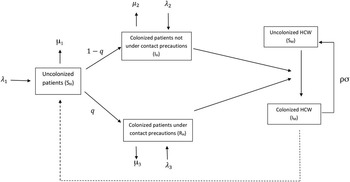
To describe the dynamics of transmission of CRE, we used the Ross-Macdonald model. The original model consists of 4 compartments: “uncolonized patients” (SH ), “colonized patients,” “healthcare workers (HCW) with uncolonized hands” (SM ), and “HCW with colonized hands” (IM ). HCW with colonized hands are the vectors of transmission of resistant bacteria. In our hospital, the standard procedure is to put all colonized patients under CP. However, compliance with CP rarely is 100%. Thus, the probabilities of transmission were considered different when HCW adhered to the use of gloves and gowns during CP and when not. For this reason, we artificially divided “colonized patients” into “colonized patients under CP” (IH ) and “colonized patients not under CP” (RH ). These 2 compartments, “colonized patients under CP” and “colonized patients not under CP,” were virtual as they represented the same group of patients, with different probabilities of transmission depending whether they were manipulated by a HCW wearing gown and gloves or not (Figure 1).
Model of transmission of carbapenem-resistant Klebsiella pneumoniae between patients and healthcare workers (HCWs). Legends are available in Table 1.

Our model had 5 differential equations describing the change in the number of individuals in each compartment:
 $${{dS_{H} } \over {d_{t} }}=\lambda _{{\rm 1}} {\minus}\mu _{1} S_{H} {\minus}abI_{M} {{S_{H} } \over {N_{H} }}$$
 $${{dI_{H} } \over {d_{t} }}=\left( {1{\minus}q} \right)abI_{M} {{S_{H} } \over {N_{H} }}{\minus}\left( {1{\minus}q} \right)\left( {\mu _{2} {\plus}\mu _{3} } \right){\plus}\left( {1{\minus}q} \right)\left( {\lambda _{2} {\plus}\lambda _{3} } \right)$$
 $${{dR_{H} } \over {d_{t} }}=qabI_{M} {{S_{H} } \over {N_{H} }}{\minus}q\left( {\mu _{2} {\plus}\mu _{3} } \right)R_{H} {\plus}q\left( {\lambda _{2} {\plus}\lambda _{3} } \right)$$
 $${{dS_{M} } \over {d_{t} }}={\minus}\left( {1{\minus}\rho } \right)\left( {ac_{2} {{I_{H} } \over {N_{H} }}{\plus}ac_{3} {{R_{H} } \over {N_{H} }}} \right)S_{M} {\plus}\rho \sigma I_{M} $$
 $${{dI_{M} } \over {d_{t} }}=\left( {1{\minus}\rho } \right)\left( {ac_{2} {{I_{H} } \over {N_{H} }}{\plus}ac_{3} {{R_{H} } \over {N_{H} }}} \right)S_{M} {\minus}\rho \sigma I_{M} $$
Formulas 2 and 3 refer to a single compartment, “colonized patients,” divided in 2 compartments proportionally to compliance with CP. It was a strategy used to simulate compliance with CP as the probability of transmission from patients to HCW is not equal depending on the compliance. The number of patients that goes to one or the other compartment is proportional to compliance with CP ((1− q ) or q ) as the number of patients who are admitted or discharged.
Uncolonized patients were admitted at rate λ1 (Table 1). Colonized patients were admitted at rate (λ2+λ3). Considering the percentage of adherence to CP to be q, then q(λ2+λ3) was the rate of colonized patients admitted and under CP and (1−q)(λ2+λ3) was the rate of colonized patients admitted and not under CP.
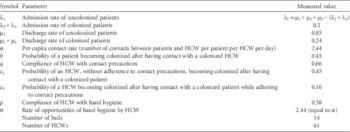
Parameters Used in the Mathematical Model to Describe the Transmission of Carbapenem-Resistant Enterobacteriaceae in an Intensive Care Unit

NOTE. HCW, healthcare worker.
Uncolonized patients were discharged at rate µ1. Colonized patients were discharged at rate (µ2+µ3).
Patients interacted with HCWs at a contact rate of α contacts between patients and HCW per patient per HCW per day. b was the probability of a patient becoming colonized after having contact with a colonized HCW. Once the patient became colonized, he/she was considered to be colonized for the entire ICU stay.
The probability of an HCW becoming colonized after having contact with a colonized patient without adhering to CP was c 2 and the probability of an HCW becoming colonized after having contact with a colonized patient while adhering to CP was c 3.
Compliance with HH was ρ, and σ was the rate of opportunities of HH by an HCW after contact with a patient or the patient’s surroundings. This was equal to per capita contact rates.
In this model, we assumed that the HCW population was constant, the probability of transmission by colonized patients was equal to that by infected patients, patient-to-patient transmission and HCW-to-HCW transmission were not significant, persistent colonization of HCWs was rare, and the patient population and the HCW population were homogeneous.
A patient, once colonized, was considered to be colonized until discharge or death. This assumption was made because the duration of colonization is usually much longer than the length of stay in the hospital.Reference Feldman, Adler and Molshatzki 8 , Reference Zimmerman, Assous, Bdolah-Abram, Lachish, Yinnon and Wiener-Well 9
The Basic Reproduction NumberReference Massad, Coutinho, Yang, de Carvalho, Mesquita and Burattini
10
(
 $$R_{0} $$
) represented by equations (1)–(5), which is the average number of secondary cases generated by a primary case, was calculated by neglecting the admission rates
 $$\lambda _{i} $$
and expressed as follows (see Supplementary Material):
 $$R_{0} ={{a^{2} \,bm(c_{2} {\plus}c_{3} )(1{\minus}\rho )} \over {(\mu _{2} {\plus}\mu _{3} )\rho }}\gt 1,\,for\,\rho \,\ne\,0$$
Determining the Parameters of the Model
To determine the parameters used in the model we prospectively evaluated a 14-bed medical ICU in a tertiary care teaching institution affiliated with the University of São Paulo, Brazil. Data on admission rates, discharge rates, number of HCWs, compliance with HH, compliance with CP, and rates of contact between HCWs and patients were collected.
Throughout the entire study, all patients admitted had surveillance cultures collected (rectal) on admission and weekly thereafter until discharge or death. Clinical cultures were performed when indicated. Admission and discharge rates were obtained through daily evaluation of hospital records.
Information on compliance with HH, compliance with CP, and contact rates between HCW and patients was obtained by direct observation performed during 9 hours a week: 3 hours in the morning shift, 3 in the afternoon shift, and 3 at night. The HH compliance rate was calculated as the proportion of HH opportunities observed in which the HCW washed his/her hands or used an alcohol-based hand rub. Opportunities were defined as any of the 5 moments for HH defined by the World Health Organization proposed in their document. 11 The CP compliance rate was defined as the proportion of contacts between HCWs and patients under CP in which the HCW used gown and gloves. A contact was defined as any contact of a HCW with a patient or with his/her surroundings. HCWs did not know they were being observed.
The probability of transmission between patients and HCWs was measured with different HCWs and different colonized patients. To estimate the probability of an HCW becoming colonized after having contact with a CRE-colonized patient while adhering to CP, HCWs were instructed to manipulate a colonized patient using gown and gloves for 20 seconds and, after taking off their gloves, had their hands cultured using the “sterile bag” technique.Reference Larson, Strom and Evans 12 To estimate the probability of a HCW becoming colonized after having contact with a CRE-colonized patient without adhering to CP, HCW were instructed to manipulate a colonized patient for 20 seconds, after which their hands were cultured. To estimate the probability of a patient becoming colonized after contact with an HCW who had not been compliant with HH, volunteers‘ hands were cultured after shaking hands with an HCW who had manipulated a CRE-colonized patient for 20 seconds without adhering to CP. To estimate the efficacy of HH, the hands of HCWs were cultured after manipulating a CRE-colonized patient for 20 seconds without adhering to CP and, subsequently, using alcohol-based hand rub or washing their hands. The sample size for these procedures was estimated on the basis of the probability of hand contamination found in a previous study.Reference Sypsa, Psichogiou and Bouzala 5 Given an α of 0.05, power of 90%, the sterile bag technique was applied in 160 opportunities.
The model was simulated using Berkeley Madonna, version 8.3.18, software. Deterministic simulation was performed for the definition of goals and stochastic simulations were performed for comparison of the model data with data collected from the unit in the intervention phase.
Using the Model as the Basis for an Intervention and Evaluation of the Intervention
During a 10-month period, we collected baseline data and the parameters used in the mathematical model were determined. After the baseline period, the intervention period lasted 24 weeks, based on the simulations generated by the model; goals were set for HCW compliance with HH and compliance with CP.
An initial meeting was held during each work shift and the following data were presented to the HCWs:
-
- Rates of compliance with HH during the baseline period;
-
- Rates of compliance with CP during the baseline period;
-
- Prevalence rates of patients admitted already colonized and of patients who acquired CRE during their stay in the ICU;
-
- Goals determined for HCW compliance with HH and with CP.
During the intervention period, surveillance cultures continued as described and compliance with HH and with CP were evaluated by direct observation 9 hours a week, as described.
During weekly meetings held in each working shift, feedback about the above rates measured in the previous week was presented to HCW. The goals were reinforced and the cases of patients with CRE acquired in the unit were presented in order to make the staff understand responsibilities for the outcomes. Weekly meetings took place during the first 12 weeks and, weekly, new cases of colonization and compliance rates were also presented in a poster in the unit. During the next 12 weeks, data were presented in the poster but meetings were not held. The entire intervention lasted 24 weeks.
Because we had the number of colonized patients and the number of new acquisitions of CRE in each week, we were able to calculate Rn in each week.
Microbiological Methods
Hand culturing
The “sterile bag” technique consisted of putting HCW’s hands inside a bag containing a solution of 1 L of 0.01M phosphate-buffered saline, 1 mL Tween80 (0.1%), and1 g sodium thiosulfate (0.1%) adjusted to pH 7.9. The solution was incubated for 24 h at 37°C, and 20 mL were inoculated on a brain-heart infusion medium containing meropenem at a concentration of 0.5 mg/L and incubated for another 24 h. Next, 100 μL were inoculated on MacConkey agar plates. Isolated microorganisms were identified using biochemical methods and antimicrobial susceptibility testing was performed using the disk diffusion method to confirm carbapenem resistance.
Surveillance cultures
Samples were inoculated in thioglycolate broth (BD) and incubated overnight at 37°C. They were inoculated in MacConkey agar (BD) with carbapenem discs for overnight incubation. Lactose-positive colonies with inhibition halo lower than 22 mm for ertapenem and/or 23 mm for meropenem/imipenem (per Clinical and Laboratory Standards Institute guidance, M100-S25) were identified by matrix-assisted laser desorption/ionization–time-of-flight (VitekMS; bioMérieux) and subjected to susceptibility testing by automated methods (Vitek2, AST239 card; bioMérieux).
RESULTS
Parameters Used in the Model
After manipulating a colonized patient for 20 seconds without adhering to CP, HCW hands were contaminated with a CRE in 45% of opportunities (Table 1). After using gown and gloves, HCW hands were contaminated in 10% of opportunities. After shaking hands with an HCW who had manipulated a CRE-colonized patient for 20 seconds without adhering to CP, volunteers’ hands were contaminated with a CRE in 22% of cases. When culturing the hands of HCWs who had used an alcohol-based hand rub or had washed their hands, no colonization with CRE was detected.
During the baseline period, the prevalence of colonization by CRE at admission in the ICU was 17.6%. Daily admission and discharge rates are in Table 1. Because the ICU has a patient waiting list for admission, bed occupancy was considered to be 100%. The per-capita contact rate was 2.44 contacts per patient per HCW per day. The observed baseline compliance rate with HH was 38% and with CP was 66%. The calculated R0 in the baseline period was 11.
The Model as a Basis for Intervention
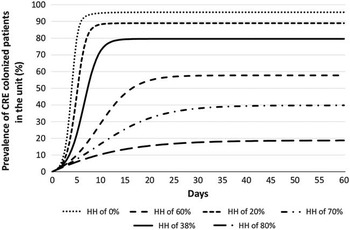
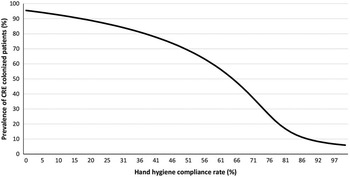
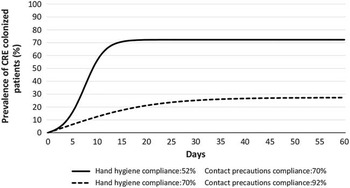
The dynamics of CRE transmission and prevalence of colonized patients in the unit were simulated in different scenarios of HH compliance and CP compliance (Figures 2 and 3). On the basis of the simulations, we established a goal of 80% of compliance with CP and 60% of compliance with HH, projecting the maintenance of a prevalence of CRE colonized patients at approximately 20%, similar to the prevalence of patients admitted already colonized. The model was more sensitive to contact rate and compliance with HH (Supplementary Material).
Predicted prevalence of patients colonized by carbapenem-resistant Enterobacteriaceae (CRE) in the intensive care unit with varying the rates of compliance with hand hygiene (HH). We considered a fixed rate of compliance with isolation precautions of 80%.

Estimated prevalence, after 60 days, of patients colonized with carbapenem-resistant Enterobacteriaceae (CRE) in an intensive care unit, considering varying rates of compliance with hand hygiene and a fixed rate of compliance with contact precautions of 80%.

Evaluation of the Intervention
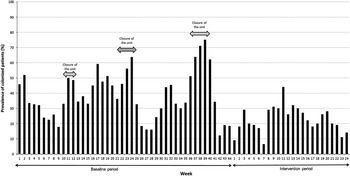
During the baseline period, the ICU had to be closed 3 times as a measure to stop the spread of CRE. The prevalence of CRE-colonized patients on these occasions exceeded 50%. Each time the unit was reopened, prevalence rates soared rapidly (Figure 4).
Observed weekly prevalence of patients colonized with carbapenem-resistant Enterobacteriaceae (CRE) in the intensive care unit during the baseline and intervention periods. Arrows show the periods during which the unit was closed to new admissions.

The goals for compliance with HH and CP were reached on the third week of the intervention period and were kept above target levels in all but weeks 6 and 8. Rates of HH compliance went from 38% in the baseline period to a median of 63% in the intervention period. Rates of compliance with CP went from 66% in the baseline period to a median of 84% in the intervention period.
Simulations of the prevalence of CRE-colonized patients, considering the best and worst compliance rates with HH and CP rates observed in the intervention period, are depicted in Figure 5.
Estimated prevalence of patients colonized with carbapenem-resistant Enterobacteriaceae (CRE) in an intensive care unit, considering the worst and the best compliance rates with hand hygiene and contact precautions directly observed during the intervention.

The prevalence of CRE-colonized patients remained between 10% and 45% during the entire intervention period (Figure 2). The median prevalence of colonized CRE patients went from 33% (excluding weeks of closed unit) in the baseline period to 21% in the intervention period. The median weekly Rn in the intervention period was 0.42 (range, 0–2.1). The unit has not been closed since the beginning of the intervention.
DISCUSSION
We developed a model to explain the transmission dynamics of CRE in an ICU. The model helped to establish specific goals in order to control the high prevalence rates and was able to predict the outcomes. By using well-defined targets, we were able to achieve the goals and to reduce CRE transmission within the unit. To our knowledge, this is the first study in infection control to measure most variables of a model in real life and to apply the model as a decision support tool for intervention.
We found that, using CP, the probability of colonizing the hands of HCW is 4.5 times smaller than when not using gown and gloves. Additionally, HH was 100% effective in our study and we were able to measure the probability of transmitting CRE to a third person after a contact with a colonized patient. As far as we know, our model is the first to measure all these probabilities and the first one to maintain colonized patients in the transmission chain even when they are under CP.
The use of specific goals for HH and CP together with the strategy of weekly audit and feedback succeeded in leading HCW toward better practices. Ivers et alReference Ivers, Jamtvedt and Flottorp 13 demonstrated that the strategy of audit and feedback is more effective when explicit targets are provided. The simulations were an important tool to determine the goals that could control the spread of CRE and clearly established feasible targets. On the basis of the simulations, we chose goals that were feasible but not ideal. We believe that most ICU settings are quite different from the one in our study but the model developed could be used in different settings by adjusting parameters for each specific epidemiologic situation, such as compliance with HH, compliance with CP, and prevalence of colonized patients on admission. In an ICU that does not perform surveillance cultures, point prevalence and surveillance cultures on admission of a sample of patients would probably generate enough information to start a simulation and set specific goals.
In our ICU, as predicted by the model and as observed in real life, control of CRE transmission was extremely difficult and required very high rates of compliance with HH and CP. This was due to the high prevalence of patients already colonized on admission and the low discharge rate of colonized patients (3.5 times smaller than that of uncolonized patients). This difference was probably due to the fact that CRE-colonized patients tended to be more severely ill, with more comorbidities and more invasive devices.Reference Swaminathan, Sharma and Poliansky 14 , Reference Bhargava, Hayakawa and Silverman 15
The high prevalence of CRE-colonized patients on admission reflects the situation in most public hospitals in São Paulo, where CRE, mainly Klebsiella pneumoniae, are endemic. A predominant clone was introduced in several hospitals.Reference Pereira, Garcia, Mostardeiro, Fanti and Levin 16 Another study used mathematical models to predict the impact of interventions on vancomycin-resistant Enterococcus and found that the high influx of patients colonized with vancomycin-resistant Enterococcus and the prolonged duration of hospitalization of these colonized patients substantially increased the prevalence of such colonization.Reference D’Agata, Webb and Horn 17
An effort to control multidrug resistance would be expected to have an overall impact on healthcare-acquired infections. We observed that there was no change in the incidence of healthcare-acquired infections in the ICU. However, the incidence of infections caused by multidrug-resistant pathogens and the incidence of catheter-related bloodstream infections acquired in the ICU decreased during the intervention. Additionally, the unit succeeded in keeping the prevalence of CRE below 20% in the year following the intervention (data not shown).
Our study has limitations. Authors have advocated the use of stochasticity in healthcare-associated infection models because populations tend to be small and, consequently, transmission patterns tend to be subjected to the effect of chance.Reference Cooper, Medley and Scott 6 , Reference van Kleef, Robotham, Jit, Deeny and Edmunds 7 In our study, we chose to use a deterministic approach because our objective was to determine specific targets of HH and CP rates.
Patient population was considered homogeneous and contact rates were assumed to be the same for every patient. It is reasonable to think that more severely ill patients tend to have higher HCW-patient daily contact rates. Additionally, some patient characteristics could increase skin CRE colonization.Reference Lin, Lolans and Blom 18 These biases were partially reduced by the long periods of observation to measure contact rates and by the large sample of cultured hands. We found higher contact rates than in a previous study,Reference Sypsa, Psichogiou and Bouzala 5 which may be explained by our severely ill patients, large proportion of oncohematology patients, and high prevalence of invasive devices. The probability of transmission may have been overestimated because typing of CRE isolates from patients and HCW hands was not performed. However, it is reasonable to consider that the isolation of CRE from the hands of the HCW was secondary to handling the colonized patient. An additional limitation was not to evaluate the probability of transmission after contact with the environment and to consider it equal to the probability after contact with the patient. Finally, not aspiring to full compliance may have potential administrative, legal, and ethical implications. However, we decided on a pragmatic approach to the problem. We understand that admitting that 100% is not achievable makes us vulnerable but we chose goals that were feasible but not ideal. We used the simulations in order to establish a feasible goal that would best solve the problem.
In conclusion, the application of mathematical modeling to study healthcare-associated infections seems to be a valuable tool to explain transmission patterns and to establish specific intervention goals. The inclusion of patients under CP as a source of transmission appears to bring the modeling simulations closer to what is observed in practice.
ACKNOWLEDGMENTS
We acknowledge Marjorie Shafferman for reviewing English grammar.
Financial support. None reported.
Potential conflicts of interest. All authors report no conflicts of interest relevant to this article.
SUPPLEMENTARY MATERIAL
To view supplementary material for this article, please visit http://dx.doi.org/10.1017/ice.2016.168