Staphylococcus aureus is a common cause of contagious intramammary infection (IMI) worldwide and the most frequently isolated bacterium from both clinical and subclinical mastitis in Norway (Norwegian Cattle Health Services, 2006). Staph. aureus strains have both cell-bound properties on the surface that make the bacteria capable of adherence and invasion, and secreted virulence factors which facilitate spread of the infection. Various studies have shown that specific management and environmental factors influence the occurrence of subclinical mastitis, in addition to cow-level factors (Østerås et al. Reference Østerås, Edge and Martin1999; Schukken et al. Reference Schukken, Leslie, Barnum, Mallard, Lumsden, Dick, Vessie and Kehrli1999; Zadoks et al. Reference Zadoks, Allore, Barkema, Sampimon, Wellenberg, Grohn and Shukken2001). Staph. aureus frequently causes long-lasting infections, and persistence of infection is often caused by numerous pathogen factors, host factors and host-pathogen interactions (Park et al. Reference Park, Fox, Hamilton and Davis1993; Sutra & Poutrel, Reference Sutra and Poutrel1993). The infection pattern differs between herds and these differences could be related to different strains (Zecconi et al. Reference Zecconi, Binda, Borromeo and Piccinini2005) even though other studies indicate that only a few clones are involved in the bovine mastitis complexity (Middelton et al. Reference Middleton, Fox, Gay, Tyler and Besser2002). Aarestrup et al. (Reference Aarestrup, Wegener, Jensen, Jonsson, Myllys, Thorberg, Waage and Rosdahl1997) investigated the geographical distribution of phage and ribotypes of Staph. aureus causing bovine mastitis in the five Nordic countries and concluded that there were country-specific differences in the virulence or in modes of transmission of predominating and rare types of Staph. aureus associated with bovine mastitis.
Staph. aureus can establish subclinical IMI, which typically manifests as an elevation in the somatic cell count (SCC) of milk from the affected quarter (Middleton et al. Reference Middleton, Fox, Gay, Tyler and Besser2002; Zecconi et al. Reference Zecconi, Binda, Borromeo and Piccinini2005). Appropriate treatment of subclinical Staph. aureus mastitis during lactation has been debated and individual-specific factors should be used to predict the probability of cure and in selecting cows for lactational or dry period treatment as opposed to culling. It appears that the economic outcome of lactational treatment depends on the herd, cow and pathogen strain, and treatment can be economically profitable in various situations (Swinkels et al. Reference Swinkels, Hogeveen and Zadoks2005; Barkema et al. Reference Barkema, Schukken and Zadoks2006). Others have found no beneficial long-term effects of antimicrobial treatment during lactation of subclinical mastitis caused by Staph. aureus (Sandgren et al. 2007). Treatment during the dry period has shown a higher cure rate and treatment is often more economically profitable (Østerås et al. Reference Østerås, Sandvik, Aursjø, Gjul and Jorstad1991; Sol et al. Reference Sol, Sampimon, Snoep and Schukken1994; Østerås et al. Reference Østerås, Edge and Martin1999).
Few studies have calculated the losses subclinical Staph. aureus mastitis may cause due to elevated SCC, reduced milk yield, increased risk of clinical mastitis (CM), and culling. Besides treatment costs and losses due to the discarding of milk, culling may be an expensive outcome of Staph. aureus after calving (Reksen et al. Reference Reksen, Sølverød, Branscum and Østerås2006). The objective of the present study was to compare milk yield, SCC, CM and culling in cows testing positive for Staph. aureus v. culture-negative cows approximately 1 week after calving.
Materials and Methods
Selection and randomization of the herds
The data employed in this 2-year cohort field study was based on the Norwegian selective dry cow therapy and teat dipping protocol described in detail by Whist et al. (Reference Whist, Østerås and Sølverød2007a), but a short summary is given here. Three different teat dipping regimens, a negative control (A), an iodine postmilking teat disinfection (PMTD) (B) and an external teat sealant (C), were used in the same herds. The iodine PMTD contained 0·15% (1500 ppm) iodine and all teats of all lactating cows were dipped routinely. At drying-off, the teats of cows maintained in tie stalls were dipped 2–3 d after drying-off and cows maintained in free stalls were dipped up to the last day of milking. The external teat sealant was used on all teats in all lactating cows at drying-off and 10 d before expected calving (including heifers). If the teat sealant had fallen off within 3 d of being applied it was reapplied. As there is no differences in action between group A (control) and C (external teat sealant) during lactation and there was no significant difference at calving (Whist et al. Reference Whist, Østerås and Sølverød2007a) these two groups were made a joint control group in this study.
The farmers sampled every cow as close to 6 days in milk (DIM) as possible (range, 1–30). This sample was used to classify the cow as either a cow testing positive for Staph. aureus or as a culture-negative cow. A cow testing positive for Staph. aureus was defined as a cow with isolation of Staph. aureus in one or more quarters and no other pathogens isolated in the same or other quarters. A culture-negative cow was defined as one with no bacteria isolated in any of the quarters.
Bacteriological examination of quarter milk samples
Veterinarians collected the first milk samples and taught the farmers an aseptic milk sampling technique. The farmers then collected the other milk samples throughout the trial. All quarter milk samples were analysed for bacterial growth from 0·01 ml of milk spread on blood agar plate (Blood Agar Base, Oxoid Ltd, Basingstoke, UK) mixed with 5% washed bovine erythrocytes. Examination of bacterial growth and diagnostics was in accordance with the official procedure in Norway (National Veterinary Institute, 1993) based on the procedures of the International Dairy Federation (1981). Plates were divided into four sections by streaking out a β-toxic Staph. aureus strain, and foremilk was streaked out on each quarter before incubation at 37°C±1°C for 18–24 h. Samples were considered contaminated if there was growth of >2 different types of colonies. Typical colonies for Staphylococcus spp. producing a typical β-haemolytic zone were classified as Staph. aureus. Other colonies of Staphylococcus spp. showing atypical β-haemolytic zones were classified as coagulase-positive or negative using a rapid test, the Prolex™ Staph Latex Kit (PRO-LAB Diagnostics, Toronto, Canada). Coagulase-positive isolates were defined as Staph. aureus. Growth of more than one colony-forming units (cfu) Staph. aureus/0·01 ml was reported as a positive isolation of Staph. aureus, according to the Norwegian standard.
Data retrieval
Because the trial spanned 2 years, cows contributed with 1–3 complete lactations. A complete lactation was defined as from 15 d before a calving to 15 d before the next calving or to the culling date. Calving date, corresponding parity, culling date, monthly test-days, corresponding daily milk yield in kg, and SCC measurements in 1000 cells/ml were extracted from the Norwegian Dairy Herd Recording System (NDHRS) database during the research period. A questionnaire to the participants identified how the cows were stalled.
The veterinarian recorded CM treatments with a specific health code and date of event on the Norwegian Cow Health Card which is reported to the NDHRS database (Østerås et al. Reference Østerås, Solbu, Refsdal, Roalkvam, Filseth and Minsaas2007). All mastitis cases were defined as severe or moderate (code 303) or mild (code 304). The definitions of diagnoses were according to recommendations from the International Dairy Federation (1999).
Statistical analysis
Statistical analyses and models similar to those described in detail by Whist et al. (Reference Whist, Østerås and Sølverød2007b) were used with the substitution of Staph. aureus for Streptococcus dysgalactiae and a summary and adjustments of the different models are explained here. The data were imported into SAS, and all calculations were performed using SAS, version 9·1 (SAS, Cary NC, USA). Two general linear mixed models and two Cox regression models were made to evaluate any associations between cows testing positive for Staph. aureus and lactation performance. The culture-negative cows served as a control group. Cows testing positive for Staph. aureus (Saurcow, A1) were classified into different hierarchic dummy variables according to Walter et al. (Reference Walter, Feinstein and Well1987). The dummy variables were coded according to the number of quarters with isolation of Staph. aureus: SAUR1=1, one or more quarters with isolation of Staph. aureus; SAUR1=0, no Staph. aureus detected; SAUR2=one, two or more quarters with isolation of Staph. aureus; SAUR2=0, fewer than two quarters with isolation of Staph. aureus; SAUR3=1, three or more quarters with isolation of Staph. aureus; SAUR3=0, fewer than three quarters with isolation of Staph. aureus; SAUR4=1, all four quarters with isolation of Staph. aureus; and SAUR4=0, fewer than four quarters with isolation of Staph. aureus.
The independent fixed variables included in the formula of β, were included in the primary full model for all models.

All variables were included in each of the full models simultaneously. In all four models, the independent variables, both those included in β and others, were excluded one by one from the full model using a backward elimination procedure until all remaining variables were assessed as being significant or P⩽0·10. This was done manually to keep the pure fixed effect into the model as long as any interactions of the fixed effect were included. To check for any confounding effect the variables that were excluded from the model were rechecked into the model again, one by one, as the model was built up once again by a forward selection procedure including first those with the highest F value. This was done to check for confounding, and as a final check of the fit of the model and to avoid over-fitting. The model fits were evaluated by assessing AIC value. The models with the lowest AIC value were selected as the final full model. The mixed models were all evaluated including the random effects. To avoid over-fitting of the models, the models had to be run without intercept when including parity. The final models for SCC and milk yield were tested with different correlation structures such as first order autoregressive structure [R(1), Toeplitz (1) and (2), autoregressive moving average (ARMA) (1,1), variance component (VC) and autoregressive heterogeneous first order variance ARH(1)]. AR(1) gave the best fit.
Model 1: SCC:
Before fitting the SCC model, all lactations with a CM before the post-calving sampling were deleted. The log-transformed SCC (lnSCC) test-day results were used as the dependent variable and fitted in the model according to the principle of Wood's lactation curve (Wood, Reference Wood1967). The final model was a multivariable model constructed using PROC MIXED procedures with repeated observation related to DIM within lactation. First order autoregressive [AR(1)] covariance matrix was used in the repeated statement for SCC within lactation nested within individual cow and the random statement for SCC at herd level using independent covariance matrix structure:
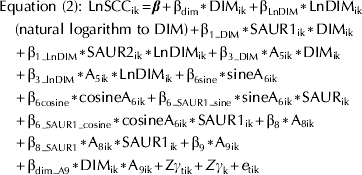
t corresponds to observation on test-day t, i observation at ith lactation and k observation at kth herd. Zγtik represents the repeated variation for ith lactation nested within individual at kth herd, Zγk the random variation at kth herd, and e tik the random error. β, A2 to A5 are defined in Equation (1).
A6 represents the SCC test-day transformed to a sine and cosine function to account for any seasonal effect as described by Østerås et al. (Reference Østerås, Sølverød and Reksen2006). The interaction between season and SAUR1 was included in the model. Furthermore a variable A8 was included, denoting whether the cow was treated for CM during the lactation and at what time the CM treatment occurred according to the test-day. The time (DIM) from the CM episode to the test-day (A8) was divided into different class intervals and included in the model (no CM before test-day, 1–30 d after, 31–60 d after, 61–90 d after, 91–120 d after, and >120 d after). The interactions between SAUR1∗A8, DIM∗A3 and DIM∗A5 were also included in this model. A variable A9 denoted whether the cow was stalled in free-stall (A9=1) or in tie-stall (A9=0) and the interaction DIM∗A9 was included.
Model 2: milk yield:
The final model was fitted exactly as Model 1, but some interactions were included and some were omitted. In addition to the dependent variables in Equation (1) A7 was also included, denoting whether the cow was diseased (noted by the farmer) on the test-day (yes=1, no=0). The values were not log-transformed but used as real values. The equation was thus a combined exponential and linear model since both DIM and lnDIM are used in the model (Macciotta et al. Reference Macciotta, Vicario and Cappio-Borlino2005). At the start, separate models were constructed for primiparous and multiparous cows. However, the final model included all parities since an interaction between SAUR1 and parity was included and this was the only different effect between the models. The variance in the repeated measurements of milk yield was modelled as described in Model 1.
Model 3: clinical mastitis and culling:
The hazard ratio (HR) for a cow to develop CM was estimated using Cox regression analyses (Cox, Reference Cox1972) with the general equation:

where β in this particular study is defined with the fixed covariates of Equation (1). In Equation (3), t is time from start of observation to mastitis therapy or culling, and Wγk is the positive frailty effect at herd level. In the culling model, an additional variable denoted whether the cow was treated for CM (Saur treated) during the lactation and after the bacteriological sample post-calving.
Each observation entered the dataset at the time of the milk sample (approximately 6 DIM) in which the cows were designated as either a cow testing positive for Staph. aureus with isolation of Staph. aureus in 1–4 quarters, or as a culture-negative cow. Cows were censored at the culling date, 15 d before the next calving date, or at a maximum observation time of 420 d. The limit for censoring at 420 d covered the full length of 95% of all lactations in the dataset. The HR for CM (culling) was calculated using time from sampling, 6 DIM, until the first CM event date (culling date) as the dependent variable. HRs with 95% confidence intervals (CI) were obtained for all covariates.
Cox models were first evaluated including herd as random effect using the ties=exact method. When running this full frailty model with the robust sandwich variance estimate, all variables with a P value >0·10 were excluded one by one. All fixed variables were included in the final frailty model if the P value was <0·10. In addition, two extra variables which were closest to P<0·05 were included as long as they had a P<0·20.
The fit of the model without frailty effect was evaluated by plotting the deviance residuals against the covariates to see whether the models fit the data adequately (Allison, Reference Allison2000). To check for proportional hazard assumption, the log of the negative log of survival was plotted against time with the most important independent variable as strata. These assessments showed no evident violations of the proportional hazard assumption, extreme deviance residuals, or patterns in the models. When fitting the final models, we used PROC PHREG (SAS, Cary NC, USA), including the positive stable frailty models in the SAS macro available from Shu & Klein (Reference Shu and Klein1999) and Shu & Klein (Reference Shu and Klein2005). The significance of the frailty effect was assessed by the likelihood ratio test of independence (Theta=1; Theta equals 1-Kendall's tau). The frailty effect was judged significant at P<0·05.
Results
Descriptive data
Of the 215 herds initially enrolled, 178 herds remained in the study after 2 years. Twelve farmers withdrew from the study because they did not manage the protocol or they suffered some accidents or force majeure outside this project. Another 23 farmers withdrew because their local veterinarian suspected that the protocol was not being followed or 50% or more of the milk samples were forgotten. Two farmers withdrew because their co-ownerships were dissolved during the study period. A total of 142 tie stalls, 22 free stalls and 14 unidentified stall types were included in the different models.
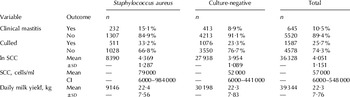
The total number of lactations sampled on average 6 DIM was 8439. Omission of all lactations with fewer than four quarters registered in the NDHRS database and mixed infections within quarter or cow were also excluded, which reduced the material to 6165 lactations. There were 4626 culture-negative cows and 1539 cows with isolation of Staph. aureus post-calving; 994 with isolation of Staph. aureus in one quarter, 363 in two quarters, 129 in three quarters, and 53 in all four quarters. Crude distributions of CM, culling, CMSCC and daily milk yield are presented in Table 1.
Crude data on the outcome variables for cows with single isolation of Staphylococcus aureus and culture-negative cows at approximately 6 days in milk

Statistical models
Model 1: SCC:
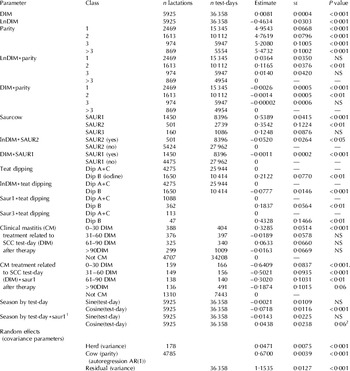
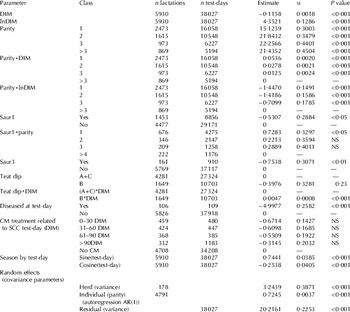
Because of the exclusion of lactations with CM before the post-calving samples, 216 test-day observations were omitted. There were 5925 lactations with at least one SCC test-day, 2743 cows had one lactation, 1577 had two, and 28 cows had three lactations. A total of 36 358 SCC test-days were used in the model. Results of the final model are presented in Table 2.
Estimates from final Model 1 [mixed model with repeated measurement related to days in milk (DIM) within lactation level]; the associations between test-day SCC according to DIM in cows that tested positive for Staphylococcus aureus at 6 DIM v. culture-negative cows at 6 DIM (n=36 358 SCC test-days). See text for definitions of model parameters

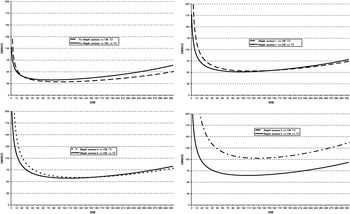
The shapes of the SCC curves differed depending on the number of quarters testing positive for Staph. aureus and whether or not the cow was housed in a herd using PMTD (Fig. 1). Figure 1 is based on estimates from the SCC model and adjusted for the use of PMTD or not, lactation without CM and season. Season was adjusted to 27 April 2004 which was the mean test-day in the trial. Cows testing positive for Staph. aureus had a significantly higher SCC throughout the succeeding lactation compared with culture-negative cows (Table 2). Cows with no isolate of Staph. aureus had a mean SCC of 41 900 in 1st parity. Cows with isolation of Staph. aureus in one quarter, no CM recorded and stalled in a herd where no iodine PMTD was used had a lactation geometric mean SCC of 60 900 cells/ml (2 quarters had 67 800 cells/ml, >2 quarters had 76 800 cells/ml). Cows stalled in herds using iodine PMTD had a mean SCC of 35 800; 62 600; 69 600 and 121 600, respectively. The shape of the SCC curve is illustrated in Fig. 1.
Cow milk somatic cell counts (CMSCC) in culture-negative cows (neg) and cows testing positive for Staphylococcus aureus, with isolation of Staph. aureus in 1 or more quarters (saur1), 2 or more quarters (saur2) and 3 or more quarters (saur3), with and without post milking iodine teat disinfection (PMTD), in first parity cows.

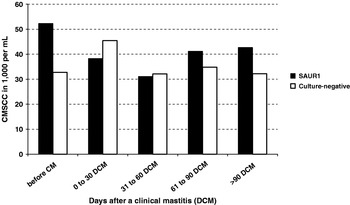
The estimated geometric mean SCC, divided into different monthly intervals from the days of CM treatment (DCM), is illustrated in Fig. 2. A CM-treated cow testing positive for Staph. aureus had a highly elevated SCC before therapy but then exhibited a significantly reduced SCC after treatment (until 60 d) compared with the SCC from a cow testing positive for Staph. aureus and not receiving treatment.
Estimated mean cow milk somatic cell counts (CMSCC) in cows testing positive for Staphylococcus aureus (SAUR1) (filled bars) on average 6 days after calving compared with culture-negative cows (open bars). All cows have been treated for clinical mastitis (CM) at days relative to CM (DCM) 0. Positive values of DCM indicate time after therapy.

Model 2: milk yield:
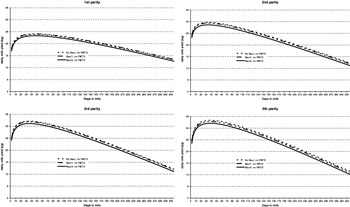
A total of 38 027 test-day observations for 5930 lactations were used. For primiparous cows, there were no significant associations in the shapes of the lactation curves except when Staph. aureus was diagnosed in more than two quarters. The parameterized milk curves for parity 1, 2, 3 and >3 for cows with no Staph. aureus isolation, Staph. aureus isolated in one quarter and Staph. aureus isolated in more than two quarters is illustrated in Fig. 3. Figure 3 is based on estimates from the milk yield model and adjusted for the use of PMTD or not, lactation without CM and season. Season was adjusted to 27 April 2004 which was the mean test-day in the trial. These cows produce 6043, 6103 and 5874 kg milk during a 305-d lactation during 1st parity; 6921, 6827 and 6598 kg milk during 2nd parity; 7357, 7283 and 7054 kg milk during 3rd parity and 7549, 7388 and 7158 kg milk during later parities (Table 3). Multiparous cows with isolation of Staph. aureus and culture-negative cows treated for CM, adjusted for the other variables in the model, had a significant 0·67–0·55 kg lower daily production from zero until 90 d after treatment compared with cows not treated.
Daily milk yield related to days in milk in culture-negative cows (no Saur) and cows testing positive for Staphylococcus aureus, with isolation of Staph. aureus in 1 or more quarters (saur1), or more than 2 quarters (saur3) in first, second, third and fourth parity cows.

Estimates from final Model 2 (mixed model with repeated measurement at lactation level nested within indiviual); the associations between daily milk yield (kg) throughout the succeeding lactation in all parities (n=5930) lactations of them (n=1453) testing positive for Staphylococcus aureus-positive v. culture-negative cows (n=4477). See text for definitions of model parameters

Model 3: clinical mastitis and culling
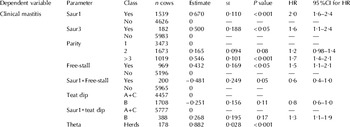
Culture results for the CM cases were not considered. Included in the survival analysis for CM and culling were 6165 lactations. Of the 645 recorded CM treatments, 232 (16·0%) were from cows that tested positive for Staph. aureus at 6 DIM, and 413 (8·9%) were from culture-negative cows at 6 DIM. Compared with culture-negative cows, the HRs for CM in cows testing positive for Staph. aureus (>0 quarter) were 2·0 (1·6–2·4) and 3·2 (>2 quarter) (Table 4). Culture-negative cows in tie stall herds using PMTD had a significantly lower risk in getting CM with a HR=0·8 (0·6–1·0) compared with culture-negative cows in tie stall herds not using PMTD.
Results and estimates from Model 3. The hazard ratio (HR) between cows testing positive for Staphylococcus aureus/culture-negative cows at 6 days in milk (DIM) and clinical mastitis using Cox survival analysis model (n=6165 lactations with 645 events for clinical mastitis). See text for definitions of model parameters

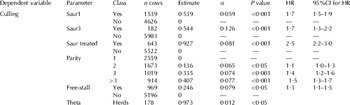
In the survival analysis for culling, 501 (33·2%) Staph. aureus-positive and 1017 (8·9%) culture-negative at 6 DIM were culled in subsequent lactations. HRs for culling for cows testing positive for Staph. aureus compared with culture-negative cows were 1·7 (1·5–1·9) (>0 quarters) and 2·9 (>2 quarters). Cows testing positive for Staph. aureus and treated for CM had an HR for being culled of 2·5 (2·2–3·0) (Table 5).
Results and estimates from Model 4. The hazard ratio (HR) between cow testing positive for Staphylococcus aures/culture-negative cows at 6 days in milk (DIM) and culling using Cox survival analysis model with cows testing positive for Staph. aureus as a random effect (n=6165 lactations with 1518 events for culling). See text for definitions of model parameters

Discussion
The mixed models for SCC and milk yield had many fixed variables and were based on a three-level hierarchical structure. The models were made with lactation nested within individual to take care of the clustering within lactation and individuals. The correlation structure used was AR(1) after checking for other relevant structures. AR(1) was proven to give the best fit to the data which is in accordance with Gröhn et al. (Reference Gröhn, Wilson, Gonzales, Hertl, Schulte, Bennet and Schukken2004). ARH(1) did not improve the fit. This could roughly indicate constant variance. The residual was plotted against predicted values to detect deviations from assumed normality of the errors and random effects at lactation and herd level. No such deviation was detected. Clustering between the herds was included as a random effect. Originally separate models were made for first- and later parities for milk yield; however, the final model included all parities since the main fixed effect was the same except for the effect of cows having an isolate of Staph. aureus. This interaction effect was finally included in the final model. Our results demonstrate an association between isolation of Staph. aureus post-calving and a higher SCC and increased risk of CM and culling compared with culture-negative cows. Average SCC in cows testing positive for Staph. aureus was approximately 60 000 cells/ml, well below the internationally used limit of 200 000 cells/ml for potentially infected quarters. This finding indicates that with regard to the loss of premium milk delivery, there are no economic issues involved in letting these cows remain untreated. It also indicates that normal SCC is below 50 000 cells/ml, as indicated by Whist et al. (Reference Whist and Østerås2007c). There is a surprisingly low impact of Staph. aureus isolation in first parity cows which could indicate that self cure after calving is quite likely. Another explanation could be that the pathogenesis for Staph. aureus strains differ between countries and differ in the virulence of transmission, and the isolated strain could thus be less pathogenic (Aarestrup et al. Reference Aarestrup, Wegener, Jensen, Jonsson, Myllys, Thorberg, Waage and Rosdahl1997). Multiparous Staph. aureus positive cows post-calving showed a higher SCC the first months after calving compared with culture-negative cows and also a significantly lower milk yield. These animals will influence both the bulk milk SCC and the milk production on the farm. These results are in agreement with those of Whist et al. (Reference Whist, Østerås and Sølverød2007b) who compared cows testing positive for Str. dysgalactiae with culture-negative cows. This study illustrates that iodine PMTD could reduce the SCC from 42 000 to 36 000 cells/ml in cows with no isolates of Staph. aureus after calving. A contrary result is seen in cows with >2 isolates of Staph. aureus after calving where the SCC increases from 77 000 to 122 000 cells/ml. This demonstrates a preventive effect on healthy cows but a deterioration effect on already infected cows. This should be followed up in experimental studies.
Milk yield did not decrease in the Staph. aureus-positive cows unless more than two quarters were infected post calving. In 1st parity cows the production loss was even lower and there is a trend towards higher milk production in cows with Staph. aureus isolated in one or two quarters. This could be explained by compensation of milk production in the other quarters as long as at least two quarters are uninfected. Overall, the milk loss and the increase in SCC is less for Staph. aureus than Str. dysgalactiae infected cows when comparing these results with those of Whist et al. (Reference Whist, Østerås and Sølverød2007b).
Our findings indicate a highly significant association between cows testing positive for Staph. aureus post-calving and an increased risk of being treated for CM in the succeeding lactation. The result is in agreement with those of Reksen et al. (Reference Reksen, Sølverød, Branscum and Østerås2006) who found that the risk of CM treatment was significantly higher among cows in which Staph. aureus was isolated compared with cows with a negative milk culture, even though the farmers did not know the sample results. Cows testing positive for Staph. aureus were also at an increased risk of being culled in the present study. In agreement with previous reports (Gröhn et al. Reference Gröhn, Eicker, Ducrocq and Hertl1998; Reksen et al. Reference Reksen, Sølverød, Branscum and Østerås2006) our study showed that culling was significantly lower for first-parity cows compared with cows in the second or later parities, but increased with increasing number of Staph. aureus-positive quarters. If the cow in addition had been treated for CM during the lactation, the risk of culling increased another 2·5 times. This observation could also be relevant for SCC and milk yield in this study; heavily infected cows tend to be culled and will not be represented in late lactation.
The use of an external teat sealant showed no positive or negative effect in this study and was therefore united with the negative control group. This was also expected as external teat sealant is not used during milking. As there is no main difference between the teat sealant group and the control group, as illustrated in previous published papers (Whist et al. Reference Whist, Østerås and Sølverød2007a) there should be no reason not to merge these two groups together in this study. For cows with isolation of Staph. aureus in at least three quarters, iodine PMTD had a negative effect on the SCC for the remaining lactation period. This result is unexpected and necessitates further studies to identify biological explanations. One explanation could be that Staph. aureus is spread within cow by the dip cup. Another explanation could be that the use of iodine PMTD will eliminate minor pathogens that provide some protection against new infections caused by major pathogens such as Staph. aureus (Rainard & Poutrel, Reference Rainard and Poutrel1988; Schukken et al. Reference Schukken, Van De Geer, Grommers, Smith and Brand1989). The identified positive effect of PMTD on SCC in culture-negative cows, as well as for CM, indicates that PMTD has a preventive effect on already healthy cows.
The authors thank the participating farmers, veterinarians, and laboratory workers for their help and support during the trial. We also thank Boehringer-Ingelheim, VetPharma, and DeLaval for their contribution of free intramammaries and teat dips. Access to the data was made possible by the Norwegian Dairy Herd Recording System and the Norwegian Cattle Health Services (for health data) in agreement No. 8/2002. The study was financially supported by grants from the Research Council of Norway.