1. Introduction
Internationally there is growing understanding that water rights are important and that a lack of effective water rights systems creates major problems for the management of increasingly scarce water supplies (Matthews, Reference Matthews2004; Bruns et al., Reference Bruns, Ringler, Meinzen-Dick, Bruns, Ringler and Meinzen-Dick2005; Meinzen-Dick and Nkonya, Reference Meinzen-Dick and Nkonya2005). This is because, in general, ill-defined property rights limit the value people assign to a resource (Randall, Reference Randall1978; Ostrom, Reference Ostrom, Bouckaert and De Geest2000; Heltberg, Reference Heltberg2002; Linde-Rahr, Reference Linde-Rahr2008; Halsema and Withagen, Reference Halsema and Withagen2008; Libecap, Reference Libecap2009). Ill-defined water rights create high transaction costs (information search, negotiation, monitoring) for making decisions over water use, which seriously impairs the efficient use of water (Challen, Reference Challen2000; Wichelns, Reference Wichelns2004). This implies that if water rights are better defined, people will be willing to pay higher prices for water use because the transaction costs will be reduced (Herrera et al, Reference Herrera, Van Huylenbroeck and Espinel2004). This makes it possible to use contingent valuation methods to evaluate alternative water rights policy options (see for example Herrera et al., Reference Herrera, Van Huylenbroeck and Espinel2004 or Frija et al., Reference Frija, Chebil, Speelman and Van Huylenbroeck2008).
According to McCann et al. (Reference McCann2005), choice experiments are particularly promising tools for such analysis because of their potential to separately value different characteristics of a given situation. This study focuses on smallholder irrigators in South Africa and uses contingent ranking (CR), a form of choice experiment, to evaluate potential improvements in the country's water rights system. This study has policy relevance as, since its introduction in 1998, South Africa's water rights system has been the subject of extensive criticism (see Louw and van Schalkwyk, Reference Louw and van Schalkwyk2002; Nieuwoudt, Reference Nieuwoudt2002; Perret, Reference Perret2002; Nieuwoudt and Armitage, Reference Nieuwoudt and Armitage2004; Backeberg, Reference Backeberg2006; Pott et al., Reference Pott, Versfeld, van Rooyen and Muir2009). Also smallholder irrigation schemesFootnote 1 play a potentially important role in rural development. Improved water rights can not only stimulate smallholders to use water more productively and invest in water conserving technologies (Wichelns, Reference Wichelns2004; Bruns, Reference Bruns2003, Reference Bruns2007; Brooks and Harris, Reference Brooks and Harris2008), but their resulting higher willingness to pay (WTP) for water can also allow governments to improve cost recovery (Ntengwe, Reference Ntengwe2004; Virjee and Gaskin, Reference Virjee and Gaskin2005). Both these aspects are of relevance as the smallholder irrigation sector in South Africa is inefficient in its use of water (Speelman et al., Reference Speelman, D'Haese, Buysse and D'Haese2008a) and the level of cost recovery of government investments is considered insufficient (Backeberg, Reference Backeberg2006; Perret and Geyser, Reference Perret and Geyser2007).
A second aim of this study was to evaluate the effect of different population characteristics on people's WTP. This additional information can help policy makers to better target their interventions, by improving their knowledge about likely support among different types of farmers for specific interventions. In this way the impact of the water right improvements can be increased.
2. Methodology
This study developed a CR experiment to determine WTP for improvements in the water rights system. CR is a survey-based technique for modelling preferences for goods, where goods are described in terms of their attributes and the level these take. Respondents are presented with various descriptions of a good, differentiated by their attribute levels and asked to rank the various alternatives. The technique originates from marketing and transportation science but more recently choice models, of which CR is a special form, have proven to be useful in valuing other multidimensional interventions (Hanley et al., Reference Hanley, Mourato and Wright2001, Bateman et al., Reference Bateman, Cole, Georgiou and Hadley2006; Burton et al., Reference Burton, Marsh and Patterson2007; Kanyoka et al., Reference Kanyoka, Farolfi and Morardet2008; Mondelaers et al., Reference Mondelaers, Verbeke and Van Huylenbroeck2009; Do and Bennett, Reference Do and Bennett2009). Like other choice models, CR avoids an explicit elicitation of respondents’ willingness to pay. CR however provides more information than classical choice models, because its rankings show more about the preferences of the respondents (Holmes and Adamowicz, Reference Holmes, Adamowicz, Boyle and Champ2002).
There are some potential problems in using the method: these include the complex nature of the statistical design, the selection of the appropriate attributes and levels and the cognitive difficulties that participants may experience when ranking choices (Hanley et al., Reference Hanley, Mourato and Wright2001). Typically, the design of a choice experiment involves three stages (Bennett and Adamowicz, Reference Bennett, Adamowicz, Bennett and Blamey2001; Holmes and Adamowicz, Reference Holmes, Adamowicz, Boyle and Champ2002). Firstly, the problem has to be characterised. Then the attributes and their levels should be chosen. Finally, experimental design procedures are used to construct the ranking tasks that will be presented to the respondents. The following paragraphs discuss the implementation of these steps in this study.
2.1. Characterisation of the problem
The National Water Act (Republic of South Africa, 1998) replaced the previous system of water rights and entitlements, which was based on the ownership of riparian land, with a new system of licences. These licenses are administrative, valid for limited period and come under conditional authorizations in case of using water (Nieuwoudt, Reference Nieuwoudt2002). Except for the fundamental right of access to water for basic human needs, all other water uses require a licence (Stein, Reference Stein2005). This change must be seen in the context of the efforts made by the new democratic government since 1994 to overcome the legacy of the apartheid system by restructuring the constitution, legal system, policies and administration (Wester et al., Reference Wester, Merrey and de Lange2003). The issuing of licences to existing and potential new water users is an ongoing process and licences have been introduced gradually in different parts of the country depending on the degree of water scarcity (DWAF, 2004).
Several authors have already identified shortcomings in the new water rights system. Backeberg (Reference Backeberg2006) describes how the short review period (every five years) of licenses has a negative effect on farmers’ investment decisions. This review period was adopted to allow government to take timely measures to maintain the integrity of water resources, achieve a balance between water supply and demand or accommodate changes in water use priorities (DWAF, 2004). However, the conditions attached to licences can be changed at each review (for instance, the volume and timing of abstractions, or the volume that may be stored) and this gives farmers the impression that their licences are insecure (Nieuwoudt and Armitage, Reference Nieuwoudt and Armitage2004). The same authors also point out that the allocation is not entirely reliable because there is no guaranteed supply; although the licence specifies the quantities that can be abstracted, there is no guarantee that there will be a sufficient supply to do so (Republic of South Africa, 1998; Pott et al., Reference Pott, Versfeld, van Rooyen and Muir2009). This has a negative effect on the quality of the title because the capacity of the title to adequately describe the resource is limited. Finally, Louw and Van Schalkwyk (Reference Louw and van Schalkwyk2002) have criticized the provisions for transferability. Transferable water rights and water markets are generally believed to improve water productivity by allowing the transfer of water rights from low-value users to high-value users (Bjornlund and McKay, Reference Bjornlund and McKay2002; Nieuwoudt and Armitage, Reference Nieuwoudt and Armitage2004; Bruns and Meinzen-Dick, Reference Bruns, Meinzen-Dick, Bruns, Ringler and Meinzen-Dick2005; Zekri and Easter, Reference Zekri and Easter2007; Brooks and Harris, Reference Brooks and Harris2008), although over-regulation will reduce the efficiency gains (Rosegrant et al., Reference Rosegrant, Schleyer and Yadav1995; Shi, Reference Shi2006).
In South Africa water right transfers, which constitute a trade in water use authorizations, are subject to the same requirements as license applications and the water management agency has to approve every transfer. This type of administrative procedure seems to create unnecessary transaction costs for transfers of water rights among irrigators in the same irrigation scheme, limiting any efficiency gains from such transfers (Pott et al., Reference Pott, Versfeld, van Rooyen and Muir2009). In addition, the legislation is vague about these arrangements and the conditions under which trade will be permitted (Perret, Reference Perret2002; Backeberg, Reference Backeberg2006). Unless the National Water Act is amended, the practice of trading will have to further develop within the framework of common law (Pott et al., Reference Pott, Versfeld, van Rooyen and Muir2009).
2.2. Design of the attribute space
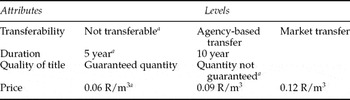
One useful way of analysing rights to natural resources categorizes six dimensions: duration, exclusivity, quality of title, flexibility, transferability and divisibility of rightsFootnote 2 (FAO, 2001; Bruns, Reference Bruns2006). This categorization highlights how the attributes of rights can be adjusted separately along various dimensions, specifying rights, while implicitly leaving other attributes of rights undefined. Challen (Reference Challen2000) and Crase and Dollery (Reference Crase and Dollery2006) have shown how this classification can be applied to water rights. To keep our analysis within manageable proportions we choose to apply only the dimensions that are most relevant to the present situation in South Africa. These were chosen from a literature review (Louw and van Schalkwyk, Reference Louw and van Schalkwyk2002; Nieuwoudt, Reference Nieuwoudt2002; Perret, Reference Perret2002; Nieuwoudt and Armitage, Reference Nieuwoudt and Armitage2004; Backeberg, Reference Backeberg2006), which identified duration, transferability and the quality of the title as the dimensions that were attracting the most concern. The selected attributes and levels were also discussed with sector experts from the Department of Water Affairs and Forestry and the Water Research Commission. Table 1 provides an overview of the attributes and attribute levels considered.
Attributes and levels used in the choice sets

aindicates the base level.
The National Water Resources Strategy Paper of South Africa (DWAF, 2004) stipulates that a water license should be re-evaluated at least every 5 years. The base level for the duration attribute was therefore set at 5 years. A second alternative duration of 10 years was chosen: this is considered long enough not to deter most investments, while still allowing government to respond to changing circumstances. Three levels of transferability were introduced in the CR experiment: no possibility to transfer, agency-based transfer and market transfer. As explained in section 2.1, the agency-based transfer option fits best with the current legal provisions. However, because non-transferable water rights reflect the current situation on the ground and because of the legal uncertainty regarding transferability, it was considered relevant to include the option of non-transferable water rights. The dimension of quality of title covers the adequacy of the title in describing the resource or item. Two levels of this dimension, non-guaranteed and guaranteed supply, were chosen for this study. Finally, to be able to economically value attribute changes, a pricing vehicle was included. We used the unit price of water in rand (R), (R/m3), to evaluate respondent's WTP for changes in the different attributes. The price attribute was set at three levels: 0.06, 0.09 and 0.12 R/m3.Footnote 3 The price of 0.06 R/m3 corresponds to typical water prices for irrigation in the study area (DWAF, 2008a, b).
2.3. Design of the ranking sets
The full factorial design or all possible combinations of four attributes, two with two different levels and two with three different levels, provide 36 possible water right definitions. Clearly, it would not be feasible to ask respondents to rank 36 profiles. Consequently, it was necessary to reduce the number of profiles by grouping them into smaller sets of four (Bennett and Adamowicz, Reference Bennett, Adamowicz, Bennett and Blamey2001; Alriksson and Öberg, Reference Alriksson and Öberg2008). This was done in three stages. In the first stage we constructed an orthogonal design, using the Orthoplan-function in the statistical package SPSS. The construction of the orthogonal design provided nine profiles. Then we used a design procedure developed by Street et al. (Reference Street, Burgess and Louviere2005) to create nine sets of 4 profiles. The interested reader can consult their work for more information about the procedure.
Street et al. (Reference Street, Burgess and Louviere2005) demonstrated that choice sets constructed in this way are balanced and minimize attribute-level overlap, which allows more information to be collected from the same sample size. These properties mean that the technique will always yield the optimal or near-optimal design for estimating main effects and the near-optimal design for estimating main effects plus two-factor interaction effects. This can be demonstrated using the Fisher information matrix.
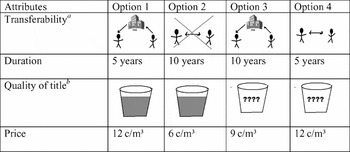
In the final stage, following Holmes and Adamowicz (Reference Holmes, Adamowicz, Boyle and Champ2002), it was decided to randomly divide the choice sets into blocks to avoid ‘respondent fatigue’. Each respondent would be randomly assigned to a particular block. Three blocks of three choice sets were constructed. Figure 1 presents a choice set. The attributes were graphically represented because it was expected that part of the respondent population would be illiterate. Farmers are currently operating under a ‘base scenario’ definition of water rights, which has the lowest water price. Because this study is concerned with improvements to this base scenario, we did not include a classic ‘no choice’ option in the choice sets. This is also seen elsewhere in the literature (Blamey et al., Reference Blamey, Gordon and Chapman1999; Foster and Mourato, Reference Foster and Mourato2002; Bateman et al., Reference Bateman, Cole, Georgiou and Hadley2006; Hanley et al., Reference Hanley, Colombo, Tinch, Black and Aftab2006). If such an option were to be included in the choice set, by construction one of the other options would always be dominant, because each choice contains at least one option where price remains at the low level and one or more of the other attributes are improved.
Choice set example.

2.4. Data collection
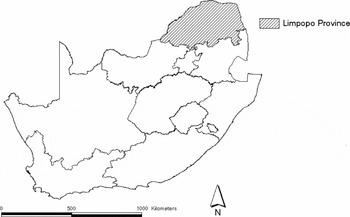
The data were collected in April 2008 in the Limpopo province of South Africa (see Figure 2). A sample of eight irrigation schemes that typified smallholder irrigation schemes in rural South Africa was identified from the national database of small-scale irrigation schemes. This sample included both larger irrigation schemes, with more than 100 farmers, and smaller schemes, with 30–40 farmers. The total area covered by the schemes was about 1,000 ha. Care was taken that the sample covered different cropping patterns which, in turn, reflect varying degrees of water scarcity.
Location of Limpopo province within South Africa.

Contacts with the scheme managers were made through the agricultural extension servicesFootnote 4 responsible for the schemes. About 30% of the farmers in these schemes were randomly selected from a list of active farmers provided by the scheme management. A team of interviewers consisting of post-graduate students from Limpopo University in Polokwane was trained to conduct the interviews. The training also involved one day of pre-testing the questionnaire. The farmers were interviewed in their fields. Before starting the questionnaire, the interviewers explained the objective of the study and gave information about the existing water rights system. In a stepwise manner, the farmers were familiarised with the graphical representation of the attribute levels in the CR experiment. In addition to the CR experiment the questionnaires also asked for detailed information regarding farming activities, alternative income sources and institutional aspects of water management. On average, the interviews took about 45 min. In total 134 questionnaires were completed, which provided 402 choice sets for analysis.
2.5. Analytical framework
The econometric analysis of data collected from a CR experiment is based on McFadden's conditional logit model, which is grounded in the random utility framework (McFadden, Reference McFadden and Zarembka1974). The indirect utility function Uij is decomposed into two parts:

The first is an observable element b(Xij, Zi) which describes the preferences of respondent i as a function of the attributes of the alternatives presented to the individual Xij and the characteristics of the individuals Zi. The second is a stochastic element eij, which represents those influences on individual choice that cannot be observed by the researcher.
Typically, it is assumed that the eij are independently and identically distributed with an extreme value (Weibull) distribution, resulting in a conditional logit model. However, a conditional logit model only allows the identification of the most preferred alternative and thus does not fully utilize all the information contained in a CR experiment. Beggs et al. (Reference Beggs, Cardell and Hausman1981) developed an extension to the basic conditional logit model, known as the rank-ordered logit model. This is capable not only of identifying the most preferred alternative but also the exact ordinal ranking of all the remaining elements. In the model, the probability of obtaining a particular ranking can be expressed as (Hanemann and Kanninen, Reference Hanemann, Kanninen, Bateman and Willis1999)

Once the parameter estimates of this model have been obtained, a WTP can be derived for each attribute (Hanley et al., Reference Hanley, Wright and Adamowicz1998, Reference Hanley, Mourato and Wright2001). When it is assumed that utility is a linear function of the attribute levels, as in (1), WTP can simply be expressed as

in which by is the coefficient of the cost attribute and bc is the coefficient of any of the other attributes. Equation (3) therefore expresses the marginal rate of substitution between the price attribute and the other attribute in the equation and provides what is technically known as the implicit price.
3. Results and discussion
3.1. Characteristics of the sample population
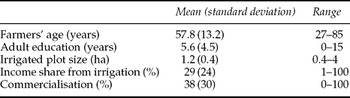
Some selected characteristics of the sample population are presented in table 2. The average age of the farmers in the sample was 58 years, they had an average of 5.6 years of schooling and the average plot size was 1.2 ha. These figures are typical for this population as a whole (Perret, Reference Perret2002; Van Averbeke and Mohammed, Reference Van Averbeke and Mohamed2006; Hope et al., Reference Hope, Gowing and Jewitt2008). The schemes in the sample are surface irrigated, which is the prevailing method on South African smallholder schemes. In the drier regions of Limpopo most farmers only cultivate the irrigated land during the wet summer season, and maize is the most important crop. In other parts of the province production is more diversified: the majority of the farmers produce maize in summer and a wide variety of crops in winter. Spinach, beans, beetroots, cabbages and tomatoes were the most important winter crops among this sample.
Selected sample population characteristics
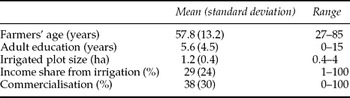
For most of the households in the sample, cropping is not their main source of income. As in most rural areas of South Africa, pensions and child allowances are the most important income sources (Perret et al., Reference Perret, Lavigne, Stirer, Yokwe and Dikgale2003; Hope et al., Reference Hope, Gowing and Jewitt2008). The income share from irrigated farming among the farmers was highly variable, ranging between 1% and 100% with an average of 29%. Higher dependency on income from irrigated farming was generally associated with a lower overall income level, as it generally reflected an absence of other income sources. Most production is subsistence-oriented. The average degree of commercialisation, calculated as the value share of production that is marketed, was 38%.
From the survey it is apparent that water shortages at irrigation schemes in Limpopo province mainly manifest themselves in reductions in the area cultivated during the dry season. In the winter season, 37% of the farmers reduce their cultivated area and about the same proportion of farmers stop production. This study also monitored respondents’ level of trust in water management institutions. Farmers were asked to indicate on a 5 point Likert scale how much confidence they had in three different levels of water institutions. These scores were then averaged. Nearly 36% of the farmers had low confidence in the functioning of the water management institutions (average score of less than 1.7), 31% claimed to have a lot of confidence (average score of more than 3.3), and trust levels for the remaining 34% were somewhere in between.
3.2. Rank-ordered logit results
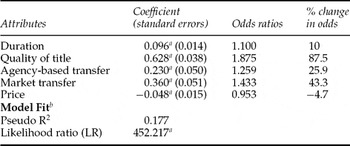
The results of the rank-ordered logit models were obtained using the statistical package STATA version 9. Following the recommendations of Holmes and Adamowicz (Reference Holmes, Adamowicz, Boyle and Champ2002), qualitative attributes were effect-coded. When using effect-coding, the base level is assigned code −1. For the quality of title dimension, ‘non-guaranteed supply’ was the base level while for the transferability, the base level was ‘no possibility to transfer’. In effect-coding the utility of the base level of a variable equals the negative of the sum of the coefficients for the other levels of that variable, while the utility of the other levels corresponds to their coefficient. A Hausman specification test was performed for all models to test the assumption of independence of irrelevant alternatives (IIA), a specific assumption, which always has to be tested for this type of models. The data supported this assumption for all models. Table 3 presents the rank-ordered logit estimates for the full sample. Interaction effects were tested, but none of them were retained in the model as their coefficients were not significant.
Rank-ordered logit model results (full sample n = 134)

asignificant at 0.01.
bThe Pseudo R2 reported here and in the following tables is also known as Mc Fadden rho square.
All the coefficients in the main effects model significantly differ from zero at a 99% significance level, meaning that they all are significant determinants of choice. The signs of the attribute parameters are as expected. Guarantee of water supply, increased duration of the licence, and improvements in transferability all increased the probability of an option being chosen. Conversely, a higher water price decreased this probability. This is also reflected in the odds ratios and the derived percentage change in odds, which reflect the difference in probability of choosing a particular option when the attribute changes. For most respondents, guaranteed supply and market transfer were most important.
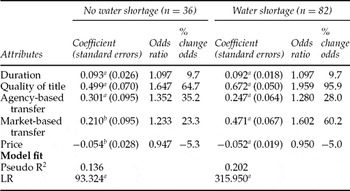
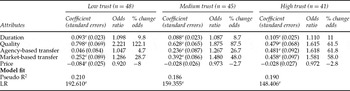
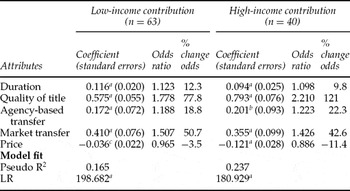
In a second step the population was stratified in three ways: first according to the level of water shortage experienced by the farmers, second according to the overall income share derived from irrigated production, and finally according to their level of trust in the water management institutions. The model's results for these different segments of the population are presented in tables 4–6.
Rank-ordered logit model results for segments with different levels of water shortage

asignificant at 0.01; bsignificant at 0.05.
Rank-ordered logit model results for segments with different institutional trust levels

asignificant at 0.01.
Rank-ordered logit model results for segments with different reliance on irrigation for their income

asignificant at 0.01; bsignificant at 0.05; csignificant at the 0.1.
Likelihood ratio tests confirmed that the parameter estimates are not identical for the different segments. Table 4 compares results for respondents who experienced severe water shortages (and reduced the area they cultivate in the dry season by more than 25%) and respondents who did not experience water shortages (no reduction in cultivated area). Results for the remaining group of farmers are not reported because the sample (n = 16) was too small to yield reliable results. The probability of choosing a water right option with an assured water supply was clearly much higher among farmers experiencing water shortages than those who do not experience shortages. In addition farmers experiencing shortages show a stronger preference for market transfer, probably because they see this as a potential way of ensuring access to water supply (Pott et al., Reference Pott, Versfeld, van Rooyen and Muir2009). Bjornlund (Reference Bjornlund2006), Calatrava and Garrido (Reference Calatrava and Garrido2005) and Hadjigeorgalis (Reference Hadjigeorgalis2008) have also described the role that water markets could play in addressing supply risk in regions with fluctuating supply.
Table 5 illustrates the importance of institutional trust. For farmers with low institutional trust mainly the quality of the title is important, while introduction of agency-based transfer hardly increases the odds. Farmers with a high level of institutional trust consider a system with agency-based transfer to be as important as the quality of the title. Thus, any change in the transferability of water rights would appear to first require an improvement in the levels of trust in the water institutions to be successful. As long as levels of trust are low, people will not value increased transferability and therefore improvements in efficiency or cost recovery will not be fully exploited. Communication is an important aspect here; at present farmers have a low awareness about how the water management institutions work and what their responsibilities are. This issue was also raised in earlier studies by Wester et al. (Reference Wester, Merrey and de Lange2003), Waalewijn et al. (Reference Waalewijn, Wester and van Straaten2005) and Orne-Gliemann (Reference Orne-Gliemann2008). The smallholders’ unfamiliarity with the water management institutions might explain their current low level of trust in these institutions.
Table 6 shows the impact of the income contribution of irrigation on the preferences of farmers. It compares farmers for whom irrigation makes a small income contribution (<20%) with those for whom it makes a high contribution (>35%). If the income from irrigation constitutes only a small part of the total family income, then a unit price increase only has a minor impact on the odds of choosing an option. When irrigation is responsible for 35% or more of the family income, the disutility of a unit price increase is about three times larger. As all the farmers in the sample have similar sized plots, a larger income share from irrigation is usually associated with a lower and less diversified total income. This could clearly be seen in the dataset and is in accordance with findings for other smallholder schemes (see Perret et al., Reference Perret, Lavigne, Stirer, Yokwe and Dikgale2003; Yokwe, Reference Yokwe2009). For farmers who are more financially dependent on irrigation, the quality of the title is much more important since their income is more affected by insufficient supply.
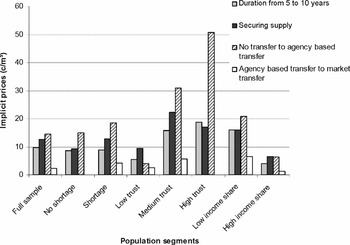
One of the main objectives of this study was to obtain the implicit values of marginal attribute changes. Figure 3, based on (3), presents the estimates of the implicit prices derived for the entire sample and for different strata. The results for the full sample indicate that the average farmer highly values securing supply (WTP of 0.12 R/m3) and the opportunity for agency-based transfer (WTP of 0.14 R/m3 for a shift from not transferable to agency-based transfer). Compared to a system of agency-based transfer, the establishment of water markets does not seem to add much value, yielding an additional WTP of just 0.02 R/m2.
Implicit values of attributes changes for different segments.

The impact of smallholder characteristics on their WTP can be assessed by comparing the WTP for different segments of the sample. This analysis shows that respondents in the different segments have quite different WTP for the attribute changes. Farmers experiencing water shortages are willing to pay more for a secure supply than those not experiencing shortages (0.13 R/m3 compared to 0.09 R/m3) and also to pay more for improved transferability of water rights. Figure 3 shows that this applies to both transferability levels (agency- and market-based). This finding could, again, be taken as indicative that these farmers see transferability as an option for assuring a secure water supply in periods of drought. It is evident that the WTP of farmers with low levels of institutional trust is lower for all attribute changes than for those with medium or high institutional trust. The difference is particularly marked when evaluating a change from no transfer to agency-based transfer, an option for which farmers with low institutional trust are only willing to pay 0.04 R/m3, compared to 0.31 R/m3 and 0.50 R/m3 for those with medium and high trust, respectively. It is also of interest that when institutional trust is high, agency-based transfer is preferred to market transfer (very small negative WTP to go from agency-based transfer to market transfer).
Overall the analysis makes it clear that trust in institutions is a very important determining factor when it comes to evaluating property rights. Another finding is that the WTP of poorer farmers (who depend more on irrigation) is lower for all attribute changes. This may well reflect the limited capacity of these poorer farmers to pay for water, a problem already identified by Backeberg (Reference Backeberg2006) and Perret and Geyser (Reference Perret and Geyser2007). This implies that pursuit of the cost recovery objective needs also to pay close attention to increasing the productivity and thus the income of these farmers.
4. Conclusions
As competition for water grows and supplies come under more strain, water users and water management organizations are seeking better institutional arrangements for coordinating use and resolving conflicts. Improving water rights is one option for increasing water productivity, increasing the benefits from existing and new investments in water supplies, and enhancing rural livelihoods. In this way improvements in water rights can help to reduce poverty (Meinzen-Dick and Nkonya, Reference Meinzen-Dick and Nkonya2005).
This study demonstrates how CR can be used to measure the benefits from improving different dimensions of water rights among smallholder irrigators in South Africa. While such farmers have a potential to contribute to poverty reduction in rural areas, they clearly struggle with problems of low water use efficiency and insufficient cost recovery of government investments (Speelman et al., Reference Speelman, Farolfi, Perret, D'Haese and D'Haese2008b). In this context it is pertinent to evaluate the expected impact of water rights reforms on this stakeholder group.
The results of the rank-ordered logit model using the full sample indicate that improved water rights can bring significant economic benefits to smallholders. They highly value the possibility to transfer such rights and receive an assured supply. However these overall results mask large differences between different segments of the farming population. Farmers experiencing water shortage have a higher WTP for a secure supply and for improved transferability of water rights. As indicated by Pott et al. (Reference Pott, Versfeld, van Rooyen and Muir2009), these farmers see improvements in the water rights system as a potential solution for their water shortage problem. Calatrava and Garrido (Reference Calatrava and Garrido2005) studied an irrigation district in Southern Spain, under similar climatic conditions, and demonstrated that water markets can play an important role in countering supply risks.
Our analysis of institutional trust indicates that trust in the institutions is necessary to fully value water rights improvements. This implies that, from a cost recovery perspective, it is important for the government to increase the level of trust of small-scale farmers in the water management institutions, since this will increase their WTP for the proposed interventions in the water rights.
Finally, the poorer farmers in the sample, who are more dependent on irrigation for their income, experience a significantly stronger disutility of water price increases, which limits their WTP for water rights improvements. This again highlights the importance of continuing effort from government departments and the research community to help smallholder irrigators in South Africa to increase their productivity and income (Backeberg, Reference Backeberg2006).
While the results presented in this paper offer valuable insights to policy makers to guide water right reforms, the approach also has its limitations. The type of analysis provided here should be part of a broader framework that also weighs the costs of the interventions against the benefits. Some reforms, such as an increase in the licence review period, might lower costs, while others will have a price tag attached to them. Furthermore, in a country such as South Africa where equity is a prime concern, it is important to consider the distributional effects on all stakeholders. Intersectoral water markets for example might cause water re-allocation from agriculture to non-agricultural uses, with negative effects for smallholder irrigators. Further research is required to add to our knowledge of what the effect of water rights interventions is on different stakeholders and the costs of these interventions.