INTRODUCTION
Humans impact 100% of ocean areas (41% of oceans are strongly impacted; Halpern et al. Reference Halpern, Walbridge, Selkoe, Kappel, Micheli, D'Agrosa, Bruno, Casey, Elbert, Fox, Fujita, Heinemann, Lenihan, Madin, Perry, Selig, Spalding, Steneck and Watson2008) and 83% of land surfaces (Sanderson et al. Reference Sanderson, Jaiteh, Levy, Redford, Wannebo and Woolmer2002) through livelihood activities. The need for integrated management across landscapes and seascapes is evidenced given that: (1) 40% of people globally live within 100 km of the coast (Millennium Ecosystem Assessment 2005); (2) most the world's megacities are in coastal areas (Klein et al. Reference Klein, Nicholls, Thomalla, Kreimer, Arnold and Carlin2002); and (3) land-based anthropogenic use and pressures on coastal and marine ecosystems involve multiple sectors (e.g. agriculture, urban development, forestry). These anthropogenic impacts can be direct, indirect and sometimes occur in unexpected ways, due to the connectivity of ecosystems across terrestrial, freshwater and marine realms (GESAMP 2001; Ruttenberg & Granek Reference Ruttenberg and Granek2011; Wilkinson & Brodie Reference Wilkinson and Brodie2011; Chen & Hong Reference Chen and Hong2012).
The challenges faced by integrated land-sea management initiatives (ILSM) cross social, economic and ecological boundaries (GESAMP 2001; Holt et al. Reference Holt, Godbold, White, Slater, Pereria and Solan2011) and are multi-objective in nature. Many management institutions focus either on terrestrial, freshwater or marine realms, but do not typically cross the land-sea boundary (Lebel Reference Lebel2012). However, the conservation and sustainable use of coastal and marine areas often requires these realms to be managed in a coordinated and integrated manner (Ruttenberg & Granek Reference Ruttenberg and Granek2011; Álvarez-Romero et al. Reference Álvarez-Romero, Adams, Pressey, Douglas, Dale, Auge, Ball, Childs, Digby, Dobbs, Gobius, Hinchley, Lancaster, Maughan and Perdrisat2015) while accounting for the needs of various people within each realm (Mora & Sale Reference Mora and Sale2011). When terrestrial, freshwater and marine management programs are implemented independently there can be an increased risk of failure (Silvestri & Kershaw Reference Silvestri and Kershaw2010).
The concept of ILSM has been discussed extensively (Crist et al. Reference Crist, Madden, Varley, Eslinger, Walker, Anderson, Morehead and Dunton2009; Ruttenberg & Granek Reference Ruttenberg and Granek2011; Álvarez-Romero et al. Reference Álvarez-Romero, Adams, Pressey, Douglas, Dale, Auge, Ball, Childs, Digby, Dobbs, Gobius, Hinchley, Lancaster, Maughan and Perdrisat2015) as an effective strategy for conservation (Corson et al. Reference Corson, Gruby, Witter, Hagerman, Suarez, Greenberg, Bourque, Gray and Campbell2014). The simultaneous conservation of land and sea can increase the success of conservation programs (Klein et al. Reference Klein, Jupiter, Selig, Watts, Halpern, Kamal, Roelfsema and Possingham2012). In one study, protecting 2% of land area was 500 times more beneficial to the protection of coral reefs when the placement of a forest reserve considered nearby costal marine ecosystems (Klein et al. Reference Klein, Jupiter, Selig, Watts, Halpern, Kamal, Roelfsema and Possingham2012). The importance of addressing the land-sea interface in conservation is also evidenced by some coral reefs being impacted more by the associated impacts of deforestation than by climate change, at least in the near future (Maina et al. Reference Maina, de Moel, Zinke, Madin, McClanahan and Vermaat2013).
Despite the calls for action from the scientific community, it is unclear how or whether ILSM is consistently being integrated into conservation and sustainable development agendas. Few programs have successfully created management plans that connect terrestrial, freshwater and marine realms (Kirkman & Kirkman Reference Kirkman and Kirkman2002; Beger et al. Reference Beger, Grantham, Pressley, Wilson, Peterson, Dorfman, Mumby, Lourival, Brumbaugh and Possingham2010), and programs that do consider land-sea connections are mostly local and only recently initiated (Lebel Reference Lebel2012). Success rates are further reduced by the lack of overlap between management and scientific realms, marine and terrestrial systems, and different government agencies and stakeholder groups (Christie Reference Christie2011; Holt et al. Reference Holt, Godbold, White, Slater, Pereria and Solan2011; Ruttenberg & Granek Reference Ruttenberg and Granek2011). In response to these limitations, several frameworks (e.g. Integrated River Basin Management, Integrated Island Management; Christie Reference Christie2011; Jupiter et al. Reference Jupiter, Jenkins, Lee Long, Maxwell, Carruthers, Hodge, Govan, Tamelander and Watson2014 a) and a large number of management tools have been suggested (World Bank 2006). These planning and governance approaches often have overlapping goals (World Bank 2006), and frequently emphasize integration across different sectors and entities (e.g. across government agencies or ecosystems; Christie Reference Christie2011). As such, the similarity between different approaches can be confusing to stakeholders (Christie et al. Reference Christie, Fluharty, White, Eisma-Osorio and Jatulan2007), but highlight the socio-political challenges faced by integrative and regionally specific initiatives (Kenchington Reference Kenchington2010). Despite these frameworks for action, ILSM is not easy; there are distinct differences between terrestrial, freshwater and marine conservation (Hockey & Branch Reference Hockey and Branch1994), and merging these efforts may not be intuitive. Also, some coastal programs are still planned without consideration of all three realms (Frid et al. Reference Frid, Paramor, Brockington and Bremner2008) or by considering the trade-offs of protecting one or another (Hughes et al. Reference Hughes, Fenichel and Gerber2011).
Gaps in knowledge regarding ILSM approaches remain (Lebel Reference Lebel2012). While there have been reviews of integrated land-sea conservation (e.g. Álvarez-Romero et al. Reference Álvarez-Romero, Pressey, Ban, Vance-Borland, Willer, Klein and Gaines2011, Álvarez-Romero et al. Reference Álvarez-Romero, Adams, Pressey, Douglas, Dale, Auge, Ball, Childs, Digby, Dobbs, Gobius, Hinchley, Lancaster, Maughan and Perdrisat2015), we are not aware of any systematic reviews of ILSM approaches. We conducted a review of the literature to increase understanding of ILSM programming, the objectives being to: (1) examine characteristics of ILSM programs profiled in the literature (program descriptions; factors prompting the use of ILSM; frameworks/strategies used); (2) assess recommendations made by theoretical/review papers regarding the planning, implementation and management of land-sea programs; (3) summarize how land-sea programming has actually been planned, implemented and managed in the field; and (4) provide recommendations on how to implement different stages of the ILSM process.
METHODS
This literature review was based on a systematic search of peer-reviewed literature, although several non-peer reviewed reports (grey literature) known to the authors were included to reflect ideas/programs being implemented, particularly by larger non-profit and multilateral funding agencies (e.g. GESAMP 2001; GEF 2004; Crist et al. Reference Crist, Madden, Varley, Eslinger, Walker, Anderson, Morehead and Dunton2009; Silvestri & Kershaw Reference Silvestri and Kershaw2010; Govan Reference Govan2011; Wilkinson & Brodie Reference Wilkinson and Brodie2011). A systematic review of the grey literature was not undertaken due to the difficulties of systematically searching this source, much of which is not indexed online or found without help from subject experts. Although most of the information included in the review stems from the peer-reviewed literature, the grey literature provided helpful insight into aspects of ILSM not discussed elsewhere.
English-language peer-reviewed literature was searched using systematic review procedures in October 2014. To focus the search on relevant literature, and to decrease the scope of the review to a manageable size, thematically relevant journals were first identified due to their categorization as ‘Biodiversity and Conservation’ or ‘Marine & Freshwater Biology’ journals in the 2013 Thomson Reuters Journal Citation Report (143 journals). An additional six conservation-themed journals were added to this list, following the methods as in Fuller et al. (Reference Fuller, Lee and Watson2014). To identify the relevance of candidate journals, journal scope statements and recently published articles were used to identify whether publication focus included any of these topic areas: (1) conservation or management; (2) marine areas; and (3) coastal regions. Journals were selected for inclusion in the literature search if: (1) they had an impact factor of greater than 1.00 (when impact factors were available); (2) they had a focus on conservation or management; and (3) marine or coastal regions were considered acceptable topics for publication. In total, 58 of the 143 journals met these requirements. Candidate journals were searched (ISI Web of Science) using the following search terms: ‘marine OR coastal OR ocean* OR sea* AND coral reef* OR fish* OR protected area* OR mangrove* OR wetland* OR marsh* OR saltmarsh* AND land use OR sediment* OR ero* OR deforest* OR degrad* OR farm* OR agricultur*’. When candidate journals were not archived on ISI Web of Science, all past issues were surveyed for relevant literature.
Search results (n = 4371 ISI Web of Science results and n ≈ 300 papers from non-indexed journals) were screened using a three-step process, involving exclusion first by title, then by abstract examination and finally by reading the paper.
Search results were considered candidates for inclusion in the review if they: (1) took place in the context of land-sea connectivity in which the impacts of terrestrial, marine and freshwater realms are considered; and (2) tested or implemented conservation/management interventions. Papers could discuss any stage of the planning/implementation and management process. Papers were not included if: (1) they examined levels of chemicals/metals/sediments in coastal marine waters without considering program management or implementation; or (2) activities were undertaken that did not explicitly examine land-sea connections and conservation/management initiatives. We acknowledge that the inclusion of papers, and the information collected from papers, depended on how studies were framed by authors and on the use of keywords/phrases by authors in their manuscripts. The selection of papers and the subsequent interpretation of the data may have introduced bias into the review process, although the wide scope of the literature search (>4700 papers) ensured a thorough review of a substantial portion of the literature.
Articles selected for inclusion in the review were then categorized by the: (1) type of paper (hypothetical/theoretical/review papers, hereafter referred to as ‘theoretical’, and ‘case studies’); (2) stage of intervention process (‘planning and implementation’ or ‘management’, with ‘planning and implementation’ defined as programs in the planning or first stages of implementation and ‘management’ defined as programs in any stage following the initial implementation of the project); (3) characteristics of relevant ILSM projects discussed within the papers, if applicable (e.g. location, year in which conservation program was implemented, geographic scope). ‘Planning’ and ‘implementation’ were grouped together as there was significant overlap in the literature between these two stages, with most papers discussing both stages simultaneously.
For objective one, the following information was extracted from both theoretical papers and case studies: (1) terminology used to describe land-sea connections; (2) reasons cited for undertaking ILSM; (3) frameworks used in ILSM; and (4) strategies for undertaking ILSM. For objective two, theoretical papers were used to compile key recommendations for the planning, implementation and management of ILSM programs. For objective three, case studies were reviewed to understand the real-world applications of the theoretical literature. For objective four, best practices guidelines from theoretical papers and lessons learned from case studies were summarized into recommendations for undertaking ILSM programs. Findings of the studies are discussed in detail under sub-headings organized first by objective and then either under planning/implementation or management.
Some quantitative data were extracted from case studies to illustrate the characteristics of ILSM programs included in this review. Qualitative data and the presence/absence of certain characteristics were also used to illustrate trends across the literature. In some cases, a categorical Pearson's Chi square test was used to confirm the magnitude of difference between different ILSM case studies.
RESULTS AND DISCUSSION
A total of 108 instances (17 from the grey literature) of ILSM described in 94 papers were found for this review, including 24 theoretical papers and 84 case studies (Fig. S1 and Table S1). The 84 case studies took place in 37 countries, on every continent except Antarctica, with 65% of the case studies recorded in countries with a Human Development Index of greater than 50 (Fig. S1 and Table S1). Of the 84 case studies, 24 focused on planning/implementation, 50 focused on management, and nine focused on both planning/implementation and management (Table S1). Papers were published between 1991 and 2014, with 88% (n = 95) published in or after the year 2000. Case studies focused on planning/implementation initiatives founded in the 1980s and later. Case studies discussing program management highlighted initiatives founded in every decade since the 1950s (Fig. S2).
Characteristics of ILSM programs
Terminology used to describe land-sea connections
All papers considered aspects of land and marine planning, however, not all papers mentioned land-sea connectivity. All theoretical papers (100%, n = 24) specifically mentioned the land-sea connection. By contrast, case studies were less likely to mention land-sea connections (29%, n = 84) despite fitting the inclusion criteria for this literature review (Pearson's Chi square test; Chi square = 38.581, p < 0.0001). A wide variety of terms were used to describe land-sea connections: (1) land-sea boundary/bridge/connection/planning; (2) linked habitats/land and ocean; (3) integration of various aspects of coastal ecosystems (e.g. integration of land, coastal and marine management; integration of coral reef, sea grass and mangrove management), approaches (e.g. land-sea approach), management policies (e.g. ocean and coastal policies), and planning (e.g. land and marine planning); (4) cross-system threats; (5) oceanic-terrestrial interface; (6) trans-boundary; and (7) transitional zone. Some papers used descriptive phrases linked to specific conservation initiatives, indicating the types of land-sea connection considered: ‘Mountains to the Sea’ (Whyte et al. Reference Whyte, Belle, Ramstad and Gardner2008); ‘Paddock to Reef’ (Brodie et al. Reference Brodie, Kroon, Schaffelke, Wolanski, Lewis, Devlin, Bohnet, Bainbridge, Waterhouse and Davis2012); ‘Reef to Ridge’ (Govan Reference Govan2011); ‘Coastal Zone and Small Islands endeavour’ (Cleary et al. Reference Cleary, Suharsono and Hoeksema2006); and ‘Vanua’ (Adams Reference Adams1994). The terminology used when describing ILSM can be used interchangeably (e.g. ‘catchment’ and ‘watershed’; Wilkinson & Brodie Reference Wilkinson and Brodie2011) or broadly (e.g. ‘integration’; Tallis et al. Reference Tallis, Ferdana and Gray2008).
Terminology is important (Piraino et al. Reference Piraino, Fanelli and Boero2002). When terms are not used in a fixed manner or not adequately defined, they can lose their ability to convey meaning (Hess & Fischer Reference Hess and Fischer2001; Piraino et al. Reference Piraino, Fanelli and Boero2002). Within the context of ILSM, the use of many synonyms could dilute the public's understanding of ILSM and its scope (Piraino et al. Reference Piraino, Fanelli and Boero2002). However, the use of different terms to describe ILSM could also provide organizations with the flexibility to accurately describe their specific program activities. Additionally, the lack of uniform terminology in ILSM decreases the ease with which information about ILSM can move among and between researchers and practitioners; less than 30% of case studies clearly identified themselves as undertaking land-sea conservation. Finally, without consistent terminology, the goals and functions of ILSM may be unclear and lead to difficulties among practitioners to develop and manage a well-designed program; these concerns have been noted in landscape corridor planning, which shares many of the attributes of ILSM (corridors can cross over numerous habitats and administrative boundaries, and involve integrated management; Hess & Fischer Reference Hess and Fischer2001).
Reasons to undertake ILSM programming
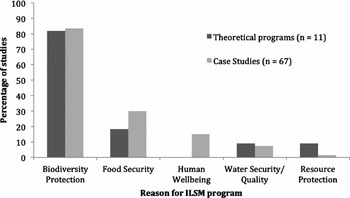
Biodiversity protection was the most commonly cited reason why ILSM programs should be/were instituted, in both theoretical papers and case studies (Fig. 1). The percentage of case studies (82%) and theoretical papers (84%) that mentioned biodiversity protection as a reason for instituting ILSM programming did not differ (Pearson's Chi square test; Chi square = 0.021, p = 0.8843). Food security, human wellbeing, water security/quality and resource protection were also mentioned. These results reflect the emphasis on protecting biodiversity in the past (Rojas Reference Rojas1992), and the recent shift towards integrated conservation and development programs that consider human wellbeing (Egoh et al. Reference Egoh, Rouget, Reyers, Knight, Cowling, van Jaarsveld and Welz2007). These results may also reflect a bias in our review, given that many of the journals included in this study focused on biodiversity and conservation topics.
Reasons cited for the creation of integrated land-sea management programs (theoretical papers and case studies). Reasons were not mutually exclusive and papers could cite more than one reason. ILSM = Integrated land-sea management.

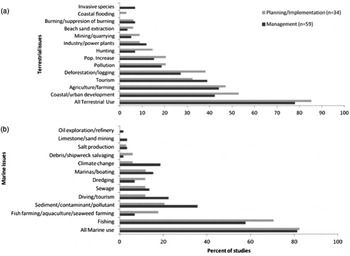
Most case studies (73%, n = 84) reported the simultaneous anthropogenic use of terrestrial and marine realms. The complexity of ILSM is emphasized by the fact that many threats cross the land-sea boundary; some are regional and global in scope, while others can be rather proximate (Fig. 2). The same types of terrestrial anthropogenic threats were cited at both the planning/implementation and management stages (Fig. 2). However, papers discussing program management were less likely to cite concerns with natural resource use (e.g. deforestation and hunting) and more likely to cite concerns related to tourism than papers discussing program planning/implementation (Fig. 2). Likewise, when discussing marine anthropogenic use, management papers were more likely to cite land-based threats (e.g. sediment/contaminants/pollution), tourism (e.g. diving/tourism) and global (e.g. climate change) impacts than those related to natural resource use (e.g. fishing, fish farming and dredging; Fig. 2). It therefore appears that during the planning/implementation phase of ILSM, programs focus on mitigating threats related to natural resource use and proximate environmental degradation. By contrast, during the management phase, programs focus on long-term programming (e.g. eco-tourism) and on mitigating ongoing impacts from less proximate environmental degradation. This mismatch between planning/implementation and management may reflect the transition that ILSM programs can undergo from program implementation to maintenance. Conversely, the mismatch may also reflect disconnects between the two phases, where programs that are initially planned/implemented are not those that will ultimately be most successful, useful or able to sustain themselves in the long-term. This highlights the need for ILSM programs to plan for a shift in program objectives over time and to consciously plan/implement programs that are likely to succeed during the management phase.
Types of (a) terrestrial and (b) marine issues in case studies at the planning/implementation and management stages. Issues were not mutually exclusive and papers could cite more than one issue.

Frameworks used to approach management of the land-sea boundary
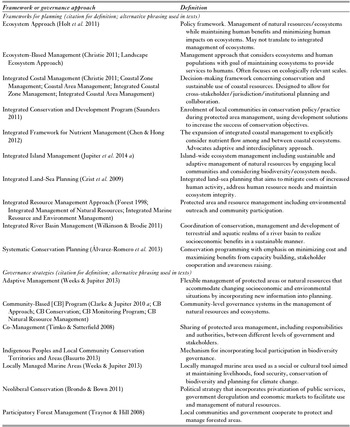
Theoretical (62.50%) and case studies (45.24%) did not differ in the percentage of studies mentioning a specific framework or governance approach when discussing ILSM (Pearson's Chi square test; Chi square = 2.226, p = 0.1357). Case studies and theoretical papers listed multiple frameworks, with several synonyms, as guiding their programming; in many cases, these frameworks were described in similar terms with broadly overlapping objectives (Table 1). For example, the integration of marine resource and environment management was considered synonymous to Integrated Coastal Management by Kenchington (Reference Kenchington2010), and Integrated Island Management in Jupiter et al. (Reference Jupiter, Jenkins, Lee Long, Maxwell, Carruthers, Hodge, Govan, Tamelander and Watson2014 a) described an island-wide version of Integrated Coastal Management. However, the frameworks did show some differences in their approach, with some targeting specific aspects of the land-sea connection (e.g. Integrated Framework for Nutrient Management; Chen & Hong Reference Chen and Hong2012) or emphasizing human wellbeing (e.g. Integrated Conservation and Development Program; Saunders Reference Saunders2011). Governance approaches were also mentioned, including: adaptive management; community based programming; co-management; indigenous peoples and local community conservation territories and areas; locally managed marine areas; neoliberal conservation; and participatory forest management (Table 1).
Planning frameworks and governance strategies as utilized by case studies. Definitions are based on those provided in the text of the case study reports.

Several theoretical papers (37.5%) and many case studies (54.76%) did not explicitly list a framework or governance approach when discussing ILSM. This may be because popular frameworks and governance approaches are sometimes too inflexible or confusing to use in practice; in the Philippines, a switch to Ecosystem-Based Management (EBM) from Integrated Coastal Management at the national level caused confusion about the difference between the two approaches and concern for how EBM would fit in the cultural and political context (Christie Reference Christie2011). This hypothesis is supported by the many synonyms used to describe similar and overlapping frameworks; it is logical that some programs would re-name a framework or governance strategy in order to better reflect their goals and objectives. Alternatively, the fact that case studies did not usually list a specific framework or governance strategy may simply point to the disconnect between scientists and practitioners, a problem noted in other fields of conservation (Field et al. Reference Field, O'Connor, Tyre and Possingham2007). Finally, it is possible that case studies utilize the strategies suggested by theoretical papers but use different terminology or have developed their own approaches based on local context. Of course it is also possible that the decision to use certain terminology is driven by funding opportunities and/or by trends in conservation. However, no case studies or theoretical literature explicitly mentioned this.
Strategies for undertaking ILSM
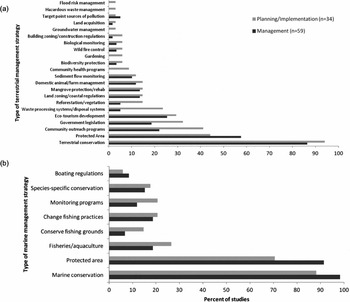
Most case studies (94%, n = 84) proposed/implemented at least one type of terrestrial and one type of marine management strategy simultaneously. Protected areas, broadly defined as any area with some kind of year-round protection, including multi-use reserves, were the most common type of management strategy in both terrestrial and marine realms (Fig. 3). In addition, terrestrial management strategies were more diverse than in the marine realm (21 terrestrial vs. seven different marine programs/strategies mentioned). Terrestrial management strategies mentioned by >20% of case studies included: protected areas, community outreach programs, government legislation, use of eco-tourism, and the development of waste processing and disposal systems (Fig. 3). Strategies for marine management mentioned by >20% of case studies included: protected areas, fisheries/aquaculture programs, conservation of fishing grounds (e.g. periodic closure), changing fishing practices (e.g. banning specific types of fishing equipment) and implementation of biotic/abiotic monitoring programs. Case studies focusing on management tended to cite a lower diversity of terrestrial management initiatives and were more likely to list protected areas as a method of management than case studies focusing on creation/implementation (Fig. 3).
Types of management strategies used in case studies in (a) terrestrial and (b) marine realms. Strategies were not mutually exclusive and papers could cite more than one strategy.

The popularity of protected areas as a method of management reflects past emphasis on habitat protection (Gaines et al. Reference Gaines, Lester, Grorud-Colvert, Costello and Pollnac2010). In addition, the fact that case studies utilized a wider diversity of management strategies in terrestrial areas, as compared to marine areas, also echoes trends seen in the literature. For example, the use of marine protected areas complemented by conservation efforts on both terrestrial and marine areas – to address threats from pollution and human population needs – have been recommended as a strategy for marine conservation (Allison et al. Reference Allison, Lubchenco and Carr1998). These protected areas can serve multiple functions including the protection of biodiversity or to increase the long-term sustainability of resources actively used by the community (Jupiter et al. Reference Jupiter, Jenkins, Lee Long, Maxwell, Carruthers, Hodge, Govan, Tamelander and Watson2014 b).
Key recommendations regarding the planning, implementation and management of ILSM programs
Recommendations by theoretical papers for the planning and implementation stage
Theoretical papers recommended that the following items be instituted or considered during the planning/implementation phase of a new ILSM program: (1) data collection, organization and analysis, including habitat/scientific/ecological data and socioeconomic information with the goal of providing guidance on how to distribute funds and management actions across programs (Halpern et al. Reference Halpern, Ebert, Kappel, Madin, Micheli, Perry, Selkoe and Walbridge2009; Beger et al. Reference Beger, Grantham, Pressley, Wilson, Peterson, Dorfman, Mumby, Lourival, Brumbaugh and Possingham2010; Klein et al. Reference Klein, Ban, Halpern, Beger, Game, Grantham, Green, Klein, Kininmonth, Treml, Wilson and Possingham2010; Wilkinson & Brodie Reference Wilkinson and Brodie2011); (2) articulated goals for the project agreed on by stakeholders (Wilkinson & Brodie Reference Wilkinson and Brodie2011; Jupiter et al. Reference Jupiter, Jenkins, Lee Long, Maxwell, Carruthers, Hodge, Govan, Tamelander and Watson2014 a); (3) long-term planning for financial and human capacity needs (Jupiter et al. Reference Jupiter, Jenkins, Lee Long, Maxwell, Carruthers, Hodge, Govan, Tamelander and Watson2014 a); (4) communication with, and inclusion of, stakeholders in a transparent manner (Wilkinson & Brodie Reference Wilkinson and Brodie2011; Lebel Reference Lebel2012); (5) conflict mitigation between stakeholders (Wilkinson & Brodie Reference Wilkinson and Brodie2011); and (6) investment by the government, private sector and non-profits (Wilkinson & Brodie Reference Wilkinson and Brodie2011).
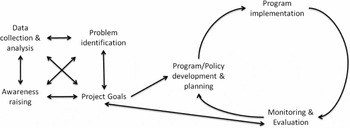
The recommended order for considering these different aspects of the planning process differed between studies. The order in which these are considered may change based on regional conditions, existing stakeholder support, quality of background knowledge on the local ecosystems, biodiversity, anthropogenic impacts and socioeconomic landscape. However, a general framework for approaching and undertaking the planning process – and how it feeds the implementation process – is visualized in Fig. 4. There is a non-linear relationship between different aspects of the planning and implementation process (Fig, 4). While, in an ideal scenario, programs progress through the different stages of planning, implementation and management in an orderly and premeditated manner (e.g. re-evaluating project goals on a regular basis; Wells et al. Reference Wells, Samoilys, Makoloweka and Kalombo2010), in some cases, a crisis precipitates program development (Lebel Reference Lebel2012), including data collection, awareness raising, problem identification, monitoring and evaluation, or adaptive management.
Flowchart of planning, implementation and management process in integrated land-sea management, summarizing the approaches recommended in the theoretical literature. Planning occurs on the left of the figure while adaptive management occurs on the right; different programs enter the flowchart in different places.

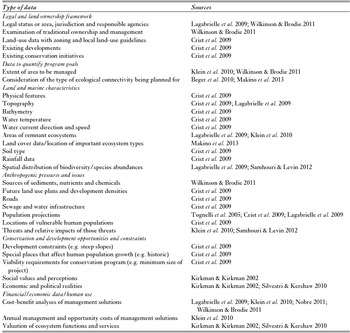
Data collection and analysis were recommended for the planning phase of ISLM by every theoretical paper. While most papers focused on a subset of data types and collection techniques (Table 2), one study emphasized that the information available to planners may often be sufficient to justify action and that implementation should not be delayed significantly in order to collect additional information (GESAMP 2001). Nevertheless – in an ideal scenario – vast amounts of accurate and disparate sources of information are considered simultaneously when planning an ILSM initiative (Table 2). This information can be taken from a range of sources, including literature reviews, expert knowledge (Lagabrielle et al. Reference Lagabrielle, Rouget, Payet, Wistebaar, Durieux, Baret, Lombard and Strasberg2009), satellite imagery (Klein et al. Reference Klein, Ban, Halpern, Beger, Game, Grantham, Green, Klein, Kininmonth, Treml, Wilson and Possingham2010), existing datasets and data-collection initiatives (Nobre Reference Nobre2011).
Types of data to be collected or considered when planning an integrated land-sea management program, as recommended by the theoretical papers.

The theoretical papers did not comprehensively identify all of the data sources that could be useful in planning and implementation. For example, there was a lack of explicit emphasis on data to support project goals not directly related to conservation, such as resource and land access needs. The emphasis on collecting, almost exclusively, ecological data is a noted problem in the environmental policy realm and has led to inadequate policies; interdisciplinary research has been offered as a solution to this problem (Christie Reference Christie2011). In addition, well-known strategies for collecting information with the help of local communities – including participatory geographical information systems (Brown & Raymond Reference Brown and Raymond2007) or surveying for Traditional Ecological Knowledge (Berkes et al. Reference Berkes, Colding and Folke2000) – were mentioned in almost no theoretical papers (but see Jupiter et al. Reference Jupiter, Jenkins, Lee Long, Maxwell, Carruthers, Hodge, Govan, Tamelander and Watson2014 a). They were, however, utilized by several of the case studies (e.g. Gerhardinger et al. Reference Gerhardinger, Godoy and Jones2009; Ens Reference Ens2012). This may indicate a bias in past land-sea theoretical literature towards topics that are most relevant to ILSM (e.g. examining cross-realm nutrient flow; Chen & Hong Reference Chen and Hong2012), while topics that are more general to conservation (such as the use of Traditional Ecological Knowledge, discussed in countless papers and reports; Clarke & Jupiter Reference Clarke and Jupiter2010 b; Govan et al. Reference Govan, Schwarz and Boso2011) are left relatively unexamined in the context of ILSM. It is therefore important for programs to continue leveraging successful strategies from both the terrestrial and marine literature and modifying them to the ILSM context; the fact that case studies utilized these tools and strategies is evidence that this is already occurring in applied management programs.
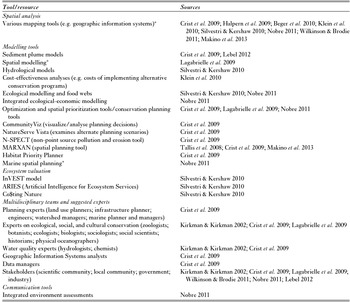
Several papers provided strategies aimed at simplifying, streamlining, or managing the data analysis process (Table 3). For example, spatial mapping and modelling tools have been developed in order to function as decision-support tools (Crist et al. Reference Crist, Madden, Varley, Eslinger, Walker, Anderson, Morehead and Dunton2009; Halpern et al. Reference Halpern, Ebert, Kappel, Madin, Micheli, Perry, Selkoe and Walbridge2009; Beger et al. Reference Beger, Grantham, Pressley, Wilson, Peterson, Dorfman, Mumby, Lourival, Brumbaugh and Possingham2010; Lebel Reference Lebel2012). Also, the use of experts or multi-disciplinary teams from governments, donors and NGOs can bring together the realm-specific expertise of multiple stakeholders (Adams Reference Adams1994; Crist et al. Reference Crist, Madden, Varley, Eslinger, Walker, Anderson, Morehead and Dunton2009; Lagabrielle et al. Reference Lagabrielle, Rouget, Payet, Wistebaar, Durieux, Baret, Lombard and Strasberg2009; Beger et al. Reference Beger, Grantham, Pressley, Wilson, Peterson, Dorfman, Mumby, Lourival, Brumbaugh and Possingham2010; Nobre Reference Nobre2011; Wilkinson & Brodie Reference Wilkinson and Brodie2011; Lebel Reference Lebel2012). Multidisciplinary teams bring together conflicting points of view, but increase project success by identifying potential conflicts and focusing on priority issues that are easiest to manage (Wilkinson & Brodie Reference Wilkinson and Brodie2011). These groups help ensure a thorough understanding of scientific methods, a process that may help decrease conflicts (Nobre Reference Nobre2011). When there is no decision-making group, and when no other mechanisms are in place to link research outputs to the planning process, research may not be incorporated into the program (Lebel Reference Lebel2012).
Types of resources available for synthesizing and analysing data for integrated land-sea management programs, as recommended by theoretical papers. *These tools are rather broad due to the wording used by authors in the original papers. When authors suggested specific applications or tools, they are listed in this table. However, it was not uncommon for authors to refer – broadly – to a set of tools that could be useful.

The use of data analysis or decision-making tools depends on program goals and available data. In many cases, goal setting should precede data analysis; tools and data sources should be identified only after project goals are articulated and should be selected to provide the highest benefit to the project, regardless of their inherent benefits (GESAMP 2001). When data analysis is initiated prior to goal setting, it can lead to inefficient resource use (e.g. collection of unnecessary data; use of metrics that do not measure project progress). Tools should only address the issues relevant to the program (Nobre Reference Nobre2011), should use the best data available and should not increase confusion or decrease communication between stakeholders (Silvestri & Kershaw Reference Silvestri and Kershaw2010). Conversely, available tools are sometimes not utilized even when they are beneficial to the project (Lebel Reference Lebel2012). Data availability can constrain the use of the most appropriate tools, and may present a significant logistical bottleneck to program development.
No theoretical papers mentioned scenario planning or trade-off analysis although it could be argued that these analyses are implicit in the strategies aimed at simplifying, streamlining or managing the data analysis process (Table 3). In the time since we conducted our literature search, at least one paper has been published on ILSM and scenario planning (Álvarez-Romero et al. Reference Álvarez-Romero, Adams, Pressey, Douglas, Dale, Auge, Ball, Childs, Digby, Dobbs, Gobius, Hinchley, Lancaster, Maughan and Perdrisat2015). Scenario planning is key to ILSM as it can facilitate cross-realm planning when data is missing, help stakeholders envision multiple different futures and increase stakeholder participation (Álvarez-Romero et al. Reference Álvarez-Romero, Adams, Pressey, Douglas, Dale, Auge, Ball, Childs, Digby, Dobbs, Gobius, Hinchley, Lancaster, Maughan and Perdrisat2015).
Recommendations by theoretical papers for the management of ILSM programs
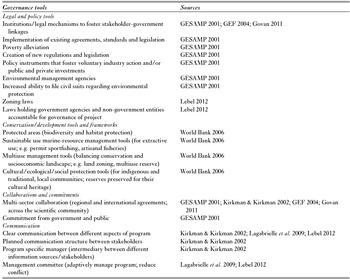
Many papers discussed ILSM broadly, mentioning tools that could be used in both the planning/implementation and management phases (Table 4). However, some aspects of program design were discussed only in reference to the management phase. First, scalability (upscaling programs; Govan Reference Govan2011) was considered important for program success. Second, long-term planning – separate from adaptive management – was mentioned by several studies. Third, the development of long-term finance strategies are key and can include self-financing or the inclusion of programs into national budgets (Govan Reference Govan2011). Finally, the production of a strategic management plan that is easy to understand and implement was considered important to long-term success (Kirkman & Kirkman Reference Kirkman and Kirkman2002).
Mechanisms used to manage integrated land-sea management programs, as recommended by theoretical papers.

Adaptive management (visualized in Fig. 4) was mentioned numerous times in the theoretical literature (Table 4). Adaptive management can help programs adjust to changing anthropogenic threats, varying stakeholder needs and incorporate new information, and may become more important in governance (Lebel Reference Lebel2012) as the climate changes (GEF 2004). However, adaptive management can be challenging in the ILSM context, where the different realms and ecosystems might have markedly different objectives or be experiencing different levels of anthropogenic use. However – and despite these difficulties – adaptive management is key to the success of ILSM projects, especially at larger geographic scales (GEF 2004).
The literature suggests that a successfully managed ILSM program should include the following components: (1) ongoing education and outreach to raise problem awareness (GESAMP 2001; Kirkman & Kirkman Reference Kirkman and Kirkman2002; Govan Reference Govan2011); (2) ongoing monitoring to identify stressors causing ecosystem change (Kirkman & Kirkman Reference Kirkman and Kirkman2002; Silvestri & Kershaw Reference Silvestri and Kershaw2010; Govan Reference Govan2011); (3) the use of environmental planning and management frameworks to address ecosystem connectivity (Fig. 4; GESAMP 2001; Silvestri & Kershaw Reference Silvestri and Kershaw2010); (4) capacity building, focusing on the adoption and transfer of technologies (GESAMP 2001); (5) environmental impact assessments (GESAMP 2001); and (6) decisions made based on cost-benefit analyses (GESAMP 2001). These components do not have to be expensive to maintain. For example, ongoing monitoring can use communities as cost-effective monitors (Govan Reference Govan2011).
Based on these components, the literature suggests that successful ILSM program outcomes can be summarized as: (1) locally and culturally appropriate (GESAMP 2001; Kirkman & Kirkman Reference Kirkman and Kirkman2002; Govan Reference Govan2011; Wilkinson & Brodie Reference Wilkinson and Brodie2011); (2) appropriate for the type of ecosystem being planned for (Beger et al. Reference Beger, Grantham, Pressley, Wilson, Peterson, Dorfman, Mumby, Lourival, Brumbaugh and Possingham2010); (3) suitable to national institutional structure and capacity (GESAMP 2001; Kirkman & Kirkman Reference Kirkman and Kirkman2002; Govan Reference Govan2011; Wilkinson & Brodie Reference Wilkinson and Brodie2011); (4) having national government commitment (Kirkman & Kirkman Reference Kirkman and Kirkman2002) with a coordinated response across different institutions (Silvestri & Kershaw Reference Silvestri and Kershaw2010); (5) managers chosen for technical ability (Kirkman & Kirkman Reference Kirkman and Kirkman2002); (6) managed/advised by multidisciplinary teams (Kirkman & Kirkman Reference Kirkman and Kirkman2002); (7) quality assurance protocols that allow for problems to be addressed when they arise (Kirkman & Kirkman Reference Kirkman and Kirkman2002); (8) supported by scientific evidence, including a justification for the geographic placement of an initiative (Beger et al. Reference Beger, Grantham, Pressley, Wilson, Peterson, Dorfman, Mumby, Lourival, Brumbaugh and Possingham2010; Halpern et al. Reference Halpern, Ebert, Kappel, Madin, Micheli, Perry, Selkoe and Walbridge2009; Govan Reference Govan2011; Wilkinson & Brodie Reference Wilkinson and Brodie2011); (9) considered to have a high likelihood of success, compared to alternative initiatives (GESAMP 2001; Govan Reference Govan2011); (10) cost effective (Govan Reference Govan2011); and (11) potentially applicable elsewhere (Govan Reference Govan2011).
Key findings from case studies on the planning, implementation and management of ILSM programs
Local communities were not often utilized for their knowledge of local ecosystems or surveyed for their opinions, attitudes and needs. Case studies reported the inclusion of local knowledge and social science information less than 40% of the time in both the planning/implementation and management phases. By contrast, the use of scientific knowledge was cited 65% of the time in the planning/implementation phase and 46% of the time in the management of initiatives.
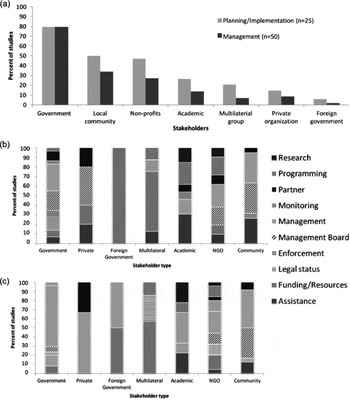
With the exception of government agencies, stakeholder involvement was low. This is surprising given the well-known benefits associated with stakeholder collaboration in conservation (Knight et al. Reference Knight, Cowling and Campbell2006). Governments at the local, regional or national scale were involved in 79% of case studies examining program planning/implementation, and 80% of case studies discussing program management. By contrast, the involvement of all other stakeholders was mentioned by less than 50% of the planning/implementation and management case studies (Fig. 5), with management case studies always citing the involvement of stakeholders at a lower rate than planning/implementation stage case studies (Fig. 5).
Participation of different stakeholders in case studies (a) and types of participation of different stakeholders in case studies during (b) planning and implementation (n = 34) and (c) management stages of land-sea conservation (n = 59). Case studies were excluded when no stakeholder engagement was noted.

Efforts to involve stakeholders in program planning/implementation or management were not always successful. For example, almost 11% of case studies, which purportedly involved communities in the planning/implementation and/or management phases, reported that the lack of sufficient community involvement still presented a hurdle to program success. However, case studies were significantly less likely to list a lack of community involvement as a barrier to program success when the communities were involved as stakeholders in the program (Pearson's Chi square test, Chi square = 5.855, p = 0.0155). Therefore, involvement of the community does seem to decrease the hurdles faced by conservation programs and when efforts at involving local communities fail, the degree of participation that communities are entitled to should be addressed. This is especially true in cases where ILSM programs cannot advance except through community-led engagement of local communities; several successful case studies are highlighted in Wilkinson & Brodie (Reference Wilkinson and Brodie2011).
The degree of stakeholder participation and involvement varied (Fig. 5). Involvement could include anything from program management to participation in a management board. Different types of involvement were not mutually exclusive; for example, governments could provide both legal frameworks and funding. In some cases, involvement of a stakeholder was described in vague terms (e.g. using the word ‘partner’) or by indicating that the stakeholder assisted the program but without information about the scale, scope and longevity of that assistance. The level of stakeholder involvement could change over time (Fig. 5). For example, some communities were not involved in the planning/implementation phase but became active participants in program management (e.g. Timko & Satterfield Reference Timko and Satterfield2008; Basurto Reference Basurto2013).
Few planning/implementation (21%, n = 34) and management (20%, n = 50) case studies mentioned the provision of benefits to communities. Benefits provided to local communities included: (1) alternative income-generating activities; (2) payments for land purchases; (3) park fees disbursed for social development programs; (4) compensatory payments in areas with human-wildlife conflict; (5) natural resource extraction, with profits and job availability benefiting local communities; (6) eco-tourism; (7) payments for ecosystem services; (8) microcredit programs; and (9) short-term jobs.
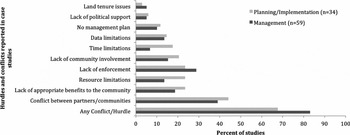
Most case studies faced conflicts and hurdles to their programs. Management case studies were more likely (83%) to name at least one conflict/hurdle than planning/implementation case studies (68%; Pearson's Chi square test, Chi square = 4.265, p = 0.0389; Fig. 6). Conflict between partners/stakeholders/communities was the most cited source of conflict (Fig. 6), and included: (1) lack of support from local communities; (2) weak communication between stakeholders and authorities; (3) incongruence between upland and marine management; (4) lack of consensus between the park management and the community; (5) confusion or lack of clarity about the rules of natural resource use; (6) tension between different eco-tourism operators and park management; (7) too many stakeholders and a lack of a communication/collaboration between them; and (8) conflict between legal frameworks at different levels. Conflict arising from inadequate/conflicting legal frameworks is perhaps the most difficult to overcome and suggests that the enabling conditions for ILSM may sometimes not be in place. The examination of whether conflicts, and subsequent program failures, are due to deficiencies in execution by practitioners or whether they are due to systemic barriers warrants further study in the ILSM context.
Hurdles and conflicts cited as barriers to conservation success in case studies. Hurdles/conflicts were not mutually exclusive and papers could cite more than one hurdle/conflict.

Key recommendations on the implementation of ILSM programs
Program focus and management
Where human activities simultaneously impact multiple realms in the same region, conservation strategies should consider integrated management of terrestrial, freshwater and marine areas (Klein et al. Reference Klein, Ban, Halpern, Beger, Game, Grantham, Green, Klein, Kininmonth, Treml, Wilson and Possingham2010). Different realms may not require equal levels of conservation effort; one study found that marine conservation, in most places, had a higher return on investment than terrestrial conservation (Klein et al. Reference Klein, Ban, Halpern, Beger, Game, Grantham, Green, Klein, Kininmonth, Treml, Wilson and Possingham2010). Depending on program priorities, some realms may be targeted more than others. For example, the velocity of climate change – which was mentioned by case studies almost exclusively in the context of ocean warming and acidification – and the shift in seasonal temperatures are predicted to occur at some latitudes at a greater rate in the marine realm than on land (Burrows et al. Reference Burrows, Schoeman, Buckley, Moore, Poloczanska, Brander, Brown, Bruno, Duarte, Halpern, Holding, Kappel, Kiessling, O'Connor, Pandolfi, Parmesan, Schwing, Sydeman and Richardson2011). Of course, ILSM might not always be feasible due to resource limitations (Govan Reference Govan2011).
Although biodiversity conservation is a common reason for the implementation of programs (Fig. 1), the need to explicitly account for human wellbeing is demonstrated by the fact that the second-most cited hurdle in ILSM case studies was the lack of provision of appropriate benefits to communities (Fig. 6). The explicit use of a framework and/or governance strategy may be useful in guiding the ILSM process; different frameworks can be modified to project needs, given their overlapping aims (Table 1).
Most project sites will face several different anthropogenic threats. Sewage is one of the highest priorities in many regions, though agricultural runoff and negative impacts from industry (GESAMP 2001) as well as coastal/urban development and deforestation can also be high priorities (Fig. 2). Programs should be willing to adapt to external threats (e.g. climate change; Silvestri & Kershaw Reference Silvestri and Kershaw2010) in the face of population growth, changes in resource availability (Mora & Sale Reference Mora and Sale2011), and changes in tourism levels, political instability and legal challenges. Some of the threats mentioned in case studies are not typically considered in management plans of protected areas (Mora & Sale Reference Mora and Sale2011); therefore, these should be addressed either by increasing the scope of management plans or utilizing different tools (e.g. legal mechanisms).
Varied anthropogenic challenges can be addressed by combining different strategies and approaches (Mora & Sale Reference Mora and Sale2011) at the multinational (Kohonen Reference Kohonen2003; Nobre Reference Nobre2011; Hering et al. Reference Hering, Borja, Carvalho and Feld2013), national (Nobre Reference Nobre2011) or sub-national level. Working with multiple levels of government may allow for protection against non-local threats such as climate change (Silvestri & Kershaw Reference Silvestri and Kershaw2010) or regional sedimentation (Butler et al. Reference Butler, Wong, Metcalfe, Honzak, Pert, Rao, van Grieken, Lawson, Bruce, Kroon and Brodie2011). Regulatory gaps should be addressed using legal frameworks, with adaptive management used to accommodate changes in the type and magnitude of anthropogenic threats (Lebel Reference Lebel2012). The implementation of programs presents a major impediment in ILSM (e.g. the implementation crisis; Knight et al. Reference Knight, Cowling and Campbell2006; Wells et al. Reference Wells, Samoilys, Makoloweka and Kalombo2010; Lebel Reference Lebel2012) and programs should proactively plan for these difficulties.
Geographic, spatial and temporal considerations
Depending on the location, ILSM programs may not always be necessary. Some areas of the globe are experiencing higher anthropogenic pressures than others. Europe and Asia have been identified as areas with high land-based impacts on coastal regions (Halpern et al. Reference Halpern, Walbridge, Selkoe, Kappel, Micheli, D'Agrosa, Bruno, Casey, Elbert, Fox, Fujita, Heinemann, Lenihan, Madin, Perry, Selig, Spalding, Steneck and Watson2008); 40% of the world's coastline experiences few impacts from terrestrial anthropogenic activities (Halpern et al. Reference Halpern, Ebert, Kappel, Madin, Micheli, Perry, Selkoe and Walbridge2009).
Challenges facing ILSM programs may differ between developed and developing countries. For example, developing countries may lack financial resources and the institutional capacity required for effective implementation (Lebel Reference Lebel2012). Local communities in these countries may also be strongly affected by new conservation programs, necessitating increased stakeholder engagement and equitable information dissemination programs (Silvestri & Kershaw Reference Silvestri and Kershaw2010). Many of the issues are described in a case study focusing on the Solomon Islands (Lane Reference Lane2006). By contrast, developed countries may have more stakeholders (e.g. government agencies) with overlapping management responsibilities; in these situations, management groups that mitigate conflict between stakeholders are recommended (Lagabrielle et al. Reference Lagabrielle, Rouget, Payet, Wistebaar, Durieux, Baret, Lombard and Strasberg2009; Lebel Reference Lebel2012).
ILSM can be implemented at different scales (Klein et al. Reference Klein, Ban, Halpern, Beger, Game, Grantham, Green, Klein, Kininmonth, Treml, Wilson and Possingham2010) and the size of the program will depend on its goals. The stressors of marine systems may not always be in close proximity to the marine area of interest (Wilkinson & Brodie Reference Wilkinson and Brodie2011). However, when an ILSM program is considered necessary, land-based and marine-based conservation initiatives should be relatively close to one another geographically because the benefits obtained by the marine system from the ILSM approach may decrease with distance (Beger et al. Reference Beger, Grantham, Pressley, Wilson, Peterson, Dorfman, Mumby, Lourival, Brumbaugh and Possingham2010). Nevertheless, there are cases in which ILSM should consider implementation over a larger area. For example, when the upstream and inland processes affecting coastal ecosystems occur over large areas or across complex networks of tributaries, it can be important to protect upstream habitats/ecosystems (e.g. for anadramous/catadromous fishes). In cases where ILSM takes place over large areas, or when land-based and marine-based programs cannot be located in proximity to one another, different interventions may increase the success of the conservation initiative (Klein et al. Reference Klein, Ban, Halpern, Beger, Game, Grantham, Green, Klein, Kininmonth, Treml, Wilson and Possingham2010). One key consideration is that larger projects may include more stakeholders, complicating the communication and collaboration process (Ruttenberg & Granek Reference Ruttenberg and Granek2011); the difficulties of managing large numbers of stakeholders were cited several times in case studies (Ruttenberg & Granek Reference Ruttenberg and Granek2011). Conversely, if a program is too small, it might not be able to tackle underlying issues or to reach some of its goals (e.g. protecting biodiversity or ensuring ecosystem connectivity; Mora & Sale Reference Mora and Sale2011).
Finally, the temporal aspect of ILSM must be considered. Short-term projects are needed in cases where action is urgently needed or where program success is likely (GESAMP 2001). Long-term programs, however, reflect the reality that the successful implementation of ILSM programs takes time (GESAMP 2001). Time limitations were noted by several case studies, as the time lag following interventions can frustrate donors and local communities who: (1) may expect to experience socioeconomic benefits very quickly; and (2) expect interventions to noticeably improve ecosystems within a short period of time. The planning process, including building trust and consensus, can also take a long time.
Organization and planning of ILSM
Projects should either be organized as one all-encompassing campaign (e.g. a protected area covering both land and marine areas of interest) or, if multiple related projects are taking place across the same region, should be organized under one management plan at a programmatic level. The type of approach taken depends on geography, scale, time and access to resources. For example, programs taking place in developing areas (where there are, perhaps, fewer stakeholders) or at small scales may wish to consider one all-encompassing campaign. On the other hand, projects organized over a long time period, over large areas and/or in developed countries (where there are many stakeholders, existing programs and/or resources) may benefit from utilizing a management plan. These approaches are not mutually exclusive and a nested approach could be used (see principle 10 in Jupiter et al. Reference Jupiter, Jenkins, Lee Long, Maxwell, Carruthers, Hodge, Govan, Tamelander and Watson2014 a). If a management plan is used, it should clearly articulate the land-based and marine-based objectives; program goals should be identified with stated data-collection and monitoring mechanisms that can provide information directly related to the program objectives (Nobre Reference Nobre2011). In addition, the use of a management committee is suggested when several stakeholders are involved (Lagabrielle et al. Reference Lagabrielle, Rouget, Payet, Wistebaar, Durieux, Baret, Lombard and Strasberg2009). Management committees should be composed of elected officials and stakeholder representatives, and should: (1) develop a management plan; (2) consider both ecological and socioeconomic objectives/needs; (3) provide a mechanism for linking research/date outputs into the planning process; (4) integrate management across realms; and (5) adapt management practices based on monitoring outcomes (Lagabrielle et al. Reference Lagabrielle, Rouget, Payet, Wistebaar, Durieux, Baret, Lombard and Strasberg2009; Lebel Reference Lebel2012). Management committees should also ensure that strategic plans are utilized and that regulations and other legal mechanisms are not ignored (Lebel Reference Lebel2012).
Stakeholder engagement
The lack of authentic stakeholder engagement is a problem for many programs (Lebel Reference Lebel2012). Despite frameworks that explicitly aim to involve local communities (Table 1) and recommendations that stakeholders can be valuable information resources (Table 3), local communities were involved in less than 50% of the case studies. This presents a major conflict (Fig. 6) to ILSM and in cases where ILSM programs are appropriate, programs will likely not be successful unless they include stakeholders in the planning, implementation and management process (Lebel Reference Lebel2012). Programs often fail due to conflicts between stakeholders and not due to technical issues (Silvestri & Kershaw Reference Silvestri and Kershaw2010).
Effective communication with stakeholders can be improved as a part of the adaptive management cycle (Fig. 4), though simply increasing the number of involved stakeholders without providing a framework for conflict resolution (e.g. management committee) may negatively impact conservation programming (Silvestri & Kershaw Reference Silvestri and Kershaw2010; Lebel Reference Lebel2012). The case studies suggest that simply involving a community in programming does not guarantee that the involvement will have the intended outcomes (e.g. community adherence to program rules). This is especially true if some stakeholders hold more power than others (Lebel Reference Lebel2012). Economically important stakeholders are usually considered in the planning process (e.g. fishing communities); however, less well-organized stakeholders should also be engaged (Lebel Reference Lebel2012). Examples where stakeholder engagement may have been biased are discussed in Fortwangler (Reference Fortwangle2007) and Larsen et al. (Reference Larsen, Acebes and Belen2011). Political and social theories can be used to increase understanding of why some stakeholders might engage differently than other (e.g. social identity theory; Mason et al. Reference Mason, Lim-Camacho, Scheepers and Parr2015). Understanding the role that stakeholders play in the management process may help clarify stakeholder relations (Silvestri & Kershaw Reference Silvestri and Kershaw2010) as can the use of both direct and indirect stakeholder communication methods (Vella et al. Reference Vella, Bowen and Frankic2009).
CONCLUSION
Instances of ILSM were used to increase understanding about how ILSM programming is adapting to cross-realm outcomes. While there have been steps taken in the theoretical literature to address ILSM (Wilkinson & Brodie Reference Wilkinson and Brodie2011; Jupiter et al. Reference Jupiter, Jenkins, Lee Long, Maxwell, Carruthers, Hodge, Govan, Tamelander and Watson2014 a; Álvarez-Romero et al. Reference Álvarez-Romero, Adams, Pressey, Douglas, Dale, Auge, Ball, Childs, Digby, Dobbs, Gobius, Hinchley, Lancaster, Maughan and Perdrisat2015), these strategies and recommendations are not necessarily being adhered to by applied programs. Case studies were less likely than theoretical papers to name the land-sea connection and >50% did not explicitly list a framework or governance approach. Our study also highlights the differences between undertaking land-based and sea-based management individually, and the unique challenges faced by organizations that integrate multiple ecosystems into one comprehensive program. Finally, our study points to the increased need for long-term planning, in addition to adaptive management in conservation, and especially in ILSM.
In this study, we synthesized recommendations from the literature regarding ILSM, discussed how these recommendations have been implemented by applied programs and highlighted opportunities for improvement. Given the importance of ILSM (Ruttenberg & Granek Reference Ruttenberg and Granek2011) in the context of a future where a large portion of the globe's population will live in coastal areas (Klein et al. Reference Klein, Nicholls, Thomalla, Kreimer, Arnold and Carlin2002; Millennium Ecosystem Assessment 2005), we believe that this review is an important step in clarifying how ILSM programming can be implemented successfully.
ACKNOWLEDGEMENTS
HG and DG thank the Betty and Gordon Moore Foundation. This material is based upon work supported by the National Science Foundation (NSF) Graduate Research Fellowship under Grant DGE-1144462 to KER. All opinions, findings, conclusions and recommendations expressed are those of the authors and do not necessarily reflect the views of the NSF.
Supplementary material
To view supplementary material for this article, please visit http://dx.doi.org/10.1017/S0376892916000023