Introduction
Prospective memory (PM) refers to memory for future intentions (e.g. taking medication, paying bills) and it is crucial for independent living in old age. Although there is evidence of substantial age-related deficits in PM (e.g. Henry et al., Reference Henry, MacLeod, Philips and Crawford2004; Knight et al., Reference Knight, Nicholls and Titov2008), older adults have demonstrated the ability to compensate for their deficits in everyday life (Rendell and Craik, Reference Rendell and Craik2000; Schnitzspahn et al., Reference Schnitzspahn, Ihle, Henry, Rendell and Kliegel2011). The present study set out to identify effective strategies of facilitating PM in older adults. Specifically, we tested whether providing older adults with feedback would improve their PM performance.
Feedback is defined as “post-response information that is provided to learners to inform them of their actual state of learning or performance” (Narciss, Reference Narciss, Spector, Merrill, van Merrienboer and Driscoll2008, pp. 126). Considerable evidence has been gathered to suggest that feedback has a positive effect on learning and memory (e.g. Vollmeyer and Rheinberg, Reference Vollmeyer and Rheinberg2005; Metcalfe and Kornell, Reference Metcalfe and Kornell2007; Wang and Wu, Reference Wang and Wu2008), provided that certain recommendations regarding the form of feedback are followed (see Hattie and Timperley, Reference Hattie and Timperley2007; Shute, Reference Shute2008, for further reviews). A key theme in these recommendations is that the feedback should be objective, specific, presented in manageable units, and well-targeted. Research has shown that feedback can also improve memory performance in the elderly (West et al., Reference West, Bagwell and Dark-Freudeman2005; Da Silva and Sunderland, Reference Da Silva and Sunderland2010; Tse et al., Reference Tse, Balota and Roediger2010). One could assume that feedback should be even more beneficial for older than younger adults as their performance is usually worse and there is more room for improvement. For instance, Gielen et al. (Reference Gielen, Peeters, Dochy, Onghene and Struyven2010) demonstrated that participants with worse pretest performance benefited more from receiving feedback than participants who initially performed better. Da Silva and Sunderland (Reference Da Silva and Sunderland2010) actually demonstrated that older compared to young adults showed greater improvement with feedback.
There are a number of different ways in which feedback can improve task performance (Hattie and Timperley, Reference Hattie and Timperley2007; Shute, Reference Shute2008). One group of mechanisms involves the use of cognitive processes, such as using new memorization strategies, correcting inappropriate strategies or some procedural errors. For PM tasks, memorization strategies may involve more elaborative encoding of intentions or more frequent rehearsals during the retention period. Another group of mechanisms is related to affective processes. According to Hattie and Timperley (Reference Hattie and Timperley2007) feedback can improve performance through affective processes by increasing engagement, effort, and motivation. The aging literature suggests that placing feedback in the social context may be an effective way of strengthening its affective influence in the elderly. The presence of other people generally tends to enhance positive emotions (see Fischer et al., Reference Fischer, Manstead and Zaalberg2003, for a review), but the elderly seem to be especially susceptible to the positive impact of social interactions. This relates to the social selectivity theory, that is supported by research showing older adults are generally more oriented towards socially meaningful interactions (Carstensen, Reference Carstensen1992). Older adults also displayed stronger social commitment when completing a task (West et al., Reference West, Bagwell and Dark-Freudeman2005). What is more, there is research that showed highlighting the social context of the PM task improved performance in older but not younger adults (Altgassen et al., Reference Altgassen, Kliegel, Brandimonte and Filippello2010). Therefore, for older adults feedback presented during social interaction may be more meaningful and encouraging than feedback they proceed through by themselves.
Given the effectiveness of feedback in facilitating learning and memory, we expected that feedback would improve PM performance. Using the results of Da Silva and Sunderland (Reference Da Silva and Sunderland2010) and Gielen et al., (Reference Gielen, Peeters, Dochy, Onghene and Struyven2010) suggesting older adults and lower pretest performers benefiting most from feedback, we predicted that a positive effect of feedback would be more pronounced in older than young adults. On the basis of the social selectivity theory (Carstensen, Reference Carstensen1992), we speculated that only older adults would benefit more from feedback presented by an experimenter than from the same feedback they proceeded through by themselves.
Method
Participants
A total of 75 young adults (age: M = 21.64 years, SD = 2.10, range = 19–29) and 72 older adults (age: M = 70.36 years, SD = 5.66, range = 61–87) participated in the study. There is uneven number of participants in the age groups as 6 young and 9 older participants were not able to be included as their data was incomplete due to technical difficulties during the experimental session. The groups did not significantly differ in the relative frequencies of men and women (26.7% and 34.7% men for young and older adults respectively), χ2(1) = 1.12, p = 0.289 or years of formal education, t(145) = 1.44, p = 0.152 (young adults: M = 14.81, SD = 1.89; older adults: M = 15.38, SD = 2.77). The older adult participants were screened for the presence of dementia, using the Polish version of the Mini-Mental State Examination (MMSE; Folstein et al., Reference Folstein, Folstein and Fanjiang2009) (all participants ≥27). They were all physically active, healthy, and living independently.
Two measures of cognitive ability were used to establish a neuropsychological baseline for all participants. Speed of processing was tested using the digit symbol subtest of the Polish version of the Wechsler Adult Intelligence Scale-Revised (Brzeziński et al., Reference Brzeziński, Gaul, Hornowska, Jaworowska, Machowski and Zakrzewska2004). Verbal ability was measured using the synonym subtest of the APIS-Z test, which is recognized as a reliable estimate of crystallized intelligence (Matczak et al., Reference Matczak, Jaworowska, Ciechanowicz and Stańczak2006). Young adults outperformed older adults in the test of processing speed, t(145) = 18.16, p < 0.001 (young adults: M = 69.33, SD = 11.20; older adults: M = 38.17, SD = 9.50), but they performed worse than older adults on verbal ability, t(145) = 3.04, p = 0.003 (young adults: M = 5.73, SD = 3.15; older adults: M = 7.56, SD = 4.08). Thus, this sample is representative of other aging studies.
We randomly assigned 27 young and 27 older adults to each of the three feedback conditions: none, non-social, social. However, the number of participants included in the analyses for each age group for the three conditions was: young: 24, 24, 27; older: 25, 24, 23. The participants from each age group were evenly assigned to the three conditions but then 15 participants were not included due to technical difficulties during the experimental session (see above). The three conditions did not significantly differ in demographical characteristics such as the relative frequencies of men and women (young adults: χ2(2) = 1.54; older adults: χ2(2) = 0.04, ps ≥ 0.463), age (Fs < 1 for young and older adults) or years of formal education (young adults: F(2, 72) = 0.08; older adults: F(2, 69) = 1.53, ps ≥ 0.225). Similarly, the conditions did not significantly differ in processing speed (Fs < 1 for young and older adults) or verbal ability (young adults: F(2, 72) = 1.10; older adults F(2, 69) = 0.71, ps ≥ 0.338).
Participants were told that the study would examine how people cope with different types of everyday tasks. They were not given any more information about the research goals and hypothesis until the study was over.
Materials and procedure
The experimenters conducting were co-authors and thus were not blind to the experiment but they did learn and follow closely very precise responses to specific scenarios.
virtual week
This is a computer-based laboratory measure of PM designed to represent PM in daily life (original version, Rendell and Craik, Reference Rendell and Craik2000). It uses a computerized board game format, in which participants move around the board with the roll of a die. Each circuit of the board represents a waking day. As participants move around the board, they must pick up event cards. There are 10 event cards per virtual day with each card presenting participants with a brief description of an activity relevant to the virtual time of day (e.g. a meal or shopping) and a decision to make with three options related to the daily activity (e.g. what to eat or what to buy). In addition, participants have to remember to carry out life-like intentions (PM tasks). The choosing of activities, rolling dice and moving the token constitute the ongoing activity for the PM tasks embedded in Virtual Week. Each day of Virtual Week included eight PM tasks (four regular, four irregular) and did not include the two-time check tasks, as in recent studies (e.g. Mioni et al., Reference Mioni, Rendell, Henry, Cantagallo and Stablum2013). Participants did not physically carry out the PM tasks; rather they clicked on the “Perform Task” button when they felt it was the appropriate moment and selected the task from a list of possibilities (PM tasks and distracters).
The four regular PM tasks were the same each day and simulated the kinds of regular tasks that occur as one undertakes normal duties (such as taking medication every day at the same time), two were event-based (triggered by specific event cards: breakfast and dinner event cards), and two were time-based (triggered by specific times on virtual time clock of day: 11am and 9pm). The time-based tasks required monitoring of a virtual clock in a prominent position. As in recent studies (e.g. Mioni et al. Reference Mioni, Rendell, Henry, Cantagallo and Stablum2013), this study used the computerized version of Virtual Week with a virtual time clock, rather than consecutive hours of day marked on squares on the board, as in original version. This virtual time clock was calibrated to the position of the token on the board. The four irregular PM tasks were different each day and simulated the kinds of occasional tasks which occur in everyday life (such as phone plumber and pick up dry-cleaning). Again, the four irregular tasks consisted of two event-based and two time-based tasks (e.g. pick up dry-cleaning when shopping triggered by event card depicting shopping; and phone plumber at 5 p.m. triggered by virtual clock). As observed in recent studies with Virtual Week (Mioni et al., Reference Mioni, Rendell, Henry, Cantagallo and Stablum2013) the critical distinction is that regular relative to irregular PM tasks in Virtual Week impose substantially fewer demands on retrospective memory function. This is because they (i) are learnt to criterion as opposed to encountered incidentally; (ii) are repeatedly performed rather than one-off non-recurring tasks; (iii) involve fewer cue action associations across the duration of Virtual Week (4 vs. 20), and (iv) involve less complex content.
The first virtual day was preceded by a trial day. The experimenter interacted with the participant during the trial day, talking them through the procedures, prompting and giving feedback with each PM response. In each condition, participants then completed five virtual days.
No feedback condition
Participants played the standard version of Virtual Week. The only difference was that after each virtual day they were engaged in a filler task that lasted the same time period as it took to provide feedback in two other conditions. For the filler task, participants rated pictures of restaurants with the names of the restaurants printed on them. They rated how much they like the restaurant, how much they like the name of the restaurant, and to what extent the name fits the appearance of the restaurant. Participants were first given the filler task at the end of the trial day and then proceeded through it by themselves after each virtual day but with instructions on the computer screen to engage in filler and stop filler task. At the end of the trial day, participants were only told that they would be given an additional task after each virtual day and all instructions they would need to complete this task would be given on the computer screen.
Non-social feedback condition
Virtual Week was modified to provide specific feedback on PM performance at the end of each virtual day, the trial day included. This was provided via a sequence of three computer screen displays that participants proceeded through by themselves. This feedback was designed to meet the recommendations for feedback reported in the introduction: specific, objective, and well-targeted, and presented in manageable units. Separating the feedback into three screens ensured it was in manageable units. On the first screen display, participants were informed for each PM task separately whether their response was correct, miss, little late, lot late, little early or lot early. This feedback met the criteria of objective and specific feedback. The second display presented their overall performance during the day in a pie chart. The third display included a line chart that presented how they had performed on each day so far. The three screens presented the feedback at three distinct levels: the response on each specific task for the virtual day; the performance overall for the virtual day; and performance over all virtual days. The first screen display was presented for 40 seconds and the other two for 20 seconds each, with a 10 seconds gap before each feedback window when there was displayed a request to wait for data to be calculated.
At the end of the trial day, this feedback was presented and discussed with participants. During the trial day participants were told that they would be given feedback on their performance after each virtual day and were asked to read it carefully. They were told that each feedback window would stay on for set time to ensure that they would have ample time to read and take in the feedback but the experimenter would not comment on or discuss the feedback with them. After the trial day and at the end of each virtual day, participants proceeded through the three feedback windows by themselves. The experimenter was always present in a room to monitor whether participants followed the instructions as indicated.
Social feedback condition
In this condition, specific feedback on PM performance was also provided at the end of each virtual day, the trial day included, but participants were taken through the feedback by the experimenter. The same three screen displays as in the non-social feedback were presented for 40, 20, and 20 seconds respectively. However, each display was introduced by the experimenter during the 10 second interval before each feedback window. The experimenter said: “You have managed to reach the end of your virtual day. I will present you your results in a minute. Let's have a look together how you coped with the tasks. Please read carefully the information you will be given.” The experimenter then referred to the specific form of feedback that was going to be presented, e. g. “Let's have a look at which tasks you managed to cope well with and which you did not.” or “Let's have a look what your overall performance during the day was.” No more information was given either before or during the presentation.
As in the non-social feedback condition, participants were told during the trial day that they would be given feedback on their performance and at the end of the trial day the feedback was presented and discussed with participants. However in this condition, they were also told the experimenter would go through the results with them after each virtual day. Participants were told that the experimenter wished to help and make the game more interesting for them, and to this purpose, would devote some time to present their results after each virtual day. However, it was stressed that the experimenter would not comment on or discuss the feedback during the presentation.
Summing up, all participants received the same information about the aim of study and were identically taught how to play Virtual Week during the trial day. The difference between the conditions appeared for the first time at the end of the trial day when the instructions about feedback or the filler task were provided. In the non-social feedback condition participants were only told to read the feedback carefully. In the social feedback condition they were also told that the experimenter had prepared the feedback having their good in mind and would go through their results with them. Other differences between the two conditions appeared before the feedback presentation after each virtual day. In the non-social feedback condition each feedback window was preceded by a computer screen displaying that the results are being calculated, whereas in the social feedback condition it was introduced by the experimenter. However, in neither condition the feedback was explained or commented on.
In the present study, reliability as indexed by Cronbach's alpha for all PM tasks (40 PM tasks, 8 per virtual day) across all feedback conditions was .73 for young and .89 for older.
Statistical analyses
The statistical package SPSS-20 was used for data analysis. The overall PM performance as function of age group and feedback condition was analyzed with a 2 × 3 × 2 × 2 mixed ANOVA with between-group variables age group (young, older), feedback condition (none, non-social, social), and within-groups variables PM task (regular, irregular) and PM cue (event-based, time-based). This was followed up with separate factorial ANOVAs, with the between-group variable of age group and feedback condition, for each of the four measures comprising the within groups measures of PM task and PM cue: regular event-based, regular time-based, irregular event-based, and irregular time-based. In all ANOVAs, interactions were analyzed with tests of simple effects. All post hoc tests for simple effects were conducted as pair-wise Bonferroni comparisons, adjusted for multiple comparisons. For simple effects, effect sizes were calculated as partial eta-squared but for post hoc Bonferroni paired comparison effect sizes were calculated as Cohen's d.
Results
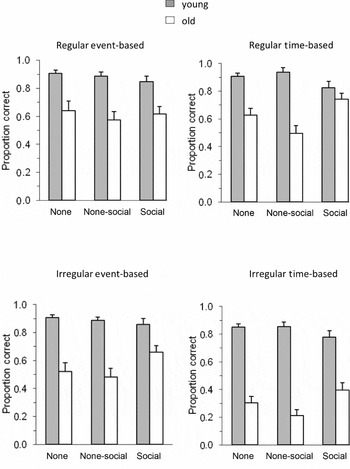
A 2 × 3 × 2 × 2 mixed ANOVA on the proportion of correct PM tasks revealed main effects of age, F(1, 141) = 132.52, p < 0.001, ηp 2 = 0.49, PM task, F(1, 141) = 82.62, p < 0.001, ηp 2 = 0.37, and PM cue, F(1, 141) = 26.16, p < 0.001, ηp 2 = 0.16, but not feedback, F(1, 141) = 1.03, p = 0.360, ηp 2 = 0.01. There were several significant interaction effects and critically a four-way interaction, F(2, 141) = 3.25, p = 0.042, ηp 2 = 0.04. As the primary interest was the effect of age group and feedback condition, this was followed up with separate analyses of these between-groups variables for regular event-based tasks, regular time-based tasks, irregular event-based tasks and irregular time-based tasks. The proportions correct on each of these tasks are displayed in Figure 1, as function of age group and feedback condition.
Mean proportion of correct PM tasks as a function of age group (young, old) and feedback condition (none, non-social, social). Error bars depict standard error of the mean.

Regular event-based PM
Analysis of these tasks revealed a main effect of age group, F(1, 141) = 47.78, p < 0.001, ηp 2 = 0.25, but not feedback condition, F(2, 141) = 0.53, p = 0.591, ηp 2 < 0.01. There was no interaction effect F(2, 141) = 0.38, p = 0.684, ηp 2 < 0.01. Figure 1 shows the consistent age-related deficits across all three feedback conditions.
Regular time-based PM
Analysis of these tasks revealed a main effect of age group, F(1, 141) = 60.41, p < 0.001, ηp 2 = 0.30, and feedback condition while not a main effect F(2, 141) = 1.39, p = 0.253, ηp 2 = 0.02 was an interaction effect F(2, 141) = 9.05, p < 0.001, ηp 2 = 0.11. Follow-up simple effects analysis of the interaction revealed older were worse than young within no feedback, F(1, 141) = 22.10, p < 0.001, ηp 2 = 0.14, and non-social feedback, F(1, 141) = 53.56, p < 0.001, ηp 2 = 0.28, but young and older did not differ for social feedback, F(1, 141) = 1.94, p = 0.166, ηp 2 = 0.01. Further analysis of the interaction revealed a simple main effect of feedback condition for older, F(2, 141) = 8.24, p < 0.001, ηp 2 = 0.11, but not young adults, F(2, 141) = 1.98, p = 0.141, ηp 2 = 0.03. For older adults Bonferroni post hoc tests revealed that participants with non-social feedback performed worse than both social feedback (p < 0.001, d = 1.05) and no feedback (p = 0.029, d = 0.51), and approaching significance (p = 0.057, d = 0.52) was worse performance on no feedback compared to social feedback.
Irregular event-based PM
Analysis of these tasks revealed a main effect of age group, F(1, 141) = 74.94, p < 0.001, ηp 2 = 0.35, and feedback condition while not a main effect F(2, 141) = 1.27, p = 0.284, ηp 2 = 0.02 was an interaction effect F(2, 141) = 3.09, p = 0.048, ηp 2 = 0.04. Follow-up analysis of the interaction revealed a simple main effect of age group within each feedback condition: no feedback, F(1, 141) = 34.733, p < 0.001, ηp 2 = 0.20; non-social feedback, F(1, 141) = 36.87, p < 0.001, ηp 2 = 0.21; and social feedback, F(1, 141) = 9.02, p = 0.003, ηp 2 = 0.06. Older adults were consistently worse on each condition and effect size was similar on no feedback and non-social feedback but much smaller on social feedback. Further analysis of the interaction revealed a simple main effect of feedback condition for older, F(2, 141) = 3.87 p = 0.023, ηp 2 = 0.05, but not young adults, F(2, 141) = 0.32, p = 0.730, ηp 2 < 0.01. For older adults, Bonferroni post hoc tests revealed, participants with social feedback performed better than both no feedback (p = 0.036, d = 0.51) and non-social feedback (p = .009, d = 0.67), but no feedback and non-social feedback did not differ (p = 0.579, d = 0.12).
Irregular time-based PM
Analysis revealed a main effect of age group, F(1, 141) = 227.83, p < 0.001, ηp 2 = 0.63, and feedback condition while not a main effect F(2, 141) = 0.91, p = 0.405, ηp 2 = 0.01 was an interaction effect F(2, 141) = 4.71, p = 0.011, ηp 2 = 0.06. Follow-up analysis of the interaction revealed a simple main effect of age group within each feedback condition: no feedback, F(1, 141) = 82.67, p < 0.001, ηp 2 = 0.37; non-social feedback, F(1, 141) = 111.89, p < 0.001, ηp 2 = 0.44; and social feedback, F(1, 141) = 41.47, p < 0.001, ηp 2 = 0.23. Older adults were consistently worse on each condition, with large effect sizes on each condition but both no feedback and non-social feedback had larger effects sizes than social feedback. Further analysis of the interaction revealed a simple main effect of feedback condition for older, F(2, 141) = 4.46 p = 0.013, ηp 2 = 0.06, but not young adults, F(2, 141) = 1.03, p = 0.360, ηp 2 = 0.01. For older adults, Bonferroni post hoc tests revealed participants with social feedback performed better than non-social feedback (p = 0.003, d = 0.78) but no feedback did not differ with both non-social feedback (p = 0.130, d = 0.41) nor social feedback (p = 0.133, d = 0.37).
Discussion
The main finding was that older adults significantly benefited from feedback provided by the experimenter. Young adults performed equally well no matter whether they were provided with feedback or not. The positive effect of social feedback on the performance of older adults was medium in magnitude for irregular event-based tasks and regular time-based tasks. Social feedback substantially reduced or eliminated age-related differences in PM performance on those tasks. It also reduced the age deficit on irregular time-based tasks to some extent.
In light of the consistent very good performance by young adults, the claim that age-related deficits have been eliminated needs qualifying and any conclusions about differences between young and older adults in their sensitivity to social feedback are limited. However, it is worth noting that for young adults there was still some room for improvement. Their overall performance was near ceiling, but for irregular PM tasks their performance without any feedback ranged from a proportion of 0.70 correct to 1.00 correct, with only one participant having a maximum score of 1.00. Nevertheless, the clear and critical finding is that the performance of older adults has been enhanced by feedback provided by the experimenter.
As in other research in which Virtual Week has been used (Henry et al., Reference Henry, Rendell, Phillips, Dunlop and Kliegel2012), older adults generally had more difficulties with irregular than regular intentions and more difficulties with time-based than event-based PM: with the best performance on regular event-based tasks and poorest performance on irregular time. The pattern of feedback effects suggests that older adults did not benefit from social feedback on the least demanding task (regular event), benefited only to a small extent on the most demanding task (irregular time) but benefited substantially on the tasks of intermediate difficulty (regular time and irregular event). It may be that they did not try as hard to improve their performance on PM tasks they perceived as relatively easy to realize (e.g. take medication after breakfast every day). On the other hand, even their greatest efforts may not have been enough to substantially improve their performance on the most demanding PM tasks. The pattern of results accords with the multiprocess model (McDaniel and Einstein, Reference McDaniel and Einstein2000) that emphasizes that PM tasks can vary in the extent that strategic processes are required compared to automatic processes. For some PM tasks to be completed successfully, one needs to strategically monitor the environment for the presence of the target event or strategically monitor the time. However, when the target event is salient and strongly associated with the intended action, encountering the target event relatively automatically brings to mind the intended action. In our study, the least demanding task (regular event-based) could be invoking automatic processes and low level demands on strategic processes, and thus the feedback increasing motivation and a more strategic approach is not going to be as helpful. The other tasks could be requiring some level of strategic processes, and thus increased motivation supports more effortful strategic processing and thus improves performance. However, when the PM task is most demanding in terms of strategic processing, then it is possibly too demanding for increased motivation to help.
Unexpectedly, PM with non-social feedback was not only worse than with social feedback, but it was not any better than without any feedback at all. For regular time-based tasks, it was even worse than in the no-feedback condition. One possible explanation is that introducing the feedback in the social context made it more salient compared to the non-social feedback condition. Although in both conditions the feedback was presented for the same amount of time and was neither explained nor discussed, participants may have paid less attention to the feedback when they proceeded through it by themselves and thus it was not helpful. However, the finding that PM with non-social feedback was significantly worse than without any feedback for one type of tasks (and numerically worse for all other types) suggests another explanation. It is worth noting that older adults generally performed poorly on Virtual Week and therefore feedback they received was most often negative. Feedback highlighting relatively poor performance may have evoked negative emotions (e.g. frustration, threatened self-esteem) that can inhibit learning processes and effective use of information (Kluger and DeNisi, Reference Kluger and DeNisi1996). Research has shown that negative feedback elicits negative affect and consequently does not improve or even decreases subsequent performance in low self-efficacious people (Shrauger and Sorman, Reference Shrauger and Sorman1977; Kernis et al., Reference Kernis, Brockner and Frankel1989). Since the elderly have increasing difficulties with memory, self-efficacy and little confidence in their ability to remember (West et al., Reference West, Dennehy-Basile and Norris1996), our older adult participants might have experienced these adverse reactions. It can be argued that positive emotions induced by the social context of receiving feedback were helpful in overcoming negative emotional responses to negative feedback. Thus, presenting feedback by the experimenter may have offset the negative impact of the content of the feedback and enabled effective use of received information. However, further research is needed to tease out whether social feedback enhanced performance amongst older adults because of effects on motivation via social emotional functions or increasing saliency of the feedback.
Despite the feedback meeting the critical recommendations of specific, objective and well-targeted, it was only effective when the feedback displayed on the computer was presented by the experimenter, i.e. feedback in a social context. Interestingly, the non-social feedback condition, resembled the format that occurs in computer games, particularly in computer based training exercises, with specific results on performance displayed on computer screen. Therefore the findings of this study suggest that computer games/tasks displaying feedback on screen may not be effective for older adults unless this feedback can have a social aspect such as an experimenter or trainer taking the game participant through the feedback presented on computer screen. Thus these findings have implications for training programs that often involve computer based tasks and automated feedback (Lustig et al., Reference Lustig, Shah, Seidler and Reuter-Lorenz2009). Further accentuating the importance of these implications, is that feedback is thought to be one of the critical features of effective training programs (Lustig et al., Reference Lustig, Shah, Seidler and Reuter-Lorenz2009). Along with other features like considerable repetitions of the training task, increasing difficulty, and that difficulty being adaptive to performance of the individual undertaking training (Basak et al., Reference Basak, Boot, Voss and Kramer2008). Interestingly, there appears to be a lack of systematic investigation of feedback in cognitive training studies, along with the lack of previous studies investigating feedback with PM tasks (Green and Bavelier Reference Green and Bavelier2008). This study makes an original contribution showing promising benefits of feedback from automated feedback in computer based PM tasks, but it was limited to situation where this feedback was augmented by the presence of the experimenter guiding them through the feedback. There is need for further research to explore why the effects limited to situation where the experimenter was present during feedback and effects were also limited on the least demanding and most demanding tasks but substantial on tasks of intermediate difficulty.
Conflict of interest
None.
Description of authors’ roles
All four authors collaboratively designed the study. A. Niedźwieńska formulated the research questions, developed the Polish version of Virtual Week, supervised the data collection and wrote the paper. P.G. Rendell modified Virtual Week to the procedure requirements, was responsible for carrying out the statistical analysis and participated in writing the paper. K. Barzykowski and A. Leszczyńska collected the data and assisted in writing the paper.
Acknowledgments
This research was supported by an International Project grant from the Polish National Science Center: 2011/01/M/HS6/00681. In addition it was supported by a Discovery Project grant from the Australian Research Council.