INTRODUCTION
Taxonomic and biogeographic research dealing with cold-water coral species from Antarctic and sub-Antarctic waters have been extensively reviewed by Cairns (Reference Cairns1982). Later, Cairns (Reference Cairns1990) diagnosed, keyed and illustrated the Antarctic species, including some that also occur off sub-Antarctic Argentina. General information on coral and other cnidarian species of the Magellanic Region (Argentina) has been compiled by Zamponi (Reference Zamponi2008), while more recently, Cairns & Polonio (Reference Cairns and Polonio2013) added new distribution ranges for some scleractinian corals, and also described new species from the Malvinas/Falkland Islands and off Argentina.
In particular, the genus Flabellum groups organisms that are exclusively solitary with a worldwide distribution in depths ranging from coastal to abyssal areas, having a ceratoid, trochoid to flabellate shape, with a non-reinforced pedicel and a deep fossa without columella (Cairns, Reference Cairns1990), among the main characters. This genus is represented in Antarctic waters by three species (Flabellum gardineri Cairns, Reference Cairns1982, Flabellum impensum Squires, 1962 and Flabellum flexuosum Cairns, Reference Cairns1982) (Cairns, Reference Cairns1990), with some additional cold-water species recorded at sub-Antarctic, south-west Atlantic and south Pacific waters (Flabellum thouarsii Milne Edwards and Haime, 1848, Flabellum curvatum Moseley, 1881, Flabellum areum Cairns, Reference Cairns1982, Flabellum apertum Moseley, 1876, Flabellum knoxi Ralph and Squires, 1962 and Flabellum cinctutum Cairns & Polonio, Reference Cairns and Polonio2013) (Cairns, Reference Cairns1982; Cairns & Polonio, Reference Cairns and Polonio2013). In Argentina, this genus is represented by five species: Flabellum thouarsii, Flabellum curvatum, Flabellum areum, Flabellum apertum and Flabellum cinctutum (Zamponi, Reference Zamponi2008; Cairns & Polonio, Reference Cairns and Polonio2013).
Flabellum (Flabellum) impensum is a very conspicuous species, typically from Antarctica, distinguished from the other Flabellum species of the region by its larger size and greater number of septa. It is an endemic species of the Antarctic region, distributed at circumpolar continental Antarctica, the Palmer Archipelago, South Shetland Islands, South Orkney Islands and South Sandwich Islands, with one disjunct record from the Antipodes Islands (Cairns, Reference Cairns1990, Reference Cairns1995). It is commonly collected between 100 and 1000 m depth, although its bathymetric range is reported to be 46–2260 m (Cairns, Reference Cairns1990).
We report the first record of the species outside Antarctic waters, in South America, specifically in shallow coastal waters of Tierra del Fuego Province, Argentina. The extension range of this typically Antarctic species is discussed.
MATERIALS AND METHODS
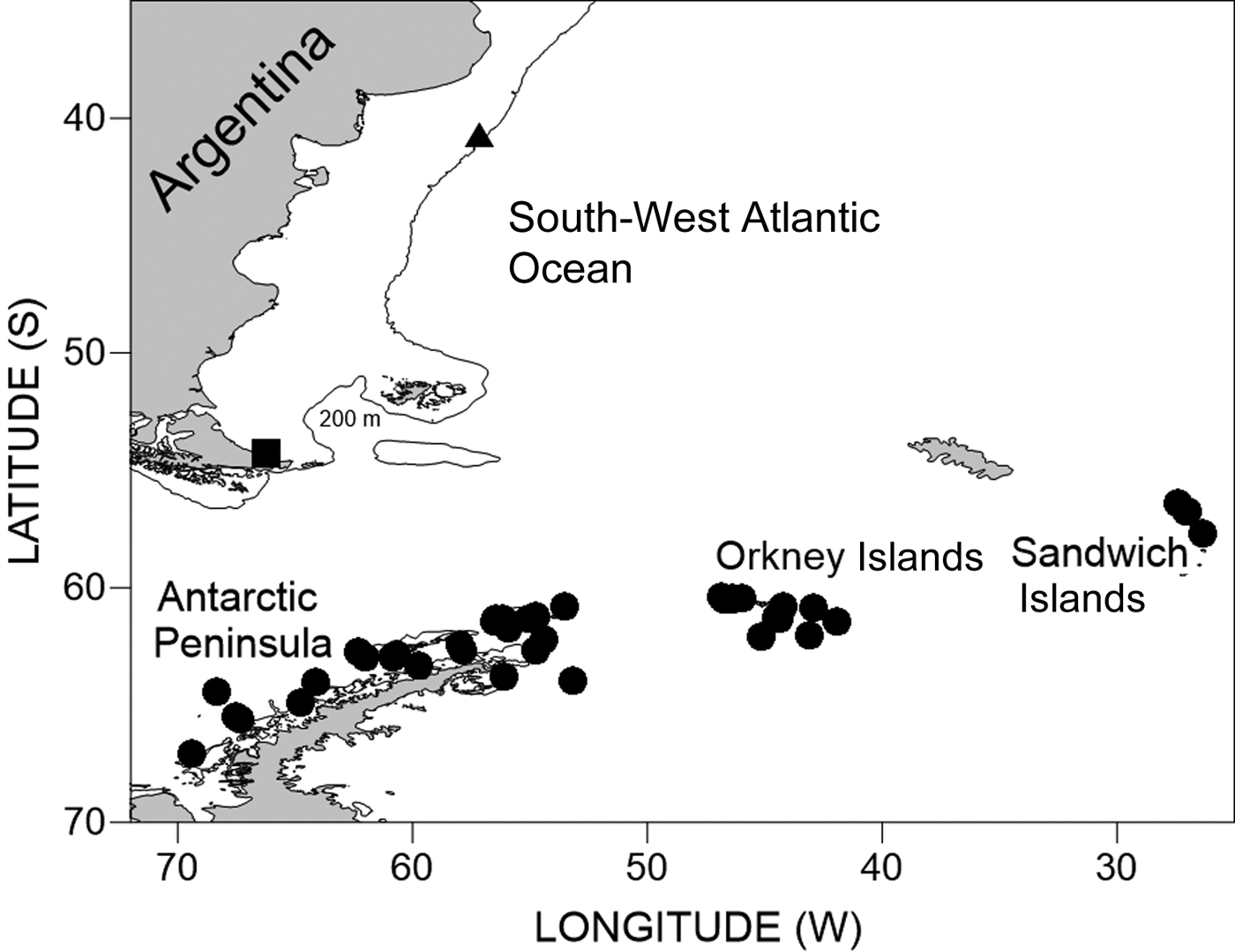
The studied material was collected during a research cruise on the OV ‘Puerto Deseado’ (Argentina), using a bottom trawl. The research campaign aimed to collect biological and oceanographic data around Tierra del Fuego Province (Argentina), including the Beagle Channel, after the Antarctic phase. The corals were collected in the north of Tierra del Fuego, at 54°17.64′S 66°15.37′W, at 52 m depth (Figure 1).
Collection sites of Flabellum impensum in Argentina, and known distribution and records from the Antarctic Peninsula and sub-Antarctic waters (from Cairns, Reference Cairns1982). Solid square: present study; solid circles: Cairns’ previous records; solid triangle: Cairns’ unpublished record.

Individuals were collected alive (some were slightly broken due to sampling procedure), photographed on board and kept frozen for transportation to the Laboratory. Thereafter, the individuals were cleaned, dried, measured and identified. General characterization of the benthic assemblage of the haul is also provided.
RESULTS AND DISCUSSION
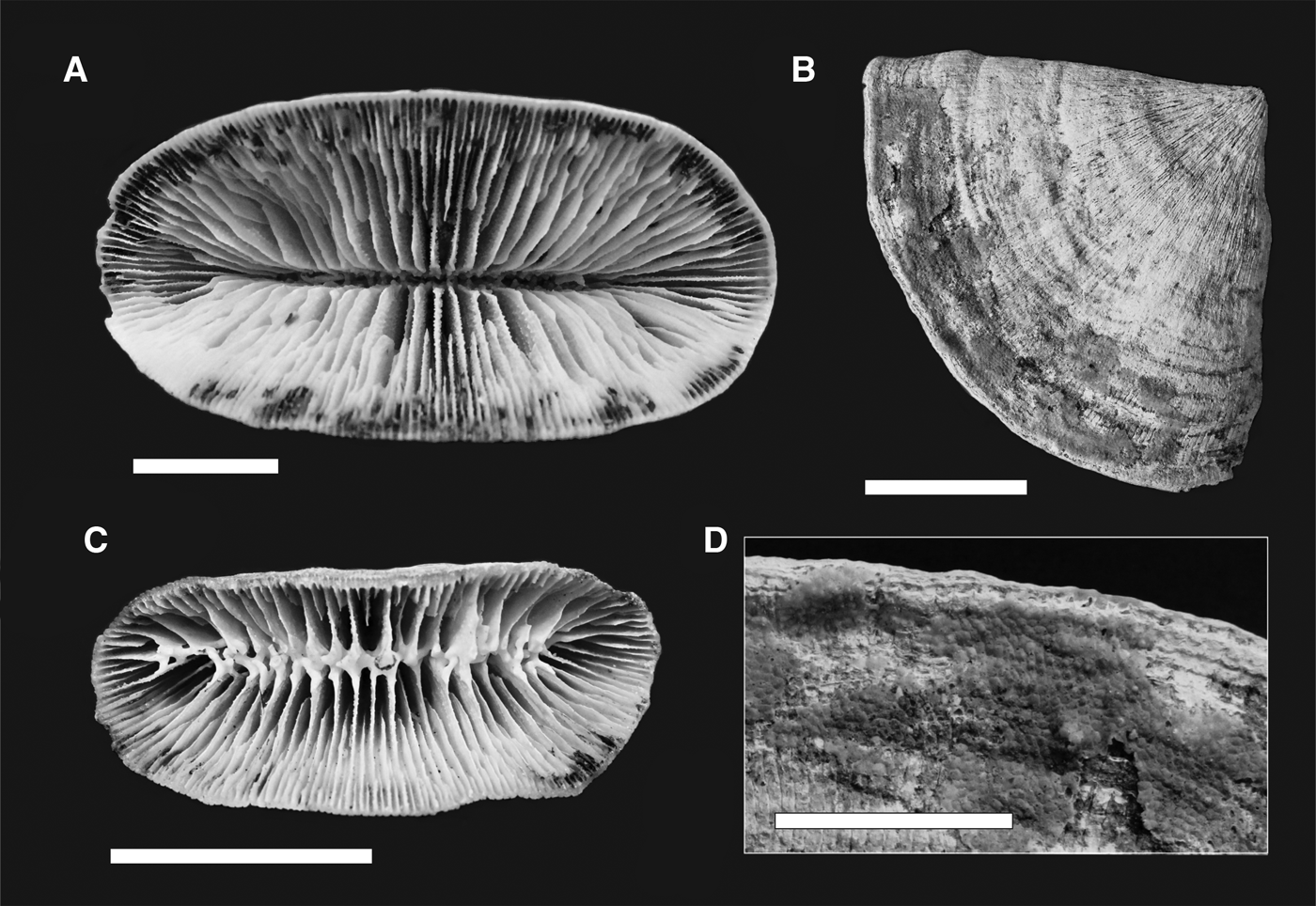
Nine individuals of Flabellum (Flabellum) impensum were identified. They were deposited at the Museo Argentino de Ciencias Naturales ‘Bernardino Rivadavia’, under the collection number MACN-In 39802. They all presented the typical flabellate shape of the species, a Greater Calicular Length/Lesser Calicular Length ratio (GLC/LCL) between 1.76 and 2.8, pedicels ranging from 2 to 3 mm in diameter, and had from 170 to 238 septa in the bigger individuals having six cycles (Figure 2, see Cairns, Reference Cairns1990 for descriptive and general terminology). The corals ranged between 43 and 65 mm in height. A rudimentary columella deep within the fossa (conformed after the fusion of lower inner edges of the septa) was evident in some broken individuals (Figure 2C).
Flabellum impensum specimens. (A) Calice; (B) Lateral view of flabellate corallum; (C) Broken individual showing the pseudocolumella; (D) Detail of the bryozoans colonies found attached to the side. Scale bars: A = 2 cm; B and C = 3 cm; D = 1 cm.
Bryozoa colonies were found on one or both sides of the corals (Figure 2D) on eight individuals, which could be interpreted as an indication of an upright living position, according to Cairns (Reference Cairns1982). One of the broken individuals also presented bored holes in one side.
Faunistic assemblage at the sampling site based on the catch of the haul showed the presence of a great variety of organisms, comprising many large individuals of the tunicate Paramolgula gregaria (Lesson, 1830) and the cirriped Austromegabalanus sp., and also large colonies of bryozoans. Additionally, at least 12 sponge morphospecies were collected, mollusks (Polyplacophora, Gastropoda and Bivalvia), many echinoderm species comprising the basket star Gorgonocephalus chilensis (Philippi, 1858), the ophiuroid Ophiactis asperula (Philippi, 1858) and the sea urchins Austrocidaris canaliculata (A. Agassiz, 1853) and Pseudechinus magellanicus (Philippi, 1857), primnoid and other soft corals belonging to Alcyonacea, sea anemones, polychaetes, many peracarid crustaceans and a few fishes.
The present results extend the distributional range of Flabellum (F.) impensum to South America, in Argentinean coastal waters of the Tierra del Fuego Province. This is also one of the shallowest records of the species (52 m), commonly found at depths ranging from 100 to more than 2000 m. Additionally, there was one unpublished (and up to present, doubtful) record of Flabellum impensum off the Buenos Aires Province, at 40.7°S 57.2°W, collected at a depth of 85 m in the research vessel ‘Edisto’ in the year 1959 (Figure 1). This record corresponded to a specimen of conical shape, deposited at the Smithsonian National Museum of Natural History and identified by Cairns (Collection No. 47377) (S. Cairns, personal communication). The present finding corroborates the presence of this species in Argentinean waters, extends its distribution to Tierra del Fuego Province (54°17.64′S) and helps to corroborate the early finding at 40.7°S in South America, updating the septentrional distribution range of Flabellum impensum.
ACKNOWLEDGEMENTS
The authors would like to thank Dr Stephen Cairns who checked the species identification, provided the early (unpublished) record and made useful suggestions for this paper. This study was partially supported by PICT 2013-0629 (to L. Schejter).