


Introduction
Why do judges vary in their support for a free press? Journalist and Booker Prize-winning novelist Arundhati Roy (Reference Roy1999) encountered the limits of judicial tolerance for critical expression after publishing an article sharply criticizing a court’s decision to lift a stay on the Sarovar Dam project in Gujarat, India. Roy described the decision as callous, inattentive to the needs of displaced communities and emblematic of broader failures in Indian governance. She was held in contempt. Writing for the Supreme Court of India, Justice R.P. Sethi defended the contempt order in the name of institutional preservation: ‘The confidence in the courts […] cannot, in any way, be allowed to be tarnished, diminished or wiped out by contumacious behavior[… Any] criticism of the judicial institution [which…] results in undermining the dignity of the courts […] has to be punished’ (In Re: Arundhati Roy 2002, para. 1–2).
Sethi’s argument departs sharply from conventional accounts of a free press in constitutional democracies. As the U.S. Supreme Court declared in New York Times v. Sullivan (1964, 270), public debate must remain ‘uninhibited, robust and wide-open,’ even when it involves ‘vehement, caustic and sometimes unpleasantly sharp attacks’ on public officials. That includes judges. Yet judges frequently use contempt powers to punish speech critical of their own conduct (Keck, Metroka and Price Reference Keck, Metroka and Price2018).Footnote 1
We argue that judicial support for a free press systematically declines when journalistic coverage threatens the judiciary’s institutional authority. Drawing on a dataset of 658 press freedom decisions from eight countries – Australia, Canada, Colombia, Germany, India, Norway, South Africa and the United States – and the European Court of Human Rights (ECtHR), we find judges significantly less likely to protect journalistic coverage when it targets courts rather than elected or administrative officials. Using a mixed-methods approach, supported by Annotation for Transparent Inquiry (ATI), we show that judges apply distinct justifications when restricting coverage critical of the judiciary. These shifts persist even when the tone of coverage is held constant and various institutional and legal factors are taken into account.
Our findings contribute to the scholarship on judicial behavior in two key ways. First, we identify a fundamental limitation in constitutional governance with significant normative implications. Because judges are the primary institutional guardians of press freedom, journalists encounter a structural conflict of interest when they turn their scrutiny on the courts themselves. Our findings show that judges are not immune to this conflict, applying press freedom protections less generously to coverage targeting the judiciary and the legal profession than to coverage targeting elected officials or bureaucrats. The normative implication is significant. The actors most empowered to enforce constitutional rights against powerful institutions are systematically less likely to do so when their own institution is at stake. Second, we extend the endogenous institutionalist literature by showing that judicial self-interest shapes press freedom adjudication across eight jurisdictions and a supranational tribunal, suggesting that the mechanism is a durable feature of judicial institutions rather than a product of any single legal culture.
Determinants of judicial behavior
Prominent new-institutionalist approaches to judicial behavior, including attitudinal models and some applications of the strategic model, have generated important insights about judicial behavior toward free speech and press (Baum Reference Baum2017; Botero et al. Reference Botero, Ellett, Keck and Stohler2021; Epstein and Segal Reference Epstein and Segal2006). Yet, these approaches have sometimes paid limited attention to how judges respond when journalistic coverage targets the judiciary itself, precisely when institutional self-interest is directly implicated.
Endogenous accounts, by contrast, emphasize motivations that stem from judges’ roles as institutional officeholders. Judges may act to preserve the authority, legitimacy, or prestige of the courts they control (Keck Reference Keck2007; Skowronek Reference Skowronek1995: 94; Spaeth Reference Spaeth1962). Some theories, including many strategic accounts, treat this endogenous interest instrumentally, as a means to pursue policy goals (Epstein and Knight Reference Epstein and Knight1998: 67; Maltzman, Spriggs II and Wahlbeck Reference Maltzman, Spriggs and Wahlbeck2000: 23). Others, drawing on historical or interpretive methods, treat institutional identity as constitutive. As Rogers Smith argues, political institutions ‘also have a kind of life of their own. They influence the self-conception of those who occupy roles defined by them in ways that can give those persons distinctively ‘institutional’ perspectives. Hence such institutions can play a part in affecting the political behavior’ of judges and other legal actors (Smith Reference Smith1988: 95). On this view, judges may act from a sense of duty or obligation rather than narrow self-interest (Smith Reference Smith1988: 95; see also Cover Reference Cover1975). A sense of duty might arise from judges’ self-conceptions, as Smith suggests. Or, perhaps judges meet their obligations because they feel compelled by the expectations of their audiences, as Lawrence Baum (Reference Baum2006) has argued.
Scholars have found considerable evidence supporting the idea that judges are motivated by such endogenous, institutional interests (Brandwein Reference Brandwein2011; Clayton and Gillman Reference Clayton and Gillman1999; Cover Reference Cover1975; Gillman Reference Gillman1993; Gillman and Clayton Reference Gillman, Clayton, Clayton and Gillman1999a; Gillman and Clayton Reference Gillman and Clayton1999b; Novkov Reference Novkov2001). Such commitments help to explain why judges sometimes adopt muted responses to authoritarian challenges from the political branches, while other times taking up the causes of victims of authoritarian violence (compare González-Ocantos Reference González-Ocantos2016; Hilbink Reference Hilbink2007: 5; Hilbink Reference Hilbink, Ginsburg, Moustafa, Ginsburg and Moustafa2008); why judges sometimes foster closer ties to social groups when issuing controversial decisions that bind the elected branches (Woods Reference Woods2017); why judges sometimes take advantage of opportunities to make international law binding on domestic actors, while other times avoiding such opportunities (compare Alter Reference Alter1996; Alter Reference Alter2009; Pavone Reference Pavone2022: 52–87) and adopt positions in free speech and press cases that seemingly go against their policy preferences (Bailey and Maltzman Reference Bailey and Maltzman2008). Endogenous commitments may also account for seemingly inconsistent rulings in free press cases, where judges support or restrict rights depending on how such decisions implicate judicial norms or institutional prestige (Bailey and Maltzman Reference Bailey and Maltzman2008; but see Lax and Rader Reference Lax and Rader2010).
We argue that such institutional motivations help explain Justice Sethi’s reaction. Criticism of courts uniquely implicates judicial legitimacy in ways that criticism of other institutions does not (Epstein and Knight Reference Epstein and Knight1998: 67; Keck Reference Keck2007; Maltzman, Spriggs II and Wahlbeck Reference Maltzman, Spriggs and Wahlbeck2000: 23; Skowronek Reference Skowronek1995: 94; Spaeth Reference Spaeth1962). Unlike criticism of elected officials or bureaucrats, press coverage of judges directly implicates the institutional integrity of the judiciary, raising concerns that may influence judicial behavior in similar ways across national contexts.
Hypotheses and alternative explanations
This institutional perspective generates a testable hypothesis. Journalists report on a wide range of public actors, including elected officials, bureaucrats, judges and private individuals. If judges act to preserve the legitimacy of the institutions they serve, then, all else equal, their support for journalists’ press rights should vary based on the subject of journalistic scrutiny. When journalists critique elected officials or bureaucrats, judges’ institutional interests are not directly implicated. But when courts themselves are the target, judges may respond more defensively. Accordingly, in free press cases involving media defendants, we expect less judicial support when the coverage targets judges rather than politicians or bureaucrats (
$ {H}_1 $
 ).
Extending this insight further, we cast judges not simply as narrowly favoring their judicial colleagues but instead as protecting the legal domain more broadly. Judges understand their roles and obligations as extending not just to their colleagues on the bench but also to other legal actors, institutions and processes, like trials. If true, we would expect those cases which involve critical coverage of trials or court officers (like prosecutors or defense attorneys) as well as judges to receive less judicial support for a free press than those involving criticism of politicians or bureaucrats not associated with legal proceedings (
$ {H}_2 $
 ).
Several alternative explanations could account for the observed pattern of judicial behavior. We review these here and incorporate them into our subsequent analyses. One possibility is legal rather than institutional. In some jurisdictions, constitutional or charter-based protections for free expression contain explicit exceptions for contempt of court. Article 19(2) of India’s Constitution, for example, contains one of these provisions. Perhaps, Justice Sethi would behave differently if India’s Constitution had been drafted differently. Such provisions may help explain comparatively lower levels of judicial support for journalists in those contexts, independent of any institutional self-interest.
A second alternative centers on journalists’ behavior. Perhaps, it is not so much who journalists cover, but how they cover them. Journalists may adopt a harsher or more defamatory tone when reporting on judges than on other figures. If so, it is the sentiment or tone of the coverage, not institutional concerns, that drives judicial behavior.
A third alternative focuses on the judiciary’s relative weakness. Judges may rule against journalists not because courts are their institutions but because they are weak. As the ‘least dangerous branch,’ the judiciary is often seen as ill-equipped to counter public criticism. Judges may thus be less motivated by institutional self-interest than by a normative concern about power imbalances and therefore might shield weaker institutions from perceived disproportionate attacks, while expecting more powerful officials to defend themselves. In the next section, we discuss the methodology used to test these various hypotheses and alternative explanations.
Research design
To assess whether judges are systematically less supportive of journalists’ free press claims when coverage targets the judiciary, the ideal approach would involve manipulating only the subject of criticism and observing resulting judicial behavior. In practice, however, we rely on observational data from appellate decisions in which journalists or media organizations invoke free speech or free press rights. These cases vary along many dimensions, including the target, content and tone of criticism, alleged harms, journalistic professionalism, national legal cultures and judicial composition.
A further source of heterogeneity concerns the temporal distribution of cases. Our sample spans a long historical period across courts operating under very different constitutional arrangements, raising the possibility that regime shifts rather than institutional self-interest are driving the observed asymmetry. This concern is most pronounced in the American context, where the Court began ruling in favor of free-speech claimants more systematically in 1931. However, the remaining courts in the judicial subject category issue decisions that cut in both directions in close temporal proximity, which is difficult to reconcile with a straightforward regime-change interpretation (see Figure F1, where we discuss in greater detail why we reject a regime-based account of the finding we assert here).
Given this variation and the relative rarity of the cases, we adopt a mixed methods approach to test the various hypotheses. Qualitative case studies allow us to assess the tone of coverage and interrogate judicial reasoning in depth, despite small sample sizes, while systematic coding and comparative analysis help us identify patterns across the broader population of cases. If both approaches point in the same direction, we can be more confident that observed patterns reflect genuine judicial sensitivities rather than idiosyncratic features of particular disputes. Overall, the different analysis across different data and methods enhances analytical leverage and mitigate concerns about any single measure or technique in isolation.
We analyze cases drawn from the Global Free Speech Repository (2015), focusing on cases in which journalists or media corporations claimed constitutional protection for coverage about public officials, political candidates, or private individuals. The sample includes 658 decisions from eight apex courts in democratic states and one supranational tribunal: South Africa, Germany, the United States, Norway, India, Canada, Australia, Colombia and the European Court of Human Rights (ECtHR) (Table 1). These high court decisions offer authoritative guidance on the scope of press protections. While influential, such cases are atypical in that they often present difficult legal questions and require claimants with the resources to pursue lengthy appeals.
Case selection and sample distribution by court

Table 1. Long description
The table consists of three columns titled Court, Frequency, and Percent. The rows list the following entities in order. European Court of Human Rights. Supreme Court of the United States. Constitutional Court of Colombia. Supreme Court of Norway. Federal Constitutional Court of Germany. Supreme Court of India. Supreme Court of Canada. High Court of Australia. Constitutional Court of South Africa. The final row is labeled Total. The data cells for Frequency and Percent are currently blank in this visual representation.
These courts were selected for three main reasons. First, they vary in the degree of protection afforded to journalists. while the U.S. Supreme Court and ECtHR offer comparatively strong safeguards, the Colombian and Indian high courts provide more limited support. Second, the sample spans multiple legal traditions and global regions, allowing for broader comparative insights. Third, it includes both national and supranational apex courts. The ECtHR is particularly valuable in this regard, as it brings together judges from diverse national backgrounds, offering a cross-national perspective within a single institution.
The sample was further limited to cases in which a journalist or media corporation asserted free speech or free press claims, as only these cases implicate the dynamics under investigation. The category of ‘media corporation’ proved overly broad and initially included cases involving the distribution of obscene or pornographic material. Such cases, along with those concerning non-political documentaries, were excluded as they primarily raised questions of sex or morality rather than press freedom. We also removed cases involving general regulatory challenges unless the regulation was clearly intended to punish critical coverage, as in Grosjean v. American Press Company (1936) (see Cortner Reference Cortner1996).
Our dependent variable measures the level of judicial support for free press claims. Each decision was coded for the proportion of judges siding with the journalist or media corporation, yielding a continuous measure that accounts for variation in panel size and split decisions. All the courts in our sample allow for dissenting opinions. We also tested the robustness of our results using a binary version of this measure, coding a decision as favorable to the press (1) if more than half of the panel sided with the journalist or media corporation and as unfavorable (0) otherwise. The two measures produced no meaningful differences in our results, which is perhaps unsurprising given that 78.6% of decisions in our sample were either unanimously in favor of or unanimously against press rights. Because the continuous measure is more interpretable and captures the full range of variation in judicial support, we focus on it in the main text (see Figures C1–C3 for binary results).
We also recorded whether any opinions invoked institutional justifications, such as those advanced by Justice Sethi, that defend press restrictions in the name of judicial dignity, legitimacy or the rule of law.
To test our institutional hypotheses, we systematically coded the primary target of journalistic criticism in each case as one of four categories: (1) private individuals, (2) elected officials or candidates, (3) bureaucrats or (4) legal actors. Two coders analyzed the underlying news stories to assess the story subject (
$ \kappa =0.846 $
 ). In cases involving hybrid or ambiguous roles, we conducted secondary coding to clarify the institutional context. For
$ {H}_1 $
 , the legal category was limited to stories about judges. For
$ {H}_2 $
 , it was expanded to include judges, lawyers (including prosecutors) and coverage of trials. Table 2 presents the distribution of these categories.
Frequency of story subjects, coding for
$ {H}_1 $
 and
$ {H}_2 $


Table 2. Long description
The table consists of five columns and six rows.
Column headers from left to right are: Story Subject, Decisions (first category), Sample (percent), Decisions (second category), and Sample (percent).
Row-by-row data:
* Private: 10 decisions (13.5 percent) for the first category; 15 decisions (18.1 percent) for the second category.
* Political: 31 decisions (41.9 percent) for the first category; 34 decisions (41.0 percent) for the second category.
* Bureaucratic: 28 decisions (37.8 percent) for the first category; 29 decisions (34.9 percent) for the second category.
* Judicial: 5 decisions (6.8 percent) for the first category; indicated by a dash for the second category.
* Legal: Indicated by a dash for the first category; 5 decisions (6.0 percent) for the second category.
* Total: 74 decisions (100 percent) for the first category; 83 decisions (100 percent) for the second category.
We also include three additional variables to account for potential confounders. First, we use a dummy variable indicating whether the jurisdiction’s constitution or charter-based free expression clause includes an explicit exception for contempt of court. Second, to control for the possibility that judges may rule against journalists not to defend the judiciary as an institution, but out of sympathy for officials who occupy comparatively weak institutional positions, we would ideally compare judicial treatment of criticism directed at judges versus criticism directed at analogous non-judicial officials, such as ombudsmen or administrative adjudicators. Our dataset does not include sufficient cases involving judge-like officials, such as ombudsmen. We, therefore, proxy institutional strength by coding the person bringing the legal action as a local, subnational (state/provincial), or system-wide (national/federal) actor on the theory that if judges are sympathetic to institutionally vulnerable plaintiffs, we would expect more pro-plaintiff rulings when the complainant is a local official than a national one because local officials command fewer resources, less formal authority and smaller platforms from which to respond to criticism. Two coders were used to assess this variable’s values (
$ \kappa =0.918 $
 ). In jurisdictions in which the government initiated legal proceedings on behalf of the story subject, we assessed institutional strength based on the level of the government actor.
Third, to determine whether the tone of the coverage at issue in each case impacts judicial behavior, we use a variety of approaches, leveraging the strengths of each to offset the weaknesses of others. First, we generate baseline regression results. Second, we conduct a sentiment analysis of all quotations of the underlying journalistic materials that judges use in their decisions. Sentiment analysis is a form of natural language processing (NLP) that identifies the emotions or attitudes associated with components of text (Grimmer and Stewart Reference Grimmer and Stewart2013), or ‘how do people feel about a given subject’ (Curini and Fahey Reference Curini, Fahey, Curini and Franzese2020: 534). Specifically, we employ existing dictionaries of English, French, German, Spanish and Norwegian to capture the positive or negative valence of words in the excerpts in our sample. While this dictionary approach has some limitations with minority languages (Mohammad Reference Mohammad and Meiselman2016) and specialized vocabularies (Rice and Zorn Reference Rice and Zorn2021), the languages examined here are closely related and studies using our dictionary approach yield consistent results across them (Mohammad Reference Mohammad and Meiselman2016: 24). Moreover, sentiment analysis is useful for providing supporting evidence to other approaches in mixed-methods designs like ours (Curini and Fahey Reference Curini, Fahey, Curini and Franzese2020: 537).
All statistical analyses were done in R (2025), and the sentiment analysis employed the syuzhet package (Jockers Reference Jockers2015; Jockers Reference Jockers2023).Footnote 2 In the baseline regression and the fuller models with sentiment data, each court of origin generates multiple observations, so we cluster by court of origin and use Bell-McCaffrey-adjusted standard errors (Bell and McCaffrey Reference Bell and McCaffrey2002; Blair et al. Reference Blair2022). Effectively, this approach controls for national legal culture and is similar to a fixed-effects model with clustered standard errors. Our most complete models include story subject and sentiment, control for the court rendering the decision and the level of the actor bringing the claim, and include interaction terms to capture the conditional relationship between story subject and sentiment, and we visualize the results to assist interpretation (Brambor, Clark and Golder Reference Brambor, Clark and Golder2006). All code is in the replication materials.
One caution is that sentiment analysis can misidentify the valence of a word whenever that word is extracted from its context. For example, journalists critical of political decisions will sometimes employ sarcasm or hyperbole in service of their arguments, substituting words with a positive valence when they wish to communicate something negative. Similarly, sentiment analysis cannot determine how much journalists deviate from the truth. Moreover, judges vary in their decisions about how much of the underlying publication they quote in their opinions. Each of these problems can affect the quantitative assessment of an article’s sentiment.
Our measurement choices are designed to mitigate these challenges. We examine only the negative sentiment scores of the underlying publications, excluding positive sentiment entirely. This directly addresses the sarcasm concern. Words deployed ironically to convey a negative meaning tend to carry a formally positive valence and therefore do not contaminate a measure based solely on negative valence words. We defend this decision on the additional assumption that story subjects will not seek legal remedies against publications with an overall positive sentiment, an assumption that our sample supports, as the average sentiment score is negative. To account for judges’ varied propensity to quote at length from the underlying material, we divide our sentiment scores by the total number of words considered as part of the sentiment analysis (i.e., [sentiment score]/[total words]), which we call a ‘sentiment ratio’ (or ‘negative ratio’ when only using negative sentiment scores).
Finally, we integrate the quantitative analysis with qualitative case studies, following Jason Seawright’s (Reference Seawright2016) multi-method framework, to assess whether the mechanisms suggested by our statistical findings are borne out in the content of judicial opinions. We use ATI (Jacobs, Kapiszewski and Karcher Reference Jacobs, Kapiszewski and Karcher2022) to ensure interpretive transparency and to enable readers to access the underlying materials directly. We focus on three courts selected to capture variation in baseline protectiveness. The ECtHR and the Supreme Court of India represent, respectively, among the more and less speech-protective courts in constitutional democracies over the period examined (Keck, Stohler, et al. Reference Keck, Stohler, Richard and Erik2015), while the U.S. Supreme Court exhibits significant intra-court variation over time. The U.S. Supreme Court was initially skeptical of press freedom claims involving criticism of the judiciary, but it later shifted to a far more protective posture. This trajectory suggests that institutional self-interest does not wholly determine judicial responses to press criticism and that ideological commitments to press freedom can, under some conditions, override it. Within each court, cases were selected on a most-similar basis. Specifically, we select clusters of cases comparable in the tone of the underlying journalistic coverage but diverging in outcome depending on whether the subject of coverage is a judicial or political actor. This design holds tone constant, isolating the association between the story subject and the arguments judges marshal in their opinions.
Judges’ institutional interests and a free press
This section presents our analysis of judicial behavior toward journalists reporting critically on private individuals and public officials. The evidence supports our institutional hypotheses, namely that judges are less protective of critical coverage when it targets the courts or the broader legal complex, consistent with
$ {H}_1 $
 and
$ {H}_2 $
 .
Descriptive analysis. We begin with some descriptive statistics. Although relatively basic, these descriptive results complement the more sophisticated analyses that follow and convey the core story in simple, straightforward terms. Figure 1 reports these descriptive statistics via a violin plot with the distribution of cases by story subject (horizontal axis) and the proportion of justices that supported free speech in the decision (vertical axis). Each point in the background is a case, and they are offset (jittered) so that all cases are visible. The width of each plot varies depending on the number of cases, and a horizontal dashed line marks the mean support for a free press for each story subject. This figure highlights a few patterns. First, the mean support for free press rights is lowest for cases with judicial subjects (57.6%), indicating that judges are less protective of critical coverage targeting courts than coverage targeting political actors (79.0%), bureaucrats (74.2%) or private story subjects (65.5%). Second, for most story subjects, the top of the violin plot is wider than the bottom, indicating a general tendency for these courts to rule unanimously in favor of press rights. The sole exception is the judicial subject category, where the top and bottom are of comparable widths, indicating that when coverage targets the courts, judges are nearly as likely to rule unanimously against press rights as for them.
Violin plot showing distribution of decisions by story subject and percent of justices who support a free press.

Figure 1. Long description
The Y axis is labeled percent support free speech and ranges from 0.00 to 1.00 in increments of 0.25. The X axis is labeled subject and contains four categories from left to right. Each category features a violin plot outline, a horizontal dashed red line indicating the mean, and light gray jittered dots representing individual data points.
* Political. The distribution is heavily skewed toward 1.00 with a wide top and a very thin neck extending down to 0.00. The mean is approximately 0.78.
* Bureaucratic. Similar to Political, the distribution is widest at 1.00 and tapers significantly toward the bottom. The mean is approximately 0.76.
* Judicial. This plot is narrow throughout with slight widening at the 1.00 and 0.00 extremes. The mean is the lowest of the groups at approximately 0.56.
* Private. The distribution is more evenly spread than the first two, with a wide top and a mean of approximately 0.65.
Across all categories, there is a high concentration of data points clustered exactly at the 1.00 and 0.00 marks.
Regression analysis. Figures 2 and 3 report the initial statistical results showing the effect of story subject on the percentage of time judges supported the free press rights of those story subjects. Figure 2 reports the analysis with ‘judicial’ story subjects (i.e., only judges), and Figure 3 reports the analysis with the broader class of ‘legal’ story subjects, which includes all legal actors: judges and court staff, as well as prosecutors and other lawyers. Each panel includes a base model on the left with only story subjects and a fuller model on the right that adds controls for court and level. Because of perfect collinearity between the court variable and the constitutional contempt exception, we include only the court variable in the full model. Notably, however, a separate model using only the contempt provision (reported in the Tables B1 and B2) counterintuitively shows that the presence of such a provision is positively associated with judicial support for free press. We interpret this result as an artifact of our sample composition. The European Court of Human Rights, which interprets a charter containing an explicit contempt exception, is also among the most protective courts in our dataset and contributes a disproportionately large share of observations.
Judicial support based on ‘judicial’ subjects from the justice sector. All models calculate standard errors clustered on court.

Figure 2. Long description
A two-panel coefficient plot with a shared y-axis and an x-axis labeled Beta ranging from negative 0.4 to 0.2. A vertical solid line marks the zero point.
Left panel titled base model:
* Political: Point estimate at 0.0.
* Bureaucratic: Point estimate slightly below 0.0 with a wide error bar extending from negative 0.15 to 0.1.
* Judicial: Point estimate at negative 0.22 with error bars from negative 0.3 to negative 0.15.
* Private: Point estimate at negative 0.15 with error bars from negative 0.2 to negative 0.1.
Right panel titled full model:
* Political: Point estimate at 0.0.
* Bureaucratic: Point estimate at 0.0 with wide error bars from negative 0.15 to 0.15.
* Judicial: Point estimate at negative 0.18 with error bars from negative 0.25 to negative 0.12.
* Private: Point estimate at negative 0.1 with error bars from negative 0.18 to 0.0.
* E C t H R: Point estimate at 0.0.
* Australia: Point estimate at negative 0.38.
* Canada: Point estimate at negative 0.32.
* Colombia: Point estimate at negative 0.35.
* Germany: Point estimate at negative 0.1.
* India: Point estimate at negative 0.2.
* Norway: Point estimate at negative 0.18 with error bars from negative 0.22 to negative 0.12.
* South Africa: Point estimate at 0.05.
* United States: Point estimate at negative 0.15.
* level: Point estimate at 0.0 with small error bars.
Judicial support based on ‘legal’ subjects from the justice sector. All models calculate standard errors clustered on court.

Figure 3. Long description
The two panels are titled base model on the left and full model on the right. Both share a horizontal axis labeled Beta ranging from negative 0.4 to 0.2 with a solid vertical reference line at 0.0. The vertical axis lists categories from top to bottom.
In the base model panel
* Political is at 0.0.
* Bureaucratic is at 0.0 with a wide horizontal error bar.
* Legal is at negative 0.22.
* Private is at negative 0.13.
* The remaining country and level rows are blank.
In the full model panel
* Political is at 0.0.
* Bureaucratic is at 0.03 with a wide error bar.
* Legal is at negative 0.18.
* Private is at negative 0.09.
* E C t H R is at 0.0.
* Australia is at negative 0.34.
* Canada is at negative 0.31.
* Colombia is at negative 0.34.
* Germany is at negative 0.11.
* India is at negative 0.20.
* Norway is at negative 0.18.
* South Africa is at 0.03.
* United States is at negative 0.16.
* level is at negative 0.01.
Judges in the sample were consistently less likely to protect journalists and media corporations from legal actions when the subjects of stories were judicial, compared to stories in which the subjects were political or bureaucratic actors. This is evident in the figure, where the reference category for story subject is ‘political’. The estimate for bureaucratic subjects is not statistically distinguishable from that for political subjects, whereas the estimate for judicial subjects is far to the left of zero, around
$ -0.2 $
 . That is, judges protected free press rights about 20% less often when journalists covered judicial or legal subjects (see panel b) than when they covered political or bureaucratic subjects. This core result remains stable across panels and in both the base and fuller models. The chilling effect of judicial subject matter on claimant outcomes holds even when ECtHR cases are excluded, allaying concerns about sample composition (see Figure E2).
The results are generally consistent with
$ {H}_1 $
 , especially with regard to the differences between (a) judicial and political actors and (b) judicial and bureaucratic actors, suggesting that anti-judicial coverage does indeed activate judges’ institutional interests in ways that implicate free press rights. The results also support
$ {H}_2 $
 , namely, that critical coverage of judges, lawyers, court staff or legal proceedings is expected to receive less judicial support for free press rights than those involving criticism of politicians or bureaucrats. Importantly, these patterns remain robust even after controlling for the identity of the high court and the institutional strength of the actor initiating proceedings against the journalist or media outlet. These results reinforce the conclusion that institutional self-interest, rather than legal status or institutional strength alone, helps explain variation in judicial support for press freedom.
Sentiment analysis
As discussed above, variation in judicial support for journalists’ free press rights may also reflect the tone of journalistic coverage. Judges may be less inclined to uphold such rights when the reporting appears unfair, inflammatory or overtly hostile. To evaluate this alternative explanation, we incorporate both sentiment analysis and qualitative case studies. We present the quantitative picture first. Table 3 summarizes the sample used for our sentiment analysis. The sample of 530 is smaller than the earlier sample of 658 from Table 1 because judges often failed to use direct quotations of the underlying material, or such materials had not been published, so not all court cases had excerpts that could be coded for sentiment.
Sentiment samples, constructed two ways (‘Judicial’ and ‘Legal’)

Table 3. Long description
The table is organized into seven columns. The first column is Subject, followed by two sets of three columns representing the Judicial and Legal constructions. Each set includes Decisions, Pct. (percentage), and Neg. ratio (mean).
* Private: Judicial Neg. ratio (mean) is negative 0.027. Legal Neg. ratio (mean) is negative 0.026.
* Political: Judicial Neg. ratio (mean) is negative 0.025. Legal Neg. ratio (mean) is negative 0.025.
* Bureaucratic: Judicial Neg. ratio (mean) is negative 0.026. Legal Neg. ratio (mean) is negative 0.026.
* Judicial: Judicial Neg. ratio (mean) is negative 0.027. Legal data is marked with dashes.
* Legal: Judicial data is marked with dashes. Legal Neg. ratio (mean) is negative 0.033.
* Total: Judicial Neg. ratio (mean) is negative 0.026. Legal Neg. ratio (mean) is negative 0.026.
Note: The Decisions and Pct. columns for both constructions are blank in the provided data except for the dashes in the Judicial and Legal subject rows.
For the materials analyzed here, our primary measure of sentiment is the negative ratio: the number of words with a negative valence divided by the total number of words quoted in the judicial opinion. As shown in Table 3, coverage of judges and other legal actors is, if anything, only slightly more negative than coverage of other public officials once the total number of quoted words is taken into account. Supplementary measures (reported in the Table A1) reveal that stories involving judges and legal actors do contain a higher absolute number of negative words. However, those differences disappear when controlling for the length of quoted material. We interpret this pattern as evidence that judges may become more defensive when their own institutions are the subject of critical reporting, leading them to reproduce longer excerpts from the underlying coverage. In this sense, the greater volume of quoted language in judicial opinions may itself reflect heightened institutional sensitivity. Crucially, even after accounting for sentiment and quotation length, the identity of the story subject continues to shape judicial outcomes, suggesting that institutional self-interest, rather than the tone of the reporting alone, plays a central role in shaping judicial behavior in free press cases.
We find support for the argument that the combination of story subject and sentiment influences judicial behavior toward journalists’ free press rights. Figure 4 displays our results for the full models with the interaction term while also controlling for court and level. The top row of graphs (panels a–c) reports results for court-related story subjects coded as ‘Judicial.’ The bottom row (panels d–f) reports results for the broader category of law-related subjects coded as ‘Legal.’ Following Brambor et al. (Reference Brambor, Clark and Golder2006)), we report both sides of the interaction and predicted values: the graphs on the left (panels a and d) report marginal effects for sentiment across story subjects, the middle graphs (panels b and e) report marginal effects for story subject across sentiment scores and the graphs on the right (panels c and f) report predicted values. Each row of graphs should be read together to assist interpretation.
The interactive effect of story sentiment and story subject on judicial support for a free press; left: marginal effect of sentiment; middle: marginal effect of subject; right: predicted values by subject and sentiment. The top row reports results for coding ‘judicial’. Bottom row reports results for coding ‘legal’.

Figure 4. Long description
The figure consists of six panels arranged in two rows of three.
Top row (judicial coding):
* Panel a: A dot plot showing the marginal effect of sentiment across four subjects: Political, Bureaucratic, Judicial, and Private. The Judicial subject shows the highest positive marginal effect, though all categories have 95 percent confidence intervals crossing the zero baseline.
* Panel b: Three line graphs showing the marginal effect of subject across negative ratio values. The subjects compared to Political are Bureaucratic, Judicial, and Private. The Judicial-Political comparison shows a steep positive slope as the negative ratio approaches zero.
* Panel c: A predicted value plot with three sentiment levels (negative ratio of negative 0.67, negative 0.18, and 0). For the Judicial subject, the predicted value is lowest when the negative ratio is highest.
Bottom row (legal coding):
* Panel d: Similar to panel a, but with the Legal subject replacing Judicial. The Legal subject shows a significantly higher positive marginal effect than the others, with a confidence interval entirely above zero.
* Panel e: Similar to panel b, comparing Bureaucratic, Legal, and Private subjects to Political. The Legal-Political comparison shows a strong positive slope.
* Panel f: Similar to panel c, showing predicted values. For the Legal subject, the predicted value is significantly negative when the negative ratio is negative 0.67, but increases toward zero as the ratio improves.
The results shown in panels a and d indicate that judicial support for journalists’ press rights increases with story sentiment but only for coverage targeting the judiciary or the legal profession. Sentiment narrowly misses a statistically significant effect for judicial story subjects at the .05 level, but this effect is significant at the .10 level (see Figure B1). The effect is highly significant for legal story subjects (panel d, at .001 level). That is, as we move across the full range of story subjects from left to right in Figures B1a and B1d, the marginal effect of sentiment is usually not statistically significant. The only departures from this pattern relate to story subjects coded as ‘judicial’ (
$ p<.10 $
 ) or ‘legal’ (
$ p<.001 $
 ).
Looking at the other side of the subject-sentiment interaction in the middle panels, judicial or legal story subjects generally do not have a meaningful effect (relative to political story subjects) except when sentiment is high, that is, less negative, and here only at .10 level for the ‘Legal’ subjects (see Appendices; the effect is evident when negative ratio is higher than
$ -0.5 $
 ). In greater detail, as we move from left to right across the full range of sentiment values, the effect of the subject ‘Judicial’ is consistently negative, as is the effect of the subject ‘Legal.’ However, the effect is only statistically significant for ‘Legal’ and at
$ p<0.10 $
 .
Lastly, the panels on the right (c and f) report predicted values of judicial support for free press across story subjects and at the minimum (black), median (dark gray) and maximum (light gray) values of sentiment (
$ -0.67 $
 ,
$ -0.18 $
 and
$ 0 $
 , respectively). The key findings here relate to judicial and legal story subjects. In panel c, there is an increased support for free press rights when both (a) the story subject is judicial and (b) the sentiment is higher, and this difference is significant at the 0.10 level. Even at median sentiment values, the predicted support for coverage related to judicial subjects is lower than that for political subjects, and the estimate falls outside the confidence interval for political subjects. The same pattern appears in panel f: increased support for free press rights when (a) the subject is legal and (b) sentiment is higher, and this difference is highly significant (
$ p<0.001\Big) $
 . Again, even at the median sentiment, there is less predicted support for legal subjects than for political ones.
Taken together, these findings clarify the conditional argument that judges respond more to the sentiment of journalistic coverage when that coverage is of their own home institution or legal profession than to the sentiment in coverage of other subjects. If the coverage is neutral or positive, judges respond protectively; if the coverage is negative, judges are more punitive. Put simply, judicial support for the press rights of the media is at its lowest when the story subject is the legal sector or profession and the tone of the coverage is negative. See Appendices for full results.
Qualitative analysis
We now turn to case studies from the three courts identified above. The ECtHR and the Supreme Court of India anchor opposite ends of the speech-protectiveness spectrum among constitutional democracies, yet both frequently invoke institutional concerns to justify limits on coverage critical of judges. The U.S. Supreme Court offers variation over time. Although initially deferential to judicial authority in contempt cases, the Court reversed course in Bridges v. California (1941), demonstrating that ideological commitments to press freedom can override institutional self-interest. Cases within each court were selected on a most-similar basis. We identify clusters of cases comparable in the tone of the underlying journalistic coverage, as confirmed by our sentiment scores, but that diverge in outcome depending on whether the subject of that coverage is a judicial or political actor. This design isolates the effect of story subject on judicial behavior by holding constant the variable most likely to confound our core finding, reinforcing our central claim that judges are measurably less supportive of press rights when the criticism is directed at their own institution than when it targets other public actors. Crucially, judges do not just reach different outcomes in such cases. They instead deploy a distinctively institutional set of justifications. When journalistic coverage implicates the judiciary, judges appear to reason from a perception of heightened institutional vulnerability. Because judicial authority depends on public confidence in ways that elected officials’ authority does not, judges often treat critical press coverage as a more existential threat and respond accordingly.
The European Court of Human Rights. The ECtHR provides an instructive setting for analyzing judicial responses to journalists’ free press claims. Under Article 10 of the European Convention on Human Rights, the Court applies a proportionality test, assessing whether restrictions (1) are ‘prescribed by law,’ (2) pursue a legitimate aim and (3) are ‘necessary in a democratic society.’ Though its application varies by case, the test consistently empowers ECtHR judges to reassess the facts independently of domestic legal standards. This transnational review operates within the Court’s ‘margin of appreciation’ doctrine, which grants deference to national traditions while enforcing principled scrutiny. Most decisions in our sample were issued by seven-judge chambers, with some decided by larger panels of up to 24 judges.
The Court is more likely to uphold journalists’ free press rights when coverage targets elected officials or bureaucrats than when it targets judges. This pattern suggests that judicial responses are shaped, at least in part, by institutional self-interest. While the ECtHR often affirms the press’s role as a ‘purveyor of information and public watchdog’ (Sweeney Reference Sweeney2012: 154), its rulings reveal a less protective stance when the judiciary itself is the object of criticism.The ECtHR case study is instructive precisely because the court’s strong record on freedom of the press makes the pattern we document all the more striking. Judges are less supportive of press rights when journalists cover the judiciary, even controlling for tone (Table 4).
ECtHR cases involving elected officials and judges

Table 4. Long description
The table consists of five columns: Case, Figure, Sentiment, Neg. ratio, and Support percentage.
* Row 1: Jucha and Żak v. Poland 2012. Figure: Political. Sentiment: minus 25. Neg. ratio: minus 0.044. Support: 100 percent.
* Row 2: Prager and Oberschlick v. Austria 1995. Figure: Judge. Sentiment: minus 23. Neg. ratio: minus 0.046. Support: 44.4 percent.
* Row 3: Lopes Gomes Da Silva v. Portugal 2014. Figure: Political. Sentiment: minus 23. Neg. ratio: minus 0.054. Support: 100 percent.
To establish a baseline for judicial receptivity to press freedom, we begin with two ECtHR cases involving defamation claims against elected politicians. Jucha and Żak v. Poland (2012) involved a news story about a politician who scored lowest (−25) in our sentiment analysis among ECtHR cases involving politicians. The article was essentially a hatchet job, chronicling the politician’s misdeeds and callousness. For example, the journalist reminded readers that ‘at the beginning of winter Councillor C. was involved in the eviction of two pregnant women from a flat located at … Street in Tarnów. Everyone also remembers the explanation of C. who described one of the evicted women as running a shebeen and suggested that she together with her daughter were women of easy virtue’ (Id. at 2). The journalist accused the politician of a series of legal improprieties, ‘denigrating people,’ lying and being overly sensitive and overly ambitious. And yet, despite the story’s harsh tone, the ECtHR asserted that ‘there is no doubt that those were matters of public interest and that reporting on them formed an integral part of the task of the media in a democratic society’ (para. 39). Indeed, the ECtHR repeatedly emphasized ‘the essential role played by the press in a democratic society. Although the press must not overstep certain bounds, regarding in particular the protection of the reputation and rights of others, its duty is nevertheless to impart – in a manner consistent with its obligations and responsibilities – information and ideas on all matters of public interest’ (para. 41). Accordingly, the Court afforded the publication significant leeway to scrutinize public officials, characterizing such reporting as essential to democratic oversight. All seven members of the judicial panel ruled in favor of the journalists.
Nor was the conspiratorial screed at issue in Lopes Gomes Da Silva v. Portugal (2000) all that much better. In this case, the manager of the Portuguese daily Público used the editorial pages to denounce the nomination of Mr. Silva Resende, a candidate for Lisbon City Council running on the Popular Party (Partido Popular–CDS/PP) ticket. The manager referred to Mr. Resende as an ‘unthinkable choice,’ ‘ideologically… grotesque,’ and ‘baffoonish’ candidate. Mr. Resende was ‘an incredible mixture of crude reactionaryism, fascist bigotry and coarse anti-Semitism’ while simultaneously ‘a character who represents the most complacent, stale and ridiculous aspects of the Portuguese right-wing’ (para. 10). Despite the polemical tone and inflammatory language, the ECtHR ruled unanimously in favor of the newspaper manager. Although the Court was again willing to acknowledge limits of acceptable criticism, the outer ambit of those limits was wider for public officials. The Court further lectured that politicians ‘inevitably and knowingly lays himself open to close scrutiny of his every word and deed.’ Therefore, this politician’s interest in the protection of his reputation had ‘to be weighed against the interests of open discussion of political issues’ (para. 30(ii).) In light of those considerations, the manager’s attacks were characterized as opinions appropriate in ‘a political debate on matters of general interest,’ and any adverse legal findings constituted a violation of Article 10 of the European Charter.
Journalists, however, have not always encountered the same degree of judicial leniency when their criticism targets the judiciary itself. The paradigmatic example is Prager and Oberschlick v. Austria (1995), a foundational case that continues to be cited by the ECtHR in nearly all subsequent rulings involving public criticism of judges. The case arose when, in 1987, Prager wrote a long-form article detailing his especially critical investigation of the Vienna Regional Criminal Court, entitled ‘Danger! Harsh Judges!’ The summary of the 13-page article accurately conveyed its tone:
[Judges] treat each accused at the outset as if he had already been convicted. They have persons who have travelled [sic.] from abroad arrested in court on the ground that there is a danger that they will abscond. They ask people who are unconscious after fainting whether they accept their sentence. Protestations of innocence are greeted on their part with a mere shrug of the shoulders and attract for their authors the heaviest sentence because they have not confessed. – Some Austrian criminal court judges are capable of anything; all of them are capable of a lot: there is a pattern to all this. (para. 9)
Prager reserved some of his harshest criticism for ‘Judge J,’ including that ‘Nothing was comparable to … Judge [J.]’s arrogant bullying’ and other reports of Judge J’s incompetence. As a consequence of his statements, an Austrian court sentenced Mr. Prager to 120 days in prison and ordered him to pay substantial damages, though both the custodial sentence and the monetary penalties were later reduced on appeal. When the case reached the ECtHR, the Court acknowledged the essential role that a free press plays in a democratic society. Yet, unlike in other defamation cases, in which it emphasized the need to protect robust public discourse, the Court here placed greater weight on the responsibilities that accompany press freedom. It observed that ‘the press plays a pre-eminent role in a State governed by the rule of law. Although it must not overstep certain bounds set, inter alia, for the protection of the reputation of others, it is nevertheless incumbent on it to impart – in a way consistent with its duties and responsibilities – information and ideas on political questions and on other matters of public interest.’ In contrast to its usual deference to harsh editorial tone in cases involving elected officials, the Court struck a notably different tone when the target was the judiciary, emphasizing the ‘special circumstances’ of the case and suggesting narrower protections for coverage critical of judges.
Regard must, however, be had to the special role of the judiciary in society. As the guarantor of justice, a fundamental value in a law-governed State, it must enjoy public confidence if it is to be successful in carrying out its duties. It may therefore prove necessary to protect such confidence against destructive attacks that are essentially unfounded, especially because judges who have been criticized are subject to a duty of discretion that precludes them from replying. (Id. at para. 34)
Many of the ECtHR cases resolved by the Court emphasized the imperative of maintaining public confidence in the judiciary. ‘By maintaining that the Viennese judges “treat each accused at the outset as if he had already been convicted,” or in attributing to Judge J. an “arrogant” and “bullying” attitude in the performance of his duties, the applicant had, by implication, accused the persons concerned of having, as judges, broken the law or, at the very least, of having breached their professional obligations. He had thus not only damaged their reputation but also undermined public confidence in the integrity of the judiciary as a whole’ (Id. at para. 36). The Court was further unpersuaded by Prager’s defense that he had exercised an adequate level of journalistic diligence in preparing the article (Id. at para. 37). While the majority acknowledged that freedom of expression encompasses exaggeration and even provocation, it concluded that Prager’s statements exceeded permissible bounds. This reasoning would come to shape a line of subsequent ECtHR decisions imposing significant limitations on journalistic criticism of judges. To be sure, journalists did prevail in some of these cases. But as the broader pattern suggests, their free press claims received markedly less judicial support when directed at the judiciary itself, underscoring the argument that institutional self-interest may inform judicial interpretations of press freedom.
Supreme Court of India. Unsurprisingly, courts less protective of expressive freedoms often mirror the ECtHR’s heightened sensitivity to criticism of the judiciary. The Supreme Court of India offers a telling example. While it has defended established figures and mainstream causes, it has been more reluctant to protect disfavored or marginal speakers, especially when their coverage does not align with core regime interests (Botero et al. Reference Botero, Ellett, Keck and Stohler2021). This pattern holds in cases involving anti-judicial coverage. Although the Court has occasionally sided with ‘legal insiders,’ such as prominent lawyers or former judges, it frequently invokes judicial dignity and institutional trust to justify restrictions. As the manuscript’s opening example shows, Indian judges regularly rely on institutional reasoning, reinforcing the view that judicial protections for coverage are shaped, in part, by perceived institutional interests. In this case study, we show that the Supreme Court of India has, on occasion, treated journalistic criticism of the judiciary harshly, even when controlling for tone (Table 5).
Indian Supreme Court cases involving elected officials and judges

Table 5. Long description
The table consists of five columns: Case, Figure, Sentiment, Neg. ratio, and Support percent.
* Row 1: R. Rajagopal v. Tamil Nadu 1994. Figure: Politician. Sentiment: minus 7. Neg. ratio: minus 0.062. Support percent: 100.
* Row 2: H.S. Nagra v. Kapil Sibal 2010. Figure: Judge. Sentiment: minus 6. Neg. ratio: minus 0.030. Support percent: 100.
* Row 3: In Re: H. Singh and V. Kumar 1996. Figure: Judge. Sentiment: 1. Neg. ratio: minus 0.011. Support percent: 0.
Once again establishing a baseline, the Indian Supreme Court demonstrated its willingness to protect journalistic freedom in R. Rajagopal v. Tamil Nadu (1994), even in the face of highly critical and potentially inflammatory content. In that case, a newspaper sought to publish excerpts from the autobiography of one of India’s most notorious serial killers. The manuscript implicated local officials in several of the murders, and the authorities had repeatedly attempted to block its publication. Despite the autobiography’s insinuations of official criminality and the risk that such revelations might undermine public confidence in law enforcement, the Court upheld the newspaper’s right to publish. The decision affirmed that journalists must be free to report on matters of public concern, even when their coverage casts government actors in a deeply unfavorable light. Notably, however, the target of the reporting in Rajagopal was the police and political authorities, underscoring a consistent judicial tendency to defend free expression when other institutions are the subject of criticism.
The forms of anti-judicial coverage adjudicated by the Indian Supreme Court closely resemble those encountered in other jurisdictions examined here. Judges have faced allegations of corruption, favoritism or professional impropriety, often provoking institutional defensiveness. A paradigmatic example is In Re: Harijai Singh and Vijay Kumar (1996). The case arose after the Sunday Tribune falsely alleged that the two sons of India’s Chief Justice had inappropriately been favored to receive allotments of petrol pumps. Despite issuing an unqualified apology for the erroneous reporting, the newspaper received no protection under the Court’s interpretation of Article 19. While the Court reaffirmed the foundational role of a free press in a democratic society, it emphasized that this freedom came with corollary duties. ‘The Editor of a Newspaper or a journal has a greater responsibility to guard against untruthful news and publications for the simple reason that his utterances have a far greater circulation and impact then the utterances of an individual and by reason of their appearing in print, they are likely to be believed by the ignorant’ (para. 11). Failure to live up to those responsibilities risked ‘disorder and anarchy’ (para. 11). The Court did not rehearse Justice Sethi’s institutional argument in full, but instead only obliquely referred to the repercussions ‘causing an embarrassment to this Court.’ Nonetheless, the justices proved particularly unsympathetic, stating that the ‘news items with which we are concerned can neither be said to be fair or made in good faith but wholly false and the explanation given is far from satisfactory’ (para. 12).
Strikingly, the Supreme Court of India has, at times, sided with non-journalists whose anti-judicial criticisms found their way into the press when those critics came from within the legal establishment. In Hari Singh Nagra v. Kapil Sibal (2010), the Senior Advocate Kapil Sibal circulated a private note lamenting the deteriorating state of the legal profession and outlining proposals for reform. Portions of the letter, which included pointed criticisms of the judiciary, were subsequently published, apparently without Sibal’s consent, by The Times of India, India’s largest newspaper. The Court treated Sibal’s remarks as ‘fair criticism’ and declined to sanction him. Nonetheless, it still required The Times of India to explain its editorial decision to publish the excerpts, even though the paper had issued an apology. The outcome illustrates the Court’s more lenient posture toward critical coverage emanating from legal insiders, even as it maintained tighter scrutiny over journalistic actors, reinforcing the claim that institutional proximity can shape judicial interpretations of free press protections.
Supreme Court of the United States. The United States stands as something of a global outlier in its approach to free press protections (Schauer Reference Schauer and Ignatieff2005). Although claimants before the ECtHR also enjoy relatively high success rates, the U.S. Supreme Court has been notably more receptive to free press arguments in domains where other courts have hesitated or drawn sharper limits (Howard Reference Howard2019; Krotoszynski Reference Krotoszynski2009; Rosenfeld Reference Rosenfeld2003; Saunders Reference Saunders2017). Justices Hugo Black and William O. Douglas, in particular, championed an especially expansive interpretation of the First Amendment, often advocating near-absolute protection for the communication of information. Their absolutist views extended even to journalistic criticism of the judiciary, as exemplified in Bridges v. California (1941). That decision marked a watershed in American free speech and press jurisprudence, signaling a shift away from earlier periods when courts regularly punished journalistic commentary on judicial conduct, often, though not always, in ways that resembled Justice Sethi’s argument. The U.S. case study thus underscores that history is not destiny. At least some justices have found ways to align their institutional roles with expansive press protections. Taken together, this variation reinforces the broader claim that judicial behavior toward the media is shaped by institutional interests, but that the suppression of journalistic criticism is not inevitable when courts are tasked with policing such coverage. Before Bridges, however, we can glean the same pattern as in our other case studies, in which judges seem to treat journalists differently, even when controlling for tone (Table 6).
SCOTUS cases involving elected officials and judges

Table 6. Long description
The table consists of five columns: Case, Figure, Sentiment, Negative ratio, and Support percentage.
* Row 1: Near versus Minnesota 1931. Figure: Politician. Sentiment: minus 16. Negative ratio: minus 0.035. Support: 56 percent.
* Row 2: Bridges versus California 1941. Figure: Judge. Sentiment: minus 5. Negative ratio: minus 0.031. Support: 56 percent.
The U.S. Supreme Court established a new baseline for First Amendment protections for journalists in Near v. Minnesota (1931). In that case, the owner of the Saturday Press published a series of incendiary articles about the local government, alleging that ‘a Jewish gangster was in control of gambling, bootlegging and racketeering in Minneapolis, and that law enforcing officers and agencies were not energetically performing their duties,’ implicating the Chief of Police in a corruption ring (Near v. Minnesota 1931, p. 704). The accusations, prominently displayed and aggressively detailed, were considerably more provocative than those at issue in later judicial contempt proceedings where press claims were rejected. Yet in Near, the Court refused to allow state officials to impose prior restraints, even in the face of inflammatory and potentially defamatory content. Crucially, Hughes emphasized the structural role of the press in checking government abuse, writing: ‘The fact that the liberty of the press may be abused by miscreant purveyors of scandal does not make any the less necessary the immunity of the press from previous restraint in dealing with official misconduct’ (720). Significantly, the Court declined to focus on tone or reputational harm. Instead, it grounded its analysis in the systemic role that press freedom plays in democratic accountability and thereby laying the foundation for a far more press-protective jurisprudence in the decades that followed.
This approach stood in stark contrast to earlier U.S. Supreme Court cases involving anti-judicial speech. On at least two occasions, the Court upheld contempt orders against newspapers that had published material critical of the judiciary. In one such case, the Court affirmed sanctions against the Toledo News-Bee after its editors published articles and cartoons critical of the judge for his handling of a contract matter involving the city and a local public transportation company. The Court justified its ruling by invoking a rationale that closely resembles Justice Sethi’s later argument: that suppressing certain forms of critical coverage was necessary to safeguard public confidence in judicial institutions. ‘The safeguarding and fructification of free and constitutional institutions is the very basis and mainstay upon which the freedom of the press rests, and that freedom, therefore, does not and cannot be held to include the right virtually to destroy such institutions’ (Toledo Newspaper Co. v. U.S. 1918, p. 419). In doing so, the Court prioritized institutional preservation over press freedom, underscoring how judges both in the United States and abroad have, at times, adopted similar reasoning when confronted with speech that directly challenges their authority. Moreover, these decisions seemed to fly directly in the face of a U.S. statute drafted in response to the impeachment of James H. Peck, the federal District Court Judge for the District of Missouri, who held an attorney in contempt for criticizing Peck’s reasoning in a land grant dispute (Currie Reference Currie2005: 185–89). Congress ultimately adopted a statute restricting the federal judiciary’s contempt powers only to those who ‘so near thereto as to obstruct the administration of justice’ (18 U.S.C. § 401). In these early cases, therefore, legal considerations did not seem to drive judicial decision-making.
But institutional dignity was never the only justification advanced for restricting anti-judicial coverage. Several years before the Toledo News-Bee case, Justice Oliver Wendell Holmes upheld contempt charges against former U.S. Senator and publisher of two newspapers Thomas M. Patterson for articles and cartoons suggesting that members of the Colorado Supreme Court had upended an election result favoring Republicans in exchange of appointments to the state’s supreme court (Patterson v. Colorado 1907). Importantly, Holmes did not base his reasoning on the protection of the judiciary’s reputation or institutional dignity. Instead, he defended the suppression of press freedom on the grounds that it was necessary to preserve the integrity of the judicial process, seemingly in line with 18 U.S.C. §401. In Holmes’s view, public commentary that might influence jurors, even if factually accurate, posed a threat to the fair administration of justice and could therefore be punished without violating the First Amendment.
A publication likely to reach the eyes of a jury, declaring a witness in a pending cause a perjurer, would be none the less a contempt that it was true. It would tend to obstruct the administration of justice, because even a correct conclusion is not to be reached or helped in that way, if our system of trials is to be maintained. The theory of our system is that the conclusions to be reached in a case will be induced only by evidence and argument in open court, and not by any outside influence, whether of private talk or public print. (Patterson v. Colorado 1907, p. 462)
Holmes’s reasoning in Patterson ultimately laid the groundwork for a very different result in Bridges v. California (1941), benefiting the judiciary’s critics. Bridges consolidated two anti-judicial coverage cases: the first involved a published telegram in which a labor leader threatened a retaliatory strike if a court-managed labor dispute was enforced; the second concerned the publication of editorials strongly advocating that a judge sentence two people to prison. In both instances, courts issued contempt citations against the publications. Unlike in earlier decisions, the Supreme Court, per Justice Hugo Black, rejected the contempt orders, holding that such coverage could be punished only if it posed a clear and present danger to the administration of justice. Black was unpersuaded by arguments that a free press should be curtailed to maintain reverence for the judiciary. He dismissed such reasoning explicitly: ‘The assumption that respect for the judiciary can be won by shielding judges from published criticism wrongly appraises the character of American public opinion. [… A]n enforced silence, however limited, solely in the name of preserving the dignity of the bench, would probably engender resentment, suspicion, and contempt much more than it would enhance respect’ (Bridges v. California 1941, p. 270). Although Black acknowledged that courts were distinct from other institutions, he nonetheless resisted blanket restrictions on commentary related to legal proceedings. Instead, he argued that the constitutionality of such speech must turn on ‘the circumstances of their publication to determine to what extent the substantive evil of unfair administration of justice was a likely consequence, and whether the degree of likelihood was sufficient to justify summary punishment’ (Bridges v. California 1941, p. 271).
While even Justice Black proved willing to allow limits on a free press to preserve a fair trial, the Supreme Court remained united in its support for a free press critical of judges thereafter. In Pennekamp v. Florida (1946), for example, the Court came to the defense of the Miami Herald for criticizing a judge’s handling of criminal cases, including eight rape indictments that the judge had sent back to a grand jury for re-presentation, suggesting that the judge would go out of his way to favor defendants. Shortly thereafter, in Craig v. Harney (1947), most of the Court supported journalists’ press rights after landing in contempt of court for coverage critical of a local judge after he had entered a directed verdict against a military veteran. The judge’s ‘behavior and attitude has brought down the wrath of public opinion upon his head, properly so. Emotions have been aggravated. American people simply don’t like the idea of such goings on, especially when a man in the service of his country seems to be getting a raw deal.’ The Court revisited and upheld the First Amendment protections for anti-judicial speech in Landmark Communications v. Virginia (1977) after a newspaper reported on a pending investigation of misconduct by a state judge.
The American case thus stands as something of an outlier, largely because Justice Black was willing to question the empirical premise that suppressing speech critical of judges would preserve the dignity or authority of the judiciary. Unlike many of his counterparts on other courts, Black refused to assume that institutional legitimacy could be strengthened through enforced silence. At the same time, however, he did not dismiss institutional concerns altogether. On the contrary, he acknowledged that restrictions on speech might be justified when necessary to ensure the proper functioning of institutions essential to democratic governance, such as the courts. In this respect, Black shared with judges around the world a common set of institutional priorities that could, at times, run counter to expansive speech protections. What distinguished him was his refusal to accept, without compelling evidence, that suppressing critical coverage would actually advance those institutional interests.
Conclusion
The quantitative and qualitative evidence presented in this paper supports the central claim that judges both ‘do what they say’ and ‘say what they do’ when responding to journalistic criticism of the judiciary: they act from a distinctly institutional motivation to preserve the authority and legitimacy of the courts. This tendency manifests as measurably lower judicial support for journalists’ free press claims when the subject of the coverage is the judiciary, as compared to analogous criticisms directed at politicians or bureaucrats (Figure 2). Moreover, when we adopt a broader understanding of judges’ institutional interests extending beyond personal criticism to include the perceived integrity of judicial proceedings, the effect grows more pronounced. In such cases, judicial protection of anti-legal coverage even falls below the level of protection afforded to coverage critical of private individuals (Figure 2).
Judicial responses to these cases are also characterized by a distinct set of justificatory arguments, and that distinctiveness speaks to a specific causal mechanism rooted in the institutional vulnerability of courts. The logic articulated by Justice Sethi in Arundhati Roy, namely, that false or disruptive coverage threatens the rule of law and public confidence in the judiciary, reappears in opinions issued by judges on the European Court of Human Rights and, at times, the U.S. Supreme Court. These arguments frame the judiciary as uniquely vulnerable to reputational harm, and that framing reflects a genuine structural condition. Unlike elected officials or bureaucrats, judges command neither sword nor purse. Instead, their authority rests on public perceptions of their legitimacy and the perceived integrity of legal processes. When a court’s legitimacy is publicly questioned, it has few comparable resources with which to respond, whereas legislatures can mobilize electoral support or bureaucrats can rely on administrative authority. Only a few judges, such as Justice Black in the United States and Judge Martens in his dissent in Prager, have challenged the empirical basis of this assumption, questioning whether suppressing anti-judicial coverage truly preserves institutional legitimacy. But these judges remain in the minority, often outvoted by colleagues more inclined to defend the institutions they serve. By revealing the reasoning judges deploy when they diverge from a protective posture, the qualitative evidence demonstrates that institutional vulnerability is not merely a background condition but an active consideration that shapes how judges frame their obligations, and, presumably, how they rule.
The qualitative findings reinforce the statistical trends. Courts frequently quote anti-judicial coverage at greater length than other forms of critical expression, and when controlling for the amount of quoted coverage, the sentiment of judicial opinions is no more negative in tone than in cases involving other targets of journalistic scrutiny. Indeed, the content of anti-judicial speech is often similar in substance and severity to coverage critical of other officials, routinely alleging professional misconduct or ethical improprieties. While two sentiment measures suggest that anti-judicial coverage is somewhat harsher in tone, these differences are not large enough to account for the observed decline in judicial support. Such effects also persist when we control for other legal and institutional explanations that would seem to yield similar behavioral patterns. The evidence suggests that judges’ institutional interests exert an independent and measurable influence on their willingness to protect coverage that challenges the judiciary itself.
These empirical findings have important implications for normative debates about the scope and enforcement of journalists’ free press rights. Journalists play a vital role in democratic governance, particularly by holding public officials, including judges, accountable. In general, the judges studied here have provided substantial support for press freedom. Yet, insofar as we rely on institutional actors to adjudicate and enforce rights claims, we must remain attentive to how institutional self-interest can shape those outcomes. Because these interests are endogenous to the very actors empowered to protect constitutional rights, it is unlikely that such biases can ever be eliminated entirely. The American case is instructive and offers an alternative path forward, suggesting that deeper commitments to free press ideals can, in some cases, help overcome such biases.
Acknowledgements
The authors are grateful to Nola Roberts for her excellent research assistance. They also thank Julie Novkov, Tom Keck, Matthew Baxter, Sebastian Karcher, and the anonymous reviewers for their helpful feedback on the project.
Data availability statement
This paper uses ATI, an approach to openness in qualitative scholarship. Access to the annotations, as an overlay to the digital article, can be found by viewing the full-text HTML of this article online at https://doi.org/10.1017/S2045381726100380. Access to a stand-alone copy of the annotations and underlying data is available via the Qualitative Data Repository at https://doi.org/10.5064/F6QK6YFW. Replication materials are available via Harvard Dataverse at https://doi.org/10.7910/DVN/QDGNMM.
Funding statement
This article draws on research supported by the National Science Foundation (SES-1535250).
Competing interests
The authors declare none.
Long descriptions
A. Descriptive information
In this appendix, we provide additional descriptive information about our sample and statistical analyses. Table A1 reports four alternate measures of sentiment across story subject categories: (1) the difference between words with positive and negative valence (Sentiment), (2) the sum total of words with a negative valence (Negative), (3) a ratio of the sentiment score in (1) to the total words quoted (Sentiment Ratio) and (4) a ratio of negative score to the total words quoted (Negative Ratio). Negative Ratio is the measure used in the main analysis.
Sentiment sample measured four ways, by story subject

Table A1. Long description
The table contains seven columns: Subject, Decisions, Pct. (percent), Sentiment (mean), Negative (mean), Sent. ratio (mean), and Neg. ratio (mean). The Decisions and Pct. columns are empty in this view.
* Private: Sentiment mean minus 3.12, Negative mean minus 6.88, Sent. ratio mean minus 0.014, Neg. ratio mean minus 0.027.
* Political: Sentiment mean minus 3.34, Negative mean minus 10.77, Sent. ratio mean minus 0.008, Neg. ratio mean minus 0.025.
* Bureaucratic: Sentiment mean minus 3.52, Negative mean minus 13.59, Sent. ratio mean minus 0.012, Neg. ratio mean minus 0.026.
* Judicial: Sentiment mean minus 8.78, Negative mean minus 18.59, Sent. ratio mean minus 0.012, Neg. ratio mean minus 0.027.
* Total: Sentiment mean minus 3.54, Negative mean minus 9.83, Sent. ratio mean minus 0.012, Neg. ratio mean minus 0.026.
The raw sentiment and negative word counts for cases involving judicial story subjects are considerably more negative than for other subject categories, suggesting that press coverage of judges and the legal profession tends to be more critical in tone. However, this gap narrows substantially when we turn to the ratio measures, with both the Sentiment Ratio and Negative Ratio for judicial subjects approaching the overall sample mean. Notably, the ratio measures for judicial subjects remain more negative than those for political subjects even after this compression. One interpretation is that judicial cases involve longer quotations, which inflate the raw counts without proportionally affecting the ratios. In any case, the convergence of the ratio measures across subject categories supports our use of the Negative Ratio as the primary measure in the main analysis, as it is less sensitive to variation in the volume of quoted material.
B. Additional results
In the main text, we rely on figures to communicate our main findings. We present the underlying regression tables here. In our baseline model (see Table B1, Model 1), we find support for
$ {H}_1 $
 : judicial support for journalists’ free press rights declines by almost 23% when those journalists cover judges when compared to journalistic coverage of political actors (base category).
Judicial support for free speech remains comparatively low when journalists cover judges

Table B1. Long description
A table with four columns: the first lists variables, and the subsequent three are labeled Model 1, Model 2, and Model 3.
* The Intercept values are 0.781 for Model 1, 0.650 for Model 2, and 0.844 for Model 3, all significant at p < 0.001.
* Bureaucratic variable shows non-significant coefficients: -0.017 (Model 1), -0.006 (Model 2), and 0.000 (Model 3).
* Judicial variable shows significant negative coefficients across all models: -0.226 (Model 1), -0.192 (Model 2), and -0.161 (Model 3), all at p < 0.001.
* Private variable shows significant negative coefficients: -0.136 (Model 1, p < 0.001), -0.103 (Model 2, p < 0.001), and -0.090 (Model 3, p < 0.05).
* Level variable is -0.011 in Model 2 and -0.006 in Model 3, both non-significant.
* Contempt variable is only in Model 2 with a significant positive coefficient of 0.200 (p < 0.001).
* Model 3 includes country-specific coefficients, all significant at p < 0.001 except where noted: Australia -0.367, Canada -0.309, Colombia -0.341, Germany -0.100, India -0.198, Norway -0.170, South Africa 0.034, and United States -0.156.
Standard errors are provided in parentheses below each coefficient. Significance levels are indicated by asterisks: one for p < 0.05, two for p < 0.01, and three for p < 0.001.
*p < 0.05, **p < 0.01, ***p < 0.001.
Standard errors in parentheses.
These results remain robust even after controlling for the complainant’s institutional strength and relevant legal factors, such as whether the jurisdiction recognizes a constitutional exception to free press for contempt of court (Model 2). Notably, judges in jurisdictions with such contempt provisions exhibited 20% greater support for journalists’ free press rights than those in jurisdictions without such provisions. This finding is counterintuitive: one might reasonably expect that the existence of a free-speech exception would make it easier for judges to restrict critical speech, not harder. We interpret this result as a function of the sample’s composition. A large proportion of our observations comes from the European Court of Human Rights (ECtHR), which is governed by a legal framework that permits contempt exceptions. Nevertheless, the ECtHR is among the most protective courts in our dataset regarding freedom of expression and press freedom. Accordingly, the observed positive association likely reflects the ECtHR’s institutional orientation toward rights protection, rather than the independent influence of the contempt provision itself. Diagnostics, including influence statistics (not reported here), also showed that the majority of influential observations came from the baseline model (Model 1), which was the ECtHR, further supporting the inference that the rights-protectiveness of the ECtHR is driving the results related to contempt provisions.
Model 3 takes the analysis one step further and also controls for systemic variation across high courts (the base category is the ECtHR), including explicit exceptions for contempt of court. And yet, even when controlling for these additional factors, support for
$ {H}_1 $
 remains robust, even if the size of the estimated effect has decreased somewhat.
Table B2 replicates this analysis for
$ {H}_2 $
 , examining judges’ behavior toward journalists who cover not just judges but also legal actors and trials more generally. Such coverage is associated with a 23% decrease in judicial support when compared to analogous political coverage. Model 4 shows the baseline model, which supports
$ {H}_2 $
 . Model 5 indicates robust support for
$ {H}_2 $
 when controlling for legal and institutional factors. Model 6 also indicates support for
$ {H}_2 $
 when controlling for systemic factors (with the ECtHR again serving as the base category).
Judicial support for free speech remains comparatively low when journalists cover legal actors

Table B2. Long description
The table consists of four columns: the first lists variables, and the subsequent three represent Model 4, Model 5, and Model 6.
* Intercept: Model 4 is 0.781, Model 5 is 0.647, and Model 6 is 0.845. All are significant at p < 0.001.
* Bureaucratic: Model 4 is 0.012, Model 5 is 0.028, and Model 6 is 0.033.
* Legal: Model 4 is -0.226, Model 5 is -0.205, and Model 6 is -0.179. All are significant at p < 0.001.
* Private: Model 4 is -0.134 (p < 0.001), Model 5 is -0.101 (p < 0.001), and Model 6 is -0.087 (p < 0.05).
* Level: Model 5 is -0.010 and Model 6 is -0.006.
* Contempt: Model 5 is 0.203 (p < 0.001).
* Australia: Model 6 is -0.343 (p < 0.001).
* Canada: Model 6 is -0.311 (p < 0.001).
* Colombia: Model 6 is -0.344 (p < 0.001).
* Germany: Model 6 is -0.105 (p < 0.001).
* India: Model 6 is -0.198 (p < 0.001).
* Norway: Model 6 is -0.180 (p < 0.001).
* South Africa: Model 6 is 0.031 (p < 0.001).
* United States: Model 6 is -0.157 (p < 0.001).
Standard errors are provided in parentheses below each coefficient. Significance levels are indicated by asterisks: one for p < 0.05, two for p < 0.01, and three for p < 0.001.
*p < 0.05, **p < 0.01, ***p < 0.001.
Standard errors in parentheses.
Figure B1 reports the same graphs as shown in Figure 4 in the main text but at the 90% confidence level (
$ p<.10 $
 ).
The interactive effect of story sentiment and story subject on judicial support for free press; left: marginal effect of sentiment; middle: marginal effect of subject; right: predicted values by subject and sentiment. Top row reports results for coding ‘judicial’. Bottom row reports results for coding ‘legal’.

Figure B1. Long description
The figure consists of six panels arranged in two rows of three.
Top row, coding judicial.
Panel a, Marginal effect of sentiment across subjects. A dot plot with 90 percent confidence interval bars. The x axis lists subjects: Political, Bureaucratic, Judicial, and Private. The y axis is the marginal effect of sentiment slope from negative 2 to 4. Judicial shows the highest positive effect, while Bureaucratic is near zero.
Panel b, Marginal effect of subject across values of sentiment. Three line graphs showing slopes for Bureaucratic minus Political, Judicial minus Political, and Private minus Political as sentiment negative ratio moves from negative 0.6 to 0.0. The Judicial minus Political slope shows a sharp linear increase toward zero.
Panel c, Predicted Judicial Support for Free Speech. A dot plot comparing three negative ratio levels: negative 0.67, negative 0.18, and 0. For the Judicial subject, predicted values are lowest at the negative 0.67 ratio.
Bottom row, coding legal.
Panel d, Marginal effect of sentiment across subjects. Similar to panel a, but the third subject is Legal instead of Judicial. Legal shows a high positive effect.
Panel e, Marginal effect of subject across values of sentiment. Similar to panel b, with Legal replacing Judicial. The Legal minus Political slope shows a steep linear increase from negative 2 to 0.
Panel f, Predicted Judicial Support for Free Speech. Similar to panel c, showing predicted values for Political, Bureaucratic, Legal, and Private subjects. For the Legal subject, the predicted value is significantly lower at the negative 0.67 ratio compared to the other subjects.
C. Robustness checks with a binary outcome (0,1)
The main analysis in the manuscript examines a continuous outcome. Some readers may be interested in binary case outcomes, and whether the results are stable when the dependent variable is coded dichotomously (1 = decision supports press rights; 0 otherwise).Footnote 3 The subsequent figures report this analysis of a binary version of the dependent variable. Decisions are coded 1 if more than half the justices supported press rights (i.e., 1 if
$ pct>0.5 $
 ; 0 otherwise).
The core findings remain unchanged. Figures C1 and C2 show that the results with the binary outcome are virtually identical to those reported in Figures 2 and 3. Also, Figure C3 reports predicted values for the full, interactive model, showing the conditional relationship between sentiment and story subject, similar to the right-hand panels in Figure 4. Again, there are no meaningful differences in the results.
Judicial support for press rights based on ‘judicial’ subjects from the justice sector. Outcome is binary: 1 = support for press rights; 0 otherwise. All models calculate standard errors clustered on the court.

Figure C1. Long description
The plot consists of two side-by-side panels with a shared y-axis and an x-axis labeled Beta ranging from negative 0.8 to 0.0. A vertical zero line indicates the point of no effect.
Left Panel: base model.
- Political: Point estimate at 0.0.
- Bureaucratic: Point estimate at negative 0.2 with a wide horizontal error bar extending from negative 0.5 to 0.2.
- Judicial: Point estimate at negative 0.6 with an error bar from negative 1.0 to negative 0.3.
- Private: Point estimate at negative 0.4 with an error bar from negative 0.6 to negative 0.2.
Right Panel: full model.
- Political: Point estimate at 0.0.
- Bureaucratic: Point estimate at negative 0.1 with a wide error bar from negative 0.5 to 0.3.
- Judicial: Point estimate at negative 0.45 with an error bar from negative 0.8 to negative 0.1.
- Private: Point estimate at negative 0.3 with an error bar from negative 0.5 to negative 0.1.
- E C t H R: Point estimate at 0.0.
- Australia: Point estimate at negative 0.7.
- Canada: Point estimate at negative 0.75.
- Colombia: Point estimate at negative 0.95.
- Germany: Point estimate at negative 0.4.
- India: Point estimate at negative 0.6.
- Norway: Point estimate at negative 0.45.
- South Africa: Point estimate at 0.1.
- United States: Point estimate at negative 0.45.
- level: Point estimate at 0.0.
Judicial support for press rights based on ‘legal’ subjects from the justice sector. Outcome is binary: 1 = support for press rights; 0 otherwise. All models calculate standard errors clustered on court.

Figure C2. Long description
The plot consists of two side-by-side panels titled base model and full model. The X-axis is labeled Beta and ranges from negative 1.0 to 0.5. A solid vertical line marks the zero point. The Y-axis lists categories from top to bottom: Political, Bureaucratic, Legal, Private, E C t H R, Australia, Canada, Colombia, Germany, India, Norway, South Africa, United States, and level.
In the base model panel:
* Political is slightly below zero.
* Bureaucratic is negative with a wide error bar crossing zero.
* Legal is significantly negative, centered around negative 0.7.
* Private is negative, centered around negative 0.4.
* The remaining country-specific categories are blank in this panel.
In the full model panel:
* Political and Bureaucratic are centered on zero with wide error bars.
* Legal remains negative at approximately negative 0.6.
* Private is negative at approximately negative 0.3.
* E C t H R is centered on zero.
* Australia, Canada, and Colombia show significant negative coefficients, with Colombia being the most negative at approximately negative 1.0.
* Germany, India, Norway, and United States show moderate negative coefficients between negative 0.4 and negative 0.6.
* South Africa and level are centered on or very near zero.
Predicted values by story subject and story sentiment showing the interactive effect of sentiment and subject on judicial support for free press; Panel a reports results for coding ‘judicial’. Panel b reports results for coding ‘legal’.

Figure C3. Long description
Two side-by-side dot plots titled Predicted Judicial Support for Free Speech with a subtitle Sentiment equals Negative Ratio. Both panels share a y-axis labeled predicted value ranging from 0 percent to 100 percent. A legend at the bottom of each panel identifies three negative ratio levels: minus 0.67 represented by black dots, minus 0.18 by dark gray dots, and 0 by light gray dots.
* Panel a: The x-axis categories are Political, Bureaucratic, Judicial, and Private. For Political, support is lowest at minus 0.67 and highest at 0. For Bureaucratic, support is moderate across all ratios. For Judicial, support drops significantly to 0 percent at minus 0.67 but remains high at 0. For Private, support is moderate at minus 0.67 and high at 0.
* Panel b: The x-axis categories are Political, Bureaucratic, Legal, and Private. The trends for Political, Bureaucratic, and Private are similar to Panel a. For the Legal category, support is at 0 percent for the minus 0.67 ratio, approximately 10 percent for minus 0.18, and nearly 80 percent for the 0 ratio.
Vertical error bars indicate the confidence intervals for each data point, with wider intervals generally observed for the minus 0.67 negative ratio across most categories.
D. Case selection for integrated, mixed-methods design: Additional criteria
Figure D1 reports typicality scores for the cases in our sample. These data are organized by court and story subject.
Violin plot of typicality scores by court and case subject.

Figure D1. Long description
A violin plot displays typicality score abs open parenthesis residual close parenthesis on the Y axis from 0.00 to 1.00. The X axis lists nine courts from left to right. E C t H R, Australia, Canada, Colombia, Germany, India, Norway, S A, and U S.
Individual data points are color coded by case subject. Political in pink, Bureaucratic in green, Judicial in teal, and Private in purple.
* E C t H R has the highest density of points concentrated between 0.10 and 0.30, with a long tail extending to 0.90.
* Australia and Canada show narrower distributions with lower density.
* Colombia and Germany exhibit elongated distributions with peaks near 0.40 and 0.20 respectively.
* India shows a distinct bulge around 0.45.
* Norway and U S show relatively even distributions across the score range.
* S A has no visible violin plot, only a few scattered points.
Specific data labels are scattered throughout, such as 273 and 58 in E C t H R, 614 in Colombia, and 652 in U S.
Typicality scores are the absolute value of the residual for each observation (Seawright Reference Seawright2016; Seawright and Gerring Reference Seawright and Gerring2008). Observations include only those in the final model with the interaction between story subject and sentiment (
$ N=529 $
 ). The numbers in the plot are unique identifiers for cases with judicial subjects (identification numbers and points are offset to avoid overlap, so they are not always close together).
High scores identify poorly predicted cases, that is, off-the-line, ‘deviant’ or ‘atypical’ observations; low scores identify well-predicted cases, that is, on-the-line, ‘typical’ observations (Seawright Reference Seawright2016; Seawright and Gerring Reference Seawright and Gerring2008). In low-scoring, typical cases, a research is in a confirmatory mode, seeking to flesh out causal mechanisms or pathways that illuminate the associations in the regressions. In high-scoring, atypical cases, a researcher is in an exploratory, ‘discovery’ mode to identify new explanations or hypotheses or to improve measurement. Seawright (Reference Seawright2016) argues that these types of cases are more promising than typical cases.
E. Drawing inferences from our sample
The ECtHR provides a disproportionate share of cases to our sample, raising a potential concern that this one court may be driving the model’s results. In this section, we address this concern in two ways. First, we generate influence diagnostics in order to better discern whether ECtHR may be largely responsible for our findings. If the concern is the accuracy of our estimated coefficient for judicial story subject, then a particularly useful measure of influence is the change in this coefficient if we sequentially delete each observation. This influence measure is specific to the key explanatory variable of interest (judicial story subject) and can be generated for each observation. This measure of influence is called
$ dfbetas $
 and has been called ‘the most direct measure of influence’ (Fox Reference Fox1990). A negative dfbeta means that the overall coefficient for judicial is pushed in a negative direction if that observation is excluded. Conversely, a positive dfbeta means that the overall coefficient for judicial is pushed in a positive direction if that observation is excluded.
Figure E1 plots dfbetas, organized by court, with ECtHR cases falling in the broad middle of the figure. In this figure, there are several observations from the ECtHR that are very positive and others that are very negative, offsetting each other. Specifically, there are four observations with the most negative dfbetas, and eight observations with some of the more positive dfbetas, though of lower magnitude (size) than the negative dfbetas. Also, there are observations from other courts that have a large impact on the coefficient for judicial story subjects in both a negative and positive direction. If the ECtHR were driving the negative coefficient for the judicial variable, then there would be a disproportionately large number of positive dfbetas among the ECtHR observations, without any countervailing negative dfbetas. That is not the case.
Impact on coefficient of judicial variable (dfbetas) for each observation.

Figure E1. Long description
A scatter plot titled d f b e t a s values for coefficient of Judicial with a subtitle stating Thresholds are at plus or minus 2 divided by the square root of n.
* The y-axis is labeled d f b e t a s and ranges from negative 0.2 to 0.2.
* The x-axis is labeled Observation index and ranges from 0 to 600.
* A dashed black line sits at y equals 0. Two solid red horizontal lines represent the influence thresholds above and below the zero line.
* Data points are color-coded by country or entity: Australia, Canada, Colombia, E C t H R, Germany, India, Norway, South Africa, and United States.
* Most observations cluster tightly around the zero line.
* Significant outliers are marked with vertical blue lines connecting the point to the zero baseline and labeled with observation numbers.
* Notable positive outliers include observations 6, 27, 169, 220, 281, 480, 500, 504, 531, and 607, which is the highest peak near 0.3.
* Notable negative outliers include observations 10, 55, 179, 277, 279, 337, 499, 529, 572, and 645.
* The distribution shows higher volatility and more frequent threshold crossings in the later observation indices, particularly between 450 and 650.
Additionally, Table E1 complements this figure by identifying the 10 cases with the most positive dfbetas and the 10 cases with the most negative dfbetas. As Table E1 demonstrates, the four cases that exert the most negative influence on our estimate all come from the ECtHR, and these cases pull most strongly against our finding. That is, by retaining these cases in our sample, which we do, we make it more difficult to detect the effect we report. The cases that pull in the opposite direction, lending support to our estimate, come from the Indian, American and Colombian courts, though not necessarily with similar magnitude. To be sure, Table E1 also identifies ECtHR cases with positive dfbetas, though with considerably lower magnitude. The asymmetry between these two sets of ECtHR cases suggests that, at the extremes, the ECtHR is not responsible for our observed effect. Indeed, if anything, including the ECtHR cases constitutes a kind of harder test for the relationship we find.
Most influential cases in the sample: DFBETA values for the 10 lowest- and 10 highest-scoring observations

Table E1. Long description
The table contains four columns: Case number, Support percentage, Court, and d f b e t a.
Top 10 lowest d f b e t a values:
- Case 55: 0.00 percent Support, E C t H R, -0.303.
- Case 277: 0.00 percent Support, E C t H R, -0.303.
- Case 179: 0.00 percent Support, E C t H R, -0.299.
- Case 270: 0.00 percent Support, E C t H R, -0.299.
- Case 10: 0.00 percent Support, Germany, -0.250.
- Case 646: 0.00 percent Support, United States, -0.217.
- Case 499: 0.00 percent Support, India, -0.173.
- Case 500: 0.00 percent Support, India, -0.173.
- Case 530: 0.11 percent Support, United States, -0.173.
- Case 573: 0.00 percent Support, India, -0.170.
Top 10 highest d f b e t a values:
- Case 169: 1.00 percent Support, E C t H R, 0.149.
- Case 281: 1.00 percent Support, E C t H R, 0.149.
- Case 220: 1.00 percent Support, E C t H R, 0.156.
- Case 27: 1.00 percent Support, Germany, 0.177.
- Case 6: 1.00 percent Support, Germany, 0.177.
- Case 481: 1.00 percent Support, India, 0.190.
- Case 501: 1.00 percent Support, India, 0.199.
- Case 532: 1.00 percent Support, United States, 0.200.
- Case 505: 1.00 percent Support, United States, 0.208.
- Case 608: 1.00 percent Support, Colombia, 0.283.
Lastly, Figure E2 reports a more blunt, split-sample approach in which we simply drop all ECtHR observations from the analysis and then also examine the ECtHR on its own. Our original full base model is on the left, the model without the ECtHR is in the middle, and the model with only the ECtHR is on the right. In the middle panel, even after a substantial reduction in sample size (
$ N=246 $
 ), judicial support for free press claimants in cases involving judicial story subjects remains negative and statistically significant (
$ p<.01 $
 ). The contrast with cases involving private story subjects is instructive. In those private-story subject cases, the effect for private subjects disappears once ECtHR cases are excluded and our other controls are introduced, whereas the effect for judicial subjects persists. In the right panel, examining only the ECtHR, the effect of judicial story subjects is still negative but the statistical significance has weakened (though still significant at the 90% level).
These patterns suggests that our core finding is not an artifact of the ECtHR’s disproportionate share of the sample. Rather, these auxiliary analyses support the conclusion that our core finding reflects a durable feature of how courts across diverse legal systems adjudicate press freedom claims involving judicial story subjects.
Coefficient plots for full base model (
$ N=657 $
 ), base model without ECtHR (
$ N=246 $
 ) and base model with only ECtHR (
$ N=411 $
 ). In the model without ECtHR, the reference category is the United States. In the model with only ECtHR, there are no other courts, so standard errors are not clustered.

Figure E2. Long description
A three-panel coefficient plot. The horizontal axis for all panels is Beta, ranging from negative 0.4 to 0.4 with a vertical reference line at 0. The vertical axis lists variables: Political, Bureaucratic, Judicial, Private, E C t H R, Australia, Canada, Colombia, Germany, India, Norway, South Africa, United States, and level.
Panel 1, full base model: Political and E C t H R are at 0. Bureaucratic is at 0 with wide error bars. Judicial, Private, Australia, Canada, Colombia, Germany, India, Norway, and United States are all negative, with Australia being the most negative at negative 0.4. South Africa is slightly positive. Level is at 0.
Panel 2, base model without E C t H R: Political and Private are at 0. Bureaucratic is positive at 0.2. Judicial, Australia, Canada, Colombia, India, and Norway are negative. Germany and South Africa are positive. Level is slightly negative.
Panel 3, base model with only E C t H R: Political is at 0. Bureaucratic, Judicial, and Private are negative, with Judicial having the widest error bars extending to negative 0.4. The country-specific variables and level are not plotted or are at 0.
F. Rejecting a regime-based account
As noted in the manuscript, a fourth alternative explanation of the phenomenon we uncover here focuses on the effect of political regimes. Some of the judicial politics literature inspired by Robert Dahl (Reference Dahl1957) accounts for judicial behavior as the product of judges’ membership in dominant political coalitions. These arguments have been especially influential in the American context (see, e.g., Gillman Reference Gillman, Clayton and Gillman1999; Levinson Reference Levinson2006) and may help to explain important shifts in judicial reception toward a free press generally. The U.S. Supreme Court is perhaps the most well-documented example. Before 1931, the Court ruled in favor of exactly one free speech claimant in Fiske v. United States (1927). After 1931, by contrast, it proved far more receptive to such claims. A regime-based account would threaten our inference if judicial-subject cases were disproportionately decided during periods when courts viewed free speech and press claims dimly, while arising less frequently or not at all during more speech-protective periods. Under this scenario, the asymmetry we identify could reflect the timing of litigation rather than judges’ institutional self-interest.
We can cast doubt on this alternative explanation by presenting the data in a slightly different way. According to a regime-based account, we would expect courts to show weak support for free press claims involving judicial-story subjects during periods when they generally show weak support for free speech and press claims. In addition, during periods of strong judicial support for a free press, courts consider a disproportionately smaller share of cases involving judicial-story subjects when judicial support for free-press rights is high. Figure F1 allows us to examine the confluence of these patterns by plotting judicial support for free press claims involving judicial and non-judicial story subjects across courts over time. The American case offers the most support for the regime explanation. We document this shift in our case study of the U.S. Supreme Court. But the U.S. Supreme Court considered a comparable number of judicial-story subject cases before and after the supposed regime shift, suggesting that any difference we do find in judicial support based on story subject cannot be accounted for by a regime-based account, even in the place where it holds real explanatory power. In the European Court of Human Rights, by contrast, which contributes the largest share of our observations, no clear relationship is evident, even when we include loess-smoothers, which we do not present here because of the number of assumptions we would have to make to test the regime explanation fairly across different countries. We further note that the regime concept is difficult to apply to the European Court of Human Rights at all because it is situated very differently from domestic high courts and lacks the tight party-court alignment that makes regime periodization tractable (see, e.g., Balkin Reference Balkin2020: 15). In addition, no obvious parallel pattern is evident in the high courts of Canada, Colombia, Germany, or India. Courts contributing too few judicial-subject cases to infer a pattern are, for the same reason, unlikely to be driving the asymmetry we identify. Taken together, the figure suggests that the asymmetry we identify is not reducible to regime-level variation in any single court, much less the overall sample.
Judicial support for free press claims by story subject and court over time. Points represent individual case outcomes, measured as the percentage of judges supporting the free press claimant, and are jittered slightly for visibility. Judicial subject are shaded darkly, and non-judicial subjects are in light gray.

Figure F1. Long description
The multi-panel scatter plot consists of nine panels arranged in a three-by-three grid. The x-axis represents the year from 1925 to 2000, and the y-axis represents the percentage of judicial support from 0.00 to 1.00. Dark black dots represent judicial subjects, and light gray dots represent non-judicial subjects.
* Top row panels: E C t H R shows a high density of cases concentrated after 1975, with many points at 1.00 and 0.00. Australia has very few cases, appearing around 1975 to 2000. Canada shows a sparse but upward-trending distribution starting after 1975.
* Middle row panels: Colombia shows cases clustered near the year 2000, primarily at the 1.00 and 0.00 extremes. Germany shows a concentration of cases between 1950 and 2000, with several judicial subjects at the 1.00 mark. India shows a scattered distribution starting around 1950, with several judicial subjects at 0.00 after 1975.
* Bottom row panels: Norway shows a small cluster of cases starting after 1975. South Africa shows a very sparse set of cases near the year 2000. The United States panel shows the longest historical record, beginning before 1925, with a high density of both judicial and non-judicial subjects distributed across all percentage levels between 1950 and 2000.

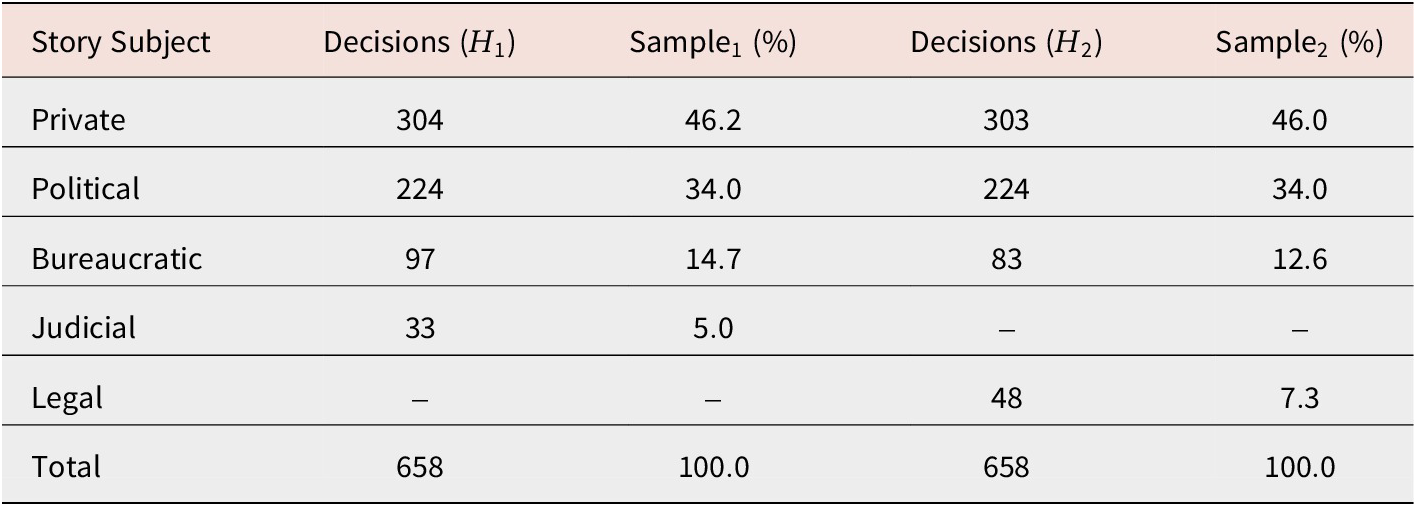


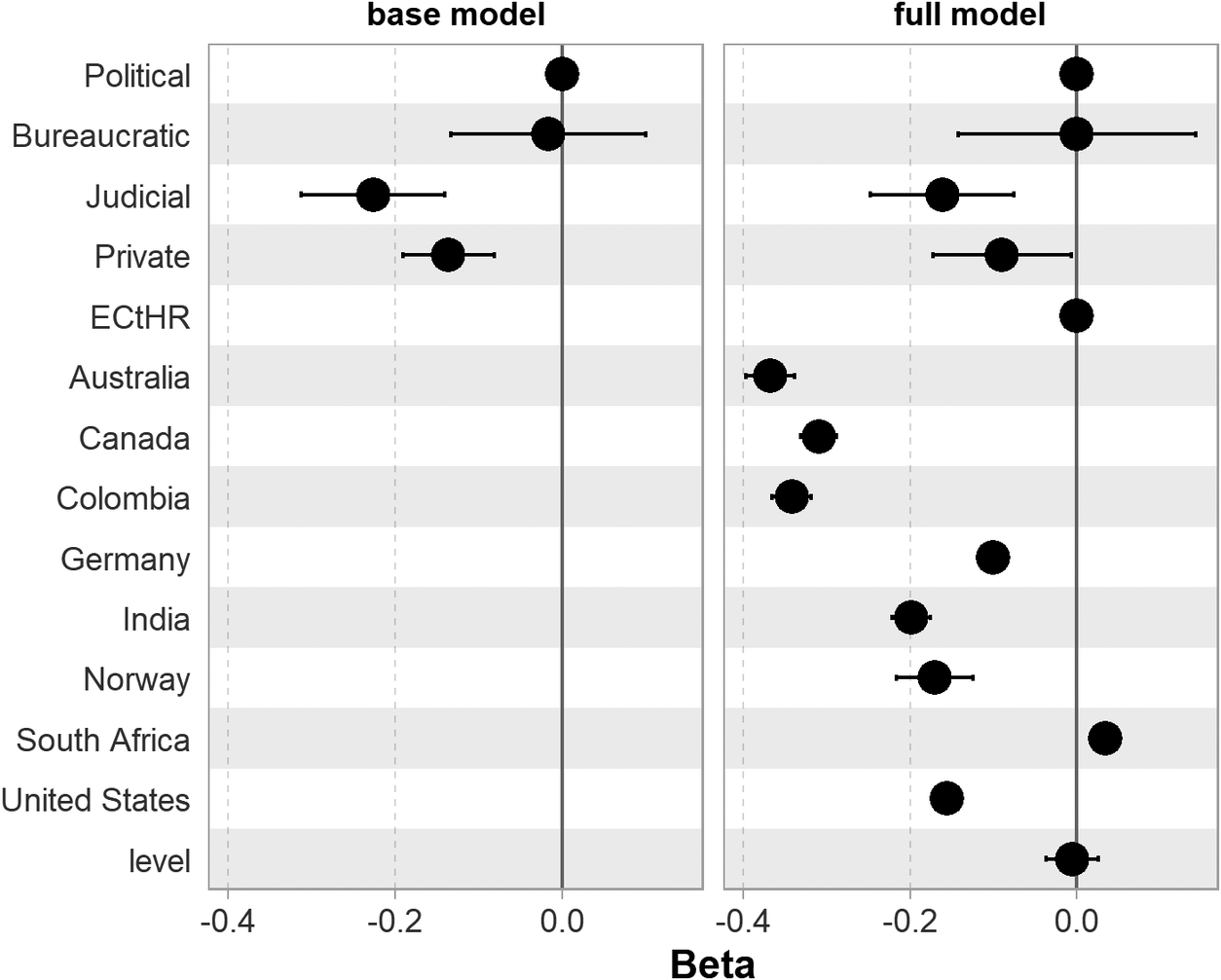
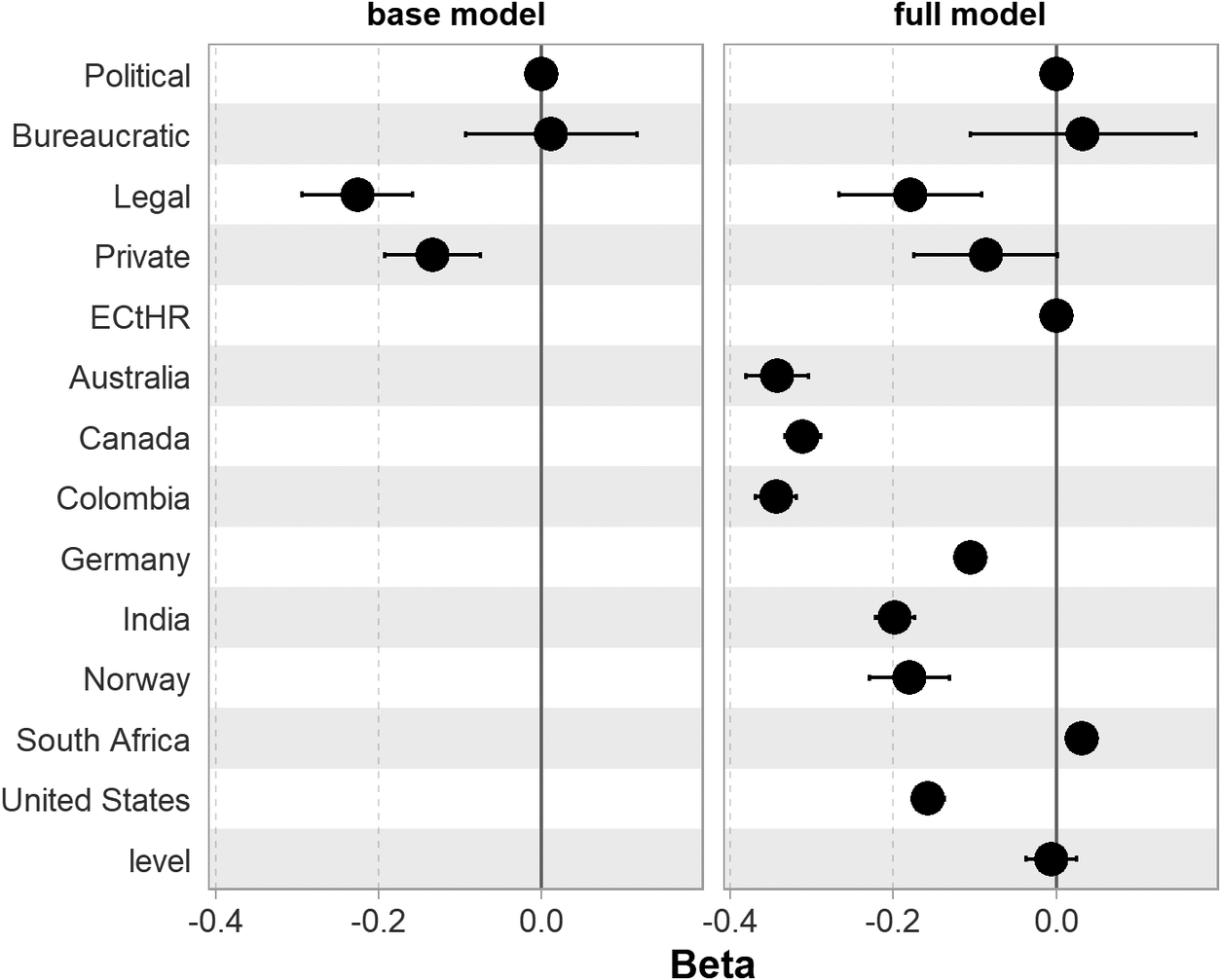
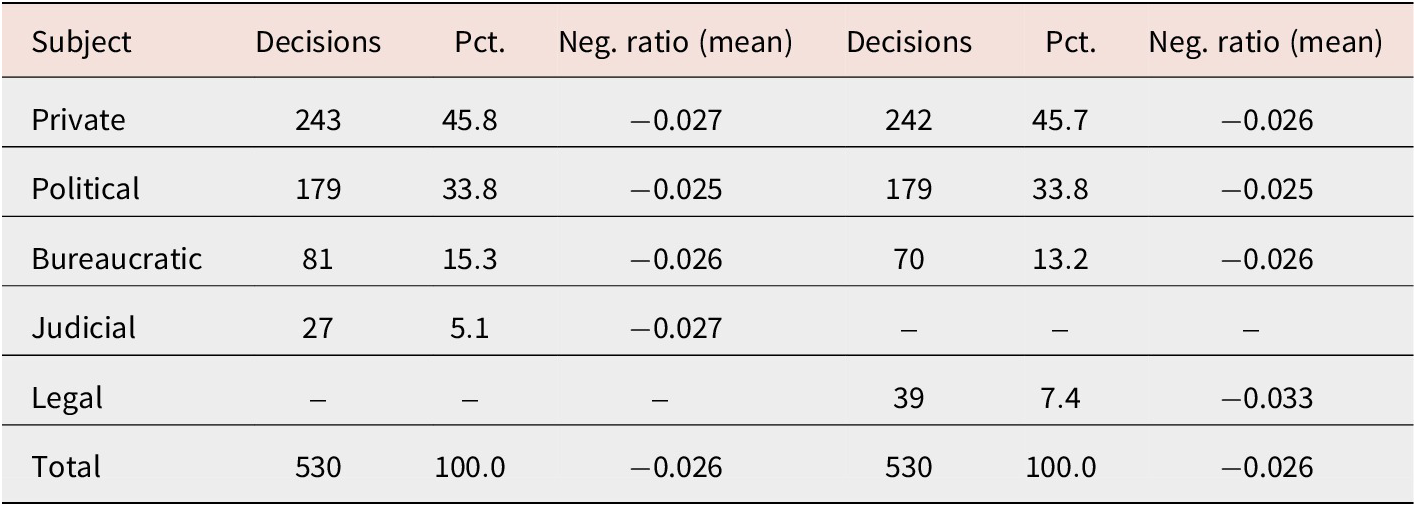

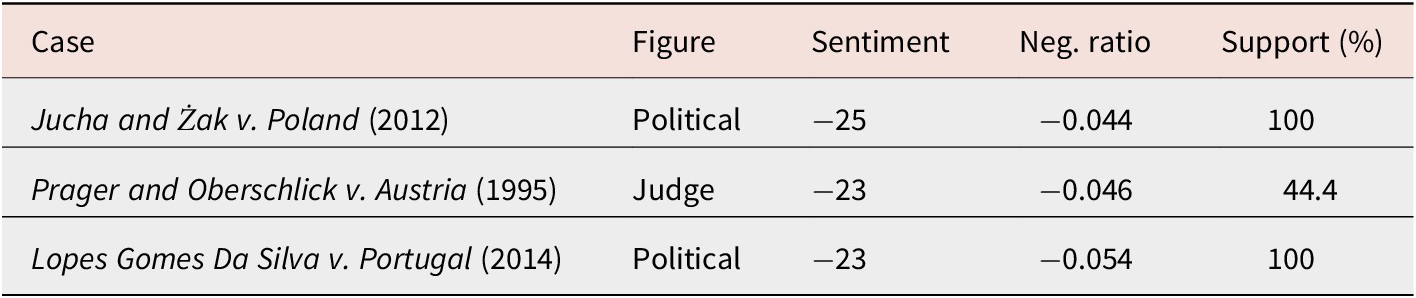
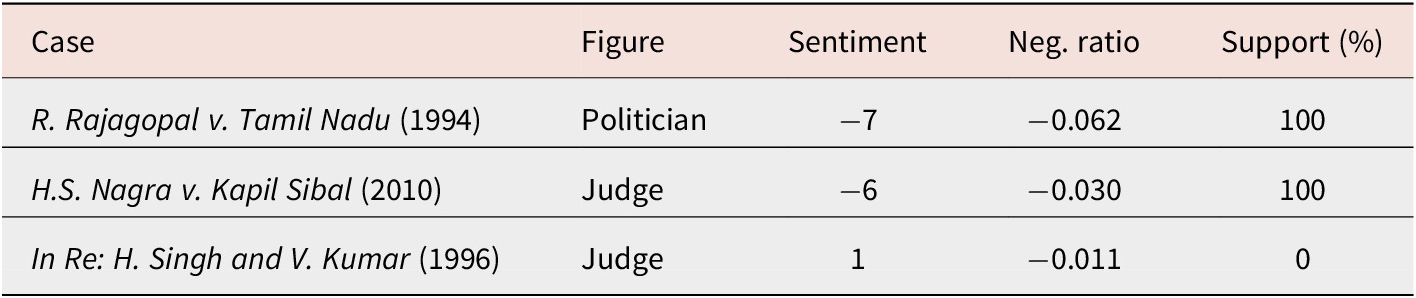

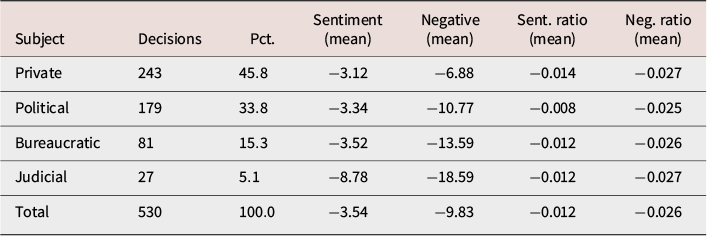


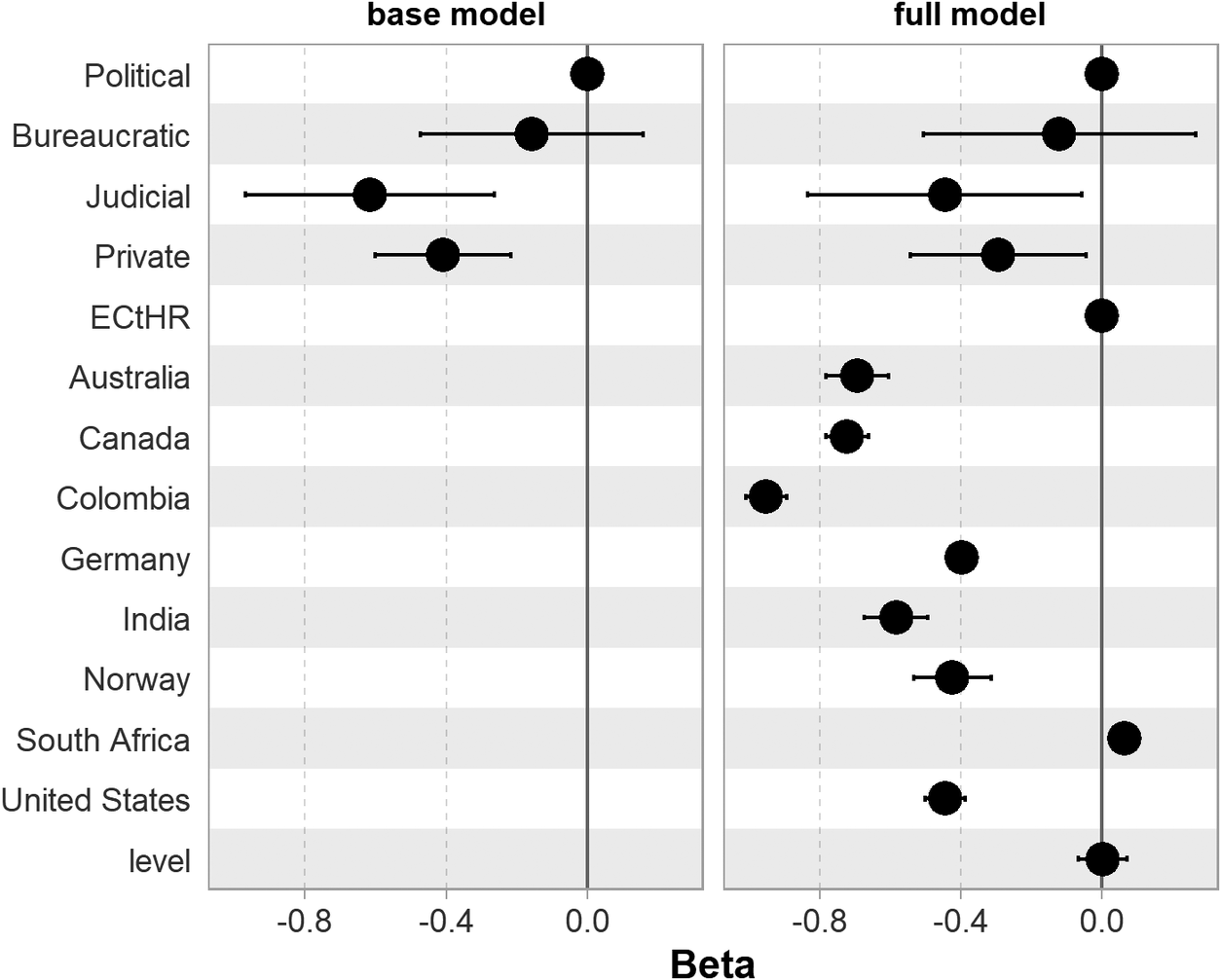
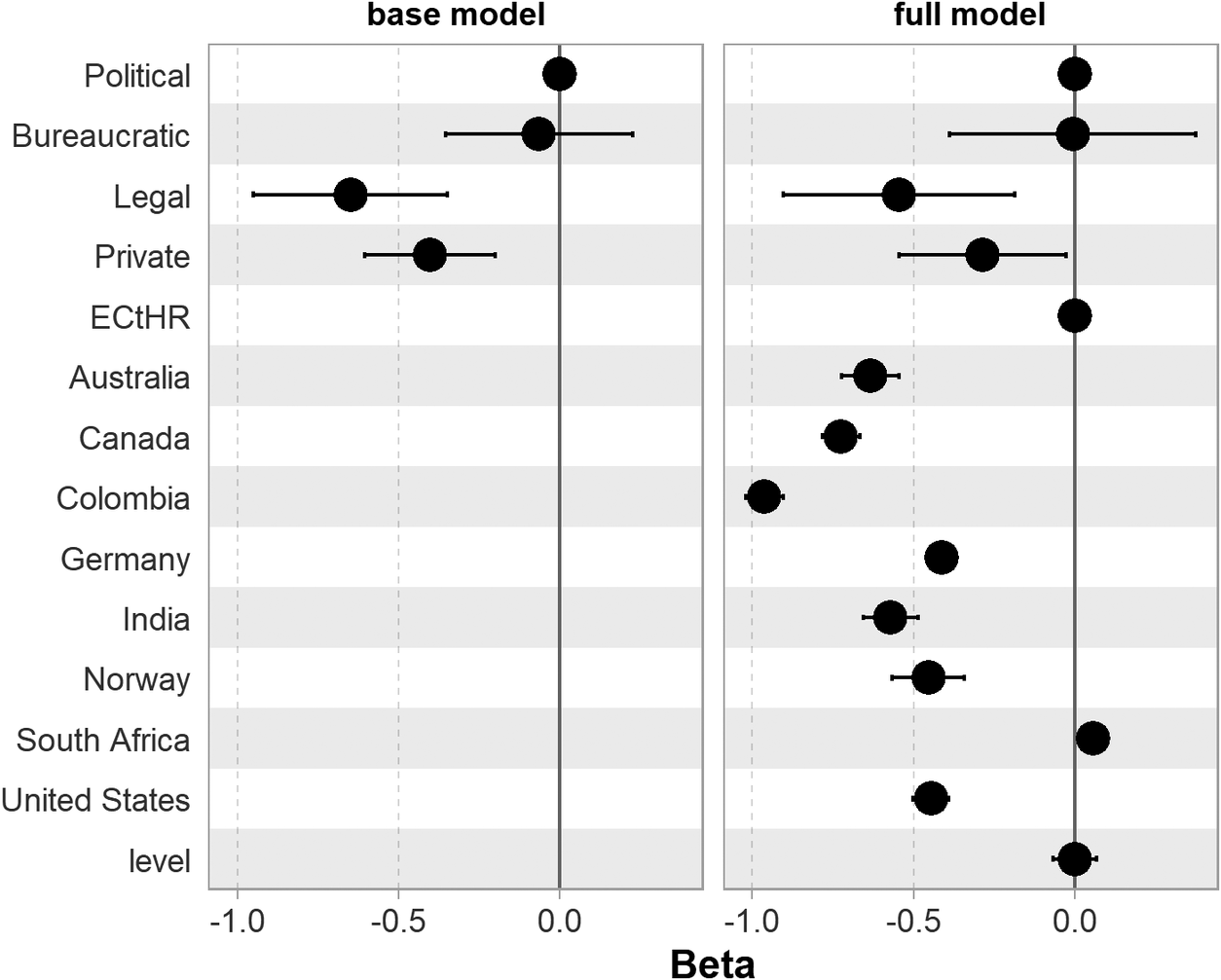
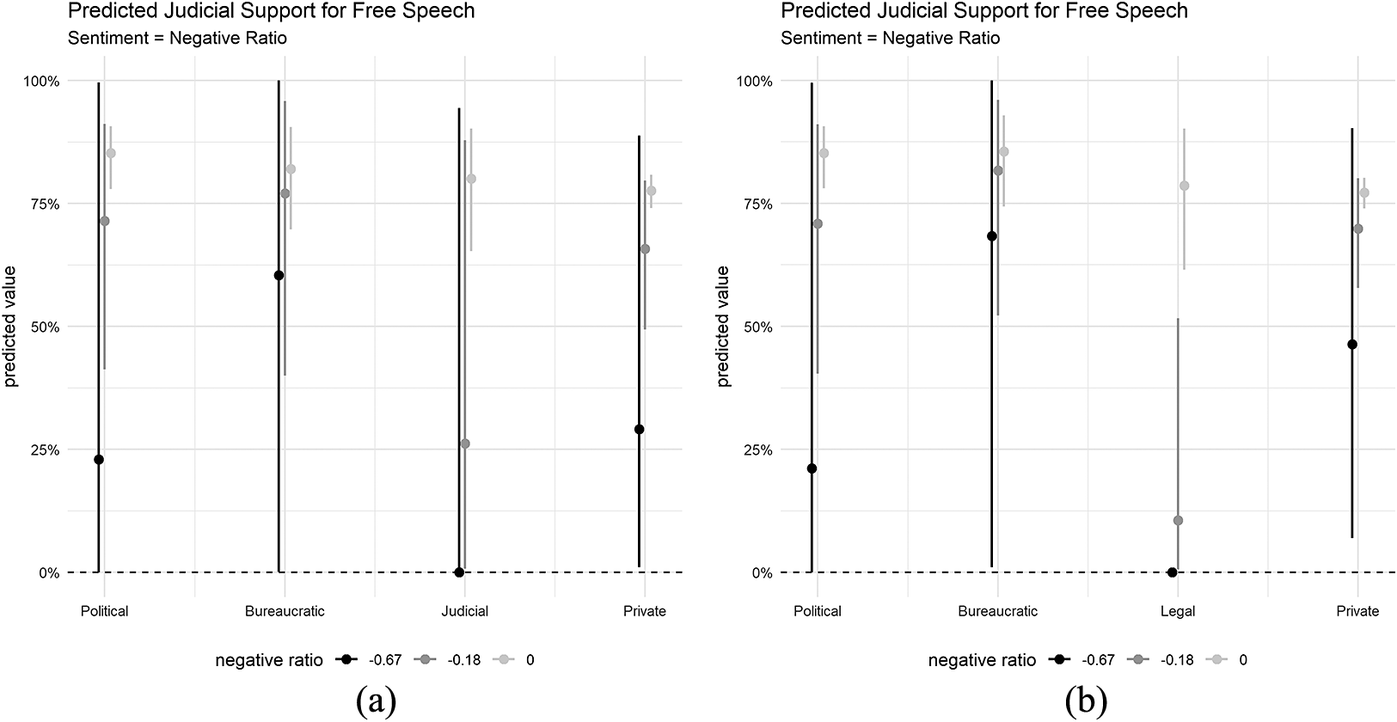


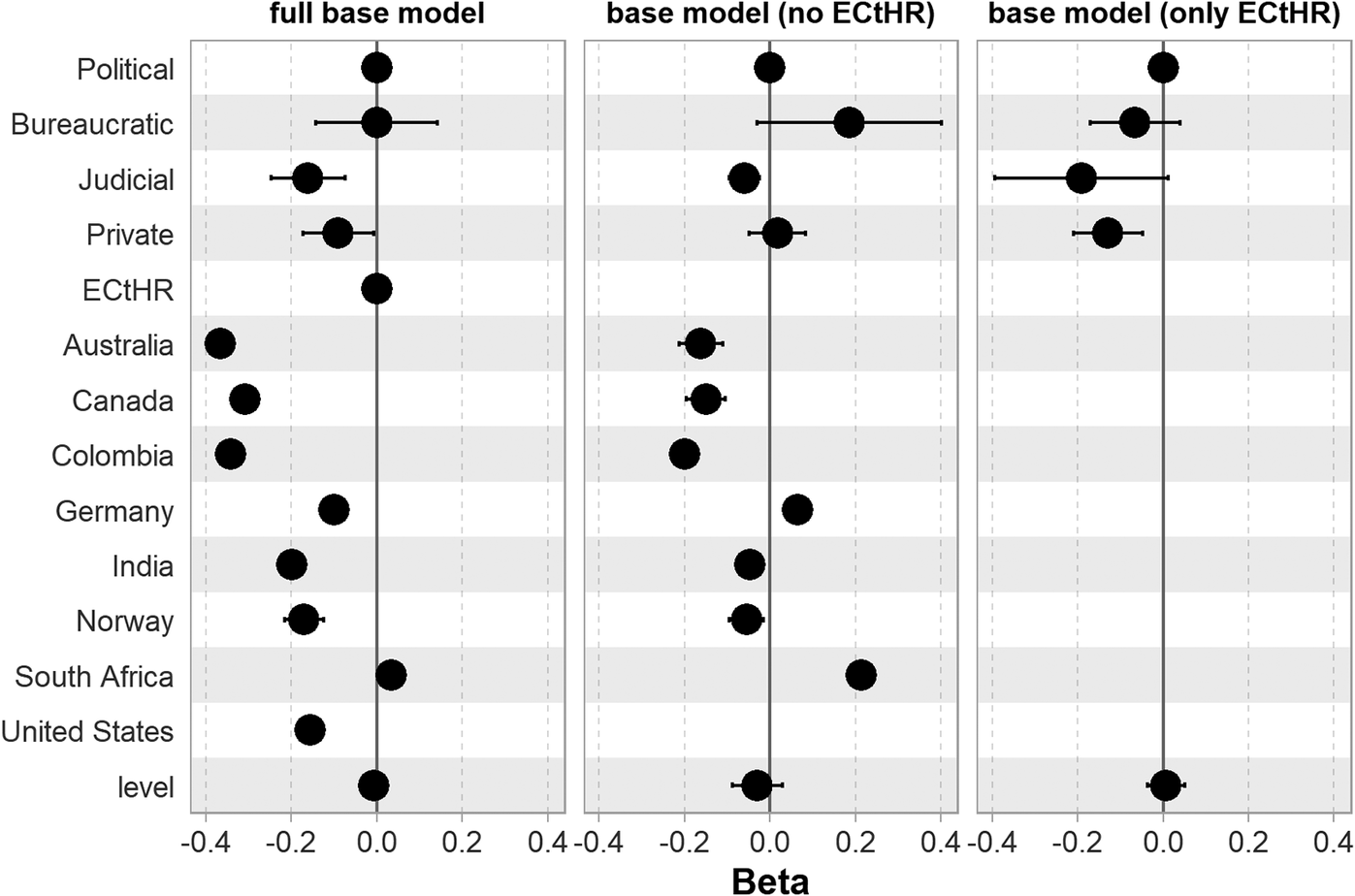


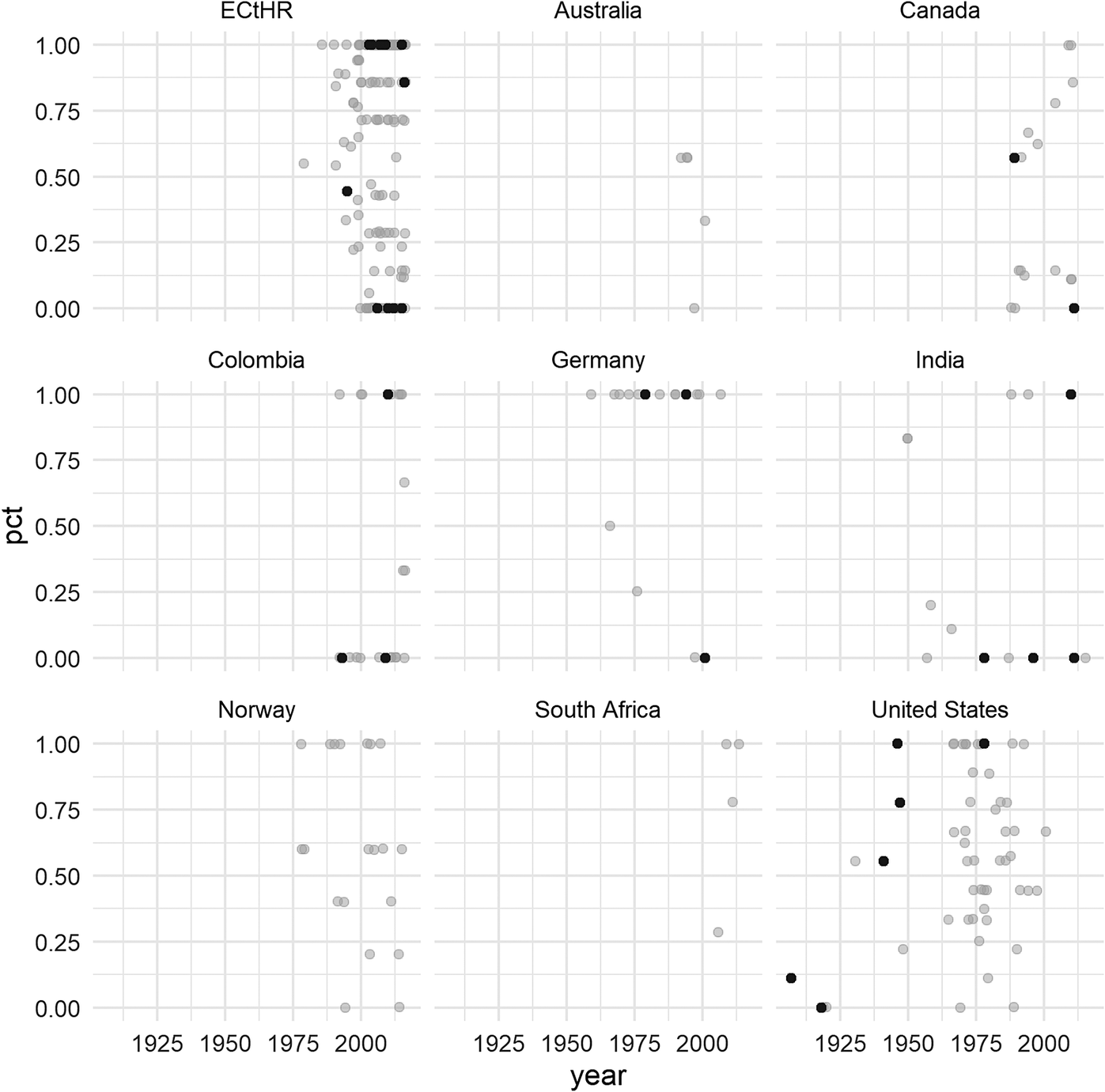

 Open access

