Introduction
The prevalence of cardiac malformations is approximately 8 per 1000 live births worldwide.Reference Hoffman and Christianson1 The success of cardiac surgery in the developed world during the last two decades is enormous. A majority of these patients undergoes surgery, with good or satisfying long-term outcomes. With the advent of modern cardiac surgery, even complex forms of congenital cardiac disease may be corrected by a definite or palliative operation. As a number of these patients continue to survive into adolescence and adulthood, congenital defects have become one of the major predisposing factors for infective endocarditis.Reference Korzeniowski, Kaye and Braunwald2 In a nation-wide epidemiological study on endocarditis from Netherlands, the underlying predisposition in about one-tenth of patients was a congenitally malformed heart.Reference Van der Meer, Thompson, Valkenburg and Michel3 Another study of underlying cardiac lesions in adults with endocarditis demonstrated that 13% had congenital cardiac disease.Reference McKinsey, Ratts and Bisno4 This association between congenitally malformed hearts and endocarditis remains a lifethreatening handicap for such individuals.
The luxury of early cardiac interventions for congenital cardiac disease in infancy and childhood, nonetheless, remains a privilege that is rarely accessible to those residing in the developing world, accounting for two-thirds of the global population. As a result, many infants with complex defects in developing countries do not see their first birthday. Furthermore, cardiac defects in which the risk of endocarditis could be significantly decreased with corrective surgery, such as ventricular septal defects and persistent patency of the arterial duct, are not submitted for surgical correction. These defects are generally compatible with survival into adolescence, and thus form a large proportion of endocarditis in the setting of congenital cardiac disease in developing countries such as Pakistan. Infective endocarditis in this subset of the population with congenitally malformed hearts, to the best of our knowledge, has not previously been studied from countries in the developing world. In this case-series, we study specifically endocarditis in patients with congenitally malformed hearts, delineating the underlying predisposing factors, epidemiology, clinical presentation, complications and outcomes in order better to define this clinical entity in a region of the developing world.
Patients and methods
We reviewed retrospectively the medical records of all patients admitted to Aga Khan University Hospital, Karachi, Pakistan with underlying congenitally malformed hearts and a diagnosis of endocarditis over a period from January, 1991, to December, 2004. The hospital is located in the center of Karachi, a multiethnic city with a population of 15 million, representing all the ethnic subgroups in Pakistan. The population includes a large number of immigrants and referrals from underserved rural areas, where undetected congenital cardiac disease is more common. The median number of admissions during the period was 13,300 patients annually. In this study, we used the revised Duke criterions for the diagnosis of endocarditis to validate our results.Reference Li, Sexton and Mick5 Electronically coded medical records, and the echocardiographic logbook, revealed 188 patients with suspected endocarditis. Of these, 159 patients fulfilled the modified criterions,Reference Li, Sexton and Mick5 and 48 of these (30.1%) had an underlying congenitally malformed heart.
Many of the patients had a known congenital defect, while others were diagnosed with congenital cardiac disease after initially presenting with endocarditis. Adults with congenital heart disease were defined as those more than 16 years of age. Fever was defined as a single reading of 38°C or more. Patients were classified to have acute endocarditis if they had symptoms for 10 days or less. The number, site, size, and mobility of vegetations, the site and importance of valvar regurgitation, and other valvar injuries such as perforation, abscess, aneurysm, or rupture of tendinous cords, were detailed by transthoracic and transoesophageal echocardiography. Vegetations were defined as localized oscillating masses of dense shaggy echoes that were attached to a valvar leaflet, or to a supporting structure, or in the path of a turbulent jet or on implanted material. A perivalvar abscess was defined as a region of reduced echodensity or echolucent cavity adjacent to the valve or within the valvar annulus. A distinct region of reduced echo density of greater than 5 mm size inside the ventricular myocardium, detectable throughout the cardiac cycle, was regarded as an intramyocardial abscess. Renal failure was defined by level of creatinine in the serum greater than 2-mg/dl, or a rise over baseline of greater than 1 mg/dl in patients with chronic renal insufficiency. Nosocomial endocarditis was identified if the patient developed symptoms after 3 or more days of hospitalization for reasons other than endocarditis.
The laboratory workup of these patients included a complete blood count, erythrocytic sedimentation rate, serum creatinine, serum electrolytes, urine analysis and culture, chest X-ray, several blood cultures, with 3 to 5 sets of aerobic and anaerobic bottles inoculated in sterile Bactec Plus™ bottles (Becton-Dickinson, NJ, USA) drawn before the initiation of antibiotics, transthoracic echocardiography, and if needed, transoesophageal echocardiography. In patients with fever and headache or with neurological signs, examination of cerebrospinal fluids and appropriate imaging were conducted. Fungal cultures were sent in selected cases. The serological tests for Coxiella burnetii, Brucella, and Bartonella were not sent because of financial constraints of the patients and the low clinical index of suspicion. Pakistan is not in the endemic zone for these fastidious organisms, as only a few isolated cases have been reported from northwest of the country.Reference Ahmed6–Reference Qazilbash and Bari8
Statistical interpretation of data was performed using the computerized software program SPSS version 13.0 (SPSS, Inc, Chicago, IL, 1999). Descriptive statistics are presented as percentages for discrete variables. Continuous variables are presented as mean plus or minus standard deviations.
Univariate analysis was done for factors associated with mortality and to compare cyanotic and acyanotic heart disease using Pearson Chi Square, Fischer Exact Test and Student’s t Test where appropriate, and a p value of less than 0.05 was considered statistically significant.
Results
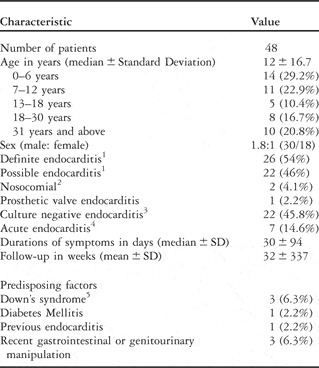
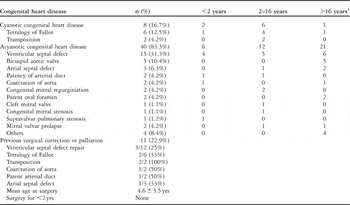
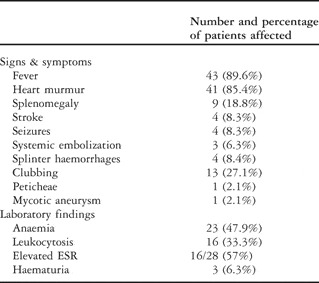
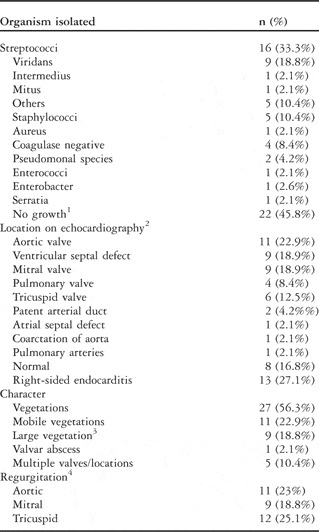
We found 48 patients with congenitally malformed hearts to have endocarditis according to the modified Duke CriterionsReference Li, Sexton and Mick5 (Table 1). A steady rise in the number of cases was seen over the period of study. Of the 48 patients, 38 (80%) presented in the second half of the study, from 1999 through 2004. Mean follow-up was two-years and two and a half months, and one patient was lost to follow-up. Antibiotics prior to presentation had been given to 23 patients (48%), including 2nd and 3rd generation cephalosporins (40%), pencillin (20%), aminoglycosides (30%) and Amoxicillin in 10%. In 54% of the patient, the endocarditis was definitive according to the Duke criterions.Reference Li, Sexton and Mick5 Rheumatic heart disease was a concomitant diagnosis in 4 (8.4%) patients. Table 2 gives the distribution of congenitally malformed hearts. Only 11 (22.9%) patients had undergone previous surgery. Patients with cyanotic heart disease were more likely to have positive cultures (78% versus 48.7%), and had a higher incidence of renal failure (28% versus 8.3%) and thrombocytopenia (60% versus 11.7%, p-value 0.03, 95% CI 1.4-89). There were no differences between cyanotic and acyanotic defects in terms of death, heart failure, surgery, and complications. Table 3 lists the pertinent clinical and laboratory findings. In one-third (16/48) of our patients, blood cultures were positive for streptococci, while 22 (45.8%) patients had persistent negative cultures. Table 4 lists the aetiological agents isolated from these patients. Echocardiography was performed in 46 (95.8%) patients, transthoracic echocardiography in 45 (93.8%), and transoesophageal echocardiography in 6 patients (12.5%). Transthoracic echocardiogram was positive in 30 of 45, giving a sensitivity of 67%, and transoesophageal echocardiography was positive in 5/6, with a sensitivity of 87%. The valves involved, and other significant findings on echocardiography, are listed in Table 4.
General characteristics.

SD Standard deviation, 1Modified Duke’s criteria, 2 > 72 hrs in hospital for reasons other than endocarditis, 3At least 2 sets of negative cultures and persistent negative cultures through out the course of endocarditis, 4Symptoms of <10 days duration, 5One patient each had a ventricular septal defect, ASD and a patent arterial duct.
Underlying congenital defects.

Clinical manifestations and laboratory findings.

ESR: erythrocyte sedimentation rate; SD: Standard deviation.
Distribution of organisms recovered from blood cultures and echocardiographic findings seen in patients.

1At least 2 sets of negative cultures and persistent negative cultures through out the course of endocarditis, 2Includes multiple vegetation/abscesses,3Size >10 mm, 4Moderate to severe regurgitation.
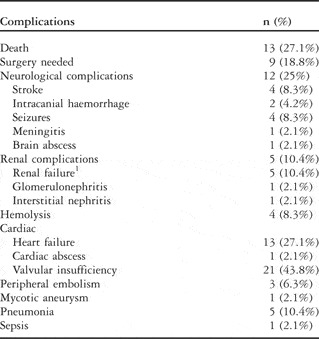
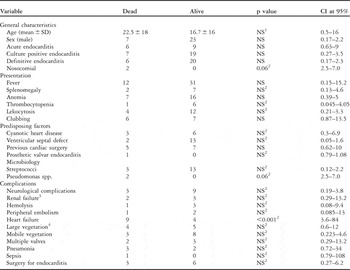
Most patients were treated with a beta-lactam or vancomycin in combination with gentamicin, depending on the sensitivities, for from 4 to 6 weeks. Surgery was performed in 9 (18.75%) patients, of whom 3 (33%) died. These patients died of sepsis, heart failure, and brain abscess, respectively. None of the organisms were significantly related to surgery. The indications for surgery were heart failure refractory to medical treatment, stroke or peripheral embolism, very large or mobile vegetations, and endocarditis refractory to medical treatment. Of all the patients, 13 (27.1%) died due to endocarditis or one of its complications (Table 5). Table 6 illustrates the factors associated with mortality in these patients. There were no differences in mortality between patients with or without congenitally malformed hearts.
Complications and mortality observed in patients with infective endocarditis.

1Defined as serum creatinine level >2 mg/dl or a rise over baseline creatinine of >1 mg/dl in patients with chronic renal insufficiency.
Risk factors for mortality in patients with Infective endocarditis and congenital heart disease.

NS: Not Significant; SD: Standard deviation. 1Student’s t-test, 2Fischer Exact Test, 3Defined as serum creatinine level >2 mg/dl or a rise over baseline of >1 mg/dl in patients with chronic renal insufficiency, 4Size >10 mm.
Discussion
Our study, to the best of our knowledge, represents one of the first case-series of endocarditis in patients with congenitally malformed hearts from the developing world. Most of the patients had uncorrected malformations, such as ventricular septal defect, tetralogy of Fallot, atrial septal defect, persistent patency of the arterial duct, congenital mitral valvar disease, and aortic coarctation. In contrast, approximately 70% of children with endocarditis complicating congenital cardiac disease in the developed world have had previous cardiac surgery, particularly palliative shunt procedures and complex intracardiac repairs.Reference Martin, Neches and Wald9, Reference Johnson, Rosenthal and Nadas10 Nearly one-third to half of all these defects are critical, requiring intervention in the first year of life.Reference Hoffman and Kaplan11 With currently available modalities for treatment, over three-quarters of infants born with critical cardiac disease can survive beyond the first year of life, and many can lead near-normal lives thereafter. This privilege of early diagnosis and timely management is restricted to children and adolescents of the developed countries. The majority of children born with congenitally malformed hearts in developing countries do not get the necessary care, resulting in a high morbidity and mortality. Only one-fifth of the patients seen in our study had undergone a previous cardiac repair or palliation. Previous studies on endocarditis in children from the developing world have shown that less than one fifth of those with congenitally malformed hearts have had a previous surgical repair or palliation.Reference Dhawan, Grover and Marwaha12–Reference Lertsapcharoen, Khongphatthanayothin, Chotivittayatarakorn, Thisyakorn, Pathmanand and Sueblinvong17 Congenital cardiac diseases in developing countries remain undiagnosed and under-treated.Reference Bassili, Mokhtar, Dabous, Zaher, Mokhtar and Zaki18–Reference Saxena21
Patients with cyanotic heart disease, particularly of the complex type, were underrepresented in our study. These patients usually do not survive without surgery, while repair, insertion of prosthetic material, or palliation leads to a very high annual risk for endocarditis.Reference Morris, Reller and Menashe22, Reference Geva and Frand23 Cyanotic heart defects as an underlying predisposition for endocarditis in the United States increased from less than 20% in 1950s to 45% by the 1970s.Reference Johnson, Rosenthal and Nadas10 As a large majority of patients with complex cyanotic heart disease never survive to childhood, or even infancy, in most of the developing world, these lesions constitute only one-fifth or less of those with endocarditis and congenital cardiac disease.Reference Dhawan, Grover and Marwaha12–Reference Lertsapcharoen, Khongphatthanayothin, Chotivittayatarakorn, Thisyakorn, Pathmanand and Sueblinvong17, Reference Bhat, Jalal, John and Bhat24, Reference Sadiq, Nazir and Sheikh25 Of those with cyanotic diseases, tetralogy of Fallot constitutes three-quarters of the patients in our series. The other two patients with complex cyanotic heart disease had transposition, and had undergone surgical repair in infancy. This emphasizes the fact that survival of patients with complex cyanotic heart diseases without corrective surgery is dismal. Tetralogy of Fallot represents an exception among cyanotic heart diseases, as children with this condition can survive several years without surgery. In fact, some patients may go unrecognized till late in infancy, and present with endocarditis in childhood. Only one-third of the patients with tetralogy of Fallot in our series had undergone surgical correction. Recent studies have shown that tetralogy of Fallot is now a rare cause of endocarditis in both children and adults in the developed world.Reference Van der Meer, Thompson, Valkenburg and Michel26 Complete closure of the ventricular septal defect associated with tetralogy of Fallot, eliminating the systemic-to-pulmonary shunt, minimizes the susceptibility to endocarditis.Reference Morris, Reller and Menashe22, Reference Geva and Frand23
Left-to-right shunts, particularly in those with uncorrected ventricular and atrial septal defects and arterial ducts, are the most common underlying defects seen in our series. This trend is similar to the experience in the developed world prior to the emergence of definitive surgery. High-velocity or turbulent flow caused by the high pressure left-sided circulation causes endocardial damage, and creates a nidus for subsequent bacterial colonization and endocarditis. Early detection and surgical repair has lead to a decline in the importance of left-to-right shunts as sites of bacterial endocarditis in the developed world.Reference Martin, Neches and Wald9–Reference Hoffman and Kaplan11 Complete surgical repair eliminates, or markedly decreases, the risk of endocarditis in these patients.Reference De Gevigney, Pop and Delahaye27 Of a large cohort seen in a community-based 30-year study, none of the patients with a definitively corrected ventricular septal defect developed endocarditis.Reference Morris, Reller and Menashe22 Without surgical repair, nonetheless, these patients are at high risk for endocarditis, with an incidence of 1.1% at 5 years of age or an overall risk of 3.8 cases per 1000 patient-years.Reference Morris, Reller and Menashe22 As a result ventricular septal defect now constitutes less than one-fifth of those with endocarditis in the developed world.Reference Martin, Neches and Wald9, Reference Johnson, Rosenthal and Nadas10 On the other hand, ventricular septal defect is the most common underlying congenital anomaly seen in both adults and children in our series. Of these, four-fifths had not undergone prior surgical correction. A similar trend is seen in the rest of the developing world, where ventricular septal defect accounts for almost half of congenital defects in children with endocarditis,Reference Dhawan, Grover and Marwaha12–Reference Lertsapcharoen, Khongphatthanayothin, Chotivittayatarakorn, Thisyakorn, Pathmanand and Sueblinvong17, Reference Bhat, Jalal, John and Bhat24, Reference Sadiq, Nazir and Sheikh25 of whom only 5 to15% had undergone prior surgical repair.
In 2 of our patients, infective endocarditis developed in the setting of an underlying patent arterial duct. A recent study from northern Pakistan reported that infective endocarditis of patent arterial duct might be very common.Reference Sadiq, Latif and Ur-Rehman28 This high incidence of infective endocarditis in patients with patent arterial duct is unusual, and represents something close to the natural history of uncorrected patent arterial duct,Reference Campbell29 as suture ligation of patent arterial duct completely eliminates the risk of endocarditis. Infective endarteritis of patent arterial duct is now extremely rare in most parts of the world.Reference Martin, Neches and Wald9, Reference Hoffman and Kaplan11, Reference Balzer, Spray, McMullin, Cottingham and Canter30
More than one-tenth of our patients had a bicuspid aortic valve. The natural history of a bicuspid valve is premature calcification, which occurs in nearly all individuals aged 40 years, with subsequent possibility of progression to aortic stenosis. Endocarditis is a well-recognized complication, usually occurring in the fourth and fifth decades of life, as in our series. Most data from the developedReference McKinsey, Ratts and Bisno4, Reference Lamas and Eykyn31 and developing worldReference Choudhury, Grover and Varma32 reports that bicuspid aortic valve may be the underlying cause for up to one-sixth of patients with native valvar endocarditis. This entity is considered to be the most common congenital cardiac lesion seen at autopsies.Reference Roberts33
Neonates, infants and young children undergoing palliative or corrective surgery currently represent the largest group of children at risk of endocarditis in most of the developed world. It should be emphasized that the increase in overall incidence of endocarditis is largely due to a greater frequency of the disease among the neonates and children under 2 years of age, as seen in our series. On the other hand, our series also has a large proportion of adults more than 16 years. As more patients with these defects are reaching adulthood, the number of cases of endocarditis in adults with congenitally malformed hearts has increased.Reference Li and Somerville34
Boys outnumber girls in our series. This is in contrast to most of the data worldwide, except South Asia.Reference Bhat, Jalal, John and Bhat24, Reference Sadiq, Nazir and Sheikh25, Reference Roberts33 This may be because of bias on behalf of parents in South Asia to favour the male child over the female. Males are better cared for, and taken to the hospital more frequently for treatment. On the other hand, many girls in South Asia with life-threatening diseases, such as congenitally malformed hearts, are generally left to the “will of God” to suffer a natural course of events, and never make it to the hospital.
Both patients with nosocomial endocarditis in our series died. Nosocomial endocarditis is usually associated with a structurally normal heart, and occurs in the setting of surgical procedures or use of intravenous catheters.Reference Prendergast35 The high mortality in our patients is consistent with worldwide data, where nosocomial endocarditis carries a mortality of more than half. In a recent series from Madrid, nosocomial infection accounted for endocarditis in over one-fifth of patients, and resulted in more than half dying.Reference Bouza, Menasalvas, Munoz, Vasallo, del Mar Moreno and Garcia Fernandez36
We see a lot of patients with endocarditis and negative cultures. The high ratio of negative cultures is not unusual for developing countries, and has been found in up to three-fifths.Reference Bhat, Jalal, John and Bhat24, Reference Sadiq, Nazir and Sheikh25 The most common important cause of such a high ratio of culture-negative endocarditis is prior use of antibiotics without appropriate workup, as seen in half of our patients.
Mortality of endocarditis seen in our series is much higher than most of the developed world, where it is generally between 5 and 20%. We are a tertiary care referral centre, and these results may represent a skewed population. This high mortality can be attributed to late presentation, prior use of antibiotics causing negative cultures with subsequent late diagnosis, and advanced underlying cardiac diseases such as severe pulmonary hypertension. It is important to note that patients from developed countries with endocarditis are already high risk because of more complex congenital heart diseases. Many of these children have already undergone multiple cardiac surgeries before presentation, and more frequently acquire nosocomial endocarditis, which carries a grave prognosis. Despite these predisposing factors for endocarditis in the developed world, the comparatively higher mortality seen in this series further emphasizes the need aggressively to treat and prevent endocarditis in Pakistan.
Our study has several limitations. First, the retrospective nature of the study does not allow for control of data and requires cautious interpretation of the results. Serology and polymerase chain reaction for fastidious organisms such as Brucella, Bartonella, Coxiella burnetii, and other rare causes of endocarditis were not sent, and thus we may have missed some patients with culture-negative endocarditis. Being a tertiary care private referral center, the data may not truly represent endocarditis in the community, and may be skewed towards a high-risk patient and wealthier population. Our study was not adequately powered to identify risk factors for mortality because of the small size of the sample. Many of the patients received prior antibiotics, and thus the ‘true’ microbiology cannot be ascertained. The series most likely underestimates the true incidence of endocarditis, given the limitations in microbiologic detection of the cause of endocarditis. Further prospective studies are needed to confirm our results.