Introduction
Staphylinidae are a biologically diverse group of insects distributed in different habitats in almost all continents except America (Manley, Reference Manley1977). Paederus fuscipes Curtis (Coleoptera: Staphylinidae) inhabits moist areas, such as rice fields (Klimaszewski et al., Reference Klimaszewski, Newton and Thayer1996; Bong et al., Reference Bong, Neoh, Jaal and Lee2012) where it is prevalent in the growing season from April to August and between October and December; it disperses in August and September during the harvesting season into surrounding areas (Manley, Reference Manley1977). From the literature, 622 specific names have been compiled under the genus Paederus (Frank, Reference Frank1988), the only genus in this family, consisting of 50 species that cause linear dermatitis when they come into contact with human skin (Bong et al., Reference Bong, Neoh, Jaal and Lee2012). Reaction occurs more severely when the beetle is crushed, releasing pederin on the skin. Adults of some species are capable of running on water and navigating in response to light. Unlike most staphylinid adults, which avoid daylight, Paederus adults are active in the open during the day. However, flight seems largely restricted to nights of high temperature (Silva et al., Reference Silva, Lobo, Lima, Brito and Costa-Neta2015). Adults of at least some species are attracted at night to incandescent and fluorescent lights (Frank and Kanamitsu, Reference Frank and Kanamitsu1987). A voluminous amount of literature exists about the medical problems associated with linear dermatitis caused by P. fuscipes from different countries.
Thirteen species of Paederus have been so far reported from Iran. Among those, P. fuscipes is predominant, especially in the Caspian Sea region, where frequent cases of linear dermatitis occur every year from mid-April to October, with a particularly high incidence from May to August (Nikbakhtzadeh and Tirgari Reference Nikbakhtzadeh and Tirgari2008; Nikbakhtzadeh et al., Reference Nikbakhtzadeh, Naderi and Safa2012). In a study in Iran, Janbakhsh and Ardalan identified three species of Paederus involved in linear dermatitis, but P. fuscipes is the most important and is widespread in hot and humid areas of the country (Janbakhsh and Ardalan, Reference Janbakhsh and Ardalan1977). Numerous investigations report cases of linear dermatitis (Zargari et al., Reference Zargari, Kimyai-Asadi, Fathalikhani and Panahi2003). Whereas this disease is a rural problem in the south, mainly in villages or small towns, it is an urban problem in the northern provinces along the sea shore. In these regions, P. fuscipes has three activity peaks: mid-June, mid-August and mid-September (Nikbakhtzadeh and Tirgari, Reference Nikbakhtzadeh and Tirgari2008).
Beetles are usually adapted to sandy beaches but relatively unstudied in these ecosystems (Craig, Reference Craig1970), and there are few references in the literature to the presence of Paederus beetles there. Staphylinidae beetles are found on the tidal zone of the beaches (Klimaszewski et al., Reference Klimaszewski, Newton and Thayer1996); however, they are neither aquatic nor can they be found on dry sands (Klimaszewski et al., Reference Klimaszewski, Newton and Thayer1996). Little is known about the extent of their presence on beaches; therefore, this field survey was designed and undertaken to study the scale of presence of Paederus beetles on sandy beaches on the southern coast of the Caspian Sea.
Materials and methods
Study area
This study was carried out in Mazandaran Province in northern Iran situated between the sea and the northern side of the Alborz mountain range. The latitude for this area is 36.5656 °N and the longitude is 53.0588 °E. It has a moderate, subtropical climate with an average temperature of 25 °C in summer and about 8 °C in winter. Although snow may fall heavily in the mountains, it rarely falls at sea level. Fourteen (14) of the 18 counties are situated on the seashore. The main occupation of the three million inhabitants is rice cultivation in the coastal areas and plains.
Sampling
Systematic entomological sampling was carried out to collect Paederus beetle specimens from all 14 coastal counties of Mazandaran Province. Sampling took place monthly for a complete calendar year from April 2012 to March 2013. Specimens were collected by well-experienced field staff in the middle of each month in one suitable beach in each of the 14 coastal counties. During each sampling effort, searches on and in the sand were made for half an hour using bare hands in gloves. A few sampling efforts were also made using a Centers for Diseases Control light trap. All sampling sites were GPS-marked and notes taken on the weather conditions (as well as temperature and relative humidity of the sampling times). Collected beetles were put in appropriately labelled 15 mL Falcon tubes containing 70% ethanol and transferred for identification to the Entomology laboratory of the School of Public Health, Mazandaran University of Medical Sciences.
Specimen identification
The specimens were studied under a stereomicroscope and identified to species level using the external characters and genitalia features (Freude et al., Reference Freude, Harde and Lohse1964; Coiffait, Reference Coiffait1982). Many male specimens had parts of the genitalia exposed, so the genitalia were easily pulled out. The identification of the insects was confirmed by Dr Serri of the Iranian Plant Protection Research Institute. The specimens mentioned in this paper are stored in the Insect Collection of the Mazandaran University of Medical Science.
Results
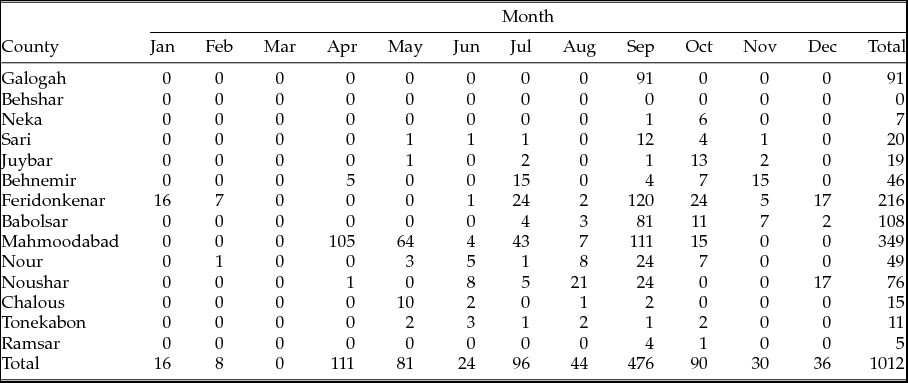
During the study period from April 2012 to March 2013, the minimum temperature was 12.3 °C in February and the maximum was 34.5 °C in August. The minimum relative humidity of the sampling sites in the 14 counties was 60.8 in April and the maximum 84.5 in November. In this 12-month-long sampling in the study area in 2012/2013, a total of 1012 Paederus specimens were collected and identified as P. fuscipes Curtis. Distribution of the specimens based on the months and different counties is summarized in Table 1.
Number of Paederus fuscipes in different scales, temporal (month) and spatial (county), in 14 coastal counties of Mazandaran Province, Iran

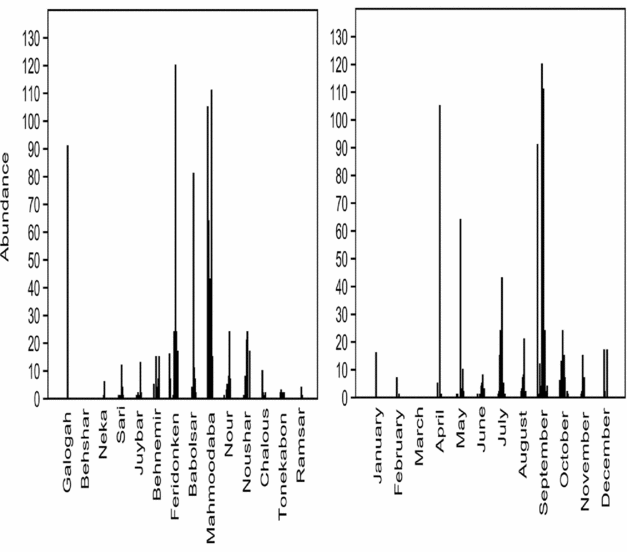
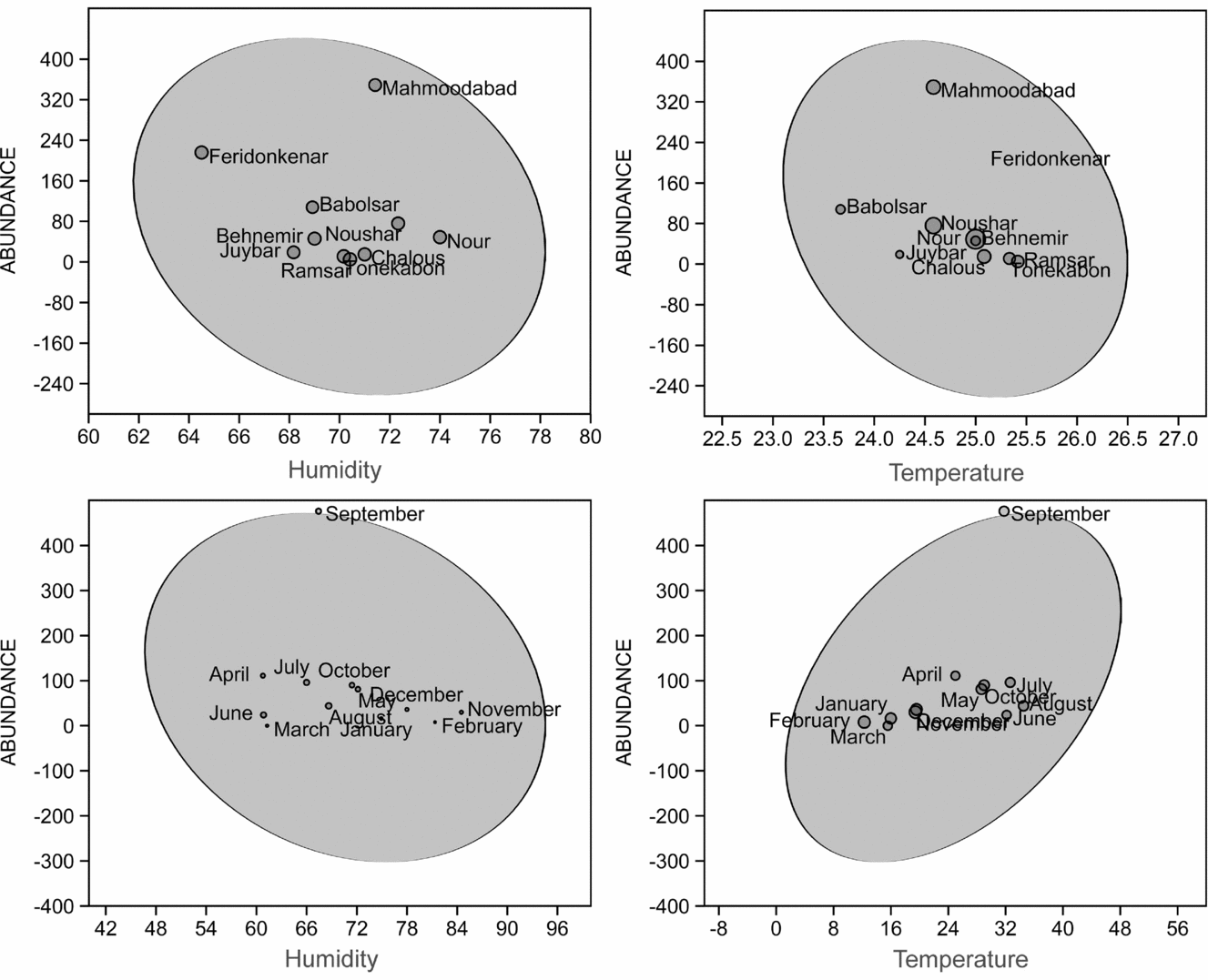
In terms of spatial distribution, the highest number (349) was collected from Mahmoodabad (Table 1). When temporal distribution of the specimens was considered, the highest number of specimens (476) was collected in September (Table 1). The highest frequency of P. fuscipes was observed in different temporal scales in September (93%) and in spatial scales in Feridonkenar (75%), (Fig. 1). Also when bubble plots with 95% ellipses were drawn for abundance, humidity and temperature, Mahmoodabad and September exhibited higher numbers of collected specimens than the other areas and months (Fig. 2).
Abundance and frequency of Paederus fuscipes in different scales: spatial (counties) and temporal (months).

Bubble plots of abundance of P. fuscipes specimens and temperature of the study area. Bubble size reflects humidity (left panels) and temperature (right panels).

A light trap was used on only two occasions in Babolsar with 25 specimens in November and in Mahmoodabad with 87 specimens in October. These numbers were higher than the number of specimens collected with the other sampling method, clearly revealing the attraction of the beetles to UV light.
Discussion
Rove beetles (Staphylinidae) are a group of insects normally found in and around vegetation that feed on other insects as predators (Frank and Kanamitsu, Reference Frank and Kanamitsu1987; Bong et al., Reference Bong, Neoh, Lee and Jaal2013). There is extensive literature on the occurrence and distribution of the species in vegetation in almost all parts of the world (including Malaysia, India and Pakistan) (Manley, Reference Manley1977; Frank and Kanamitsu, Reference Frank and Kanamitsu1987; Nikbakhtzadeh and Tirgari, Reference Nikbakhtzadeh and Tirgari1999; Reference Nikbakhtzadeh and Tirgari2008; Nasir and Akram Reference Nasir and Akram2012; Nasir et al., Reference Nasir, Akram and Ahmed2012; Nikbakhtzadeh et al., Reference Nikbakhtzadeh, Naderi and Safa2012; Bong et al., Reference Bong, Neoh, Lee and Jaal2013; Nikhita et al., Reference Nikhita, Srithilak and Radhakrishnan2014). Several species of the insect have been reported from Iran, including P. fuscipes Curtis. In northern Iran, P. fuscipes Curtis is the main species with wide distribution (Nikbakhtzadeh and Tirgari, Reference Nikbakhtzadeh and Tirgari1999, Reference Nikbakhtzadeh and Tirgari2008; Nikbakhtzadeh et al., Reference Nikbakhtzadeh, Naderi and Safa2012). However, no country in the world has reported the occurrence of any of the species on sandy beaches. This is the first report of the widespread distribution of the rove beetle P. fuscipes Curtis on the Caspian Sea coastal sand in Mazandaran, northern Iran.
The highest number of the specimens was collected from Mahmoodabad followed by Feridonkenar and Babolsar with significant differences from the rest of the counties (P < 0.05). This is because these are the main rice cultivation areas in the province and large numbers of P. fuscipes live in the farms between rice fields and the surrounding vegetation, predating on other insects, e.g. rice leafhoppers and Collembola (Bilde et al., Reference Bilde, Axelsen and Toft2000). Also in these counties, vast rice fields are in close vicinity to the seashore.
September is the peak month for the number of specimens collected from beaches in Mazandaran when the highest number of cases of linear dermatitis is reported (Zargari et al., Reference Zargari, Kimyai-Asadi, Fathalikhani and Panahi2003). In Mazandaran, the climate is warm and humid in summer, which are the conditions that staphylinids prefer for movement (Bong et al., Reference Bong, Neoh, Lee and Jaal2013). Also the highest fecundity of P. fuscipes usually occurs under such conditions, resulting in an increase in population size and leading to higher risk of linear dermatitis for the rice farmers and residents of the nearby towns and villages (Bong et al., Reference Bong, Neoh, Lee and Jaal2013). Also, September coincides with the rice harvesting activities, including straw burning, which disrupts the ecological niches of P. fuscipes (Bong et al., Reference Bong, Neoh, Lee and Jaal2013). These activities disrupt the habitat and normal activities of P. fuscipes and render the rice fields unfavourable refuges. In addition, the beetles might also face food shortages after the disturbance of their prey base in the crop fields. Displaced P. fuscipes may take refuge in the nearby beaches in search of food and humidity. The favourable climatic conditions and rice harvesting activities are the most important factors giving September the highest abundance of P. fuscipes on the beaches. Harvesting and destruction of rice fields result in a lack of food for P. fuscipes, and therefore, force them to disperse (Jahn et al., Reference Jahn, Litsinger, Chen, Barrion, Koul and Cuperus2007). Adults of staphylinid beetles prey on detritivore Arthropoda, such as Collembola in the rice fields (Bilde et al., Reference Bilde, Axelsen and Toft2000). Because the populations’ prey enormously decreases during harvest (Petersen, Reference Petersen2002), adults of P. fuscipes migrate and disperse to adjacent areas immediately after harvesting (Hanna and Hamad, Reference Hanna and Hamad1975; Thorbek and Bilde, Reference Thorbek and Bilde2004). Seashores usually contain salt meadows and organic soil, therefore, arthropods, such as Collembola can be active there (Fjellberg, Reference Fjellberg2007; Reference Fjellberg, Böcher, Kristensen, Pape and Vilhelmsen2015). These factors cause the higher abundance and frequency of increase in P. fuscipes on the seashore of counties, such as Mahmoodabad and Feridonkenar.
Although we collected the maximum number of specimens from counties with the most rice cultivation activities, the number of P. fuscipes specimens in Galogah peaked only once in September. This was because of the rice farms on both sides of the 5 km road to the beach in Galogah and the harvesting of rice, which had disturbed the natural habitat of the beetles, forcing them to take refuge on the nearest beach. This phenomenon is of great importance, as the sampling site in Galogah is a holiday resort with about 50 cottages that are rented to holiday-makers, who use energy-saving fluorescent lights at night. These lights seem to have attracted the beetles, which then assembled in the resort in thousands. This attraction to white light (Janbakhsh and Ardalan, Reference Janbakhsh and Ardalan1977; Frank and Kanamitsu, Reference Frank and Kanamitsu1987; Rahman and Norjaiza, Reference Rahmah and Norjaiza2008) was proven, after a higher number of specimens was collected using a light trap with UV light on two occasions in the study area.
Unlike most staphylinid adults, which avoid daylight, adult P. fuscipes are active in the open during the day (Frank and Kanamitsu, Reference Frank and Kanamitsu1987). Our observations show that while on beaches, the beetles seem to behave normally and are active. Even if their presence is temporary, this is enough to pose great danger of linear dermatitis to those who travel long distances to the seashore for the sand and sun, whose signs were evident from the faces and trunks of the holiday-makers (Majidi-Shad et al., Reference Majidi-Shad, Janbakhsh and Bagheri-Zenooz1989; Nikdel, Reference Nikdel1995; Zargari et al., Reference Zargari, Kimyai-Asadi, Fathalikhani and Panahi2003; Nikbakhtzadeh and Tirgari, Reference Nikbakhtzadeh and Tirgari2008; Nikbakhtzadeh et al., Reference Nikbakhtzadeh, Naderi and Safa2012).
Conclusion
Paederus fuscipes is common on sandy beaches in Mazandaran Province. The presence of the insect peaks in September, during and shortly after the rice-harvesting season. This important finding opens a new dimension in the study of the biology and ecology of the beetle, and has practical importance in terms of human health, especially of those traveling to the holiday resorts of the Caspian Sea in northern Iran.
Acknowledgements
The authors wish to express their gratitude to the Vice Chancellor for Research, Mazandaran University of Medical Sciences and Tehran University of Medical Sciences, Iran for financial assistance in the form of a joint research grant. Thanks are also extended to the field workers and drivers for their assistance in sample collection.