INTRODUCTION
Changes in spatial and/or temporal distribution and abundance of cetaceans over time have implications for identifying, assessing and mitigating the effects of human activities upon them and for the development of suitable conservation and management strategies, as well as for our understanding of their ecology. As a result, regular monitoring of cetacean populations is important from conservation, management and scientific perspectives (Evans & Hammond, Reference Evans and Hammond2004). While such monitoring often consists of estimating population abundance or density across a wide area (e.g. Hammond et al., Reference Hammond, Berggren, Benke, Borchers, Collet, Heide-Jørgensen, Heimlich, Hiby, Leopold and Øien2002), monitoring of changes in the patterns of occurrence of cetacean species within an area can also provide important information (Evans & Hammond, Reference Evans and Hammond2004). In particular, while collecting data to accurately estimate cetacean abundance or density can be logistically complex and financially costly, changes in patterns of occurrence over time within a particular study area can potentially be investigated using non-dedicated vessels to undertake repeated surveys along fixed transects through areas of interest at relatively low cost. As a result, surveys can be conducted more frequently, providing finer-scale information on seasonal and inter-annual changes.
In this paper, we analyse data collected from monthly surveys conducted along a relatively fixed transect using a passenger ferry (‘The Pride of Bilbao’) as a research platform to investigate seasonal and inter-annual changes in the occurrence of striped dolphin (Stenella coeruleoalba Meyen, 1833) common dolphin (Delphinus delphis Linnaeus, 1758) and harbour porpoise (Phocoena phocoena Linnaeus, 1758) in sections of the English Channel and the Bay of Biscay between 1996 and 2006 (Figure 1). While information on the distribution and relative abundance of cetaceans in this region has been published previously (e.g. Kiszka et al., Reference Kiszka, MacLeod, van Canneyt, Walker and Ridoux2007), this is the first analysis of inter-annual changes in cetacean occurrence for this region, as well as providing additional information on patterns of seasonal occurrence. Therefore, this study provides important information for the conservation and management of these three species in this region as well as increasing the understanding of temporal variations in their distribution. In addition, this study suggests an approach that can potentially provide information on changes in species status over a wide area at relatively low cost and in a relatively simple manner in terms of data collection and analysis.
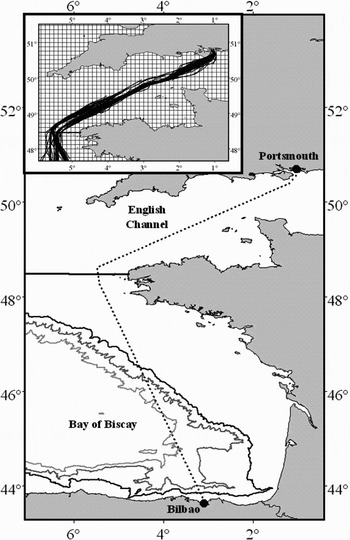
Main map: the study area and approximate route of ‘The Pride of Bilbao’ in the English Channel and the Bay of Biscay during BDRP monthly surveys between 1996 and 2006. Depth contours shown are 200 m (black), 2000 m (dark grey) and 4000 m (light grey). Inset: 0.125° by 0.125° grid cell structure used to calculate occupancy for this study. Black lines show all ferry tracks in sea states 4 or less surveyed between 1996 and 2006.

MATERIALS AND METHODS
Data on cetacean occurrence were collected during regular monthly surveys conducted by the Biscay Dolphin Research Programme (BDRP) on a P&O passenger ferry, ‘The Pride of Bilbao’, as it travelled along its usual route from Portsmouth on the south coast of England to Bilbao in northern Spain between 1996 and 2006 (Figure 1). This route allowed regular surveys along approximately the same transect, reducing the potential effects of variations in spatial coverage on temporal changes in occurrence (Figure 1 inset). All surveys were conducted from the bridge of the ferry set at approximately 30 m above sea level, allowing good visibility of a field ahead and to the sides of the ferry. Surveys were conducted by a team of three experienced observers, with at least two being on duty at any one time. The observers used the naked eye and binoculars alternatively to search for cetaceans in an 180° arc ahead of the vessel. The speed (range 15–20 knots), direction of travel and the position of the ship and environmental conditions, such as sea state and visibility, were recorded on a regular basis (at least every 30 minutes or whenever the ship changed course). When a group of cetaceans was sighted, the position of the ship was recorded, along with species identification and a number of other variables not used in this analysis (such as behaviour, group size, distance and angle to sighting).
These data were entered into a geographical information system (GIS) created in ESRI ARCview 3.3. The survey track was re-constructed from the recorded positions of the ship and the appropriate sea state was assigned to each survey leg. The data were then divided into summer (April–September) and winter (January–March and October–December) periods and then separated into individual years. Sightings of the three species of interest were plotted and similarly separated into seasons and years. The study area was then divided into a grid with a cell resolution of 0.125° latitude by 0.125° longitude (Figure 1 inset) and the cells surveyed during each time period were identified as those through which one or more survey legs passed during the appropriate time period. For common and striped dolphins, only survey legs in sea states of four or less were used to identify surveyed cells, while for harbour porpoises only survey legs conducted in sea states of three or less were used to account for differences in detectability between harbour porpoises and the more visible dolphin species. While some studies use lower sea state thresholds when analysing data for these cetacean species, these thresholds were used here as the eye height of the observers on ‘The Pride of Bilbao’ is substantially higher than most vessels used for cetacean research (~30 m versus <10 m or less), increasing detectability around the vessel, particularly at higher sea states. Surveyed cells where each species was sighted were then identified and classified as presence cells. All other surveyed cells were classified as absence cells.
Once the status of each species in each cell surveyed was classified, the distribution and occupancy rates were compared between seasons and years for sampled areas for the whole area and from two distinct oceanographic areas within it: the English Channel and the Bay of Biscay. The English Channel is an area of relatively sheltered shelf waters between the French and UK mainlands, while the Bay of Biscay is a more open habitat that varies from shelf waters to deep abyssal areas. For the purposes of this study, a line running east–west through the Island of Ushant off the French coast near Brest was used to divide the study area into these two regions. The division between these two areas is also marked by change in the direction of the transect from predominantly north-east–south-west to predominantly north-west–south-east (Figure 1). Occupancy rates were calculated by dividing the number of presence cells for each species by the total number of cells surveyed for a specific time period (Hall, Reference Hall2006). A Spearman rank-correlation coefficient (which can test for non-linear as well as linear trends) was used to test whether any apparent increases or decreases in occupancy over time were significant.
RESULTS
The common dolphin (Delphinus delphis)
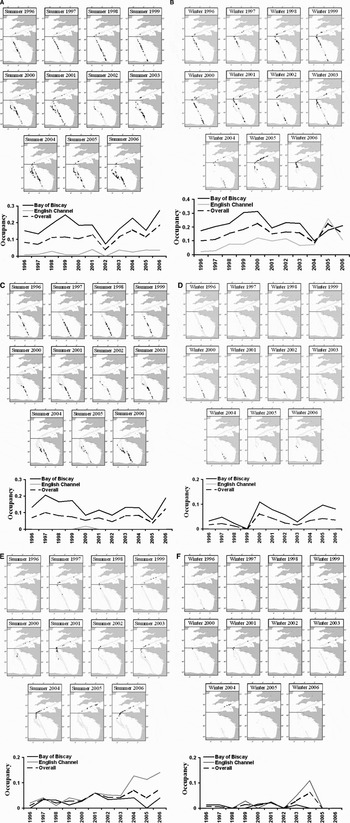
The common dolphin was the most commonly sighted species during BDRP surveys, accounting for almost 40% of all encounters (Table 1). In the summer period, occupancy rates across the whole study area across the 11 year time period ranged from a low of 0.04 in summer 2002 to a peak of 0.19 in summer 2006 (Figure 2A). While common dolphins occurred in both shelf and deep water areas of the Bay of Biscay region in summer months, they were only occasionally recorded in the shelf waters of the English Channel. For example, while in the Bay of Biscay occupancy rates varied from 0.07 to 0.27, in the English Channel they varied from 0.00 to 0.04 (Figure 2A). Therefore, the annual variations in summer occurrence are largely explained by changes in occupancy within the Bay of Biscay, where peaks and troughs were synchronous to the overall pattern.
The changes in the occurrence of common dolphins, striped dolphins and harbour porpoises in the English Channel and Bay of Biscay. Clear cells represent those surveyed at least once in sea states 4 or less in a year and filled cells represent those where this species was recorded at least once. The lower graph shows the changes in occupancy (the proportion of all cells surveyed in a year where a species was recorded) for the whole study area and separately for the Bay of Biscay and the English Channel. (A) Common dolphins in summer months; (B) common dolphins in winter months; (C) striped dolphins in summer months; (D) striped dolphins in winter months; (E) harbour porpoises in summer months; (F) harbour porpoises in winter months.

Summary of survey effort and number of sightings for common dolphins (sea states 4 or less), striped dolphins (sea states 4 or less) and harbour porpoises (sea states 3 or less) in summer and winter from BDRP monthly surveys.

The occurrence of common dolphins in the winter period was noticeably different from that in summer with most sightings over shelf waters and relatively few in the deep water areas of the Bay of Biscay. However, these deep waters of the Bay of Biscay were not surveyed as fully in winter months after 2003 due to changes in the sailing times in relation to winter daylight hours. The overall occupancy of the study area by common dolphins in winter months varied from a low of 0.07 in 2004 to a high of 0.23 in 2000, with no apparent trend over time (Figure 2B). However, there were differences in the temporal trends between the Bay of Biscay and the English Channel. Occupancy in the Bay of Biscay fluctuated from a peak of 0.31 in 2000 to a low of 0.10 in 2004 with no apparent trend over time (Figure 2B). In contrast, there appears to have been a gradual but sustained five-fold increase in occupancy by common dolphins in the English Channel in winter months from 0.02 in 1996 to 0.11 in 2006, although this positive trend was not significant (Figure 2B).
There was no clear relationship between the occurrence of common dolphins either over all or within each region between summer and winter months of the same year and these seem to fluctuate in an unrelated fashion. The overall occupancy of common dolphins in summer and winter fluctuates around 0.12, suggesting that the species status across the region as a whole is relatively stable. However, it is uncertain if the same sections of the population occur in the study area in summer and winter periods.
The striped dolphin (Stenella coeruleoalba)
The striped dolphin was the second most commonly sighted cetacean species in the study area, accounting for almost 12% of all encounters recorded during BDRP surveys. These sightings were almost exclusively confined to the Bay of Biscay region, including some shelf areas close to deeper waters (Figure 2C). There has been a noticeable change in the occurrence of striped dolphins in summer months in the Bay of Biscay over time. While occurrence varied around 0.19 from 1996 to 1999, after this time the occupancy rates dropped noticeably to around 0.10 from 2000 to 2005 (Figure 2C).
In winter months, striped dolphins were mostly recorded in deeper waters of the Bay of Biscay and were not recorded as extensively on the shelf and shelf edge as in summer months. The occurrence of striped dolphins in the Bay of Biscay in winter months has increased across the time period from 0.03 in 1996 to 0.08 in 2006 (Figure 2D). In particular, there was a noticeable increase in the winter occurrence of striped dolphins between 1999 and 2000. This increase in occupancy in the Bay of Biscay in winter months in recent years is despite the decline in survey coverage of some areas where striped dolphins might be expected to occur since 2003 (Figure 2D). The spatial distribution of occurrence in winter has not changed noticeably over time suggesting that differences are not due to changes in habitat preferences. Years of lower occurrence in summer tend to have higher occurrence in winter and the increased usage of the Bay of Biscay by striped dolphins in winter months from 1996 to 2006 coincided with a decreased use in summer months across the same time period. In particular, there seems to have been a noticeable change in the seasonal occurrence of striped dolphin in the Bay of Biscay in 2000 where the occurrence in summer declined markedly and the occurrence in winter increased markedly.
The harbour porpoise (Phocoena phocoena)
The harbour porpoise was the least frequently encountered of the three species examined in this study and accounted for about 6% of all encounters during BDRP surveys. This species occurrence was restricted to the shelf waters of the northern Bay of Biscay and the English Channel in both summer and winter months (Figure 2E, F). In summer months, there was an overall increase in the occurrence of this species from 1996 to 2006, primarily driven by a seven-fold increase in occurrence of harbour porpoises in the English Channel from 0.02 in 1996 to 0.14 in 2006 (Figure 2E). In particular, while occurrence in this area was generally low (with an occupancy rate of around 0.04) in summer months until 2003, since then it has increased to an occupancy rate of over 0.10 in summer 2005 and summer 2006. This trend to increasing harbour porpoise occurrence in the English Channel between 1996 and 2006 is significant (rs = 0.882, N = 11, P < 0.05). There is no obvious trend in the summer occurrence of harbour porpoises in the Bay of Biscay; however, it has varied from as low as zero in 1996 and 2005 to as high as 0.05 in 2001. There was no relationship between the occupancy of harbour porpoises in the Bay of Biscay and the English Channel in the same summer.
Harbour porpoise occurrence in the sampled areas of both the English Channel and Bay of Biscay was generally lower in winter than in summer, with no apparent trends over time (Figure 2F). There is no relationship between summer and winter occurrence of harbour porpoises in the same year. Therefore, the increased occurrence of harbour porpoises in summer months over time, particularly in the English Channel, has not been matched by a similar increase in occurrence in winter months. This suggests a recent increase in seasonal movements of harbour porpoises in to the surveyed areas of the English Channel in summer months, particularly since 2003.
DISCUSSION
The BDRP surveys provide a fine-scale picture of changes in the occurrence of common dolphins, striped dolphins and harbour porpoises along a relatively fixed transect in the English Channel and Bay of Biscay over an eleven year period, and demonstrate the usefulness of using passenger ferries as research platforms for the regular monitoring of patterns of occurrence in specific areas of interest. The key finding of this study is that there has been a significant increase in the occurrence of harbour porpoises in summer months in the English Channel between 1996 and 2006. There is also evidence to suggest that the winter occurrence of common dolphins in the English Channel and striped dolphins in the Bay of Biscay has also increased over this time period, although the trends for these species are not significant. While the aim of this study was primarily to examine changes in occurrence within the surveyed area, it is worth considering whether these changes can provide any clues to changes in species occurrence in the wider surrounding areas as a whole as this would have implications for a number of important factors for cetacean conservation and management.
There is a growing awareness that for monitoring changes in population size for many conservation purposes, it is not always the absolute population size that is required. Instead, changes in population size can be inferred from trends in an index that is itself related to abundance and that can be calculated from data that are easier to collect (Battersby & Greenwood, Reference Battersby and Greenwood2004). A positive relationship between occupancy and abundance has been described as one of the most widespread relationships in ecology and has been identified in a very wide range of taxa (Gaston et al., Reference Gaston, Blackburn, Greenwood, Gregory, Quinn and Lawton2000). When such relationships exist, occupancy can be used as an index of abundance and occupancy has been used to monitor changes in the conservation status of a number of organisms (e.g. British mammals: Battersby, Reference Battersby2005). Hall (Reference Hall2006) investigated the feasibility of using occupancy to monitor changes in the status of cetacean species and found that there were strong positive relationships between relative abundance and occupancy and sightings rate and occupancy. Therefore, while there are a number of potential limitations (for example changes in group size over time may affect the strength of abundance–occupancy relationships and may need to be accounted for), occupancy can provide a suitable index for monitoring changes in cetacean populations (see Hall, Reference Hall2006 for a full discussion of this topic).
Therefore, the changes in occupancy identified from this study are likely to indicate that changes in abundance have also occurred. However, the question remains as to whether changes within the areas surveyed along the fixed transect used in this study are actually representative of the wider region, and therefore whether it provides information that can be used for conservation and management purposes. In order to assess this, it would be necessary to compare the changes in occupancy along the survey route with information on actual changes in occurrence, abundance or density for the surrounding region over the same time period. While this is not possible for the Bay of Biscay or for winter months, surveys of the English Channel were conducted in summer 1994 and summer 2005 as part of a project to estimate cetacean abundance throughout shelf waters of northern Europe. These surveys found that while harbour porpoises were not recorded in the English Channel in summer 1994, their abundance in this region was substantially greater in summer 2005 (Hammond et al., Reference Hammond, Berggren, Benke, Borchers, Collet, Heide-Jørgensen, Heimlich, Hiby, Leopold and Øien2002; http://biology.st-andrews.ac.uk/scans2/).
Therefore, the significant trend to increasing summer porpoise occurrence in the English Channel between 1996 and 2006 identified in this study is consistent with the changes in abundance detected by the more detailed surveys of the wider region at either end of the study period. This suggests that the changes in occurrence along the fixed transect used in this study may indeed reflect changes in abundance across a wider area. As a result, the data from the regular surveys conducted by BDRP have the potential to help provide more fine-scale temporal information on when and how the observed change in abundance between 1994 and 2005 occurred. For example, this study suggests that the observed change in abundance of harbour porpoises in the English Channel may not simply be the result of a gradual, consistent increase between 1994 and 2005, but rather that it has been particularly influenced by changes in seasonal occurrence of harbour porpoises in the English Channel in summer since 2002. Similarly, this study suggests that winter abundance within the English Channel may not necessarily have increased in step with the observed increase in abundance in summer months as there has been no concurrent increase in winter occurrence. This highlights the potential usefulness of this approach to monitoring the conservation status of cetacean species. However, more research is required to assess whether seasonal and inter-annual changes in occurrence recorded along fixed transects using passenger ferries as research platforms do indeed reflect changes in abundance for the wider region around them. This could be achieved through future, more detailed comparisons between occurrence of cetacean species measured in this way and estimates of abundance from detailed surveys such as those conducted in 1994 and 2005, and further analysis of the current data set.
The approach presented here of using data from repeated surveys of a fixed transect to infer changes over a wider area offers the potential for constructing a low cost monitoring programme to provide regular and rapid updates on the conservation status of cetaceans within a region of interest. For example, the waters around north-west Europe are crossed by a relatively large number of ferries connecting the islands of the UK, the Republic of Ireland and the Faeroes to each other and to mainland Europe. By conducting surveys on a number of these ferry routes through representative areas, it may be possible to provide regular updates on species status across this region at a much lower cost and on a more frequent basis than conducting widespread surveys using dedicated research platforms. By using changes in occupancy as an index for changes in occurrence and abundance, these updates can be calculated rapidly to provide an indication of changes in status at the end of each year (Hall, Reference Hall2006), so providing annual feedback to conservationists, policy makers, managers and other stakeholders. This approach also has the additional advantage that changes in graphs of occupancy in conjunction with maps showing changes in distribution within each year, as presented in this study, provide information on changes in species status in a format that is relatively easy for non-specialists (who may be ultimately responsible for making policy, management and conservation decisions based on such data) to interpret and understand. However, while more widely used in other taxa, the use of occupancy in this manner for cetaceans is still in its infancy, and similar information on trends in abundance (although not necessarily changes in distribution) could be obtained from sightings rates or relative abundances, if these can be accurately calculated, from the same types of surveys. In addition, more research is required to assess whether changes along fixed transects are, in general, representative of changes across a wider area or whether the similarities in changes in occurrence of harbour porpoises along the fixed transect surveyed by BDRP and the SCANS data from the wider area are unique to this particular transect and species.
Finally, this study found that there have been a number of changes in the occurrence of these species between 1996 and 2006. In particular, there has been a significant trend to the increasing occurrence of harbour porpoises in surveyed areas of the English Channel in summer months. This change, and other variations in occurrence in other species, could be due to a number of factors. For example, it could reflect changes in water temperature or oceanographic conditions that directly affect these species or it could reflect changes in the distribution of prey. However, there is little published information on prey preferences of these species within this area to allow a direct comparison between dietary preferences, prey distribution and changes in occurrence to be made. Therefore, future research is required to identify the driving forces behind the observed variations in species occurrence. In particular, more information is required on the dietary preferences of these species within the region, how preferred prey species have changed in availability and/or distribution and whether such changes are correlated with the observed changes in occurrence.
ACKNOWLEDGEMENTS
The authors would like to thank P&O Ferries for providing access to ‘The Pride of Bilbao’ by the Biscay Dolphin Research Programme to allow them to conduct these surveys. In addition, the authors would like to thank the captains and crew of ‘The Pride of Bilbao’, as well as all observers who have taken part in these surveys over the years.