1. INTRODUCTION
To reduce the environmental impact of human activity, engineers and scientists have devoted much effort to improve the technical efficiency of products and services. Examples include the invention of electric/hybrid cars and substantial improvements in the fuel efficiency of motorized vehicles. However, increased resource efficiency of products may actually cause consumers to use the resource more, a phenomenon known as the rebound effect (Sorrell et al., Reference Sorrell, Dimitropoulos and Sommerville2009). For example, people may drive longer distances with a more fuel-efficient car, thereby offsetting at least some of the anticipated resource savings. In addition, unanticipated obstacles may prevent the adoption of more resource-efficient technologies.
Therefore, the current work aims to better understand product use and consumer behavior. Specifically, it investigates the relationship between products that transform mechanically and consumer environmentally conscious behavior (ECB). We use the term ECB to refer to individual behavior with an intention to change (benefit) the environment; details will be provided in Section 2.2.
A number of undergraduate design and thesis projects suggested a relationship between mechanically transformable products and ECB. Students were tasked with designing products to support the pursuit of student-identified proenvironmental activities. For example, Anderson et al. (Reference Anderson, Istchenko, Loberto, MacNeil, Martin and Peruzzo2007) developed a bicycle helmet that flattened when not in use, such that it can be more conveniently carried in a book bag. Lam (Reference Lam2008) developed a collapsing reusable coffee mug to make it more compact to carry. Son (Reference Son2010) developed a baby stroller that can convert into a front/back carrier to facilitate use of public transit. All of these projects incorporated aspects of mechanical transformation in their concepts. Therefore, this research aimed to further explore the connection between transformation and ECB to help designers exploit that connection.
This paper is organized as follows. Section 2 summarizes related work. Sections 3 and 4 describe our methods and the transformable products we studied. Section 5 presents our observations. Sections 6 and 7 provide discussions and conclusions.
2. LITERATURE REVIEW
2.1. Mechanical transformation
While Ferguson et al. (Reference Ferguson, Lewis, Siddiqi and De Weck2007) provide an overview of flexible and reconfigurable systems, we will focus on the transformation principles identified by Singh et al. (Reference Singh, Walther, Koraishy, Krager, Wood, Putnam and Jensen2007). Singh et al. (Reference Singh, Walther, Koraishy, Krager, Wood, Putnam and Jensen2007, Reference Singh, Skiles, Krager, Wood, Jensen and Sierakowski2009) examined existing products, patents, and biological phenomena to extract three transformation principles and 20 transformation facilitators. The three transformation principles defined as “generalized directives to bring about a certain type of mechanical transformation” are expand/collapse, expose/cover, and fuse/divide. These principles respectively aim to change the size of a product, alter functionality by revealing or concealing a new surface, and divide a product into many parts or vice versa. Example products that use transformation principles include umbrellas that extend and collapse canopies, laptops that conceal and reveal screens and keyboards, and screwdrivers with exchangeable bits to accommodate various screw heads. These three principles are reported to cover all types of mechanical transformations in the engineering domain. In addition, 20 transformation facilitators (e.g., flip, fold, and material flexibility) enable various types of transformation when applied together but cannot create transformation when applied singly. Singh et al. also describe the use of cards that guide the application of transformation principles in concept generation (2007), and they applied transformation principles and facilitators to develop an ATV/motorcycle that transforms to adapt to different terrains (2009). Wang et al. (Reference Wang, Kuhr, Kaufman, Crawford, Wood and Jensen2009) analyze a collection of transformer toys to generate further transformation definitions and guidelines. Weaver et al. (Reference Weaver, Wood and Jensen2008, Reference Weaver, Wood, Crawford and Jensen2010) studied 190 reconfigurable products to identify trends in transformation (e.g., correlation between principles and facilitators).
Camburn et al. (Reference Camburn, Guillemette, Crawford, Wood, Jensen and Wood2010) derived a set of indicators that could signal the potential benefits of implementing transformation in products. The indicators are intended to help designers identify when transformation would likely be beneficial in an early design phase. Examples of the indicators include needs for frequent storage, frequent transportation, and multiple devices to be used in a shared environment or process.
Kuhr et al. (Reference Kuhr, Wood, Jensen and Crawford2010) developed a method to help designers identify new opportunities for designing transformers. This method involves using two tools, concept opportunity diagrams and constituent relationship charts. The former can assist designers in analyzing relevant functional states of single-function devices, and the latter can help designers explore possibilities of applying transformation facilitators.
2.2. ECB
2.2.1. Environmentally significant behavior
Stern (Reference Stern2000) defines environmentally significant behavior as individual behavior that can affect the environment and identifies such behavior in two ways:
1. by its direct impact on the environment (e.g., forest clearing or driving a low-emission car) and
2. by an individual's intent to change (benefit) the environment (e.g., using a reusable coffee cup instead of disposable ones).
Stern believes that the impact-oriented definition is necessary to identify behaviors that can make a significant difference to the environment. One attribute of this definition is that the impact of such behaviors can be objectively measured. For example, one can count the number of trees cut down as a result of forest clearing, a behavior that creates a negative impact on the environment, or one can measure the reduction in CO2 produced by driving a low-emission car, a behavior that creates a positive impact on the environment. In contrast, the intent-oriented definition allows researchers to understand and change relevant behaviors by examining people's beliefs and motives. However, Stern warns that environmentally conscious intent may not lead to decreased environmental impact. For example, users of electronic readers or tablets may believe that their reduced consumption of paper benefits the environment. However, the environmental impact of producing, using, and disposing of such electronic devices may exceed that for the paper saved.
We aim to study how transformation principles can affect behaviors of individuals, rather than estimate the impact of the behaviors on the environment. Therefore, we define the term ECBs to mean individuals' behaviors intended to benefit the environment.
While many researchers (e.g., Telenko & Seepersad, Reference Telenko and Seepersad2010; Esposito & Linsey, Reference Esposito and Linsey2012) aim to better develop environmentally conscious products, we focus on products that support ECBs.
2.3. Lead-user methods
Lead users are described by von Hippel (Reference von Hippel1986) as those who have needs in advance of the mainstream, many of whom may have devised their own solutions because none existed. Hannukainen and Hölttä-Otto (Reference Hannukainen and Hölttä-Otto2006) expanded the definition of lead users to include the disabled, noting that deaf users text messaged well before the mainstream population. The lead-user method aims to identify opportunities for novel product ideas by observing users who operate under extreme requirements, experiencing needs ordinary users may not (e.g., marathon runner vs. casual jogger). The underlying premise is that enabling users with extraordinary needs will also benefit users with more ordinary needs. Examples of solutions that were initially developed for extraordinary situations but also benefit ordinary situations include antilock braking systems used in automobiles, which were originally developed for planes landing on aircraft carriers. To overcome the challenge of finding sufficient lead users, Lin and Seepersad (Reference Lin and Seepersad2007) aim to turn ordinary users into extraordinary/lead users by placing them in artificially created extraordinary situations.
The lead-user method has proven effective for identifying ECB strategies. Srivastava and Shu (Reference Srivastava and Shu2011, Reference Srivastava and Shu2013a) chose Mennonites as lead users, because of their low consumption lifestyles, and found that resources in discrete units instead of continuous flow facilitated resource conservation. Affordances corresponding to lead-user insights were then abstracted (Srivastava & Shu, Reference Srivastava and Shu2013b). In the current research, the lead-user method is applied to discover new insights into transformation principles in relation to ECB.
Applied to the transportation aspect of ECB, extraordinary users include those with a range of disabilities, the elderly, and those tending to young children. However, Anderson et al. (Reference Anderson, Istchenko, Loberto, MacNeil, Martin and Peruzzo2007) argued that university student bicyclists with neither lockers nor desks to store their helmets also comprise a class of situational extraordinary users. Extraordinary users we studied include those who bike regularly in the Canadian winter, a cyclist who brings his bike on business trips involving multiple cities, and students who transport furniture without using motorized vehicles.
We believe that by removing obstacles for lead users who are extremely motivated for either personal or financial reasons to pursue ECB, we can gain insights that enable the general population to pursue ECB.
3. METHODS
3.1. Identifying and selecting products for study
Many transformable products reduce environmental impact without necessarily aiming to do so. Products that provide multiple functions in a single product that would otherwise require multiple products reduce resources required in their manufacture, distribution, and disposal. Products that require less storage space when not in use can reduce living space requirements. Reduced living space requirements enable environmental benefits associated with denser living, such as reduction in resources required in transportation, utilities infrastructure, and so on. However, we wanted to focus on transformable products that more actively support consumers' ECB at each use, rather than have the most impact be at product purchase and disposal.
We initially searched for transformable products that support ECB by browsing
• Websites that describe, promote, and/or sell environmentally conscious products, for example, ecofriend.org, GreenMuse.com, envirogadget.com, mnn.com (mother nature network), guardianecostore.co.uk (now ethicalsuperstore.com), and mec.ca (mountain equipment co-op) and
• Websites of design firms, blogs, and magazines, for example, ideo.org, thedesignblog.org, and yankodesign.com.
Of the 45 transformable products found from the above, 15 involved energy, mostly reducing consumption of nonrenewable sources:
• 9 involved expandable/collapsible solar panels
• 3 involved manual versions of electricity-powered devices
• 2 involved harnessing wind power
• 1 siphoned energy from a USB port to a AA battery
Fifteen supported environmentally conscious transportation:
• 6 were transformable forms of scooters/carts
• 4 were transformable forms of bikes
• 3 were transformable forms of footwear (e.g., portable flat/coverall shoes or removable wheel train for skates
• 2 involved transformable helmets
Of the remaining 15,
• 6 were transformable containers for water/food
• 4 were transformable versions of furniture
• 3 were transformable versions of clothing/personal shelter
• 2 were transformable kitchen gadgets
While the first category emphasizes decreased use of nonrenewable energy, most of the corresponding products change the source of power more than the associated behavior.
One of the most significant ways that humans can reduce environmental impact is through modes of transportation. However, the use of environmentally preferred transportation (e.g., walking, biking, or public transit) often presents obstacles not only specific to its use but also in the carrying out of other ECBs. For example, it is far more convenient to carry reusable coffee cups, grocery bags, and so on, in a car, than it is to transport them personally in one's book bag or briefcase.
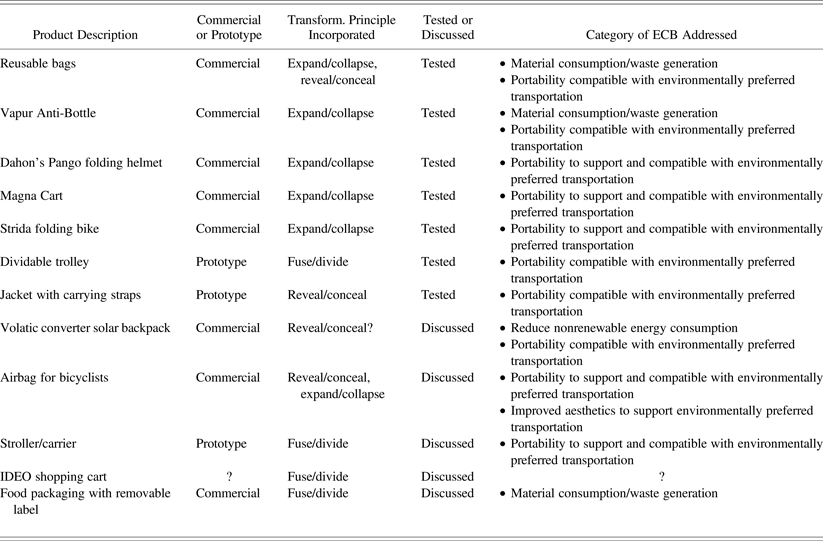
We therefore focused on products that support the use of environmentally preferred transportation, as well as enhance the ability to carry out other ECBs by those who walk, bike, or use public transit as their main mode of transportation. Consistent with this focus, we studied the use of seven transformable products that support ECB. Five of these products implemented the expand/collapse principle as their primary mode of transformation, while expose/cover and fuse/divide were used by one transformable product each. Table 1 shows these seven and other transformable products that we did not study in depth but included in our discussion.
Summary of products/prototypes studied and discussed

Reviews and other information we found on products that claim to be ecofriendly tended to be incomplete and inconsistent. We therefore used, observed, and interviewed users of these products to identify insights into the relationship between transformation principles and ECB. Use observation involved both firsthand product use and other product users.
3.2. Firsthand use testing
We personally utilized transformable products to appreciate use contexts and possible user behaviors related to the products examined. The use/test periods ranged from 2 weeks to 6 months. Product testing continued as long as new insights and observations were obtained. Testing and observing over a long period of time helped uncover unexpected situations where the products were needed or became useful in a new way. The products were intentionally used in a wide range of situations and environments. For example, a collapsible reusable water bottle was used while working in an office environment, while walking around outdoors, and when playing sports. Testing in a variety of situations helped identify particular cases where the products failed to be useful or could not perform properly, and why such limitations occurred.
3.3. Articulated-use interviews
We observed and interviewed participants in their use of three commercially available transformable products. We could not find or recruit participants for the other four transformers because the products were either still fairly new or were not yet tested for safety.
The articulated-use interview method involved interviewing participants while they were using the product. Interview questions elicited insights into general usage of the product and the product in comparison with alternative ways of accomplishing the ECB (e.g., using a folding bike vs. using public transit or private vehicle). The interviews ranged from about 20 to 60 min and lasted until participants were not able to provide new information about the product.
4. TRANSFORMABLE PRODUCTS STUDIED
This section describes the seven transformable products studied. We selected products that required mechanical change as a means to alternate between different modes and could easily be seen to support the use of an environmentally preferred transportation mode or to support such users in their pursuit of other ECBs. Very few products met the above criteria, but we were able to identify five products, all of which incorporate the expand/collapse principle. To address the shortcomings we observed of one product, we developed two new prototypes (Son & Shu, Reference Son and Shu2012) that apply the other transformation principles (expose/cover and fuse/divide).
4.1. Reusable grocery bags
The reusable bags tested varied significantly in material properties and the degree of foldability (Fig. 1). For example, some bags can be stuffed into a small, attached storage pouch. Others were made of a thicker yet more durable material, which can carry more items although they cannot be folded as compactly.
(Color online) Various types of reusable shopping bags that were studied.
4.2. Vapur Anti-Bottle
The Vapur Anti-Bottle (Fig. 2) is a reusable liquid container made of flexible polyethylene that allows it to be flattened and rolled or folded (Vapur.us, 2009). When compacted, this container's size is similar to that of a smart phone, and it can fit in spaces as small as pants' pockets or smaller compartments of bags. The container's ability to collapse made it conducive to being almost always carried in a bag without conscious planning. This water bottle was tested for 6 consecutive months.
(Color online) Vapur Anti-Bottle. Images used with permission (http://www.vapur.us). (a) Folded and unfolded states and (b) stored in pants' pocket.
4.3. Dahon's Pango folding bike helmet
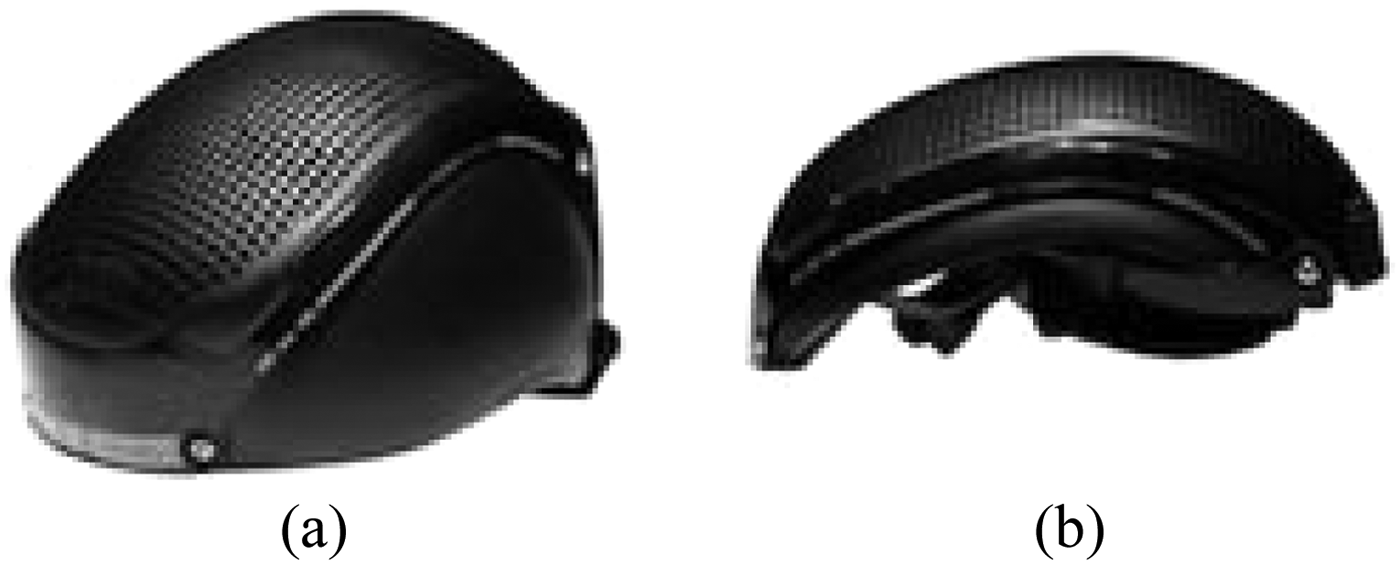
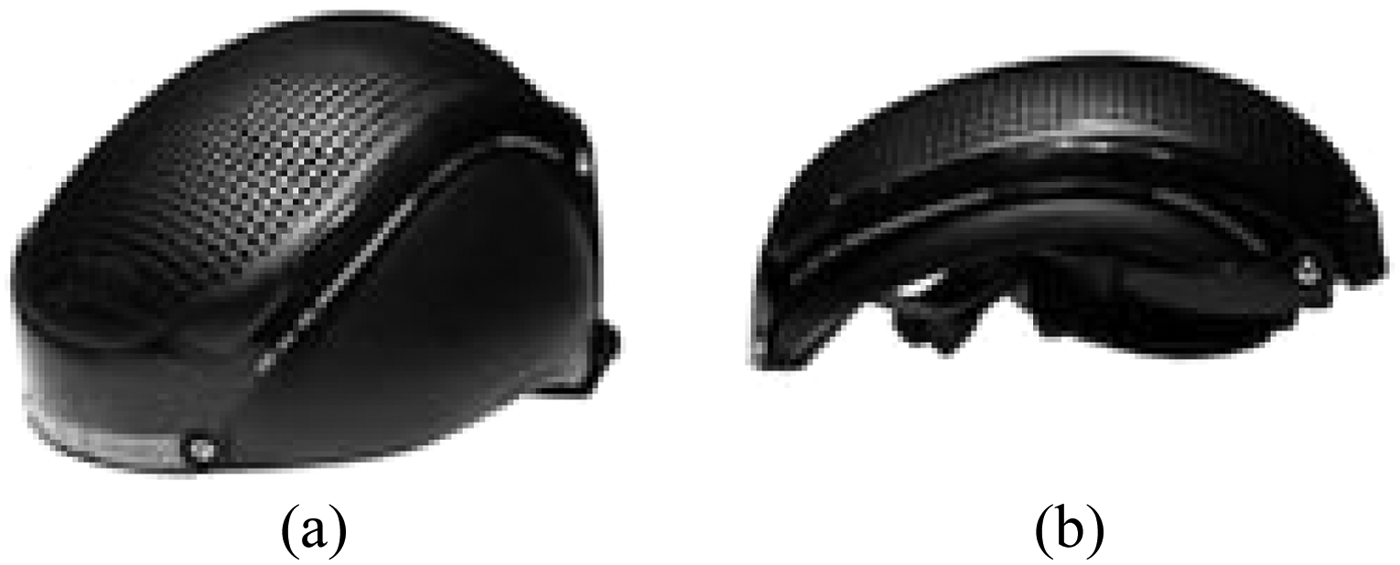
Dahon, a bicycle manufacturer, designed a folding helmet for cyclists (Fig. 3). The Pango helmet consists of an external plastic shell, and unlike the one-piece foam in most bike helmets, segmented foam plates form the inner part of the Pango (Dahon.com, 2010). The segmentation enables Pango's structural transformation, but this may also prevent it from meeting US safety standards. The helmet was used and tested for 2 weeks.
Dahon's Pango folding helmet. Images used with permission (http://www.dahon.com). Product no longer available. (a) Fully expanded and (b) folded for storage.
4.4. Magna Cart
The Magna Cart is a portable, transformable hand truck (Fig. 4). Features that enable its space-saving transformation are a telescoping handle, hinged wheel supports, and a hinged base plate (kk.org, 2010). In contrast to how the product may be used by drivers who store it in their trunks, we tested the product as a personal hand truck for transporting bulky and/or heavy objects either while walking or while using public transit.
(Color online) Magna Cart. Images used with permission (http://www.welcomproducts.com). (a) Loaded and folded states and (b) folded state (http://www.kk.org).
4.5. Strida folding bicycle
Of the many folding bikes available, we chose to study the Strida folding bicycle because one of its design requirements was compatibility with public transit (Sanders, Reference Sanders1985; Dezeen.com, 2008). This bike was the largest of the seven products studied. Figure 5 shows how the Strida bike can be folded into a compact, wheeled walking stick for storage and carrying. We tested this product for approximately 2 months.
(Color online) Strida folding bike. Images (of earlier model) used with permission (http://www.strida.com). (a) Folded state and (b) riding state.
4.6. Trolley with dividable modules (prototype)
Two new transformable products were developed to address the limitation observed of the Magna Cart: it was not sufficiently portable to fit into most bags for frequent carrying.
For our first concept, we were inspired by the Move-it cardboard cart developed by David Graham for those who transport large boxes without personal automobiles. Graham's concept (not pictured) consists of a handle and two wheels that adhere to corners of corrugated fiberboard boxes to facilitate transportation of the boxes (Designboom.com, 2010).
Figure 6 shows our trolley with dividable modules, conceptualized and prototyped to achieve two objectives: to increase its portability and to apply and better understand the fuse/divide principle.
(Color online) Trolley with dividable modules. (a) Separated modules and (b) modules attached to a box.
4.7. Object-carrying jacket for cyclists (prototype)
Next, the expose/cover principle was applied to develop a new concept to explore its effect on portability. The object-carrying jacket is intended to be a highly portable way to support transporting heavy and/or bulky objects for bikers or public transit users. The jacket appears similar to a sport rain jacket, but it incorporates a back strap system with five tie-down straps arranged to allow secure attachment of objects of various sizes and shapes. When the carrying function is not needed, the back straps can be covered to maintain the look of a regular jacket. To carry an object, one unzips the cover to expose the straps and buckles as shown in Figure 7.
(Color online) Object-carrying jacket for cyclists. (a) Front and back views and exposed-strap state and (b) in-use state.
5. OBSERVATIONS
This section reports how each of the three transformation principles appears to support ECBs.
5.1. Expand/collapse enables spontaneous use
We observed that the expand/collapse principle enabled spontaneous uses of products. As expected, products that collapsed when not in use required much less storage space than their nontransformable versions. As a result, they are likely to be carried around more often, making the product more frequently available for use, including unplanned use. For example, the collapsible reusable shopping bag neither weighs much nor takes up much space, and could be carried in a purse or backpack at all times. Therefore, it is more likely to be available to hold spontaneous purchases, reducing the need for disposable bags. Similarly, the collapsible water bottle helped users avoid using disposable water bottles, and the Pango folding helmet allowed one to make safer, spontaneous use of rental bicycles when the unexpected need for such a trip arose.
Another example of supporting spontaneous use involves the Strida folding bicycle. The portability of the bike when folded enabled users to access other transportation modes more spontaneously than with a nonfolding bike, a benefit that was especially useful in inclement weather. For example, in contrast to users of regular bicycles, Strida users were less sensitive to changes in weather because they could quickly fold their bicycle and take it in a taxi or on public transit without the need for tying down or peak-use time limitations that may affect regular bikes.
The Magna Cart folding trolley, while portable, was not portable enough to support spontaneous use. Because it is larger than most standard backpacks, it often must be carried separately by hand. It can fit into a top-loading backpack with the wide base sticking out, but the weight imbalance makes the load unstable and prone to falling out. In addition, depending on the size of the load on the cart, the load may be too wide to fit through turnstyles and must be removed from the cart and separately maneuvered through narrow entries of public transit. Relevant to this situation, spinner suitcases are better than two-wheeled suitcases for maneuvering through narrow spaces.
5.2. Expose/cover hides unused ECB-related features
The only product studied that exclusively applied the expose/cover principle was one we developed specifically to overcome the inability of the Magna Cart to support spontaneous use. After discovering that portability enables spontaneous use, we hypothesized that adding ECB-related features to commonly carried or worn products such as jackets or backpacks could enable spontaneous uses of the new features. Our object-carrying jacket that features a set of cinch straps on the back facilitates the spontaneous transportation of heavy or bulky objects while bicycling or walking. However, these straps look particularly awkward when not being used. Implementing the expose/cover principle, a flap reduced this problem by hiding the straps when they were not needed.
5.2.1. Products not studied but relevant to expose/cover
Related to hiding unused ECB-related features, an existing product combines a backpack with a solar panel for charging electronic devices (Fig. 8; voltaicsystems.com, 2013). Because many people use a backpack or other bag daily, a solar panel can both reduce nonrenewable energy use and improve convenience by having an alternative source of energy to power or recharge small electronic devices. Although the bag did not incorporate the expose/cover principle, we believe that a cover may both improve the appearance of the bag and protect the solar panel when not in use.
(Color online) Voltaic Converter Solar Backpack (http://www.Voltaicsystems.com, 2013). Image used with permission.
We have since learned of the “invisible bicycle helmet/airbag for bicyclists” developed by Swedish industrial designers for bicyclists who dislike the aesthetics of helmets (hovding.com, 2005). Based on an airbag that is deployed upon sensing impending impact, the “undeployed” state looks like a scarf or neck wrap (Fig. 9). This product reminded us that while North Americans may view bicycling as a sport/hobby or transportation for the extremely motivated, many more Scandinavians/Europeans of all ages bicycle for transportation. Such bicyclists may be less tolerant of the decreased aesthetics involved with bicycle helmets and literally want an “invisible helmet” that does not interfere with hairstyle and style in general. The invisible helmet/bicyclist airbag is a model implementation of expose/cover, that is, exposing the helmet only when needed. The invisible helmet also supports our hypothesis that expose/cover may enable more people to participate in ECB, by concealing the displeasing aesthetics involved until actually required.
(Color online) Invisible Bicycle Helmet/Airbag for Bicyclists. Images used with permission (http://www.hovding.com). (a) Undeployed state and (b) deployed state.
5.3. Fuse/divide facilitates transporting heavy/bulky objects
The fuse/divide principle enables one to separate heavy/bulky items into smaller and lighter objects. A dividable object may also overcome spatial constraints. For example, the Magna Cart transformable trolley, even when folded, could not fit into most backpacks. In contrast, the portable trolley with dividable modules developed by the lead author could be separated into smaller parts. The collection of these parts required much less space, and could much more easily be carried in a bag. However, it took longer than with the Magna Cart to attach our prototype of the modular trolley to a box. Like all designs, the quality of implementation of the principle is critical to the product's success. The ease of fusing/dividing may be especially important if the component parts themselves are not useful (e.g., with our modular trolley prototype).
5.3.1. Products not studied but relevant to fuse/divide
Dividable products may be more ergonomic to use. For example, a transformable baby stroller designed by Son (Reference Son2010) for public transit users allows users to separate the seat module from the chassis and wear it as a baby carrier (Fig. 10). This separation of modules could enable users to take a flight of stairs without requiring help from a second adult. Stairs present significant obstacles for most existing strollers. The task of carrying a loaded stroller up or down a flight of stairs is at best burdensome and at worst dangerous.
(Color online) A stroller that converts into child carrier (Son, Reference Son2010). (a) Concept and (b) prototype.
The IDEO shopping cart (Fig. 11) also applies fuse/divide by enabling the user to attach and detach shopping baskets to the frame of a shopping cart. A benefit of this concept is that it increases shoppers' maneuverability by allowing them to move through more crowded spaces without the cart, but with a shopping basket alone (ideo.com, 1999).
(Color online) IDEO Shopping Cart. Image used with permission (http://www.ideo.com).
Fuse/divide can also facilitate reuse of packaging. For example, packaging whose information labels remove easily reveal a container that is more aesthetically pleasing and thus more likely to be reused than packaging whose labels do not (Fig. 12).
(Color online) Easily separable product labeling on packaging. (a) Labeled state and (b) unlabeled state.
5.4. Summary of transformation principles and ECBs
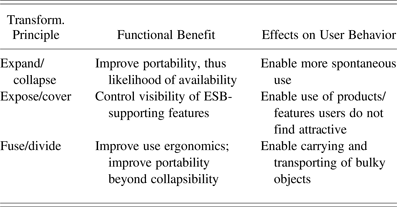
Table 2 summarizes the functional benefits and consequent effects on user behavior for each transformation principle. That is, the implementation of each transformation principle provides benefits that affect user behaviors relevant to ECBs.
Transformation principles and effects on behavior
5.5. Transformation and compromised function
Despite the advantages of volume change enabled by the expand/collapse principle, collapsibility sometimes compromised important functions in the products we studied. For example, the Magna Cart's telescoping handle bent more easily than a handle on a nontransforming cart, and segmented foam plates of the Pango folding helmet reduced its protective capacity. In the Pango helmet's case, the functional compromise was so critical that the product could not be introduced into the North American market. Strida, the folding bicycle, offers more flexibility but is slower to ride and harder to repair than a standard bicycle. A collapsible coffee cup or water bottle is more convenient to carry, but it could perform less well than a standard reusable coffee cup or water bottle. Even noncollapsible versions of products we are accustomed to being collapsible provide benefits. For example, a more rigid backpack can remain upright without support, a surprisingly useful feature.
However, such functional compromises caused by poor implementations of transformation are not always critical, or the benefit achieved through transformation can be more significant than corresponding compromises. For instance, although the Vapur Anti-Bottle is much less stiff than a regular rigid water bottle, the reduced rigidity is rarely a problem. The Vapur Anti-Bottle was still rigid enough to maintain the form of a water bottle yet soft enough to be flattened and rolled up when empty. In addition, the urban users of the Strida folding bicycle felt that the benefit of being able to bring the bike indoors, reducing the risk of potential theft, enabled by its foldability, far exceeded the drawback of slower riding speed. However, such examples still highlight the added challenges of designing and producing transformable products.
6. DISCUSSION
6.1. Generalizability of our observations
6.1.1. Users studied
Although we found some transformable products studied to be effective in facilitating ECBs, this effect might not apply to different users. For example, all of the reusable shopping bag users we observed/interviewed preferred to walk to grocery stores, so the foldability of their bags was often appreciated. However, this might not be true for those who drive to grocery stores owing to the large amount of storage space in cars.
6.1.2. External validity
In the context of qualitative, exploratory field research, external validity refers to “the extent to which the data may be generalized beyond the research project” (Dane, Reference Dane2011). One factor affecting external validity is the scene (i.e., city) where transformable products were tested and participants resided. Toronto was the main scene of the current research, so the current work's findings are based on a variety of elements of the city including its infrastructure (e.g., public transit system). As a result, the findings of this study may not extend to dissimilar scenes (e.g., rural settings). However, some elements of the findings may be transferrable to other urban settings that share common attributes with Toronto. Other factors that affect external validity include the range of weights and sizes of the seven transformable products tested, as well as the demographics of our participants.
6.2. Other factors that affect transformable products
Despite the benefits of transformable products, a number of factors may hinder their adoption and continued use. This section describes three such factors.
First, other products or solutions could address the same needs. For example, regarding the Vapur Anti-Bottle, the convenience of buying a bottle of water may discourage some users, especially those who are outdoors often, from finding a water fountain for their reusable bottle. Users may also buy bottled water only occasionally, reusing that bottle until they find the need to buy another bottle of water. Many users may be satisfied with a regular reusable bottle that they already own, and they do not feel the need to use a transformable one. Similarly, most other transformable products also come in nontransformable versions that could be sufficient or preferred (e.g., folding bike vs. regular bike).
Second, relatively complex transformable products such as folding bikes could be more difficult to maintain owing to the nonstandard parts used for transformative mechanisms (e.g., joints or connection points). For example, personal attempts to repair the Strida folding bike, in addition to interviews with other users, revealed that many local bike shops had neither parts nor knowledge for maintaining the folding bike. This obstacle may prevent users from continuing to use the bike or from buying the bike in the first place. However, the severity of this factor is likely to decrease with increased demand for such products. An obvious way to address this obstacle is to ensure that nonstandard parts either are durable enough to not require replacement or are made available as replacement parts.
Third, other factors also affect the use of transformable products. For example, many Toronto residents are asked to use grocery-bag-sized plastic bags to dispose of garbage. Therefore, even when a plastic bag fee was in place, some residents chose disposable bags, because they were required as garbage bags. The plastic bag fee, however, still significantly reduced the number of disposable bags used.
6.3. Infrastructure and ECB
We believe that transformation facilitates individual participation in ECBs until obstacles in infrastructure are removed. Because a sufficient amount of participation is required before improvements in infrastructure to support such behavior can be justified, products that increase the participation in such activities will help move such activities from lead-user to more mainstream.
As an example of infrastructure to support ECB, an alternative to the folding bicycle is the bicycle rental system that is available in several cities. Such bicycles remove the burdens of maintenance, storage, and theft. In addition, they need not be carried around like a folding bicycle. However, just as the success of public transit depends on its widespread availability, the success of bike renting systems depends on availability of bikes near one's origin and the possibility of return near one's destination.
The ideal situation is that reusable options are available at the point of use, to enable spontaneity without the hassle of carrying an often-compromised version of a product at all times. Another example is the reusable ecotray container offered by University of Toronto cafeterias. For a nominal deposit, diners can choose to have their food served in an ecotray rather than in disposable packaging. The deposit is returned upon return of the ecotray, which need not be immediate. The ecotray addresses several concerns that establishments have with consumers bringing their own reusable containers. First, food servers are acquainted with the standard tray and know how to portion using it. Second, because the establishment is responsible for washing the trays, this reduces the concern that unsanitary containers can cause illness in those who consume their food.
Other infrastructure possibilities that enable ECB include dollies or carts that can be available for a deposit from stores such that they need not be owned, nor must they be returned immediately, which detracts from their convenience.
7. CLOSING
7.1. Summary
The current research explored how mechanical transformation can support ECB. We interviewed and observed lead users in ECB as well as used ECB-supporting transformable products in natural settings. We observed that each of the transformation principles supports ECB in different ways. While the portability enabled by the expand/collapse principle is not surprising, what was less expected is that portability of ECB-supporting products enables their spontaneous use. There existed fewer ECB-supporting products that incorporate the expose/cover principle. However, we believe that expose/cover enables one to incorporate, yet hide potentially unaesthetic, features that support ECB in often-used or worn items. Finally, we found fuse/divide to enable portability beyond what is possible with expand/collapse alone. Fuse/divide may also make possible other product transport and reuse strategies.
7.2. Conclusion
We observed that existing transformable products that actively support ECB tend to support the use of environmentally conscious transportation and/or reduce the consumption of disposable products. While one may more easily avoid disposable products while at home or at work, it is more challenging to carry reusable versions of commonly disposable products, especially while using environmentally preferred modes of transportation. Our other work on ECB focuses on principles and behavior that reduce the consumption of household energy and water (Srivastava & Shu, Reference Srivastava and Shu2013a, Reference Srivastava and Shu2013b).
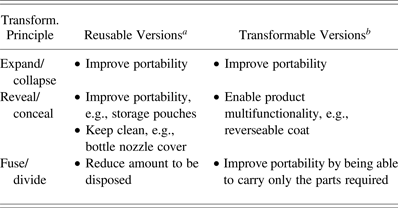
Our observations on how transformation principles could be applied to modify existing or create new products that support ECB, summarized in Table 3, are described below. Expand/collapse can be applied to improve the portability of reusable versions of commonly used disposable products. Reliance on disposable products may lessen if reusable versions are more conveniently available. Expand/collapse may also be applied to facilitate multiple modes of transportation (e.g., biking AND public transit, walking AND public transit).
Transformation and possible effects on product type
aDisposable products such as bags, bottles, and packaging.
bProducts that are not normally transformers, such as bikes, helmets, carts, strollers, solar backpacks.
Expose/cover can be applied to hide potentially aesthetically displeasing features that are occasionally required to support ECB. Such features we found or propose include straps that facilitate carrying loads while walking/bicycling, head protection to enable safer bicycling, and solar panels to reduce consumption of nonrenewable energy.
Fuse/divide can be applied to enable better portability of products (e.g., child carrier/stroller or separable trolley cart parts), while using environmentally preferred transportation. Fuse/divide can also improve portability by making it possible to carry just the part that is required.
Fuse/divide may also reduce the need to clean reusable versions of products that are often disposable. For example, even people who are sufficiently motivated to bring reusable versions of disposal products often find obstacles in keeping them clean while away from home/work. Fuse/divide could be used to minimize the portion of the product that is disposed of and to avoid the need to clean the product (e.g., liners for coffee cups). Fuse/divide can also support the reuse of normally disposable products (e.g., packaging), by making the product labeling easier to remove, and thus more aesthetically pleasing.
We conclude that mechanically transformable products support and enable ECBs, especially when existing infrastructure present obstacles. Such products may increase the rate of participation in ECB, which then justifies improvements to the shortfalls in infrastructure for which they compensate.
ACKNOWLEDGMENTS
The authors thank the Natural Sciences and Engineering Research Council of Canada for financial support of this work.
Jay Jungik Son obtained his MS in mechanical and industrial engineering and his BS in engineering science at the University of Toronto. His research focused on transformation principles and environmentally conscious behaviors.
L. H. Shu is an Associate Professor in mechanical and industrial engineering at the University of Toronto, where she held the Wallace G. Chalmers Chair of Engineering Design. She obtained her PhD and MS from MIT and her BS from the University of Nevada, all in mechanical engineering. She is active in ASME Design Theory and Methodology and is a fellow of CIRP and received the F.W. Taylor Medal Award in 2004. Her research interests include creativity in conceptual design, systematic identification and application of biological analogies in biomimetic (biologically inspired) design, and identifying and overcoming obstacles to personal environmentally conscious behavior.