Introduction
The size of the elderly population is increasing in the U.K. and its constituent countries (Shah and Mackenzie, Reference Shah, MacKenzie, Bhugra and Bhui2007). A recent cross-national study reported an increase in suicide rates with aging in males and females in 25 and 27 of the 62 countries respectively (Shah, Reference Shah2007a). Thus, elderly suicides are an important public health concern.
Time trends of elderly suicide rates
Suicide rates in the U.K. in the age-bands 65–74 and 75+ years in both sexes declined between1979 and 2002 (Shah, Reference Shah2007b; Shah et al., Reference Shah, Bhat, MacKenzie and Koen2008). Elderly suicide rates in both sexes declined in studies of varying periods between 1960 and 1999 in England and Wales (McClure, Reference McClure2000; Hoxey and Shah, Reference Hoxey and Shah2000; Shah et al., Reference Shah, Elanchanny and Collinge2001; Pritchard and Hansen, Reference Pritchard and Hansen2005), particularly in the “young-old” (65–84 years) (Shah et al., Reference Shah, Elanchanny and Collinge2001). Suicide rates in males in the age-bands 65–74 and 75+ years increased by 4% and 10% respectively between 1971 and 2000 in Scotland (Stark et al., Reference Stark, Hopkins, Gibbs, Rapson, Belbin and Hay2004), but decreased by 25% and 24% in the corresponding age-bands in females. Specific data on time trends of elderly suicide rates in Northern Ireland are not available.
Age-associated trends
Suicide rates in males peaked in the age-band 15–24 years in 1990 (Biddle et al., Reference Biddle, Brock, Brookes and Gunnell2008) and in the age-band 25–34 in the late 1990s in England and Wales (McClure, Reference McClure2000; Middleton and Gunnell, Reference Middleton and Gunnell2000). Suicide rates in males declined in all the 10-year age-bands older than 45–54 years, but increased again in the age-band 75+ years (University of Manchester, 2006). Suicide rates were the highest in males over the age of 65 years and in females in the age-band 75+ years in two London boroughs in 1993 (Henderson et al., Reference Henderson, Mellin and Patel2005).
Between 1969 and 1971, a linear increase in suicide rates with aging was observed in both sexes in Scotland (Ross and Krietman, Reference Ross and Krietman1975). However, recent studies report that suicide rates in males peaked in the age-bands 25–34 and 35–44 years and in females in the age-bands 25–34, 35–44 and 45–54 years (Platt, Reference Platt2003; Scottish Executive, 2006). Suicide rates in males in the age-bands 65–74 and 75+ years were the lowest of all age-bands (Scottish Executive, 2006). Recent studies from Northern Ireland report that suicide rates peaked in the age-bands 21–44 years and 25–54 years in males and females respectively (Department of Health, Social Services and Public Safety Northern Ireland, 2006; Burns et al., Reference Burns, Goodall and Moore2008; O'Reilly et al., Reference O'Reilly, Rosato, Connolly and Cardwell2008).
Suicide prevention strategies
The governmental initiative, Health of the Nation (Department of Health, 1992) set a target to reduce the suicide rate by 15% by 2000 in England. A subsequent initiative, Saving Lives: Our Healthier Nation (Department of Health, 1999), set a further target to reduce the suicide rate by at least 20% by 2010 in England. This was supported by the National Suicide Prevention Strategy for England (Department of Health, 2002). A suicide prevention action plan for Wales is currently being developed (Welsh Assembly Government, 2008). The national suicide prevention strategy Choose Life for Scotland (Scottish Executive, 2002) is a 10-year plan with a target reduction of 20%, from 17.4 per 100,000, to be reached by 2013. In Northern Ireland, the national suicide prevention strategy was initially implemented through the Promoting Mental Health strategy (Department of Health, Social Services and Public Safety Northern Ireland, 2003) and subsequently enhanced by a separate suicide prevention strategy Protect Life (Department of Health, Social Services and Public Safety Northern Ireland, 2006) with the aim of reducing the overall suicide rate by 10% by 2008 and a further reduction of 5% by 2011.
As the governmental suicide reduction targets for 2010, 2011 and 2013 for England, Northern Ireland and Scotland respectively move closer, examination of the following facets pertaining to elderly suicide rates may provide helpful information:
• time trends in elderly suicide rates
• age-associated trends in suicide rates
• comparison of suicide rates between the three constituent countries.
The null hypothesis in this study was that there is no change in elderly suicide rates over time, no age-associated trends in suicide rates, and no differences in suicide rates between the three constituent countries.
Methods
Data collection
Data on suicide rates for both sexes in the age-bands 65–74 and 75+ years for the U.K. and the three constituent countries (England and Wales, Northern Ireland and Scotland) were ascertained from the WHO for each of the 24 years from 1979 to 2002 (www.who.int/whosis/database/mort/table1_process.cfm ). These data were for the actual year of suicide.
Data on male and female suicide rates for each of the seven 10-year age-bands 15–24 years to 75+ years for the latest five years (1998–2002) were also ascertained from the same WHO website for the U.K. and the three constituent countries. The average annual suicide rates for each of these seven age-bands were calculated to reduce any random annual variations when examining age-associated trends in suicide rates.
Data analysis
The data were analyzed using SPSS version 15.
The relationship between study years and the suicide rates in both the elderly age-bands for both sexes in the whole of the U.K. and the three constituent countries was examined with Spearman's correlation coefficient because the data were not normally distributed. This allowed examination of trends in suicide rates over time. This method has been successfully used before (Hoxey and Shah, Reference Hoxey and Shah2000; Shah et al., Reference Shah, Elanchanny and Collinge2001; Reference Shah, Bhat, MacKenzie and Koen2008; Shah, Reference Shah2007a; Reference Shah2007b).
Each of the seven age-bands 15–24, 25–34, 35–44, 45–54, 55–64, 65–74 and 75+ years were coded numerically in the ascending order of 1 to 7. Spearman's correlation coefficient was used to examine the relationship between the seven age-bands and suicide rates by correlating the ascending order numerical codes for the seven age-bands with the average suicide rate over the latest five years for each age-band. This method has been successfully used in earlier studies (Shah, Reference Shah2007a; Reference Shah2007c).
Wilcoxon's matched-pair signed-ranked test was used to compare suicide rates between each pairwise combination of the three constituent countries; this test was chosen as the data were not normally distributed.
Results
Time trends
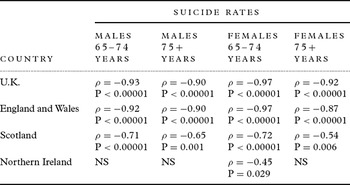
As illustrated in Table 1, there was a significant decline in suicide rates over the 24-year study period in males and females in the age-bands 65–74 and 75+ years for the whole of the U.K., England and Wales and Scotland. For Northern Ireland, there was a significant decline in suicide rates over the same period in females in the age-band 65–74 years, but there were no significant changes in males in the age-band 65–74 and 75+ years and females in the age-band 75+ years.
Time trends in elderly suicide rates over 24 years 1979–2002

NS = not significant.
Age-associated trends
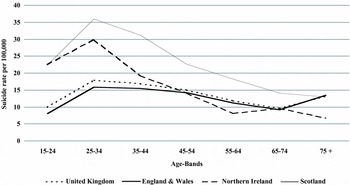
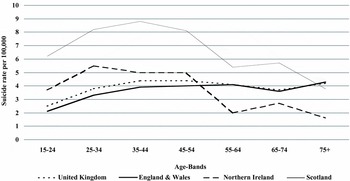
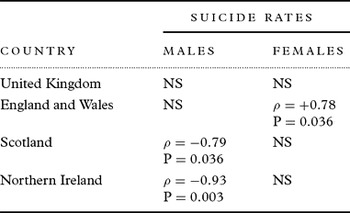
Figures 1 and 2 illustrate the age-associated trends in suicide rates for both sexes for the whole of the U.K. and the three constituent countries. Table 2 illustrates the correlations for these age-associated trends in suicide rates.
Age-associated suicide rates in males 1998–2002.

Age-associated suicide rates in females 1998–2002.

Age-associated trends in suicide rates

NS = not significant.
For the whole of the U.K., there was no significant linear age-associated trend in suicide rates for both sexes. However, in males there was a peak in the age-band 25–34 years and in females in the age-bands 35–44 and 45–55 years.
For England and Wales, there was no significant linear age-associated trends in suicide rates in males, but in females suicide rates increased with increasing age (ρ = +0.78, P = 0.036). However, for males there was a peak in the age-band 25–34 years.
For Scotland, suicide rates in males decreased with increasing age (ρ = −0.79, P = 0.036), but there was no significant linear age-associated trend in suicide rates in females. Additionally, in males there was a peak in the age-band 25–34 years and in females in the age-bands 25–34, 35–44 and 45–54 years.
For Northern Ireland, male suicide rates decreased with increasing age (ρ = −0.93, P = 0.003), but there was no significant linear age-associated trend in suicide rates in females. Additionally, in males there was a peak in the age-band 25–34 years and in females in the age-bands 25–34, 35–44 and 45–54 years.
Comparison of suicide rates among the three countries
Suicide rates in males in the age-band 65–74 years were higher in Scotland than in England and Wales (Z = −3.74, P < 0.00001) and Northern Ireland (Z = −3.50, P < 0.00001) only. There was no significant difference in suicide rates in males in the age-band 65–74 years between England and Wales and Northern Ireland.
Suicide rates in males in the age-band 75+ years were higher in England and Wales than in Northern Ireland (Z = −3.61, P < 0.00001), but there was no significant difference between England and Wales and Scotland. Suicide rates in males in the age-band 75+ years were higher in Scotland than in Northern Ireland (Z = −3.09, P = 0.002).
Suicide rates in females in the age-band 65–74 years were higher in England and Wales than in Northern Ireland (Z = −2.67, P = 0.008), but there was no significant difference between England and Wales and Scotland. Suicide rates in females in the age-band 65–74 years were higher in Scotland than in Northern Ireland (Z = −4.1, P < 0.00001).
Suicide rates in females in the age-band 75+ years were higher in England and Wales than in Northern Ireland (Z = −4.3, P < 0.00001) and Scotland (Z = −2.4, P = 0.018). Suicide rates in females in the age-band 75+ years were higher in Scotland than in Northern Ireland (Z = −4.0, P < 0.00001).
Discussion
Some methodological issues require consideration. The study years were arbitrarily chosen because the WHO website only provides data for the years 1979–2002. However, a study period of 24 years is reasonably long. In the U.K., the coroner can only return a verdict of suicide if suicide can be proved beyond reasonable doubt. Thus, some genuine suicides can be misclassified as deaths due to undetermined causes (Dennis et al., Reference Dennis, Read, Andrews, Wakefield, Zafar and Kavi2001). The WHO, using the International Classification of Diseases Version 9, only provides data on those with a verdict of suicide in the U.K. and the three constituent countries; data on deaths due to undetermined causes were not available. However, recent studies have argued that within individual countries there is internal consistency (Sainsbury, Reference Sainsbury1983) and such variations may be less important when changes in patterns of suicide rates are examined (Pritchard, Reference Pritchard1992). Data were only available for two elderly age-bands and therefore conclusions about trends for five-year age-bands after the age of 65 years cannot be made. The findings of this study, confined to the U.K. and its constituent countries, cannot be generalized to other developed countries.
Time trends
The decline in suicide rates in both sexes in both elderly age-bands over the 24−year study period in the whole of the U.K., England and Wales and Scotland is consistent with previous reports for the U.K. (Shah, Reference Shah2007a; Shah et al., Reference Shah, Bhat, MacKenzie and Koen2008), England and Wales (Hoxey and Shah, Reference Hoxey and Shah2000; McClure, Reference McClure2000; Shah et al., Reference Shah, Elanchanny and Collinge2001; Gunnell et al., Reference Gunnell, Middleston, Whitley, Dorling and Frankel2003; Pritchard and Hansen, Reference Pritchard and Hansen2005) and Scotland (Platt, Reference Platt2003; Stark et al., Reference Stark, Stockton and Henderson2008). However, the observed decline in male suicide rates in both the elderly age-bands in Scotland was not observed in another recent Scottish study (Stark et al., Reference Stark, Hopkins, Gibbs, Rapson, Belbin and Hay2004). This discrepancy may be due to: the methodological issues described above; differences in methodology; and differences in the time periods and the study duration. Only female suicide rates in the age-band 65–74 years declined in Northern Ireland, but other comparative data are not available.
Although this study did not systematically examine possible explanations, there may be several potential explanations for the observed decline in suicide rates in both the elderly age-bands for both sexes in the whole of the U.K., England and Wales and Scotland. Some recent initiatives in the U.K. may have helped improve detection and treatment of individuals at risk of suicide: legislation encouraging general practitioners to offer annual physical and mental examination to those over the age of 75 years; the “Defeat Depression” campaign organized by the Royal College of Psychiatrists and Royal College of General Practitioners; the government's “Health of the Nation” and “Our Healthier Nation” suicide reduction targets; the National Confidential Inquiry into Suicides and Homicides for England and Wales; the National Service Frameworks for Mental Health and for Older People; the National Suicide Prevention Strategy for England, Scotland and Northern Ireland; introduction of the “Breathing Space” helpline; and large investment in media publicity in Scotland (Hoxey and Shah, Reference Hoxey and Shah2000; Shah et al., Reference Shah, Elanchanny and Collinge2001; Shah, Reference Shah2007b; Pritchard and Hansen, Reference Pritchard and Hansen2005; Stark et al., Reference Stark, Stockton and Henderson2008). Independent influence of these factors as a period effect in the context of age, period and cohort effects has not been examined and may have an additional effect on suicide rates (Stark et al., Reference Stark, Stockton and Henderson2008). Although the current study did not examine these issues specifically, evidence from the literature supporting this hypothesis is considered below.
Suicide rates in mixed age groups in London (Kennedy et al., Reference Kennedy, Iveson and Hill1999), Scotland (Boyle et al., Reference Boyle, Exeter, Feng and Flowerdew2005; Stark et al., Reference Stark, Hopkins, Gibbs, Rapson, Belbin and Hay2007) and Northern Ireland (Department of Health, Social Services and Public Safety Northern Ireland, 2006) were higher in areas with high socio-economic deprivation. In England and Wales, elderly suicide rates were higher in areas with high socio-economic deprivation (Whitley et al., Reference Whitley, Gunnell, Dorling and Smith1999; Shah et al., Reference Shah, Uren, Baker and Majeed2002) and high social fragmentation (Whitley et al., Reference Whitley, Gunnell, Dorling and Smith1999). Decline in elderly suicide rates over time in England and Wales was associated with an increase in national gross domestic product (Gunnell et al., Reference Gunnell, Middleston, Whitley, Dorling and Frankel2003) and measures of improved healthcare provision (Gunnell et al., Reference Gunnell, Middleston, Whitley, Dorling and Frankel2003; Lodhi and Shah, Reference Lodhi and Shah2005), including an increase in the number of general practitioners and hospital medical staff, number of outpatient appointments for mental illness, number of field social workers and day center staff (Lodhi and Shah, Reference Lodhi and Shah2005). This suggests that elderly suicide rates may be associated with socio-economic deprivation, social fragmentation and provision of adequate health and social service resources. Thus, improvement in the social and health structure of society may be important. Decline in elderly suicide rates in England and Wales (Lodhi and Shah, Reference Lodhi and Shah2004) was also associated with an increase in prescription rates of selective serotonin reuptake inhibitor antidepressants; this may have been a direct result of initiatives mentioned in the previous paragraph promoting health-seeking behavior among patients at risk of suicide and improving antidepressant prescribing patterns amongst doctors.
Although the above explanations could theoretically explain the observed decline in female suicide rates in the age-band 65–74 years in Northern Ireland, they do not explain an absence of decline in suicide rates in females in the age-band 75+ years and males in both the elderly age-bands. One explanation for this may be that only three of the ten suicide prevention action points in the original suicide prevention strategy in Northern Ireland have been met in full (Department of Health, Social Services and Public Safety Northern Ireland, 2006).
Age-associated trends
The observed peak in suicide rates in males in the age-band 25–34 years in the whole of the U.K., England and Wales, Scotland and Northern Ireland was consistent with previous reports from England and Wales (McClure, Reference McClure2000), Scotland (Stark et al., Reference Stark, Hopkins, Gibbs, Rapson, Belbin and Hay2004; Scottish Executive, 2006) and Northern Ireland (Department of Health, Social Services and Public Safety Northern Ireland, 2006; Burns et al., Reference Burns, Goodall and Moore2008; O'Reilly et al., Reference O'Reilly, Rosato, Connolly and Cardwell2008). The observed peak in suicide rates in females in the age-bands 25–34, 35–44 and 45–54 years in Scotland and Northern Ireland and in the age-bands 35–44 and 45–54 years in the whole of the U.K. have been observed before in Scotland (Scottish Executive, 2006) and Northern Ireland (Department of Health, Social Services and Public Safety Northern Ireland, 2006; Burns et al., Reference Burns, Goodall and Moore2008; O'Reilly et al., Reference O'Reilly, Rosato, Connolly and Cardwell2008). The significant linear increase in female suicide rates with increasing age in England and Wales has been observed before (Henderson et al., Reference Henderson, Mellin and Patel2005). The decline in male suicide rates with aging in Scotland and Northern Ireland has not been reported before in these countries, but is consistent with a similar observation in the Republic of Ireland (Shah, Reference Shah2007a).
Comparison of elderly suicide rates between the three countries
Elderly suicide rates were generally lower in Northern Ireland than in Scotland and England and Wales for the 24-year period 1979–2002, but previous comparative data were not available.
There was no difference in suicide rates in males in the age-band 75+ years and females in the age-band 65–74 years between England and Wales and Scotland. Suicide rates in males in the age-band 65–74 years were lower and in females in the age-band 75+ were higher in England and Wales than in Scotland. This was partly consistent with the observation that elderly suicide rates in both sexes were lower in Scotland than in England and Wales (Ross and Kreitman, Reference Ross and Krietman1975), but this observation is almost four decades old. More recent comparative data between these two countries are not available.
Conclusion
The observed similarities and differences in elderly suicide rates, time trends for elderly suicide rates and age-associated trends in suicide rates between the three constituent countries of the U.K. offer an opportunity to examine the differential characteristics between these countries that may potentially explain these observations. These differential characteristics include differential prevalence of mental illness, genetic risk factors for mental illness and suicidal behavior, life expectancy, cultural factors, socio-economic deprivation, income inequality, population density, urban versus rural location, access to methods of suicide, mental health legislation, and the availability, accessibility and models of delivery of health (including mental health) and social care services (Crombie, Reference Crombie1991; Kennedy et al., Reference Kennedy, Iveson and Hill1999; Whitley et al., Reference Whitley, Gunnell, Dorling and Smith1999; Shah et al., Reference Shah, Uren, Baker and Majeed2002; Boyle et al., Reference Boyle, Exeter, Feng and Flowerdew2005; Pritchard and Hansen, Reference Pritchard and Hansen2005; Department of Health, Social Services and Public Safety Northern Ireland, 2006; Shah, Reference Shah2007a; Reference Shah2007b; Reference Shah2008; Shah et al., Reference Shah, Bhat, MacKenzie and Koen2007; Shah and Bhat, Reference Shah and Bhat2008; Stark et al., Reference Stark, Hopkins, Gibbs, Rapson, Belbin and Hay2007; Reference Stark, Stockton and Henderson2008).
Conflict of interest
None.
Acknowledgments
The University of Central Lancashire kindly funded JC as a student intern to conduct this project. Marian Lawrenson's administrative help was also greatly appreciated.