INTRODUCTION
The bluntnose sixgill shark, Hexanchus griseus (Bonnaterre, 1788), has been known from Turkish waters since the voyage of the Italian research vessel ‘Marsigli’ in the early 1920s (Ninni, Reference Ninni1923). In his preliminary report on the fish fauna and fisheries in Turkish seas, Ninni (Reference Ninni1923) reported the first ichthyological list from the region, which includes some brief data on the bluntnose sixgill shark. Later, Deveciyan (Reference Deveciyan1926) made a significant contribution to the first writings on H. griseus from Turkish waters, mostly from the Sea of Marmara, based on the specimens landed at İstanbul Fish Market.
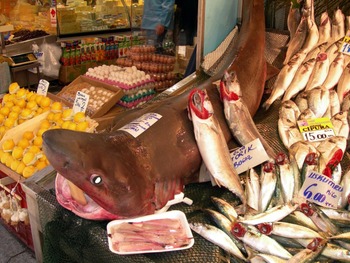
Although the first recordings of H. griseus in the Sea of Marmara date back to the 1920s, a clear ignorance of the bluntnose sixgill shark in the general ichthyological fauna studies of Marmaric waters is obvious. The reason for this scientific ignorance is that the bluntnose sixgill shark, like other shark species, has no importance in the marine fisheries of Turkey (Akşıray, Reference Akşıray1987; Kabasakal, Reference Kabasakal1998a). However, due to drastic reductions in the stocks of commercially important bony fish, the bluntnose sixgill shark, once considered as a nuisance, is now sought by fishermen as an alternative catch. The change of mind of Turkish fishermen with respect to the bluntnose sixgill shark, as well as the interest of the popular media in landings of large sharks (Figure 1), caused a significant and dangerous fishing pressure on H. griseus.
A bluntnose sixgill shark (specimen No. 49; Table 1), Hexanchus griseus (Bonnaterre, 1788), displayed in the fishmarket in İstanbul.

Kabasakal (Reference Kabasakal1998b) recorded H. griseus from the Sea of Marmara. Since that time, at least 40 bluntnose sixgill sharks have been captured in Marmaric waters by commercial fishing vessels, and subjected to several investigations (Kabasakal, Reference Kabasakal2004, Reference Kabasakal2006). Since a remarkable number of bluntnose sixgill sharks have been captured during the last 10 years, the author questioned whether the Sea of Marmara may be inhabited by a resident population of H. griseus. The present study analyses the previous and recent captures of the bluntnose sixgill sharks in the Sea of Marmara, with a discussion on the possibility of a marine protected area in Marmaric waters for conserving the species.
MATERIALS AND METHODS
The surveys dealing with the Marmaric population of Hexanchus griseus are part of extensive research of the sharks of Turkish waters. During these surveys, data were collected from the following sources: (1) field investigations on board of fishing vessels, particularly purse-seiners, as well as visiting fishing ports and fishmongers, whenever the capture of a bluntnose sixgill shark was reported by the fishermen to author; (2) popular media such as daily newspapers, and fishing and diving magazines; and (3) preserved samples of jaws, body parts or whole specimens of bluntnose sixgill sharks, displayed by the fishermen. Whenever possible the following data were recorded: total length (TL), where the shark was laid on one side with the caudal fin in its natural position, sex, weight, coloration and any specific pattern on the skin. A strip of teeth from the lower jaws of several bluntnose sixgill sharks, and a complete set of upper and lower jaws of a subadult male (specimen No. 49; Table 1), were preserved. All the collected samples and photographs of the specimens are kept by the Ichthyological Research Society (IRS).
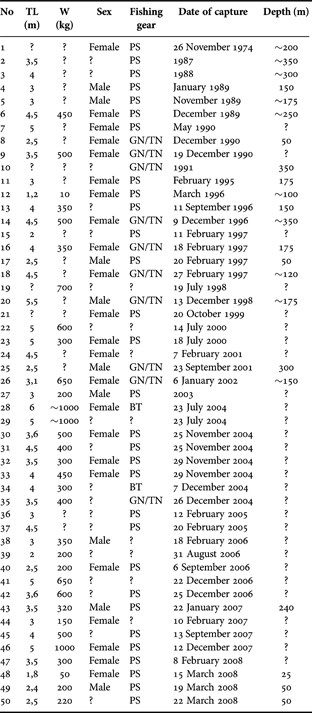
Fishing data of the bluntnose sixgill sharks. Specimen numbers are same as shown in Figure 2.

PS, purse-seine; BT, bottom-trawl; GN, gill-net; TN, trammel-net.
RESULTS
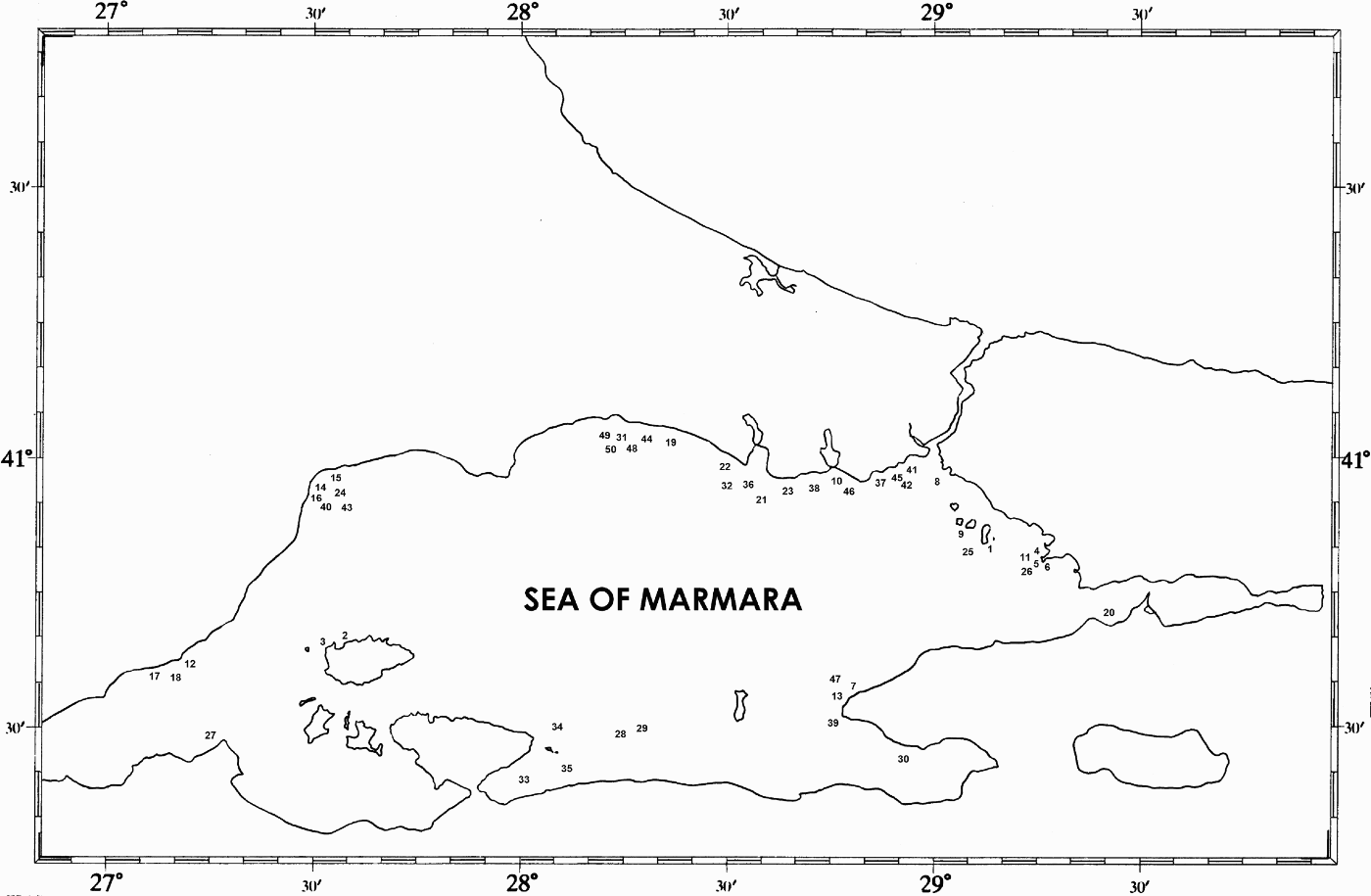
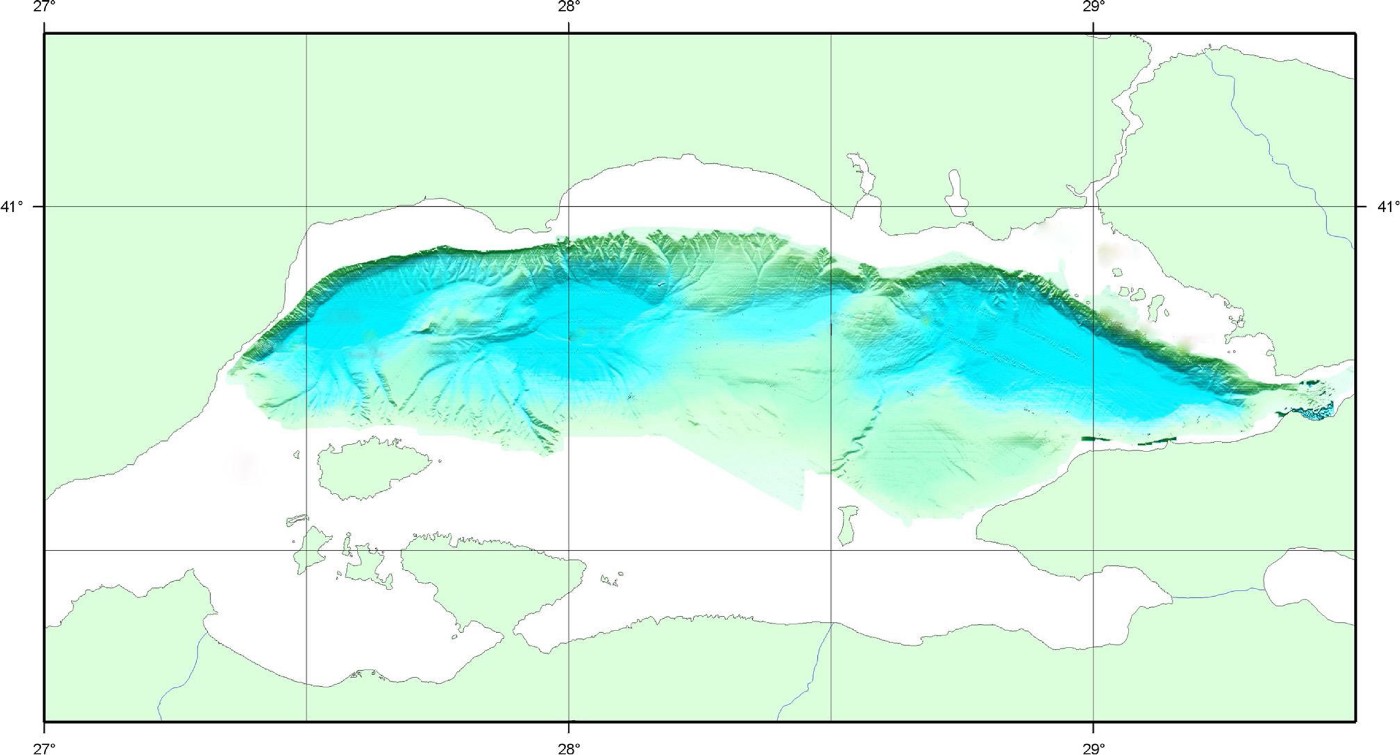
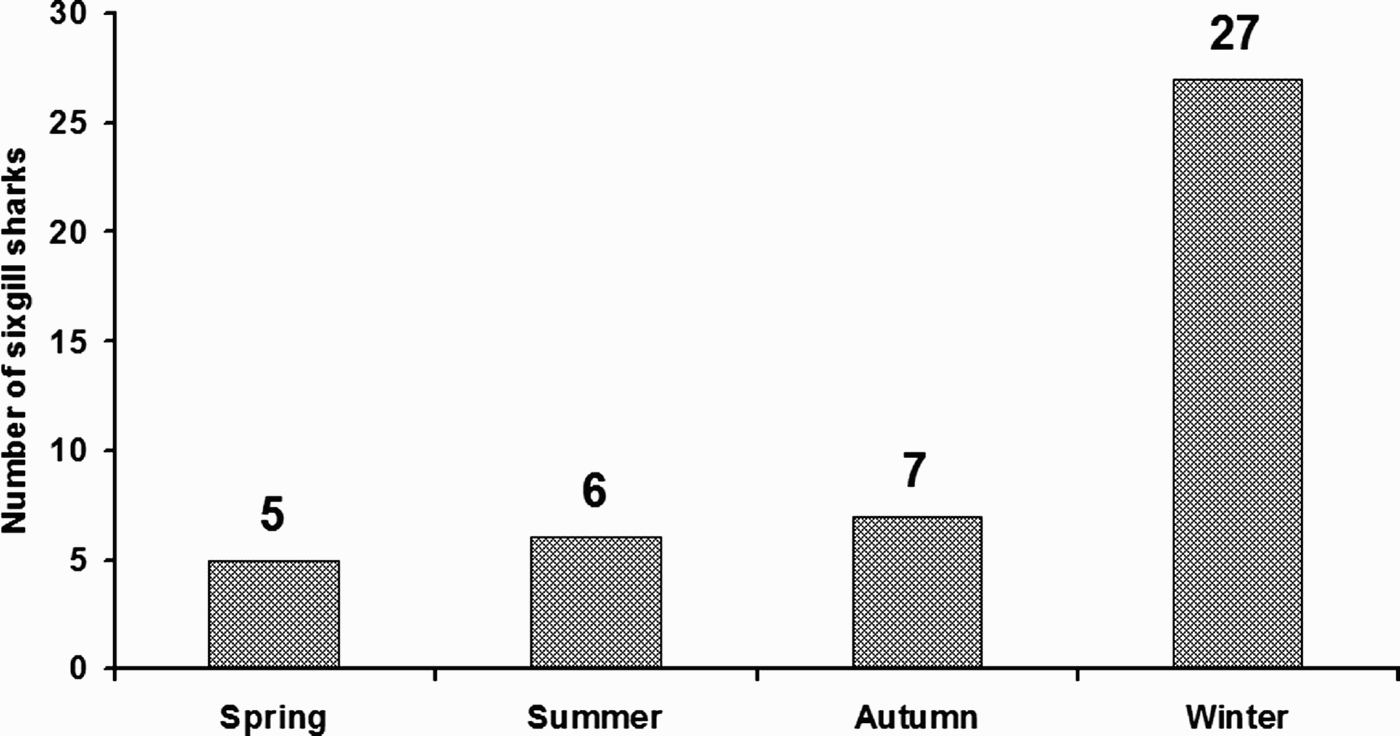
Following the field surveys and the review of the above data sources, 50 bluntnose sixgill sharks were recorded from the Sea of Marmara (Figure 2). Total lengths of the observed specimens ranged from 1.2 m (specimen No. 12) to 6 m (specimen No. 28), and weighed between 10 kg (specimen No. 12) to 1000 kg (specimen No. 46) (Table 1). Nine specimens were males, 23 were females and 18 were of unknown sex. Thirty-four bluntnose sixgill sharks were captured along the northern continental slope and shelf area, followed by 11 specimens from south–south-western shoals, and 5 specimens from the eastern slope close to Çınarcık trench (Figures 2 & 3). The maximum depth of capture recorded during the present study was 350 m (specimen No. 10). Regarding the bathymetric distribution of the captured bluntnose sixgill sharks, the majority of the specimens (39; 78% of the total catch) were recorded in slope and shelf waters of the eastern and northern Sea of Marmara, bordering Çınarcık, Tekirdağ and Ganoz trenches from east to west, where the depth exceeds 1000 m (maximum depth is 1335 m in Tekirdağ trench; Figures 2 & 3). Season of catch data were recorded for 45 bluntnose sixgill sharks (90%); the majority of the specimens (60%) were captured in winter, followed by autumn (15.5%), summer (13.3%) and spring (11.1%) (Figure 4). Thirty-one bluntnose sixgill sharks were captured by commercial purse-seiners (60%), 10 (20%) were captured by gill- or trammel-netters and 2 (4%) by bottom-trawlers. The fishing gear used for the remaining 8 specimens (16%) is unknown (Figure 5).
Capture localities of Hexanchus griseus in the Sea of Marmara. Numbers on the map are same as presented in Table 1.

Bathymetric map of the Sea of Marmara.

Seasonality of the captures of Hexanchus griseus in the Sea of Marmara.

Fishing gears used in the catching of Hexanchus griseus.

DISCUSSION AND CONCLUSIONS
Maximum total length of Hexanchus griseus recorded in the present study (6 m, specimen No. 28), was well above the total lengths reported for this species by Castro (Reference Castro1983, in Ebert, Reference Ebert1986) and Capapé et al. (Reference Capapé, Guélorget, Barrull, Mate, Hemida, Seridji, Bensaci and Bradäi2003). This female bluntnose sixgill shark was captured on 23 July 2004 by a commercial bottom-trawler and reliably measured by the author at the fishing port. Celona et al. (Reference Celona, De Maddalena and Romeo2005) recorded a specimen captured in December 2000 in the Messina Strait, whose total length was estimated to be 500–600 cm and concluded that this size-range may be the largest ever recorded for H. griseus. Furthermore, according to Castro (Reference Castro1983, in Ebert, Reference Ebert1986) the largest reported bluntnose sixgill shark is 482 cm TL. Therefore, specimen No. 28 of the present research is probably the largest bluntnose sixgill shark recorded to date.
In the milestone work of Capapé et al. (Reference Capapé, Guélorget, Barrull, Mate, Hemida, Seridji, Bensaci and Bradäi2003), the authors reported historical and contemporary recordings of H. griseus in the Mediterranean Sea. Based on these data, Capapé et al. (Reference Capapé, Guélorget, Barrull, Mate, Hemida, Seridji, Bensaci and Bradäi2003), listed 114 bluntnose sixgill sharks captured between 1896 and 2000. Celona et al. (Reference Celona, De Maddalena and Romeo2005) recorded 37 specimens over a four year period in north-eastern Sicilian waters. Kabasakal (Reference Kabasakal2004, Reference Kabasakal2006) reported the capture of 39 and 21 bluntnose sixgill sharks from Turkish waters, respectively. Fifty bluntnose sixgill sharks were captured over the last thirty-eight years, most of them during the last 10 years (Table 1).
Regarding the seasonality of captures, bluntnose sixgill sharks were captured mostly in winter (Figure 4). In Turkish waters, the fishing season lasts between September and May. The capture of 6 bluntnose sixgill sharks in summer months, when fishing is prohibited, indicates a persisting fishing pressure on H. griseus throughout the year. The dates of capture of bluntnose sixgill sharks recorded by Capapé et al. (Reference Capapé, Guélorget, Barrull, Mate, Hemida, Seridji, Bensaci and Bradäi2003) and Celona et al. (Reference Celona, De Maddalena and Romeo2005) show that capture of H. griseus in the Mediterranean spreads throughout the year; similar patterns were observed in Turkish seas. This continuous fishing pressure on bluntnose sixgill sharks negatively impacts the survival and conservation of the species.
Hexanchus griseus has a wide depth-range between surface and 2500 m (Carey & Clark, Reference Carey and Clark1995; Lorance et al., Reference Lorance, Latrouite, Séret, Séret and Sire2000; Dunbrack & Zielinski, Reference Dunbrack and Zielinski2003; Lipej et al., Reference Lipej, De Maddalena and Soldo2004). Although it has been observed near the edge of abyssal zone at 2490 m in the Mediterranean Sea (Priede et al., Reference Priede, Froese, Bailey, Bergstad, Collins, Dyb, Henriques, Jones and King2006), it is known that bluntnose sixgill sharks may temporarily visit the shallow reefs (e.g. Flora Islets in the Strait of Georgia, British Columbia; Dunbrack & Zielinski, Reference Dunbrack and Zielinski2003). Carey & Clark (Reference Carey and Clark1995) attached acoustic depth transmitters to two female bluntnose sixgill sharks at Bermuda and observed that, on release, H. griseus moved offshore and swam steadily down to a depth of 1000 m. The authors also observed that sharks remained near the bottom at depths ranging from 600 to 1100 m. According to Carey & Clark (Reference Carey and Clark1995) and Lorance et al. (Reference Lorance, Latrouite, Séret, Séret and Sire2000), H. griseus is the most common large shark on slope waters, at Bermuda and in the Bay of Biscay, respectively. Barrull & Mate (Reference Barrull and Mate2000) reported that H. griseus is common in the bathyal waters down to a depth of 1000 m in the Mediterranean Sea. During the present study, 78% of the captured specimens were recorded along the northern Marmaric slope and the maximum depth of capture was 350 m (specimen No. 10; Table 1). Meriç (Reference Meriç1995) also recorded the bluntnose sixgill shark from the northern slope.
Carey & Clark (Reference Carey and Clark1995) reported that, during the depth telemetry, H. griseus specimens were swimming in the permanent thermocline. According to Dunbrack & Zielinski (Reference Dunbrack and Zielinski2003), activity pattern of H. griseus may be related to seasonal changes in the water column temperature profile. The authors also concluded that the cool, thermally stable, deep bottom layer is probably critical for the existence of bluntnose sixgill shark populations (Dunbrack & Zielinski, Reference Dunbrack and Zielinski2003). The northern Marmaric coast is bordered by three trenches, where the maximum depth is 1335 m, and the water column below 75 m to the deepest point is thermally stable at ~14°C (Kocataş et al., Reference Kocataş, Koray, Kaya and Kara1993). Regarding these topographic and thermal conditions, the narrow shelf and the following steep slope along the northern coast offer a suitable environment for Marmaric bluntnose sixgill sharks, which may allow temporary excursions to the coastal zone and return to bathyal habitats in a relatively short distance (Figure 2 & 3).
Regarding the Turkish marine fishery, the Sea of Marmara is a significant and intensively exploited fishing ground (Kocataş et al., Reference Kocataş, Koray, Kaya and Kara1993). Therefore, here interactions between the fishermen and the bluntnose sixgill sharks are inevitable. Almost all of the bluntnose sixgill sharks are incidentally captured by the commercial fishing boats, purse-seiners and gill- and trammel-netters in particular. Wide-scale deployment of such non-selective fishing gears for multispecies fishery in shelf and upper slope waters, down to a depth of ~350 m, creates an obvious fishing pressure on H. griseus, as well as other shark species, in Marmaric waters (Kabasakal, Reference Kabasakal2003). Popular interest in large sharks, by both media and the public, prompt the fishermen to land the captured bluntnose sixgill sharks to display in the fish markets (Figure 1).
Hexanchus griseus mainly occurs over the bathyal grounds of northern trenches, and they approach nearby coastal waters, particularly in spring and summer. Although the current data may provide significant guidance for the fisheries authorities, still many gaps exist in the entire picture. There is a clear need for more fishery-independent data and research into the survivability of H. griseus caught by different fishing methods at various depths, if they are released after capture. Interviews with the fishermen suggest that at least half of the bluntnose sixgill sharks recorded during the present study survived ~20 minutes or more on the decks of the fishing boats. Compensating for the cost of the damaged fishing nets is the common reason of the fishermen for killing the hauled bluntnose sixgill sharks. Although no reliable data are available on the population dynamics of H. griseus in the Sea of Marmara, it is obvious that drastic declines in species with low productivity are highly unlikely to be reversible in the short to medium term (Cavanagh & Kyne, Reference Cavanagh, Kyne and Shottoni2005).
In the depth telemetry study of H. griseus at Bermuda, Carey & Clark (1995) observed that two bluntnose sixgill sharks with acoustic depth transmitters attached moved over a distance spanning less than 10 km between the depths of 600 and 1100 m. The fact that bluntnose sixgill sharks remained within a small area in the depth-range (Carey & Clark, 1996), may be the key factor for the conservation of H. griseus in the Sea of Marmara.
Today, no habitat has yet been specifically protected for the purpose of conserving H. griseus in Turkish waters. Because of its late age of maturity (18 to 35 years for females) (COSEWIC, 2007), it is likely susceptible to overfishing even at low levels of mortality. The IUCN has assessed the bluntnose sixgill shark as lower risk/near threatened (LR/nt) (COSEWIC, 2007). Fishing presents the only known proximate threat to bluntnose sixgill shark populations in the Sea of Marmara. Since the Marmaric fishermen do not deploy fishing gears in deep bathyal waters—the maximum depth recorded during the present study was 350 m—populations of H. griseus inhabiting the trenches seem intact from the pressure of the fishery. Inclusion of H. griseus in the endangered marine fish list of the Turkish Fisheries Act would be the first step for the protection of the species in Marmaric waters, as well as along the entire Turkish coast. Furthermore, banning the retention and selling of bluntnose sixgill sharks captured by both commercial and recreational fisheries is another urgent need before subjecting H. griseus to 100% protection.