

Introduction
Sheep have been present in Brazil for almost 500 years, but their numbers have not increased to the same extent as other farm animals (Hermuche et al., Reference Hermuche, Silva, Guimarães, Carvalho Júnior, Paiva, Gomes and McManus2012, Reference Hermuche, Maranhão, Guimarães, Carvalho Júnior, Gomes, Paiva and McManus2013). This has been largely due to herd structure (smallholders), perceived use of sheep as a secondary culture and lack of interest from major research groups. Taking into account rapid genetic erosion (Hall and Ruane, Reference Hall and Ruane1993; Scherf, Reference Scherf2000) and the importance of Animal Genetic Resources for the future (Notter, Reference Notter1999), it may not be possible to wait for specific and detailed information on available breeds and ecotypes.
The Brazilian Bergamasca is an Italian breed from the Lombardy region, which is widespread mainly in Northern Italy (Dalvit et al., Reference Dalvit, De Marchi, Zanetti and Cassandro2009). In Italy, this breed specializes in meat production and is widely used in crossing with other breeds. It is thought to have been introduced in Brazil in the 1930s with Italian immigration (Miranda and McManus, Reference Miranda and McManus2000; Paiva et al., Reference Paiva, Silvério, Egito, McManus, Faria, Mariante, Castro, Albuquerque and Dergam2005). Although once widespread has been substituted for other breeds, especially hair sheep. In Brazil, it is considered a triple purpose breed raised for milk, meat and coarse wool (Miranda and McManus, Reference Miranda and McManus2000), and at present is threatened with extinction in the country.
More recently, there has been some interest in this breed for milk production to make cheese, which is not traditional in Brazil, but a few herds are left. The rare ARK haplotype has also been described in this breed (Luhken et al., Reference Luhken, Buschmann, Brandt, Eiden, Groschup and Erhardt2007) meaning that it may be useful in studying scrapie resistance in sheep. Embrapa (Brazilian Agricultural Research Corporation) included domesticated and naturalized breeds threatened of extinction in its Program of Research on Genetic Resources in 1983. Currently, the conservation of animal genetic resources is carried out by diverse Research Centers of Embrapa, Universities, State Research Companies, as well as private farmers.
Currently, much of the naturalized animals are in small and scattered populations. Small populations are unstable, since they are more exposed to stochastic factors that can lead to extinction, such as demographic stochasticity, environmental variation, genetic drift and inbreeding depression (Armstrong, Postiglioni and Gonzáles, Reference Armstrong, Postiglioni and Gonzáles2006).
Genetic diversity can be considered the cornerstone of conservation genetics, since it is the basis of the evolutionary potential of species to respond to environmental changes. The most threatened populations are subdivided into different groups in different fragments of habitat, nature reserves or in groups of different breeds or lines, in the case of domestic animals (Toro and Caballero, Reference Toro and Caballero2005).
This study aims to analyse genealogical information integrated with simulation tools in the risk of extinction and molecular markers of a Conservation Nucleus of this breed to determine the effectiveness of current conservation efforts.
Material and methods
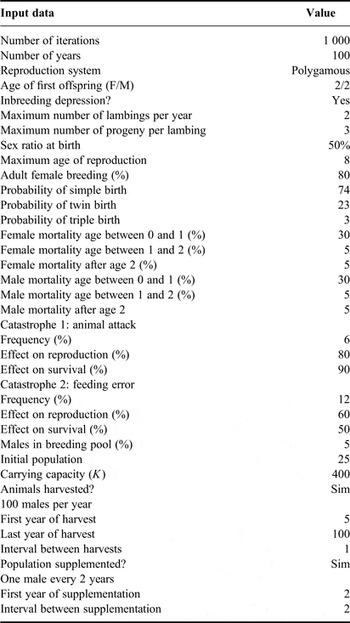
The flock of Brazilian Bergamasca sheep used in this study is kept on the University of Brasilia (UnB) research farm, is part of the Brazilian National Program for Conservation of Animal Genetic Resources and this is the only one of this breed to participate in this program. The population studied was of 1 559 animals, which included all Brazilian Bergamasca sheep on the UnB farm born between 1990 and 2010. There were 48 percent males and 52 percent females. Data for the population viability analysis were taken from the questionnaire answered by the curator of the flock, the data from which are in Table 1. On the other hand, information for the pedigree analysis were obtained in the animal register.
Demographic parameters used to simulate the population of sheep Brazilian Bergamasca with Vortex.

Two analyses were carried out: one looking at the genetic structure of the herd over the 20-year period to determine population parameters (pedigree analysis) and the other simulating future events to evaluate the future of the herd (viability analysis).
Pedigree analysis
The population genetic parameters were computed using the ENDOG program, version 4.8. The program details can be found in Gutiérrez and Goyache (Reference Gutiérrez and Goyache2005). ENDOG is a computer program for population genetics that performs various demographic and genetic analyses from pedigree information. A number of population and genetic parameters were computed for the reference populations, which consist of animals with both parents known. Parameters included: pedigree completeness level was computed as the proportion of ancestors known per parental generation; the number of equivalent to discrete generations (t) for each individual in a pedigree; the inbreeding coefficient (F), defined as the probability that two alleles at a randomly chosen locus are identical by descent; The average relatedness coefficient (AR), defined as the probability that an allele randomly chosen from the whole population belongs to a given animal; the probability of gene origin was characterized by computing: effective number of founders (f e) was computed according to Lacy (Reference Lacy1989); effective number of ancestors (f a); the founder genome equivalents was calculated from the inverse of twice the average coancestry of the individuals within the population. Effective population size (N e) was computed following Gutiérrez et al. (Reference Gutiérrez, Altarriba, Díaz, Quintanilla, Cañón and Piedrafita2003).
Population viability analysis
Simulations of interactions between demographic, environmental and genetic factors were carried out using the program Vortex, version 9.99. A questionnaire was developed to be answered by the curators of the herds linked to the Brazilian National Program for Conservation of Animal Genetic Resources with the information required for program input. According to Miller and Lacy (Reference Miller and Lacy2005), the Vortex program begins by creating individuals to form a base population and then steps through life cycle events on an annual basis. Stochastic events such as breeding success, progeny number, sex at birth and mortality rate were determined by a predefined probability density function given by the operator (Table 1). Consequently, each iteration of the model gave a different result and by running the model hundreds of times, and a range of possibilities and outcomes were examined. The scenario described in Table 1 was called baseline and all the other scenarios created changed one parameter of it to test the population (Tables 5 and 6).
The data including catastrophes described above were informed by the curator of the nucleus. The loss of genetic variability is simulated as the transmission of alleles from parents to offspring in a hypothetical neutral site. For each animal at the beginning of the simulation is assigned two unique alleles at this locus. Then for each individual created during the simulation is randomly assigned one of the alleles from each parent.
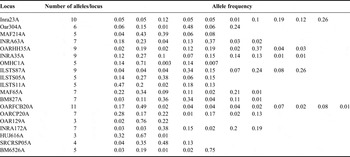
The program monitors how many alleles remain in the original population, by giving the mean number of alleles remaining within extant population, the average heterozygosity and genetic diversity relative to the initial level. Forty-six Brazilian Bergamasca animals were genotyped using 19 microsatellite markers to provide input allele frequency information, obtained in the Animal Genetics Laboratory in Embrapa Genetic Resources and Biotechnology, Brasilia – DF, Brazil (Table 2). Diversity indexes for microsatellites were calculated using the Molkin package (Gutiérrez et al., Reference Gutiérrez, Royo, Àlvarez and Goyache2005).
Microsatellite loci information in Brazilian Bergamasca sheep.

To determine which factors most threaten this population, new scenarios were tested to see the behaviour of the parameters. Forty-two additional scenarios were created, as described in Tables 5 and 6, by changing baseline (Table 1) values, maintaining other variables stable.
Results
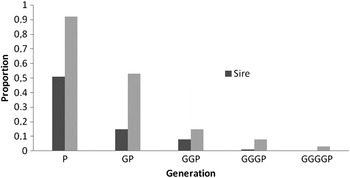
Pedigree data on 1 559 animals were analysed, the herd was classified as commercial using according to Gutiérrez and Goyache (Reference Gutiérrez and Goyache2005) as care has been taken over the years to buy rams where possible to avoid inbreeding. Pedigree Information increased over the generations were analysed, with more information available on dams than sires, with almost 100 percent of dams known in the present generation (Figure 1). The reference populations were taken as the animals with both parents known. This population will be smaller than that one used to analyse Founders. The effective founder population Size was 229 with 791 animals in the reference population and 215 ancestors contributing to the reference population. The effective number of founders/ancestors for the reference population was 42/34 with 12 animals supplying 50 percent of the ancestors.
Proportion of parents known per generation in a Conservation Nucleus of Brazilian Bergamasca sheep. P – parent, GP – grandparent, GGP – great grandparent.

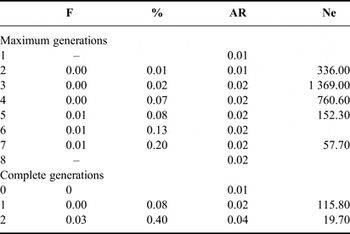
The Computed Mean Inbreeding was 0.29 percent and Mean AR was 1.52 percent. These numbers are comparable to those for the Galega (Adán et al., Reference Adán, Fernández, Justo, Rivero, Rois and Lama2007) and Mallorquina (Goyache et al., Reference Goyache, Fernández, Espinosa, Payeras, Pérez-Pardal, Gutiérrez, Royo and Álvarez2010) sheep in Spain and well below the dangerous level (10 percent).
As the generations increased, there was little change in inbreeding and AR (Table 1). This was due to careful control of reproduction in the nucleus. Although very low (<0.4 percent) there is an increase over the generations, which should be carefully monitored. There were 2 percent matings between sibs and 1 percent between parent-offspring. These values are summarized in Table 3, per generation.
Inbreeding (F), average relatedness (AR) and effective population size (Ne) per generation in a Conservation Nucleus of Brazilian Bergamasca sheep.

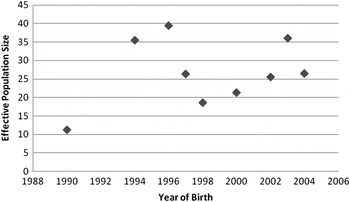
Effective population size per year (Figure 2) has remained relatively stable over the years, varying about 30 animals. The sharp decrease in 1998 was due to an attack by dogs, which killed the whole lamb flock and a large number of ewes.
Effective population size per year of birth in a Conservation Nucleus of Brazilian Bergamasca sheep.

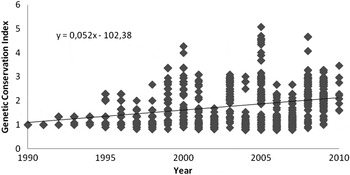
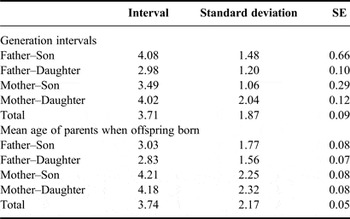
Generation intervals (Table 4) varied from 4.08 (father–son) to 2.98 years (Father–daughter). This shows a relatively fast turnover of reproducing animals. In terms of mean age of parents when offspring were born these were higher for dams than sires. Alderson (Reference Alderson1990) used the genetic conservation index (GCI) to calculate an effective number of founders in the pedigree of an animal. The higher the GCI value the higher the value of an animal for conservation. Mean GCI was 1.36, varying between 0.77 and 5.07. This has increased steadily over the years with an increment of approximately 0.05 per year (Figure 3).
Genetic conservation index for year of birth in a conservation nucleus of Brazilian Bergamasca sheep.

Generation intervals (L), their standard deviations (SD) and standard errors (SE) for a Conservation Nucleus of Brazilian Bergamasca sheep.

Using sires to analyse differentiation, F is was found to be −0.080; F st = 0.069 and F it = −0.005, all indices being close to zero. In the present study, when sires were considered subpopulations there is low genetic differentiation (7.7 percent of total genetic variation). Self-coancestry was 0.50, inbreeding 0.003 and Nei distance between sires 0.069, showing that, according to the pedigree analysis, no immediate problems in maintenance of genetic diversity within the herd is seen.
Population viability analysis
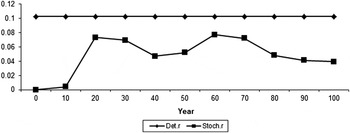
The estimated probability of extinction in population viability analysis was 17 percent and therefore, the possibility of success of 83 percent. From the scenarios that have become extinct, the average time to extinction was 59 years (Table 5). Considering only the deterministic growth of the population, i.e. no inbreeding depression, mating with no restrictions and no entry and exit of animals, the population would grow until it reaches the carrying capacity of the environment (K) and the deterministic growth rate (Det.r) remained stable for the full simulation period. However, the stochastic prediction considering the factors and the stochastic growth rate (Stoch.r) was different (Figure 4).
Difference between the deterministic (Det.r) and stochastic (Stoch.r) growth rates for the period of Vortex simulations in Brazilian Bergamasca sheep.

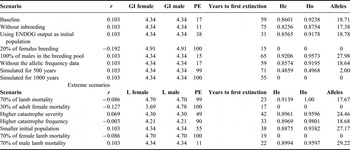
Result summary obtained from Vortex simulations in Brazilian Bergamasca sheep considering baseline and the alternative scenarios.

r, deterministic growth rate; L, generation interval; PE, probability of extinction; He, expected heterozygosity; Ho, observed heterozygosity; Alleles, estimated final number of alleles.
In the herd analysed, population growth was much lower than expected considering only the Det.r (Figure 4). The difference in expected values between Stoch.r and Det.r is clearly seen. While the first had high variation, the second remained stable throughout the period of the simulation, which supports the idea that the population is highly susceptible to environmental and genetic effects, such as variations in the feed, precipitation levels, inbreeding and genetic drift.
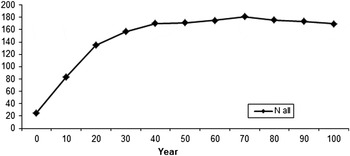
When considering the influence of environmental variation, the population did not reach K = 400 (Figure 5). The values of genetic diversity were relatively high, always above 0.8 (Table 5). The overall results did not change significantly when the default program was used (each animal at the beginning of the simulation is assigned two unique alleles and not using real population genetic data (Table 5)), as the genetic diversity values were very similar in both scenarios. However, when calculating the within diversity observed directly from the original microsatellite markers, the following values of diversity was obtained: (1) observed heterozygosity of 0.6880 (SD 0.0160); (2) expected heterozygosity of 0.6864 (SD 0.0335); (3) mean number of alleles 6.53 (SD 2.29); and fixation index (Fis) of −0.002 (P > 0.05).
Total number of animals achieved at the end of Vortex simulations in Brazilian Bergamasca sheep considering only the stochastic growth rate, i.e. environmental and genetic factors.

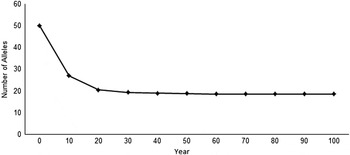
The mean observed heterozygosity reported by Vortex is the mean inbreeding coefficient of the population (Miller and Lacy, Reference Miller and Lacy2005), in this case, a high inbreeding value of 0.9238. One thousand iterations were needed to ensure stabilization of the results (Harris, Maguire and Shaffer, Reference Harris, Maguire and Shaffer1987). This population appeared to be influenced by genetic effects inherent to small populations. This can also be noticed by observing the average number of alleles, which declined to less than half of the initial value for the projected period (Figure 6), indicating a great loss of allelic diversity, which can endanger the long-term population persistence.
Total number of alleles obtained at the end of Vortex simulations in Brazilian Bergamasca sheep estimated for the entire period simulated.

The results of the simulations (Tables 5 and 6) showed that removing inbreeding from the analysis (Table 5) only reduced the probability of extinction, but the other parameters remained unchanged. This was expected, since the program models inbreeding depression as a reduction in the survival of offspring during the first year of life, and the lamb mortality in this population is already high (30 percent).
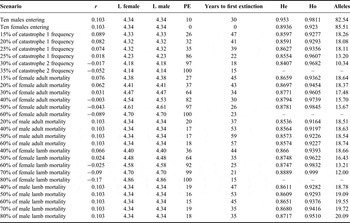
Result summary for the scenarios testing alternative management options in Vortex simulations in Brazilian Bergamasca sheep.

r, deterministic growth rate; L, generation interval; PE, probability of extinction; He, expected heterozygosity; Ho, observed heterozygosity; Alleles, estimated final number of alleles.
When comparing the Effective Number of Founders and Ancestors for the reference population found by ENDOG (42/34) with the initial population size (25) answered by the curator of the herd, it is noticed that the value found by pedigree analysis was higher than the actual initial population. This may be due to error in animal records or the reduction of the herd size due to pressure to reduce the number of animals to increase the commercial herd.
To include a value of the initial population obtained in the analysis with ENDOG in the simulation with Vortex, we chose the 12 animals supplying 50 percent of the ancestors to also check the impact of a smaller initial population. This increased the probability of extinction, but did not affect the other parameters (Table 5).
The lowest percentage of females breeding each year had a strong impact on the population with a probability of extinction of 100 percent. On the other hand, raising the percentage of males available for breeding increased only the genetic variability of the population and did not affect the other parameters (Table 5).
The population seemed to be viable for the simulation period of 100 years, but increasing the simulation time to 500 and 1 000 years there was a probability of extinction of 99 and 100 percent, respectively (Table 5). Fieberg and Ellner (Reference Fieberg and Ellner2000) found that extinction probabilities seem to be an uncertain measure, sensitive to various parameters and data quality. According to these authors, attempting to incorporate density dependence, genetic effects, interactions with other species to the models will inevitability introduce even more uncertainty.
Increasing the mortality of lambs had a strong impact on the population, with a negative growth rate, increase in the generation interval and increased the probability of extinction (Table 5). Separating the mortality of male and female lambs, it is noticed that the major impact is due to the mortality of female lambs, probably due to the role of females in reproduction and the characteristic of the herd of having more females than males. Working with Vortex, Brook et al. (Reference Brook, Lim, Harden and Frankham1997) found that small changes in mortality, potentially due to inbreeding depression, minor chronic disease, or new exotic predators, had a profound effect on the population projected future. This same author observed that the mortality of the juveniles was more important in determining the extinction probability than that of the adults. Any increase in mortality also greatly reduced the size of any extant populations. However, in this study the mortality of adult females had a greater impact on the population than the mortality of young females (Table 5).
The extreme scenarios, higher mortality of lambs, higher mortality of female lambs (Table 5), affected the population growth rate, the general interval and the probability of extinction, but did not affect the genetic variability, probably because the population was extinct in the simulations before losing the genetic variability. The frequency of the catastrophe seemed to be worse than the severity (Table 5), showing that it is better to have fewer severe catastrophes than several mild disasters.
From the conclusions of the extreme scenarios, we attempted to determine the extent to which the population would be still viable by changing some parameters to determine critical points in the management of these animals and suggest measures to be adopted in the conservation of this herd (Table 6). In the first two scenarios, ten male and ten female adults were added to the population every 2 years for 100 years. The entrance of this animals increased genetic variability, greatly influenced the final number of alleles, reduced the probability of extinction, but did not affect the growth rate and the generation interval. The increase in the final number of alleles was expected, since the Vortex considers that all migrants are not related to the initial population and have unique alleles. Another implication of this, according to Brook et al. (Reference Brook, Lim, Harden and Frankham1997), as Vortex assumes all supplemented animals are unrelated; inbreeding could not be realistically modelled.
Catastrophe 1, animal attack, being less severe (Table 6), even at higher frequencies did not affect the population to a great extent, once the genetic variability was maintained high and did not affect either the growth rate and generation interval. Catastrophe 2, feeding error, being more severe, rapidly affected population. Up to 25 percent did not show much effect, but from 30 percent the population is already in a declining trend and at 35 percent the probability of extinction was 100 percent.
The mortality of adult female (Tables 5 and 6) has a greater effect than the mortality of males. At 30 percent mortality of adult females affects the population, but it is still viable. For example, 40 percent adult male mortality does not affect most of the population parameters, but at the same 40 percent of adult female mortality the trend is a decrease in the population growth rate. At 60 percent mortality of adult females, the probability of extinction is 100 percent.
The population was more “resistant” to female lamb mortality than to adult female mortality (Table 6). Up to 50 percent mortality of female lambs, the population was affected, but was still viable. At the 60 percent mortality the population growth rate was negative and only at 80 percent of female lamb mortality that the probability of extinction was 100 percent. On the other hand, the mortality of male lambs did not affect much, since up to 80 percent mortality and the population was still viable.
Discussion
Pedigree analysis
This herd is part of the Brazilian National Program for Conservation of Animal Genetic Resources and the only Brazilian Bergamasca herd in the program. Of the five naturalized breeds of sheep analysed by Paiva et al. (Reference Paiva, Silvério, Egito, McManus, Faria, Mariante, Castro, Albuquerque and Dergam2005), this breed had showed the lowest gene diversity and percentage of polymorphic loci. The lack of sire information is due to multiple ram mating groups, errors in recording and frequent exchange of farm helpers. Nevertheless these numbers are significantly higher than those found by Goyache et al. (Reference Goyache, Fernández, Espinosa, Payeras, Pérez-Pardal, Gutiérrez, Royo and Álvarez2010) and Álvarez et al. (Reference Álvarez, Fernández, Espinhosa, Payeras, Gutiérrez, Royo and Goyache2007) for Mallorquina and by Alfonso et al. (Reference Alfonso, Parada, Legarra, Ugarte and Arana2006) for Latxa Black-Faced sheep breed in Spain. These latter authors note that the lack of genealogies leads to computation of high generation intervals.
The effective number of founders/ancestors for the reference population was 42/34 with 12 animals supplying 50 percent of the ancestors. The effective number of ancestors for the reference population of Conservation Nucleus of Galego sheep in Spain was 13 animals with five explaining 50 percent of the ancestors (Adán et al., Reference Adán, Fernández, Justo, Rivero, Rois and Lama2007). The Brazilian Bergamasca Conservation Nucleus has therefore a higher genetic base and a low effective number of ancestors for the reference population. The low number of ancestors, which explain half the genetic variation, indicates a super usage of a low number of sires. This is due to difficulty in finding rams of this breed, distances and cost required to transport these animals when found (usually >1 000 km) as well as funding difficulties for a Federal University sheep herd.
Generation intervals are similar to those found for a Conservation Nucleus of Galega (Adán et al., Reference Adán, Fernández, Justo, Rivero, Rois and Lama2007) and Mallorquina sheep (Goyache et al., Reference Goyache, Fernández, Espinosa, Payeras, Pérez-Pardal, Gutiérrez, Royo and Álvarez2010) in Spain. These are on the lower limit for those calculated by Huby et al. (Reference Huby, Griffon, Moureaux, De Rochambeau, Burge and Verrier2003) in six French meat sheep breeds in France but higher than those found by Goyache et al. (Reference Goyache, Gutiérrez, Álvarez, Fernández, Royo and Gomez2003) for the Xalda of Asturias breed, which is also threatened with extinction. High generation intervals are due to dams and sires remaining in reproduction for a long time. This is due to high lamb mortality (~30 percent per year) mainly caused by harsh dry winters (8 percent relative humidity and temperatures reaching 5 °C at night rising to 30 °C during the day) and infections caused by Haemonhcus contortus, which are resistant to antihelminthics.
Moureaux et al. (Reference Moureaux, Verrier, Ricard and Mériaux1996) reported that when inbreeding using pedigree studies on horse breeds are considered, two groups of horse breeds may be distinguished: one group of international breeds, showing values ranging from 0.81to 2.89 percent, and the other group with small population sizes with values ranging from 2.25 to 14.7 percent. Although the population here was small, the inbreeding is less than found in the international breeds. This may be due to two factors: careful choice of sires in the conservation herd or lack of pedigree information (Sabbioni et al., Reference Sabbioni, Valentino, Francesca and Paola2007). Low AR means that an animal shares a low percentage of genes with the rest of the population; these animals could therefore serve to disseminate the breed to other farms or regions in the country.
The herd size has not increased and sires are becoming more difficult and expensive to find on the national market, this reduced herd size may bring problems for the conservation nucleus in the coming years. The effective population size is an important parameter to monitor breeds and breeding programs since it is related to inbreeding depression and loss of genetic variability. According to Gandini et al. (Reference Gandini, Ollivier, Danell, Distl, Georgoudis, Groeneveld, Martyniuk, Van Arendonk and Woolliams2004) Ne is the measure of choice to determine the risk of extinction of a population. The determination of this parameter allows one to infer the rate of inbreeding and loss of genetic diversity within the population. This population kept Ne relatively stable and could recover from the sharp decrease of 1998, but probably with the difficulty of introducing new animals, the Ne could not stay stable for very long.
Population viability analysis
The Det.r equals the average growth of the population if the flock is large enough to avoid being affected by random or stochastic factors. The Det.r will correctly predict the population development if the birth and mortality rates are constant over time and within the expected values, if there is no inbreeding depression, no limitation or restriction on random mating and has not limiting to the carrying capacity of the environment. However, usually one or more of these assumptions are not respected, thus leading to a slightly lower population growth than expected by the deterministic growth rate (Ballou, Lacy and Miller, Reference Ballou, Lacy and Miller2005).
The Stoch.r is calculated for each year of the simulation. Usually, this parameter is lower than Det.r and only shows values close to Stoch.r if the population growth is steady and robust. The Stoch.r will be noticeably smaller than the Det.r if the population is under wide fluctuations due to environmental variation, catastrophes and demographic or genetic instability inherent to the small populations (Frankham, Ballou and Briscoe, Reference Frankham, Ballou and Briscoe2008). As seen in Figure 4, there is a difference between the Det.r and stoch.r, with a wide variation of the second, supporting the idea of environmental and genetic effects on susceptibility.
According to Miller and Lacy (Reference Miller and Lacy2005), the expected heterozygosity remaining in a simulated population, in the case of this study 0.8601, is a useful metric of genetic decay for comparison across scenarios and populations. From this result, it is found that the value of heterozygosity calculated by Vortex, using real allele frequency data or not, should be analysed considering only the decrease from the value of 100 percent. We do not suggest using the final value of He to confirm whether the population is threatened or not.
The instability present in the population is probably due to inbreeding depression and low allelic diversity (Figure 6), since the housing environment is controlled and does not present major challenges to the animals, unless the mortality of lambs that can be considered high (around 30 percent). The genetic instability is caused possibly by the small number of animals entering the population and the use of a few sires. Population managers should concern with the variation depleting effects of genetic drift, which can be countered by the introduction of occasional immigrants to prevent deleterious inbreeding within population (Lacy, Reference Lacy1987).
The extinction probability should not be considered alone and should not be the only factor taken into account when determining conservation strategies. It can be used to indicate the population trend of extinction or persistence and warn if conservation measures must be urgent or not. The reliable predictions of extinction probabilities can be made only for short-term time horizons, 10 to 20 percent as long as the period over which the population has been monitored (Fieberg and Ellner, Reference Fieberg and Ellner2000). These authors stated that the given typical amounts of data available it will rarely be meaningful to estimate a long-term extinction probability, but it may sometimes be possible to reliably estimate a short-term extinction probability. Considering the amount of data available in this study, neither it would be appropriate nor reliable to estimate the probability of extinction for a period longer than 100 years.
According to Table 5, it is better to have fewer severe catastrophes than having several mild disasters. Keith et al. (Reference Keith, Akçakaya, Thuiller, Midgley, Pearson, Phillips, Regan, Araújo and Rebelo2008), working with plants found that species populations were more viable under the less frequent catastrophe simulations, in this case, fire. The frequency and severity of catastrophes had major effects on both the probability of extinction and the final size of extant populations. When a catastrophe's frequency and severity were increased concurrently, the likelihood of extinction increases dramatically (Brook et al., Reference Brook, Lim, Harden and Frankham1997).
Both catastrophes analysed in this study, are easily avoided, improving the feeding control by making a stock for the drought period, training the handlers and protecting the flock from attacks installing fences and arresting the animals at night, period on which most attacks have occurred. These procedures would reduce the frequency of the catastrophes, which seemed to be worse to the population (Table 5).
Working with Vortex, Lindenmayer, Lacy and Pope (Reference Lindenmayer, Lacy and Pope2000) found that in the absence of animals entering, the population rapidly collapsed. One migrant per generation is an appropriate lower limit to the amount of gene flow that is desirable, but sometimes more than one migrant per generation will be necessary to achieve the desired genetic goals (Mills and Allendorf, Reference Mills and Allendorf1996).
According to these same authors, one migrant per generation is sufficient to avoid the loss of alleles in subpopulations caused by genetic drift and will allow the allele frequencies within subpopulations to respond to local selective pressures. However, deviations from the ideal population structure will tend to compromise the effectiveness of migration relative to expectations, including the social structure and taking into account the relative reproductive success of immigrants. This could mean that more than one migrant per generation may be necessary. The acquisition of new animals for this herd is difficult as there is a lack of pure commercial flocks for purchase or exchange, the distances between farms, priorities for research and bureaucracy in trading animals with a herd belonging to a public university in Brazil. Therefore, it would be very difficult to increase the entry of animals beyond what has already occurred in the analysed period.
Based on these results (Table 5), we noticed that the mortality rates of adults and lambs, males and females should always be monitored and controlled to ensure the viability of the population. The lamb mortality rate could be decreased by improving the management, especially taking better care of the new born, such as navel dipping, colostrum, protecting from the cold and wind, dam mastitis control, as well as vaccinating at the appropriate time. However, the mortality of the adult females seemed to be more critical to the population and should be closely monitored by the curators, even though it is already low, about 5 percent. Changes to mortality and fecundity were a dangerous threat to the short-term persistence of the population Brook et al. (Reference Brook, Lim, Harden and Frankham1997) studied. Even relatively minor increases in mortality or decreases in fecundity translated into strong effects on population size and extinction probability.
Conclusion
While no immediate problems are observed in the conservation nucleus, reduced herd size and lack of other herds of this breed could cause problems in the near future. From all of the scenarios, it is concluded that the number of females is critical to sustain the population. The key parameters to be observed in a conservation management were providing the entrance of animals, control the frequency of catastrophes, not so much the severity, and control the mortality of females, especially the adults ones (up to 30 percent).
Acknowledgements
The authors acknowledge to the CNPq, INCT-Pecuária, FAPDF and Finatec for financial support.
Statement of interest
No conflict of interest was identified in this study.