Introduction
Faecal incontinence in older people is a distressing and socially isolating condition, which is associated with increased risk of morbidity, mortality and dependency.Reference Nelson, Norton, Cautley and Furner1–Reference Chassagne, Landrin, Neveu, Czernichow, Bouaniche and Doucet4 Many older individuals will not voluntarily disclose the problem to their general practitioner or nurse and, regrettably, health care providers do not routinely enquire about it. This ‘hidden problem’ can therefore lead to a downward spiral of psychological distress, dependency and poor health. The condition can especially take its toll on informal carers of home-dwelling patients,Reference Finne-Soveri, Sorbye, Jonsson, Carpenter and Bernabei5 with faecal incontinence being a leading reason for requesting nursing home placement.Reference Landefeld, Bowers and Feld6, 7
Even when older people are noted by health care professionals to have faecal incontinence, the condition is often managed passively, especially in the long-term care setting where it is most prevalent. Current surveys show that the level of awareness regarding appropriate assessment and treatment options is limited among primary care physicians.Reference Thekkinkattil, Lim, Finan, Sagar and Burke8 The importance of identifying treatable causes of incontinence in frail older people rather than just managing it passively (e.g. by pads provision without assessment) is strongly emphasized in national and international guidance.Reference Landefeld, Bowers and Feld6, Reference Norton, Whitehead, Bliss, Metsola, Tries, Abrams, Cardozo, Khoury and Wein9, Reference Norton, Thomas and Hill10 Audit shows, however, that adherence to such guidance is generally poor, with non-integrated services, and sub-optimal delivery by professionals of even basic assessment and care.Reference Potter, Peel, Mian, Lowe, Irwin and Pearson11, Reference Coffey, McCarthy, McCormack, Wright and Slater12
This review is based on a search of PUBMED up to March 2008, using the following keywords: (i) ‘anal, bowel, faecal, fecal’ AND ‘incontinence’; (ii) constipation; (iii) ‘urinary’ AND ‘incontinence’; (iv) laxatives, enemas, suppositories; (iv) other relevant phrases such as ‘comprehensive geriatric assessment’, ‘stroke’ etc. Additional articles were identified by examining reference lists, the Cochrane Library and other recent systematic reviews.
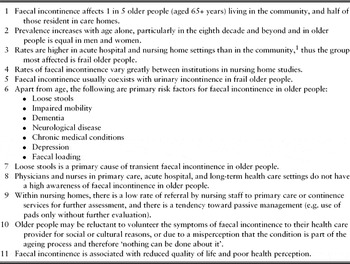
Prevalence and risk factors for faecal incontinence (Box 1)
The rate of faecal incontinence increases with each successive decade over the age of 40 in community-dwelling people.Reference Pretlove, Radley, Toozs-Hobson, Thompson, Coomarasamy and Khan13 Faecal incontinence also has a greater impact on quality of life as people age.Reference Perry, Shaw, McGrother, Matthews, Assassa and Dallosso14, Reference Bharucha, Zinsmeister, Locke, Seide, McKeon and Schleck15
Epidemiology of faecal incontinence

The prevalence in adults aged over 80 years ranges from 12 to 22%, with men and women being equally affected.Reference Perry, Shaw, McGrother, Matthews, Assassa and Dallosso14–Reference Roberts, Jacobsen, Reilly, Pemberton, Lieber and Talley16 Faecal incontinence is often associated with loose stools, raising the issue of chronic diarrhoea itself being an under-evaluated problem in older people. The majority of people (50–70%) have urinary as well as faecal incontinence.Reference Edwards and Jones2, Reference Roberts, Jacobsen, Reilly, Pemberton, Lieber and Talley16 Other associated factors are poor health perception, co-morbidity, physical disability, cerebrovascular disease, low mood, anxiety, living alone, hysterectomy and prostate disease.Reference Nelson, Norton, Cautley and Furner1, Reference Edwards and Jones2, Reference Markland, Goode, Burgio, Redden, Richter and Sawyer17–Reference Melville, Fan, Newton and Fenner19 A prospective study has linked faecal incontinence to increased mortality in community-dwellers independently of age, gender, and poor general health.Reference Nakanishi, Tatara, Shinsho, Murakami, Takatorige and Fukuda3 Frailer home-dwelling patients with faecal incontinence are at greater risk of pressure sores and have high usage of community nurses and home health care – thus it is a costly condition.Reference Finne-Soveri, Sorbye, Jonsson, Carpenter and Bernabei5
Faecal incontinence affects a third of acutely hospitalized older peopleReference Schultz, Dickey and Skoner20, Reference Bliss, Johnson, Savik, Clabots and Gerding21 with contributing (and treatable) factors being faecal loading (in 57%), functional disability (83%), loose stools (67%), and cognitive impairment (43%).Reference Akpan, Gosney and Barrett22 Severity of illness also plays a part. Faecal incontinence in the acute setting is often transient, with those patients with loose stools and less co-morbidity being more likely to have resolution within three months.Reference Akpan, Gosney and Barrett22
Prevalence and new-onset incidence of faecal incontinence in care homes is even higher. A prospective French study documented a baseline prevalence of 54% among 2602 nursing home residents.Reference Chassagne, Landrin, Neveu, Czernichow, Bouaniche and Doucet4 In those who were continent at baseline, the incidence of new-onset faecal incontinence over a 10-month period was 20% (equally in women and men). Incontinence was transient (<5 days) in 62% but, of the 38% patients who developed long-standing problems, 26% died within 10 months compared with 6.7% of those who remained continent. This highlights the need for periodic review of faecal incontinence in care homes, as underlying causes, particularly overflow and loose stools, can be treated and prevented.
Among UK studies, there is a striking variation in prevalence of faecal incontinence between individual nursing homes, ranging from 17 to 95%.Reference Peet, Castleden and McGrother23–Reference Tobin and Brocklehurst25 As the case-mix within these nursing homes is likely to be comparable, the variations may be more reflective of different standards of care rather than of different patient characteristics. Faecal incontinence rates may therefore be useful as a proxy measure for quality of care in care homes.
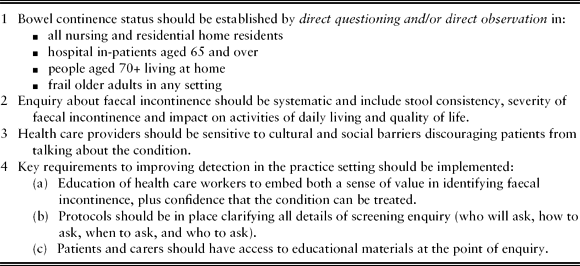
Faecal incontinence in older adults – the ‘hidden’ problem (Box 2)
One reason for faecal incontinence to remain hidden is reluctance on the part of patients to self-report what they view as an embarrassing and humiliating condition. Another is that patients may want to talk to a health care professional, but then feel that they receive dismissive responses. Health providers also do not ask about faecal incontinence. In a British primary care study of patients aged 75 years and over, only half of those reporting faecal incontinence (or their carers) had discussed the problem with a health care professional and only one out of eight patients with daily incontinence had done so. The GPs involved in this study reported full knowledge of incontinence status in only 33% of patients with a continence problem.Reference Prosser and Dobbs26 Likewise, another UK study found that less than 50% of older people with faecal incontinence living at home had spoken with a health care professional, although one quarter stated that they would like to do so, women more so than men.Reference Edwards and Jones2 Even in a younger cohort of patients with faecal incontinence (mean age 53 years), most cases were unrecognized by GPs.Reference Kalantar, Howell and Talley27 Among Swedish people aged 75 years and over, those with faecal incontinence-associated discomfort were more likely to seek medical help.Reference Stenzelius, Westergren and Hallberg28
Identifying faecal incontinence in older people

Even in the acute hospital setting where regular observation is possible, only one in six patients of any age reporting faecal incontinence have the symptom documented by ward nursing staff.Reference Schultz, Dickey and Skoner20 Likewise, nursing staff in care homes are aware of faecal incontinence in only half of residents self-reporting the condition.Reference Harari, Gurwitz, Avorn, Choodnovskiy and Minaker29 Even where incontinence is identified, care home patients will often be treated passively. In a 1980s UK care home study, only 4% of patients with long-standing faecal incontinence had been referred to their general practitioner for further assessment.Reference Tobin and Brocklehurst25 Sadly, current audits show that attitudes and quality of care have not improved since then. A national UK audit of faecal incontinence in older people found that care homes were particularly difficult to recruit, and that those who did participate generally reported hampered data collection due to poor clinical records, limited information technology and staff shortages.Reference Potter, Peel, Mian, Lowe, Irwin and Pearson11 These are process issues that may inhibit quality improvement. The results did, however, show that patients admitted with pre-existing faecal incontinence tended to simply be placed on containment management (e.g. pads), rather than being assessed for causes and possible treatment, and this was despite having good access to continence specialist care. Surveys show that faecal loading is present in 70% of care home residents with faecal incontinence,Reference Akpan, Gosney and Barrett22 so treatable overflow incontinence, among other causes, is clearly being overlooked in this setting. A recent UK survey found that trained care home staff cited advanced age as being the principle cause of urinary and faecal incontinence,Reference Rodriguez, Sackley and Badger30 a knowledge deficit no doubt leading to under-assessment and passive treatment.
Causes of faecal incontinence in older people
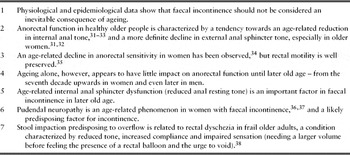
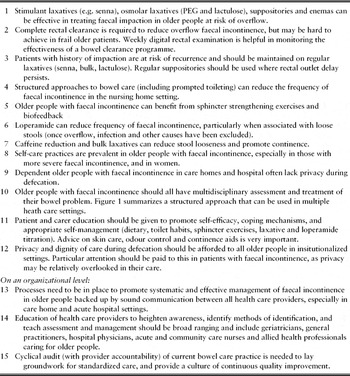
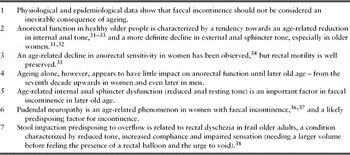
The causes of faecal incontinence in older people are often multifactorial. The aim of this section is to categorize these in a clinically meaningful way, emphasizing the identification of potentially reversible factors. Age-related changes in anorectal function play a small contributory role (Box 3). Comprehensive geriatric assessment (assessing medical, functional and psychosocial factors in addition to the bowel) is key to identifying all contributing causes for faecal incontinence in frail older people.
Anorectal function and faecal incontinence in older people
A. Overflow incontinence secondary to constipation and stool impaction
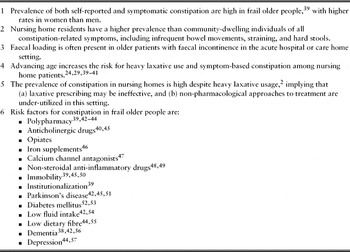
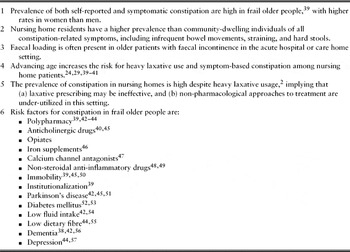
Constipation is the most important cause of faecal incontinence in frail older people, as it is treatable, preventable and frequently overlooked. A UK hospital survey in the 1980s found that faecal impaction was a primary diagnosis in 27% of acutely hospitalized geriatric patients admitted over one year.Reference Read, Abouzekry, Read, Howell, Ottewell and Donnelly38 More recent surveys similarly found that faecal loading was present in 57% of older acute hospital inpatientsReference Akpan, Gosney and Barrett22 and 52–70% of care home residents with faecal incontinence.Reference Akpan, Gosney and Barrett22, Reference Tobin and Brocklehurst25Box 4 summarizes prevalence and causes of constipation in older people.
Epidemiology of constipation in older people
B. Functional incontinence
Functional incontinence occurs in individuals who are unable to access the toilet in time due to impairments in mobility, dexterity or vision. These patients may even have normal lower gut function. Epidemiological studies in older people have repeatedly shown that poor mobility is a strong risk factor for faecal incontinence after adjustment for other variables.Reference Nelson, Norton, Cautley and Furner1, Reference Chassagne, Landrin, Neveu, Czernichow, Bouaniche and Doucet4, Reference Finne-Soveri, Sorbye, Jonsson, Carpenter and Bernabei5, Reference Nakanishi, Tatara, Naramura, Fujiwara, Takashima and Fukunda56–Reference Chassagne, Landrin, Neveu, Czernichow, Bouaniche and Doucet58 It is also a primary risk factor for constipation in older people.Reference Kinnunen39, Reference Harari, Gurwitz, Avorn, Choodnovskiy and Minaker45, Reference Donald, Smith, Cruikshank, Elton and Stoddart50 While these studies particularly examined immobility as a risk factor, it is likely that problems of sensation and dexterity impairment are also contributory.
C. Dementia-related incontinence
Some patients with advanced dementia lack cortical control of the defecation process and so tend to void formed stool once or twice daily following mass peristaltic movements. One study identified dementia as the primary cause of faecal incontinence in 46% of nursing home residentsReference Tobin and Brocklehurst25 and the condition has been identified as an independent risk factor in epidemiological studies.Reference Chassagne, Landrin, Neveu, Czernichow, Bouaniche and Doucet4, Reference Nakanishi, Tatara, Naramura, Fujiwara, Takashima and Fukunda58–Reference Chassagne, Landrin, Neveu, Czernichow, Bouaniche and Doucet60 These individuals are very commonly incontinent of urine also.Reference Nakanishi, Tatara, Naramura, Fujiwara, Takashima and Fukunda58
D. Comorbidity-related incontinence
The following diseases may cause faecal incontinence and are more common in older people:
Stroke
Faecal incontinence affects 30–56% of individuals acutely after stroke, 11% at 3 months, and 11–22% at 12 months.Reference Harari, Coshall, Rudd and Wolfe61, Reference Nakayama, Jorgensen, Pedersen, Raaschou and Olsen62 Major faecal incontinence is four and a half times more prevalent in stroke survivors than the non-stroke population.Reference Brittain, Perry, Shaw, Matthews, Jagger and Potter63 It may develop months after acute stroke and can be transient, consistent with constipation with overflow as one possible cause.Reference Harari, Coshall, Rudd and Wolfe61, Reference Brocklehurst, Andrews, Richards and Laycock64 Epidemiological data suggest that faecal incontinence is associated more with disability-related factors, particularly functional difficulties in using the toilet, and anticholinergic medications, than stroke-related factors (e.g. severity and lesion location) faecal incontinence.Reference Harari, Coshall, Rudd and Wolfe61, Reference Brittain, Perry, Shaw, Matthews, Jagger and Potter63, Reference Baztan, Domenech and Gonzalez65
Diabetes mellitus
Prospective data show that diabetes is a risk factor for the development of faecal incontinence, especially in men.Reference Ostbye, Seim, Krause, Feightner, Hachinski and Sykes66 It may occur in people with diabetic neuropathy affecting the gut through the dual mechanisms of (a) bacterial overgrowth resulting from severe prolongation of gut transit causing the characteristic nocturnal diarrhoeaReference Ron, Leibovitz, Monastirski, Habot and Segal52 and (b) multifactorial anorectal dysfunction: reduced basal and squeeze pressures, spontaneous relaxation of the internal anal sphincter, reduced rectal compliance and abnormal rectal sensation.Reference Camilleri53, Reference Sun, Katsinelos, Horowitz and Read67 Diabetic anorectal incontinence can be further exacerbated by acute hyperglycaemia.Reference Russo, Botten and Kong68
Sacral cord dysfunction
The neuropathophysiology of rectal dyscheziaReference Read, Abouzekry, Read, Howell, Ottewell and Donnelly38 is compatible with diminished parasympathetic outflow from the sacral cord. Rectal dyschezia is characterized by impaired rectal sensation (needing a larger volume before feeling the presence of a rectal balloon and the urge to void), lower rectal pressures during rectal distension and impaired anal and perianal sensation, and is clinically associated with recurrent rectal impaction and continuous faecal soiling.Reference Read, Abouzekry, Read, Howell, Ottewell and Donnelly38 Common conditions in older people that could impair sacral cord function are ischaemia and spinal stenosis.
E. Anorectal incontinence
Age-related internal anal sphincter dysfunction is an important contributing factor,Reference Rasmussen, Christiansen, Tetzschner and Sorensen69, Reference Barrett, Brocklehurst, Kiff, Ferguson and Faragher70 as it lowers the threshold for balloon (stimulated stool) expulsion.Reference Barrett, Brocklehurst, Kiff, Ferguson and Faragher70 In a study of women with anorectal faecal incontinence comparing underlying causes in young (mean age 42 years) and old (mean age 72 years) patients, the former were more likely to have an isolated anal sphincter defect, while the aetiology was more multifactorial in the older group, including haemorrhoidectomy, diabetes, rectal and vaginal prolapse and pudendal neuropathy.Reference Wang, Patterson, Hart and Varma37 Later-life faecal incontinence in women is linked to childbearing via structural damage to the external anal sphincter, and pelvic musculature,Reference Nygaard, Rao and Dawson71 and uterovaginal prolapse and rectocoele are also risk factors in women.Reference Ng, Chen, Lon and Chen72, Reference Meschia, Buonaguidi, Pifarotti, Somigliana and Amicarelli73 Rectal prolapse is also associated with faecal incontinence and occurs more commonly in older adults.Reference Matheson and Keighley32
F. Loose stools
Loose stools increase the risk of incontinence in normally continent older adults by overwhelming a functional but age-compromised sphincter mechanism. Frail older individuals are particularly susceptible to bowel leakage in the context of loose stools.Reference Chassagne, Landrin, Neveu, Czernichow, Bouaniche and Doucet4, Reference Tobin and Brocklehurst25 Forty-four per cent of cases of faecal incontinence in a nursing home study were related to diarrhoea.Reference Chassagne, Landrin, Neveu, Czernichow, Bouaniche and Doucet4
Potentially reversible causes of loose stools in older adults are:
Excessive use of laxative. One-third of community-dwelling people aged 65+ regularly take laxatives, far exceeding the prevalence of constipation in this population. In care homes, laxative use, in particular docusate, has been linked to faecal incontinence.Reference Brocklehurst, Dickinson and Windsor24
Drug side-effects. Examples include proton-pump inhibitors, selective serotonin re-uptake inhibitors, magnesium-containing antacids and cholinesterase inhibitors.
Lactose intolerance. This is an age- and ethnicity-related phenomenon. Lactose malabsorption rate is 15% in healthy women aged 40–59 years compared with 50% in those aged 60–79 years.Reference Goulding, Taylor, Keil, Gold, Lewis-Barned and Williams74
Antibiotic-related diarrhoea. Among hospitalized patients taking antibiotics, age, female gender and nursing home residency significantly increase the risk for Clostridium difficile-associated diarrhoea.Reference Al-Eidan, McElnay, Scott and Kearney75 Diarrhoea takes longer to resolve following treatment of C. difficile in frail older patients.Reference Al-Eidan, McElnay, Scott and Kearney75 The presence of faecal incontinence is in itself a risk factor for recurrent C. difficile in hospitalized patients, in addition to prolonged fever, and H2-antagonist treatment.Reference Tal, Guverich and Guller76
Cancer. Loose stools are an indicator of possible cancer, and all patients with this symptom should be screened clinically for neoplastic and systemic illness. Colorectal cancer is associated with both constipation and use of laxatives, though this risk association is likely to be confounded by the influence of underlying habits.Reference Sonnenberg and Muller77 A study comparing younger and older (age 70+) men with faecal incontinence found colon and prostate cancer to be significantly more common in the older group.Reference Kim, Chae, Chung, Sands, Speranza and Weiss78
Clinical assessment of faecal incontinence in older adults
There is much room for improving clinical standards in this area; current surveys indicate a lack of thoroughness by doctors and nurses in assessment in all settings, with failure to obtain an accurate symptom history or to perform rectal examinations.Reference Potter, Peel, Mian, Lowe, Irwin and Pearson11, Reference Morgan, Spencer and King79 A national UK audit of faecal incontinence in primary care, acute hospital and care homes was conducted in 2007 and showed that only 22–33% of those surveyed had a documented basic assessment of history and rectal examination.Reference Potter, Peel, Mian, Lowe, Irwin and Pearson11 Causes for faecal incontinence were documented in between 27 and 49% of participants, the 27% being in the acute hospital sector.
Self-report of bowel symptoms relating to faecal incontinence is reliable and reproducible in older cohorts, including those in long-term care.Reference Osterberg, Graf, Karlbom and Pahlman80–Reference Frank, Flynn and Rothman82 Documentation of the type of incontinence is diagnostically very important.Reference Landefeld, Bowers and Feld6 Stool consistency should be established using the visual Bristol stool chart. Constant passive leakage of loose stool or stool-stained mucus is characteristic of overflow, while anal sphincter dysfunction tends to cause small amounts of leakage. Where external anal sphincter weakness predominates, patients often report urgency prior to leaking, while internal sphincter dysfunction is more likely to cause unconscious leakage.Reference Engel, Kamm, Bartram and Nicholls83 The symptom of urgency is also associated with diarrhoeal disease. Patients with dementia-related incontinence often pass complete bowel movements, especially after meals in response to the gastrocolic reflex. Where an unexplained change in bowel habit is identified, colonoscopy should be considered to rule out colorectal cancer.
Assessment of faecal incontinence must include an assessment for constipation. Based on international consensus, constipation is defined according to self-report of a combination of at least two of the following symptoms (‘Rome II and III criteria’): usually = <2 bowel movements per week over at least 3 months, hard stool, straining >25% of evacuations, feeling of incomplete evacuation.Reference Talley, Fleming and Evans48, Reference Longstreth, Thompson, Chey, Houghton, Mearin and Spiller84 It is important to identify the constipation subtype of rectal outlet delay as it affects 21% of community-dwellers aged 65 years and overReference Talley, Fleming and Evans48 and may lead to rectal impaction and faecal incontinence. It is defined as have the feeling of anal blockage during evacuation and prolonged defaecation (>10 minutes) and/or need for manual evacuation. Constipated older people tend to suffer primarily from difficulties with rectal evacuation and symptoms of straining and hard stool, rather than from reduction in stool frequency.Reference Harari, Gurwitz, Avorn, Bohn and Minaker85
An objective assessment for constipation is particularly important in frail older people who may:
1 be unable to report bowel-related symptoms due to communication or cognitive difficulties.
2 have regular bowel movements despite having rectal or colonic stool impaction.
3 have impaired rectal sensation and rectal dyschezia and so be unaware of symptoms associated with a large faecal bolus in the rectum.Reference Read, Abouzekry, Read, Howell, Ottewell and Donnelly38
4 have non-specific symptoms (such as delirium, leucocytosis, anorexia, functional decline) in association with severe faecal impaction.
Digital examination can reasonably assess anal sphincter tone – easy finger insertion with gaping of the anus on removal indicates poor internal sphincter tone, while reduced pressure around the finger when asking the patient to ‘squeeze and pull up’ suggests external sphincter weakness. Such digital assessment of basal and squeeze tone has been shown to be as sensitive and specific as manometry in discriminating sphincter function between continent and incontinent patients aged over 50 years.Reference Hallan, Marzouk, Waldron, Womack and Williams86
Incontinent patients without evidence of rectal stool impaction digitally should ideally undergo a plain abdominal radiograph to establish or rule out the diagnosis of overflow. Additional uses are to measure the extent and distribution of faecal loading, evaluate bowel obstruction secondary to impaction and rule out acute complications of impaction such as sigmoid volvulus and stercoral perforation.Reference McKay, Smith and Eastwood87, Reference Starrveld, Pols and Van Wijk88
Certain symptoms associated with faecal incontinence (abdominal pain, rectal bleeding, recent change in bowel habit, weight loss, anaemia) should prompt further consideration of underlying neoplasm.Reference Majumdar, Fletcher and Evans89 Chronic constipation alone is generally not considered an appropriate indication for lower bowel endoscopy.Reference Pepin and Ladabaum90 However, as the prevalence of colorectal cancer increases with age, index of suspicion should be higher in older adults.91 It should be noted that bowel preparation for lower endoscopy or barium enema may itself cause faecal incontinence. Furthermore, dementia and stroke are independent predictors of inadequate colonic preparation.Reference Ness, Manam, Hoen and Chalasani92 Such at risk patients should have constipation optimally treated before undergoing bowel preparation.
Evaluation of toilet access should be multidisciplinary, and include assessment of function (e.g. Barthel), mobility (e.g. ‘get up and go’), visual acuity, upper limb dexterity (undoing buttons) and cognition. An even more practical assessment is to watch someone transfer and manage clothing. Appropriateness of the commode design for the individual concerned should be considered (e.g. trunk support, adaptability, mobility, foot support).Reference Potter, Peel, Mian, Lowe, Irwin and Pearson11, Reference Nazarko93 For community patients, the health care provider should be aware of the physical layout of the patient's home and, in particular, bathroom details of location, distance from main living area, width of doorway for accommodating walking aids, presence of grab rails or raised toilet seat. Low lighting levels, high degree of clutter and hard to manage clothing may also be relevant.
Faecal incontinence is a primary independent risk factor for pressure sores in frail older people,Reference Finne-Soveri, Sorbye, Jonsson, Carpenter and Bernabei5, Reference Baumgarten, Margolis and Gruber-Baldini94 so evaluation of skin integrity (with pressure ulcer risk assessment) is important. Pelvic examination is also relevant in view of the association between urogenital prolapse (particularly rectocoele) and faecal incontinence in older women.Reference Ng, Chen, Lon and Chen72, Reference Meschia, Buonaguidi, Pifarotti, Somigliana and Amicarelli73, Reference Jackson, Weber, Hull, Mitchinson and Walters95
Bowel-specific quality of life scores have been used in clinical trials of faecal incontinence management, though not so much in older people. They are now being increasingly used in clinical practice, but no tool has been specifically validated in the older population. In patients with neuropathic faecal incontinence, the impacts rated most important by patients were upon activities and ‘getting out of the house’, rather than physical aspects such as soiling and hygiene.Reference Byrne, Pager, Rex, Roberts and Solomon96
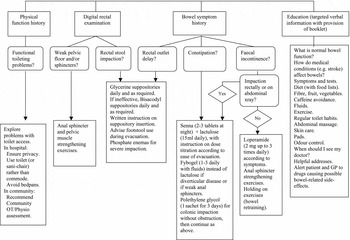
A UK randomized controlled trial (RCT) evaluated a multi-component assessment and treatment intervention for constipation and/or faecal incontinence in frail older stroke patients, using an approach summarized in Figure 1.Reference Harari, Norton, Lockwood and Swift97 The assessment was undertaken in patients’ homes, outpatient clinics and hospital wards by a non-specialist nurse who had received simple training in bowel care. Thirty per cent reported faecal incontinence and the majority had more than one underlying cause: over half had constipation with overflow, 41% reduced internal sphincter tone, 55% weak external sphincter tone and 47% functional difficulties with toilet access.
Multifactorial assessment and intervention protocol for faecal incontinence and constipation in older people.

Treatment of faecal incontinence in older adults (Box 5)
There are very few published trials of treatment of faecal incontinence in older people and no trials on prevention of faecal incontinence. Within this context, the overall UK NICE guideline recommendation was a stepwise approach to treatment, starting in the majority of cases with conservative measures.Reference Norton, Thomas and Hill10
Treatment of faecal incontinence in frail older people

Faecal impaction and overflow incontinence
One trial evaluated a therapeutic intervention in elderly nursing home residents with faecal incontinence, based on treatment recommendations to general practitioners.Reference Tobin and Brocklehurst25 Patients with rectal impaction and continuous faecal soiling were classed as having overflow and recommended treatment was enemas until no further response, followed by lactulose. Complete resolution of incontinence was achieved in 94% of the two-thirds of patients in whom full treatment compliance could be obtained. Another care home study found that treating constipation was only effective in improving overflow faecal incontinence when long-lasting and complete rectal emptying (monitored by weekly rectal examinations) was achieved using daily lactulose, daily suppositories and weekly tap-water enemas.Reference Chassagne, Jego, Gloc, Capet, Trivalle and Doucet98 Number of faecal incontinence episodes fell by 35% and staff workload (based on soiled laundry counts) by 42% in those with effective bowel clearance. Effective clearance, however, was only achieved in 40% of the study group.
A 1997 systematic review of effective laxative treatment in elderly people found that the few published RCTs were potentially flawed due to small numbers and other methodological concerns.Reference Petticrew, Watt and Sheldon99 In the 10 years since that review, there has been little rigorous research specific to the older population.Reference Ramkumar and Rao100, Reference Gallagher, O'Mahoney and Quigley101 The following conclusions are drawn from these meta-analytic reviews of efficacy of laxatives in treating chronic constipation in adults:
1 In trials conducted in older people (>55 years), significant improvements in bowel movement frequency were observed with a stimulant laxative (cascara – similar to senna)Reference Nakanishi, Tatara, Shinsho, Murakami, Takatorige and Fukuda3 and with lactulose,Reference Edwards and Jones2 while psylliumReference Edwards and Jones2 and lactuloseReference Edwards and Jones2 were individually reported to improve stool consistency and related symptoms in placebo-controlled trials. There is little evidence of differences in effectiveness between categories of laxatives.
2 Level 1 evidence supports the use of polyethylene glycol (Movicol) in adults.
3 Level 2 evidence supports the use of lactulose and psyllium in adults.
4 A stepped approach to laxative treatment in older people is justified, starting with cheaper laxatives before proceeding to more expensive alternatives.
The stepped approach to treating chronic constipation in older people should be used, in addition to lifestyle measure, of senna or bulk laxative, adding lactulose if persistent, plus suppositories for rectal outlet delay. For colonic disimpaction, however, the potent hyperosmolar laxative polyethylene glycol (Movicol or PEG) is more effective than lactulose and safe in nursing home residents, having no dehydration or haemodynamic side-effects.Reference Puxty and Fox102 An RCT of adults (aged 17–88 years) with faecal loading and bowels not open for ≥ 3 days showed that 8 sachets/day of PEG resolved impaction in 89% within 4 days with few adverse effects.Reference Chen, Su, Tung, Chang, Wong and Geraint103 The starting dose for acute disimpaction should be more cautious in older people – 2 sachets of Movicol daily with upwards titration if needed – and easy toilet access should be ensured.
Daily enemas (until no further result) should be used alongside polyethylene glycolReference Tobin and Brocklehurst25, Reference Chassagne, Jego, Gloc, Capet, Trivalle and Doucet98 for disimpaction. Phosphate enemas are commonly used, but repeated application should be avoided in renal impairment as dangerous hyperphosphataemia may occur.Reference Korzets, Dicker, Chaimoff and Zevin104 Tap water enemas are the safest type for regular use, though they are not available in certain countries. Arachis oil retention enemas are useful in loosening higher colonic impaction. For prevention of recurrent impaction, glycerine suppositories should be used regularly in patients with rectal outlet delay. High risk patients, e.g. those with neuropathic bowel, with recurrent overflow faecal incontinence despite regular laxative and suppository use, may need weekly enemas long-term. The use of polyethylene glycol as a regular laxative should be confined to high risk people whose chronic constipation has proved resistant to milder alternatives such as senna and lactulose.
Anorectal faecal incontinence in older adults
A combined approach should be used: firstly, sphincter strengthening exercises that are similar to pelvic floor exercises where the patient is asked to ‘pull up and squeeze’ and hold for 10 seconds, at least 20 times a day; secondly, ensure stools of firm consistency through diet, caffeine avoidance and bulk laxatives; and thirdly, use loperamide if needed, starting with 1–2 mg a day and titrate upwards.Reference Norton, Whitehead, Bliss, Metsola, Tries, Abrams, Cardozo, Khoury and Wein9 An RCT in adults with faecal incontinence showed that technological biofeedback showed no greater benefit compared with education about sphincter strengthening exercises.Reference Norton, Chelvanayagam, Wilson-Barnett, Redfern and Kamm105 Pelvic floor exercises are effective in older women with urinary incontinenceReference Burgio, Locher and Goode106 and frail older people, contrary to some misperceptions, can adhere to such programmes.Reference Harari and Igbedioh107,135 Caffeine increases intestinal transit and reducing intake can influence looseness of stools and reduce bladder over activity.Reference Norton, Whitehead, Bliss, Metsola, Tries, Abrams, Cardozo, Khoury and Wein9 Bulk laxatives can improve bowel control in anorectal incontinence by firming stools, but the effect can vary between individuals.Reference Norton, Whitehead, Bliss, Metsola, Tries, Abrams, Cardozo, Khoury and Wein9 The use of loperamide (e.g. taken before going out) can greatly restore a person's self confidence by giving a sense of control, though constipation should be monitored with regular use in older people. Presentation with obvious external sphincter damage, or other anorectal problems such as prolapse or severe haemorrhoids, merits further surgical assessment.
Dementia-related faecal incontinence
Prompted or scheduled toileting (preferably after meals) can reduce frequency of faecal incontinenceReference Bates-Jensen, Alessi, Al-Samarrai and Schnelle108 and increase number of continent bowel movementsReference Ouslander, Simmons, Schnelle, Uman and Fingold109 in care home residents, and should be part of the bowel care programme for patients with dementia-related faecal incontinence, whether at home or in institutions. Psychological approaches can also prove beneficial.Reference Stokes, Potter, Norton and Cottenden110
Multi-component management
There are no published studies of multi-component interventions in older people. An RCT in frail older stroke survivors with constipation and/or faecal incontinence evaluated a one-off assessment leading to targeted patient/carer education with booklet and treatment recommendations made to the routine health care provider.Reference Harari, Norton, Lockwood and Swift97 At one year follow-up the intervention group, compared with controls receiving usual care, were more likely to be altering their diet and fluid intake to control their bowels, and at 6 months had a higher percentage of ‘normal’ defecations. This type of evaluation cannot define any specific action with particular beneficial effect, but does test a practical approach that non-specialist doctors and nurses could feasibly apply in various settings. This approach is set out in Figure 1.
Self-care and privacy and dignity
The most commonly used self-care practices among US home-dwelling older people with faecal incontinence are dietary change, wearing pads and limiting activity.Reference Bliss, Fischer and Savik111 A UK study asked frail older patients with faecal incontinence about privacy during defecation.Reference Akpan, Gosney and Barrett112 Adequate privacy was reported by only 23% of nursing home residents and 50% of hospital in-patients. Lack of privacy, particularly in dependent older people in institutions, is a major care issue and has been adopted in the UK as a theme by geriatric societies and charities (eg British Geriatric Society ‘Behind Closed Doors’).
Conflicts of interest
There are no conflicts of interest.