INTRODUCTION
Trophically transmitted parasites face a number of challenges (Poulin, Reference Poulin1998). After escaping the host's immune response, additional challenges include modifying the present host to ensure transition to the next host (e.g. Milinski, Reference Milinski1985; Poulin and Thomas, Reference Poulin and Thomas1999; Poulin, Reference Poulin2010). However, this manipulation must not occur before the parasite has reached a developmental stage where it is capable of infecting its next host (e.g. Koella et al. Reference Koella, Rieu and Paul2002; Hammerschmidt et al. Reference Hammerschmidt, Koch, Milinski, Chubb and Parker2009). Moreover, in host-specific parasites such host manipulation by parasites must not increase the present host's susceptibility to other predators than the next specific host (Levri, Reference Levri1998; Parker et al. Reference Parker, Ball, Chubb, Hammerschmidt and Milinski2009), since host-specific parasites usually die when transferred to wrong host-species (e.g. Bråten, Reference Bråten1966). In addition, parasites must trade-off own growth and the host's and its own survival. Some populations of trophically transmitted parasites even experience time periods when transmission to the next host is temporarily inhibited, for example in lakes covered by ice which prevents transmission of parasites from intermediate aquatic hosts to terrestrial hosts for up to 6–7 months (Heins et al. Reference Heins, Singer and Baker1999).
Trophically transmitted parasites face an additional challenge when two or more conspecific parasites infect the same host individual (Frank, Reference Frank1996; Parker et al. Reference Parker, Chubb, Roberts, Michaud and Milinski2003). On one hand, by cooperatively slowing down own growth, multiple parasites may exploit their present host more prudently. Hence, growth and survival of the present host may be ensured until the parasites are ready to infect the next host according to the life-history-strategy model suggested by Parker et al. (Reference Parker, Chubb, Roberts, Michaud and Milinski2003). Alternatively, the multiple parasites may selfishly (over-) exploit the host's resources before the other parasites do the same, known as the ‘tragedy of the commons’ (Hardin, Reference Hardin1968). These cooperative and selfish parasite strategies may both lead to reduced parasite fitness depending on whether the other conspecific parasites act selfishly or cooperatively (Frank, Reference Frank1996; Christen and Milinski, Reference Christen and Milinski2003; Parker et al. Reference Parker, Chubb, Roberts, Michaud and Milinski2003).
The cestode Schistocephalus solidus is a trophically transmitted parasite with a complex life cycle and is well suited for studies on effects of parasites on hosts (Jäger and Schjørring, Reference Jäger and Schjørring2006; Barber and Scharsack, Reference Barber and Scharsack2010; Hafer and Milinski, Reference Hafer and Milinski2016). The tapeworm has four consecutive stages and three hosts. It enters the water body as an egg which hatches into a free living coracidia which again turns into the procercoid stage when preyed upon by its first intermediate copepod host. The parasite enters the plerocercoid stage in its second obligatory and specific intermediate host which is a three-spined stickleback (Gasterosteus aculeatus, L.). The final host is usually a bird where the tapeworm matures sexually within 36–48 h (Hopkins and McCaig, Reference Hopkins and McCaig1963; Smyth, Reference Smyth1994) and releases its eggs with the host's faeces into the water body again (e.g. Smyth, Reference Smyth1946; Wootton, Reference Wootton1976). Infections of its secondary intermediate host, sticklebacks, has been described to occur in the spring (Meakins and Walkey, Reference Meakins and Walkey1973; Wedekind and Milinski, Reference Wedekind and Milinski1996; Christen and Milinski, Reference Christen and Milinski2005), summer (Pennycuick, Reference Pennycuick1971) or as one major wave in the autumn (Tierney et al. Reference Tierney, Huntingford and Crompton1996), after which the plerocercoid finds its way to the body cavity of the fish. Schistocephalus solidus drains a lot of energy from its stickleback host (Walkey and Meakins, Reference Walkey and Meakins1970). More than 98% of the growth of the S. solidus occurs within the stickleback body cavity according to Orr and Hopkins (Reference Orr and Hopkins1969) and Christen and Milinski (Reference Christen and Milinski2003), and the total mass of S. solidus becomes relatively large and may even exceed the stickleback host mass (Arme and Owen, Reference Arme and Owen1967). Net body mass at a given length is lower in sticklebacks infected by S. solidus as compared with uninfected fish (Tierney et al. Reference Tierney, Huntingford and Crompton1996), and infected sticklebacks die sooner when starved (Walkey and Meakins, Reference Walkey and Meakins1970). Acquiring resources and growing to a large body mass is important for S. solidus since larger parasites have higher reproductive success in the final host (Scharer and Wedekind, Reference Scharer and Wedekind1999). In a German stickleback population, small specimens at a length around 2 cm eat the small copepods (the first intermediate host of S. solidus) mainly during spring and summer, whereas sticklebacks larger than about 3·8 cm seem to consider the small copepods as sub-optimal prey items not worth consuming (Christen and Milinski, Reference Christen and Milinski2005). The tapeworm ends up in the narrow body cavity of a sticklebacks host and, in order to grow in size, the parasite must allow the stickleback to grow larger as well (Christen and Milinski, Reference Christen and Milinski2005). After about 3 months at 19° C as a plerocercoids in sticklebacks, S. solidus were found to be fully infective to their final host (ducklings) in an experiment by Orr and Hopkins (Reference Orr and Hopkins1969; see also Hopkins and McCaig, Reference Hopkins and McCaig1963). Infected sticklebacks have an elevated respiratory burst activity from day 47 after infection, and the cost of this burst is reflected in the hepatosomatic index which is reduced in infected relative to control fish (Scharsack et al. Reference Scharsack, Koch and Hammerschmidt2007; see also Hammerschmidt & Kurtz, Reference Hammerschmidt and Kurtz2005). Moreover, this increase in respiratory burst activity happens shortly after the S. solidus reaches 0·05 g (Scharsack et al. Reference Scharsack, Koch and Hammerschmidt2007). Interestingly, threshold parasite mass for being able to be infective in the final host (a bird) is about 0·05 g according to Orr and Hopkins (Reference Orr and Hopkins1969) and Tierney and Crompton (Reference Tierney and Crompton1992) although some plerocercoids smaller than 0·05 g may also be infective (Hopkins and McCaig, Reference Hopkins and McCaig1963; Meakins and Walkey, Reference Meakins and Walkey1973). For simplicity, plerocercoids ⩽0·05 g and >0·05 g are hereafter referred to as ‘non-infective’ and ‘infective’, respectively. More details about the life cycle of S. solidus can be found in e.g. Wootton (Reference Wootton1976) and Christen and Milinski (Reference Christen and Milinski2005).
Non-infective and infective S. solidus are expected to have different interests. A non-infective S. solidus will die if transferred to the next host too early, whereas the infective will eventually die without reproducing if not transferred at all or to a non-host species, e.g. a predatory fish. Hence, non-infective tapeworms are expected to reduce or at least not increase the present host's susceptibility to the consecutive host, whereas the infective tapeworm should increase the present host's chances of being preyed upon by the next host (Hammerschmidt et al. Reference Hammerschmidt, Koch, Milinski, Chubb and Parker2009). A direct conflict arises when non-infective and infective S. solidus infect the same individual host. In a controlled experiment by Hafer and Milinski (Reference Hafer and Milinski2015), the procercoid S. solidus which was infective to the next host was able to increase the activity of the host copepod to make the copepod more vulnerable to predation. The non-infective tapeworm had no effect on the copepod host. The host's escape behaviour was the response variable in this experiment (Hafer and Milinski, Reference Hafer and Milinski2015). The same authors reported increased energy drain, as opposed to active manipulation of host behaviour, in another controlled experiment with sequential infection of stickleback by plerocercoids S. solidus having a conflict of interest over the direction of host manipulation (Hafer and Milinski, Reference Hafer and Milinski2016).
The relative effect of single and multiple S. solidus on its intermediate hosts has been examined in two more studies so far. Michaud et al. (Reference Michaud, Milinski, Parker and Chubb2006) reported S. solidus procercoids growth rate and asymptotic total volume to be larger in multiple compared with single infections after experimentally infecting copepods by 1, 2 or 3 parasites. This suggests that the parasite can respond to signals about the presence of their competing conspecifics and respond by adjusting growth due to the number of competitors present (Michaud et al. Reference Michaud, Milinski, Parker and Chubb2006). In another controlled experiment, where Christen and Milinski (Reference Christen and Milinski2003) infected sticklebacks by either one or several plerocercoid S. solidus, the condition factor of the stickleback host decreased significantly in single but not in multiple-infected fish. Thus, this study indicates that multiple plerocercoids are somehow able to avoid overexploiting their host (Christen and Milinski, Reference Christen and Milinski2003).
This present field study aims to test the hypothesis whether multiple as compared with single-infected plerocercoid S. solidus exploit their stickleback host to different extents as suggested by Christen and Milinski (Reference Christen and Milinski2003). We examined this by comparing the body condition of single and multiple-infected hosts using datasets from two wild stickleback populations each sampled during two years.
MATERIALS AND METHODS
The three-spined sticklebacks and their S. solidus from two landlocked freshwater lakes in Northern Norway, were studied. Lake Nedre Vollvatn is approximately 45 m wide and 190 m long and located in Bodø at 67°17′N, 14°25′E at an altitude of 125 m. These sticklebacks are perennial and dominated in numbers by the three youngest age-groups (J.T. Nordeide, unpublished results). The fish become sexual mature at an age of 2 years. Spawning starts around 25 May and lasts the subsequent 5–6 weeks, and the spawning stock is dominated in number by 2- and 3-year-old fish but a few 4- and 5-year-old fish also participate (J.T. Nordeide, unpublished results). Lake Nedre Vollvatn is covered by ice and snow usually from November to April or early May. The other lake, Lake Storvatnet, is approximately 200 m wide and 600 m long, and located near Brønnøysund at 65°43′N, 12°11′E at an altitude of 3 m. This lake is covered by ice for a variable number of weeks during the winter months. We had no information about the biology of the sticklebacks or parasites in Lake Storvatnet prior to this study.
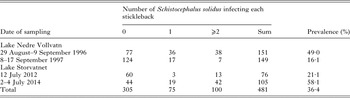
The animals in each of the two lakes were sampled in different years (Table 1). In Lake Nedre Vollvatn the fish were sampled in late August to mid-September, which was about three months after the termination of the spawning period. Sampling in Lake Storevatnet was carried out in the first half of July (Table 1), and several males had reddish throat and some females still contained mature eggs indicating that the spawning season was not completely over yet. The fish were caught by traps with no bait, spread along the shoreline from 0·5 to 3·0 m from land and from 0·3 to 1·5 m depth. The traps were made by cutting 1·5 L soda bottles into two parts, turning the upper one-third part upside down and assembling the two parts by twine. The traps caught mainly sticklebacks with a body length larger than about 3·0 cm, although a few smaller specimens were caught as well. Sex of each fish specimen was determined by inspecting the gonads, and total length was measured to the nearest mm. Schistocephalus solidus in each fish were counted and wet weight of each parasite was measured to the nearest 0·001 g immediately after removal from the host. Body dry mass of each fish was measured to the nearest 0·001 g after carefully removing the stomach, intestine, potential S. solidus, and remains of eggs of mature females (from the July samples), and drying the fish at 105 °C for 10 h (until no further weight loss). Dry weight of the fish was used in the calculations of condition (see below) since starving fish may compensate the loss of muscle weight by increasing the water content in the remaining muscle (Love, Reference Love1980). To further substantiate our choice of presenting the parasite index estimated from dry (and not wet) weight of the fish, we calculated the ratio of wet weight/dry weight of non-infected fish as 4·78 ± 1·015 (mean ± s.d.) and infected fish as 5·35 ± 0·959. The difference was significant (t = 6·20, P < 0·001, d.f. = 472, Student's t-test) and suggests that infected fish have higher water content in their remaining flesh.
Number and prevalence of infection of three-spined sticklebacks sampled at two lakes. The sticklebacks are divided into three categories: non-infected sticklebacks, and sticklebacks infected by one, or more than one Schistocephalus solidus

A ‘Parasite-index’ was calculated for each fish as:
 $$\eqalign{{\rm Parasite} - {\rm index} & = {\hbox{wet weight of all }}S. \;solidus/ \cr & \quad({\hbox{wet weight of all }}S. \;solidus \cr &\quad+ {\hbox{body dry weight of the fish}})}$$
where both the weight measurements were in grams.
Statistics were carried out using SPSS version 20·0 (SPSS Inc. Chicago, IL, USA). Body ‘condition’ of each fish was first estimated as the residual from a linear regression of (x 0·25 transformed, see below) dry weight over length, as recommended by Jakob et al. (Reference Jakob, Marshall and Uetz1996). Before the linear regression was carried out the dry body weight of each stickleback was x 0·25-transformed in order to achieve linearity when plotted against length (see Supplementary information S1). The final analyses were carried out as General Linear Models (GLM) module after checking that the dataset conformed to the assumptions of homoscedasticity of variance, linearity, normality of errors, collinearity and independence (Grafen and Hails, Reference Grafen and Hails2002). Stickleback body ‘condition’, as defined above, was used as response variable and ‘single-multiple infection’, whether the fish was parasitized by one or more than one S. solidus, was added as fixed factors. ‘Year’ of sampling was added as a fixed factor to block for different years of sampling. ‘Year’ blocks for difference between lakes as well since the two lakes were sampled in different years (see Table 1). ‘Parasite-index’ (as defined above) was added as a covariate. Non-parasitized fish were not included in the GLMs. The reason for this is that non-infected stickleback hosts have a ‘Parasite-index’ of zero by definition, and it makes no sense to run the GLMs with zero values of the covariate ‘Parasite-index’ of the non-parasitized hosts.
Three separate GLMs were carried out and these three models differed only concerning which sticklebacks were included in the model. In the first model, all parasitized fish from both lakes and from all 4 years were included. Due to potential different virulence of non-infective and infective S. solidus (see the Introduction section), only part of the dataset was included in the second and third GLMs. In the second GLM we examined potential effect of infective tapeworms only. We included only stickleback hosts infected by one or more S. solidus with infective (>0·05 g) tapeworms, regardless of whether or not they were infected by non-infective ones. The third GLM included only stickleback hosts with non-infective S. solidus (⩽0·05 g). P-values were two-tailed and P < 0·05 was considered significant.
To test for potential differences in host body condition between parasitized and non-parasitized sticklebacks (as non-parasitized hosts could not be included in the GLMs, see above), potential difference in body condition between non-parasitized and parasitized sticklebacks was carried out without adjusting for ‘Parasite-index’. Mean (±s.d.) was calculated for non-infected and infected hosts separately from estimated residuals of x 0·25-transformed dry weight of the fish over length.
This study was carried out in accordance with ethical guidelines stated by the Norwegian Ministry of Agriculture through the Animal Welfare Act. The number of infected sticklebacks used in this study was determined based on the criteria of: (i) including animals from two different populations, each in two different years, in order to make the study reasonable general for stickleback populations of this region. (ii) At the same time our intention was not to sacrifice more fish than necessary to be able to detect reasonable effect sizes.
RESULTS
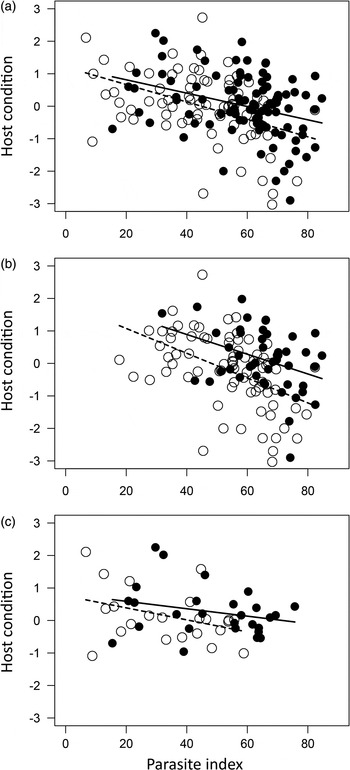
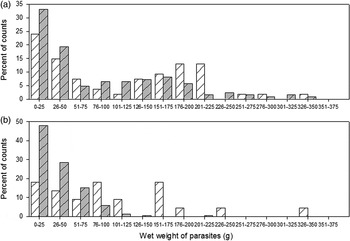
A total of 481 stickleback hosts were examined (Table 1). The prevalence of tapeworms varied between the two lakes and years from 16·1 in Lake Nedre Vollvatn in 1997, to 58·1% in Lake Storvatnet in 2014 (Table 1). Uninfected sticklebacks and sticklebacks infected by one or more than one tapeworms were 305 (63·4%), 75 (15·6%) and 100 (20·8%), respectively. The maximum number of plerocercoids in one host was 24, from a stickleback caught in Lake Storvatnet in 2012, and they were all small (⩽0·0341 g). Maximum number of plerocercoids in one fish from Lake Nedre Vollvatn was 9. The parasite index (with fish body weight measured in dry weight as defined above, see the Materials and methods section) varied from 6·7 to 84·7 as shown in Fig. 1a (an alternative parasite index calculated using wet weight of the fish as opposed to dry weight of the fish and otherwise equal, varied from 0·01 to 0·68, see Supplementary information S3b). In stickleback hosts infected by a single S. solidus (‘single infected’) in Lake Nedre Vollvatn, 39·6% (21 of 53 individuals) of the parasites were non-infective (Fig. 2a). The corresponding numbers for S. solidus from multiple-infected fish were 51·6% (65 of 126) non-infective (Fig. 2a), and number of non-infective and infective did not differ between S. solidus found as the sole (single) and multiple S. solidus (χ 2 = 2·14, P = 0·288, d.f. = 1, χ 2 test). In Lake Storvatnet, 31·8% (7 of 22) of the single-infected S. solidus were non-infective, whereas 78·3% (296 of 378) of the multiple-infected ones were non-infective (Fig. 2b), and this difference was significant (χ 2 = 24·45, P < 0·001, d.f. = 1, χ 2 test). Mean (±s.d.) total mass of all parasites pooled in each host (excluding fish without S. solidus) was 0·228 (±0·0236) g in Lake Storvatnet and 0·177 (±0·0124) g in Lake Nedre Vollvatn, and the distribution of total mass did not differ significantly between the lakes (Z = 1·045, P = 0·225, Kolmogorov–Smirnov test). The number of sticklebacks infected by a single or by multiple S. solidus were 75 and 100, respectively, when fish from both lakes and years were pooled (Table 1). Mean (±s.d.) total mass of S. solidus in each stickleback, of single and multiple-infected sticklebacks, was 0·116 g (±0·0906) and 0·243 g (±0·1564), respectively, in Lake Nedre Vollvatn, and this difference was significant (U = 565·5, P < 0·001, Mann–Whitney U-test, N 1 = 53, N 2 = 45). Corresponding numbers for Lake Storvatnet was 0·110 g (±0·0781) and 0·275 g (±0·2230), and this difference was significant as well (U = 264·5, P < 0·001, Mann–Whitney U-test, N 1 = 22, N 2 = 55). The mean (±s.d.) body length of sticklebacks infected by single and multiple S. solidus was 4·2 (±0·12) cm and 4·6 (±0·08), respectively, when all data were pooled. This difference was significant (P = 0·017, see Supplementary information S2). Of the 100 multiple-infected sticklebacks, 35, 19, 11 and 35 were infected by 2, 3, 4 and ⩾5 parasites, respectively.
Scatter-plots of stickleback host condition versus parasite index from Lake Nedre Vollvatn 1996 and 1997 and Lake Storvatnet 2012 and 2014. All infected hosts were included in (a). In (b) only hosts infected by Schistocephalus solidus with a mass >0·05 g were included, and in (c) only hosts infected by S. solidus with a mass ⩽0·05 g (and no parasites >0·05 g) were included. Hosts infected by 1 and ⩾2 tapeworm(s) are shown as open and filled circles, respectively. Dashed and full lines show linear regression lines for hosts infected by 1 and ⩽2 tapeworm(s), respectively. The y-axis shows residuals of x 0·25-transformed dry weight adjusted for host body length. Parasite index is parasite wet weight/(parasite wet weight + host dry weight). Non-infected hosts are not included in these figures since their ‘Parasite-index’ is zero by definition.

Histograms of the distribution of wet mass of individual parasitic tapeworms (Schistocephalus solidus). The tapeworms and their hosts were sampled in (a) Lake Nedre Vollvatn in 1996 and 1997 (pooled) and (b) in Lake Storvatnet in 2012 and 2014 (pooled). White and grey bars show parasites which were the sole or one of multiple (⩾2) tapeworm(s) infecting one particular stickleback host, respectively. See Table 1 for information about N. The scale of the y-axis differs between the two figures.

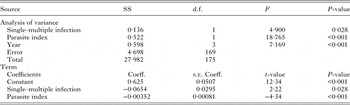
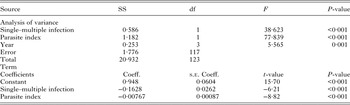
The three GLMs presented below differ with regard to which sticklebacks were included in the analyses. In the first GLM, all sticklebacks with one or more S. solidus were included regardless of parasite mass and infection stage. Both predictors ‘parasite index’ (relative mass of the parasites), and ‘single-multiple infection’ (whether the stickleback was infected by one or more parasites) were significant (Table 2). The ‘parasite index’ was negatively associated with the sticklebacks’ ‘condition’ (Table 1a) demonstrating that sticklebacks with large parasite mass (regardless of number of individual parasites) had lower body condition than sticklebacks infected with lower mass of parasites. Single-infected sticklebacks had a lower condition than multiple-infected fish, as demonstrated by the lower linear regression line of ‘condition’ plotted against ‘parasite index’ of single- compared to multiple-infected fish (Fig. 1a). This means that at a given parasite mass host condition was lower when infected by one compared with more than one parasites. This model explained 22·7% of the variation of the response variable. Running the same model again with wet (instead of dry) fish weight (both in the response variable and in the Parasite-index) gave similar results (see Supplementary information S3).
Test statistics when including all stickleback hosts from both Lake Nedre Vollvatn in 1996 and 1997 and from Lake Storvatnet in 2012 and 2014

‘Condition’ (residuals of power-transformed dry body weight adjusted for length) as response variable in a GLM Type III (adjusted) sums of squares (SS). The predictor ‘single–multiple infection’ is whether the stickleback host was parasitized by one or multiple tapeworms (Schistocephalus solidus) (non-parasitized hosts are excluded), and ‘parasite index’ is wet weight of all tapeworms, as percentage of the sum of fish dry body weight (after removing weight of parasites) plus wet weight of all tapeworms. The model explained 22·7% of the variation (adjusted R 2 = 0·227).
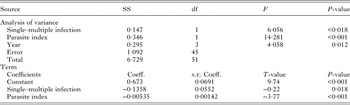
Due to the potential conflict of interests between infective and non-infective parasites as outlined in the Introduction, we ran a second and a third model. In the second GLM (see Table 3, Fig. 1b) we included only stickleback hosts with one or more S. solidus which were ready to infect the final host, regardless of whether or not they were infected by non-infective S. solidus (⩽0·05 g) as well. The percentage of the variation explained by this model increased to 51·2 (Table 3), and the model gave similar results as the first model concerning the significance level of the predictors and their association to the response variable (Table 3, Fig. 1b). The third GLM included only the data from sticklebacks infected by only non-infective S. solidus. Again this model explained a relatively large part of the variation (45·2%, Table 4), and the model gave similar results as the two other models concerning the significance level of the predictors and their association to the response variable (Table 4, Fig. 1c). The blocking factor ‘year’ explained a significant although relative small part of the variation in each of the GLM models (Tables 2, 3 and 4).
Test statistics including only stickleback hosts parasitized by Schistocephalus solidus which are infective (individual S. solidus mass >0·05 g) if transferred to the next host regardless of whether or not hosts were parasitized by smaller (⩽0·05 g) non-infective S. solidus

The data were collected in Lake Nedre Vollvatn in 1996 and 1997 and Lake Storvatnet from 2012 and 2014. ‘Condition’ (residuals of power-transformed dry body weight adjusted for length) as response variable in a GLM Type III (adjusted) sums of squares (SS). The predictor ‘single–multiple infection’ is whether the stickleback host was parasitized by one or multiple infective (S. solidus) (non-parasitized hosts were excluded), and ‘parasite index’ is wet weight of all tapeworms, as percentage of the sum of fish dry body weight (after removing weight of parasites) plus wet weight of all tapeworms. The model explained 51·2% of the variation (adjusted R 2 = 0·512).
Test statistics including only stickleback hosts which are both (i) parasitized by Schistocephalus solidus which are non-infective (individual S. solidus mass ⩽0·05 g) if transferred to the next host, and (ii) at the same time not parasitized by S. solidus which are infective (individual S. solidus mass >0·05 g) in the next host

The data are from Lake Nedre Vollvatn in 1996 and 1997 and Lake Storvatnet from 2012 and 2014. ‘Condition’ (residuals of power-transformed dry body weight adjusted for length) as response variable in a GLM Type III (adjusted) sums of squares (SS). The predictor ‘single–multiple infection’ is whether the stickleback host was parasitized by one or multiple non-infective tapeworms (S. solidus) (non-parasitized hosts were excluded), and ‘parasite index’ is wet weight of all tapeworms, as percentage of the sum of fish dry body weight (after removing weight of parasites) plus wet weight of all tapeworms. The model explained 45·2% of the variation (adjusted R 2 = 0·452).
Mean (±s.d.) residuals (x 0·25-transformed dry mass over length) host condition estimated without correcting for ‘Parasite-index’ (see Materials and methods), was 0·245 (±0·947) for uninfected hosts, and –0·421 (±0·946) for infected hosts. The two means are significantly different (t = 7·384, P < 0·001, d.f. = 471, t-test).
DISCUSSION
The predictors ‘parasite index’ and ‘single-multiple infections’, each explained a significant part of the variance in the response variable ‘condition’ of the host. Parasite index was an important predictor in all three statistical models, and was negatively associated with condition of the host. More interestingly, at a given parasite index an infection by one individual S. solidus depleted the condition of its stickleback host more than multiple infections. Splitting the dataset into two parts, depending on whether the individual S. solidus had reached a mass where they were large enough to be infective (>0·05 g) or still to small (⩽0·05 g) to infect the consecutive host, approximately doubled the percentage of variation explained by the models.
The lower virulence of multiple S. solidus compared to single ones, on stickleback host in this field study, concurs with results from controlled experimental infections using the same species and carried out by Christen and Milinski (Reference Christen and Milinski2003), and with the theoretical life history strategy (LHS) model suggested by Parker et al. (Reference Parker, Chubb, Roberts, Michaud and Milinski2003). Christen and Milinski (Reference Christen and Milinski2005) suggested that less virulence of multiple-infected plerocercoids can be explained as multiple plerocercoids need to allow the host to grow larger to enable not just one but multiple parasites to reach the threshold of 0·05 g body mass required to infect the consecutive host (see the Introduction section).
A second explanation to consider has to do with the temporal lack of future transmission possibilities from the stickleback body cavity to the final bird intestine for S. solidus during the long winters in North Norway. There are at least two contrasting strategies how S. solidus might prepare for the winter when lakes are covered by ice for months and S. solidus plerocercoids cannot be transferred to their final bird host. One strategy might be to drain energy from the stickleback host severely in order to grow large enough to become infective for the final host as early in the summer or autumn as possible. Becoming infective (>0·05 g) early increases the time period available for infecting the final bird host before such transmission is impeded by the ice, and this will decrease the parasite's generation time and hence increase its fitness. It is reasonable to assume that a single-infected plerocercoid S. solidus has the potential to reach the infective mass of 0·05 g earlier in the summer or autumn compared with their multiple-infected conspecifics, since single-infected ones do not share resources. Hence, single infective S. solidus have a longer time period where they are able to infect a bird. An alternative strategy is to exploit the stickleback host prudently in order to allow the stickleback host, and the S. solidus, to survive the harsh winter months and go for transmission to the bird intestine during the next spring or summer. This strategy assumes a perennial stickleback population and a reasonable probability that infected stickleback hosts survive the harsh winter. Both these assumptions seem to apply in a stickleback population in Alaska infected by S. solidus (Heins et al. Reference Heins, Singer and Baker1999). In the perennial stickleback population in Nedre Vollvatn the prevalence of S. solidus dropped from 49·0% in September 1996 (Table 1) to 6·2% (8 of 129) the following spring (J.T. Nordeide, 20–27 May 1997, unpublished results), suggesting substantial mortality of infected sticklebacks during the winter months. Our data do not allow us to distinguish between energy drainage from the parasites, selective predation of infected sticklebacks (see e.g. Jakobsen et al. Reference Jakobsen, Johnsen and Larsson1988), or a combination of both, as the reason for this presumably high winter mortality. Several authors have reported relatively low prevalence of S. solidus plerocercoids in spring and early summer (Meakins, Reference Meakins1974; McPhail and Peacock, Reference McPhail and Peacock1983), and increasing prevalence during early summer and autumn (Pennycuick, Reference Pennycuick1971; Meakins, Reference Meakins1974; McPhail and Peacock, Reference McPhail and Peacock1983). However, despite this winter mortality it is likely that a larger ratio of multiple compared with single S. solidus go for the prudent host energy drainage strategy (see above). If so, this may contribute to explain the lower virulence of multiple relative to single-infected S. solidus demonstrated in the present study.
A possible third explanation for the relatively low virulence of multiple compared with single S. solidus may be natural selection for mutual cooperative behaviour to allow the host to grow for the two parasites’ mutual benefit, for example as in a TIT-FOR-TAT strategy (Axelrod and Hamilton, Reference Axelrod and Hamilton1981). This suggestion applies to the 35% of the multiple-infected sticklebacks which were infected by two S. solidus. Fourthly, in an experimental study Jäger and Schjørring (Reference Jäger and Schjørring2006) found related compared with non-related S. solidus to be more successful in infecting stickleback hosts. Similarly, we cannot exclude the possibility that multiple parasites within each host in the present may theoretically cooperate to restrain exploitation of the host because they are related. However, we lack information about relatedness of S. solidus and are unable to confirm or disprove this hypothesis.
Our understanding of the proximate mechanisms causing the multiple compared with single S. solidus to be less virulent towards their stickleback host remains poor, leaving this question open for future exiting research. One potential mechanism may be related to acting relatively gently towards the host is a side effect of a fierce struggle between the multiple parasites allocating resources to fight each other by unknown mechanisms, at the expense of resources invested to exploit and harm the host (reviewed by Read and Taylor, Reference Read and Taylor2001).
Although testing all prediction in the theoretical LHS model by Parker et al. (Reference Parker, Chubb, Roberts, Michaud and Milinski2003) was beyond the scope of this field study, we should mention that the results from our present field study seem to concur with another prediction from this model as well. Total mass of all S. solidus in a host was higher in multiple-infected S. solidus compared with single ones, as expected from the LHS model, and contrary to results by Christen and Milinski (Reference Christen and Milinski2003).
A potential flaw in this field studies is our lack of information about when the hosts in these perennial populations became infected. The different S. solidus infected their hosts at different times and we cannot exclude the possibility that some of them might even have survived the winter as plerocercoids. The different S. solidus might therefore consequently have drained energy from their stickleback hosts during different time periods. On the other hand, the distribution of mass of individual in single- and multiple-infected S. solidus did not differ much in the Lake Nedre Vollvatn samples (see the Results section, Fig. 2a), indicating that the time of infection does not differ much between the two groups. Running the GLM on data from Lake Nedre Vollvatn only gave very similar results (Supplementary information S4) as the pooled results from both lakes (see the Results section). In addition, only by controlled experiments can we potentially rule out the possibility that single-infected sticklebacks had lower condition anyways, and that those with higher body condition were prone to multiple infections.
To conclude, this field study suggests that multiple infections by S. solidus lowers the body condition of their intermediate stickleback host less severely compared to single-infected S. solidus, at a given parasite mass.
SUPPLEMENTARY MATERIAL
The supplementary material for this article can be found at http://dx.doi.org/10.1017/S0031182016000676.
ACKNOWLEDGEMENTS
We thank Per Johan Jakobsen for valuable suggestions when planning the analyses, and anonymous reviewers for a number of constructive suggestions.
FINANCIAL SUPPORT
This research received no specific grant from any funding agency, commercial or not-for-profit sectors.