The ‘most Arctic’ of all birds, the ivory gull (Pagophila eburnea) is the focus of much recent attention. A population decline has been reported in the Canadian breeding population (Gilchrist and Mallory Reference Gilchrist and Mallory2005) and there is concern for the species due to reduction in its primary habitat, the polar sea ice, induced by climate change. It was therefore listed as ‘near threatened’ (NT) by the International Union for the Conservation of Nature (IUCN) in 2005, has been listed as ‘vulnerable’ (VU) on the Greenland Red List (Boertmann Reference Boertmann2008) and was in 2006 listed as ‘endangered’ in Canada by the committee on the status of endangered wildlife in Canada (COSEWIC 2006). In line with this growing concern, the Arctic Council working group CAFF (Conservation of Arctic Flora and Fauna) recently issued a conservation strategy (Gilchrist and others Reference Gilchrist, Strøm, Gavrilo and Mosbech2008), which among other issues points out that more information on population numbers is needed.
In Greenland, the ivory gull breeding stronghold is the northeasternmost corner of the island, between 80° N and 83° N (Boertmann Reference Boertmann1994). The sea off this part of Greenland is covered by vast drift ice fields throughout the year, yet localised and predictable bodies of open water make the region attractive to breeding ivory gulls. The northeast water polynya, an ice free area which opens very early in spring and remains partly open even in winter, is located between 80° N and 81° 30′ N. From this polynya a lead zone between the coastal fast ice and the dynamic drift ice stretches to the northwest for more than 350 km, providing additional areas of open water.
From July to August 2008, the first two authors surveyed all of northeast Greenland for coastal seabirds from aircraft, and particular effort was devoted to the ivory gull stronghold. The survey platform was a high winged and twin engined Partenavia P-68 Observer with excellent observation conditions. The flight altitude was 250 feet (~80 m) and the survey speed was 90 knots (~160 km/h).
The third author provided information from satellite tracked Ivory Gulls caught at two breeding sites in the area in July 2007 and June 2008 (Gilg and others Reference Gilg, Sabard, Aebischer, Hardy and Bernard2008; see: www.seaturtle.org/tracking/?project_id=233). After transmitter attachment a number of these birds repeatedly returned to other onshore sites, which presumably were breeding colonies. The aerial survey presented the opportunity to test this hypothesis.
The region was surveyed between 30 July and 1 August 2008. Six sites to which satellite tracked ivory gulls returned were checked and all proved to be breeding colonies, each holding between 10 and 125 adult birds. The results of the survey and an updated status of the species in Greenland will be published elsewhere. Here we report the discovery of a striking breeding habitat. One of the sites to which the satellite tracked birds returned was located in the middle of a wide fjord in which no islands had ever been reported, at a position of approx. 82° 14′ N, 21° 27′W.
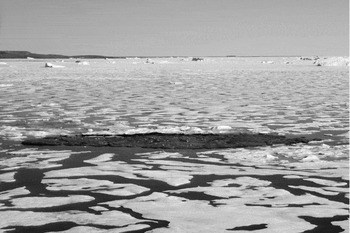
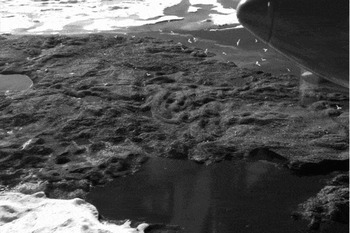
At a distance the site looked like a small gravel island surrounded by melting first year fjord ice (Fig. 1). However, at closer range it turned out to be a thick ice floe, approximately 100 m long by 20 m wide, and covered with a dark gravely moraine. Here, at least 125 adult ivory gulls and 35 chicks could be counted (Fig. 2).
The ice floe colony seen at distance. It is frozen into first year ice, which is disintegrating. 1 August 2008.

A closer look at the ice floe colony, in which approximately 125 adult ivory gulls and 35 chicks were seen.

The ice floe could have come from one of the glaciers in the head of Independence Fjord, as occasionally dark or partly dark icebergs made up from frozen moraine are calved from these glaciers. The floe could be the last remnants of a small tabular berg (which did not tip), upon which a thick layer of gravel gradually built up during the melt.
Another explanation could be that the floe was a piece of frozen coastal moraine gravel. Moraines at the shoreline are impregnated by seawater. This water freezes in winter, enclosing all the moraine material in a solid, mixed block of ice and gravel. With the subsequent up-and-down movements caused by the daily tides, these blocks can detach and eventually drift when there is open water, despite their higher density than regular sea ice (J.-C. Gascard, personal communication, 1 December 2008). When the surface melts in the summer, a layer of gravel builds up and this may become suitable for breeding ivory gulls.
Russian scientists have long suggested that ivory gulls could breed on large ice islands in the polar sea (Uspenski in Johansen Reference Johansen1958), but they have never been able to substantiate this claim. In 1960, however, Canadian ornithologists found and described a breeding colony on a gravel covered ice floe in the Peary Channel, high Arctic Canada (MacDonald and Macpherson Reference Macdonald and Macpherson1962). Except for a single nest placed on a small, beached iceberg in Svalbard (Kristoffersen Reference Kristoffersen1926), this has represented the only evidence for this remarkable nesting substrate.
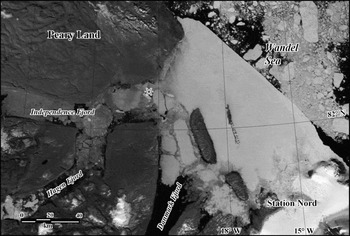
Seen from a gull's point of view, the gravel covered ice floe looks similar to some of the ‘true’ small islands on which the species breeds in the region. As seen from MODIS images of the ice, it was fixed in the fjord ice at least until mid August and was frozen in again in early September. The drift of the floe was hence limited, at most, to a three week period. Furthermore, the drift was spatially limited since a wide barrier of consolidated drift ice blocked the entrance of the fjord, preventing the floe from escaping into the Wandel Sea. This barrier had been in place at least since 2004 (Fig. 3). The potential movement of the colony, if any, was therefore limited and would only occur when many of the young gulls had already fledged. The colony may therefore have existed at the same location for several years and may persist as long as the ice barrier is in place and the floe does not disintegrate.
The ice situation on 1 August 2008 (MODIS images). The star shows the position of the ice floe colony. Note the large solid ice barrier blocking the entrance of the fjords. This is present on all available MODIS images (since 2004). Image courtesy of NASA's MODIS team.

An advantage of choosing an ice floe rather than one of the small islands available in the region (which are also surrounded by sea ice until mid August) may be the greater distance from the mainland (7.5 km) and, hence, from Arctic fox (Alopex lagopus) predation, the most immediate threat to breeding ivory gulls in this part of Greenland. Fox predation must however be relatively rare because some of the ivory gull colonies are situated on low mainland shores or on coastal islands (<100 m from the shore). One colony is even located close to a military outpost, that is known to attract foxes. Hence, the primary reason for the birds to choose such an ephemeral substrate for breeding might simply have been dictated by the fact that no other alternative small and ‘true’ island exists within 50 km of the site.
The disadvantage to breeding on ice is that the substrate may melt resulting in nest collapse as reported for herring gulls (Larus argentatus) (Morris and Chardine Reference Morris and Chardine1985) and gentoo penguins (Pygoscelis papua) (J. Chardine, personal. communication, 2 March 2009). This problem is overcome either by carrying the egg on the feet as in the case of emperor penguins (Aptonodytes forsteri), the only bird species regularly breeding on ice, or using ice floes covered by a thick isolating layer of gravel and dirt, as in the ivory gull colony reported here. Such floes suitable for nest placement and that includes that they are more or less fixed over the season, are rare, thus explaining why seabird colonies are so infrequently reported from this substrate.
Acknowledgements
The aerial seabird survey was part of a study aiming to collect background data for an environmental impact assessment (EIA) of oil exploration activities and was funded by the Greenland Home Rule Government. The MODIS image was processed by Mikkel Tamstorf and Carey Smith corrected the English. John Chardine and anonymous referees provided useful comments on the first draft of the manuscript. The Greenland Home Rule Government, the Danish Polar Centre and the Greenland Command (running the military section of Station Nord) helped with the permits and logistic. Brigitte Sabard and Adrian Aebischer took part in the satellite tracking programme, work that was mainly been funded by GREA (Arctic Ecology Research Group – France), the Prix gore-tex initiative, a National Geographic Society research grant, Fondation Avenir Finance, Intermarché, and F. Paulsen.