Introduction: Landscapes that linger
As it happens, T. S. Eliot finished drafting his famous poem ‘The Waste Land’ in Switzerland in late 1919, early 1920. Switzerland provides the empirical backdrop for our article. In the short extract quoted above, the ‘withered stumps’ allude to old tapestries, specifically one depicting the classical story of Philomela. Having had her tongue cut out by her brother-in-law Tereus, who had raped her, Philomela wove a tapestry as a way to report his crime. More generally, however, the ‘withered stumps’ serve as an allegory for the stories offered up by decaying objects, as well as the powerful resonances of their spatial-temporal configuration. Our article here is likewise concerned with stories told but not spoken, seen but not heard.
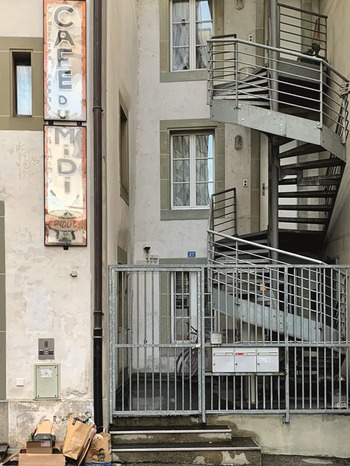
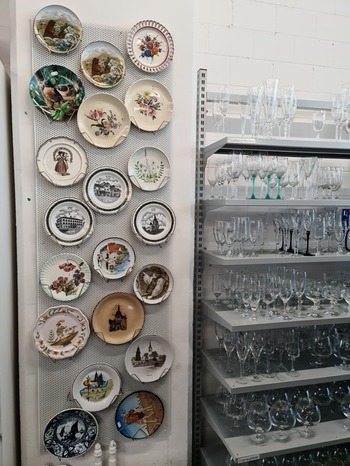
The lofty poetic reference from ‘The Waste Land’ also sets the scene nicely for the more pedestrian remnants and leftovers at the heart of our article; these are exemplified in Figures 1 and 2 where we point to two different semiotic landscapes: one exterior and publicly oriented, one interior and more domestically oriented. Both landscapes are constituted, at least in part, with rubbish from other places and other times. In Figure 1, we show a street in Fribourg, Switzerland. We are struck by the faded, weather-worn Café du Midi sign on the wall of the building but are mostly interested in the paper and cardboard (bottom left) neatly bagged or bundled for collection. In this instance, language—in its printed, written form—is quite tangibly materialized and, like so much stuff, is being thrown away. In Figure 2, meanwhile, we turn to the ‘micro-landscape’ (Juffermans Reference Juffermans, Peck, Stroud and Williams2019) of a much-loved Swiss institution: the brocante (French), Brockenstube (German) or, more colloquially, just Brocki. Taken at one of the larger of these secondhand/thrift stores in Bern, this particular snapshot shows a wall-mounted collection of decorative plates alongside a large shelving unit filled with an assortment of drinking glasses. It is the plates which interest us most: a ceramic montage speaking of previous homes, personal collections, historical vignettes, and, in at least three cases, holidays in Cataluyna, Tunisia, and on the 1,000-year-old pilgrimage across the north of Spain. In this instance, language is less obviously or visibly evident; it is nonetheless inherent as a trace or memory, one which is significant enough to imbue the plates with renewed cachet.
A snapshot of recycling day in Fribourg.

Secondhand goods for sale at a Brocki in Bern.

Much like Eliot's literary example, our two Swiss vignettes are ideal instantiations of important discursive chronotopes, which is to say, they manifest the temporal and spatial structuring of language and other semiotic actions. In a moment, we will review key scholarship on chronotopes and especially the ways language scholars have been orienting to the idea. For now, though, we just want to note that our general focus is on landscapes that linger, on a reading of spaces which are structured by the passage of time. And these are spaces that are both liminal and laminated; in other words, they are marked by in-betweenness and transition, as well as being organized through multiple temporalities. Indeed, places are always constituted as both singular moments (or series of moments) and much longer durations, just as they are constituted, in subjective and site-specific ways, by different paces and shifting rhythms (see Wunderlich Reference Wunderlich and Edensor2010 on ‘place-temporality’). As something lived (Lefebvre Reference Lefebvre and Nicholson-Smith1974/Reference Lefebvre and Nicholson-Smith1991) or experienced, spaces are thus simultaneously fast and slow, as well as short-term (e.g. circadian or event-constituted) and long-term (e.g. historical or longue durée). It is precisely these temporal laminations and the discursive mediation of time-space which we track by attending to the ordinary places of waste.
Key concepts: Chronotopes, temporal laminations, linguistic hauntings
The primary organizing principle of our article is the notion of the chronotope. In this regard, we are obviously indebted to Bakhtin's (Reference Bakhtin, Holquist, Emerson and Holquist1981:84) original coinage: ‘the intrinsic connectedness of temporal and spatial relationships that are artistically expressed in literature’. In this sense, time and space are inseparable and are central to the way literary genres are constituted. Importantly, in his rendition of Bakhtin's work, Holquist (Bakhtin Reference Bakhtin, Holquist, Emerson and Holquist1981:425–26) helps make this literary notion more relevant for other language scholars; in this regard, he explains chronotopes as a ‘unit of analysis’ and as an ‘optic for reading texts as x-rays of the forces at work in the culture system from which they spring’. It is this potential for cultural decoding which Agha (Reference Agha2007:320) exploits by conceptually expanding the analytic scope of chronotopes to wider cultural representations: ‘depictions of place-time-and-personhood to which social interactants orient when they engage each other through discursive signs of any kind’. In our article here, we follow Ahga's lead, although with a particular focus on the discursive—the way speech, writing, and other semiotic practices are inevitably also organized spatially-temporally.
In taking up the Bakhtinian notion of the chronotope, we mean to avoid a too-simplistic ‘time + space’ approach, one which addresses temporality and spatiality but treats them as ontologically separate. Rather, we follow the lead of geographers like May & Thift (Reference May and Thrift2001) who signal the inseparability of time and space with the term timespace. (We ourselves prefer to render this as time-space.) More specifically, we understand chronotope in much the same the way Crang (Reference Crang2001:190) does: as the ‘unity of time and place’, as a ‘sense of temporalised place’, and as a ‘place not necessarily of singular time but a particular constellation of temporalities, coming together in a concrete place’. This approach to time-space is particularly useful for dealing with (urban) waste. While, much has been written about the spatialities of waste—allied with Douglas’ (Reference Douglas1966/2002) famous approach to dirt as ‘matter out of place’—there has also been increasing attention paid to the temporalities of waste, both short-term and long-term (see Allon, Barcan, & Eddison-Cogan Reference Allon, Barcan, Eddison-Cogan, Allon, Barcan and Eddison-Cogan2021). We align our current study with this work, wanting to show how the placing and timing of stuff work simultaneously to produce it as waste. The key point, however, is to show how these processes are discursively framed and accomplished.
Chronotopes and issues of temporality have only recently but relatively quickly been taken up by sociocultural linguists, and sometimes also in the specific context of linguistic/semiotic landscape research. In this regard, we highlight just a few of the most germane points of connection for our current purposes. One of the best-known engagements with chronotopes by a discourse analyst has been Pietikäinen's (Reference Pietikäinen2014) study of a Sámi village in Finland; from this we take her documentation of a stable regulatory chronotope compared with a dynamic transitory chronotope. There is also tightly allied work drawing on the Foucauldian heterotopia which necessarily entails time-space formations (e.g. Tufi Reference Tufi2017; Milani & Levon Reference Milani and Levin2019) where the liminality and interactional management of time-space is addressed. Quite a few studies within semiotic landscape studies attend directly or indirectly to time-space for thinking through the long durée cultural politics of language and other semiotic practices in postindustrial or postcolonial settings. Here, for example, we point to Gendelman & Aiello (Reference Gendelman, Aiello, Jaworski and Thurlow2010), Trinch & Snajdr (Reference Trinch and Snajdr2017), Lyons & Karimzad (Reference Lyons and Karimzad2019), and then, from the same volume, Baro (Reference Baro, Peck, Stroud and Williams2019), Guissemo (Reference Guissemo, Peck, Stroud and Williams2019), and Mpendukana & Stroud (Reference Mpendukana, Stroud, Peck, Stroud and Williams2019). Across all of this work, we find various germane issues being raised such as semiotic layerings, nostalgia-based symbolic economies, regimes of (in)visibility, shifting absences/presences, and the temporal reconfigurations/reclamations of space. Coming closer to our own focus here, Guinto (Reference Guinto2019) documents the comings and goings of migrant workers in Hong Kong's Central district, highlighting how landscapes are constituted through both spatial movement and temporal fluctuation. Dong (Reference Dong2021:10), too, offers a situated analysis of urban migrant communities (in Beijing) where she pinpoints what she calls the ‘scaled simultaneity of multiple timespaces’. These studies make productive conceptual-empirical moves which help align linguistic landscapes research with contemporary theoretical perspectives on time.
In the current article, we want to map some of the ways urban landscapes are structured along very similar lines to those just mentioned. Specifically, we draw attention to multiple, differently scaled but simultaneous or laminated temporalities. (We prefer laminated over layered (cf. Backhaus Reference Backhaus2005) for its sense of composite, bonded materials as opposed to a looser covering or overlaying. Lamination is also established in sociocultural linguistics through Goffman's (Reference Goffman1974) work on framing.) When spaces are temporally laminated, their rhythms/cycles/durations are seldom neatly ordered, linear, or bounded (Wunderlich Reference Wunderlich and Edensor2010). In this regard, therefore, we orient to the kind of postmodern chronotopes about which literary and cultural studies scholars write (e.g. Nowotny Reference Nowotny and Plaice1996; Smethurst Reference Smethurst2000). Heading in a similar direction to certain colleagues in our field (see above), we certainly want to move beyond the tendency in linguistic landscapes research to think of chronotopes in static, binarized ways (cf. Thurlow Reference Thurlow2019); this means complicating time-space relations such as past/present, stable/mobile, traditional/transgressive, or passé/cutting-edge. As Smethurst (Reference Smethurst2000) tells us, contemporary time-space formations are typically characterized by decentered, de-differentiated (e.g. blurring here and there, presence and absence), and non-linear relations. This all has particular significance for the nature of waste and, especially, for the way it takes place in our lives as something simultaneously visible and hidden, present and absent.
Over twenty years ago, Billig (Reference Billig1997) argued that a major failing of sociocultural linguistics was its undue—exclusive, even—attention to what is present in discourse rather than what is absent, what is said rather than what is not said, left unsaid, or prohibited. Every act of expression, every moment of talk, inevitably entails an act of repression (Billig's term) or, more accurately, suppression.Footnote 1 This is exemplified in the way children are taught to avoid impolite or rude language in order to produce polite, ‘clean’ language. In much the same way, linguistic landscapes research has been consistently wedded to the study of only visible (written) language; it is certainly ill-equipped, as Karlander (Reference Karlander2019) notes, for examining absences and erasures even though these are no-less ideologically or experientially significant. Meanwhile, in a somewhat different register and orienting to other disciplines, Deumert (Reference Deumert2018, Reference Deumert2022) has recently made the case for a ‘sociolinguistics of the spectre’—drawing on a longer line of hauntology scholarship, most notably Derrida (Reference Derrida1993/2006). In closely allied work, Bock & Stroud (Reference Bock, Stroud, Peck, Stroud and Williams2019) invoke zombies (the undead) to account for the historical traces and remnants which inform people's sense of space/place. Hauntology, as Deumert explains, offers itself as a radical opportunity—empirical and political—for attending properly to voices that are both silenced (excluded) and silent (unheard/unseen). This does require that sociocultural linguists seek out language which has otherwise been overlooked or forgotten—words that are otherwise absent or invisible.
Against this conceptual backdrop, we turn to the empirical focus of our article which, as we say, takes the form of two case studies. The first case study returns us to the liminal time-space formations of garbage day and the banal ‘spectacles of waste’ (cf. Straw Reference Straw, Boutros and Straw2010) which take place on the street in front of people's houses. Our concern here is to highlight the particular way that language—sometimes explicit but often hidden and/or repressed—inevitably structures the chronotopes of waste and, in turn, the (urban) landscape. Our second case study then demonstrates some of the ways language structures secondhand shops as micro-landscapes or spatial texts (cf. Kosatica Reference Kosatica, Blackwood and Macalister2021), but also how language is central to the practices of (re)valuation by which waste is interactionally constituted and given social meaning. As with our first case study, the stuff donated to Brockis is imbued with language—implicit conversations and stories from the past—but is also explicitly organized through language in its re-emplacement and its transition from one owner to another. In both our case studies, we are equally interested in the overt languaging of waste and in the covert ways language haunts the places of waste.Footnote 2
Case study 1: Waste's regulatory and repressive chronotopes
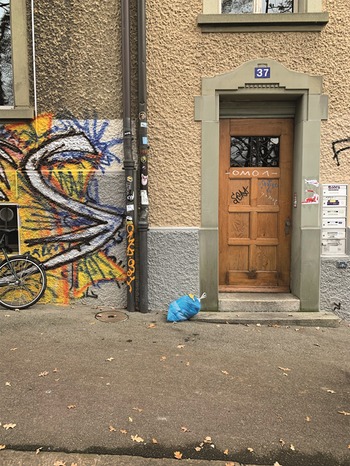
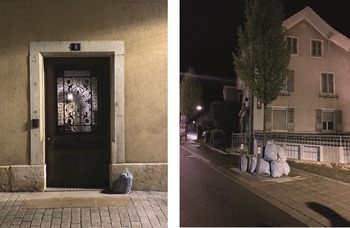
For our first case study, we draw on a multisite visual ethnography conducted by author Pellanda (Reference Pellanda2021) in which he documented the everyday practices of household waste disposal in five Swiss cities.Footnote 3 A good example is shown in Figure 3: a lone garbage bag placed neatly on the street just outside a front door. While this appears to be a very peaceful, perhaps even silent scene, we propose that this bag and this moment are saturated with language, both implicitly and explicitly so. Residents in most Swiss cities are obliged twice a week to use city-approved bags for disposing of their general household waste (not glass, certain plastics, or metals); every second week, they must also neatly bundle or paper-bag their paper/cardboard waste (recall Figure 1). Typically, specific times are stipulated when this waste may be deposited outside or curbside for early-morning collection. In this way, time structures waste, and waste, in turn, structures space. What is perhaps less clear is how language structures everything—or, at least, how it co-constitutes or mediates these chronotopes.
An official blue garbage bag left outside for collection in Bern.

These banal moments of wasting are examples of how waste itself can function in its own right as a semiotic resource (Thurlow Reference Thurlow2022). The garbage bags help performatively produce, for example, good Swiss citizens, and, as Pellanda (Reference Pellanda2021; after Hawkins Reference Hawkins2006) notes, help virtue-signal middle-class subjectivities. But they also rewrite the city in significant ways by leaving their mark on its landscape—fleetingly but repeatedly. Indeed, the transient nature of these little household actions is rendered all the more significant by their repetition and collective scale. As Karlander (Reference Karlander2019) argues, presence and semiotic impact are always relative, and even the apparently erased or sidelined expression of human actions are replete with meaning. Furthermore, just because things take place outside ‘normal’ waking hours—in the apparently silent moments of the night—does not make them irrelevant to linguistic consideration. While the ‘lingering matter’ (Stanes Reference Stanes, Allon, Barcan and Eddison-Cogan2021) of the curbside deposits momentarily blurs the boundary between insider/private/invisible space and outside/public/visible space, these spatial-temporal boundaries are carefully managed and regulated through an extensive documentary regime (Cavanaugh Reference Cavanaugh2022). Akin to Pietikäinen (Reference Pietikäinen2014), we thus encounter a regulatory discursive chronotope by which waste is determined and contained; although, as others note (Hird Reference Hird2012; also Alexander & O'Hare Reference Alexander and O'Hare2020), this containment is largely fictive.
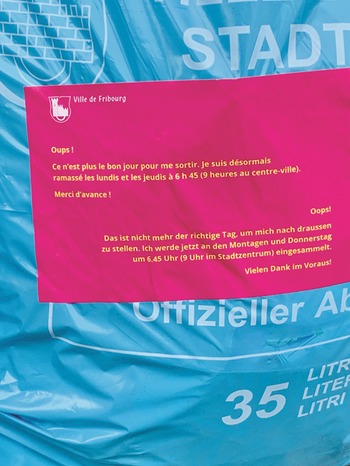
Waste, as Douglas (Reference Douglas1966/Reference Douglas2002) so famously reminds us, is produced through an ordering of space; it is also how spaces are produced as certain kinds of place. Waste is not allowed to be (or not supposed to be) exposed or left just anywhere. Nor can it take place at any time. As we say, the process of disposal follows strict ordinances which, over time, emerge as deeply held—and policed—cultural norms. It is in this way that language—in the form of documentary regimes—is still the primary means through which waste is defined, managed, and regulated. The very act of placing something in one of the city-approved garbage bags is itself a performative act by which something is declared discardable (see Thurlow Reference Thurlow2022); these everyday categorizations and valuations help structure the social biographies (Kopytoff Reference Kopytoff and Appuadurai1986) of the stuff people throw away. Here, one might think of the expiration dates printed on food packaging (Tam Reference Tam, Allon, Barcan and Eddison-Cogan2020). Language is undeniably central to the transmutation of stuff into waste, and while much of this discursive mediation takes place behind the scenes, occasionally it makes itself known. In Figure 4, for example, we show a friendly reminder-cum-warning pasted onto a garbage bag left outside at the wrong time, the unsanctioned moment. Translated from French and German, the label reads:
(1) Oops! This is not the right day to take me out. I'm only collected on Mondays and Thursdays at 6:45 (09:00 in the city center). Thanks in advance.
A friendly reminder-cum-warning from the City of Fribourg.

With its synthetically personalized style, this little message is a momentary expression of the far more extensive documentary regimes and financial-juridical systems which underwrite the spatial and temporal regulation of domestic waste in the city (see Pellanda Reference Pellanda2021; also Cavanaugh Reference Cavanaugh2022). The point is that, sometimes overtly but often covertly, language is always at work in disciplining and policing the management of waste and, thus, the boundary between private and public space. This may be a first in a series of linguistic hauntings we consider in our article.
The linguistic hauntings of everyday waste also take another form, one which is potentially even more productive (or provocative) for sociocultural linguistics and, specifically, linguistic landscape studies. In this regard, we start with the scenes depicted in Figures 5 and 6. In the dead of night, ready for the officially appointed moment, garbage bags wait quietly for collection in Delémont. Despite the deceptive calm of night or dusk, waste itself is never silent. However taciturn they may be, these garbage bags are not uncommunicative. Instead, they index—and bring to the fore—the world of interactions, discussions, and dinner-table conversations which make possible and make meaningful the consumption generating waste to start with. This is why we want to understand the garbage bags as both site-specific spectacles and as spectral presences. For this, we find precedents in long-standing and recent sociocultural linguistics.
Garbage bags wait quietly for collection in Delémont.

As Baudrillard (Reference Baudrillard2007:25) observed, ‘nothing just vanishes; of everything that disappears there remain traces’. In the face of absence, erasure, or concealment, therefore, we must turn to the traces of language (cf. Ingold Reference Ingold2007 in Jaworski & Wei Reference Jaworski and Wei2021). It is by looking at/for unspoken or unseen words that we can start piecing together ‘semiotic layers’ (Karlander Reference Karlander2019:207) and other spatiotemporal remains. Following Billig's (Reference Billig1997; see below) lead, for example, Thurlow & Moshin's (Reference Thurlow, Moshin, Shröter and Taylor2018) analysis of taboo language in the news media hinged on the pursuit of traces or what they called ‘explicit absences’; paradoxically, these verbal gaps often called attention to themselves through verbose euphemisms, circumlocutions, or other dissembling speech acts. However, not all language-use necessarily leaves such conveniently explicit traces; in which case, a little imagination is needed for reconstructing ‘expired’ speech. This, of course, is where many scholars run into trouble or find themselves in trouble, having committed themselves for so long to the business of facts not fiction, evidence not speculation.
The same type of omission-cum-suppression signals the second of the discursive chronotopes of waste in our case study. Domestic waste is a sociomaterial practice which is fully betwixt and between. Combining (highly regulated) visibility and an (apparent) non-existence, our garbage bags are simultaneously deposited ‘here’ on the outside but are also replete with stuff from ‘there’ on the inside. As Grosz (Reference Grosz2001:xv) observes, ‘to be outside something is always to be inside something else’. Domestic microscapes are thereby ejected into, and interwoven with, the macroscape of the street and beyond (i.e. municipal landfills or incineration plants). Time-space thus expands and collapses; it is also simultaneously ephemeral and infinite (Hird Reference Hird2012)—and with literally endless ecological ramifications. The point is that, in the liminal, laminated time-space of the curbside, otherwise out-of-sight or behind-closed-doors consumption reveals itself. Although concealed in opaque garbage bags, the extent—if not the exact content—of people's household shopping and feeding is made partially knowable. And, by the same token, these bags make discernable or imaginable a world of domestic talk: mealtime banter, family discussions about foodstuff and foodways, and negotiations about food waste (see Evans Reference Evans2014), for example. This otherwise invisible, private language spills onto the streets and lingers too.
Attending to the spectral presence of language is not just fanciful conceptual matter, nor is a simply linguistic one. It is certainly no coincidence that hauntology has been taken up by scholars of waste and discard studies too (e.g. Scanlan Reference Scanlan2005; Doeland Reference Doeland, Ek and Johansson2020). While waste may be transformed, says Hird (Reference Hird2012), it never quite goes away. In this regard, hauntology usefully highlights the inherent or defining relationality of waste (Doeland Reference Doeland, Ek and Johansson2020:7); in other words, how people are connected to stuff, and how they are connected to each other through stuff. (Social relationships are, of course, central to the work of sociocultural linguistics.) Language is also one of the major means by which waste is disavowed or ‘disappeared’ (Alexander & O'Hare Reference Alexander and O'Hare2020). Just as waste is spatially and temporarily displaced (to elsewhere and afterwards), it is likewise displaced in the way we talk about it. In Alexander & O'Hare's (Reference Alexander and O'Hare2020) terms, language functions thus as another ‘technology of unknowing’. This is why the reconstruction (or reimagining) of past conversations—linguistic hauntings—has important ecological implications for dealing with waste. If there is a micro-politics in simply noticing waste (Hawkins Reference Hawkins2006), there is certainly a politics in talking about it more honestly and in knowing how people talk about it (or not) behind closed doors. The goal therefore becomes one of discursive recovery for countering discursive repression/suppression.
Case study 2: The chronotopes of (re)valuation
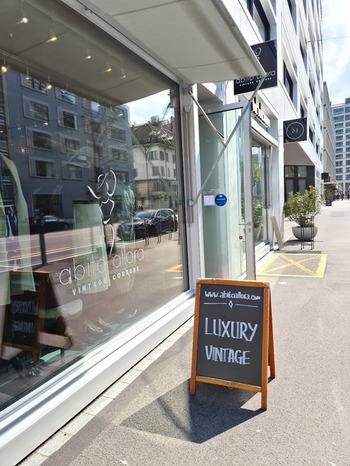
Rather typically for linguistic landscape research, we start our second case study with some commercial signage in Figure 7: a snapshot taken in the freshly redeveloped Europaallee neighborhood in Zurich. This place is the height of modernity. It is where Google is headquartered, for example, and the main drag is lined with trendy cafes and restaurants, interior-design stores, and clothing boutiques. The staging of hip and fashionable also entails the no-less fancy secondhand shop shown in Figure 7. This is a shop peddling, we are told on the appropriately retro sandwich board, ‘luxury vintage’ and ‘designer second hand’. The shop window also bears the slogan, ‘vintage couture’. It is surely telling that other people's discards or refuse are refashioned here as ‘vintage’ and ‘designer’. We also know from Appelgren & Bohlin (Reference Appelgren and Bohlin2015a; also Cross Reference Cross2017), for example, how these commodified rhetorics of nostalgia are happening everywhere nowadays. Indeed, the frisson or special value of secondhand goods lies precisely in the fact that the epitome of fashion is something old-fashioned—and preferably in a literal and noticeable way. In this shop and in the neighbourhood at large, time and people's experiences of time are evidently neither singular nor neatly bounded; instead, multiple temporalities are tightly interwoven (see Adam Reference Adam and Ingold2002). Spaces like these are thus temporally laminated through the combination of past and present, old and new, and trendy and dated. Invariably, it is also language which manages or mediates these complex chronotopic configurations.
Shop selling ‘luxury vintage’ (and ‘designer second hand’) in Zurich.

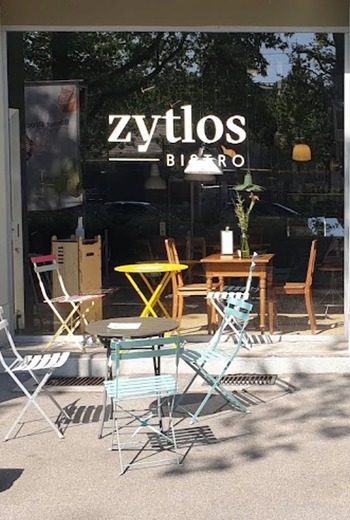
The same word-time-space configurations arise also in Switzerland's more ordinary secondhand shops, those commonly known as Brockis. As with garbage collection, Brockis are liminal sites in both spatial terms (e.g. inside/outside, private/public, micro/macro) and temporal terms (e.g. past/present, old/new, long-term/short-term). This liminality is captured in Figure 8 which shows the outside and inside of a relatively large, well-known Brocki in Bern—the Bärner Brocki—which now includes the Zytlos (‘timeless’) bistro, itself furnished inside with for-sale secondhand furniture. As part of an ongoing collaborative project between authors Thurlow and Wohlgemuth, we have interviewed the managers of three different Brockis in Bern with the goal of documenting the discursive production of value (see Thurlow Reference Thurlow2022). Our concrete focus has been learning about the systems of receiving, sorting, displaying, and selling donated items. For our present purposes, however, we pick up the ‘stories of waste’ at the heart of the secondhand exchange facilitated by Brockis; these are summarized nicely by one of our interviewees (translated from Swiss German) in extract (2).
(2)
1 … at the Brocki we are actually not just circulating
2 material, but we tell stories. In fact, the story of a piece of
3 furniture or the story of an object is sometimes so present,
4 it's as if you were buying a story. In doing so, you
5 somehow buy an epoch, or you buy a place, or another
6 human being's life story. A lot of people also get excited if
7 you can tell them where the object comes from …
The Zytlos (‘timeless’) bistro at the Bärner Brocki in Bern.

In this extract, the Brocki manager invokes the semiotic resonances of objects donated to and bought from the store, ostensibly pointing to the same kind of commodified nostalgia we mentioned a moment ago. In this way, the Brocki is framed (lines 1–2) as a place constituted not only by the circulation of things but also as an in-between and go-between place: somewhere people who have never met exchange their stories. In purchasing another ‘life story’ (line 6), customers are therefore also buying another time (‘epoch’) and another place (line 5). Storytelling here is not simply a romantic notion or a marketing tactic. More than just an idea, these are the object biographies (Kopytoff Reference Kopytoff and Appuadurai1986) which concretely structure how people talk about and give meaning and value to things. It is in this way, too, that people come to form deep affective-cum-social attachments to both things and, in/around their consumption of stuff, to other people (see Miller Reference Miller, Tilley, Keane, Küchler, Rowlands and Spyer2006). As the Brocki manager notes (lines 3–4), the distinction between an item's materiality and its symbolic resonance is not a clear one at all: ‘it's as if you were buying a story’. He also notes how customers give special value to those objects whose provenance can be explicitly narrated (lines 6–7). These spoken stories are, however, not the only ones present and/or of value.
The micro-landscape of the Brocki is inherently structured by words from the past, by the unseen or unheard stories imbued in each donated item. These are the objects’ personal origin stories which quite literally give the objects their cachet. Knowing that something has been previously owned and used (and then discarded) is precisely what makes it worth something. And this is why, as Appelgren & Bohlin (Reference Appelgren and Bohlin2015b) note, processes of remembering are central to the value of second-hand objects. Sometimes the objects’ biographies leave tangible traces: etches on wood, mended tears, scratched surfaces, bent corners, worn edges, and so on. These traces may be appreciated as ‘patina’ or ‘wear-and-tear’, or less appreciated when it comes to, say, smoky smells, chips, or missing pieces. The point is that all traces, however noticeable or peculiar, speak of previous owners and places, echoing past uses, social interactions, familiar relationships, and, presumably, countless conversations. This is what brings us again to the spectral presences of waste. As Hetherington (Reference Hetherington2004:162) puts it, ‘the absent is only ever moved along and is never fully gotten rid of’. Just as things have a ‘stubborn persistence’ (Allon et al. Reference Allon, Barcan, Eddison-Cogan, Allon, Barcan and Eddison-Cogan2021:3), therefore, it makes sense to think of their stories as persisting too—in the form of linguistic hauntings. In the Brockis, we certainly find the same kind of repressive chronotope as in the curbside garbage bags; in this case, people discard/donate things along with their stories, presumably making time and space for yet more things and other stories. And this repression—or more accurately suppression—both exceeds linear clock-time (Adam Reference Adam and Ingold2002) and entails language. As it happens, these material and linguistic exchanges are also deeply affective (see Thurlow Reference Thurlow2022; also Navaro-Yashin Reference Navaro-Yashin2009). In this regard, recall ‘excited’ (extract (2), line 6) but also note ‘they're almost crying’ below in extract (4), lines 4–5.
There are ways in which language plays a more explicit (and conveniently perceptible) role in structuring the time-space configurations of Brockis. This brings us to a third discursive chronotope of waste, one which is surfaced in three more extracts from a different Brocki manager.
(3)
1 Antiques are dead. Really, for the last two years they have
2 become quite dead. … We also have a big cupboard here,
3 also antique, big, no one wants that. Perhaps a couple of
4 years ago this should have been worth 5,000 to 6,000
5 Francs, now 50 Francs is expensive.
Extract (3) is a prime example of the way time-space relations frame and organize the core processes of value destruction and value creation in Brockis. In this regard, we note elsewhere (Thurlow Reference Thurlow2022) how stuff is transformed through a complex series of discursively underwritten performative actions: donors start by declaring items ‘discardable’ but potentially redeemable; the Brocki then determines the items redemption-worthiness and decides whether to sell them, divert them, or destroy them. Within the context of a not-for-profit but still commercial domain, this process comprises two interconnected actions: evaluating an object and putting a price on it. Thus, the manager in extract (3) emphatically declares antiques ‘dead’ and ‘quite dead’ (lines 1, 2) which is to say no longer in demand (line 3, ‘no one wants that’). This assessment is based on market forces and, specifically, the time-sensitive cycles of fashion (‘the last two years’ in line 1 and ‘a couple of years ago’, line 3). Thus, the monetary value of a cupboard drops to almost nothing. These specialist interpretations and assessments of time—as period, duration, and cycle—are one of the key ways by which Brockis are discursively and practically constituted as spaces of exchange.
The same kinds of time-based assessments—evaluations and pricings—are talked about in extract (4) where market forces are again seen to be at work (‘nobody wants that’, line 8).
(4)
1 … the younger generation like yours [to Laura Wohlgemuth] but also
2 the slightly older ones have a lot of interest in such
3 if they're particularly white or shabby chic. …
4 If we go to the old people and say, ‘hey they have no
5 value’, they're almost crying. Then they say, ‘uuuh, at the
6 time we invested so much in them, now nothing. But
7 they're so robust, really good, stable’. But phhh, it doesn't
8 matter, but nobody wants that. Shhht. Gone.
In this extract, time offers itself as a marker of quality, insofar as the age of an item is taken as a guarantee of goodness indexed by robustness (line 7) and stability (line 7). This sense of periodicity intersects with another measure or experience of temporality so that ‘the younger generation’ (line 1) comes to be associated with a fashionable preference for ‘white or shabby chic’ (line 3). By the same token, we learn that ‘old people’ (line 4) are distressed (‘they're almost crying’, line 5) when confronted with a kind of time-value collapse: it is hard for them to comprehend how items which, once upon a time, cost so much now ‘have no value’ (lines 4–5)—it feels as if time amounts to and counts for nothing (‘Shhht. Gone’, line 8). Although this is admittedly a reconstructed exchange, we have no reason to doubt the validity of these discursive interactions where the value of things and time are contested or negotiated. These chronotopes of (re)evaluation are one of the key ways we see temporalities structuring the movement and management of waste in the Brockis. There is one other expression of this discursive chronotope worth highlighting, one which appears nicely in extract (5)
(5)
1 When things aren't moving well then we donate leftover
2 clothes to Africa or Cuba. And if they both reject them,
3 both groups, then we give it to the clothing drive. … Or
4 repairing bicycles, if not repairable sssht send to Africa.
Very briefly, in extract (5) the shop manager discusses how the local time-space configurations of the Brocki (and of Switzerland) intersect with—or are laminated onto—other ones. We learn that when ‘things aren't moving well’ (line 1) they are shipped off to ‘Africa or Cuba’ (line 2) where, presumably, the fashion cycle is slower or simply out of date. By the same token, when a bicycle is not deemed worthy of repair –not worth the time spent – then it is hurriedly dismissed (‘sssht’, line 4) to Africa. It seems that, just as the micro-landscape of the Brocki constitutes a liminal, transitional point of exchange between previous owners and new owners, it manages other temporally and spatially scaled exchanges/relationships too. In this regard, we learned also from our interviews how Brockis are subject to other temporal orders, such seasonal cycles such as the demand for ski gear in winter or the influx of Spring-cleaning donations. Like regular shops, Brockis also experience their own circadian and hourly rhythms (i.e. peak and quiet days/times). Across all of these laminated temporalities, Brockis emerge as sites where time and the passing of time are spatialized, made manifest, and discursively negotiated. Appelgren & Bohlin (Reference Appelgren and Bohlin2015b:159) sum things up nicely: ‘The circulating [secondhand] object thus has the capacity to connect distant places and times, and make present layers of accumulated histories, events and memories.’
Much like the garbage-bag spectacles in our first case study, Brockis are organized as time-spaces of both repression and expression. To start, the objects donated have themselves been declared rubbish by their former owners who, for whatever reasons, are seeking to conceal their waste or move it out of sight. This is not necessarily a profligate act, nor is it a mindless one. In her interviews with people having to sort through the houses of older or deceased family members, Lovatt (Reference Lovatt2015) documents just how much thought (and presumably talk) often goes into the discarding/donating of stuff. This, again, is another way in which out-of-place, out-of-time language nevertheless structures the Brockis’ secondhand exchanges. Meanwhile, in the moment of these exchanges, language is evident in its more talkative, noisy form too. Here we think of the role language plays in the active receiving, sorting, categorizing and labelling of donated items: the sometimes sensitive, fraught exchanges between donors and staff members (old people's tears), as well as the documentary regime by which Brockis determine the (market) value and price of items. And then there is the language of the stories sold in the moment by the Brocki and those being told after the fact by customers. Most importantly, however, language is central to the discourses of time-space by which waste is revalued and redirected onwards.
Conclusion: Attending to linguistic hauntings
Waste is famously a matter of boundary keeping and boundary maintenance. This is what the well-known insights of Douglas (Reference Douglas1966/2002) helped us understand. But waste also complicates boundaries, calling attention to the inherent relativity, variability, multiplicity, and liminality of spatial formations, as well as temporal ones. The exchange of second-hand goods makes this apparent: something declared old rubbish in one place becomes new treasure in another. The object exists as both here and there, and as past and present. Waste is thus simultaneously laminated with different spaces and different times. It is for this reason that we find waste to be a productive focus for complicating some of the binaries which typically structure linguistic landscape studies: most notably, micro/macro, private/public, absent/present, and, perhaps most important of all, visible/invisible. We note also that waste obliges scholars to thinking beyond the waking hours and to venture into the apparent silence of the night. Indeed, one of our primary contentions in this article has been that linguistic landscape studies, like so much sociocultural linguistics, privileges only obvious, readily accessible language—words which are spoken and/or seen. This, we think is an epistemological and empirical mistake. It also has important political or ideological ramifications.
In our article we have considered how waste structures places (or writes them; see Jaworski & Wei Reference Jaworski and Wei2021); we did this with reference to the differentiated rhythms of garbage collection and secondhand exchanges. These are both sites which lead us to recognize that, while it may often be constituted as ‘out of place’, it is also often out of time in at least three related ways. First, waste is out of time in the environmental sense: running out of time. Second, waste is typically managed outside normal working/waking hours, under the cover of darkness, as it were. Third, waste explicitly and implicitly manifests past consumptions and previous social interactions. In our paper, we have been primarily concerned with the second and third of these disjunctive temporalities. We have, for example, attended to the second ‘out of time’ perspective as a potential corrective for linguistic/semiotic landscapes research which, almost without exception, addresses only daytime or waking spaces. (To be fair, this is a bias running across the social sciences.) By the same token, we appealed to the third ‘out of time’ perspective as a critique of language scholars’ persistent attention to visible/audible language—as in outward expression—rather than to language which is disavowed, concealed, or silenced. For this, we have oriented heavily to Billig's (Reference Billig1997) use of psychoanalysis for highlighting the inherently repressive capacity of language. We are also inspired by Karlander's (Reference Karlander2019) more recent attention to the semiotic resonances of erasure and absence. But mostly, we have wanted to root our article in the potential contribution to sociocultural linguistics of hauntology, following the local moves already being made (Deumert Reference Deumert2018, Reference Deumert2022). In this regard, Deumert (Reference Deumert2018) proposes that ‘spectral thinking can help us to develop new ways of listening to the margins of the world, the margins of experience, the margins of what is “speakable” (and “hearable”)’. In our article here, we have surfaced the ways that waste is marked by a series of linguistic hauntings.
Ultimately, an attention to time/temporality has much still to offer sociocultural linguistics and, specifically, linguistic landscape studies. We have, for example, already heard this argument made by the likes of Scollon (e.g. Reference Scollon, Bhatia, Flowerdew and Jones2007) and Blommaert (Reference Blommaert2013) vis-à-vis the proper historicizing of language and the need to track its transformation over time (and space). Of course, it was Bakhtin (Reference Bakhtin, Holquist, Emerson and Holquist1981) who also famously taught us that every freshly produced utterance expresses ideas and meanings already uttered; inevitably, then, everything people say originates in another time and another place. Along with scholars elsewhere in the humanistic social sciences, we agree that it is important to think sophisticatedly about time. This means avoiding the regularities and linearities of clock time, recognizing instead how discursive chronotopes are, at one and the same time, both vast and enduring, and minute and fleeting. As Alexander & O'Hare (Reference Alexander and O'Hare2020) argue, we also need to consider how language is entailed in not only the representation of waste, but also in its obfuscation and disappearance. This means that our current methods and practices will probably need to be adjusted; we certainly cannot continue to expect that our evidence is located in single, neatly bounded places or in fixed, measurable moments. Nor can we assume that the only language worth knowing—however convenient or amenable—is language that is spoken/audible or written/visible. This old way of thinking will surely prevent us from making a useful contribution to understanding one of the most pressing issues of our time: the production of waste.