Introduction
There is no formal single definition of “disaster” that is universally accepted, but common themes emphasize the impact of extreme events on humanity and the ability to overwhelm existing resources.Reference Labrague, Hammad, McEnroe-Petitte and Fronda1-3 Disasters can be classified into three broad categories: natural (eg, seismic/meteorological events), man-made (eg, industrial accidents/conflicts/terrorism), or a mixture of both (eg, pandemics).Reference Sundnes and Birnbaum4 In 2019, at least 396 natural disasters were reported world-wide, affecting over 95 million people and resulting in 11,755 deaths, with an estimated cost of US$130 billion.5 Man-made disasters such as terrorist attacks can lead to immense social and economic impacts, where the essence of fear itself paralyzes the system.6,Reference Aly and Balnaves7 Pandemics (such as coronavirus disease 2019 [COVID-19]) can result in mass casualties causing substantial morbidity and mortality that can rapidly exhaust health care capacity while disrupting the economy and the social fabric.
Common principles in disaster management include the internationally accepted “all-hazards, all-agencies” approach across the Prevention, Preparedness, Response, and Recovery (PPRR) cycle.Reference Aimers, Winn, FitzGerald, Tarrant, Aitken and Fredriksen8 Prevention involves hazard reduction but also the building of community resilience. Preparation incorporates early warning signs and plans for specific risks, whereas the response and recovery stages deal with management during and after the disaster has occurred.Reference Aimers, Winn, FitzGerald, Tarrant, Aitken and Fredriksen8
Primary health care professionals (PHCPs) are generally seen to be the “linchpin” of the health care system being the first point of patient contactReference Kringos, Boerma, Hutchinson, Van der Zee and Groenewegen9 and being on the front line when these extreme events occur.Reference Willson and Lim10 As they provide long-term care to the local population (Table 1), PHCPs offer a unique and important perspective to attenuate the impact of the disaster due to their established acceptance and recognition from the community.Reference Ingram, Tinago and Estrada11 During the initial stages of the COVID-19 pandemic in both Australia and the United States (USA), there was confusion as to the role of PHCPs, particularly general practitioners (GPs), in diagnosing and managing infected patients.12,Reference Kamerow13
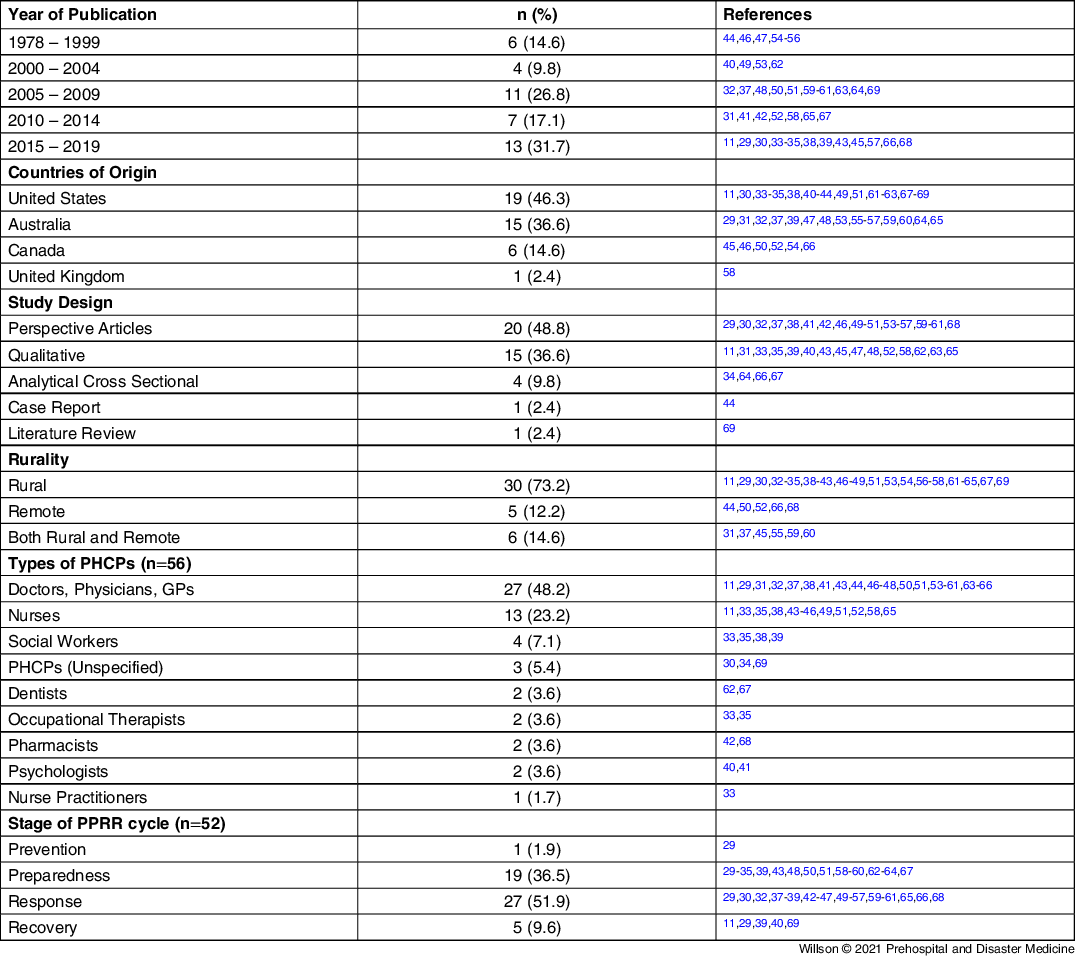
Characteristics of Included Papers (n = 41)

Note: Some papers described multiple roles and PPRR stages, hence to calculate % for this section, n = 56 (type of PHCPs) and n = 52 (stages of PPRR cycle) across 41 papers.
Abbreviations: PHCPs, primary health care professionals; GPs, general practitioners; PPRR, prevention/preparedness/response/recovery.
Both “rural” and “remote” communities differ by local factors and socioeconomic context,Reference Willson and Lim10 however PHCPs working in either of these regions face additional challenges in preparing for disasters due to lack of and maldistribution of resources.Reference Davis and Bartlett14 In response to the “thin” workforce from reduced staffing availability, some rural and remote PHCPs fulfil several roles to meet the health care needs of their local population.Reference Lim, Emery, Lewis and Sunderland15-Reference Lim and Geelhoed18 In addition, rural and remote areas may be particularly vulnerable to extreme events due to geographical isolation, less-developed infrastructure, and less epidemiological surveillance capacity than larger urban areas, which means early warning may not be readily available.Reference Putzer, Koro-Ljungberg and Duncan19-Reference Lim21 Recognition of these primary health care (PHC) challenges are important to ensure adequate disaster management on a local level.
Within existing disaster management research, there is a gap in the literature regarding the roles of PHCPs in a rural and remote setting. The aim of this study is to assist in the development of practice-based disaster preparedness and future policy discussion by identifying these roles. A preliminary search did not identify any review publications in this context.Reference Willson and Lim10
Methods
It was anticipated that a broad range of papers would be identified, encompassing different methodologies, participants, types of disaster, as well as varied definitions of PHC and rurality. A Johanna Briggs Institute (JBI; Adelaide, Australia) scoping review methodology was therefore employed to summarize this complex evidence.Reference Peters, Godfrey, McInerney, Baldini, Khalil, Parker, Aromataris and Mun22 There was slight variation from the published protocol due to the refinement of the review objectives. Specific areas of investigation for this review included:
1. Types of PHCPs and their roles in relation to disaster management; and
2. Types of disasters that affect Australia, New Zealand (NZ), the United Kingdom (UK), Canada, and the USA.
Inclusion and Exclusion Criteria
The protocol for this study with detailed inclusion and exclusion criteria has been published elsewhere.Reference Willson and Lim10 Papers were considered if they were written in English; from Australia, NZ, UK, Canada, or the USA; published after 1978; and described roles of PHCPs in rural or remote areas during disasters. Papers were identified for inclusion by keywords such as “rural,” “regional,” “non-urban,” and “remote.” The terms “rural” and “remote” were inconsistently defined in the studies examined. A very broad definition was accepted as any location that was not urban (discussed further in published protocol).Reference Willson and Lim10 All stages of the PPRR cycle were considered. Qualitative, quantitative, and mixed methods studies, as well as other papers such as perspective articles, were included. Hospital-based studies were excluded.
Search Strategy/Data Collection
The search strategy has been published elsewhere.Reference Willson and Lim10 In brief, searches included PubMed (National Center for Biotechnology Information, National Institutes of Health; Bethesda, Maryland USA); Cumulative Index to Nursing and Allied Health Literature (CINAHL; EBSCO Information Services; Ipswich, Massachusetts USA); Embase (Elsevier; Amsterdam, Netherlands); Scopus (Elsevier; Amsterdam, Netherlands); OpenGrey (Institut de l’Information Scientifique et Technique; Vandoeuvre-lès-Nancy Cedex, France); Trove (National Library of Australia; Canberra, Australia); and Mednar (Deep Web Technologies; Santa Fe, New Mexico USA).Reference Willson and Lim10 The final search was conducted in April 2019.
Identified citations were imported into EndNote X9 (Clarivate Analytics; Philadelphia, Pennsylvania USA) for management. Citations were screened by title and abstract, full text of eligible literature was assessed against criteria, and included papers were critically appraised using the relevant JBI checklists by KW and DL (Supplementary Material; available online only).Reference Willson and Lim10 To measure the agreement between the two reviewers for the qualitative items, a kappa coefficient, a statistical measure of inter-rater reliability, was obtained with agreement between ratings used as an indication of the reliability of the reviewer’s classifications.Reference Sim and Wright23 An agreement rate of >88% was achieved, representing a high level of agreement. Discrepancies in extraction of the data were resolved through discussion between KW and DL to achieve full consensus. Data were extracted and summarized as per the JBI methodology.Reference Peters, Godfrey, McInerney, Baldini, Khalil, Parker, Aromataris and Mun22 The rural or remote context of the paper was clarified where required, and all included authors were contacted to identify any other related works.
Ethics Approval
Clearance was given by the Flinders Social and Behavioural Research Ethics Committee (Flinders University; Adelaide, Australia) that an ethics application was not required for this scoping review.
Results
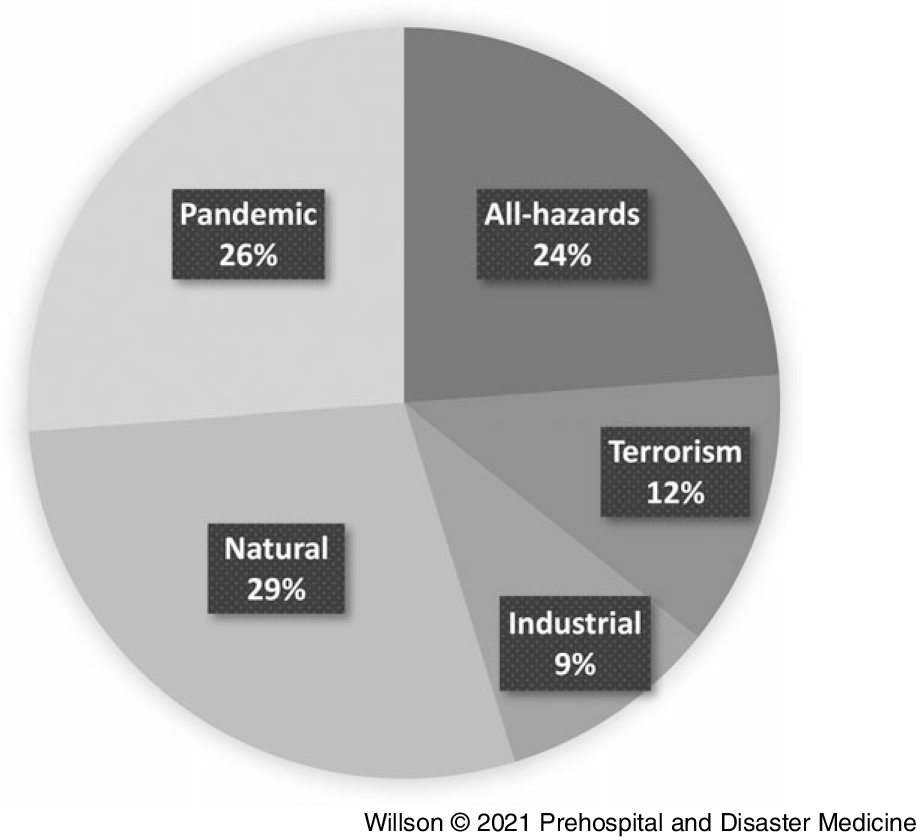
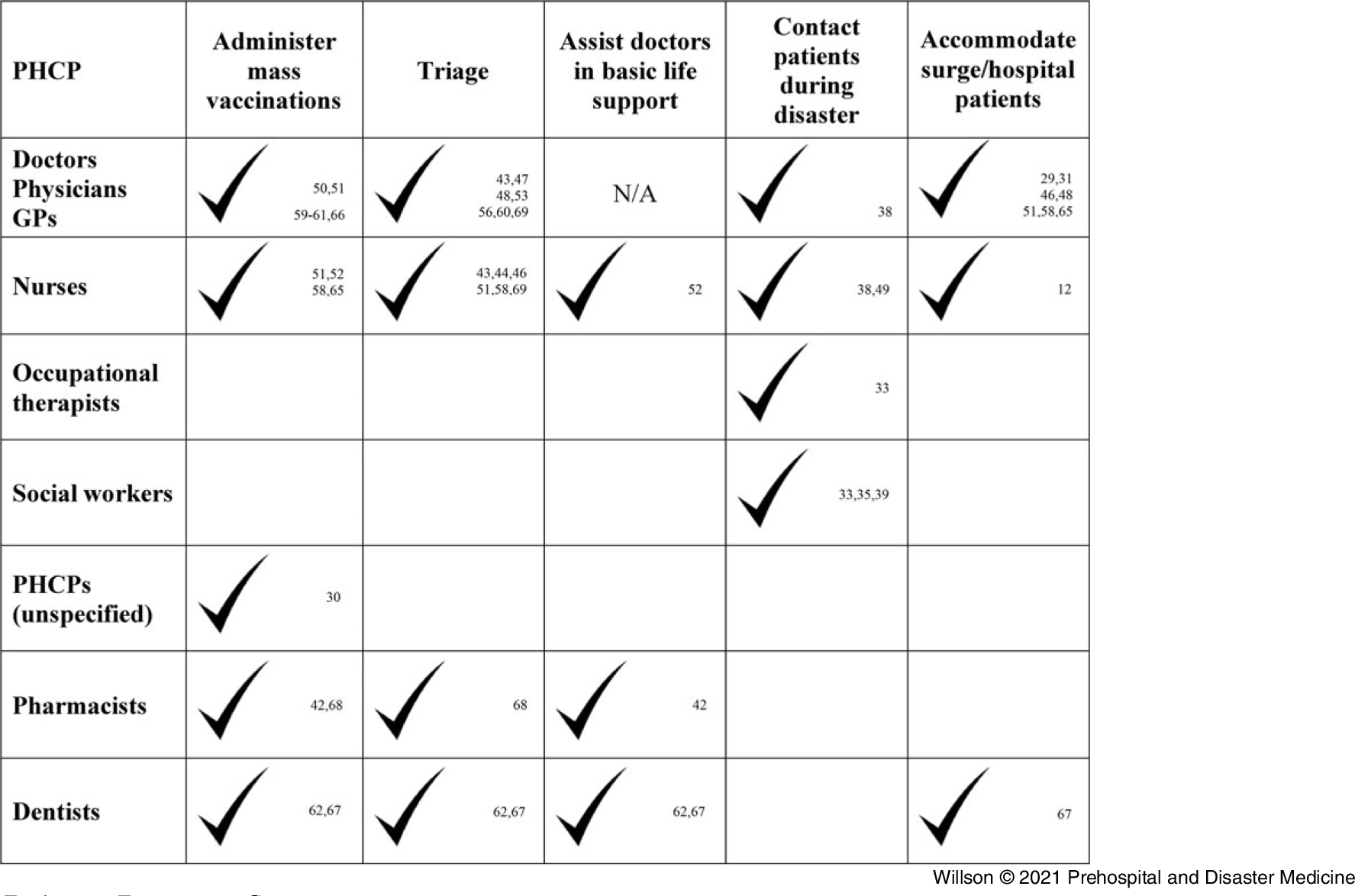
The outcomes of the searching and screening process are documented in Figure 1 Reference Moher, Liberati, Tetzlaff and Altman24 resulting in forty-one papers being selected for final inclusion. Key characteristics of the included papers are summarized in Table 1, with the majority being published between 2015-2019 (31.7%) from the USA (46.3%). Some papers mentioned several PHCPs and multiple PPRR stages, and sixty-one roles of PHCPs were identified. The various types of disasters identified are represented in Figure 2, with natural disasters and pandemics being the most common. Figure 3 and Figure 4 describe the five roles most frequently identified within the preparedness and response stages, respectively.
Flow Diagram (adapted from Moher, et alReference Moher, Liberati, Tetzlaff and Altman24).
Abbreviation: PHC, primary health care.

Types of Disasters.

Top Five Roles in Preparedness Stage.
Abbreviations: GPs, general practitioners; PHCPs, primary health care professionals.

Discussion
There can be a tendency for central agencies to disrupt the long-standing health arrangements in place when a disaster occurs,Reference Oppizzi and Speraw25 such as had occurred in the response to COVID-19.Reference Smeeth26 In Australia, GPs and many PHCPs were overlooked as focus was solely on the acute health sector.27 However, PHCPs are a trusted, local source of expertise, accepted and respected leaders of their rural and remote communities, with extensive knowledge of unique health care needs within that community.Reference Lim21,Reference Van Driel, Lim and Clark28 Therefore, the effective and meaningful engagement of PHCPs throughout the continuum of disaster management is critical. Analysis of the included papers support this proposition; a wide range of PHCP roles were identified and consolidated into four broad categories: patient factors, organizational factors, public health factors, and psychological factors. Specialized roles within PHC were also discussed.
Patient Factors
Optimizing patient wellness is an important role for GPs in the prevention stage.Reference Burns, Douglas and Hu29 During the preparedness stage, PHCPs can assist in building individual resilience through the maintenance of health and environmentally sustainable lifestyles,Reference Ziegler, Morelli and Fawibe30,Reference Purcell and McGirr31 motivating patients to prepare, and conducting disaster assessments.Reference Aisbett, Phillips, Sargeant, Gilbert and Nichols32-Reference Killian, Moon, McNeill, Garrison and Moxley34 Discussing preparedness strategies may result in better patient outcomes, particularly for those who are at risk of isolation or adverse health effects during an extreme event, such as the elderly or patients with chronic medical conditions.Reference Wyte-Lake, Claver and Dobalian35 General practitioners utilize a “person-focused care” approach across their patient’s visits rather than disease-specific appointments; patient education and health literacy in a disaster context can be integrated as part of the continuity of care model.Reference Starfield36 Social workers and occupational therapists in rural and remote areas are in close communication with GPs and can work with clients to individually prepare for unexpected events as well as provide assistance during the disaster itself.Reference Wyte-Lake, Claver and Dobalian35 Follow-up on patients after the disaster is the epitome of PHC,Reference Burns, Douglas and Hu29,Reference Sartore, Kelly and Stain37 and social workers,Reference Kanter, Abramson, Redlener and Gracy38,Reference Howard, Agllias, Bevis and Blakemore39 psychologists,Reference Ginexi, Weihs and Simmens40 and other PHCPs play a vital role in assisting patients with accessing support post-disaster, especially as the recovery stage is often prolonged.Reference Ziegler, Morelli and Fawibe30,Reference Osofsky, Osofsky, Wells and Weems41
Organizational Factors
As accepted leaders within their area, PHCPs can coordinate disaster preparedness for both their local community/committee and their PHC organizationReference Claver, Wyte-Lake and Dobalian33,Reference Shelton and Foster42 through training other health care staff, participating in disaster planning drills and meetings,Reference Claver, Wyte-Lake and Dobalian33 and coordinating leadership roles.Reference Rupp43-Reference Anikeeva, Braunack-Mayer and Street48 Family physicians and nurses can provide valuable insights for future disaster planning due to their knowledge of patient factors and medical needs within their community.Reference Purcell and McGirr31,Reference Anikeeva, Braunack-Mayer and Street48,Reference Lewis49 Sustaining the on-going delivery of day-to-day services of the PHC organization requires a delicate balance to cater for urgent appointments.Reference Ingram, Tinago and Estrada11,Reference Burns, Douglas and Hu29,Reference Hamer46,Reference Mackie and Lu50-Reference Charania and Tsuji52 Clinicians may need to undertake primary surveys in the setting of a disaster and medically manage patients at the clinic,Reference Rupp43,Reference Ammons, Moore, Pons, Moore, McCroskey and Cleveland44,Reference Hamer46,Reference Bushfires53-Reference Somers, Drinkwater and Torcello56 as well as coordinate evacuations or transfers to tertiary centers.Reference Ammons, Moore, Pons, Moore, McCroskey and Cleveland44,Reference Lewis49,Reference Moralejo, Russell and Porat54,Reference Somers55,57 On the other hand, temporarily providing routine hospital services in the clinic may be required,Reference Burns, Douglas and Hu29,Reference Moralejo, Russell and Porat54 as well as sharing clinic supplies with the rural hospital.Reference Moralejo, Russell and Porat54
Specialized roles for a nurse practitioner can involve surge capacity planning, organizing intermediate care beds and home packages,Reference Day, Challen and Walter58 as well as alerting other health care staff of the disaster.Reference Claver, Wyte-Lake and Dobalian33 Nurses can also train community members to act as auxiliary staff to support the clinic during an event (eg, crowd control or security),Reference Charania and Tsuji52 staff temporary walk-in centers treating minor ailments/injuries,Reference Day, Challen and Walter58 and assist with essential housekeeping or administrative duties to keep the clinic running.Reference Kulig, Penz, Karunanayake, MacLeod, Jahner and Andrews45 The role of securing stocks, bolstering supplies, and use of personal protective equipment during the disaster is also of vital importance for PHCPs to ensure appropriate protection for self and family at home.Reference Ziegler, Morelli and Fawibe30,Reference Rupp43,Reference Hamer46,Reference Anikeeva, Braunack-Mayer and Street48-Reference Charania and Tsuji52,Reference Horvath, McKinnon and Roberts59-Reference Chmar, Ranney, Guay, Haden and Valachovic62
Public Health Factors
Primary health care professionals have a significant role in pandemic surveillance by identifying patients at risk and reporting any potential outbreaks. A strong working relationship between PHCPs and the public health authorities in the preparedness stage can be an important predictor of an effective response,Reference Mackie and Lu50 and communication and coordination for this is an important role for doctors.Reference Rust, Melbourne, Truman, Daniels, Fry-Johnson and Curtin51,Reference Moore60,Reference Katcher, Bayou, Anderson and Davis61,Reference Hsu, Mas, Jacobson, Papenfuss, Nkhoma and Zoretic63 General practitioners play a crucial role in providing information to public health authorities, and the importance of collecting sentinel data during pandemics such as influenza have been discussed frequently in the literature.Reference Anikeeva, Braunack-Mayer and Street48,Reference Mackie and Lu50,Reference Rust, Melbourne, Truman, Daniels, Fry-Johnson and Curtin51,Reference Horvath, McKinnon and Roberts59,Reference Moore60,Reference Hsu, Mas, Jacobson, Papenfuss, Nkhoma and Zoretic63-Reference Morton, Birtwistle, Fumerton and Allison66 Dentists can also be involved in on-going monitoring of the spread of disease and any recurrence within their own patients, and can report to the relevant public health contact, as appropriate.Reference Chmar, Ranney, Guay, Haden and Valachovic62,Reference Bhoopathi, Mashabi, Scott and Mascarenhas67 General practitioners, nurses, and nurse practitioners can be tasked with communicating with government and non-governmental agencies as needed during a disaster.Reference Purcell and McGirr31,Reference Claver, Wyte-Lake and Dobalian33,Reference Bushfires53,Reference Somers, Drinkwater and Torcello56,57
Psychological Factors
In the aftermath of disaster, physical wounds heal but emotional sequalae can endure, and it has been well-demonstrated in the literature that PHC doctors, nurses, and psychologists have significant roles in supporting mental health.Reference Ziegler, Morelli and Fawibe30,Reference Sartore, Kelly and Stain37,Reference Kanter, Abramson, Redlener and Gracy38,Reference Ginexi, Weihs and Simmens40,Reference Kulig, Penz, Karunanayake, MacLeod, Jahner and Andrews45,Reference Bushfires53 Providing mental health strategies as part of disaster planning helps prepare patients for these psychological impacts,Reference Ziegler, Morelli and Fawibe30 and it is valuable for medical and nursing staff, together with psychologists, to collaborate in order to provide a team-based approach for comprehensive patient care.Reference Sartore, Kelly and Stain37,Reference Kanter, Abramson, Redlener and Gracy38,Reference Ginexi, Weihs and Simmens40,Reference Osofsky, Osofsky, Wells and Weems41,Reference Kulig, Penz, Karunanayake, MacLeod, Jahner and Andrews45,Reference Bushfires53 Primary care professionals can provide mental health “first-aid”Reference Kanter, Abramson, Redlener and Gracy38 as well as conduct mental health evaluations and provide trauma-informed counseling.Reference Ziegler, Morelli and Fawibe30 Primary health care professionals are also in an ideal position to initiate mental health interventions at an early stage of concern.Reference Sartore, Kelly and Stain37 Due to latency of negative mental health impacts after an acute event, PHCPs can regularly “check in” with their patients by continuing to follow-up their on-going medical and mental health care within the community. This therefore allows patients to integrate into existing services using existing infrastructure as needed.
Specialized Roles
Dentists can assist in the forensic identification of victims, diagnosing possible bioterrorism infection in their own practice, and providing first aid.Reference Chmar, Ranney, Guay, Haden and Valachovic62,Reference Bhoopathi, Mashabi, Scott and Mascarenhas67 If online resources are down during the disaster, pharmacists can assist in treating decisions and medical management and can also create medication access points for patients if transport is difficult.Reference Moore and Kenworthy68 Specific roles for doctors include managing acute trauma,Reference Aisbett, Phillips, Sargeant, Gilbert and Nichols32,Reference Somers, Maxfield and Drinkwater47,Reference Somers, Drinkwater and Torcello56,57,Reference Katcher, Bayou, Anderson and Davis61 carrying emergency equipment as a first responder,Reference Somers, Drinkwater and Torcello56,57 being part of the field team,Reference Burns, Douglas and Hu29,57,Reference Tsao, Dobalian, Wiens, Gylys and Evans69 assisting the worried-well and being aware of somatic symptoms presenting during a disaster,Reference Tsao, Dobalian, Wiens, Gylys and Evans69 quarantining patients,Reference Anikeeva, Braunack-Mayer and Street48,Reference Mackie and Lu50,Reference Horvath, McKinnon and Roberts59,Reference Moore60,Reference Morton, Birtwistle, Fumerton and Allison66 home visiting,Reference Seale, Ward, Zwar, Van, Leask and Macintyre65 or utilizing telemedicine when necessary.Reference Osofsky, Osofsky, Wells and Weems41
Figure 3 and Figure 4 illustrate that although some of the roles described are not typically fulfilled by certain PHCPs during day-to-day activities, when an unexpected event occurs, these are within their scope of practice. An example of this is in the case of pharmacists and dentists who can both provide assistance in the forms of mass vaccine administration and Basic Life Support.Reference Shelton and Foster42,Reference Chmar, Ranney, Guay, Haden and Valachovic62,Reference Bhoopathi, Mashabi, Scott and Mascarenhas67,Reference Moore and Kenworthy68 These non-traditional roles can be immensely useful during the critical phase of a disaster to take pressure off other medical and nursing professionals and is something to consider in health care organizations with extra training of staff members included as part of disaster planning and policy.
Top Five Roles in Response Stage.
Abbreviations: GPs, general practitioners; PHCPs, primary health care professionals.

Limitations
Limitations of this review include the restrictive nature of the study origin; only papers from selected English-speaking members of the Global North group (Australia, NZ, UK, Canada, and USA) were included (see published protocol for justification for this selection).Reference Willson and Lim10 No eligible papers from NZ were identified. By combining the findings from different countries and different characterization of “rural” and “remote,” this descriptive study reduced the sensitivity in understanding how local factors would uniquely affect the contextualization of disaster management; the synthesis of factors nonetheless increased the specificity of this research findings in regards to generalizability and transferability to other similar PHC settings.Reference Willson and Lim10 There were no eligible papers regarding the roles of other allied health practitioners such as audiologists, optometrists, paramedics, or speech pathologists despite strategies to reduce publication bias such as extensive searching during the scoping review development in several databases and grey literature and the inclusion of a wide range of keywords relating to allied health.
Conclusion
This review highlights roles that can be fulfilled across the PPRR continuum for many types of rural and remote PHCPs facing disasters. The most common events facing PHCPs in this context are natural disasters and pandemics, although PHCPs can contribute to planning and preparedness for “all-hazards.” This research has illustrated essential roles in patient care, health care organizations, public health, psychological support, and other specialized tasks during these disasters. The segmentation of the roles of PHCPs provides a framework for future contributions and for further analysis. Further research is necessary to detail these roles, to identify the specific contribution PHCPs can make to these areas, and to identify the factors that may influence these contributions.
Primary health care professionals can and do have important contributions to the disaster response, especially in attenuating the surge on the acute care sector. They provide patient-centered care based on the existing trust and respect that PHCPs have from their community. Rural and remote PHCPs as respected leaders and a “sound voice” can provide assurance, reinforce key messages, disseminate and tailor delivery of messages to vulnerable community members, while ensuring that chronic and preventative measures are still being undertaken. As society eventually begins the long road to recovery after the acute devastation from the disasters, rural and remote PHCPs are invested in their communities and will be the consistent and constant pillar to aid this recovery.
This descriptive scoping review illustrates that engaging PHCPs in disaster management is critical to resilience and recovery of rural and remote communities. Understanding the capacity and roles of PHCPs in these contexts can aid health care organizations in developing disaster policies, and thus assist in preparedness for catastrophes that may occur.
Acknowledgments
The authors would like to thank medical research librarian Ms. Leila Mohammadi for her advice during the development of the search strategy.
Conflicts of interest/disclosure
This scoping review contributed to a Doctor of Medicine degree for author KW. There are no conflicts of interest to declare.
Author Contributions
KAW: Substantial contribution to the study conception, design, and implementation; facilitated the human research ethics clearance, acquisition of data, data analysis, and interpretation; prepared the manuscript. GJFG: Substantial contribution to the study conception and design; data interpretation; helped to draft the manuscript. DL: Substantial contribution to the study conception, design, and implementation; data analysis and interpretation; helped to draft the manuscript; student supervision.
Supplementary Materials
To view supplementary material for this article, please visit https://doi.org/10.1017/S1049023X21000200