Introduction
The World Health Organization defines unsafe abortion as a procedure for terminating a pregnancy carried out either by persons lacking the necessary skills or in an environment that does not conform to minimal medical standards, or both (World Health Organization, 1992). Worldwide, unsafe abortions were estimated at between 21 and 22 million in 2008, adding 2 million to the figure of 2003. There were approximately 210 million pregnancies in 2008. Therefore, one in ten pregnancies perhaps ended in an unsafe abortion worldwide. Nevertheless, the global rate of unsafe abortion, at 14 per 1000 women aged 15–44 years, has remained unchanged since 2003; and it is even higher in developing countries, i.e. 23 per 1000 women (World Health Organization, 2011). Each year, an estimated 80,000 women die from complications of unsafe abortion, accounting for at least 13% of global maternal mortality. The burden of unsafe abortion lies primarily in the developing world; the highest rates are in Africa, Latin America and the Caribbean, and are quite alarming in South and South-East Asia (Warriner & Shah, Reference Warriner and Shah2006). Limited access to modern contraceptives and prohibited elective termination of pregnancy result in a significant number of deaths of women due to unsafe abortion (Belton et al., Reference Belton, Whittaker and Barclay2009). The challenging target of the Millennium Development Goals to reduce maternal mortality by 75% by 2015 will not be possible without addressing the high toll of unsafe abortions. However, there are examples where the provision of post-abortion care services has significantly reduced the maternal mortality related to unsafe abortions, as well as enhancing access to modern contraceptives (Cobb et al, Reference Cobb, Putney, Rochat, Solo, Buono, Dunlop and Vandenbroucke2001; Karen & Tesfaye, Reference Karen and Tesfaye2007).
In order to reduce maternal mortality and morbidity arising from unsafe abortions in countries with restrictive abortion laws, the participants at the 1994 United Nations International Conference on Population and Development (ICPD) agreed that women should have access to quality services for the management of complications arising from abortion. Subsequently, the original ICPD post-abortion care model was adopted and further developed by the Post-abortion Care Consortium. The Consortium defined post-abortion care as an approach for the reduction of mortality and morbidity from incomplete and unsafe abortions and resulting complications, and for improving women's sexual and reproductive health and lives (Post-abortion Care Consortium Community Task Force, 2002). Originally, the essential elements of post-abortion care (PAC) included emergency treatment of unsafe abortions and related complications; contraceptive and family planning services; and reproductive and other health care services. In 2002, the original model was updated and transformed from a medical to a public health model and two further elements – counselling and community and service provider partnerships – were added.
In Pakistan, a nationwide study conducted in 2002 found that nearly 890,000 out of 2.4 million unintended pregnancies were terminated by induced abortion, with an incidence rate of 29 per 1000 among women aged 15–49 years (Sathar et al., Reference Sathar, Singh and Fikree2007). A few years later, Pakistan's Demographic and Health Survey (2006–07) revealed that 6% of all maternal deaths can be attributed to abortion-related complications (National Institute of Population Studies & Macro International, 2008). Restrictive abortion laws in Pakistan have created a considerable reluctance among qualified health professionals to provide post-abortion care to women in need. Until 1990, the 1860 Penal Code of the British colonial era was in force. According to this abortion was a crime unless performed in good faith in order to save the pregnant woman's life. Article 312 of the Penal Code specified that any person performing an abortion was subject to imprisonment for three years and/or a fine; and if the woman was ‘quick with child’, the penalty was imprisonment for up to seven years and payment of a fine. The same penalty applied to a woman who caused herself to miscarry. The law was re-visited to re-frame its provisions in accordance with the principles of Islamic law. The law was amended and provisionally came into effect in 1991. Through a presidential ordinance, it became a permanent law in 1996. As per the new law, categories of abortion offences are based on the stage of pregnancy. Under Islamic law, organs and limbs are usually deemed to be formed in the fetus by the fourth month of pregnancy. Abortion carried out before the organs of the fetus have formed is prohibited except when performed to save the life of the woman or to provide necessary treatment. At any later stage, termination of pregnancy is prohibited, except to save a woman's life or to provide necessary treatment to avoid complications (Hessini, Reference Hessini2007).
Nonetheless, there is a pressing need to increase access to quality post-abortion care services for women experiencing complications related to miscarriage and incomplete abortion in Pakistan. This is the only solution to reduce a considerable number of maternal deaths. Also, the strengthening of family planning services is imperative to address the huge unmet need for contraceptives, which when not fulfilled, leads to unwanted or untimed pregnancies (Shaikh, Reference Shaikh2010).
The objectives of this study were:
• To establish the socio-demographic profile of clients receiving PAC services, either through surgical or medical treatment, and to determine their preferred method.
• To determine the factors affecting clients' satisfaction regarding PAC-M and PAC-S treatment.
• To explore the clients' perception of the nature and extent of barriers experienced while accessing PAC services
• To understand the challenges faced by the reproductive health volunteers (RHVs) in the field and to figure out strategies to overcome them.
Methods
This is an exploratory qualitative research study, conducted during May–June 2010, of women of reproductive age using the Marie Stopes Society (MSS) quality post-abortion care (PAC) services. This included women with complications related to miscarriage and unsafe or incomplete abortions, and cases referred by reproductive health volunteers (RHVs) deployed in the field by the Marie Stopes Society.
Sampling
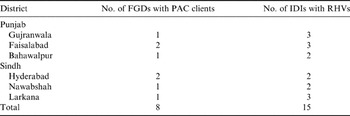
The study was conducted in six randomly selected districts of Sindh and Punjab (three from each province). A total of eight focus group discussions (FGDs) were conducted with PAC clients and fifteen in-depth interviews (IDIs) were conducted with the reproductive health volunteers (refer to Table 1). A quantitative exit interview questionnaire was administered to the 76 PAC clients in the two provinces.
Distribution of sample by district, Punjab and Sindh Provinces, Pakistan, May–June 2010

Data collection
The study team developed the FGD and IDI guides, and translated and pre-tested them. After slight changes in the phrasing of questions, the tools were finalized for data collection. The study protocol was reviewed and approved by Marie Stopes International. Research teams comprised female data collectors and FGD facilitators who had experience in field-based research and who were fluent in the local languages, Sindhi and Punjabi. Moreover, they were trained in reproductive health concepts and qualitative data collection techniques, and later supervised by the manager and the director of the research and metrics unit of MSS. In-depth interviews and focus group discussion were tape-recorded with the informed consent of respondents. The mean duration of each FGD was 1.5 hours, and each IDI lasted for approximately 1 hour. The focus group and the interview notes were first translated and transcribed in Urdu by the data collectors. Subsequently Urdu-to-English translation was done by the investigators.
Data analysis
From the node and sub-node analysis, the themes were generated using an adapted constant comparison analysis process (Glasser, Reference Glaser1965). This method is commonly used in grounded theory methodology, and is also applied as a method of analysis in qualitative research. It requires the researcher to take one piece of data (e.g. one interview, one statement or one theme) and compare it with all other pieces of data that are either similar or different. During this process, the researcher begins to look at what makes this piece of data different and/or similar to other pieces of data. Though there were hardly any inconsistencies, data collectors were made to sit together and decide if there were any, while translating from local to Urdu language.
The IDIs and FGDs were transcribed and translated into English verbatim and coded thematically. The interview transcripts were coded by utilizing a manual technique. These codes were refined and combined across transcripts to develop more general codes for further analysis.
Focus group discussions with PAC clients
The majority of the participants were between the ages of 25 and 35 years, with four children as a median number for both provinces. Most were housewives with two-thirds having an education between grades 5 and 10. The majority of households earn barely the minimum wage, i.e. Rs6000 per month (US$70).
Knowledge of, and community attitudes towards, family planning and abortion
Almost all the participants had heard of modern contraceptive methods and considered family planning necessary for the health of a mother. All of them confirmed that abortion is considered as a sin in their respective communities and it is generally perceived that abortion is sought only in cases when the child is illegitimate. A few participants pointed out that even use of family planning is sometimes considered a sin in their communities. A woman from Punjab expressed:
People think that abortion is a murder and look down upon those persons who go for abortion. So it's better to have child spacing rather than having unwanted pregnancies and then abortions. Women who go for abortion are considered as having an illegitimate child.
A woman from Sindh said:
Family planning is also considered as a sin and it is believed that people will fall sick, if they use family planning products.
Women from Punjab had similar views. Nevertheless, most of the participants from Sindh and Punjab had a consensus on having fewer children. Another woman from Punjab said:
In past, six to eight children was a norm but the trend has changed and now fewer children are preferred. Ideally, the number of children should not exceed four.
Use of contraceptive and PAC
Most of the women in Sindh and Punjab had received one medical or surgical treatment as part of post-abortion care during the previous year. The majority of them reported having used a short-term contraceptive method (condom, pill or injection) before conceiving the unplanned pregnancy, and therefore had to go for unsafe abortion. A woman from Sindh said:
I have undergone cleaning of my womb, which was done by a local dai [untrained traditional birth attendant] 6 months ago because we were relying only on condoms before.
Some of the participants stated that method failure is also an important factor behind the increasing number of the unwanted pregnancies, most of which end in abortions. A woman in Sindh reported:
Method failure is a barrier towards the use of contraception. A woman in our community had an operation, yet she became pregnant. Thus people become disillusioned and develop distrust on the permanent contraceptive methods.
There were some participants who had two unsafe abortions in a year and they were not using any contraceptives before. A woman from Punjab said:
I went to get my womb cleaned from a local dai twice as somehow we were not using any contraceptive methods before abortion.
Cost incurred in using PAC services
By and large, most respondents reported that post-abortion care services were available in their vicinity either at some private centres or at NGO clinics. There were very few women who did not know of any such service available nearby. Participants reported that the fees for PAC services varied from provider to provider (based on their qualifications and experience) and depended on the severity of the case: unsafe-abortion-related complications and/or delays, incomplete abortion and miscarriage. Most women from Punjab said that the cost of using PAC services in their areas was very high:
The providers of private sector charge Rs2000–2500 for the cases with minor complication during early pregnancy; Rs3000–4000 for cases with major complications during early pregnancy and Rs5000–10,000 in life-threatening situations.
Unlike Punjab, the charges for PAC services were relatively low in Sindh.
Method of choice and reasons for method preference
The majority of PAC clients in both provinces preferred the medical treatment method over the surgical one (84% in Punjab and 82% in Sindh). This is because it involves ‘less pain’, is ‘easier to employ’ and ‘has fewer complications’. A woman said:
I chose the medical treatment because it is easy and there is no pain.
A very small number of respondents went for surgical treatment on the advice of the doctor because it suited them. A woman said:
I had undergone surgical treatment because baji (doctor/nurse) at the health centre advised me to go for it, based on the clinical examination done by her and severity of my condition.
Reasons for seeking PAC services
Unwanted pregnancy was mentioned as a common reason for undergoing unsafe abortion through a non-qualified provider because some participants already had young children and others considered their family to be complete. A woman in Punjab, who had used PAC services from NGO clinics, said:
I went for cleaning of my womb performed by a local baji because my children were very small and they needed proper care. It is difficult for a mother to take care of too many young children. But due to the complication and heavy bleeding of this unsafe procedure, I was referred to NGO clinic by a RHV where surgery was provided to me as the treatment for incomplete abortion.
Quite a few participants had undergone unsafe abortion because of financial constraints and were conscious of the fact that a large family would be a financial burden. These women then received PAC services from the NGO centre. A woman in Sindh said:
We are poor and already suffer from financial problems; therefore, I opted to terminate pregnancy through a local dai who used some herbs. But due to the complications resulting from the procedure, a local baji referred me to the NGO clinic for the treatment of complications.
Satisfaction with PAC services
Almost all of the participants found that their experience of seeking PAC services at the NGO centre was very positive and none of them reported any serious complications during the procedure. A woman in Sindh said:
The procedure was very good and I did not face any complication.
Most of the participants showed satisfaction with the overall expertise and co-operative attitude of the staff and the clean environment at the NGO clinic. They appreciated the counselling offered on post-abortion care, the detailed information received regarding possible complications, the reassurance about follow-up available in case of need and information about suitable contraceptive methods. A woman from Punjab said:
I had a wonderful experience with the staff that was courteous and caring; and they did remind me that I had to come for follow up.
A woman from Sindh expressed:
The staff was very helpful and co-operative. We were given complete details, advice, and all the necessary knowledge about treatment of complication arising from abortion performed by a local dai, related side effects, and follow up etc. We were also informed about all of the modern contraceptive methods.
Moreover, most of the participants, both in Sindh and Punjab, expressed their satisfaction with the service charges at the NGO clinics, except a few who considered them ‘unaffordable’. Almost all the participants appreciated the quality of service and asserted that they would recommend the service to other women too. However, they suggested that they desired such clinics to reach out much more to be accessible to the maximum number of women in remote and rural areas.
In-depth interviews with RHVs
The reproductive health volunteers were employed by a local NGO for the purpose of increasing awareness of PAC by making door-to-door visits, and to make referrals to the clinics for quality PAC services for women who have already undergone an unsafe abortion and needed treatment to avoid complications. All of the RHVs in Punjab and Sindh were married women with considerable experience working in reproductive health. Their ages ranged from 25 to 40 years.
Providers of unsafe abortion and PAC
The RHVs in both Sindh and Punjab spoke about the lack of outlets for providing quality PAC services. An RHV from Punjab narrated:
… various private and government hospitals are providing family planning services; in addition there are local private providers who provide abortion-related services but none of them are trained to provide quality PAC services, except a local NGO clinic network which is MSS Pakistan. Due to lack of awareness and illiteracy, most of the women prefer to go to dais.
Similarly, an RHV from Sindh reported:
There are quite a few MBBS doctors and quacks providing family planning and even unsafe abortion services in backstreet clinics.
Another RHV from Sindh reported:
… dais use IUCD for abortions which causes excessive bleeding in some women and can even cause death.
Most of the participants recognized that abortion carried out by unskilled dais is unsafe as it can cause severe complications such as excessive bleeding, menstrual problems and even secondary infertility. They pointed out that women who had their abortion performed by dais came to the health facilities with post-abortion complications. One participant from Punjab reported:
I came to know of a case where a woman who had her abortion done by a dai had suffered severe bleeding for two months and now she is unable to conceive, somehow.
Community attitudes and preferences for PAC services
Community informants stated that women are increasingly becoming aware of quality PAC services provided in the areas where they live. A participant stated:
… most people in community prefer NGO services mainly because of the trained staff and the available facilities.
Community attitudes towards PAC are changing and now traditional birth attendants refer clients to the NGO clinics. An RHV said:
… we have started receiving quite a few cases referred by the local dais.
The RHVs from Punjab and Sindh said that in most cases, the client's available financial resources determine the choice of the provider for the PAC services. An RHV expressed:
… preference is given to health facilities solely on the basis of the fee charged.
Financial constraints lead to women seeking unsafe abortions, often at the expense of their health and perhaps even life. Another RHV said:
… a lot of women seeking PAC services end up with unsafe hands of dais as they offer services at the minimal charges.
The RHVs were of the view that the community attitudes towards PAC were diverse and mainly depended on the social and education background of the people. The educated have a relatively liberal view regarding PAC services. An RHV from Punjab said:
Educated people have no problems with people seeking post-abortion care. Majority are educated people in this area, therefore, there is an acceptance of post-abortion services.
However, religiously minded people or clergy consider abortion to be a grave sin and strictly oppose even the provision of PAC services. Another Punjabi RHV said:
They say it's a sin against God and we are interfering in it unnecessarily. But I don't care as my priority is client and her life. The clerics consider us murderers and hound us.
Reasons for seeking unsafe abortions
According to the majority of the RHVs in Sindh and Punjab, the main factors leading to unsafe abortion included financial constraints, complete desired family size and for saving a woman's life. As an RHV from Sindh put it:
Sometimes couples consider their family complete and therefore resort to pregnancy termination.
Another RHV from Punjab narrated thus:
People are under a lot of financial pressure compounded by household issues. They go for unsafe abortion instead of giving birth to a child which they cannot afford. I have heard about a case in the field where a woman had a serious problem like bleeding for 2 months and she was unable to conceive, she had visited a dai.
Similarly, an RHV from Sindh elaborated the financial constraints leading to unsafe abortion as:
Religious factor is not the reason always; the basic problem is the inability to afford the treatment and we cannot take these people to the centre since they don't have money. The lowest amount they can afford in Rs700–1000 whereas our charges are Rs1500–2000.
The other most common reason is an unwanted and untimely pregnancy due to the non-use, non-compliance or interrupted supply of contraceptives. One of them said:
… people don't practise family planning, end up with unwanted pregnancy and then opt for unsafe abortion.
They also suggested that unwanted pregnancies can be avoided by providing proper information and counselling to the women who are using various contraceptive methods regarding their correct use, side-effects and follow-up.
Challenges in promoting PAC services
According to the RHVs of both provinces, the major challenges in promoting utilization of quality PAC services were financial constraints, objection from in-laws, husbands and religious clerics, restrictions on woman's social mobility and a dearth of local transport. An RHV from Punjab maintained:
It is very difficult to convince the in-laws; mostly it is the mother-in-law and at times the husband.
One RHV from Punjab had a different viewpoint:
I think that religion is no more the main barrier. The problem is the inability to afford the quality treatment and we cannot take these people to the NGO-run health centre, which is relatively expensive.
A participant from Sindh said:
… there are quite a few women unable to go out of their houses as they are questioned by their in-laws and husbands; in most cases the in-laws are the main barrier.
One participant from Sindh pointed out:
… lack of transport facility is an obstacle in many of our areas. We need to provide transport facility to the women seeking treatment for complications. It will also make our field work easier.
They did not point out religion as the primary barrier.
Recommendations
Most participants (i.e. nine) suggested that satisfied clients should be approached to form an advocacy group. As one RHV in Sindh put it:
If a group of satisfied clients talks to other women, it will be able to convince them to consult quality PAC services when needed, and the women will not go to the dais anymore, who are unskilled providers.
Most of the RHVs emphasized that clinics or health facilities providing low-cost PAC services should be established close to, and accessible from, poor, under-served rural areas. This would discourage the use of back-alley, low-quality abortion services. Quality of PAC services was considered to be important factor that influences attitudes, so high quality should be maintained. They believe that the mohalla [neighbourhood] meetings are the best way to motivate people and for discussing the issues. Providing PAC services at home could also increase their acceptability and utilization. One of the RHVs commented:
… targeting influential people in the communities is crucial for the acceptability and promotion of PAC services.
They said that they were well supported by local union council officials and teachers and their wives when organizing meetings, discussion forums and promoting PAC services, and that their presence helped to convince people and arranging more camps (community support groups providing counselling and where sometimes mobile service teams provide onsite treatment).
Discussion
This study reaffirmed that knowledge about the advantages of family planning and birth spacing is adequate among Pakistani women; however, future interventions will have to focus on the actual barriers to increased uptake of contraceptives among those who badly need them and to save them from unnecessary abortions. More skilful counselling provided to family planning clients would help reduce non-compliance and method discontinuation due to the side effects of hormonal contraceptives. This would also reduce the high rates of method failures due to incorrect or inadequate knowledge of their use (Shaikh, Reference Shaikh2010).
The findings of the focus group discussions with PAC clients and in-depth interviews with RHVs corroborate each other and provide important insights into the socio-cultural and economic conditions of the women seeking PAC services such as counselling, treatment and post-treatment contraception, and their perceptions about the two methods of treating incomplete abortion/miscarriage, i.e. medical and surgical. Medical treatment emerged as the preferred method, with justified reasons, as suggested by earlier studies (Gupta, Reference Gupta1998; Harvey et al., Reference Harvey, Beckman and Satre2001). Unwanted and untimely pregnancy was found to be the most common reason for seeking an abortion.
Private clinics, unskilled traditional birth attendants and unqualified medical practitioners are the main sources of unsafe abortion. Financial constraints remain an over-arching factor such that women can neither afford the fees of trained private providers, nor use private transport to access a reputable health facility. Therefore, informal low-cost services appear to be the only option left for them. Social protection strategies or some modality of health financing, e.g. vouchers, must be thought out to address the issue of affordability and to ensure women's access to safe, clean and high-quality abortion services. Another major finding is the quality and responsiveness of the private sector, which is reflected by its level of use and client satisfaction. Despite the higher costs incurred, women still prefer to go to private sector clinics and providers, a finding validated by other studies (Barua & Apt, Reference Barua and Apt2007; Qureshi, Reference Qureshi2010).
Ensuring availability of services closer to villages or arranging transport for women may not only help to promote formal PAC service provision, but would also help to discourage back-alley, clandestine abortion providers. Encouraging results have been observed in similar programmes with such interventions (Burket et al., Reference Burket, Hainsworth and Boyce2000). There is, however, a need to regulate unqualified local private providers and medical practitioners involved in abortion provision. The RHVs could play an important role in this being motivated and incentivized to sustain this vital link between RHVs themselves and women.
The promotion of PAC services should involve institution of behaviour change communication strategies at the family level, and also with religious clerics because they have emerged as one of the major forces opposing PAC provision, somewhat more in Punjab than in Sindh. These challenges have been reported in other studies too (Ramarao et al., Reference Ramarao, Ottolenghi, Faye, Diop and Dieng2007; World Population Foundation, 2008). Social marketing is another strategy that would be a practical way of addressing cultural barriers to, and fears of, contraceptive uptake by women, and to create demand for quality post-abortion services (Gulzar et al., Reference Gulzar, Ali and Kuroiwa2008).
Conclusions
The study highlights the need and importance of promoting and implementing client-centred, quality post-abortion care services for poor, under-served women in rural Pakistan. Simultaneous interventions that work towards the social and economic empowerment of rural women is highly desirable. In the new policy scenario, especially after the devolution of the health sector to the provinces, key stakeholders have to be identified, sensitized and mobilized to address the issue of maternal morbidity and mortality resulting from unsafe abortions in Pakistan. Nonetheless, providing family planning information and counselling through community volunteers and offering quality services through all reproductive health centres (public as well as NGO) could reduce the cycle of repeated unwanted pregnancies and unsafe abortions in Pakistan.
Acknowledgments
Funding was provided by the David & Lucile Packard Foundation. The authors had no conflicts in interest.