Implications
Pasture-based livestock systems are multifunctional, delivering multiple services to society. Ecosystem Services (ES) are defined as the direct and indirect contributions of ecosystems to human well-being, many of which do not have a market value and are ignored within evaluation frameworks. Designing more informed agro-environmental policy requires us to: explore, identify and evaluate the whole range of ES linked to pasture-based livestock systems; describe the biophysical relationships among different types of agro-pastoral practices; unravel the trade-offs among different types of ES; and value the different types of ES from a three-dimensional (ecological, socio-cultural and economic) perspective.
Introduction
The concept of Ecosystem Services (ES), publicised by the Millennium Ecosystem Assessment (2005), focuses on the linkages between ecosystems, including agroecosystems, and human well-being. ES are all the contributions, direct and indirect, that people obtain from ecosystems (de Groot et al., Reference de Groot, Alkemade, Braat, Hein and Willemen2010). The contributions can be monetary or socio-cultural (i.e. the benefits provided by ecosystems to users’ cultural identity, spiritual values or social relationships (Chan et al., Reference Chan, Satterfield and Goldstein2012a)).
Formally, ES are classified into four groups: provisioning ES are material or energy outputs including goods such as food, water, fuel, timber and fibre; regulating ES are biophysical processes providing benefits such as climate regulation, flood prevention, waste treatment and water purification; cultural ES are recreational, aesthetic and spiritual benefits provided by ecosystems; and supporting ES, such as soil formation, photosynthesis or nutrient cycling, are the various processes that are necessary for the production of all the other ES. The non-provisioning ES (i.e. the regulating, supporting and cultural ES) mostly constitute public goods; individuals cannot be excluded from their use, and their use by one individual does not reduce their availability to other individuals (Cooper et al., Reference Cooper, Hart and Baldock2009).
Although its connection with the ES framework has been limited, agroecology has several features that are remarkably similar to those of ES. First, agriculture is considered a multifunctional, social–ecological system, delivering not only marketable goods but also a wide range of public goods. Second, multidimensionality is important in the valuation of agroecosystems and includes biophysical, economic and socio-cultural values. Third, understanding the complexity of agroecosystems requires a trans-disciplinary approach (Dumont et al., Reference Dumont, Fortun-Lamothe, Jouven, Thomas and Tichit2013). Fourth, synergies between scientific knowledge and traditional knowledge are needed to assess the diverse values of agroecosystems and to achieve social transformation and incidence in policymaking (Oteros-Rozas, Reference Oteros-Rozas2013).
Although the application of the ES framework to research on farming systems is still in its infancy, it has the potential to integrate the provisioning and non-provisioning ES at the same level of priority, allowing the multiple trade-offs and synergies that can exist among ES at different scales to be considered. Several high-profile reviews and meta-analyses have called for the development of multiservice approaches (Kareiva et al., Reference Kareiva, Watts, McDonald and Boucher2007); however, the trade-offs and synergies among the different types of ES are still poorly documented (Seppelt et al., Reference Scoones2011; Nieto-Romero et al., Reference Nieto-Romero, Oteros-Rozas, González and Martín-López2014). Moreover, most ES valuation studies on agroecosystems have focused on assessing the delivery of one or two ES, ignoring the ecological and social processes underlying the delivery of the complete set of ES (Power, Reference Power2010; Nieto-Romero et al., Reference Nieto-Romero, Oteros-Rozas, González and Martín-López2014).
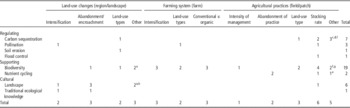
The number of times the influences on ecosystem services of diverse land management and agricultural practices were measured at different spatial scales (n=30)

aCAP measures, abandonment and intensification.
bStocking rates.
cFertiliser application and plant seeding.
dNumber of species/varieties cultivated.
eManure application, mowing/unmowing.
fNutrient addition (various combinations of mineral nutrients (N, P, K, Mg), lime addition and herbivore exclusion (insect, rabbit)).
gPrescribed burning.
Similarly, the consideration of the full range of ES in pasture-based livestock farming systems (PLFS) is also new, despite the fact that PLFS, more than other agroecosystems, strongly depend on and influence the regulating and supporting ES (Zhang et al., Reference Zhang, Ricketts, Kremen, Carney and Swinton2007). PLFS have the potential to ensure multiple ES (e.g. hedgerows reduce erosion, grasslands filter runoff, natural predators control pests and wild bees provide pollination), but there are trade-offs. Managing the trade-offs and synergies among ES at multiple scales is essential for reinforcing the contribution of PLFS to landscape multifunctionality and human well-being. Supporting methodologies that help stakeholders and policymakers to better understand the trade-offs and synergies among ES are needed to help design alternatives and explore scenarios for the future.
The ES approach is stimulating debate about the need to introduce deep policy changes (European Commission, 2011b; Bateman et al., Reference Bateman, Harwood, Mace, Watson, Abson, Andrews, Binner, Crowe, Day, Dugdale, Fezzi, Foden, Hadley, Haines-Young, Hulme, Kontoleon, Lovett, Munday, Pascual, Paterson, Perino, Sen, Siriwardena, van Soest and Termansen2013) that integrate agricultural policies with policies in other sectors, such as biodiversity (European Commission, 2011a). It also shifts the emphasis towards the supply of public, non-market goods, and thus opens up opportunities for Payments for Ecosystem Services, or ‘green payments’.
The objective of our review was to explore the application of the ES framework to European PLFS. We first established a biophysical inventory of the non-provisioning ES provided by PLFS. Second, we focused on the trade-offs between provisioning and non-provisioning ES at the field, farm, and landscape levels, and the methodologies used for assessing them in biophysical terms. Third, we reviewed the non-biophysical methodologies for ES valuation and their application to PLFS. Finally, we proposed some recommendations for policy design.
An inventory of the ES provided by PLFS in Europe
The consideration of the regulating, supporting and cultural ES delivered by agroecosystems is still relatively new (Swinton et al., Reference Swinton, Hamilton, Lupi and Robertson2007). The biophysical relationships between agroecosystems and the non-provisioning ES are neither readily apparent nor easy to measure; however, they provide the knowledge base for their valuation. We reviewed the scientific literature acknowledging those relationships within the context of PLFS. The ES were classified following the definitions given in the Millennium Ecosystem Assessment (2005) and the classification proposed by The Economics of Ecosystems and Biodiversity (Kumar, Reference Kumar2010). Biodiversity is considered a key element supporting the delivery of other ES in both the classification systems and was therefore included in our search.
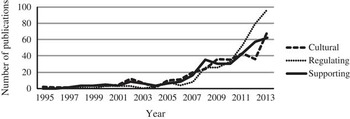
We conducted a literature search on 11 December 2013 and included all peer-reviewed publications in the SCOPUS database. Our preliminary search included a range of terms related to PLFS and the diverse non-provisioning ES (including biodiversity) and resulted in more than 13 500 references. To circumscribe the search within the ES framework, we restricted the query by explicitly including the term ‘ecosystem service’ and equivalent terms (i.e. ‘public good’, ‘externality’, ‘environmental service’ and ‘multifunctionality’). Detailed information regarding the terms included in the query is available in the Supplementary material S1. The final search result included 563 articles and showed a rapid increase in the number of publications (from an average of 10.5 per year in the period 1995 to 2005 up to 228 in 2013) following the appearance of the Millennium Ecosystem Assessment (2005) and the formal establishment of the ES concept (Figure 1). The rates of publication on supporting and cultural ES increased similarly, but to a lesser degree than the rate of publication on regulating ES.
The number of publications per year and the type of ecosystem services covered (see the Supplementary material S1 for query specifications). Biodiversity is included in the supporting ecosystem services.

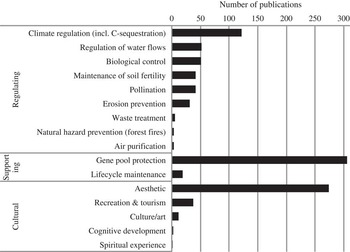
The coverage of the different non-provisioning ES in the literature was irregular: ‘gene-pool protection’ (which includes biodiversity) accounted for the largest share of the publications (30.5%), followed by ‘aesthetic value’ of landscape (27.3%) and ‘climate regulation’ (12%); the prevention or moderation of natural hazards (such as ‘forest fires’ (0.3%)), ‘air purification’ (0.3%), ‘cognitive development’ (0.2%) and ‘spiritual experience’ (0.1%) were studied little in relation to PLFS (Figure 2).
The number of publications per ecosystem service (see the Supplementary material S1 for query specifications). Biodiversity is included in the gene pool protection service.
Note: publications that covered more than one ecosystem service are counted more than once.

The search results were checked against the following criteria: the PLFS was located in Europe; the study included biophysical quantification; the paper described original research; the experimental design and analysis were sound; and the results showed relations between land management or agricultural practices and ES. Thirty publications met all of the criteria for inclusion in our subsequent analysis (Supplementary material S2). Several reasons led to the dismissal of most publications: studies were conducted in crop/arable land or forestry areas lacking explicit links to pasture-based systems; relationships between livestock and ES were mentioned but not explicitly assessed; the ES were not assessed in biophysical terms (as in reviews, theoretical reflections or frameworks for analysis) or followed non-biophysical methodologies (e.g. economic valuation or policy analysis).
We classified the 30 references meeting our criteria according to the type of ES and the indicators used in the assessment, the geographic scale of the study (patch/field, farm, or region/landscape) and the factor under analysis (e.g. land-use change, management regime or agricultural practice; Table 1). The quantitative methodologies and the main evidences found are listed in Supplementary Table S1.
Most of the studies meeting our criteria focused on biodiversity and landscape. Despite the different approaches and methodologies, there was general agreement that large shifts in PLFS management tend to impair biodiversity (Chamberlain et al., Reference Chamberlain, Fuller, Bunce, Duckworth and Shrubb2000; Stoate et al., Reference Stoate, Boatman, Borralho, Carvalho, De Snoo and Eden2001). Biodiversity was negatively affected by landscape homogenisation, either because of agricultural intensification or abandonment (Plieninger et al., Reference Plieninger, Höchtl and Spek2006), and positively affected by the use of low-input, heterogeneous and restored PLFS (Weigelt et al., Reference Weigelt, Weisser, Buchmann and Scherer-Lorenzen2009; Albrecht et al., Reference Albrecht, Schmid, Obrist, Schüpbach, Kleijn and Duelli2010; Varah et al., Reference Varah, Jones, Smith and Potts2013). Grasslands in Europe, as man-made habitats, need to be managed for higher structural heterogeneity to maintain high species diversity (Diacon-Bolli et al., Reference Diacon-Bolli, Dalang, Holderegger and Bürgi2012).
Landscape was analysed from diverse perspectives: vegetation dynamics, landscape diversity or aesthetic quality. In terms of vegetation change, we found reports of a general process of abandonment in Europe (e.g. MacDonald et al., Reference MacDonald, Crabtree, Wiesinger, Dax, Stamou, Fleury, Lazpita and Gibon2000), especially in less favoured areas (mountainous, less productive or marginal areas) where PLFS have declined (Bernués et al., Reference Bernués, Riedel, Asensio, Blanco, Sanz, Revilla and Casasús2005). This abandonment has led to a general trend of afforestation and encroachment, ending in landscape closure or homogenisation (Tasser et al., Reference Tasser, Walde, Tappeiner, Teutsch and Noggler2007; Riedel et al., Reference Riedel, Bernues and Casasus2013), reducing the mosaic value (Brady et al., Reference Brady, Sahrbacher, Kellermann and Happe2012). Moreover, afforestation impacts community composition (Alrababah et al., Reference Alrababah, Alhamad, Suwaileh and Al-Gharaibeh2007; Buscardo et al., Reference Buscardo, Smith, Kelly, Freitas, Iremonger, Mitchell, O'Donoghue and McKee2008); rare or specialist species are often replaced by habitat generalists or species associated with forested habitats (Oxbrough et al., Reference Oxbrough, Gittings, O’Halloran, Giller and Kelly2006).
Although aesthetic preferences are highly subjective and incorporate social constructs, some predictive variables were proxies for attractiveness to society, such as the presence of water, the number of different land types and the heterogeneity of the landscape (Dramstad et al., Reference Dramstad, Tveit, Fjellstad and Fry2006). In this sense, Ford et al. (Reference Ford, Garbutt, Jones and Jones2012) concluded that environmental appreciation would be greater in grazed areas, because those areas sustain significantly greater plant species richness, particularly among forbs flowers. Garcia-Llorente et al. (Reference Garcia-Llorente, Martin-Lopez, Iniesta-Arandia, Lopez-Santiago, Aguilera and Montes2012) found that multifunctional grasslands delivered not only greater aesthetic value but also a more diverse flow of ES.
Carbon sequestration was usually analysed at the field/patch scale, but direct relationships between it and PLFS were difficult to establish. Carbon stocks were greater under pastures than under cropland (Lorencová et al., Reference Lorencová, Frélichová, Nelson and Vačkář2013), and grazing did not compromise the carbon-storage potential (Medina-Roldán et al., Reference Medina-Roldán, Paz-Ferreiro and Bardgett2012). Carbon storage was strongly modulated, however, by location, soil type (Marriott et al., Reference Marriott, Fisher, Hood and Pakeman2010), stocking rate (Martinsen et al., Reference Martinsen, Mulder, Austrheim and Mysterud2011) and grassland management (Soussana et al., Reference Soussana, Loiseau, Vuichard, Ceschia, Balesdent, Chevallier and Arrouays2004).
Many ES did not appear in the studies included in our final search results, probably because the environmental effects (e.g. soil fertility, soil erosion and waste treatment) of PLFS have been studied without any explicit reference to ES. Other ES were important only in particular regions; wild forest fires, for example, have enormous environmental, social and political relevance in Euro-Mediterranean regions but less in northern areas. Grazing by domestic livestock reduced the wildfire risk by limiting the shrub and herbage biomass and maintaining landscape heterogeneity (Ruiz-Mirazo and Robles, Reference Ruiz-Mirazo and Robles2012); however, the stocking rates and grazing regimes in many cases were not enough to avoid vegetation dynamics towards encroachment (Riedel et al., Reference Riedel, Bernues and Casasus2013).
The ES concept is highly complex, because it connects ecological and social systems and recognises particular ES that are strongly connected to biodiversity (i.e. supporting and regulating ES) or to humans (i.e. cultural ES). Despite a diverse spectrum of disciplines is required to study this complexity (Martín-López et al., Reference Martín-López, Gómez-Baggethun, García-Llorente and Montes2014), we have found that the scope of the biophysical studies differed widely and lacked standardised methodologies. Furthermore, the spatial and temporal scales were often not identified.
The agricultural practices and management regimes under consideration were also very diverse. On the one hand, the studies involved or compared different land-cover types, such as grasslands, woodlands, crops, or fallow or abandoned lands (e.g. Dallimer et al., Reference Dallimer, Marini, Skinner, Hanley, Armsworth and Gaston2010; McMahon et al., Reference McMahon, Helden, Anderson, Sheridan, Kinsella and Purvis2010). On the other hand, the livestock management practices were widely heterogeneous, involving the maintenance, or the implementation, of one or several changes in existing practices, such as mowing, grazing and fertilising. For example, some studies compared different grazing intensities (stocking rates) or season lengths (e.g. Batáry et al., Reference Batáry, Báldi, Sárospataki, Kohler, Verhulst, Knop, Herzog and Kleijn2010; Martinsen et al., Reference Martinsen, Mulder, Austrheim and Mysterud2011), or tested differences between grazed and non-grazed areas (e.g. Medina-Roldán et al., Reference Medina-Roldán, Paz-Ferreiro and Bardgett2012, Riedel et al.,Reference Riedel, Bernues and Casasus2013), combinations of grazed, mowed and abandoned areas (e.g. Franzén and Nilsson, Reference Franzén and Nilsson2008; Hoiss et al., Reference Hoiss, Gaviria, Leingärtner, Krauss and Steffan-Dewenter2013); or combinations of grazing intensities and fertilisation regimes (e.g. Marriott et al., Reference Marriott, Fisher, Hood and Pakeman2010; Michaud et al., Reference Michaud, Plantureux, Amiaud, Carrère, Cruz, Duru, Dury, Farruggia, Fiorelli, Kerneis and Baumont2012). All of the management regimes had broad effects on ES delivery because of the complex interrelationships among land uses, biodiversity and ES. Hence, establishing comparisons between studies was not straightforward.
Trade-offs among ES at the field, farm and landscape levels
The simultaneous production and the complex, dynamic interrelatedness of multiple ES is often overlooked (Bennett et al., Reference Bennett, Peterson and Gordon2009). An overly narrow focus on maximising a limited set of ES could lead to unexpected trade-offs or to undesirable and sudden declines in other ES (Bennett et al., Reference Bennett, Peterson and Gordon2009). Trade-offs among ES occur when the delivery of one service is reduced as a consequence of the increased use of another service. In contrast, synergies among ES arise when multiple ES are enhanced simultaneously (Raudsepp-Hearne et al., Reference Raudsepp-Hearne, Peterson and Bennett2010). The limited knowledge of the biophysical relationships among ES makes it difficult not only to predict trade-offs and synergies but also to understand the mechanisms that cause them, and hence how to minimise or enhance them. The simultaneous management of multiple ES is important; however, it is also extremely challenging. A better understanding of the processes by which agricultural practices and management regimes influence trade-offs and synergies among ES would allow the outputs of a range of ES to be envisioned (Power, Reference Power2010).
Trade-offs across multiple scales
A few recent studies have explored trade-offs within PLFS at multiple spatial scales (e.g. Tichit et al., Reference Tichit, Doyen, Lemel, Renault and Durant2007; Sabatier et al., Reference Sabatier, Doyen and Tichit2012; Sabatier et al., Reference Sabatier, Doyen and Tichit2013). These studies used a process-based modelling approach that provides a framework for assessing trade-offs on multiple scales (field, farm and landscape) in grassland-dominated landscapes, where livestock grazing may conflict with bird conservation. The approach integrates the two ecological processes, nest trampling and chick survival, through which the direct and indirect effects of grazing and mowing influenced the life cycles, and thus the population dynamics, of birds. Nest trampling by livestock has a direct, negative effect on bird fecundity. Grass height can have a positive, indirect effect on chick survival. The modelling approach was used to find out how grasslands should be managed to reconcile fodder production, a provisioning ES, and bird conservation, a cultural ES.
At the field level, Sabatier et al. (Reference Sabatier, Doyen and Tichit2010) showed that increased grazing intensity did not have the same impact on all bird species: some species were more sensitive to nest trampling than others. It was necessary to fine-tune the grazing intensity over time to ensure the conservation of several bird species. The tuning involved temporal shifts in grazing sequences to minimise nest trampling and create optimal grass heights for bird survival (Tichit et al., Reference Tichit, Durant and Kernéïs2005a and Reference Tichit, Renault and Potter2005b; Durant et al., Reference Durant, Tichit, Fritz and Kernéïs2008). The temporal shifts were action levers in the trade-off between the ES, because they improved bird conservation without causing major loss of fodder production.
At the farm level, different land uses, such as mowing and grazing, offered contrasting habitats for birds and contrasting feeding resources for livestock (Martin et al., Reference Martin, Cruz, Theau, Jouany, Fleury, Granger, Faivre, Balent, Lavorel and Duru2009). The interactions between the ES determined both the herbage production and the health of the bird populations (Sabatier et al., Reference Sabatier, Doyen and Tichit2010; Tichit et al., Reference Tichit, Puillet, Sabatier and Teillard2011). Mowing and intensive grazing increased herbage production but impaired bird fecundity and chick survival. The proportions of grazed/mown fields in the farm area thus formed the key action lever for modulating the supplies of both ES. The study stressed, however, that it was less costly to implement the action lever on extensive (<1.4 livestock units/ha) farms than on intensive farms (>1.4 livestock units/ha) (Tichit et al., Reference Tichit, Puillet, Sabatier and Teillard2011). Similar results have been reported in mountain PLFS, where the level of farm intensification was identified as a key variable modulating the trade-off between cattle production and grassland floristic composition (Jouven and Baumont, Reference Jouven and Baumont2008).
At the landscape scale, land use was an important factor influencing the provision of, and the relationships among, multiple ES (Foley et al., Reference Foley, DeFries, Asner, Barford, Bonan, Carpenter, Chapin, Coe, Daily, Gibbs, Helkowski, Holloway, Howard, Kucharik, Monfreda, Patz, Prentice, Ramankutty and Snyder2005). It is important to determine whether land-use intensity and allocation can be action levers to move or modify the shape of the trade-off frontier. Recent studies highlighted landscape heterogeneity, the spatial arrangement of the different land uses, as a factor promoting the diversity of available habitats and thus allowing biodiversity to increase (Haslem and Bennett, Reference Haslem and Bennett2008; Groot et al., Reference Groot, Jellema and Rossing2010). Sabatier et al. (Reference Sabatier, Doyen and Tichit2013) went a step further by demonstrating that heterogeneous land use in grassland was an efficient lever to move the trade-off frontier. The simulation of a large number of landscapes revealed that at a given level of provisioning service (herbage production), increasing the landscape heterogeneity could improve cultural services (bird populations) by changing the spatial arrangement of mowed and grazed areas. The benefits of heterogeneous land use emerged from a set of interacting suboptimal habitats, where each type of land use provided some of the resources needed, and species mobility among land-use types enabled the populations to obtain all the needed resources. Those results were consistent with the results of other modelling studies conducted at the landscape scale (Polasky et al., Reference Polasky, Nelson, Lonsdorf, Fackler and Starfield2005; Groot et al., Reference Groot, Rossing, Jellema, Stobbelaar, Renting and Van Ittersum2007), illustrating how strategic land-use placement can improve trade-offs.
Methods for exploring trade-offs
There are several approaches to analysing trade-offs among ES (Groot et al., Reference Groot, Rossing, Tichit, Turpin, Jellema, Baudry, Verburg, Doyen and van de Ven2009). Here, we present a short overview of three types of modelling approaches: pareto-based optimisation, co-viability analysis (CVA) and companion modelling. The approaches offer different options to assess multiple ES, quantify the relationships among ES and explore the range of potential solutions.
The common point is to analyse the set of ES as a problem of multi-criteria decision making, where several antagonist criteria are optimised simultaneously by modifying a common driver (e.g. the land-use intensity and its spatial allocation) of several ES.
Pareto-based multi-criteria optimisation offers a static framework to solve spatially explicit problems and find the optimal spatial allocation of land-use intensity. Optimal allocations are those providing the best reconciliation among the different ES. A Pareto frontier graphically represents a set of non-dominated solutions such that a given service could not be improved without deteriorating another service and vice versa (Groot et al., Reference Groot, Oomen and Rossing2012).
CVA provides a quantitative tool for dynamically exploring a solution space defined by the supply of several ES. With CVA, a desired future and road to it can be defined by a set of restrictions representing the limits within which the supply of each ES should be maintained (Tichit et al., Reference Tichit, Doyen, Lemel, Renault and Durant2007, Sabatier et al., Reference Sabatier, Doyen and Tichit2010 and Reference Sabatier, Doyen and Tichit2012). Different mathematical tools are used to compute the set of viable decisions leading to the desired future. This approach is particularly useful for involving stakeholders in a negotiation-based planning process, because restrictions on ES can be set at different levels, depending on the knowledge and priorities of the stakeholders. Furthermore, CVA offers an integrated criterion for achieving multiple goals in a short- to long-term perspective. CVA is a powerful tool for examining interactions across temporal scales and the ways in which different objectives may conflict in the long term as a consequence of short-term decisions.
The boundaries of what is possible in terms of ES delivery should not be limited to mathematical exploration, mainly because one of the underlying aspects of trade-offs is that different stakeholders pursue different, sometimes antagonist, goals on a given landscape. As a consequence, they need to develop a common view on problem and collectively design solutions. Companion modelling is a participatory methodology that involves stakeholders in the different steps of exploring and designing solutions (Souchère et al., Reference Souchère, Millair, Echeverria, Bousquet, Le Page and Etienne2010). It provides stakeholders with elements for reflection, helping to reinforce planning for the future and understanding of complex multi-scale problems. They act as tools for decision support, dialogue and communication among a variety of stakeholders pursuing multiple objectives. Such tools can account for scale mismatch (Cumming et al., Reference Cumming, Cumming and Redman2006) between ecological processes and human processes, when, for instance, gains emerge on one scale and costs are supported on another. Participatory tools can incorporate scenarios and public policy instruments that are unaccounted for in most studies (e.g. Seppelt et al. (Reference Scoones2011) found that only 29% of studies accounted for such instruments). We have stressed that it is necessary to account for both the technical and the social and economic dimensions of ES-management practices. Companion modelling offers the advantage of integrated assessment tools that include descriptions of biophysical processes, the influences of individual and collective management decisions on those processes, the perceptions of stakeholders regarding the environment, and the social and economic consequences of management. Thus, it has the potential to foster knowledge and social representation sharing of ES. Through scenario exploration, it can also simulate the impact of management changes on ES delivery. As tools conceived for helping stakeholders to organise themselves and consult each other, they can facilitate the design of new spatial layouts for livestock farming systems that provide diversified mosaics of ES in agroecosystems.
Uncovering the socio-cultural and economic values of ES
Uncovering ES values for human well-being requires diverse tools that embrace the multidimensional (i.e. biophysical, socio-cultural and economic) nature of the value of ES (Martín-López et al., Reference Martín-López, Gómez-Baggethun, García-Llorente and Montes2014). The plurality of values makes ES intrinsically incommensurable and therefore impossible to reduce to a single unique measure (Gómez-Baggethun and de Groot, Reference Gómez-Baggethun and de Groot2008). This is one reason, among others, why different types of ES-valuation methods have been developed.
Socio-cultural valuation of ES
Socio-cultural assessments focus on the preferences, needs, values, norms and behaviours of individuals, institutions and organisations towards ES (Cowling et al., Reference Cowling, Egoh, Knight, O'Farrell, Reyers, Rouget, Roux, Welz and Wilhelm-Rechman2008). These valuation approaches are particularly appealing because of their suitability for uncovering the motivations for conserving ES (Chan et al., Reference Chan, Guerry, Balvanera, Klain, Satterfield, Basurto, Bostrom, Chuenpagdee, Gould, Halpern, Hannahs, Levine, Norton, Ruckelshaus, Russell, Tam and Woodside2012b). Socio-cultural valuation methods have been praised for their suitability and sensitivity in assessing PLFS (Oteros-Rozas et al., Reference Oteros-Rozas, Martín-López, González, Plieninger, López and Montes2013a), because PLFS have been shaped by long-term human activities and therefore have particular cultural values (Martín-López et al., Reference Martín-López, Iniesta-Arandia, García-Llorente, Palomo, Casado-Arzuaga, Amo, Gómez-Baggethun, Oteros-Rozas, Palacios-Agundez, Willaarts, González, Santos-Martín, Onaindia, López-Santiago and Montes2012).
The main tools or methods for socio-cultural valuation are consultative methods (structured processes of inquiry into people’s perceptions and preferences) and deliberative and participatory methods (group-based activities to elucidate people’s relationships with ecosystems, identify conflicts between the beneficiaries of ES, and identify trade-offs between different management strategies, land uses or possible future scenarios) (de Groot et al., Reference de Groot, Alkemade, Braat, Hein and Willemen2010; Christie et al., Reference Christie, Fazey, Cooper, Hyde and Kenter2012).
Consultative methods include individual questionnaires and in-depth interviews; both tools allow for qualitative and quantitative data analyses, but the questionnaires tend to focus on gathering quantitative data (Struhsaker et al., Reference Struhsaker, Struhsaker and Siex2005), whereas the in-depth interviews are more suitable for collecting qualitative data. Deliberative and participatory approaches include focus groups, Delphi surveys, participatory rural appraisal and participatory scenario planning (for a review see Christie et al., Reference Christie, Fazey, Cooper, Hyde and Kenter2012). These methods intend to elucidate information about people’s relationships with livestock systems to reach consensus or to unravel disagreements about relationships, identify conflicts among the beneficiaries of ES, and identify trade-offs between different management strategies, land uses or possible future scenarios (e.g. Bernués et al., Reference Bernués, Rodríguez-Ortega, Ripoll-Bosch and Casasús2013). Interest in participatory mapping of ES through social elicitation has been growing recently (e.g. Palomo et al., Reference Palomo, Martín-López, Potschin, Haines-Young and Montes2013), particularly for the spatially explicit quantification of cultural ES (Plieninger et al., Reference Plieninger, Dijks, Oteros-Rozas and Bieling2013).
Despite the recognised multifunctionality of agroecosystems, and particularly that of PLFS, there are few examples of socio-cultural valuation of ES related to livestock farming systems. Davies and Hatfield (Reference Davies and Hatfield2007) reviewed the direct and indirect value of ES provided by pastoralism in eight regional studies and highlighted the gaps in knowledge and policy options to support rangeland economies. Oteros-Rozas et al. (Reference Oteros-Rozas, González, Martín-López, López, Zorrilla-Miras and Montes2012 and Reference Oteros-Rozas, Martín-López, López, Palomo and González2013b) identified the ES related to transhumance in Spain by carrying out socio-cultural assessments via interviews, cognitive and visual ES-perception surveys, focus groups and participatory scenario planning. Among the 34 ES they identified, the most important for social well-being were fire prevention, air purification and livestock production. They also assessed the trends and factors affecting ES flows and the link between ES and the practice of transhumance on foot and found that the delivery of certain regulating ES (tree regeneration, seed dispersal, and the maintenance of soil fertility and connectivity) and cultural ES (local ecological knowledge, cultural exchange and cultural identity) were closely related to transhumance. The results suggested a particularly close link between fire prevention and the maintenance of transhumance in the study area. Lamarque et al. (Reference Lamarque, Tappeiner, Turner, Steinbacher, Bardgett, Szukics, Schermer and Lavorel2011) found that different stakeholders appreciated ES differently in three mountainous regions in Europe primarily used for livestock farming. They identified, however, a common set of ES that all stakeholders considered important, including soil erosion, water quantity and quality, forage quality, conservation of plant diversity, and aesthetics and recreation. Pereira et al. (Reference Pereira, Queiroz, Pereira and Vicente2005) used a range of tools including participatory rural appraisal and other field methods to socio-culturally assess the ES provided by agro-pastoral ecosystems in the rural community of Sistelo in northern Portugal. They identified an emotional attachment to livestock and pastoral practices, which, together with a relationship between cattle and the maintenance of pasturelands, hindered encroachment caused by natural succession, thus preventing wildfires. Heikkinen et al. (Reference Heikkinen, Sarkki and Nuttall2012) elaborated on the relationship between pastoralism and ES from the user and producer perspectives through an exercise in scenario analysis. They modelled biodiversity conservation and ecotourism as ES produced by pastoral communities under scenarios representing novel solutions to conservation–pastoralism dilemmas. Bernués et al. (Reference Bernués, Rodríguez-Ortega, Ripoll-Bosch and Casasús2013) used focus groups to quantify the importance that farmers and non-farmers attached to the ES delivered by mountain agriculture. They found that aesthetics (landscape/vegetation), gene pool protection (biodiversity maintenance) and natural hazard prevention (forest fires) were, together with opportunities for recreation and culture, were the most important ES delivered by mountain livestock systems. Several of the previously mentioned studies indicated differences between the perceptions of farmers and non-farmers: farmers gave more importance to regulating and provisioning ES, mainly those related to their own farming activity or local circumstances; whereas non-farmers gave more importance to cultural ES, generally showing more global concerns.
Economic valuation of ES
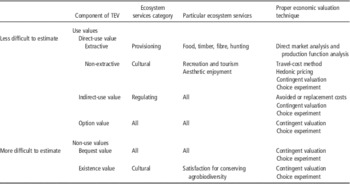
The economic valuation of ES can provide useful information about the monetary gains and losses caused by different land-use management options; thus, it can be a useful tool to quantify the ES trade-offs among different management options (Hicks et al., Reference Hicks, McClanahan, Cinner and Hills2009; Martín-López et al., Reference Martín-López, García-Llorente, Palomo and Montes2011). PLFS have great economic importance, namely, their total economic value (TEV), despite the fact that conventional markets do not recognise most ES. Components of the TEV are usually represented by a value taxonomy, which distinguishes between use and non-use values (Table 2).
Relationships between the components of total economic value (TEV) and the ecosystem services delivered by pasture-based farming systems

The most suitable economic valuation techniques for each of the TEV components and ecosystem services are shown.
On the one hand, use values comprise direct use, indirect use and option values. Direct use values derive from the conscious use and enjoyment of ES. They may be extractive, such as food, or non-extractive, such as recreation, nature tourism and aesthetics enjoyment. Hence, extractive direct use values are strongly related to provisioning ES, and non-extractive direct use values are related to cultural ES. Indirect use values are associated with the regulating ES delivered by livestock farming systems and do not entail conscious enjoyment or use. Finally, option values are related to future direct and indirect uses by humans. Non-use values are those arising from people’s feelings towards the existence of biodiversity and the ES that biodiversity provides. This type of value includes the satisfaction of knowing that ES will be available to future generations (bequest value) and the satisfaction of knowing that species, farmlands or ES continue to exist (existence value). Because non-use values are strongly based on moral and ethical issues concerning future human generations and biodiversity, they are extremely difficult to estimate with any precision.
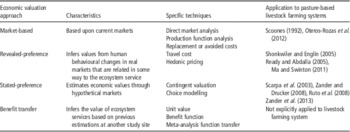
The broad spectrum of economic valuation methods that exist to cope with the heterogeneous values derived from ES can be classified into four basic approaches: market, revealed-preference, stated-preference and benefit transfer (Table 3). These approaches (except for benefit transfer) estimate the monetary value of ES on the basis of stakeholders’ preferences, expressed either in real markets (market and revealed-preference methods) or in hypothetical markets (stated-preference methods).
Characterisation of the main economic valuation approaches used for placing monetary value on ecosystem services

The broad landscape of economic techniques allows us to estimate the monetary value of the ES provided by PLFS (Table 3). Direct market analysis estimates the economic value of the provisioning ES, because most provisioning ES (e.g. meat, milk and fibre) have real market prices. The monetary values of ES that do not have markets can be estimated in an indirect way by analysing related markets using (1) the costs avoided because the maintenance of certain regulating ES, such as soil fertility (e.g. the manure produced by sheep allowed farmers to avoid the costs of fertilisation (Oteros-Rozas et al., Reference Oteros-Rozas, González, Martín-López, López, Zorrilla-Miras and Montes2012)); (2) the travel-cost method for assessing the cultural ES of recreational activities and nature tourism (e.g. Shonkwiler and Englin, Reference Shonkwiler and Englin2005; Pouta and Ovaskainen, Reference Pouta and Ovaskainen2006); and (3) the hedonic pricing for cultural ES, such as the recreational or aesthetic values derived from farmlands (e.g. Ma and Swinton, Reference Ma and Swinton2011). In addition, the stated-preference methods provide an alternative, comparative way to estimate the monetary value of most ES. On the one hand, such methods are able to estimate the economic value associated with the most intangible ES, such as the value of the existence of biodiversity (Venkatachalam, Reference Venkatachalam2004). On the other hand, the economic value of different ES can be estimated in the same exercise, because stated-preference methods are performed on the basis of hypothetical markets created through questionnaires in which people state their willingness to pay for preserving ES. For instance, the choice-experiment technique allows us to jointly estimate the economic values of the different ES provided by PLFS (see Table 2). Recent studies have focused on estimating the economic losses associated with the erosion of agro-biodiversity, in terms of diminishing local breeds, through the consideration of different ES, different components of the TEV, and both private and public goods. Martin-Collado (Reference Martin-Collado2013) and Zander et al. (Reference Zander, Signorello, De Salvo, Gandini and Drucker2013) analysed the social importance of one provisioning ES (food quality), one supporting ES (gene-pool maintenance) and three cultural ES (landscape aesthetics, cultural identity and the existence of the local breeds) attached to three local breeds in Spain and Italy. Their results showed that society valued the non-market ES (public goods) highly, as more than 75% of the estimated economic value arose from the cultural ES and the maintenance of the gene pool. Similarly, Kassie et al. (Reference Kassie, Abdulai and Wolltny2009) found that among the attributes of indigenous cows in central Ethiopia, those indirectly related to markets (i.e. fertility or disease resistance) were as important as those directly related to markets (i.e. milk provisioning). Those results suggest that society highly values the public goods derived from local breeds, suggesting that the associated ES should not be hidden in the decision-making processes of agro-biodiversity management.
Implications for policy design
Some considerations for agro-environmental policy design in Europe can be underlined on the basis of this review.
Incorporate non-provisioning ES into decision making
Agricultural policy design for PLFS should not focus only on provisioning ES, because this can result in decisions that reduce the TEV of the system (Bateman et al., Reference Bateman, Harwood, Mace, Watson, Abson, Andrews, Binner, Crowe, Day, Dugdale, Fezzi, Foden, Hadley, Haines-Young, Hulme, Kontoleon, Lovett, Munday, Pascual, Paterson, Perino, Sen, Siriwardena, van Soest and Termansen2013). Because many ES (e.g. spiritual values, cognitive development, and certain regulating and supporting services) cannot be readily translated into monetary values, or because doing so can be undesirable (Gómez-Baggethun and Ruiz-Pérez, Reference Gómez-Baggethun and Ruiz-Pérez2011), the socio-cultural values of ES need to be considered across agricultural, environmental and rural development policies.
A few ES should be chosen based on existing scientific evidence and prioritised across different agroecosystems and regions. However, the socio-cultural, economic and biophysical contexts across different sites in Europe strongly influence the valuation of ES (e.g. the prevention of forest fires is key in Mediterranean countries but not in northern Alpine areas), and therefore comparing different case studies and scaling up results can be difficult (Seppelt et al., Reference Scoones2011). Similarly, a small number of agricultural practices and land-management regimes, those with the greatest potential to enhance the prioritised ES, should be targeted by agro-environmental policies.
Consider the trade-offs and synergies
There are trade-offs within PLFS between provisioning and non-provisioning ES, and between non-provisioning services and disservices (negative environmental impacts), but there are also synergies (Bernués et al., Reference Bernués, Ruiz, Olaizola, Villalba and Casasús2011). Therefore, European policies should promote farming practices that constitute action levers to maintain a diverse spectrum of ES that benefit different stakeholders.
Individualise compensation schemes and select relevant indicators for monitoring
For agro-environmental measures to constitute effective payments for ES, schemes need to be regionalised and, if possible, individualised by farmers or farmer groups. In addition, because targeted schemes bear closely on local and small famers’ interests, payments for ES should be promoted as rewards rather than subsidies (Sabatier et al., Reference Sabatier, Doyen and Tichit2012). To do so, we must establish objective, easy-to-understand, measurable and responsive indicators to monitor the effects of compensation schemes on ES delivery and the well-being of farmers.
Finally, in terms of European research policy, dynamic and multi-scale approaches for assessing ES are greatly needed because of the mismatches between the temporal and spatial scales of various ES and agricultural practices (e.g. the recurrent labour costs of grazing are short term and occur at the farm level, whereas the benefits of forest-fire prevention are long term and reach wider territories and more recipients). While difficult to perform, upscaling exercises are necessary to contribute to agro-environmental decision making at European scale.
The ES framework integrates the capacity of agroecosystems to supply diverse ES and the perspectives and interests of stakeholders regarding the use of ES. Interdisciplinary frameworks involving natural and social scientists are therefore extremely important. Because the ES concept bears on agroecosystem management and policy, they should be opened not only to scientists and decision makers but also to other stakeholders.
Acknowledgements
Projects: Marie Curie IEF Contract no. 299794 and INIA RTA2011-00133-C02-02. The first author has a pre-doctoral fellowship from INIA.