The relationship between the adoption of new technologies in developing countries and comparative economic development continues to generate considerable research in economics and economic history.Footnote 1 In his work, Alexander Gerschenkon noted that the “technology gap” with respect to the technological frontier provides developing countries with the opportunity to quickly absorb the “backlog of technological innovations” of advanced countries and catch up with them (1962, p. 8). This process of international technology diffusion is purported to be at the root of convergence with Britain by several European countries during the nineteenth century (Landes 1969). However, catching up is by no means automatic. Rather, it requires a significant mobilization of resources, skills, and capitals over a broad front, often coupled with a complex “mix” of policy interventions towards infant industries, ranging from trade and industrial policies to other forms of government actions.Footnote 2
In his assessment of the policy mix adopted by Italian governments in the second half of the nineteenth century, Gerschenkron was characteristically blunt, pointing to a generalized “ineptness of government industrialization policies.” In particular, he argued that Italian industrialization would have benefited from a more “rationally conceived and executed tariff.” The structure of the tariff, favoring iron and steel in a coal-less country, represented a major impediment to the development of the Italian mechanical engineering industry, which “was largely left to its own devices” (Gerschenkron Reference Gerschenkron1962, pp. 80–83). Other historians have instead argued that the sluggish development of the industry lay in the overall “technical and organizational backwardness of the sector” and not in mistaken policies.Footnote 3
This article sheds new light on these issues by reassessing the case of the steam locomotive industry, one of the few relatively “high tech” sectors in which Italy was successful before 1913. The development of this industry was shaped by a complex mix of policies comprising trade policies, “non-tariff trade barriers,” and other discretionary interventions. The locomotive industry, thus, constitutes a useful vantage point to reconsider the general effectiveness of the different types of interventions adopted by the Italian governments in the period 1850–1913.
Our analysis relies on a new index of technical change based on technical indicators of the performance of different vintages of steam locomotives. The dataset includes some six thousand steam locomotives in operation in Italy from 1839 to 1913. The index casts doubt on the prevailing view that the market share of Italian steam locomotive manufacturers was severely limited by their technical backwardness. On the contrary, the new quantitative evidence on technical change suggests that the technical capabilities of Italian producers were fully adequate when compared to those of foreign producers. Efficient production required then an annual production of about 50 locomotives per firm. Tariff-based protectionism, with positive net protection in force since the mid-1880s, was not sufficient to reach this goal. Rather, this production level was achieved through specific procurement policies assuring regular orders to national producers. It was these non-tariff barriers that played a critical role for the development of the Italian locomotive industry.
THE STEAM LOCOMOTIVE INDUSTRY IN ITALY: BACKGROUND
At the point of political unification of Italy in 1861, the railway network was limited with about 3,900 km in 1864, against 18,000 km in the United Kingdom, 16,000 km in Germany, and 12,000 km in France and the system had an eminently local character, as a result of the uncoordinated investments of the different pre-unitarian states in railway infrastructure. Political unification provided a major stimulus towards the expansion of the network, so that by 1910 the network comprised about 15,300 km. However, even after unification, various sections of the network were operated by several private franchise companies. A major reorganization took place in 1885 with “Railways Conventions” assigning the management of the network to three major private franchise companies under a renewable contract: the Rete Adriatica (RA) and the Rete Mediterranea (RM) covering the peninsula along a west-east divide, and, the Rete Sicula (RS), operating in Sicily.Footnote 4 In 1905 the operation of the railway network was nationalized and taken over by the Ferrovie dello Stato (a big state-owned company with about 100,000 workers).
Debates on Italian industrialization initially focused on the relation between railway extension and market unification (Romeo Reference Romeo1959; Sereni Reference Sereni1966), and on the connection between the development of the railway network, the demand for industrial products, and the rate of economic growth (Gerschnekron 1962). To date, the most comprehensive economic appraisal of the relation between railroads and industrial growth in post-Unification Italy is Stefano Fenoaltea (Reference Fenoaltea and O'Brien1983, Reference Fenoaltea2011). Fenoaltea's appraisal points to the importance of the composition of investment. From 1861–1895, investment was devoted to construction of railway tracks (mostly using unskilled workers for earthworks and related activities) with a relatively reduced share (10 percent) devoted to the purchase of metalmaking or engineering products. From 1896–1913, the share of investment devoted to engineering products rose to about 30 percent of the total annual railway investment. Most importantly, maintenance (both of railway lines and of rolling stock) grew throughout this period so that by 1913 it was such that, “on a value added basis, the maintenance of [rolling stock] was as important as their initial fabrication and, unlike the latter, it was immune from foreign competition” (Fenoaltea Reference Fenoaltea and O'Brien1983, p. 49).
From an engineering standpoint, the steam locomotive is a sophisticated piece of equipment, comprising hundreds of parts, most of them requiring accurate manufacturing and processing. Philip Scranton (Reference Scranton1997, p. 99) regards steam locomotives as a quintessential example of nineteenth century “specialty production”: “no specialty product was then more complicated than a railway engine and few were as heavily taxed in use.” Mass production was not feasible: steam locomotives were manufactured in small batches and they often had to incorporate particular specifications requested by individual customers. This meant that locomotive manufacturers had to marshal a significant breadth of engineering competences and skills. Even if the broad contours of locomotive design were established by the 1850s, throughout the second one-half of the nineteenth century, steam locomotives underwent a stream of technical improvements, which compelled a continuous revision and updating of many details of locomotives design and manufacturing.Footnote 5
For these reasons, the steam locomotive provides an interesting perspective on the absorption of an “advanced” technology by latecomer countries. In comparative perspective, it is possible to distinguish two main “waves” in the international diffusion of the steam locomotive. During the first wave (1830–1860), the manufacturing of steam locomotives became established in England, Belgium, France, United States, and Germany. During the second wave (1880–1920), we witness the emergence, with varying success, of the manufacturing of steam locomotives in Italy, Russia, Spain, and Japan.Footnote 6
THE STEAM LOCOMOTIVE INDUSTRY IN ITALY: NEW EVIDENCE, NEW CONJECTURES
The evidence presented in this article is largely based on a new dataset described in the Appendix. It comprises two major components. The first one includes information on 5,700 locomotives, both domestic and foreign. For each locomotive we know the year and place of production, the producer's name, and a numerical identifier. The second component is based on the authoritative handbook by Giovanni Cornolò (Reference Cornolò1998) providing technical characteristics and performances of the locomotives for the period 1850–1913. By combining these two components we can chart in detail the technological characteristics of the different locomotives operating in each year.
The Process of Import-Substitution
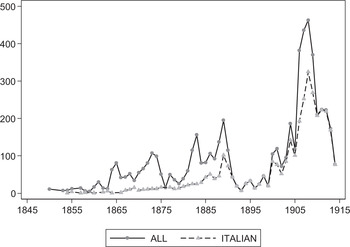
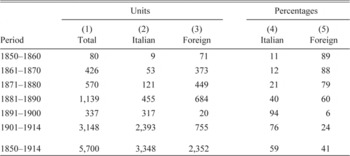
The development of Italy's locomotive market is described in Figure 1 and Table 1 illustrating both the total number of locomotives and those produced domestically.
ESTIMATED ACQUISITIONS OF STEAM LOCOMOTIVES IN ITALY, 1850–1913 (UNITS)

ESTIMATED ACQUISITIONS OF STEAM LOCOMOTIVES: TOTAL, DOMESTIC, AND FOREIGN PRODUCTION, 1850–1913

Source:
See text.
Until mid-1880s, domestic production was limited and the market was dominated by foreign manufacturers. The Italian import market was initially dominated by English producers, then by French producers, and finally by German manufacturers for whom, the Italian market was particularly significant. The Maschinenfabrik Esslingen, among the leading German producer of steam locomotives, exported during the period 1883–1887 about one-half of its production in Italy (Hertner Reference Hertner1984, p. 30). Furthermore, as noted by Albert Schram (Reference Schram1997, p. 61) German banks backed the Rete Mediterranea, and the Railways Conventions of 1885 marked the beginning of German investments in Italy. During the 1890s few locomotives were purchased, but after 1900, demand resumed with Italian producers substantially increasing their market share.
Using data on the number of locomotives, Michèle Merger (Reference Merger1986, Reference Merger1989) argues that the limited production of Italian manufacturers during the period 1861–1885 is due to three concomitant factors: the limited depth of technological capabilities of national firms, a lack of specialization leading to increasing costs, and the penalties induced by the tariff on iron. After 1885, with the new Railways Conventions, a new wave of investments took place. In this phase Merger argues that the increased domestic production was a result of the public policies favoring national manufacturers, in particular Pietrarsa, Ansaldo, and Breda.Footnote 7 The ultimate consolidation of the national industry of steam locomotives, according to Merger, takes place after 1905 when the production of private national producers is elicited by a new wave of investment following the creation of Ferrovie dello Stato (FS), the new public operating company managing the entire main network (including both new construction and maintenance of the railway lines, and the maintenance of rolling stock). However, the increase in the number of domestically-produced locomotives tells us little about their technical quality.
Patterns of Technical Change
We assess the dynamics of technical change using the traditional weight-to-power (whp) ratio, a synthetic indicator that is widely used in the engineering literature and represents “a clear expression of technical progress” in steam locomotives (Diegoli Reference Diegoli1961, p. 114). The whp ratio provides a measurement of the performance of the locomotive in a metric which is independent of its size, facilitating thus comparisons across different models and designs.Footnote 8 For each locomotive we computed the whp ratio using the data from Cornolò (Reference Cornolò1998). The whp ratio represents, therefore, our proxy for the technical performance of the various “types” of locomotive, with lower values denoting better performance and thus improved technology.Footnote 9 The different “types” of locomotives (Gruppi FS) were classified in 1905 by the engineers of the newborn Ferrovie dello Stato. Locomotives belonging to the same group are very similar in terms of technical characteristics. As Appendix A details, our sample includes more than 100 Gruppi FS. We construct an industry-level index (WHP) of technical change as the weighted average of the technical performance of the different locomotive types entering in service in that year:Footnote 10

where t represents time (year), and s gt = n gt / N t is the share of locomotive of type g introduced in year t, (with n gt and N t indicating respectively the number of locomotives of type g, and the total number of locomotives, introduced in year t); G t denotes the number of the different types of locomotives introduced in year t, and whp g is the weight-to-power ratio of locomotives of type g.Footnote 11
This index comprises only the locomotives introduced in a given year. While the sources indicate systematically the year in which a locomotive entered in operation, the information about the year in which it was scrapped is not systematic. This prevents us from constructing the index for the composition of locomotives in operation in a given year. The index of technical change, therefore, should be regarded as an index representing the level of technological performance of the investment in locomotives in a specific year.
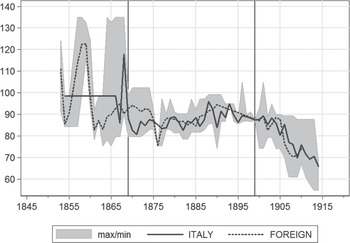
Figure 2 shows the evolution of the WHP index for Italian and foreign manufacturers. The area shaded in gray is delimited, year by year, by the maximum and minimum sample values of the WHP index. Interestingly enough, after 1870, it is not uncommon to find Italian manufacturers among the best performers (locomotives with minimum value of the whp ratio in each year).
THE WEIGHT-TO-POWER INDEX (WHP), 1850–1913

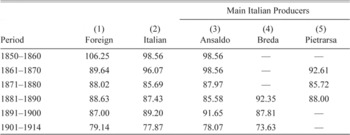
The WHP index is characterized by a decreasing trend, reflecting technical progress for both domestic and foreign locomotives. The first period (1850–1868) has wide fluctuations, which is an outcome of the limited sample size. The three decades from 1868 to 1898 shows substantial stability, with a rapid acceleration from 1898 to 1913. This pattern is not surprising. Railways, in Italy as elsewhere, were first laid out across the plains. Conquering the mountains required more powerful locomotives and better railway infrastructures, including tracks, bridges, and embankments. The rapid acceleration observed in this last phase is concomitant with the introduction of two major technical innovations: compounding and super-heating (Tey Reference Tey1910, pp. 28–36; Diegoli Reference Diegoli1961, pp. 108–9), both of which reduced the weight-to-power ratio. Compounding and super-heating were the key features of the “second-generation” of steam locomotives.Footnote 12 Compound locomotives were adopted in 1894 by the Rete Mediterranea and only later by its competitor, Rete Adriatica. Table 2 complements Figure 3 by reporting the average WHP by decade separately for foreign and domestic producers; figures on the main Italian producers of the time are also reported in columns 3–5.
THE WEIGHT-TO-POWER INDEX (WHP), 1850–1913Footnote 1

a The table reports the average value of WHP. The dash denotes missing data in our sample. Breda was only created in mid-1880s, Pietrarsa switched from new production to maintenance in the 1890s.
Source:
See text.
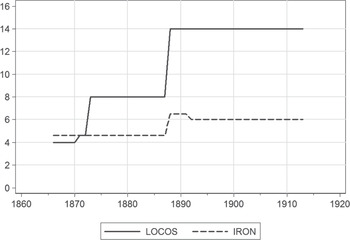
IMPORT DUTIES ON IRON AND STEAM LOCOMOTIVES: 1865–1913 (LIRE PER 100 KG)

The evidence presented so far is not consistent with the limited engineering capacity suggested by the prevailing literature (on this point see Fenoaltea Reference Fenoaltea2011, p. 150). Rather it supports contemporary views arguing that, at least from the late 1870s, Italian manufacturers were indeed capable of designing and producing steam locomotives of quality fully comparable to that of foreign competitors, or, more precisely, of the models of locomotives that English, French, and German manufacturers were importing in Italy. For example, at a conference for the 1881 Milan Exposition, Professor Leonardo Loria stated:
The national locomotives are perfectly equal, both in terms of manufacturing and assembling of components, to the best foreign locomotives … . Our locomotives are not anymore mere imitation of foreign locomotives, manufactured assembling a number of components imported from abroad, rather they are locomotives fully adapted to the special conditions of our railway network, almost completely manufactured by us, where our engineers introduce important innovations … . And, as far as the cost of production is concerned, today we are not far away from foreign firms. (Loria Reference Loria and Brioschi1881, pp. 76–77)
Additional corroboration of this point can be found in the detailed account of Cornolò who mentions other models of locomotives (such as the “Ariosto” or the “Frescot”) designed during the 1870s and early 1880s that were crowned with critical acclaim at international exhibitions, and in the engineering literature.Footnote 13
Government Policy
The domestic production of locomotives increased over the nineteenth century. In this section, we examine the impact of government policy on the growth of the industry. Interestingly, from 1870 to 1885, several parliamentary select committees (PSCs) debated alternative forms of State intervention to sustain the national industry. Of particular relevance here are the early 1870s PSC “on industry,” the late 1870s PSC “on railways,” and the mid-1880s PSC “on the revision of the trade tariff.”
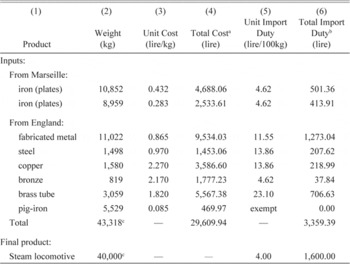
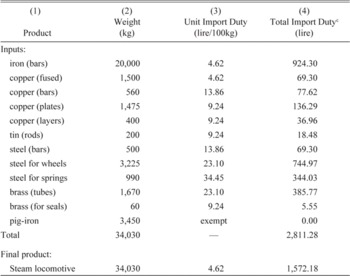
The PSC “on industry” (Comitato dell'inchiesta industriale) investigated the capacity to compete with foreign producers and the ways in which custom duties increased domestic competitiveness.Footnote 14 The engineering sector was one of the most debated with many observers and practitioners (including businessmen, managers, and engineers) interviewed. The main locomotive producers were Ansaldo (near Genoa, established in 1854) and Pietrarsa (near Naples, established in 1842). They were asked about the effects of import duties on the domestic production of steam locomotives. Both Ansaldo and Pietrarsa argued that the tariff structure worked against the domestic production of locomotives.Footnote 15 Tables 3 and 4 reproduce the evidence referring to the Pietrarsa (Naples) and Ansaldo (Genoa) workshops.Footnote 16
Table 3 reports the cost structure of a typical locomotive of the Pietrarsa workshop. Column 2 shows that some 70 percent of a “standard” steam locomotive was made of iron, while the remaining 30 percent was of pig-iron, brass-tubes, copper, steel, and bronze. Column 4 reports the total physical cost of production (excluding labor and transport costs). The total cost of materials was 29,610 lire, and 32,970 lire once import duties are included (corresponding to a 10 percent increase). The last line shows that the import duty on a steam locomotive considered as a finished product amounted to 4 lire per 100 kg. With a total weight of 40 tons, the import duty amounted to 1,600 lire.Footnote 17 The tariff's structure, therefore, implied an additional cost of 3,360 lire for domestically-produced locomotives relative to 1,600 lire for imported locomotives, resulting in a negative protection for Italian locomotive producers.
IMPORT DUTIES IN THE EARLY 1870S: PIETRARSA (NAPLES)

a Col. 4 = col 3 ∗ col. 2. Once labor costs (21,974.45 lire) and transport costs (2,172.51 lire) are included, total costs amount to 53,752 lire.
b Col. 6 = col. 2 ∗ col. 5 / 100.
c The number of kilograms reported in the table (43,318 kg) refers to the weight of the inputs used to build a “standard” locomotive. Given the loss of weight of materials tied to the production process (called sfrido in the technical jargon) the final weight of the locomotive is lower than 43,318 kg. For the sake of simplicity, the sources typically omit to consider the sfrido.
Source:
Comitato dell'inchiesta industriale (1872, p. 58); Camera dei Deputati (Reference Camera dei1871, p. 112).
Table 4 reports similar data provided by Ansaldo. For a standard “1858 Government type” locomotive, the import duties on raw materials were 2,811 lire, well above the 1,570 lire paid as duty to import the same locomotive from abroad. Although the calculations by Ansaldo are extremely coarse, they show that in the early 1870s at least one-half of a locomotive was made up of highly-protected-iron, amounting to a negative protection.
IMPORT DUTIES IN THE EARLY 1870S: ANSALDO (GENOA)

c Col (4)= col (2)∗ col(3)/100
Source:
Comitato dell'inchiesta industriale (1873, p. 43).
The PSC “on industry” concluded that: “there is no balance between the (“high”) tariff on iron and the one (“low”) on machines”; therefore “it is necessary to reduce the tariff on iron,” or “alternatively, it is necessary to raise the tariff on machines” (Comitato della inchiesta industriale 1874, p. 6). In fact, both the duties on iron and locomotives were raised over time. In the subsequent PSC “on railways” (Commissione d'inchiesta sull'esercizio delle ferrovie italiane), Pietro Peirano, a manager of Ansaldo confirmed that the key factor forcing his company to give up the production of locomotives was the penalty induced by the tariff rather than the lack or backwardness of technological competency.Footnote 18 Ansaldo and Pietrarsa's delegates were also consulted by the PSC on “the revision of international trade tariff” (Commissione d'inchiesta per la revisione della tariffa doganale) instituted in the mid-1880s and reaffirmed that the cost of protecting the metal-making sector (with high import duties on iron and other production inputs) represented a still too heavy burden for the engineering sector.Footnote 19
Net Protection on Steam Locomotives
Figure 3 shows that subsequent tariff reforms—above all that of 1887—gradually ensured a positive protection to the Italian producers of steam locomotives. The vertical distance between the continuous and dashed line provides a measure of the net-protection on steam locomotives. Obviously the measure is rough for several reasons. Iron was not the only input in the production of a steam locomotive, though most relevant in terms of weight. Second, Italian import duties were mainly tied to weight (not to value), and thus less effective the higher the price of imported goods. Finally, but importantly, the inputs' weight losses occurring during the production process are not considered. Including them would shift the dashed line upward perhaps by as much as 20–30 percent.Footnote 20 Despite these limitations, Figure 3 tentatively suggests that the net protection on steam locomotives became positive over time: a consequence of the increase, in different proportions, both of the import duties on iron and locomotives. Import duties on steam locomotives were raised from 4 to 4.62 lire in 1871; 4.62 to 8 lire in 1873; 8 lire to 14 from 1888. Import duties on iron were raised from 4.62 lire to 6.50 in 1888 and then lowered to 6.00 lire from 1892.Footnote 21
To sum up, the evidence we have discussed so far suggests that the structure of the tariff rather than alleged technological backwardness represented the main bottleneck stifling the expansion of the industry up to mid-1880s (Figure 2).Footnote 22 This became less stringent as the effective rate of protection on steam locomotive rose in the late 1880s.Footnote 23 The growth in production after 1885 is generally seen as the result of two policy changes. The first is the aforementioned 1887 reform of the tariff, raising the import duty on steam locomotives from 8 to 14 lire per 100 kg.Footnote 24 The second is the 5 percent clause introduced by the Railways Conventions of 1885, which required that locomotives procurement contracts should be assigned to national manufacturers if their prices were less than 5 percent higher than the best offer of foreign competitors.Footnote 25 This is a point of contention in the literature: several historians argued that the 5 percent clause was probably too weak to exert a major impact (Gerschenkron Reference Gerschenkron1962, p. 371; Caizzi Reference Caizzi1965, p. 381; and Papa Reference Papa1973, pp. 50–51), but the most recent contributions such as Merger (Reference Merger1986, p. 84), Giovanni Federico and Renato Giannetti (Reference Federico, Giannetti, Amatori, Bigazzi, Giannetti and Segreto1999, p. 1134), and Giannetti and Michelangelo Vasta (Reference Giannetti and Vasta2012, p. 226) claim rather that the clause played an important role in the “take-off” of domestic production of steam locomotives after 1885.
The Silent Procurement Policy, 1885–1899
There are, however, two other features of the Railway Conventions of 1885 that have received only limited attention in the literature, but are possibly far more important than the 5 percent clause and the revision of the tariff in accounting for the expansion of the domestic production. The first is the special endowment of 15 million lire granted, with the reorganization of the railway system in 1885, to the three major operating companies to purchase railway equipment and material and also to renew their locomotive fleet (Merger Reference Merger1986, p. 81). The second is the active procurement policy that was put in place after 1885, which, although not established by law, amounted to favoritism of “national champions” well beyond the preference arising from the 5 percent clause.
The point is clearly stated in an official publication of the “public works” ministry explicitly acknowledging that a segment of the Italian market for locomotives was to be reserved for national manufacturers:
In the case of locomotives the protection afforded by the aforementioned article [i.e., the five per cent clause], was not sufficient to allow national firms to win procurement contracts and, even a higher protection would have not been enough. Hence, in order to encourage the Italian locomotive industry, which is still in its infancy and it is practiced by very few firms that are now constructing the plants necessary to win against foreign competition, several procurement contracts have been assigned to these firms by means of private deals, fixing prices in such a way to allow these firms to manufacture locomotives without making losses and not making a too heavy burden for the State. (Ministero dei lavori pubblici 1889, pp. 501–2)
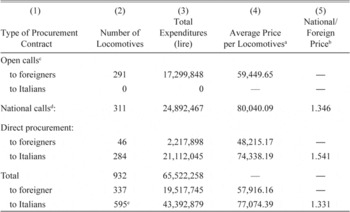
The 5 percent clause introduced by the Railway Conventions of 1885 was to be applied to contracts assigned by means of formal competitive calls (“licitazione”), but the franchise companies could also procure locomotives directly from the manufacturers outside of the competitive system as illustrated in Table 5.
ACQUISITIONS OF NEW LOCOMOTIVES: EXPENDITURE AND AVERAGE PRICE BY TYPES OF PROCUREMENT, 1885–1899

a Col. 4 = col. 3/col. 2.
b The national to foreign price ratio was obtained (rounding errors apart) as follows: (80,040.09/59,449.65) = 1.346; (74,338.19/48,215.17) = 1.541; (77,074.39/57,916.16) = 1.331.
c Open calls (“licitazioni internazionali”) were opened to both foreign and Italian producers
d National calls (“licitazioni nazionali”) were reserved for Italian producers.
e The figure (595) also includes 32 locomotives built by the Mediterranea (30) and Adriatica (2) in their own workshops, accounting for a total value of 2,611,631.62 lire.
Source:
Ministero dei lavori pubblici (1901, pp. 202–9).
Two points merit attention. Columns 4 and 5 show clearly that the 5 percent clause was insufficient to tilt the price advantage in favor of national manufacturers. Second, a significant stimulus to the national industry was implemented by means of special deals.Footnote 26 In particular, from the Railway Conventions of 1885 to 1900, the domestic production of steam locomotives was assigned either by national auctions (284 units out of 595) or by private negotiations (311 units out of 595). To be sure, the price of foreign locomotives was lower than national ones, particularly so in the case of locomotive awarded through direct procurement contracts (about 74 thousands lire against about 48 thousands lire). Most likely, this price differential reflected both the possible higher efficiency of foreign producers, but also the existence of implicit agreements guaranteeing high prices to Italian producers.
The adoption of stronger protectionist measures to favor Italian producers appears to be a leitmotiv of the parliamentary discussions.Footnote 27 Despite various calls to exclude foreign locomotives, the government rejected such outright protection. However, the government agreed that, while the various forms of tariff protection were not sufficient, the most critical issue was the irregularity of demand. Informed contemporaries identify in the small and irregular number of orders the main problem affecting the cost competitiveness of national manufacturers. In 1881 Giuseppe Colombo wrote:
The convenient manufacturing of steam locomotives requires a demand of at least 50 units per year, and a workshop with the most sophisticated and specialized machinery. Two such workshops would probably suffice to supply the needs of whole Italian railway network. Given the methods of locomotives production prevailing today also in the major foreign firms, where many components are directly purchased by iron producers or other specialized manufacturers and … given the proved ability of Italian producers in both new productions and maintenances … the success of such undertaking in Italy would be, no doubt, possible. (Colombo Reference Colombo and Brioschi1881, p. 67)
A similar point was also stressed, a quarter century later, in the 1908 celebratory volume for the 1,000th locomotive constructed by Breda:
The technical difficulties that Breda had to face daily were exacerbated by two key factors: the fierce competition from foreign producers, and the irregular and discontinuous nature of the orders. (Società Italiana Ernesto Breda 1908, p. 22)
These statements suggest that more than the shield of tariff-based protection (with positive net protection effectively achieved from the late 1880s) it was the irregularity of demand that stymied the Italian manufacturers of steam locomotives during the nineteenth century.Footnote 28
In this context, the Railway Conventions of 1885 played a critical role in reassuring the two main national manufacturers (Ansaldo and Breda) that the new political environment was going to be quite favorable to domestic producers of locomotives. This resulted in an expansion of the productive facilities of both firms so that domestic production increased relatively swiftly from a few units to more than a hundred units.Footnote 29
THE BIRTH OF THE FERROVIE DELLO STATO (1905) AND THE NEW RAILWAYS POLICY
The late nineteenth-century parliamentary debates on railways had important consequences in terms of actual economic policies. The government presented a plan concerning the acquisition of new rolling stock for the years 1900–1904. It was established (article 9 of law no. 57 of 27 February 1900) that the quantity, quality, and expenditure for new purchases of locomotives had to be agreed between the State and the operating companies. Furthermore, during the same five year period, the Government provided the companies a non-repayable grant of 28 million lire, reinforcing thus its role as chief sponsor of the railway sector. Not surprisingly, it has been remarked that the railway plan of 1900 represented the greater State commitment towards railway since the unification (Papa Reference Papa1973, p. 50). In 1905, the 20-year contract between the State and the operating companies (the Railways Conventions of 1885) was not renewed and the State assumed the direct management of the railway system through the creation of Ferrovie dello Stato (FS), a fully public company.
The rules of the game were changed considerably. The new legislation established that “the Government will assign the production of new rolling stock to national manufacturers … safeguarding, other things being equal, a fair distribution among the various producers” and “whenever necessary … the executive manager [of the newborn FS] can disregard open and national call and use private negotiations …”, but importantly, “in case of collusive behavior or any kind of fraud by national manufacturers to the detriment of the railway administration [that is the FS], or when it will not be possible for national producers to guarantee a fair price of rolling stock, according to the prevailing market conditions, then … [the Government] … will order new rolling stock to foreign producers.”Footnote 30 Two points deserve attention. The first is that the tool of direct procurement to assign orders to national producers was explicitly institutionalized. The second is that the State intended to use international auctions as a threat to limit “extortionary” pricing by national producers.Footnote 31 While the protection of the national industry was thus confirmed and even reinforced, a more rigorous expenditure policy was put in place.
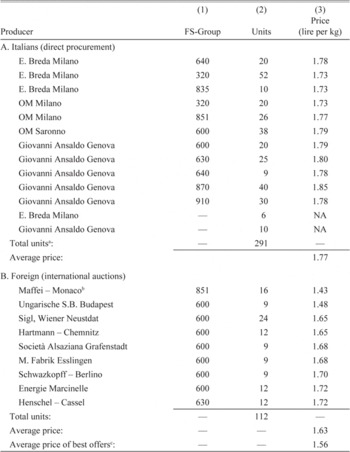
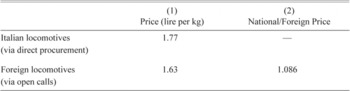
Tables 6 and 7 document the effects of the new FS regime on locomotive acquisitions and prices. Table 6 provides quantity and price data from an official 1906 report.Footnote 32 A total of 291 locomotives were assigned to national producers by direct procurement contracts, and 112 to foreign producers through international auctions. Table 7 provides an assessment of the price gap between national and foreign manufacturers in 1906. It shows that by 1906 the price gap was only about 9 percent, significantly lower than in the 1885–1899 period.Footnote 33
To summarize, with the creation of the FS in 1905, the State implemented a new policy mix capable to stimulate the national industry, by directly assigning to local producers new locomotive orders, and, at the same time, to safeguard the State budget by linking the price effectively paid to national producers to the best offers of foreign producers.Footnote 34 Foreign purchases were used to investigate the price of locomotives and to absorb demand peaks, as the one occurred in 1907–1908 when about 900 locomotives entered the FS locomotive fleet.
DOMESTIC AND FOREIGN PRICES OF 403 LOCOMOTIVES ORDERED IN JANUARY 1906, BY NATIONALITY OF THE PRODUCER

a The total does not include one locomotive ordered to Breda and one to Ansaldo to be exhibited during the Milan 1906 exposition (Camera dei Deputati 1906a, p. 11).
b A few locomotives were sold by Maffei at the price of 1.50 lire per kg (Camera dei Deputati 1906a, p. 12).
c Following Camera dei Deputati (1906c, p. 13), and article 34 of Law 429 7 July 1907 on the “State management of the railway sector”) the average price of best offers is equal to 1.56 lire per kg and computed as (1.43+1.48+1.65 +1.68)/4.
Source:
Source: See text.
PRICE OF 403 LOCOMOTIVES ORDERED IN JANUARY 1906, AND TO BE DELIVERED BETWEEN JULY 1906 AND JUNE 1907

Source:
Source: Camera dei Deputati (Reference Camera dei1906a, p. 5).
CONCLUDING REMARKS
Notwithstanding the limited endowment of the country in terms of engineering competences, the Italian steam locomotive industry achieved a level of technological sophistication in line with that of foreign producers by the beginning of the twentieth century. The early development of the industry was slowed both by the vagaries of the demand which prevented the major national players from planning an ordered expansion of productive capacity and, secondly, by tariff protection on iron products, which resulted in a cost disadvantage. From 1885 onwards national manufacturers received considerable support through a discretionary procurement policy which in practical terms amounted to an effective “non-tariff barrier” and to a more regular demand for their products, tied to the spread of the railways network leading to greater economies of scale.
The design and construction of locomotives were probably among the most sophisticated segments of the nineteenth century mechanical engineering industry and it is instructive to compare the performance of the locomotive industry with other less sophisticated branches such as cotton textile machinery where the country was unable to develop any autonomous production (Besso Reference Besso1910, pp. 142–43; A'Hearn Reference A'Hearn1998). Yet, there were also other complex engineering products in which Italy was also able to deliver a very good performance, such as the production of war-ships (Fenoaltea Reference Fenoaltea2011, p. 150), some of which were even exported. This somewhat paradoxical outcome can be explained taking into account that some of the most sophisticated branches of the mechanical engineering could endure the negative effects of the tariff, by virtue of non-tariff trade barriers such as public procurement, subsidies, and other similar policies, whereas the less sophisticated branches had to bear its full burden.
Appendix AThe Steam Locomotives Dataset
The steam locomotives dataset is based on two major components. The first one is constructed with the same approach and sources used in Ciccarelli and Fenoaltea (Reference Ciccarelli and Fenoaltea2012) for their statistical reconstruction of Italy's rail-guided vehicles industry.Footnote 35 The second component is entirely new and covers indicators of technical characteristics and performances of locomotives.
The main source for the first component of the dataset is constituted by the catalogues of the principal companies operating the railways system at different moments in time. Catalogues of this kind were published from the late 1880s by three main operating companies (Rete Adriatica (RA), the Rete Mediterranea (RM), and the Rete Sicula (RS)).Footnote 36 A similar catalogue was published in 1914 by the Ferrovie dello Stato (FS), providing an exhaustive list of locomotives in operating service at the date of 30 June 1914.Footnote 37 The catalogues set out the technical characteristics of each type of locomotive in service together with a numerical identifier, the year of construction, and the name of the building company. Our dataset is constructed by merging the relevant quantitative information stored in these four publications.
The second component of the dataset concerns technical features. For each locomotive model (Gruppo FS) we have retrieved the information on locomotives' weight and power (measured in HP) from Cornolò (Reference Cornolò1998, pp. 584–99).
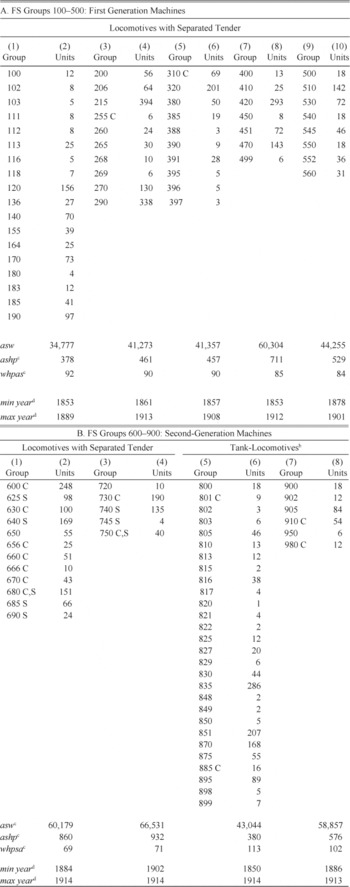
The WHP calculations presented in the previous Patterns of technical change section refer to 4,432 steam locomotives with separated tenders; the remaining 1,268 tank-locomotives (locomotives carrying water and coal on board instead of pulling them behind in a separated tender), with a WHP far higher and well above 100, are excluded.Footnote 38 Locomotives in our sample are grouped according to a classification scheme adopted by the Ferrovie dello Stato (FS) in 1905.
Table A1 illustrates the distribution of locomotives in our sample by (104) locomotive groups. The table includes two panels. Panel A includes locomotive groups from 100 to 560; these are mostly of “first-generation” (i.e., using single expansion and saturated, or “wet” steam). Panel B refers to groups from 600 to 980, and includes mostly “second generation” locomotives (i.e., adopting super-heating and/or double-expansion). The table's columns are numbered as follows. Odd numbers refer to locomotive groups. Even numbers refer to the units of locomotives within a given group. Locomotive groups included in the same column are similar in terms of technical characteristics (speed, power, weight, wheels arrangement, etc.). The bottom part of Table A1, panels A and B report the average sample weight, the average sample power, and the power-to-weight-ratio evaluated at the sample average.

 where A = TFP levels; W = real wages; R = rental cost of capital; C = raw materials and α, β, and γ are the shares of labor, capital, and raw material in total costs. The suffix ∗ indicates the foreign country. Assuming that the rental cost of capital was the same in the two countries, using the data in