1. Introduction
Nektaspida Raymond, Reference Raymond1920 is a clade of artiopod euarthropods that were major constituents of Cambrian marine ecosystems, especially during Epoch 2 (Dzik & Lendzion, Reference Dzik and Lendzion1988; Hou & Bergström, Reference Hou and Bergström1997; Budd, Reference Budd1999; Zhang et al. Reference Zhang, Shu and Erwin2007; Paterson et al. Reference Paterson, Edgecombe, García-Bellido, Jago and Gehling2010) and the Miaolingian Epoch (Whittington, Reference Whittington1977, Reference Whittington1985; Mayers et al. Reference Mayers, Aria and Caron2019). However, nektaspids are only rarely found in the younger strata of the Ordovician (Hammann et al. Reference Hammann, Laske and Pillola1990; Fortey & Theron, Reference Fortey and Theron1994; Budil et al. Reference Budil, Fatka and Bruthansová2003; Van Roy et al. Reference Van Roy, Orr, Botting, Muir, Vinther, Lefebvre, El Hariri and Briggs2010, Reference Van Roy, Briggs and Gaines2015 a; Van Roy, Reference Van Roy2013) and Silurian (Caron et al. Reference Caron, Rudkin and Milliken2004) systems. Nektaspida is generally considered to contain three families – Naraoiidae, Liwiidae and Emucarididae (Paterson et al. Reference Paterson, Edgecombe, García-Bellido, Jago and Gehling2010, Reference Paterson, García-Bellido and Edgecombe2012; Legg et al. Reference Legg, Sutton and Edgecombe2013; Mayers et al. Reference Mayers, Aria and Caron2019) – and the genus Buenaspis (Lerosey-Aubril et al. Reference Lerosey-Aubril, Zhu and Ortega-Hernández2017; Chen et al. Reference Chen, Ortega-Hernández, Wolfe, Zhai, Hou, Chen, Mai and Liu2019). In addition to these three families, recent phylogenetic analyses have suggested that Nektaspida may also include other artiopods not traditionally classified with this clade, such as Petalopleura, Saperion, Tegopelte (Mayers et al. Reference Mayers, Aria and Caron2019), Phytophylaspis, Panlongia (Legg et al. Reference Legg, Sutton and Edgecombe2013; Hou et al. Reference Hou, Williams, Sansom, Siveter, Siveter, Gabbott, Harvey, Cong and Liu2018) and Campanamuta (Legg et al. Reference Legg, Sutton and Edgecombe2013). Consequently, they have been central to discussions of the first appearance and expanding diversity of euarthropods, and of animals more broadly, during the radiations of the Cambrian Period (Budd et al. Reference Budd, Butterfield and Jensen2001; Marshall, Reference Marshall2006; Daley et al. Reference Daley, Antcliffe, Drage and Pates2018). The possession of a non-biomineralized exoskeleton (Hammann et al. Reference Hammann, Laske and Pillola1990; Edgecombe & Ramsköld, Reference Edgecombe and Ramsköld1999), together with changes in their habitat preferences (e.g. Hammann et al. Reference Hammann, Laske and Pillola1990), could explain such scarcity in the fossil record after the Miaolingian Epoch, after which time soft-tissue preservation declines in abundance and quality (Brasier et al. Reference Brasier, Antcliffe, Callow, Allison and Bottjer2011; Gaines et al. Reference Gaines, Hammarlund, Hou, Qi, Gabbott, Zhao, Peng and Canfield2012; Peters & Gaines, Reference Peters and Gaines2012; Daley et al. Reference Daley, Antcliffe, Drage and Pates2018). Consequently, the diversity of nektaspids in post-Cambrian ecosystems is low, but this seems likely to be a result of taphonomic bias, rather than representing a true evolutionary absence.
Similar bias occurs in our knowledge about the morphology and anatomy of nektaspid soft parts. The detailed information regarding morphology of the appendages, ventral sternites and digestive system is largely restricted to the Family Naraoiidae (Whittington, Reference Whittington1977; Chen et al. Reference Chen, Edgecombe and Ramskold1997; Vannier & Chen, Reference Vannier and Chen2002; Mayers et al. Reference Mayers, Aria and Caron2019; Zhai et al. Reference Zhai, Edgecombe, Bond, Mai, Hou and Liu2019). In the family Emucarididae, only cephalic appendages have been described by Paterson et al. (Reference Paterson, Edgecombe, García-Bellido, Jago and Gehling2010). In Liwiidae, a pair of antennae were figured in Liwia plana (Lendzion, Reference Lendzion1975) (see Dzik & Lendzion, Reference Dzik and Lendzion1988), but the data regarding post-antennal appendages are missing. This lack of morphological and anatomical information hinders our understanding of the phylogeny and ecology of the Nektaspida and the Artiopoda more broadly.
Here Tariccoia tazagurtensis sp. nov. is described from the Lower Ordovician (Tremadocian) Fezouata Shale Konservat-Lagerstätte of Morocco. This is the first species of Liwiidae (and of Nektaspida) to be described from the Lower Ordovician strata. Tariccoia tazagurtensis sp. nov. shows strong similarity with Tariccoia arrusensis Hammann et al., Reference Hammann, Laske and Pillola1990 from the Upper Ordovician strata of Sardinia (Italy). The first description of the anterior digestive glands in Liwiidae is also presented, augmenting knowledge of soft parts in Nektaspida. Moreover, we evaluate palaeogeographic distribution patterns and habitat preferences in this euarthropod group.
2. Geological settings
The Fezouata Shale is a sequence of Lower Ordovician strata geographically belonging to the Anti-Atlas region of Morocco. North of Zagora, the Lower Ordovician strata are exposed in the Ternata plain, forming the Tremadocian – early Darriwilian Outer Feijas Shale Group (Choubert et al. Reference Choubert, Termier and Termier1947; Destombes et al. Reference Destombes, Hollard and Willefert1985). The Outer Feijas Shale Group unconformably overlies middle Cambrian sandstones of the Tabanite group and underlies the First Bani Group (Middle Ordovician; Destombes et al. Reference Destombes, Hollard and Willefert1985; Martin et al. Reference Martin, Pittet, Gutiérrez-Marco, Vannier, El Hariri, Lerosey-Aubril, Masrour, Nowak, Servais and Vandenbroucke2015). The Outer Feijas Shale Group is subdivided into the Lower Fezouata Shale formation, the Upper Fezouata Shale formation, the Zini sandstone and quatzite formation, and the Tachilla Shale formation (Destombes et al. Reference Destombes, Hollard and Willefert1985).
In the Zagora area, the boundary between the Lower and the Upper Fezouata formation is unclear, with both formations grouped into a single, 850-m-thick unit called the ‘Fezouata Shale’ (Martin et al. Reference Martin, Vidal, Vizcaïno, Vaucher, Sansjofre, Lefebvre and Destombes2016). The Fezouata Shale contains the only known Konservat-Lagerstätte from the Lower Ordovician strata, providing a critical link between the evolutionary events of the Cambrian Explosion and the Great Ordovician Biodiversification Event (Servais et al. Reference Servais, Owen, Harper, Kröger and Munnecke2010; Landing et al. Reference Landing, Antcliffe, Geyer, Kouchinsky, Bowser and Andreas2018; Servais & Harper, Reference Servais and Harper2018). The Fezouata Shale is renowned for its exceptional preservation of non-biomineralized body fossils and contains more than 160 different genera (Van Roy et al. Reference Van Roy, Orr, Botting, Muir, Vinther, Lefebvre, El Hariri and Briggs2010, Reference Van Roy, Briggs and Gaines2015 a, b; Saleh et al. Reference Saleh, Antcliffe, Lefebvre, Pittet, Laibl, Gueriau, Perez Peris, Lustri and Daley2020). The exceptional preservation occurs in two horizons (Martin et al. Reference Martin, Vidal, Vizcaïno, Vaucher, Sansjofre, Lefebvre and Destombes2016; Lefebvre et al. Reference Lefebvre, Gutiérrez-Marco, Lehnert, Martin, Nowak, Akodad, El Hariri and Servais2018), the lower interval of which is about 70 m thick and situated 260–330 m above the Cambrian–Ordovician contact, and the second of which is about 50 m thick and 570–620 m above the Cambrian–Ordovician contact. With exceptional preservation, the lower interval is situated mostly within the Araenograptus murray Zone and lowermost parts of the Hunnegraptus copiosus Zone, which both correspond to a late Tremadocian age (Stage slice Tr3, see Gutiérrez-Marco & Martin, Reference Gutiérrez-Marco and Martin2016; Lefebvre et al. Reference Lefebvre, Gutiérrez-Marco, Lehnert, Martin, Nowak, Akodad, El Hariri and Servais2018). This age is further corroborated by acritarchs and conodonts that also support a latest Tremadocian age for this level (Lehnert et al. Reference Lehnert, Nowak, Sarmiento, Gutiérrez-Marco, Akodad and Servais2016; Nowak et al. Reference Nowak, Servais, Pittet, Vaucher, Akodad, Gaines and Vandenbroucke2016). With exceptional preservation, the upper interval most likely belongs to the ?Baltograptus jacksoni Zone of Floian age (Lefebvre et al. Reference Lefebvre, Gutiérrez-Marco, Lehnert, Martin, Nowak, Akodad, El Hariri and Servais2018).
The Fezouata Shale is generally composed of argillites with blue-green to yellow-green sandy mudstone and siltstone interbeds (Destombes et al. Reference Destombes, Hollard and Willefert1985). It is interpreted to have been deposited around storm wave-base, in an open shallow-marine environment (Martin et al. Reference Martin, Pittet, Gutiérrez-Marco, Vannier, El Hariri, Lerosey-Aubril, Masrour, Nowak, Servais and Vandenbroucke2015), ranging from proximal offshore to foreshore with a depth range of 50–150 m (Martin et al. Reference Martin, Pittet, Gutiérrez-Marco, Vannier, El Hariri, Lerosey-Aubril, Masrour, Nowak, Servais and Vandenbroucke2015; Vaucher et al. Reference Vaucher, Martin, Hormière and Pittet2016). The fluctuations of the water level are of low amplitude, but it is possible to recognize the deepest depositional environment in the middle of the Fezouata Shale (Martin et al. Reference Martin, Vidal, Vizcaïno, Vaucher, Sansjofre, Lefebvre and Destombes2016).
3. Materials and methods
Two specimens assigned here to Tariccoia tazagurtensis sp. nov. were studied. Both specimens are covered by iron oxides and/or hydroxides and preserved as compressions in shales. To expose the whole individual, the parts were mechanically prepared with a Micro-Jack 4 equipped with a 4/16″ chisel. Photographs were taken with a digital camera Olympus E-PL8 with associated Olympus M.Zuiko 30 mm f/3.5 macro lens. The lens was equipped with a polarizing filter to reduce reflections, and a second polarizer on the light source created crossed polarization to increase contrast. All specimens were photographed with low-angle NW lighting, both dry and immersed in ethanol (to increase contrast between rock and specimen). The images were subsequently processed in Adobe Photoshop CC 19.0, to enrich brightness, contrast, shadows, highlights and saturation. Line drawings were made directly from photographs using Adobe Illustrator CC 22.0.1, like a digital camera lucida (Antcliffe & Brasier, Reference Antcliffe, Brasier, Laflamme, Schiffbauer and Dornbos2011).
4. Systematic palaeontology
Order Nektaspida Raymond, Reference Raymond1920
Family Liwiidae Dzik & Lendzion, Reference Dzik and Lendzion1988
Emended diagnosis. Family of Nektaspida with the following combination of characters: three to four thoracic tergites that are narrower (tr) than the cephalic shield; first one or two thoracic tergites overlapped by cephalic shield; pygidium narrower than the cephalic shield, but of similar length to the cephalic shield.
Discussion. Liwiidae was originally proposed as a family, although not erected formally (Dzik & Lendzion, Reference Dzik and Lendzion1988). They used the presence of free thoracic tergites to distinguish it from Naraoiidae, which is characterized by the absence of articulating thoracic tergites. Fortey & Theron (Reference Fortey and Theron1994) instead included the liwiid genera Maritimella Repina & Okuneva, Reference Repina and Okuneva1969, Liwia Dzik & Lendzion, Reference Dzik and Lendzion1988, Tariccoia Hammann et al., Reference Hammann, Laske and Pillola1990 and Soomaspis Fortey & Theron, Reference Fortey and Theron1994 in the family Naraoiidae. They considered the presence of three or four free thoracic segments a plesiomorphic character of the group and not valid for designating a new family. Hou & Bergström (Reference Hou and Bergström1997) formally elevated Liwiidae to family level, but without providing a diagnosis. They included the genera Liwia, Tariccoia and Soomaspis in the Liwiidae. Budd (Reference Budd1999) defined family Liwiidae by having more than one axial articulation and added the genus Buenaspis Budd, Reference Budd1999. However, in recent phylogenetic analyses Buenaspis was always resolved either outside the Liwiidae, but inside Nektaspida (Legg et al. Reference Legg, Sutton and Edgecombe2013; Lerosey-Aubril et al. Reference Lerosey-Aubril, Zhu and Ortega-Hernández2017; Chen et al. Reference Chen, Ortega-Hernández, Wolfe, Zhai, Hou, Chen, Mai and Liu2019; Mayers et al. Reference Mayers, Aria and Caron2019), or even outside Nektaspida itself (Paterson et al. Reference Paterson, Edgecombe, García-Bellido, Jago and Gehling2010, Reference Paterson, García-Bellido and Edgecombe2012). Recently, most analyses resolve Liwiidae as a monophyletic group that is sister to Naraoiidae (Paterson et al. Reference Paterson, Edgecombe, García-Bellido, Jago and Gehling2010, Reference Paterson, García-Bellido and Edgecombe2012; Ortega-Hernández et al. Reference Ortega-Hernández, Legg and Braddy2013 b; Lerosey-Aubril et al. Reference Lerosey-Aubril, Zhu and Ortega-Hernández2017; Chen et al. Reference Chen, Ortega-Hernández, Wolfe, Zhai, Hou, Chen, Mai and Liu2019) or sister to Emucarididae (Legg et al. Reference Legg, Sutton and Edgecombe2013; Hou et al. Reference Hou, Williams, Sansom, Siveter, Siveter, Gabbott, Harvey, Cong and Liu2018). In the analysis of Mayers et al. (Reference Mayers, Aria and Caron2019), liwiids were resolved within Naraoidae, which led the authors to demote Liwiidae to the subfamily level and include it within the family Naraoidae. We prefer to keep Liwiidae at the family level for two reasons: (1) the topology presented by Mayers et al. (Reference Mayers, Aria and Caron2019) is the only analysis with Liwiidae resolved inside Naraoiidae in recent years; and (2) this topology also shows a low degree of nodal support in favour of the position of Liwiidae within Naraoiidae.
Genus Tariccoia Hammann et al., Reference Hammann, Laske and Pillola1990
Type species. Tariccoia arrusensis Hammann et al., Reference Hammann, Laske and Pillola1990; 100 m north of the mouth of the Roia Srappas into the Riu Is Arrus, c. 4 km SE of Fluminimaggiore (Sardinia, Italy); Riu is Arrus Member of the Monte Argentu Formation (Upper Ordovician, see Hammann & Leone, Reference Hammann and Leone1997).
Emended diagnosis. A genus of Liwiidae with the following combination of characters: cephalic shield sub-circular; four thoracic tergites with rounded lateral extremes; first one or two thoracic tergites overlapped by posterior margin of cephalic shield; pygidium longer than wide, with a long median keel and smooth (non-spinose) margin.
Remarks. The diagnosis of Tariccoia provided by Hammann et al. (Reference Hammann, Laske and Pillola1990) is now regarded as the diagnosis of the type species Tariccoia arrusensis Hammann et al., Reference Hammann, Laske and Pillola1990.
Discussion. Liwia differs from Tariccoia in its pointed tips of the thoracic tergites and sub-trapezoidal pygidium with well-defined axial part and with marginal spines. Soomaspis differs from Tariccoia by having only three thoracic tergites with articulating half-rings, an axial part defined on the trunk and a sub-circular pygidium showing five pleural furrows.
Tariccoia tazagurtensis sp. nov.
Figures 1–3
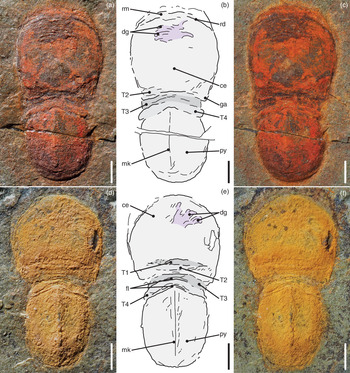
Tariccoia tazagurtensis sp. nov., Araneograptus murrayi Zone (Tremadocian, Lower Ordovician), Fezouata Shale, near Beni Zouli (Morocco). MGL 102155a, holotype, (a) photographed dry, (b) interpretative drawing and (c) photographed under ethanol. MGL 103036a, (d) photographed dry, (e) interpretative drawing and (f) photographed under ethanol. ce, cephalic shield; dg, digestive glands; fl, flange; ga, genal angle; mk, median keel; py, pygidium; rd, marginal ridge; rm, marginal rim; T1–T4, thoracic tergite one to four. Scale bar is 1 mm.

Zoobank no. urn:lsid:zoobank.org:act:E5DAD3BB-FD01-4F6B-8272-06583783276B
Material, locality, horizon. Holotype (Fig. 1a–c): MGL 102155a (part) and MGL 102155b (counterpart). Other material: MGL 103036a (part) and MGL 103036b (counterpart). Both specimens come from an outcrop located in the Ternata plain, c. 18 km NW of the city of Zagora (Morocco) and c. 6 km NNE of the village of Beni Zouli. The outcrop falls within the lower exceptional preservation interval of the Fezouata Shale (Araneograptus murrayi Zone, Tremadocian, Lower Ordovician). Material is stored in the collections of the Cantonal Museum of Geology (Lausanne, Switzerland). Exact locality data curated with the specimens.
Etymology. In Tamazight language, Tazagurt (ⵜⴰⵣⴰⴳⵓⵔⵜ in Neo-Tifinagh script) is a name for the city of Zagora near which the material was discovered. Tamazight is a language of the Amazigh people, an ethnic group that is indigenous to North Africa and who have a large population in the Anti-Atlas region of Morocco.
Diagnosis. A small (up to 8 mm long) species of Tariccoia having the following unique combination of characters: cephalon with pointed genal angles and marginal rim, pygidium with anterior margin curved forwards, a rounded posterior margin and a medial keel that does not reach posterior pygidial border.
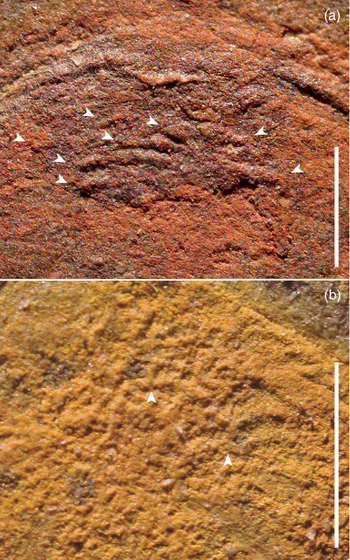
Description. The total exoskeletal length is 6.68 mm in specimen MGL 103036a and 7.24 mm in specimen MGL 102155a. Cephalic shield is sub-circular in outline and its sagittal length ranges between 3.04 mm in MGL 103036a and 3.39 mm in MGL 102155a, and transverse width between 3.47 mm in MGL 103036a and 3.79 mm in MGL 102155a. The anterior and lateral margins of the cephalic shield (‘ce’ in Fig. 1b, e) are rounded, and the posterior cephalic margin is anteriorly curved. The cephalic shield reaches its maximum width near the mid-length. A distinct anterior marginal cephalic rim (‘rm’ in Fig. 1b) is delineated by a sharp ridge (‘rd’ in Fig. 1b). The length of the cephalic rim extends to about one-fifth of the cephalic shield, being longest (sag) in the medial part. The postero-lateral edges of the cephalic shield form distinct, pointed genal angles (‘ga’ in Fig. 1b) with rounded tips. The dorsal surface of the cephalic shield is without trilobation, facial sutures or visual organs. The holotype MGL 102155a (Fig. 1a–c) shows raised finger-like structures (‘dg’ in Fig. 1b, see also Fig. 2a) that are connected medially and located in the anterior half of the cephalic shield. In specimen MGL 103036a (Fig. 1d, e), the surface of the cephalic shield preserves distinct, radially arranged, wrinkles (‘dg’ in Fig. 1e, see also Fig. 2b).
Tariccoia tazagurtensis sp. nov., Araneograptus murrayi Zone (Tremadocian, Lower Ordovician), Fezouata Shale, near Beni Zouli (Morocco); close-up of the anterior part of the cephalic shield of the holotype (a) MGL 102155a and (b) MGL 103036a. (a) Arrows pointing to proximal parts of digestive glands and (b) to bifurcation of digestive glands. Scale bar is 1 mm.

The thorax is comparatively narrow (tr), being approximately 70–80% of the width of cephalic shield. It is composed of four thoracic tergites, but the anterior two (1st and 2nd) tergites (‘T1’ and ‘T2’ in Fig. 1b, e) are overlapped by the posterior portion of the cephalic shield (‘ce’ in Fig. 1b, e), and consequently are not easily discernible in the holotype, but are clearly visible in MGL 103036a. The two posterior (3rd and 4th) thoracic tergites (‘T3’ and ‘T4’ in Fig. 1b, e) are completely exposed (Fig. 1a–f). In dorsal view all thoracic tergites are curved backwards and slightly downwards abaxially. The thoracic tergites become slightly wider (tr) and more curved posteriorly, so the 4th tergite is the widest and is in its medial part strongly deflected forwards. The first tergite seems to taper abaxially. No distinct axial lobe is visible in any of the tergites. The lateral extremes of each tergite end in rounded tips. No articulating facets or articulating half-rings are present in the thoracic tergites. The tergites seem to be articulated with each other by a narrow flange (‘fl’ in Fig. 1e) that is visible and runs along the anterior margin of the 3rd and 4th tergites (Fig. 1d–f), but is probably also present in the 1st and 2nd.
Pygidium (‘py’ in Fig. 1b, e) is sub-oval in outline, elongated and measures 3.08 mm (MGL 103036a) and 3.18 mm (MGL 102155a) in sagittal length and 2.52 mm (MGL 103036a) and 3.04 mm (MGL 102155a) in transverse width. Consequently, the pygidium is approximately 25% narrower than the cephalic shield, and is just slightly wider than the thorax. The anterior margin of the pygidium is curved forwards, exactly matching the posterior margin of the last thoracic tergite. A narrow flange (‘fl’ in Fig. 1e) runs along the anterior margin of the pygidium. The posterior margin of the pygidium is rounded. The central part of the pygidium is slightly inflated and slopes down abaxially and posteriorly. In its medial part, the pygidium carries a pronounced median keel (‘mk’ in Fig. 1b, e) that is nearly as long as the entire pygidium but does not reach its posterior margin.
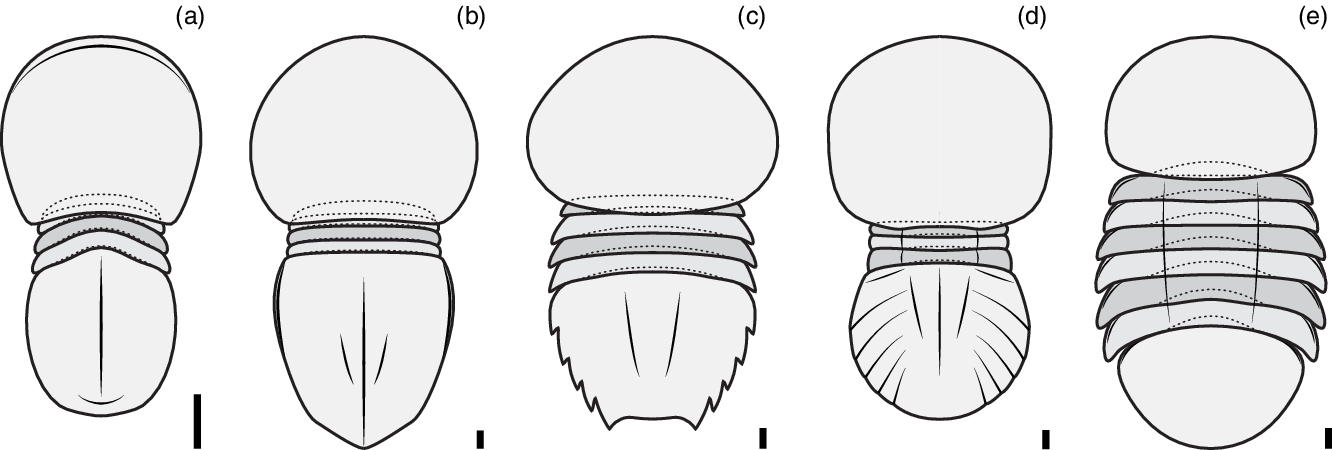
Discussion. Tariccoia tazagurtensis sp. nov. resembles Tariccoia arrusensis from the Ordovician strata of Sardinia (Hammann et al. Reference Hammann, Laske and Pillola1990; Hammann & Leone, Reference Hammann and Leone1997) in overall morphology of both the cephalon and pygidium, and in possessing four thoracic tergites with rounded lateral extremes. The differences between these two species are (see also Fig. 3a, b for comparison): (1) more pointed genal angles in T. tazagurtensis sp. nov.; (2) the cephalon with marginal rim in T. tazagurtensis sp. nov.; (3) the pygidium in T. tazagurtensis sp. nov. has anterior margin curved forwards and rounded posterior margin, while in T. arrusensis the anterior pygidial margin is nearly straight and the posterior margin is pointed; (4) the thoracic tergites are proportionally longer (sag.) and more curved in T. tazagurtensis sp. nov.; (5) the median keel in T. tazagurtensis sp. nov. does not reach the posterior pygidial margin, but does in T. arrusensis; and (6) the pygidium of T. tazagurtensis sp. nov. lacks the sharp lateral edges forming a ventral ridge seen in T. arrusensis (sensu Hammann et al. Reference Hammann, Laske and Pillola1990, text-fig. 4).
Reconstruction of members of the family Liwiidae Dzik & Lendzion, Reference Dzik and Lendzion1988 and the genus Buenaspis Budd, Reference Budd1999: (a) Tariccoia tazagurtensis sp. nov., Fezouata Shale, Morocco; (b) Tariccoia arrusensis Hammann et al., Reference Hammann, Laske and Pillola1990, Riu is Arrus Member of the Monte Argentu Formation, Sardinia; (c) Liwia plana (Lendzion, Reference Lendzion1975), Zawiszyn Formation, Poland; (d) Soomaspis splendida Fortey & Theron, Reference Fortey and Theron1994, Soom Shale, South Africa; (e) Buenaspis forteyi Budd, Reference Budd1999, Buen Formation, Greenland. Dotted lines represent underlying structures of the dorsal exoskeleton. Scale bar is 1 mm. Reconstruction of T. arrusensis, L. plana, S. splendida and B. fortey based on Hammann et al. (Reference Hammann, Laske and Pillola1990), personal observation, Fortey & Theron (Reference Fortey and Theron1994) and Budd (Reference Budd1999), respectively.

The sharp ridge that separates the marginal rim of the cephalon is one of the characters that distinguishes T. tazagurtensis sp. nov. from T. arrusensis. This structure is only preserved well in the holotype (MGL 102155, Fig. 1a, b). For this reason, it is not easy to interpret it unambiguously. This structure could also be interpreted as an imprint of the cephalic doublure or compaction-related deformation of the cephalic margin.
The exact number of thoracic tergites in T. tazagurtensis sp. nov. is not easy to determine, because the anterior thoracic tergites are overlapped by the cephalic shield. Such an overlap in Tariccoia, Liwia and Soomaspis was recognized by Edgecombe & Ramsköld (Reference Edgecombe and Ramsköld1999, character 9) and used as one of the synapomorphies of Liwiinae (= Liwiidae in this paper). Contrary to Edgecombe & Ramsköld (Reference Edgecombe and Ramsköld1999), we suggest that in Tariccoia the cephalic shield overlaps the first and also the second (at least partially) thoracic tergite. Usually two or at most three thoracic tergites are exposed in all articulated specimens of T. arrusensis, while specimens lacking the cephalic shield always show four (Hammann et al. Reference Hammann, Laske and Pillola1990, pl. 1–3; Hammann & Leone, Reference Hammann and Leone1997, pl. 1, figs 1–3). In some articulated specimens, however, the anterior one or two tergites are imprinted onto the posterior portion of the cephalic shield (Hammann et al. Reference Hammann, Laske and Pillola1990, pl. 1, figs 1, 2, 5). Similar exoskeletal configuration was likely present also in T. tazagurtensis sp. nov. Specimen MGL 103036a (Fig. 1d–f) clearly shows two posterior tergites, and traces of two more under the posterior part of the cephalic shield. Although the slightly different shape of the 1st thoracic tergite (Fig. 1d) in T. tazagurtensis sp. nov. resembles an articulating half-ring, the interpretation of it as a thoracic tergite is favoured for two main reasons. First, it is too wide to be an articulating half-ring, and second, it is quite similar to the shape of first thoracic tergite in T. arrusensis (cf. Hammann et al. Reference Hammann, Laske and Pillola1990, pl. 2, fig. 2a, b).
The articulation of individual thoracic tergites and of the pygidium was apparently facilitated by a structure morphologically similar to a flange as is known in the pleural parts of numerous, especially basal, trilobites (Whittington, Reference Whittington1989; Geyer, Reference Geyer1996; Esteve et al. Reference Esteve, Hughes and Zamora2013; Ortega-Hernández et al. Reference Ortega-Hernández, Esteve and Butterfield2013 a; Laibl et al. Reference Laibl, Esteve and Fatka2016). Such an articulation can be regarded as functionally simple, as no other articulation structures are present (e.g. articulating half-rings, fulcrum or articulating facet; cf. Bruton & Haas, Reference Bruton and Haas1997). With such a simple articulation, it seems unlikely that T. tazagurtensis sp. nov. was able to enrol, as the flange does not allow for rotation movement of arched structures, such as the thoracic tergites of T. tazagurtensis sp. nov.
5. Digestive system in Tariccoia tazagurtensis sp. nov.
There is currently little understanding of the soft anatomy in the Liwiidae. So far, only a pair of antennae were described for Liwia plana (Dzik & Lendzion Reference Dzik and Lendzion1988), and no other information of the postantennal appendages, the digestive system or the nervous system has been reported.
The holotype of T. tazagurtensis sp. nov. shows finger-like structures connected medially under the anterior half of the cephalic shield (Fig. 2a). We interpret these structures as the proximal parts of a pair of well-developed ramified digestive glands connected to an anterior part of the digestive tract. Both their preservation and morphology strongly resemble such structures as seen in Naraoia spinosa Zhang & Hou, Reference Zhang and Hou1985 from Chengjiang (cf. Vannier & Chen, Reference Vannier and Chen2002, fig. 2A, B; Zhang et al. Reference Zhang, Shu and Erwin2007, figs 28, 29). The distal ramification of the digestive glands is not preserved in the holotype, but the other specimen (MGL 103036a) shows numerous wrinkles, some of which seem to bifurcate distally (Fig. 2b). These are likely not compression-related wrinkles, which are usually concentric (cf. Hammann et al. Reference Hammann, Laske and Pillola1990; Budd, Reference Budd1999; Caron et al. Reference Caron, Rudkin and Milliken2004) or randomly orientated (Peng et al. Reference Peng, Babcock, Cooper, Gradstein, Ogg, Schmitz and Ogg2012), as opposed to radial in MGL 103036a. These structures therefore likely represent the distal parts of the ramified digestive glands. Digestive structures are known from Megistaspis (Ekeraspis) hammondi Corbacho & Vela, Reference Corbacho and Vela2010 and other trilobites from the Fezouata Shale (Van Roy et al. Reference Van Roy, Briggs and Gaines2015 a; Gutiérrez-Marco et al. Reference Gutiérrez-Marco, García-Bellido, Rábano and Sá2017), showing that preservation of gut features is possible at this locality. Preservation of internal soft tissues in general is relatively rare in the Fezouata Shale compared with other Burgess Shale-type preservations such as the Burgess and the Chengjiang Biota, and is usually only found in the presence of a mineralized or sclerotized external cuticle (Saleh et al. Reference Saleh, Antcliffe, Lefebvre, Pittet, Laibl, Gueriau, Perez Peris, Lustri and Daley2020), as is the case with trilobites and T. tazagurtensis, respectively.
Within Nektaspida the digestive system is known only in Naraoiidae and, until now, two different morphotypes have been recognized (Vannier & Chen, Reference Vannier and Chen2002): one with a long, extensively ramified anterior pair of digestive glands, present in species of Naraoia Walcott, Reference Walcott1912 and in Misszhouia canadensis Mayers et al., Reference Mayers, Aria and Caron2019 (see Vannier & Chen, Reference Vannier and Chen2002; Mayers et al. Reference Mayers, Aria and Caron2019), and one with only short digestive glands, present in Misszhouia longicaudata Zhang & Hou, Reference Zhang and Hou1985 (Vannier & Chen, Reference Vannier and Chen2002). Given that the digestive system of T. tazagurtensis sp. nov. resembles the ramified pattern seen in Naraoia and M. canadensis, we suggest that these morphologies are homologous. Indeed, the majority of phylogenies would suggest a single origin for the well-developed ramified digestive glands in both naraoids and liwiids (e.g. Paterson et al. Reference Paterson, Edgecombe, García-Bellido, Jago and Gehling2010; Ortega-Hernández et al. Reference Ortega-Hernández, Legg and Braddy2013 b; Lerosey-Aubril et al. Reference Lerosey-Aubril, Zhu and Ortega-Hernández2017; Mayers et al. Reference Mayers, Aria and Caron2019).
6. Distribution and habitat preferences in liwiids
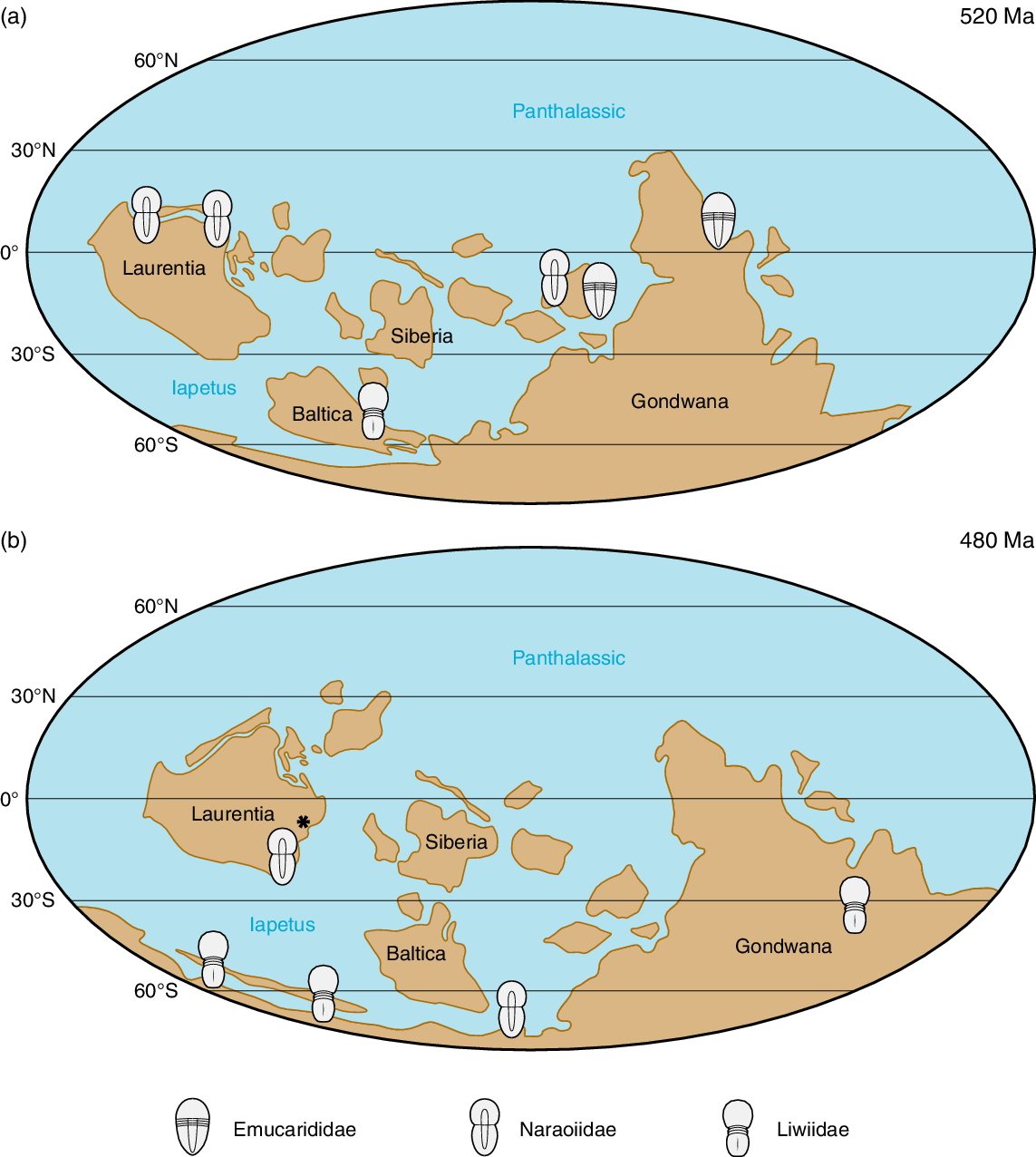
The distribution of liwiids shows a different pattern from that of other nektaspids (Fig. 4). Naraoiids have a comparatively wide distribution, being known from low latitudes of Laurentia/Laurussia (Whittington, Reference Whittington1977; Robison, Reference Robison1984; Caron et al. Reference Caron, Rudkin and Milliken2004; Schwimmer & Montante, Reference Schwimmer and Montante2007; Mayers et al. Reference Mayers, Aria and Caron2019; Lerosey-Aubril et al. Reference Lerosey-Aubril, Kimmig, Pates, Skabelund, Weug and Ortega-Hernández2020), South China (Chen et al. Reference Chen, Edgecombe and Ramskold1997; Hou & Bergström, Reference Hou and Bergström1997; Zhang et al. Reference Zhang, Shu and Erwin2007; Peng et al. Reference Peng, Babcock, Cooper, Gradstein, Ogg, Schmitz and Ogg2012; Fu et al. Reference Fu, Tong, Dai, Liu, Yang, Zhang, Cui, Li, Yun, Wu and Sun2019) and possibly also from high latitudes on the West Gondwana margin (Budil et al. Reference Budil, Fatka and Bruthansová2003). Emucaridids are restricted to low-latitude areas of East Gondwana (Paterson et al. Reference Paterson, Edgecombe, García-Bellido, Jago and Gehling2010) and South China (Zhang et al. Reference Zhang, Fu and Dai2012). According to the results of Mayers et al. (Reference Mayers, Aria and Caron2019), putative nektaspids including petalopleurans indicate a broader distribution, equatorial in Laurentia (Whittington, Reference Whittington1985; Budd Reference Budd1999, Reference Budd2011), South China (Hou & Bergström, Reference Hou and Bergström1997) and Siberia (Ivantsov, Reference Ivantsov1999), with the exception of Xandarella mauretanica Ortega-Hernández et al., Reference Ortega-Hernández, Azizi, Hearing, Harvey, Edgecombe, Hafid and El Hariri2017 from West Gondwana (Ortega-Hernández et al. Reference Ortega-Hernández, Azizi, Hearing, Harvey, Edgecombe, Hafid and El Hariri2017).
Palaeogeographical distribution of nektaspids during the (a) Cambrian, (b) Ordovician and Silurian periods. Map reconstruction for (a) early Cambrian (520 Ma) and (b) Early Ordovician, Tremadocian (480 Ma) time. Redrawn, adapted and simplified from Torsvik & Cocks (Reference Torsvik and Cocks2013 a, figs 2.7, 2.11). The Silurian species Naraoia bertensis Caron et al. Reference Caron, Rudkin and Milliken2004 is marked by asterisk. Distribution data based on Whittington (Reference Whittington1977), Robison (Reference Robison1984), Dzik & Lendzion (Reference Dzik and Lendzion1988), Hammann et al. (Reference Hammann, Laske and Pillola1990), Fortey & Theron (Reference Fortey and Theron1994), Hou & Bergström (Reference Hou and Bergström1997), Chen et al. (Reference Chen, Edgecombe and Ramskold1997), Budd (Reference Budd1999), Budil et al. (Reference Budil, Fatka and Bruthansová2003), Caron et al. (Reference Caron, Rudkin and Milliken2004), Schwimmer & Montante (Reference Schwimmer and Montante2007), Zhang et al. (Reference Zhang, Shu and Erwin2007), Paterson et al. (Reference Paterson, Edgecombe, García-Bellido, Jago and Gehling2010), Peng et al. (Reference Peng, Babcock, Cooper, Gradstein, Ogg, Schmitz and Ogg2012), Zhang et al. (Reference Zhang, Fu and Dai2012), Fu et al. (Reference Fu, Tong, Dai, Liu, Yang, Zhang, Cui, Li, Yun, Wu and Sun2019), Mayers et al. (Reference Mayers, Aria and Caron2019) and Lerosey-Aubril et al. (Reference Lerosey-Aubril, Kimmig, Pates, Skabelund, Weug and Ortega-Hernández2020).

From the Cambrian strata, the only liwiids (sensu stricto, i.e. without genus Buenaspis) so far described are Liwia convexa (Lendzion, Reference Lendzion1975) and Liwia plana (see Lendzion, Reference Lendzion1975; Dzik & Lendzion, Reference Dzik and Lendzion1988), both known from boreholes in NE Poland (Baltica, Fig. 4). An Atdabanian age for the Liwia-bearing beds has been inferred (Dzik & Lendzion, Reference Dzik and Lendzion1988), which roughly corresponds to the provisional Cambrian Stage 3 within the early Cambrian subdivision (Zhang et al. Reference Zhang, Ahlberg, Babcock, Choi, Geyer, Gozalo, Hollingsworth, Li, Naimark and Pegel2017), making this older than the more famous and fossiliferous Early Cambrian Konservat-Lagerstätten: the Sirius Passet and Chengjiang biotas (Zhang et al. Reference Zhang, Shu, Li and Han2001; Harper et al. Reference Harper, Hammarlund, Topper, Nielsen, Rasmussen, Park and Smith2019). After this early first appearance, liwiids are completely absent from the renowned low-latitude Konservat-Lagerstätten of the rest of the Cambrian strata, including Sirius Passet (Harper et al. Reference Harper, Hammarlund, Topper, Nielsen, Rasmussen, Park and Smith2019), the Chengjiang Biota (Hou & Bergström, Reference Hou and Bergström1997; Zhao et al. Reference Zhao, Caron, Hu and Zhu2009), Emu Bay Shale (Paterson et al. Reference Paterson, García-Bellido, Jago, Gehling, Lee and Edgecombe2016), Burgess Shale (Dunne et al. Reference Dunne, Williams, Martinez, Wood and Erwin2008; Caron & Jackson, Reference Caron and Jackson2008) and Weeks Formation (Lerosey-Aubril et al. Reference Lerosey-Aubril, Gaines, Hegna, Ortega-Hernández, Van Roy, Kier and Bonino2018). This suggests that, during the Cambrian Period, liwiids were either extremely rare, formed restricted populations and/or preferred specific environmental conditions that were not conducive for exceptional preservation.
Previously published Ordovician liwiids are only known from localities that represent atypical marine conditions, where nektaspids are not commonly found. Soomaspis splendida Fortey & Theron, Reference Fortey and Theron1994 is known only from the Soom Shale Member of the Cedaberg Formation, South Africa (Fortey & Theron, Reference Fortey and Theron1994; Fig. 4), where the depositional environment is interpreted to be brackish-to-marine setting, close to a retreating and down-wasting ice front (Theron et al. Reference Theron, Rickards and Aldridge1990; Aldridge et al. Reference Aldridge, Theron and Gabbott1994). Tariccoia arrusensis occurs abundantly in the Riu Is Arrus Member of the Monte Argentu Formation of SW Sardinia (Hammann et al. Reference Hammann, Laske and Pillola1990; Hammann & Leone, Reference Hammann and Leone1997) that is considered to be largely deposited in terrestrial and marginal marine environments (Oggiano et al. Reference Oggiano, Martini and Tongiorgi1986; Hammann et al. Reference Hammann, Laske and Pillola1990). Sedimentological, biostratinomical and palaeontological data suggest that T. arrusensis inhabited a restricted marine oxygen-deficient (sheltered bay, lagoon) environment, populated mainly by this species and macroscopic algae (Hammann et al. Reference Hammann, Laske and Pillola1990; Hammann & Leone, Reference Hammann and Leone1997).
Tariccoia tazagurtensis sp. nov. is the only Ordovician liwiid described from a typical open-marine deposits. Unlike the abundant T. arrusensis of the Monte Argentu Formation, T. tazagurtensis sp. nov. is a very rare faunal component of the Fezouata Shale community. This species is not even locally abundant as shown by its general absence from most of the excavated sites and from both the proximal and distal parts of the Fezouata Shale, despite extensive collecting in these areas. Moreover, the available specimens of T. tazagurtensis sp. nov. are complete and articulated. Considering their non-biomineralized exoskeleton and the presence of digestive glands, these specimens likely represent carcasses. Interpretations of the palaeoenvironmental settings of the Fezouata Shale (Martin et al. Reference Martin, Vidal, Vizcaïno, Vaucher, Sansjofre, Lefebvre and Destombes2016) suggest that these fossils experienced little or no transport before deposition. It therefore seems that T. tazagurtensis sp. nov. was living in the environment in which it was found.
From a palaeogeographic point of view, all Ordovician liwiids were restricted to cold-water settings (Fig. 4). Both T. tazagurtensis sp. nov. and T. arrusensis are known from very high latitudes on the West Gondwana margin (cf. Scotese, Reference Scotese, Lomolino and Heaney2004; Torsvik & Cocks, Reference Torsvik and Cocks2013 a, b), close to the South Pole. Soomaspis splendida comes from an area that was located at around 30° S during Late Ordovician time (Torsvik & Cocks, Reference Torsvik and Cocks2013 a, b), apparently in cold water very close to a retreating ice shield (Aldridge et al. Reference Aldridge, Theron and Gabbott1994). Liwiids may therefore have preferred cold-water conditions (at least during the Ordovician Period), in contrast to naraoiids, emucaridids and other nektaspids.
The stratigraphic distribution of liwiids suggest that they were originally components of open-marine communities (Liwia, T. tazagurtensis sp. nov.), but were apparently rare. By Middle and Late Ordovician time, some of their members had migrated to brackish-marine environments (S. splendida) or to restricted areas where they formed locally abundant populations (T. arrusensis).
7. Summary
-
1. A new species of a small nektaspid euarthropod – Tariccoia tazagurtensis sp. nov. – is described from the Lower Ordovician (Tremadocian) Fezouata Shale Konservat-Lagerstätte of Morocco. This species is characterized by a sub-circular cephalon with pointed genal angles and with a marginal rim; a thorax consisting of four tergites, the 1st and 2nd of which are overlapped by the cephalic shield; and by a pygidium with its anterior margin curved forwards, a rounded posterior margin and a long medial keel that does not reach the posterior pygidial border.
-
2. Tariccoia tazagurtensis sp. nov. preserves remains of the anterior part of the digestive tract, which is comparable to the ramified digestive glands seen in species of Naraoia and Misszhouia canadiensis. This is the first description of the digestive system in Liwiidae.
-
3. From the distribution and abundance data of Liwiidae, it is likely that members of this group preferred cold-water settings in contrast to other nektaspids, and were members of open-marine communities during their early evolutionary history, but later migrated to brackish or restricted environments.
Acknowledgements
We thank Peter Van Roy for careful reading of an earlier version of the manuscript. We are grateful to Rudy Lerosey-Aubril and Gian Luigi Pillola for discussions related to the digestive system in euarthropods and to Tariccoia arrusensis, respectively. The manuscript was greatly improved by the comments of referees John Paterson and Javier Ortega Hernández. This research was funded by the Swiss National Science Foundation, grant number 205321_179084 entitled “Arthropod Evolution during the Ordovician Radiation: Insights from the Fezouata Biota” and awarded to A. Daley. L. Laibl is supported by the Grant Agency of the Czech Republic (GACR) project no. 18-14575S, by the institutional support RVO 67985831 of the Institute of Geology of the Czech Academy of Sciences and by the Center for Geosphere Dynamics (UNCE/SCI/006). This paper is a contribution to the International Geoscience Programme (IGCP) Project 653 – The onset of the Great Ordovician Biodiversification Event.
Conflict of interest
None.