Pulmonary arterial hypertension is a progressive disease characterised by pulmonary vascular shrinkage and remodelling, resulting in the increase of pulmonary arterial pressure and pulmonary vascular resistance that can lead to right heart failure with high mortality.Reference Humbert, Morrell and Archer 1 It is haemodynamically defined as mean pulmonary artery pressure ≥ 25 mmHg, pulmonary arterial wedge pressure <15 mmHg, and pulmonary vascular resistance > 3 Woods in resting state by right heart catheterisation measurement.Reference Galie, Humbert and Vachiery 2 The average survival expectancy of patients with pulmonary arterial hypertension is only 5–7 years even with advancements in current treatments. But its pathogenesis is not fully understood. Previous published studies showed that the pathogenesis of pulmonary arterial hypertension is related to genetic susceptibility, immune inflammation, and metabolic shifts in vascular cells.Reference Federici, Drake and Rigelsky 3 – Reference Zhang and Jing 10
Previous studies showed that a variant in the bone morphogenetic protein receptor type 2 (BMPR2), a member of transforming growth factor beta (TGF-β) family, is present in 70% of patients with hereditary pulmonary arterial hypertension, 10–40% of patients with idiopathic pulmonary arterial hypertension, and a small number of congenital heart disease (CHD) patients associated with pulmonary arterial hypertension. However, up to 20% of patients diagnosed with idiopathic pulmonary arterial hypertension have identifiable germline mutations, and thus, they should be classified as hereditary pulmonary arterial hypertension.Reference Zhang and Jing 10 – Reference Pfarr, Fischer and Ehlken 14 Aberrant BMPR2 function can cause pulmonary artery smooth muscle cells proliferation and pulmonary artery endothelial cells injury, which leads to the occurrence of pulmonary arterial hypertension.Reference Wang, Ji and Meng 15 With the development of molecular genetics, scholars detect the germline variants of activin A receptor type II-like 1 (ACVRL1), Notch homolog 3(NOTCH3), endoglin (ENG), caveolin 1 (CAV1), potassium channel of subfamily K member 3 (KCNK3),THBS1, and SMAD family members even in a small number of patients with pulmonary arterial hypertension.Reference Montani, Price and Girerd 16 – Reference Navas, Tenorio and Palomino 24
In this study, we used next-generation high-throughput sequencing to investigate the genetic background of 7 cases of idiopathic pulmonary arterial hypertension and 34 cases of CHD associated with pulmonary arterial hypertension patients to evaluate the variant frequency of pulmonary arterial hypertension-related genes and provide theoretical basis for screening of patients with pulmonary arterial hypertension further.
Materials and methods
Study patients
A total of 7 cases of idiopathic pulmonary arterial hypertension (mean age, 11.06 ± 3.04 years; the ratio of males to females, 2:5) and 34 cases of CHD associated with pulmonary arterial hypertension (mean age, 1.82 ± 1.00 years; the ratio of males to females, 19:15) were enrolled in this study. All the patients are of Han Chinese ethnicity and admitted in the Paediatrics Department of Qilu Hospital of Shandong University. All patients with pulmonary arterial hypertension were screened by echocardiography and (or) right heart catheterisation following the 2015 European Society of Cardiology/European Respiratory Society standard for the diagnosis of pulmonary arterial hypertension (9 cases of CHD associated with mild and moderate pulmonary arterial hypertension were diagnosed by echocardiography alone). Secondary pulmonary arterial hypertension was eliminated after medical history enquiry, physical examination, laboratory examination, electrocardiogram, right heart catheterisation and (or) echocardiography, chest X-ray, and chest CT. All CHD patients associated with pulmonary arterial hypertension had simple CHD, having no other malformations and diseases. The CHD patients with pulmonary arterial hypertension due to left heart disease were rejected. All the selected patients signed the informed consent. This study was approved by the ethics committee of Qilu Hospital of Shandong University.
Methods
Detection of the variant of pulmonary arterial hypertension-related genes
Venous blood (2 mL) was collected with ethylenediaminetetraacetic acid anticoagulation from patients with idiopathic pulmonary arterial hypertension and CHD associated with pulmonary arterial hypertension and was stored in a refrigerator at −20 °C before using. Genomic DNA was extracted to construct a genomic library. The exons and adjacent introns region (50 bp) of genes [BMPR2(NM-001204.6), CAV1(NM-001753.4), ENG(NM-001114753.1), NOTCH3(NM-000435.2), KCNK3(NM-002246.2), SMAD1(NM-001003688.1), SMAD4(NM-005359.5), SMAD9(NM-001127217.2), ACVRL1(NM-000020.2), THBS1(NM-003246.3)] related to pulmonary arterial hypertension were captured for concentration by hybridisation. The concentrated gene fragments were sequenced by next-generation high-throughput sequencing (Illumina). The data were compared with human genome19 reference sequence provided by the University of California Santa Cruz database using NextGENe V2.3.4 software. The coverage and quality of the objective region were evaluated. The variation was filtered according to strict screening criteria, and Sanger sequencing was used to verify the genetic variation. The criteria by which variants were filtered were as follows: (1) The frequency of the variant [ExAC (http://gnomad.broadinstitute.org/), dbSNP database] in the normal population was less than 0.001 or the unreported variation. (2) The bases and amino acids were conserved. The function of variants was predicted to be deleterious by the bioinformatics software. (3) Functional loss variants such as frameshift variant, shear variation, nonsense variation, and large fragment deletion. Family studies were performed in the pulmonary arterial hypertension patients with gene variant to identify the presence of hereditary pulmonary arterial hypertension or not.
Variant functional analysis in silico prediction programs
Function prediction of gene variant was carried out by SIFT (http://sift.jcvi.org), PolyPhen2(http://genetics.bwh.harvard.edu/pph2/), and Mutation-Taster (http://www.mutationtaster.org/) bioinformatics software. Meanwhile, amino acid conservation was analysed using the National Centre for Biotechnology Information website (https://www.ncbi.nlm.nih.gov), UGENE (http://ugene.net/), and ClustalO (http://www.ebi.ac.uk/Tools/msa/clustalo/).
Statistical analysis
SPSS 22 statistical software was used for statistical analysis. Categorical variables were expressed in percentage, and Chi-square test was used to compare the categorical variables. The measurement data were expressed as mean ± standard deviation. The difference was statistically significant with p < 0.05.
Results
Results of variant detection in genes associated with pulmonary arterial hypertension
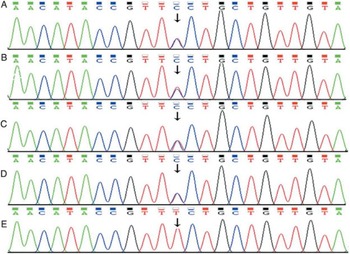
A heterozygous BMPR2 variant (c.344T>C, p. F115S) was found in one case of idiopathic pulmonary arterial hypertension, which is a girl aged 9 years and 4 months (Fig 1). After the comparison with human genome19 reference sequence, we found that the variant is reported for the first time. No variants or single nucleotide polymorphisms were found in other pulmonary arterial hypertension-associated genes (CAV1, ENG, NOTCH3, KCNK3, SMAD1, SMAD4, SMAD9, ALK1, THBS1) in patients with idiopathic pulmonary arterial hypertension and CHD associated with pulmonary arterial hypertension. Pulmonary arterial hypertension-associated genes were also detected by next-generation high-throughput sequencing in 13 family members of the patient with the variant (c.344T>C, p. F115S). The population frequency for the c.344T>C (p. F115S) variant was investigated using ExAC and was not found in the database, which indicated that the variant base was highly conserved. The patient’s father, the second aunt, and the third aunt had the same BMPR2 variant (Fig 1). Therefore, the girl with the BMPR2 variant (c.344T>C, p. F115S) was the proband of hereditary pulmonary arterial hypertension.
BMPR2 mutation (c.344T>C, p. F115S) and normal sequencing map: A, proband; B, the father of proband; C, the second aunt of proband; D, the third aunt of proband; and E, normal sequencing map. The arrows in A, B, C, and D picture indicate the BMPR2 heterozygous mutation site (c.344T > C). The arrow in E picture refers to the normal base A.

Variant function predictions in silico prediction programs
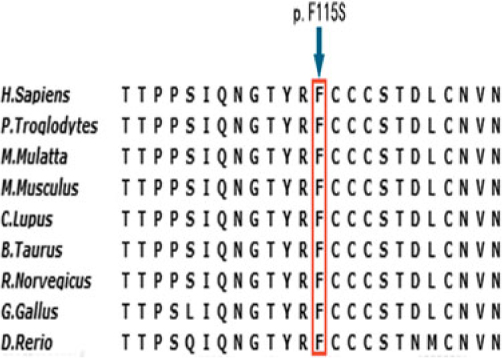
The function of the BMPR2 variant (c.344T>C, p. F115S) was detected by SIFT, PolyPhen2, and Mutation-Taster bioinformatics software, which predicted that the variant was a deleterious pathogenic variant. The heterozygous variant was confirmed to be the first report by human gene variant database (HGMD, http://www.hgmd.org) online. Homology comparison was performed using BLAST of National Centre for Biotechnology Information. Homologous protein sequences were compared using ClustalO. Amino acid conserved sequences chart of the variant was obtained after removing the gaps (Fig 2), which proved that the variant protein is well conserved.
Amino acid conservation analysis of mutation site: the arrow refers to BMPR2 mutation site (p. F115S), which is well conserved.

Clinical data of patients with BMPR2 variant and her family members
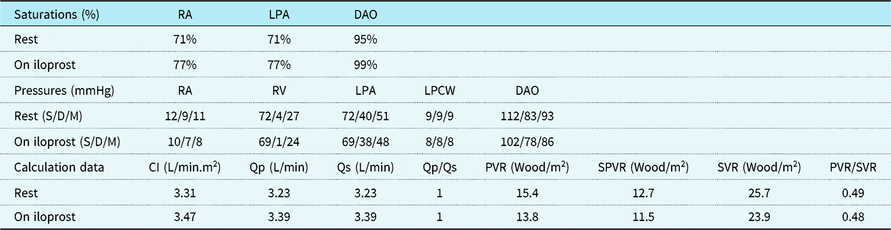
The patient with BMPR2 variant (c.344T>C, p. F115S) was a girl aged 9 years and 4 months. She was confined in the hospital because of dysponea after exercise for 11 months. The girl had no symptoms at rest and presented with palpitation and dyspnoea after general physical activities. Cardiac examination showed apical pulse dispersion and enhancement of second heart sounds in the pulmonary valve. The liver could be touched 3 cm below the subcostal margin of the midclavicular line. The routine blood test, human immunodeficiency virus antibody, thyroid function, and connective tissue disease blood detection had no obvious abnormalities. Brain natriuretic peptide increased significantly (3561 pg/mL). Electrocardiogram showed right axis deviation, pulmonary P wave, and right ventricular hypertrophy. Echocardiogram showed right atrium enlargement (48 mm × 47 mm), increased right ventricular anteroposterior diameter (35 mm), broadening of the main pulmonary artery diameter (29 mm), increased pulmonary arterial systolic pressure (78 mmHg), and moderate tricuspid regurgitation. Chest CT revealed the thickening pulmonary artery trunk and main branches and enlarging right atrium and right ventricle. She was diagnosed with severe pulmonary arterial hypertension and heart failure (NYHA class III) after admission. Clinical symptoms improved after epoprostenol, sildenafil, bosentan, warfarin, digoxin, and spironolactone treatments. Echocardiography showed that pulmonary arterial systolic pressure (70 mmHg) was lower 1 month later. She was given sildenafil, bosentan, spironolactone and aspirin after discharge. The results of her right heart catheterisation before the use of pulmonary vasodilators are shown in Table 1.
The cardiac catheterization data of the proband with hereditary pulmonary arterial hypertension

CI = cardiac index; D = diastolic; DAO = descending aorta; HGB = haemoglobin; LPA = left pulmonary artery; LPCW = left pulmonary capillary wedge; M = mean; PVR = pulmonary vascular resistance; Qp = pulmonary blood flow; Qs = systemic blood flow; RA = right atrium; RV = right ventricle; S = systolic; SPVR = small pulmonary vascular resistance; SVR = systemic vascular resistance.
The assumed global oxygen consumption (VO2) is 174 ml/min/m2 and HGB is 15.9 g/dl.10 μg iloprost solution was atomizing inhaled by oxygen driving for 30 minutes.
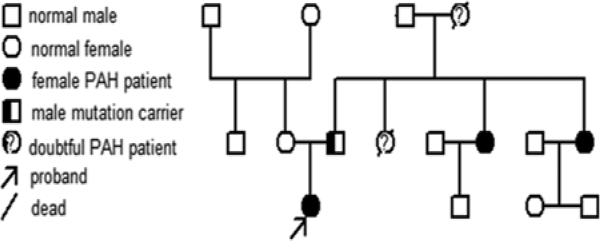
The medical history, physical examination, and echocardiograms of her family members were performed. The girl’s father was confirmed as an asymptomatic carrier and her second (pulmonary arterial systolic pressure: 88 mmHg) and third aunts (pulmonary arterial systolic pressure: 99 mmHg) had severe pulmonary arterial hypertension. The girl’s two aunts had no obvious clinical symptoms at rest, with dyspnoea occurring after exercise and were given with sildenafil, bosentan, spironolactone, and aspirin after definite diagnosis. The disease is well controlled at present. The girl’s grandmother (c.344T>C, p. F115S) and her first aunt (c.344T>C, p. F115S) died of progressive dyspnoea and paroxysmal syncope. The remaining family members showed no obvious abnormalities. Thus, the girl with the BMPR2 variant (c.344T>C, p. F115S) who was considered as a patient with idiopathic pulmonary arterial hypertension was confirmed as the proband of hereditary pulmonary arterial hypertension. The third-generation pedigree map is shown in Figure 3.
Three generation pedigree analysis of the girl with BMPR2 heterozygous mutation. Doubtful PAH means suspicious but uncertain patients with pulmonary arterial hypertension.

Discussion
In this study, genetic background of common pathogenic genes in patients with pulmonary arterial hypertension was detected in 7 cases of idiopathic pulmonary arterial hypertension and 34 cases of pulmonary arterial hypertension associated with CHD by next-generation high-throughput sequencing. A new BMPR2 variant (c.344T > C, p. F115S) was found in a girl aged 9 years and 4 months who was diagnosed with idiopathic pulmonary arterial hypertension at first. We further examined 13 cases of her family members and found that her father, second aunt, and third aunt have the same variant. The two aunts were confirmed to suffer from severe pulmonary arterial hypertension by echocardiography. Therefore, the girl who was misclassified as idiopathic pulmonary arterial hypertension was in fact a hereditary pulmonary arterial hypertension and the proband of this family. Because her grandmother who died at the age of 46 and her first aunt who died at the age of 29 accompanied with paroxysmal syncope and progressive dyspnoea, we highly suspected that they were patients with pulmonary arterial hypertension. According to the clinical data of proband and family members, we found that this family was in consensus with the three clinical characteristics of hereditary pulmonary arterial hypertension, namely, incomplete penetrance, mostly female onset, and genetic anticipation.
BMPR2 is located on 2q33 and has 13 exons. The exons 1–3 encode an extracellular ligand-binding domain, the exon 4 encodes the transmembrane domain, the exons 5–11 encode a serine/threonine kinase domain, and the exons 12–13 encode an intracellular C-terminal region (cytoplasmic domain).Reference Navas, Tenorio and Palomino 24 The variant (c.344T>C, p. F115S) we found is located in the third exon of BMPR2, which is the ligand-binding domain of bone morphogenetic proteins and BMPR2.Reference Morrell 25 , Reference Yang, Long and Southwood 26 The study of Gamou et al. indicated that the exons 3 and 12 were the mutation peaks in all exons of BMPR2 Reference Gamou, Kataoka and Aimi 27 which hinted their important role. The BMPR2 variant (c.344T>C, p. F115S) found in this study was predicted to be a pathogenic variant by SIFT, PolyPhen2, and Mutation-Taster bioinformatics software. Amino acid conservative analysis showed that the variant amino acid site is conserved in many species, suggesting its important role in the pathogenesis of pulmonary arterial hypertension. We speculated that the variant (c.344T>C, p. F115S) is likely to affect the binding of bone morphogenetic proteins to BMPR2 by expressing immature or non-functional BMPR2 protein. Moreover, the variant may interfere with the nuclear translocation of downstream signal SMAD family members s and lead to the over proliferation of pulmonary artery smooth muscle cells, which leads to pulmonary artery remodelling and the occurrence of pulmonary arterial hypertension.Reference Yang, Long and Southwood 26 Our study shows that the BMPR2 variant is the most common variant of pulmonary arterial hypertension once again, which is consistent with the previous report.Reference Austin and Loyd 28
Roberts et al. found 6 out of 106 CHD patients with pulmonary arterial hypertension had BMPR2 missense mutations (c.125A>G, p. Q42R; c.304A>G, p. T102A; c.319T>C, p. S107P; c.556A>G, p.M186V; c.125A>G, p. Q42R; c.1509A>C, p. E503D; c.140G>A, p. G47N).Reference Roberts, McElroy and Wong 29 Tatebe et al. reported a heterozygous missense mutation (c.2474A>G, p. Tyr825Cys) in a 27-year-old man with a moderate-sized secundum atrial septal defect and severe pulmonary arterial hypertension, which developed in his early teens.Reference Tatebe, Sugimura and Aoki 30 However, in our study, no variants were found in CHD patients associated with pulmonary arterial hypertension. These patients may have other genetic variants or pathogenic factors, including chronic pressure and volume overload of the pulmonary artery owing to hypoxic vasoconstriction, left-to-right shunt, and elevated pulmonary venous pressure.
According to our study,BMPR2 mutation detection and family survey are suggested in patients with pulmonary arterial hypertension for the sake of definite cause and better treatment. Clinical genetic testing can provide additional information to assist risk stratification and the development of individualised therapy.Reference Gamou, Kataoka and Aimi 27 , Reference Hadinnapola, Bleda and Haimel 31 A recent research article reported an expanded gene panel that can also increase the knowledge of pulmonary arterial hypertension in terms of genetic counselling, early diagnosis, and potential prognosis of the disease.Reference Garcia-Rivas, Jerjes-Sanchez, Rodriguez, Garcia-Pelaez and Trevino 32 Education and awareness are needed about the genetics of pulmonary arterial hypertension as well as the benefits of genetic testing and genetic counselling for pulmonary arterial hypertension specialists.Reference Jacher, Martin, Chung, Loyd and Nichols 33 Animal studies are needed to make clear the detailed pathogenic mechanism of BMPR2 mutation (c.344T>C, p. F115S) in future.
Acknowledgements
Thanks to professor Cuifen Zhao’s suggestion and guidance from the topic selection to the writing process. To be grateful for the help of my colleagues in the Department of Pediatrics and Cardiac Surgery of Qilu Hospital of Shandong University in the case collection process. Thanks for the Sinopath Diagnostics’s technical guidance.
Financial Support
This research was supported in part by the grants from the National Natural Science Foundation (#30900730), and the Shandong Province Science and Technology Development Project (#2014GSF118066) of China.
Conflicts of Interest
The authors report no conflicts of interest.