
I. INTRODUCTION
BiVO4 has three main crystalline phases: scheelite-monoclinic, scheelite-tetragonal, and zircon-tetragonal.Reference Zhao, Li and Zou1 It was first reported to be a promising visible light active semiconductor in 1999.Reference Kudo, Omori and Kato2 Researchers indicate that the scheelite-monoclinic phase, mainly in the nanoscale range, presents the best photocatalytic activity because of its low band gap (E g = 2.4 eV) and maximum absorptive wave length (515 nm).Reference Zhou, Wang, Liu, Zhang, Xu and Zhu3 Recently, monoclinic BiVO4 with a diversity of morphologies such as hollow spheres,Reference Sun, Chen, Wu, Dong and Xiong4 dumbbell-like nanostructures,Reference Zhu and Que5 microsheets,Reference Liu, Jing, Zhang, Li and Liu6 olive-like structures,Reference Ma, Li and Luo7 nanorods,Reference Wang, Li, Ding, Peng and Chen8 nanofibers,Reference Wang, Li, Ding, Peng and Chen8 bundle-like nanostructures,Reference Wang, Li, Ding, Peng and Chen8 and nanoflowersReference Wang, Li, Ding, Peng and Chen8 have been prepared by a simple hydro/solvothermal process. However, to obtain the specific and well-dispersed structures, harmful and toxic organic additives (chelating agentsReference Sun, Chen, Wu, Dong and Xiong4,Reference Zhu and Que5 or surfactantsReference Liu, Jing, Zhang, Li and Liu6,Reference Jiang, Meng, Dai, Deng, Liu, Zhang, Zhao and Zhang9 ) were always used in hydrothermal routes.Reference Ma, Li and Luo7,Reference Wang, Li, Ding, Peng and Chen8 Thus, exploring a mild and environmental friendly hydrothermal method is an urgent need for a wider application or industrialization.
To this end, many researchers prepared the controllable nanostructured materials using metal oxide precursors.Reference Ng, Iwase, Ng and Amal10–Reference Wei, Xie, Meng, Lü, Yan and Zhu12 For example, Ng et al.Reference Ng, Iwase, Ng and Amal10 reported a simple way to transform WO3·2H2O films into a ternary oxide electrode of Bi2WO6 directly without the use of Na2WO4 as an intermediate. Shang et al.Reference Shang, Wang, Ren, Sun and Zhang11 synthesized Bi2MoO6 boxes using MoO3 nanorods as in situ templates via a facile one-pot solution phase method. We also reported the facile synthesis of Bi2SiO5 nanoplates/nanoflowers using silica aerogels as precursors.Reference Wei, Xie, Meng, Lü, Yan and Zhu12 In conclusion, it is exciting and challenging to develop a facile method of preparing novel structures using metal oxide nanomaterials as precursors.
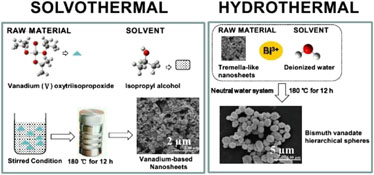
In this work, a facile hydrothermal method has been developed to synthesize monoclinic BiVO4 hierarchical spheres by using tremella-like vanadium-based nanosheets as precursors. A new hydrothermal system containing the bismuth ion and vanadium-based nanosheets in aqueous solution was adopted. Phase structure, chemical composition, and morphology were investigated systematically with various techniques. Results show that monoclinic BiVO4 spheres have novel structures and enhanced photocatalytic activity. The possible photocatalytic mechanism of the monoclinic BiVO4 hierarchical spheres is also discussed in detail.
II. EXPERIMENTS
A. Catalyst preparation
All chemicals were of analytical grade and were used without further purification.
1. Vanadium-based precursor synthesis
Vanadium-based precursors were prepared as reported previously.Reference Pan, Wu, Zhang and Lou13 0.6 mL of vanadium oxytriisopropoxide was added into 80 mL of isopropanol under vigorous stirring. The mixture solution was then transferred into a 100 mL Teflon-lined autoclave. The autoclave was maintained at 180 °C for 12 h and naturally cooled down to room temperature. The vanadium-based precursors were washed several times with distilled water and absolute ethanol and dried at 80 °C for 12 h.
2. Bismuth vanadate hierarchical sphere synthesis
In a typical synthesis of bismuth vanadate, 3 mmol vanadium-based precursors were dissolved in 70 mL of H2O (named solution A). Subsequently, 3 mmol Bi(NO3)3·5H2O was dissolved into 3 mL of HNO3 solution (4 mol/L) and named solution B. The above two solutions were mixed together under stirring. The pH value of the final solution was adjusted to 7 with 25 wt% ammonia solution. After stirring for 30 min, the mixture was transferred into an autoclave and maintained at 180 °C for 12 h before being cooled to room temperature naturally. The sample was collected and washed with deionized water and ethanol several times, respectively, and finally dried in a vacuum oven at 80 °C for 12 h.
B. Characterizations
The phase of products was characterized by x-ray diffraction (XRD) (D8 Advance diffractometer, Bruker, Germany) with Cu Kα radiation (λ = 1.5406 Å) at a scanning rate of 10° per min; a scanning electron microscope (SEM) (JSM-7001F, JEOL, Tokyo, Japan) and a high-resolution transmission electron microscope (HRTEM) (JEM-100CX II, Tokyo, Japan) operating at 120 kV were used to investigate the morphology; the energy-dispersive x-ray (EDX) microanalysis was performed during the SEM observations; the Fourier transform infrared (FTIR) spectra were recorded using a the NEXUS-470 FTIR apparatus (Thermo Scientific Nicolet, Madison, WI); The Brunauer–Emmett–Teller (BET) specific surface area was obtained from the N2 adsorption/desorption analyses at 77 K (NOVA 2000, Quantachrome, Boynton Beach, FL); ultraviolet-visible diffuse-reflectance spectra (UV-vis DRS) were recorded on a UV-2450 spectrophotometer (Shimadzu, Kyoto, Japan) equipped with spherical diffuse reflectance accessory in the range of 190–800 nm.
C. Detection of hydroxyl radical
The detection of the formed hydroxyl radicals (OH·) on the surface of BiVO4 was measured by a Gary eclipse fluorescence spectrophotometer (Agilent Technologies, Santa Clara, CA). Terephthalic acid, which reacts readily with OH· to produce a fluorescence product, 2-hydroxyterephthalic acid, was used as a probe molecule. It is known that the fluorescence intensity around 425 nm, which can be ascribed to the characteristic of 2-hydroxyterephthalic acid, is proportional to the amount of hydroxyl radicals formed in solution.Reference Ishibashi, Fujishima, Watanabe and Hashimoto14,Reference Xiao, Si, Zhang, Xiao and Tan15 Under irradiation of a 100-W xenon lamp (luminous flux = 15 lm/W, the xenon lamp is used for solar simulation. Ultraviolet radiation below 242 nm), the detection experiment process is similar to the photodegradation process. The concentration of terephthalic acid was set at 5 × 10⁻⁴ mol/L in dilute NaOH (2 × 10⁻³ mol/L) solution. The BiVO4 (200 mg) was added to 50 mL above solution, which was kept in the dark for 20 min before irradiation to ensure adsorption/desorption equilibrium. The sampling was carried out every 10 min; the solution was measured on a Gary eclipse fluorescence spectrophotometer (Agilent Technologies, Santa Clara, CA) after centrifugation. 2-hydroxyterephthalic acid can give a fluorescence peak at about 425 nm by excitation with the wave length of 315 nm.
D. Photocatalytic experiment
The photocatalytic efficiency of the sample was tested by the extent of photodecolorization of methylene blue (MB) under irradiation of a 100-W xenon lamp as the light source (luminous flux = 15 lm/W). The samples (100 mg) were added to 100 mL of MB (10 mg/L) solution, which was kept in the dark for 30 min before irradiation to ensure adsorption/desorption equilibrium. For a typical photocatalytic experiment, 100 mg of the sample was added to 100 mL of the above MB solution in a quartz tube. Prior to irradiation, the suspensions were magnetically stirred in the dark for 30 min to ensure the establishment of an adsorption/desorption equilibrium. At given time intervals, about 2 mL aliquots were sampled and centrifuged to remove the particles. The filtrates were analyzed by measuring the maximum absorbance of MB using the UV-vis spectrophotometer.
E. Active species trapping experiments
According to our previous work,Reference Jiang, Chen, Zhu, Chen, Shi and Xie16 to detect the active species during the photocatalytic process, some sacrificial agents, such as ammonium oxalate (AO), 1,4-benzoquinone (BQ), and tert-butanol (t-BuOH) were used as the hole ( ${\rm{h}}_{{\rm{vb}}}^{\rm{ + }}$) scavenger, superoxide radical (
 ${\rm{O}}_{\rm{2}}^{ \cdot - }$) scavenger, and hydroxyl radical (OH·) scavenger, respectively. This method was similar to the former photocatalytic experiment with the addition of 1 mmol of quencher in the presence of MB.
III. RESULTS AND DISCUSSION
A. Structural and morphology characterization of the as-prepared samples
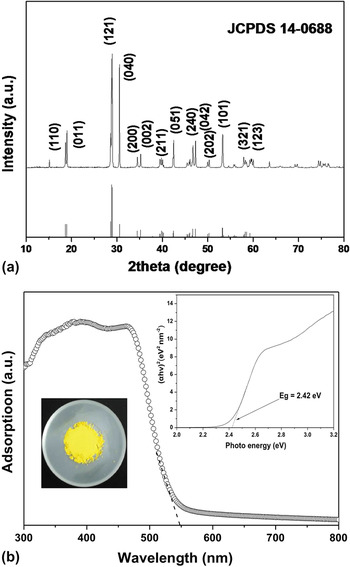
XRD pattern of the as-prepared product is shown in Fig. 1(a). All the peaks can be indexed to the monoclinic phase scheelite BiVO4 (JCPDS card no. 14-0688). No signals corresponding to other impurities can be found, indicating high purity of the sample. Tan et al.Reference Tan, Zhang, Ren, Wei, Huang and Xia17 reported that BiVO4 powders with different structures were prepared by the microwave hydrothermal method at different pHs, using Bi(NO3)3·5H2O and NH4VO3 as raw materials. At pH = 4.26–9.76, the synthesized BiVO4 powders are pure monoclinic phase. Especially, at pH = 7.81, the ms-BiVO4 with high specific surface area exhibits the best visible-light photocatalytic activity.Reference Tan, Zhang, Ren, Wei, Huang and Xia17 Meanwhile, Jiang et al.Reference Jiang, Dai, Meng, Ji, Zhang and Deng18 reported that the pH value and the surfactant have a great effect on the shape and pore structure of BiVO4. It was also reported that BiVO4 was converted to a monoclinic phase at a high temperature (≥180 °C) under hydrothermal treatment.Reference Tang, Chen and Cao22 Corresponding to our work, we choose neutral conditions to prepare the sample for obtaining BiVO4 with pure monoclinic phase and high specific surface area.
(a) XRD pattern and (b) UV-vis spectrum of the BiVO4 (inset: photograph of the sample).

Figure 1(b) shows the UV-visible diffuse reflectance spectra of BiVO4. As can be seen that BiVO4 samples have an absorption edge of 550 nm, an optical band gap of 2.42 eV is obtained by fitting the data with the formula αhν = A (hν − E g)n/2 (i.e., α, ν, E g, and A are absorption coefficient, light frequency, band gap energy, and a constant, respectively; n = 1 for direct transitionReference Liu, Jing, Zhang, Li and Liu6), which is close to the reported values.Reference Sun, Chen, Wu, Dong and Xiong4–Reference Wang, Li, Ding, Peng and Chen8
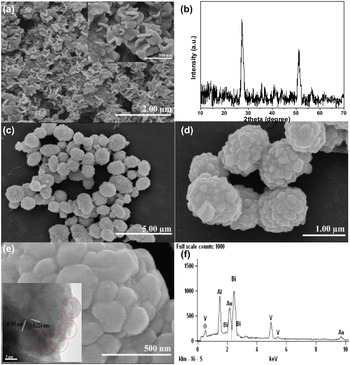
The morphologies of vanadium-based precursors were studied by SEM. At lower magnification, the SEM image [Fig. 2(a)] reveals that the products consist almost entirely of tremella-like structures. The magnified image [inset in Fig. 2(a)] shows that the thickness of the nanosheets lies between 20 and 30 nm. The corresponding XRD pattern [Fig. 2(b)] shows an unknown phase with relatively low crystallinity. This is in accordance with the previous reports.Reference Pan, Wu, Zhang and Lou13 BiVO4 hierarchical spheres were synthesized by using the above-mentioned precursors, and the morphologies of the final products are shown in Figs. 2(c) and 2(d). It can be seen that the products contain abundant microspheres with an average diameter of approximately 1–2 µm. Magnified SEM picture demonstrates that the sphere is composed of numerous nanoparticles with a mean diameter of about 100–200 nm [Fig. 2(e)].Reference Wang, Li, Ding, Peng and Chen8 HRTEM image of the spheres with clear lattice fringes is presented in Fig. 2(e) (inset), confirming its high crystallinity. The fringe spacing of 0.224 nm corresponds to the (121) facets of the monoclinic phase scheelite BiVO4, whereas the fringe spacing of 0.585 nm corresponds to the (002) facets, confirming that the spheres are elongated along the [001] direction.Reference Wang, Li, Ding, Peng and Chen8 On the basis of SEM and HRTEM results, it has been shown that the spheres were self-assembled by dozens of nanosheets with good dispersibility and uniform particle size. The result from EDX [Fig. 2(f)] shows that the products are composed of the elements of Bi, V, O, Al, and Au. Al is discovered due to the insulating tape for adhesive samples. The Au element is generated from the Au nanoparticles sputtered for the SEM test. The molar ratio of Bi to V was 1:1 according to the quantitative analysis, consistent with the stoichiometric BiVO4.
(a) SEM images and (b) XRD of novel precursors; (c–e) SEM images of the BiVO4 and HRTEM image of the spheres (inset); and (f) EDX of BiVO4.

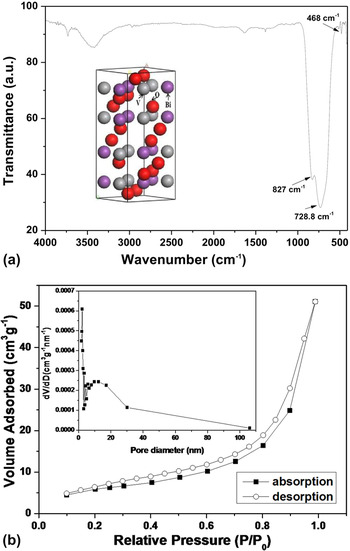
Figure 3(a) shows the FTIR spectra of BiVO4 hierarchical spheres. The IR bands at 3425 and 1620 cm−1 can be attributed to the bending vibrations of adsorbed H2O molecules. This means that the sample adsorbed water in air. The main absorption band at 728.8 cm−1 with a shoulder at 827 cm−1 can be observed. An intense IR band at 470 cm−1 is also readily observed. According to the previous works, those bands can be indexed to V–O stretching, V–O–V bridging stretching, and Bi–O stretching modes of monoclinic BiVO4.Reference Obregón and Colón19,Reference Venkatesan, Velumani and Kassiba20
(a) FTIR spectra of BiVO4 (crystal model inset); (b) N2 sorption isotherms and pore size distributions (inset) of BiVO4.

To investigate the specific surface area of as-prepared BiVO4 hierarchical spheres, nitrogen adsorption–desorption measurements were carried out and presented in Fig. 3(b). The BET surface area for BiVO4 hierarchical spheres is 21.35 m2/g. The average diameter of the pores obtained by BET analysis is about 10 nm. The larger BET surface area was attributed to the nanostructure of hierarchical spheres, which would facilitate the adsorption of organic molecules and improve the photocatalytic activity.Reference Sun, Chen, Wu, Dong and Xiong4
B. Photocatalytic oxidative degradation
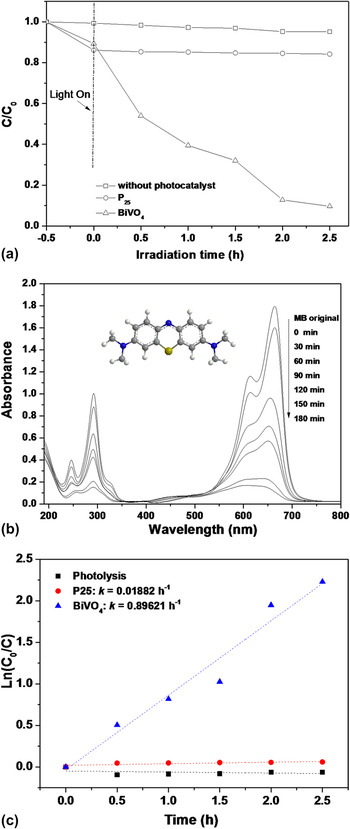
MB, a commonly used dye, was selected as a pollutant to evaluate the photocatalytic activity of the as-prepared samples.Reference Obregón and Colón19,Reference Meng, Zhang, Dai, Zhao, Zhang and Liu21 As shown in Fig. 4(a), Degussa's P25 (anatase–rutile mixture TiO2) and the direct noncatalytic photolysis of MB were tested under the same conditions. As a reference material, the P25 sample displayed a low photocatalytic efficiency of 15.5% after irradiation for 2.5 h. Meanwhile, the photocatalytic tests demonstrate that BiVO4 hierarchical spheres display higher activity than the Degussa's P25. This can be explained by the unique hierarchical structures with higher surface area, which makes the absorption of MB molecules more efficient and results in higher photocatalytic activity under visible light irradiation [Fig. 4(b)]. However, degradation of MB was very slow in the absence of a photocatalyst.
(a) Adsorption and photocatalytic degradation of MB by different samples; (b) UV-vis spectral changes of MB dye (BiVO4: 100 mg; MB: 10 mg/L); and (c) ln(C 0/C)−T for photocatalytic degradation of MB.

Moreover, Fig. 4(c) shows that the photocatalytic degradation of MB on different catalysts fits pseudo-first-order kinetics, ln(C 0/C) = kt, where C is the concentration of the MB at a given irradiation time, C 0 is the initial concentration of the MB solution (when adsorption equilibrium is reached), and slope k is the reaction rate constant. The result implies that k values for BiVO4 hierarchical spheres are higher than those of Degussa's P25. The k value of BiVO4 hierarchical spheres is 0.89621 h−1 higher than that of Degussa's P25 (0.01882 h−1). We attribute the high visible light photocatalytic activity to not only the narrow band gap structure but also the unique hierarchical morphology.Reference Tang, Chen and Cao22 BiVO4 hierarchical spheres with high absorption ability could absorb more pollutants and provide more active sites for oxidative reactionsReference Zhang, Du, Wang, Dong, Zhang, Ma and Ma23 and exhibit high enhanced visible-light photocatalytic activity.
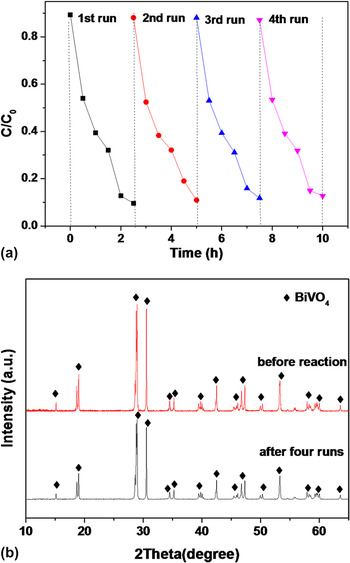
The bismuth vanadate hierarchical sphere photocatalyst was reused in four successive photoreaction experiments by centrifugation. Figure 5(a) shows the results of four cycles of run of photodegradation of MB using the reclaimed catalyst while maintaining the experimental conditions unchanged. It can be seen that the bismuth vanadate hierarchical spheres do not show a significant loss of photocatalytic activity in four successive runs. It indicates that the photocatalytic activity of bismuth vanadate is stable.
(a) Recycling test on BiVO4 for MB under visible light irradiation and (b) XRD patterns of BiVO4 before and after four runs.

Figure 5(b) presents the PXRD patterns of the BiVO4 hierarchical spheres before and after four runs under the visible light for the degradation of MB. It can be clearly observed that the phase and structure of the BiVO4 photocatalyst remained unchanged after the reaction, which also suggests that bismuth vanadate is stable in the photocatalytic process.
C. Possible photocatalytic mechanism
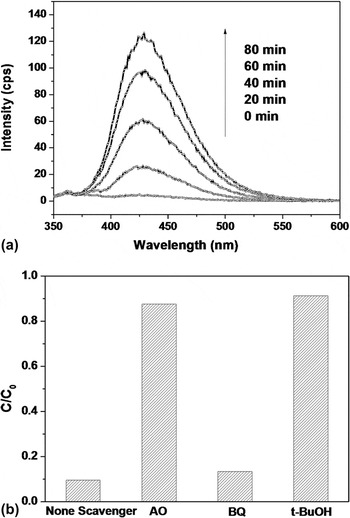
Under visible-light irradiation, electron–hole pairs are generated in BiVO4. The photogenerated electrons may react with the adsorbed oxygen to produce O2, which further reacts with water to give rise to OH·.Reference Fan, Jiang, Wang, Wang, Li, Wang, He and Xie24 The amount of OH· radical could be estimated from the fluorescence intensity. Figure 6(a) shows the OH·-trapping photoluminescence spectra of BiVO4 hierarchical spheres in a terephthalic acid solution under light irradiation. The fluorescence intensity at 425 nm increases when light is irradiated continuously.Reference Ishibashi, Fujishima, Watanabe and Hashimoto14,Reference Xiao, Si, Zhang, Xiao and Tan15 The stronger fluorescence intensity means that more OH· is produced. As well known, the greater the formation rate of OH· radicals is, the higher the separation efficiency of electron–hole pairs is achieved. Therefore, higher photocatalytic activity can be predicted.Reference Ng, Iwase, Ng and Amal10
(a) Fluorescence spectral changes observed for BiVO4 in the solution of terephthalic acid irradiated by visible light and (b) trapping experiment of active species during photodegradation of MB over BiVO4 under visible light irradiation.

To ascertain the active species in the photodegradation process, sacrificial agents such as AO, BQ, and t-BuOH were used as the hole ( ${\rm{h}}_{{\rm{vb}}}^{\rm{ + }}$) scavenger, superoxide radical (
 ${\rm{O}}_{\rm{2}}^{ \cdot - }$) scavenger, and hydroxyl radical (OH·) scavenger in the photocatalytic degradation of MB, respectively. As shown in Fig. 6(b), with 1 mmol AO as the
 ${\rm{h}}_{{\rm{vb}}}^{\rm{ + }}$ scavenger added to the photodegradation process, the rate for degradation of MB over BiVO4 hierarchical spheres is significantly depressed, indicating that mangy holes (
 ${\rm{h}}_{{\rm{vb}}}^{\rm{ + }}$) are involved in the degradation of MB. When 1 mmol BQ as a scavenger for
 ${\rm{O}}_{\rm{2}}^{ \cdot - }$ is added, no obvious decrease in the degradation rate is observed, indicating the absence of the superoxide radical. However, with the addition of 1 mmol t-BuOH, the degradation of MB was also significantly depressed, suggesting that the OH· pathways have played a great important role in the process of MB oxidation. According to the effects of different scavengers and the earlier reports,Reference Zhang, Du, Wang, Dong, Zhang, Ma and Ma23,Reference Zhang, Ai, Jia, Zhang, Fan and Zou25 the photooxidation mechanisms of the BiVO4 system may involve direct reaction of the dye with
 ${\rm{h}}_{{\rm{vb}}}^{\rm{ + }}$, indirect reaction with OH· radicals, or a dual mechanism involving both surface
 ${\rm{h}}_{{\rm{vb}}}^{\rm{ + }}$ and OH· radicals. These results indicate that the BiVO4 hierarchical sphere photocatalyst exhibited excellent in situ photodegradation of the organic dye. The pathway of photocatalytic degradation can be described throughout the following equations:
 $${\rm{BiVO}}_{\rm{4}} + h\nu \to {\rm{BiVO}}_{\rm{4}} {\rm{ (e}}^ - + {\rm{h}}_{{\rm{\,vb}}}^{\rm{ + }} {\rm{)}}\quad {\rm{,}}$$
 $${\rm{OH}}^ - + {\rm{h}}_{{\rm{\,vb}}}^{\rm{ + }} \to {\rm{OH}} \cdot \quad ,$$
 $${\rm{H}}_{\rm{2}} {\rm{O}} + {\rm{h}}_{{\rm{\,vb}}}^{\rm{ + }} \to {\rm{OH\cdot}} + {\rm{H}}^{\rm{ + }} \quad ,$$
 $${\rm{OH\cdot}} + {\rm{dye}} \to {\rm{degradation \,\,products}}\quad {\rm{,}}$$
 $${\rm{h}}_{{\rm{\,vb}}}^{\rm{ + }} \,\,{\rm{ dye}} \to {\rm{degradation \,\,products}}\quad {\rm{.}}$$
D. Possible growth pattern and formation mechanism of bismuth vanadate
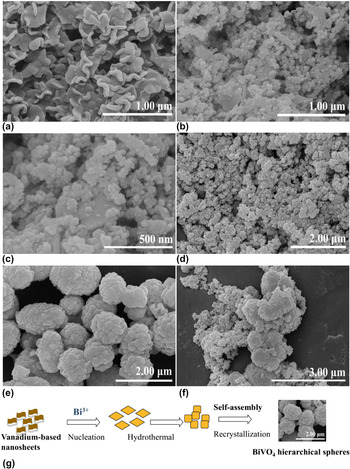
The growth mechanism is based on the SEM images (Fig. 7). First, vanadium-based precursors were tremella-like structures. The nanosheets were uniform as shown in Fig. 7(a) before the hydrothermal synthesis process. The free energy of dissolution related to the H2O molecules causes a fast dissociation of the chemical salts in solution,Reference Cavalcate, Sczancoski, Li, Longo and Varela26 so that the Bi3+ ion and vanadium-based precursors were rapidly solvated by these molecules. Second, after hydrothermal treatment for 4 h, the irregular amorphous particles that were stacked together tend to change or direct the growth of the nanosheets [Figs. 7(b) and 7(c)]. When after the hydrothermal treatment for 8 h [Fig. 7(d)], the irregular particles that were stacked together tend to generate hierarchical spheres. After hydrothermal treatment for 12 h [Fig. 7(e)], the hierarchical spheres were generated. This fact implied that the hierarchical spheres were grown by the nanosheets. The production of a novel structure in the hydrothermal process is in accordance with the well-known “Ostwald ripening mechanism.”Reference Zeng27Figure 7(f) represents the samples prepared at longer reaction times. The micrograph reveals that hierarchical spheres with some microparticles were stacked together (24 h).
SEM images of BiVO4 synthesized under different conditions: (a) the nanosheet precursors before the hydrothermal process; (b, c) the precursors at the temperature of 180 °C for 4 h; (d) the precursors at the temperature of 180 °C for 8 h; (e) the precursors at the temperature of 180 °C for 12 h; (f) the precursors at the temperature of 180 °C for 24 h; and (g) the possible formation mechanism of BiVO4.

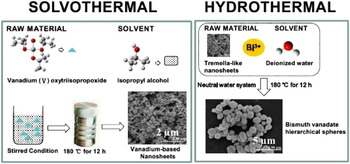
Hydrothermal synthesis and properties of BiVO4 photocatalysts.

Based on the above experimental results, the probable formation mechanism of the BiVO4 aggregates maybe ascribed to a nucleation–self-assembly–crystallization growth process in our current experiment. The schematic illustration of the formation of BiVO4 hierarchical spheres is shown in Fig. 7(g). In our approach, the BiVO4 should be formed from the combination of Bi3+ ion from the dehydration of Bi(NO3)2 and vanadate ion from the vanadium-based precursors. The formation of the BiVO4 sol played an important role in the controlled release of Bi3+ and  ${\rm{VO}}_{\rm{4}}^{{\rm{3}} - }$. With the temperature increased to 180 °C, the vanadium-based precursors were gradually decomposed to generate
 ${\rm{VO}}_{\rm{4}}^{{\rm{3}} - }$. The reaction for the formation mechanism is as shown in Eqs. (6) and (7) below:
 $${\rm{Vanadium {\hbox-} based \,\,nanosheets}}\rightleftharpoons{\rm{VO}}_{\rm{4}}^{{\rm{3}} - } \quad ,$$
 $${\rm{Bi}}^{{\rm{3 + }}} + {\rm{VO}}_{\rm{4}}^{{\rm{3}} - } \rightleftharpoons{\rm{BiVO}}_{\rm{4}} \quad .$$
IV. CONCLUSIONS
In summary, we have developed a facile hydrothermal route to synthesize BiVO4 hierarchical spheres with monoclinic structures. Vanadium-based nanosheets as specific precursors are able to help the formation of BiVO4 without any additive. The monoclinic BiVO4 hierarchical spheres have an average diameter of about 2 μm. Photocatalytic studies revealed that monoclinic BiVO4 hierarchical spheres exhibited a relatively excellent photocatalytic performance, which indicates that the final product has a promising application in environmental protection. This work also provides a new way in designing nanostructures or self-assembly architectures.
ACKNOWLEDGMENTS
This work was partly supported by National Natural Science Foundation (Grant No. 21003065), Natural Science Foundation of Jiangsu Province (Grant No. BK2010044), Industry High Technology Foundation of Jiangsu Province (Grant No. BE2013090), and Science & Technology Foundation of Zhenjiang (Grant Nos. SH2010025, SH2011005, SH2012011, and GY2012048), China.