The Malayan Emergency, which was declared by the British administration on 18 June 1948 to defeat the Malayan Communist Party (MCP) and its guerrilla war, witnessed the controversial policy of repatriating suspected communist sympathisers.Footnote 1 Emergency regulations allowed for the sweeping detention of non-citizen Chinese (‘alien squatters’), who then faced repatriation, along with their dependants, to China. The British administration regarded deportation as the fastest, most effective way to remove hard-core MCP elements and cripple the movement. The idea was to cut the guerrillas off from their civilian support and supply lines (Min Yuen, the MCP's underground support organisation).Footnote 2 But the British could not be sure that those whom they repatriated to China were communist supporters,Footnote 3 hence ‘this policy caught large numbers of innocent people in the detention net’.Footnote 4
This research focuses on the internal and external logistical and political challenges facing the British in London and Kuala Lumpur in implementing the deportation policy between 1948 and 1953. In doing so, it fleshes out aspects of a coercive period in the counter-insurgency campaign in Malaya, before the onset of the Briggs Plan for mass resettlement and Gerald Templer's ‘hearts and minds’ strategy. This era of the mass deportation of Chinese during the Emergency has been relatively under-researched in Malayan historiography. This gap was reflected even in 1950, when the British High Commissioner Henry Gurney, the major proponent of this policy, lamented: ‘The importance of repatriation to the anti-Communist campaign in Malaya has become obscured by emphasis on other factors such as military reinforcements, squatter administration, police organisation and propaganda.’Footnote 5 Gurney firmly believed that these measures could not succeed ‘without repatriation or deportation’.Footnote 6
Yet the scale of the post-1948 deportations was astonishing, as the High Commissioner was quickly granted unprecedented power to order the detention and banishment, without right of appeal, of all aliens suspected of helping the ‘bandits’ (as the guerrillas were called).Footnote 7 Such deportations were unparalleled in Malayan history. Prior to 1939, the Banishment Ordinance had been used mostly against Chinese secret society members. It worked then because there was freedom of movement between China and Malaya, and as Noel Barber remarked, ‘the threat of deportation to starving China from prosperous Malaya had always been one of the greatest deterrents to crime’.Footnote 8 The Ordinance was not, however, suitable for the large-scale deportation now argued by Gurney as necessary, and which he began implementing in late 1948.Footnote 9
From its inception in December 1948, however, the policy of repatriation was tactically and operationally flawed, and faced legal, political, practical, and humanitarian difficulties. Civil war was raging in China between the Kuomintang (KMT, the Nationalists, then fighting to stay in power in the Republic of China, ROC) and the Communists (soon to take over and declare the People's Republic of China, PRC), and from June 1949 Chinese ports were closed to shipping. This article traces the stages of decision-making over the repatriation policy in Malaya, London, and the Far East, which were affected by foreign policy concerns over Sino–British relations, the mainland governments' overseas Chinese policies, humanitarian considerations and Malayan reactions and pressures.
This article begins by looking at the rationale behind utilising the deportation tool en mass. It then discusses the development of the repatriation policy in seven overlapping stages: securing the traffic flow during the Chinese Civil War; initiating direct negotiations with the People's Republic of China (PRC); experimenting with small-scale deportations using non-official channels; turning to resettlement and protection; locating new repatriation sites outside China; looking at the option of using military force; and attempting to open Formosa's door. In conclusion, I will briefly discuss the impact of this policy on the Malayan Chinese community as well as its legacy in the making of the postcolonial nation–states of Malaysia and Singapore.
Repatriation and the Malayan Emergency
The British administration regarded Chinese squatters who were actively cooperating with communist insurgents as amongst the elements hindering their operations against the MCP. Gurney argued that stern and immediate action must be taken against these Chinese: ‘I and my advisors are satisfied that the only answer to this problem is to require dangerous alien elements to leave the Federation’.Footnote 10 He added that detention alone could not effectively solve the problem and would increase the burden on the security forces. Given that by October 1948 there were already 3,800 persons in detention camps and the numbers were expected to increase sharply, Gurney reiterated that ‘I should repeat that what I am proposing is not banishment but repatriation’.Footnote 11 The use of the term ‘repatriation’ allowed the government to justify sending back ‘home’ those who did not belong to the Federation.
In November 1948, the Colonial Office authorised Henry Gurney to promulgate Emergency Regulations providing for the repatriation of detained individuals whose appeals against detention had been rejected.Footnote 12 Under Emergency Regulation 17C (ER 17C), the first batch of 52 detainees was shipped to Swatow on 3 December. The second batch of 210 detainees (53 bound for Amoy, 27 for Hoihow, and 130 for Swatow) was shipped on 31 December.Footnote 13 But the regulation only provided the High Commissioner with the power to repatriate detainees on an individual basis, hence until January 1949, only 262 repatriations were approved. Henry Gurney believed that a far better solution would be collective repatriation: ‘The worst squatter areas must be tackled as areas.’Footnote 14 To this end, he was preparing a new regulation which would allow the government to repatriate the alien inhabitants of squatter areas en masse, without provision for any appeal.Footnote 15
The Malayan government was also under domestic pressure to take action against the Chinese squatters. The English-language newspaper, the Straits Times, had been pressing the government since 1947 to speedily deport all detained illegal immigrants who were ‘terrorising’ the country. A Straits Times editorial in September 1948 criticised the government for its failure to make fuller use of the existing Banishment Ordinance: ‘One of the more unusual aspects of the current emergency is the continued reluctance of the Federation Government to ship out of the country all those illegal immigrants it has rounded up in the last few months — most of them on suspicion of being supporters of the terrorists [….]’. Disappointed with the slow rate of deportation, the editorial strongly urged for a more decisive and determined course of action to get rid of the ‘undesirable aliens’.Footnote 16
This attack was followed by, among others, an article in the Straits Times in November 1948 linking Chinese secret societies with support for the Communists.Footnote 17 The widespread practice of paying protection money to Chinese secret societies had been declared illegal during the Emergency. The article pointed out that the victims of such extortion were not limited to the wealthier Chinese (mining towkays, rubber estate owners, businessmen, shop owners); even Indian chettiars and their firms ‘had to contribute at pistol-point too’. The article claimed that the secret societies were now collecting money for the MCP's campaign to overthrow the government. The same article quotes High Commissioner Gurney as saying that the squatters needed to be removed as the Chinese terrorists were ‘battening like leeches’ on the squatter population.Footnote 18
On 7 January 1949, Gurney himself advised the Colonial Office that Malaya was expecting to repatriate 2,000 individuals per month.Footnote 19 Dependants needed to be included in the mass expulsions, he explained, given that it was ‘impracticable and undesirable to keep inhabitants of these areas, including women and children, in detention for several months while each individual case is reviewed separately by an advisory committee. One such operation might bring in up to 1,000 people and some more rapid step is necessary in their own interests [...]’.Footnote 20 There was no other choice, he added: ‘I should not be taking this step if I were not satisfied that the larger majority of Chinese are now trying to co-operate against the bandits and that it will help rather than impede their efforts in this direction.’Footnote 21
Accordingly, on 10 January 1949, Emergency Regulation 17 (D) was passed, permitting the mass detentionFootnote 22 and repatriation of alien inhabitants, and their dependants, without provision for any appeal. Persons detained under this regulation were subject to deportation orders (ER 17C). Section 4 of ER 17 (D) clearly outlined that:
When any orders have been made under paragraph (2) of these regulations, the High Commissioner in Council may order persons subject to such orders to leave and remain out of the Federation; provided that no such orders shall apply to (a) any Federal citizens or (b) any British subject born in the Federation or in the Colony.Footnote 23
Malcolm MacDonald, the Commissioner-General for South East Asia, admitted that the new Emergency measures were ‘drastic’, but that stern and immediate actions against the squatters were ‘imperative’.Footnote 24 Creech Jones, the Secretary of State for the Colonies agreed that ‘the new regulations are very sweeping: there is no appeal from an order made under them and no such order can be called in question by any court.’ Regretting that the absence of appeal could result in ‘grave injustice’, Creech Jones explained to the Foreign Secretary that it was now impossible to amend the regulation because this would reflect indecisiveness on the part of the Gurney administration at a time of war:
Nevertheless in the present grave situation in Malaya I do not see how we can suggest that the regulations, now that they have been officially promulgated, should be withdrawn or amended; to do that would presumably [be] to give an impression of weakness and to cut the ground from under the High Commissioner's feet. The fact is that Whitehall has been presented with a fait accompli.Footnote 25
Stage 1: Securing the traffic flow during the Chinese Civil War
From the outset, however, repatriation encountered many difficulties, in particular logistical ones.Footnote 26 Shipping to China was now unreliable and halted abruptly from time to time, even from the first experimental batch sent on 3 December 1948. The first batch of 52 passengers at Swatow was blocked from landing by local authorities because the deportees did not possess Chinese consular passports, which had never been required before. In response, Gurney advocated that the British embassy in China immediately remind the Chinese government of its responsibility to accept its own nationals.Footnote 27
The new conditions placed by the Chinese government were threatening to upset the whole operation. In December 1948, Malaya was adding 50 detainees daily to the camps and expecting a sharp increase in intake when the new regulation came into effect. Gurney had emphasised: ‘We must rely on repatriation to dispose of our detainees’,Footnote 28 failing which more camps would have to be built. He explained that the Malayan government was not prepared, in any case, to accept the Chinese government's requirement of passports for all the deportees because it was both unfeasible, and would cause unnecessary disruption to the repatriation exercise.Footnote 29
The Foreign Office felt that the programme had to continue even if the KMT government opposed it. As P.D. Coates noted in January 1949, the Foreign Office did not anticipate any intervention from the Nationalists for several reasons: first, the KMT was too preoccupied with its war against the Chinese Communist Party; second, the Nationalists would probably not want to intervene, since coercive measures in Malaya were being directed against communist supporters; finally, it was almost certain that the KMT would be replaced ‘very soon’.Footnote 30 He advised that Malaya should be concerned instead with the possible reaction of the soon-to-be-installed Communist regime. The new Chinese government would undoubtedly ‘object strongly to vigorous action against Communists in Malaya’, but the Foreign Office advocated ignoring China's protests and not contemplating slackening efforts against the MCP.Footnote 31
Nevertheless, from the early stages of the repatriation programme, Creech Jones reminded Gurney not to ‘accelerate’ the existing rate of deportation (to 2,000 Chinese a month) to war-torn China. China would be confronted with difficulties resettling the new arrivals as it was already facing a huge internal refugee problem and famine. From ‘general humanitarian grounds’, it was impossible to ‘continue deportations on a large scale despite the urgency of Malaya's need’.Footnote 32
When the Swatow authorities forbade the landing of repatriates, the shipping company cancelled its acceptance of the next batch of deportees scheduled to sail in March 1949. Worrying that the operations might be put on hold again, the Federation government investigated another port of entry: Canton.Footnote 33 Authorities in London and Malaya were concerned about the delays. In many areas, police and army operations had to be suspended because all the detention camps were full. Gurney appealed to broader British concerns in the Far East: ‘In my opinion without repatriation to China we cannot win the present conflict in Malaya [….] I cannot therefore over-emphasize the vital importance of this weapon, not only to Malaya but to the whole British interest in South-East Asia.’Footnote 34
Since most of the detainees were being repatriated to Kwangtung province, the government needed to secure the right to land them at the two main ports in Kwangtung: Swatow (in the north) and Canton via Hong Kong (in the south).Footnote 35 The second alternative was not feasible, however, as Canton had neither the experience nor facilities to deal with the deportees in transit, and Hong Kong refused to provide transit assistance.Footnote 36 Indeed the British governor of Hong Kong in consultation with the British consul at Canton refused to accept large numbers of nearly destitute repatriates en route to Canton.Footnote 37
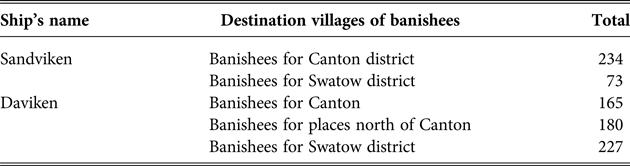
This left Swatow as the only viable port of entry to China. But many of the deportees were not even natives of Swatow (see Table 1). Some deportees also insisted they were Malayan, and that they did not even know where their villages were, and hence were not allowed to disembark.Footnote 38 The British consular office in Canton remarked that: ‘In formulating the policy of wholesale deportation we have not taken sufficient account of the implications at the receiving end of moving hundreds of people at a time.’Footnote 39 A report by a British consul showed that the Swatow authorities had refused the landing of repatriates for two major reasons: the deportees were either not from the Swatow area or did not have adequate funds to reach their native villages. Accordingly, the consul suggested that ‘the authorities in Singapore be strongly urged to sort out carefully the banishees before they sail’.Footnote 40 Malayan authorities realised the need to arrange for the reception and transfer of non-Swatow repatriates to their native villages and appointed G.W. Rothery as the acting consul in Swatow.Footnote 41
Number of banishees arriving at Swatow, Mar. 1949

Source: Report by Mr. J.K. Blackwell (Consular Officer at Canton) of visit to Swatow from 3–5 Apr. 1949, TNA, FO 371/75935, F7219/1583/10.
At the same time, the Federation was still trying to obtain official Chinese approval. But, as the British consul who visited Swatow in April 1949 had reported, attempts to request the Chinese government to accept its own nationals served no useful purpose for two reasons. First, the endless negotiations would be time consuming and would probably have an uncertain outcome. Second, approval from the central government would be meaningless because it was the local authorities which controlled the ports.Footnote 42 Following this report and subsequent discussions in Hong Kong, Gurney acknowledged the advice to ‘seek the most practical means of achieving our object without drawing their formal attention to the matter’.Footnote 43 The consul in Canton advised the Malayan government to resort to more realistic means, however, because sending repatriates to Swatow (or any other port in China) was not a permanent solution, given China's uncertain future. Even the Malayan authorities had to be well aware in early 1949 that the repatriation programme ‘might have to come to a sudden end and that they would then have to make alternative arrangements’.Footnote 44
The consul's prediction was accurate. By August 1949, there were signs that Swatow would fall to the communists. Right until then, Malaya was repatriating 900 deportees monthly. Gurney was still urging that deportations ‘should continue to the last possible moment’, reminding Creech Jones that stopping ‘repatriation may well be fatal blow to continued success of [the] operation here’. In requesting advice from the British Consul in Canton, he was willing to accept an alternative, even ‘in a reduced form’.Footnote 45 Gurney's fears materialised when the British Consulate at Swatow was ordered to close on 31 August; the High Commissioner had to recall Rothery to Malaya.Footnote 46
Stage 2: Initiating direct negotiations with the PRC
Up to January 1950, 10,000 detainees were repatriated. Gurney had continued to urge repatriation to China until the Communist takeover, arguing that the conditions for the programme would be ‘much less favourable’ once they were in power. Provided that the Chinese door remained open, he estimated that Malaya ‘might see the end [of the Emergency] at the end of 1949 [….] If the assumption is that there will be no appreciable banishment or repatriation to China during 1950, then I should be inclined to think that the prospects of ending the emergency in 1950 is small.’Footnote 47
With the Communists in power in China, the Colonial Office was faced with a tough choice: direct negotiations. The Foreign Office was asked to take up the issue of the possible resumption of repatriation with the PRC. J.D. Higham of the Colonial Office was aware of the possible complications in terms of Sino–British relations and of Chinese opposition to the negotiations on the grounds of British brutality toward the Malayan Chinese.Footnote 48 The Foreign Office responded: ‘We shall have to wait until full diplomatic relations have been established with the Chinese before we can raise the subject [repatriation] in Peking.’Footnote 49 The Foreign Office gauged that China would not conform to the international practice of receiving back its nationals: the argument that these people were Communist sympathisers, who were creating havoc in Malaya, would have no appeal to the PRC. After all, the Chinese government was providing underground moral support to the MCP. The Foreign Office advised the Colonial Office to inform Gurney about the impracticality of resuming a diplomatic line on repatriations, and that he should ‘be well advised not to count on it’.Footnote 50
Higham insisted on bringing up the issue of repatriation during Sino–British consular discussions, however. In his subsequent telegram to the Foreign Office, he stressed that: ‘the High Commissioner [Gurney] attaches such importance to this issue that I feel we must give his suggestion the most careful thought and at least return a reasoned reply to his telegram.’Footnote 51 Again the Foreign Office turned down the suggestion unequivocally on the following grounds:
These are that there can be no prospect of the repatriation of Chinese squatters from Malaya to China until full diplomatic relations have been established: and it is impossible to promise that even then it will be possible to restart the repatriation programme. We fully appreciate the importance of this question, but we consider that it would be quite useless to raise it with the Chinese at the moment.Footnote 52
Despite such strong Foreign Office disapproval, Malayan authorities continued with their repatriation plans and suggested requesting the reopening of the British consular post at Swatow. As far as N.C.C. Trench was concerned, this suggestion was ‘clearly out of the question’, for two reasons: it was unlikely that the Chinese authorities would agree to the opening of a new consular post when even the existing British consular officers in China were not recognised; and the Chinese government could likewise request the establishment of a consular office in British Malaya.Footnote 53 In any case, Malaya needed to consider whether it was ready to accept the stationing of Communist Chinese consuls, which could be seen as boosting the morale of the insurgents and inviting unnecessary foreign intervention in Malayan affairs. James Griffiths, the new Secretary of State for the Colonies, remarked that while securing the route of mass repatriation would inevitably lower the morale of the ‘bandits’, a PRC consulate would have precisely the opposite consequence.Footnote 54 Malcolm MacDonald pointed out that the PRC's underground support for the terrorist campaign ‘make it impossible for us for the time being to accept Consuls representing the Chinese Communist Government’.Footnote 55
When the Colonial Office saw that it could make no headway, it turned to considering smaller-scale repatriations: sending a small number of repatriates without the agreement of the PRC government. If this were to be noticed by Chinese immigration officers, the Colonial Office had an immediate alternative: detention on an island that was far enough from Malaya to have a ‘greater deterrent effect’. Gurney was directed to examine in consultation with the Commissioner-General the possibility of finding an area within the Malayan–Borneo region.Footnote 56
Stage 3: Experimental small-scale repatriation using non-official channels
Before the fall of the southern Chinese ports to the communists, Singapore had also made enquiries as to the possibility of using Hong Kong as a transit point for Malayan deportees en route either to Formosa (Taiwan) or Canton. The Governor of Hong Kong had refused, on the grounds that until political uncertainties were resolved, the territory could not accept any more deportees to China from any former or current British dominions. Neither the Nationalist nor the Communist regimes showed any sign of a welcome reception for such repatriates. Taiwan was imposing restrictions on the entry of Chinese even from the mainland, while the willingness of the latter was doubted. Hence the Federation government should first ascertain whether both intended recipient territories were willing to take in repatriates.Footnote 57
Since the flow of repatriation stopped in October 1949, the number of Chinese detainees in Malaya had increased to 3,500. With official repatriation to China becoming unworkable, the Malayan government turned its attention to repatriation on a commercial basis on non-British ships. In May 1950, the government approached Hong Kong once again, but to no avail.Footnote 58 Hong Kong was facing its own difficulties deporting ‘undesirables’ to the mainland, that is, the more than 6,000 ex-Nationalist soldiers and their dependants.Footnote 59
In a memorandum prepared by Gurney in May 1950, the High Commissioner outlined Malaya's critical predicament due to the failure of the deportations: escalating internal security issues, wastage of manpower — both in terms of administrators and security forces — and the financial burden of operating the camps.Footnote 60 The government was also susceptible to international human rights criticisms because some of the detainees had been in camps for two years without trial. Even in Malaya itself, their continuous detention might arouse adverse public opinion. Gurney also pointed out that the failure to press on with repatriation was ‘regarded by the Malays as a sign of weakness and tantamount to a breach of faith with them’.Footnote 61Majlis, the leading Malay-language newspaper, had urged the government to immediately deport Chinese collaborators because terrorism in Malaya would not have flourished if not for their support.Footnote 62 Gurney felt compelled to suggest sending an experimental batch to Swatow without asking China's permission, as a ‘testing ground’; if the experiment failed, ‘these people should be removed elsewhere outside the Federation.’Footnote 63
At this point, the Commissioner-General, the High Commissioner and the Governor of Singapore met with the Secretary of State in June and reached a consensus to resume repatriation. When normal passenger traffic between Malaya and China was set to resume in July 1950, the Colonial Office agreed to send 200 repatriates to Swatow. The British assumed that there would be fewer complications with the Chinese government with a smaller number of deportees. All levels of Gurney's administration unanimously agreed that the ‘renewal of the repatriation of Chinese detainees to China’ was an ‘essential prerequisite to the success of General Briggs’ operational plan'.Footnote 64 However, Trench believed that deporting so many repatriates in one shipment would create difficulties for the Swatow authorities and suggested that the number of deportees be restricted to 50 or 100, reminding Malaya of the devastation in China: ‘I find it hard to believe that the Chinese authorities, with a famine on their hands, are likely to welcome extra mouths to feed.’ He also suspected that the PRC government wished ‘to keep the pot boiling in Malaya’.Footnote 65
Four months after the unsuccessful attempt to open Hong Kong's door, Griffiths once again sought the goodwill of the Hong Kong government, requesting that it consider accepting batches of one or two hundred repatriates in transit to Canton on an experimental basis. The Federation government promised to bear all the costs of transit accommodation and onward travel, and to provide the repatriates with ‘journey money’ to their villages.Footnote 66 A. Grantham, the Governor of Hong Kong replied: ‘I fully appreciate the danger and difficulty of Malaya's position but I am afraid that I can see no possibility of passing on to China batches of Malaya deportees in the present circumstances […]’,Footnote 67 adding that stricter border controls imposed by the PRC made it difficult for Hong Kong to deport its own unwanted refugees.Footnote 68
Stage 4: Turning to resettlement and protection
British counter-insurgency measures from 1948–1949 had in reality terrorised the civilian Chinese and made them victims ‘between two terrors’, as Karl Hack observes.Footnote 69 Hack documents mass deportations, extensive arrests, widespread detention, property destruction, hut burning (and in some cases, shootings) endured by the Chinese during the early years of the Emergency.Footnote 70 While the authorities in Kuala Lumpur placed great stock on repatriation from 1948, from late 1950 onwards, a new proposal for resettlement in Malaya — the Briggs Plan — became increasingly discussed.
Hack regards the Briggs Plan as a major turning point from the hard approach towards soft measures. In what it described as ‘space and population control’, the Briggs Plan signified a belated policy to better protect the Chinese squatters. Initiated by Lieutenant General Harold Briggs, the scheme intended to systematically move 500,000 Chinese squatters into Resettlement Areas.Footnote 71 The Briggs Plan was initiated to sweep through the country, from south to north in four steps: dominate the populated areas, break up the Min Yuen, isolate the bandits, and finally, destroy them. The programme would require increased police reinforcements and administrative capacity.Footnote 72 According to its timetable, Johore was to be ‘cleared’ by 1 November 1950 while Selangor and the southern part of Pahang were to be cleared by 1 April 1951.Footnote 73
When the Briggs Plan was formulated, there were 10,500 detainees and dependants awaiting repatriation. The government anticipated a continued increase of 350 detainees a month.
It may therefore be necessary to repatriate above 15,000 persons over the next two years and it is urgently necessary to start repatriation now. Not only will repatriation solve the present detention problem, but the raising of morale which will follow it cannot be overestimated. This is recognised locally as a problem of the very highest importance but its solution does not lie in the hands of the Federation Government.Footnote 74
Stage 5: Locating new repatriation sites outside China
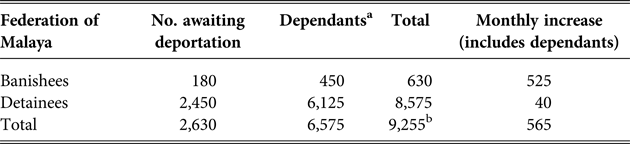
Meanwhile, seven months had passed since China had closed its doors without a new solution in sight. To speed up the counter-insurgency, the British Defence Coordination Committee (BDCC), Far East, held a special meeting on 5 May 1950. To examine other possible destinations for repatriation, a Working Party was set up under the chairmanship of J.C. Sterndale Bennett, Deputy Commissioner-General for the United Kingdom in Southeast Asia.Footnote 75 In its report, the Working Party justified the continued need for repatriation: ‘Some of the persons concerned have been detained without trial for nearly two years. They cannot safely be released but their continued detention is likely to strengthen their communist faith and is difficult to justify to outside public opinion.’ The camps alone required 1,500 guards and there were more than 9,000 detainees on the repatriation waiting list in the Federation (Table 2).Footnote 76
Number of detainees and banishees awaiting deportation in Malaya (as of 1 June 1950)
Notes: aEach of the detainees had on average 2.5 dependants, who were not detained but would have to be repatriated with them. bThis figure excludes the 50 detainees and dependants in Singapore awaiting deportation.
Source: Report on the disposal of Chinese detainees and banishees at Present in Singapore or the Federation, 1 June 1950, FO 371/83542, F1822/24.
The Working Party assumed that mass deportation via an agreement with the PRC government was not possible at present, hence it found itself unable to provide any additional advice without Foreign Office authorisation. The Foreign Office had reminded the Malayan authorities not to envisage any further action involving the Chinese government ‘pending further consideration of the matter in London’.Footnote 77 The Colonial Office, on the other hand, had stipulated that repatriation should only be considered on a voluntary commercial basis (see discussion in stage 3).Footnote 78 The detainees would disembark as ordinary passengers, but the Working Party believed that any non-official repatriation scheme — without formal agreement with China — could only be a partial solution. The local authorities might refuse the landing of repatriates and take legal action against the shipping agents.Footnote 79 Based on these limitations, the Working Party restricted itself to exploring the possibility of ‘finding a place of detention outside the mainland’.Footnote 80
Detention camps outside the mainland were contemplated as a solution to three problems simultaneously. First, it would be a safe place to send the four hundred ‘hard core’ detainees — to avoid them being re-infiltrated into Malaya by the PRC should they be deported to the mainland. Second, a deportation camp outside China would be a suitable place to deport non-Chinese nationals (Malays, British subjects, or other Federal citizens), who numbered as many as 1,500 detainees (excluding dependants). Third, this new location could be a temporary transit point while a permanent destination was being sought.Footnote 81
The Working Party proposed Borneo, the Andaman Islands, Langkawi, and Christmas Island. Borneo was at first ruled out as being unsuitable for political and administrative reasons, while it was felt that Indonesia may not agree to the use of the Andaman Islands. Christmas Island was the furthest away and lacked port facilities, and Langkawi was seen as too close to home, that is, not having the ‘psychological advantage’ of deportation. Nevertheless, the Working Party's interim report suggested that both Christmas Island and Langkawi could be used as temporary detention centres.Footnote 82
The conclusion of the Working Party is that, while the Federation Government should be recommended to arrange with the Government of Singapore for a joint investigation of the practicability of establishing a semi-permanent detention camp on Christmas Island, it is most desirable that the Federation Government should simultaneously re-examine the question of using Langkawi as a staging post for detainees.Footnote 83
Further deliberations in the Federation and London led to the conclusion that establishing transit camps in North Borneo seemed to be the only immediate workable solution. The Colonial Office contacted the Governor of North Borneo, Sir R. Hone, in November 1950. Hone was assured that the Federation would bear all costs involved, and that the detainees would eventually be moved out from North Borneo.Footnote 84 However, the authorities — the Governor of North Borneo (Hone), Governor of Sarawak (A.F. Abell), Governor of Singapore (F. Gimson) Attorney General of the Federation (S.F. Sutton), and MacDonald — were reluctant to have communists imported into North Borneo, which could jeopardise the internal security of North Borneo. They did not wish to see the colony becoming a new centre of ‘terrorist organisation’. In their opinion, the detainees ‘should be removed from South East Asia altogether’. As an alternative, the North Borneo Local Defence Committee proposed the British Solomon Islands. The Secretary of State was then asked to investigate this proposal with Australia, which had jurisdiction over the Solomon Islands.Footnote 85
The following months witnessed a stream of correspondence between the Colonial Office and Australia. As the British expected, the Australian authorities expressed their strong objections to allowing Chinese detainees into Solomon Islands, explaining that Australia was not ready to accept responsibility for the Malayan war at the risk of its own internal security. The fear was that accepting the deportees would create a ‘substantial risk of a new Chinese community being built up in the area’, with a danger of their ‘infiltrating’ other islands in the Protectorate and Australian Trusteeship territories.Footnote 86 Australia also greatly doubted that Britain would be able to later transfer them from the Solomon Islands to China. Based on such ‘political and security grounds’, the Australian authorities thought repatriation to China was the best way to deal with these detainees.Footnote 87 The British were advised not to pursue sending the detainees to the Solomon Islands.Footnote 88 The British seemed to be desperately trying to push responsibility for the war to somewhere outside Malaya, but all their efforts to secure a place outside China met with failure.
Stage 6: Looking at a forced military option
The situation in the camps in Malaya was worsening to the point that the British were now considering the dreadful solution of dumping the detainees and their dependants off the coast of China. Briggs, in a paper dated November 1950, suggested that the only real answer to the detainee problem was the simultaneous landing of all detainees on the shores of China. The Briggs Plan could not prevent the hard-core communists from resuming their pro-bandit activities. The British had no intention of resettling this class of person. However, the Foreign Office was concerned about possible repercussions on Sino–British relations, including provoking a possible outbreak of hostilities with China. J.D. Murray of the Foreign Office pointed out: ‘General Briggs may be correct in saying that there is a state of war in Malaya; but this is not the same thing as a state of war with China.’Footnote 89 Murray advised Malaya to wait for the outcome of the trial shipment and at the same time, continue to look for a detention centre outside China. One port (Swatow) was reopened in November 1950 and the first trial shipment of 693 persons took place on 16 November.Footnote 90
The military option would have to involve the British Far East Defence Secretariat, which pointed out that the operation could be done in two ways: either by ferrying the detainees ashore, thereby entering Chinese territorial waters, or by releasing the detainees in expendable boats without infringing Chinese territorial waters. The commander-in-chief outlined the requirements for the successful operation of the first option as follows: a) it ‘would have to be carried out with service assistance and under service control’; b) sufficient shipping should be available with additional ferry craft to be sent from Hong Kong; c) the St. John/Hancheun Islands should be used as the ‘dumping area’; d) the dumping should take place between April and July; e) ‘escorts the equivalent of one platoon of infantry would be required on each transport’; f) ‘naval and air forces would be required to cover the operation’; g) ‘detainees should be given adequate provisions’ and money; h) ‘a cover plan would be necessary’; and j) ‘mounting the proposed operation in the Federation would take from four to six weeks depending on the availability of transports.’ With respect to the second option, the requirements were the same except that a) ‘ferry craft from Hong Kong would not be required’; b) ‘expendable boats could be released in any relatively sheltered waters’; and c) ‘provision of expendable boats would probably take from four to six months’.Footnote 91
Both options, the commander-in-chief pointed out, would be militarily feasible but politically impractical. To begin with, there were humanitarian issues involving the wives and children of the detainees, since water hoses could be used to force the deportees to disembark. Also, politically, such forced landings were not wise. A violation of Chinese territorial waters could have adverse consequences, including the danger of provoking retaliation against British subjects in China: ‘A military operation on these lines could only be contemplated in a situation where relations with China had already been broken off and we were so near a state of war that we were prepared to risk it.’Footnote 92
Although the Foreign Office considered the plan to be most undesirable, Gurney supported the plan to dump the deportees directly on the shores without any extra craft. The need for a unilateral dumping operation was greatly felt when Beijing ordered the Swatow authorities to stop receiving the detainees from January 1951. In February 1951, however, the Foreign Office reminded Gurney that the lives of 2,000 British subjects in China were at stake.Footnote 93
But by early 1951 the first target state — Johore — had not been completely cleared according to Briggs' schedule. Malaya faced the same problem in the other states.Footnote 94 Clement Attlee, the British prime minister, called a special meeting in February 1951 to highlight the urgency of the Malayan problem and call for a new solution — North Borneo:
Perhaps the most important thing of all was to set aside immediately large areas in North Borneo for the reception of Chinese deportees and to give this operation the highest possible priority. The proposed dumping of Chinese detainees en masse on the coast of China should be held in reserve; this would amount practically to an act of war and in any case could only be carried out once.Footnote 95
A follow-up cabinet meeting shows the continuing concern that clearing Malaya would be a slow process, with the country described as a ‘guerrilla's paradise’ suffering from a shortage of administrative and resettlement officers as well as police.Footnote 96 Briggs now proposed a new timetable to clear the southern half of the country by the end of 1951. Malcolm Macdonald now saw North Borneo as the only solution, despite strong official and unofficial opposition. MacDonald proposed that, once the surveying of the island was completed, he would direct the Governor of North Borneo to accept the detainees.Footnote 97
The counter-insurgency plans were far behind schedule and the problem of what to do with the Chinese detainees ‘remained very serious’.Footnote 98 The MCP's morale had been greatly boosted by the establishment of the Chinese communist government in October 1949. The subsequent British de jure recognition of the People's Republic of China in January 1950 also had ‘unfortunate repercussions’ for the Malayan counter-insurgency.Footnote 99
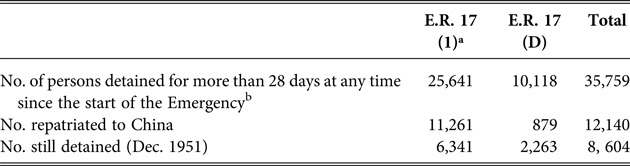
Number of persons detained and repatriated under Emergency Regulations (1948–51)
Source: ‘Malaya: Cabinet Memorandum by Mr. Lyttelton, Appendix X1: Detention and repatriation 21 Dec. 1951, CAB 129/48, C (51) 59’, in Stockwell, British documents on the end of empire, p. 350.
Notes: aIndividuals detained under section 17 (1) had the right to appeal against detention orders and the maximum period of detention was two years. Section 17 (D) allowed the High Commissioner to issue detention orders covering all the inhabitants of an area without the right to appeal. In both cases, individuals detained ‘may be deported from the Federation’.
bOf the 25,641 persons detained under Regulation 17 (1), 22,667 were Chinese; 1,753 Malays; and 1,099 Indians.
On 6 October 1951, Gurney was assassinated by the Malayan communists; this event marked a turning point in the counter-insurgency.Footnote 100 The BDCC (Far East) acknowledged that ‘the Communist hold on Malaya is as strong, if not stronger, today that it ever has been’.Footnote 101 By December 1951, a total of 12,140 repatriates had been sent back to China since late 1948 while 8,604 persons were still under detention (Table 3).
Even before Gurney's successor was appointed, the BDCC identified the next stage of the counter-insurgency strategy: consolidating the resettlement programme (350,000 squatters had been successfully resettled) and securing active cooperation from the Chinese community. These measures involved improving conditions in the settlements, increasing the number of Chinese resettlement guards, recruiting Chinese police, including Chinese in local government, and most notably, revising the citizenship rules.Footnote 102 A heavy emphasis on the Chinese was only logical when ‘The crux of the problem is the winning of the confidence and loyalty of the bulk of the Chinese population’.Footnote 103
The repatriation policy had brought up the whole issue of belonging and citizenship. On the one hand, the mass deportation of the Chinese detainees had been justified on the grounds that they were not citizens. As the consul who reported on the detainees in April 1949 had observed, many of the deportees were born in Malaya, and had no other place they could call home. They were looked upon as ‘natives of Malaya’ by outsiders. These Malayan-born Chinese had never been to China and had no village to return to.Footnote 104 Chinese communities elsewhere regarded the Malayan Chinese as having been mistreated. Forced repatriation had also created difficulties for dependants, and for the destitute families landing in China.Footnote 105
Stage 7: Attempting to open Formosa's door
The persecution of the Malayan Chinese raised strong protests from China, which regarded all overseas Chinese as its nationals. Since the end of 1950, the PRC had intensified its protests both in the print media as well as via Radio Beijing broadcasts. In September 1950, Ho Hsiang-ning, the Chairman of the Overseas Chinese Affairs Commission, issued an open protest against the British Malayan administration, questioning British sincerity in trying to establish diplomatic relations with the PRC.Footnote 106
Although J.C. Hutchinson, the British representative in Peking, regarded the protest purely as a Chinese propagandist tool to build an anti-imperialist front, the British Consul in Beijing advised the Foreign Office not to take it lightly. Sino–British negotiations for the establishment of diplomatic relations, following British recognition of the Communist regime on 6 January 1950, would be affected negatively.Footnote 107
On 4 December 1950, overseas Chinese from Malaya staged a protest rally in Peking (Beijing).Footnote 108 Two days later, 693 overseas Chinese who had arrived via Swatow gathered to protest British persecution of the Chinese in Malaya. The meeting passed a resolution with three demands for the British: the immediate cessation of violence and payment of compensation for the loss of life and property; the immediate release of all Chinese in detention camps; and finally, that the British were to bear full responsibility if they continued the persecution.Footnote 109 The Returned Overseas Chinese Association in Peking on 4 December issued a joint protest letter with the All China Federation of Labour, the All China Democratic Women's Federation, the All China Democratic Youth Federation and the All China Students' Federation to British Prime Minister Clement Attlee on 29 December. In January 1951, China's Ministry of Foreign Affairs issued the following statement:
The Central Peoples Government cannot but express grave concern over this state of affairs. We hold that not only the British colonial authorities but also the British Government should be held responsible for the persecution of overseas Chinese by the British colonial authorities in Malaya.Footnote 110
According to MacDonald, however, the campaign was directed at the treatment of the Malayan Chinese and not against repatriation per se since Beijing did not object to the continuation of repatriation, which had resumed since November 1950. Therefore, MacDonald strongly recommended the Foreign Office to take opportunity of the present advantage and to continue the programme despite intensified Chinese protests, arguing that once the programme ceased, it would be extremely difficult to resume it.Footnote 111
The British were anticipating grave consequences, such as anti-British propaganda, retaliation against British nationals, damage to British interests in China and, in a worst-case scenario, having the issue taken to the United Nations. Yet the Foreign Office also agreed that deportation must continue at any cost: ‘We should not let ourselves be deterred by threats when we have a good case for the deportation of these undesirables.’Footnote 112 Given that the anti-British campaign was likely to be intensified when more deportees arrived in China, Hutchinson suggested neutralising Beijing's campaign by announcing the grounds for the Malayan deportations — the detainees' assistance to communist bandits rather than their political views or nationality.Footnote 113 The Foreign Office, however, did not see the need to start a ‘propaganda battle’ with China.Footnote 114
The newly set up Relief Committee for Overseas Chinese Refugees of Malaya requested permission from the British Prime Minister to allow an investigation of the situation in Malaya. The Foreign Office saw the request as unreasonable (and offensive), saying that the PRC protested the treatment of their overseas nationals and yet refused to fulfil its international obligations to take them back. The Chinese government was reminded that the detainees were still in the camps because China had stopped accepting the repatriates. The Foreign Office made it clear that: ‘If however any Chinese are dissatisfied with conditions in Malaya, the authorities put no obstacle in the way of their return to China.’Footnote 115 The Malayan authorities rejected the request for an investigation after a meeting of the Malaya–Borneo Defence Council in March 1951, stating that local public opinion, especially Chinese, opposed the mission and that the Chinese in Malaya were more determined to cooperate with the Government.Footnote 116
Another option that was discussed was the more problematic idea of sending the Malayan detainees to Taiwan, but at that stage every alternative was being explored.Footnote 117 The Commissioner-General set up a subcommitteeFootnote 118 in late 1950 to investigate the new prospect. The subcommittee agreed that the scheme should be given serious consideration, as repatriation to China was liable to ‘break down’ at any time. The subcommittee outlined the reasons why sending Malayan communist detainees to Taiwan was more problematic than sending them to China. The fact that the deportees were communist supporters made it very unlikely that they would be accepted by the Kuomintang government. The deportees could also be executed in Taiwan; if they were sending the deportees to their deaths, the British would be subject to international condemnation. In any case, the British might not have a legal right to deport the Chinese to a country whose government which they did not even recognise. As the detainees were originally from the mainland (Fukien, Kwangtung and Kwangsi), it was doubtful if they could be sent to Taiwan. The deportees themselves may not be willing to be sent there.Footnote 119 Nevertheless, the subcommittee concluded: ‘The risk of the repatriation scheme being called off was sufficiently great to merit serious consideration of the possibility of repatriation to Taiwan, however, unpromising this might appear at first sight.’ On 14 December 1951, the subcommittee sought the support of the Foreign Office to instruct the British Consul in Tamsui to approach the Formosan authorities.Footnote 120
Despatches were sent to the British consulates in Hong Kong and Taiwan as well as to the Foreign Office. By January 1953, all of them had responded negatively. The Hong Kong authorities refused to accept deportees without Taiwanese entry permits and without Taiwan's agreement. The fact that the prospective deportees were communist sympathisers made the chances of getting permits even slimmer.Footnote 121
For the British Consul in Taiwan, the greatest stumbling block was the non-recognition of Taiwanese statehood. The British could not deport the Chinese to Taiwan based on their Taiwanese passports since they did not recognise the passports. Taiwan would definitely demand British recognition in return. The Consul recommended revising the scheme on a case by case basis since Taiwan might be willing to receive Formosan-born Chinese. In cases where ‘persons whose lives would be in danger if repatriated to Communist China’ the Taiwanese government should be persuaded to accept them.Footnote 122
The ideology of the Malayan deportees was the major problem. The Foreign Office itself did not view this option suitable to be brought up at all with the Nationalist government. The Malayan government was informed not to send pro-communist deportees to Formosa: ‘While we would not in general have any objection to the deportation to Formosa of persons of Formosan birth, we very much doubt whether it would be proper to ask the Formosan authorities to accept any other categories of deportees.’Footnote 123
If sending communist-orientated deportees to Taiwan was impossible, the Malayan government proposed to the Foreign Office that another category of detainees be sent: the secret society members, who would suffer persecution if they were sent to China.Footnote 124 Malaya was informed that it could deal with the British Consul in Taiwan on this matter as long as the Foreign Office was notified.Footnote 125 The protracted discussions led to no significant solution, however; option after option was explored with no viable outcome in sight. Discussions continued until 1953, when the need for deportation was no longer felt. By then, the MCP was losing the war.
Legacy of repatriation
The failure of the repatriation policy had an impact on Malaya's political future: the majority of the Chinese squatters were there to stay and the government had to find ways to accommodate them. The plan to resettle, accommodate or integrate the Chinese eventually affected race relations, demography, urbanisation, and citizenship in Malaya. The main victims of the communists were the Chinese, who comprised 1,200 of the 1,700 civilians killed. But they had not responded to the government's pleas for cooperation compared to the Malays, who were in general anti-communist. For the Malays, a Communist victory meant ‘Chinese hegemony’. But the Chinese had no political stake in the country, and it was only natural that they remained inactive.Footnote 126 In order to diffuse communal tensions, the British expedited the establishment of the Communities Liaison Committee (CLC), the founding of the Malayan Chinese Association (MCA), the introduction of constitutional reforms and elections, the formation of the multiethnic Alliance Party, and eventually the granting of national independence.Footnote 127
While detention and deportation presented an easier solution for the colonial government, its consequences on the Chinese community were highly debatable. Many alienated Chinese were forced to cooperate with the insurgents as they were not protected by the authorities. David Ucko believes that the government ‘failed to understand the plight of Malaya's civilian Chinese community’.Footnote 128 In addition, by repatriating the Chinese to the mainland, Fujio Hara observed that ‘Britain was forcing them to view China as their protector’, and mass punitive action ‘served only to worsen the situation’.Footnote 129 Richard Stubbs viewed the use of coercion and enforcement on the Chinese as unreasonable — they were ‘more worthy of sympathy than of the full weight of the law’.Footnote 130
This period reflected the British struggle to strike a balance between hard and soft counter-insurgency measures. There were various internal and external factors which compelled the policy pendulum to gradually swing away from deportation toward protection. The British administration gradually realised the deficiencies of its policies: ‘We have not provided a sufficiently powerful psychological incentive and we have failed to give the Chinese adequate protection against intimidation by the terrorists.’Footnote 131 They had failed also to understand the underlying reason for the Chinese squatters' unwilling cooperation with the bandits: fear. Harsh detention and repatriation measures created a new ‘terror’ among the rural Chinese. It was hard to make sure that the programme ‘protected the innocent while eliminating the guilty’.Footnote 132
Eventually the British shifted their policy from alienation to integration. The British, together with the leaders of the resident Chinese community, finally took up the plight of the squatters when the Chinese ports were closed. The destitution, suffering and displacement of the civilian Chinese during the period of mass detention and deportation brought about the formation of the Malayan Chinese Association (MCA) in February 1949. The MCA saw squatter relief as a priority. As Kernial Singh Sandhu stressed: ‘The cause of the squatter soon became the cause of the Malayan Chinese Association’.Footnote 133
The MCA was more than a social organisation. It sought to unite the Chinese population behind the government's anti-insurgency efforts and promote loyalty to the Malayan government. In this regard, citizenship rights for non-Malays was one of the central agendas of the party.Footnote 134 MCA's leader, Tan Cheng Lock, called for Chinese unity and for an effective voice in the government. Without a political stake in the country, the Chinese ‘have practically little or no say in its affairs and are even subject to banishment as aliens’. Banishment made Tan realise the Chinese community's predicament:
In that shape of things to come in the future of this land, will the Malayan Chinese have a place in it, or will they be degraded to the status of ‘hewers of wood and drawers of water’ for the people of Malaya? Will the Malayan Chinese be given a place in the Malayan sun or will they be relegated to the position of helots or pariahs without rights and responsibilities?Footnote 135
The British also recognised the unsatisfactory national status of the squatters and the need to give them a sense of belonging:
it seems hardly reasonable to expect people to defend a country of which they are denied full citizenship .... But it's difficult to see how we can win the co-operation of the Chinese population, so essential to this battle in Malaya — or how indeed, Malaya is to grow into a united nation, unless more Malayan born Chinese become eligible for citizenship in near future.Footnote 136
General Sir Gerald Templer, upon his appointment as the new High Commissioner and Director of Operations, issued a directive recognising the community's aspirations: ‘To achieve a united Malayan nation there must be a common form of citizenship for all who regard the Federation or any part of it as their home and the object of their loyalty.’Footnote 137 It was the proclaimed policy of the British government that ‘Malaya should in due course become a fully self-governing nation’.Footnote 138 Templer transformed the counter-insurgency strategy from a colonial war to a Malayan independence struggle, lending much credence to his ‘hearts and minds’ campaign.Footnote 139
Gradually replacing the ‘stick’ with the ‘carrot’, Templer sought to encourage new settlers to become ‘ordinary citizens’ in the resettlement areas now known as ‘New Villages’. The New Villages — equipped with schools, water supply, sanitation and public health, roads and drains, a place of worship, Home Guard, and village committee — allowed the Chinese squatters to become better integrated and politically socialised.Footnote 140 These settlers later became ‘legal citizens’ with the new citizenship legislation passed on 15 September 1952. The landmark legislation, which was made possible after two years of intense discussions in Malcolm MacDonald's Communities Liaison Committee, enfranchised 1,157,000 Chinese (as well as 220,000 Indians and 2,727,000 Malays). The introduction of the ‘delayed jus soli’ principle conferred automatic citizenship on those born in the Federation with a local-born parent.Footnote 141 A nascent Malayan citizenry was in place. As Sandhu observed: ‘Completion of this process [resettlement] would change the New Villages from reservoirs of resentment into bastions of loyal Malayan citizenry.’Footnote 142 Other constitutional advancements soon followed: continuing municipal elections, allowing Chinese entry into the Malayan Civil Service, the formation of the Alliance party, the holding of a national election, and the granting of independence.Footnote 143
Such policies were in sharp contrast with those of the Gurney administration, which believed that the Chinese could be intimidated into supporting the government. Gurney had assumed that the community would ‘lean towards whichever side frightens them more’.Footnote 144 Coercion was greatly minimised during the Templer administration: ER 17D was finally abolished on 17 March 1953, thus alleviating the need for deportation. This abolition was welcomed because it showed that the government ‘cared for the plight of rural Chinese’.Footnote 145
Conclusion
The counter-insurgency war in Malaya lasted twelve years, during which the deportation policy remained for five years, until 1953. After five years of continual correspondence involving the High Commissioner's Office, Colonial Office, Foreign Office, and the British consulates in China, Taiwan, and Hong Kong, the plan eventually faded away. The repatriation scheme was never a comprehensive programme and its implementation proved highly unfeasible. When the British formulated the policies of mass detention and deportation, they had not given much consideration as to whether the Chinese ports would remain open. They had assumed that free movement between Malaya and China would continue, and that the detainees could be readily deported without too many obstacles. But the programme had no proper facilitation, poor implementation, a lack of preparation, improper screening of deportees, and most importantly, no contingency plans. This article shows how British officials explored ever more desperate measures, including a military operation to dump the deportees on isolated islands or in boats off the coast of China, and even considered sending them to anti-communist Formosa.
The British themselves were often divided; in many cases the Foreign Office or British consular staff, and even the military, pointed out to the Colonial Office or the Federation government that the programme was flawed or even dangerous at times. Humanitarian concerns arose over the coercive and harsh measures which Gurney adopted, such as leaving the initial batches of hundreds of destitute families stranded in war-torn China (already suffering from a huge internal refugee problem and famine) without financial support, dependants or accommodation, leaving them in the hands of overstretched local authorities. The repatriation programme was seen by Malayan British authorities as a vital part of the counter-insurgency and all other considerations — China's protests, Sino–British diplomatic relations, and international criticism — were deemed secondary to the urgent need to get rid of the communists.
Finally, Malayan repatriation policies between 1948 and 1953 achieved far more than it originally intended. The harsh manner in which mass detentions and deportations were carried out among the Chinese, and the failure of the repatriation policy, which left Malaya with a huge number of stateless Chinese, was to have a long-lasting legacy on Malaya: measures which brought about ethnic reconciliation and national unity.