Introduction
Bipolar disorder (BD) is a mood disorder characterized by extreme shifts in mood (recurrent depressive and manic/hypomanic episodes), as well as the dysfunction of cognitive performance and psychological traits (Rantala, Luoto, Borraz-Leon, & Krams, Reference Rantala, Luoto, Borraz-Leon and Krams2021; Sanchez-Moreno et al., Reference Sanchez-Moreno, Bonnin, Gonzalez-Pinto, Amann, Sole, Balanza-Martinez and Group2018). BD patients are at a higher risk of suicide than the general population and other psychiatric diagnoses (Brown, Beck, Steer, & Grisham, Reference Brown, Beck, Steer and Grisham2000; Miller & Black, Reference Miller and Black2020; Simon, Hunkeler, Fireman, Lee, & Savarino, Reference Simon, Hunkeler, Fireman, Lee and Savarino2007). A recent meta-analysis pointed out that approximately 33.9% of BD patients have a lifetime history of suicide attempts (SAs) (Dong et al., Reference Dong, Lu, Zhang, Zhang, Ungvari, Ng and Xiang2019). Importantly, the predominant depressive polarity is the most likely mood state associated with higher suicide risk in BD (Mitchell & Malhi, Reference Mitchell and Malhi2004; Weinstock, Strong, Uebelacker, & Miller, Reference Weinstock, Strong, Uebelacker and Miller2016). The SA is a most powerful predictor of future suicidal behavior (Bostwick, Pabbati, Geske, & McKean, Reference Bostwick, Pabbati, Geske and McKean2016; De Berardis et al., Reference De Berardis, Fornaro, Valchera, Cavuto, Perna, Di Nicola and Tomasetti2018; Tondo, Vazquez, & Baldessarini, Reference Tondo, Vazquez and Baldessarini2021; Tondo et al., Reference Tondo, Baldessarini, Barbuti, Colombini, Angst, Azorin and Perugi2020) and has therefore properly been the target of therapeutic interventions for reducing the risk of suicide in BD patients. Of note, treatments for depression in BD are far less well developed and remain unsatisfactory (Vazquez, Camino, Tondo, & Baldessarini, Reference Vazquez, Camino, Tondo and Baldessarini2017). Currently, the pathophysiology for suicide still represents a puzzling challenge (De Berardis et al., Reference De Berardis, Fornaro, Valchera, Cavuto, Perna, Di Nicola and Tomasetti2018), let alone the suicide-preventing therapeutics. Thus, understanding the associated risk and biological mechanism of SA is important for establishing effective interventions and specific treatment for suicide in bipolar depression, achieving the goal to eradicate suicide at its roots.
The insula plays an important role in cognitive processing, emotion control and regulation, and performance monitoring in BD patients (Craig, Reference Craig2009; Li et al., Reference Li, Tang, Womer, Fan, Zhou, Sun and Wang2018; Qiu et al., Reference Qiu, Liu, Zhang, Huang, Ying, Wang and Peng2020; Yin et al., Reference Yin, Chang, Wei, Jiang, Zhou, Cui and Tang2018). Additionally, the insula is crucial for self-recognition, risk evaluation as well as anticipation, and the attenuated left insula reactivity corresponds to higher risk-taking behavior (Nestor, Hester, & Garavan, Reference Nestor, Hester and Garavan2010; Stewart et al., Reference Stewart, May, Poppa, Davenport, Tapert and Paulus2014). These may be underlying the acquired capability for suicide and seem to be crucial processes for suicide-related behaviors (Deshpande, Baxi, Witte, & Robinson, Reference Deshpande, Baxi, Witte and Robinson2016; Northoff et al., Reference Northoff, Heinzel, de Greck, Bermpohl, Dobrowolny and Panksepp2006; Schmaal et al., Reference Schmaal, van Harmelen, Chatzi, Lippard, Toenders, Averill and Blumberg2020). Convergent neuroimaging evidences in BD suicide attempters supported the involvement of insular structural and functional alterations (Amen, Prunella, Fallon, Amen, & Hanks, Reference Amen, Prunella, Fallon, Amen and Hanks2009; Baek et al., Reference Baek, Kwon, Chae, Chung, Kralik, Min and Jeong2017; Hwang et al., Reference Hwang, Lee, Tsai, Chen, Yang, Lirng and Tsai2010; Li, Chen, Gong, & Jia, Reference Li, Chen, Gong and Jia2020; Rizk et al., Reference Rizk, Rubin-Falcone, Lin, Keilp, Miller, Milak and Mann2019). Of note, based on the structure and function characteristics, the insula can be partitioned into three subregions, including ventral anterior insula (vAI), dorsal anterior insula (dAI) and posterior insula (PI) (Deen, Pitskel, & Pelphrey, Reference Deen, Pitskel and Pelphrey2011; Li et al., Reference Li, Liu, Ma, Li, Duan, An and Chen2015; Peng et al., Reference Peng, Lin, Wu, Gong, Yang and Wang2018). The vAI was most strongly correlated with the pregenual anterior cingulate cortex and thus contributes to affective and pain processing; the dAI was connected to dorsal anterior cingulate cortex and cognitive control network that can influence decision-making and behavior, while the PI was connected to primary and secondary somatomotor cortices and may involve in processing somatosensory stimuli with affective or motivational information (Craig, Reference Craig2009; Deen et al., Reference Deen, Pitskel and Pelphrey2011; Dosenbach et al., Reference Dosenbach, Fair, Miezin, Cohen, Wenger, Dosenbach and Petersen2007; Tian et al., Reference Tian, Young, Zhu, Xu, He, Chen and Qin2021). Hence, specific AI subdivisions may have distinct roles in cognitive processing and emotional regulation, as well as the patterns of connectivity. Abnormalities in insular subregion-based networks or volume have been found in both MDD and BD patients (Ambrosi et al., Reference Ambrosi, Arciniegas, Madan, Curtis, Patriquin, Jorge and Salas2017; Peng et al., Reference Peng, Lin, Wu, Gong, Yang and Wang2018; Yu et al., Reference Yu, Li, Li, Li, Meng, Liang and Li2020), as well as MDD patients with SA (Hu et al., Reference Hu, Xiao, Cao, Tan, Wang and Kuang2021). However, very few studies investigated insular subregion-based dysfunction in BD patients with SA; further studies are encouraged to investigate insular dysfunction at a subregional level in BD patients with SA.
Of note, functional magnetic resonance imaging (fMRI) studies have been used to explore the intrinsic activity or functional connectivity (FC), which may help to identify the neural correlates of suicide ideation (SI) or behavior. A recent study found the heightened activation in the right anterior insula of social rejection interacts with exposure to negative social experiences to contribute to SI (Oppenheimer et al., Reference Oppenheimer, Silk, Lee, Dahl, Forbes, Ryan and Ladouceur2020). Another study also indicated that the suicidal ideation and behavior histories directly relate to higher rostral insula fMRI activation during a cognitive control task in adults with MDD or BD with psychotic features (Minzenberg et al., Reference Minzenberg, Lesh, Niendam, Yoon, Cheng, Rhoades and Carter2015), but lower activation in the PI during social exclusion was found in in euthymic depressed female suicide attempters (Olie et al., Reference Olie, Jollant, Deverdun, de Champfleur, Cyprien, Le Bars and Courtet2017). Regarding static FC, previous studies have revealed the aberrant FC between the bilateral PI and the left orbital frontal cortex, and between the left PI and a series of motor cortices (Hu et al., Reference Hu, Xiao, Cao, Tan, Wang and Kuang2021), between the anterior cingulate gyral and insula (Pan et al., Reference Pan, Hassel, Segreti, Nau, Brent and Phillips2013), between the right insula and left amygdala (Ambrosi et al., Reference Ambrosi, Arciniegas, Madan, Curtis, Patriquin, Jorge and Salas2017), between the insula and cerebellum, as well as the insular-default mode network (Jung et al., Reference Jung, Choi, Han, Kim, Kang, Paik and Ham2020) in both the depressed adolescents and young adults with SA. However, most static FC studies of insula focused on the suicidal behaviors in patients with MDD and implicitly assumed that FC was stationary throughout the entire resting scan period. Of note, the communication across different regions is dynamic rather than static throughout the resting-state scan due to the condition-dependent nature of neural activity (Allen et al., Reference Allen, Damaraju, Plis, Erhardt, Eichele and Calhoun2014; Preti, Bolton, & Van De Ville, Reference Preti, Bolton and Van De Ville2017; Reinen et al., Reference Reinen, Chen, Hutchison, Yeo, Anderson, Sabuncu and Holmes2018). The dynamic functional connectivity (dFC) analysis could provide abundant information about the time-varying functional architecture of specific regions and sensitive to behavioral performance and emotional measures (Han et al., Reference Han, Wu, Wang, Sun, Ding, Cao and Zhou2018; Liu et al., Reference Liu, Wang, Zhang, Yang, Liu, Wang and Sun2021). A recent study indicated that the MDD patients with SI displayed increased dFC from habenula to the superior temporal gyrus, the precuneus, but decreased dFC to the lingual gyrus, the postcentral gyrus (Qiao et al., Reference Qiao, Zhang, Sun, Yang, Li, Zhao and Liu2020). Furthermore, results from dFC analyses have proved superior at correctly differentiating depressed patients with SI from those without SI and predicting the severity of SI in comparison with static FC (Liao et al., Reference Liao, Li, Duan, Cui, Chen and Chen2018). Therefore, the dFC could be a powerful supplement to static FC (Hutchison et al., Reference Hutchison, Womelsdorf, Allen, Bandettini, Calhoun, Corbetta and Chang2013) and may provide a better understanding of the neural mechanisms underlying suicide behaviors. Unfortunately, little is known about the alerted dFC variability in insular subregions that may underlie the BD-relevant suicide behaviors.
Moreover, suicidal behavior is indeed a highly complex and multifaceted phenomenon, and may result from a complex interaction between neurobiological, physiological traits and characteristics, stressful social environments, and individual vulnerability (Antypa, Antonioli, & Serretti, Reference Antypa, Antonioli and Serretti2013; Bobo et al., Reference Bobo, Na, Geske, McElroy, Frye and Biernacka2018; Hawton, Sutton, Haw, Sinclair, & Harriss, Reference Hawton, Sutton, Haw, Sinclair and Harriss2005; Leverich et al., Reference Leverich, Altshuler, Frye, Suppes, Keck, McElroy and Post2003; Orsolini et al., Reference Orsolini, Latini, Pompili, Serafini, Volpe, Vellante and De Berardis2020). Therefore, the identification of suicide risk factors of SA is clinically relevant for clinicians (Orsolini et al., Reference Orsolini, Latini, Pompili, Serafini, Volpe, Vellante and De Berardis2020). Of note, the self-report psychological tests have been extensively used in studies investigating the psychological characteristics of SA with BD. Specifically, SA risk is associated with low self-directedness, but high self-transcendence, novelty seeking, fatigability and asthenia, harm avoidance and the comorbidity with personality disorder (Jylha et al., Reference Jylha, Rosenstrom, Mantere, Suominen, Melartin, Vuorilehto and Isometsa2016a, Reference Jylha, Rosenstrom, Mantere, Suominen, Melartin, Vuorilehto and Isometsa2016b; Pallaskorpi et al., Reference Pallaskorpi, Suominen, Ketokivi, Valtonen, Arvilommi, Mantere and Isometsa2017; Pawlak et al., Reference Pawlak, Dmitrzak-Weglarz, Maciukiewicz, Kapelski, Czerski, Leszczynska-Rodziewicz and Hauser2017; Schaffer et al., Reference Schaffer, Isometsa, Tondo, Moreno, Turecki, Reis and Yatham2015). However, little is known about the underlying neural mechanism supporting the sensitivity to risk of suicidal acts in BD patients. A previous study indicated that the high emotional susceptibility trait appeared to be related to decreased intrinsic FC between the left anterior insula and the left cerebellum (Ebisch et al., Reference Ebisch, Bello, Spitoni, Perrucci, Gallese, Committeri and Pizzamiglio2015). A recent study has shown that individuals with higher psychopathic trait scores associated with weaker dynamic functional network connectivity (dFNC) from the insula, cerebellum, and other functional domains (Espinoza et al., Reference Espinoza, Anderson, Vergara, Harenski, Decety, Rachakonda and Kiehl2019). Those findings may suggest that the interindividual variation in insula connectivity explains variability in some of the personality traits and behaviors. Therefore, we hope to illuminate the insular network dynamics in BD-associated personality traits, and further clarify the alerted dFC variability in insular sub-regions that may contribute to the suicide behaviors.
To address these questions, we collected several resting-state fMRI (rs-fMRI) data from 38 BD II depression patients with SA, 30 BD II depression patients without SA (NSA) and 35 matched controls to detect the dFC alterations in insular subregions in the present study. Meanwhile, personality characteristics were conducted using the Chinese version of the Minnesota Multiphasic Personality Inventory-2 (MMPI-2). We hypothesized that BD II depression with SA would exhibit an abnormal dFC variability of the insula, and may be considered a neuromarker for predictive models in the study of SA. Our second objective was to explore the association between the abnormal dFC variability and personality characteristics. By investigating the dFC variability in BD II depression patients with SA, we expect to delineate the dynamics functional changes related to SA and personality traits, which may implicate the possible targeted brain region and behavioral intervention for such at-risk individuals initiating SA.
Methods
Study design
The present study was a cross-sectional and retrospective design and there were no follow-up observations. This retrospective study examined the neuroimage and psychological assessment records of unmedicated patients with BD II depression, included patients with SA and without SA, as well as a comparable number of volunteers who participated as healthy controls (HCs). This study type allows us to obtain a ‘snapshot’ of the pattern of the dFC variability alterations in insular subregions and personality characteristics across the population of BD patients with a recent SA.
Participants
Sixty-eight out- or in-patients diagnosed with BD II depression, between ages of 18 and 45 years from the psychiatry department of First Affiliated Hospital of Jinan University, Guangzhou, China enrolled in this cross-sectional trial. We only recruited patients with ages between 18 and 45 years old who belonged to young adults, in order to reduce the potential influence of age-related vascular lesions and degenerative on brain function.
Two experienced psychiatrists (YJ and SZ, with 23 years and 6 years of experience in clinical psychiatry, respectively) followed the Diagnostic and Statistical Manual of Mental Disorders, Fifth Edition (DSM-5) diagnostic criteria for BD type II depression.
We employed the 24-item Hamilton Depression Rating Scale (HDRS) and Young Mania Rating Scale (YMRS) to obtain a comprehensive measure of depressive and mania symptoms, and Beck Scale for Suicidal Ideation (SSI-Beck) was used to assess suicidal ideation. Patients with BD II were neither medicated naïve nor medicated for at least 6 months at the time of the enrollment, and required to meet with a 24-item HDRS score of ⩾21 points and a YMRS score of <7 points. Exclusion criteria were: (1) other axis I psychiatric disorders and symptoms (except in BD patients); (2) a history of the use of any psychotropic medication, psychotherapy, or electroconvulsive therapy; (3) a history of neurological or organic brain disorder; (4) a history of alcohol/substance abuse; and (5) any physical illness demonstrated by personal history or clinical or laboratory examinations, pregnancy, or postpartum depression and any contraindication to MRI scanning. Of note, 30 patients were defined as BD II with SA group who had a recent SA (time limit of 1 month) during this episode just before being recruited to this study. Thirty-eight patients were defined as BD II NSA group who had no history of or active suicide variables (suicidal ideation and suicidal behavior).
Besides, 35 right-handed volunteers participated as HCs between the ages of 18 and 45 were recruited from the community. HCs were required to meet with a 24-item HDRS score of <8 points and a YMRS score of <7 points. They were carefully screened through a diagnostic interview, the Structured Clinical Interview for DSM-IV Nonpatient Edition (SCID-NP), to rule out the presence of current or past psychiatric illness in self or first-degree relatives or past substance abuse/dependence.
All participants were right-handed Chinese Han people. The study was approved by the Ethics Committee of First Affiliated Hospital of Jinan University, China. All participants signed informed consent forms after reviewing a full written and verbal explanation of the study.
Psychology status and psychological characteristics assessment
The psychology status was qualified using the Chinese versions of the following scales: 24-item HDRS, YMRS, and SSI-Beck. The severity of depressive symptoms was evaluated by 24-item HDRS, the severity of manic symptoms was evaluated by YMRS, and the severity of suicidal ideation was evaluated by SSI-Beck. The psychological characteristics assessment was qualified using the Chinese version of the MMPI-2. Of note, the version which consists of 333 questions was used in the current study.
Image acquisition and preprocessing
GE Discovery MR750 3.0 T System with an eight-channel phased-array head coil was used to obtain all imaging data. During the scanning, the subjects were asked to relax with their eyes closed without falling asleep. The rs-fMRI data were acquired using a gradient echo-planar imaging sequence with the following parameters: time repetition (TR)/time echo (TE) = 2000/25 ms; flip angle = 90°; voxel size = 3.75 × 3.75 × 3 mm3; field of view (FOV) = 240 × 240 mm2; matrix = 64 × 64; slice thickness/gap = 3.0/1.0 mm; 35 axial slices covering the whole brain; and 210 volumes acquired in 7 min. In addition, a three-dimensional brain volume imaging sequence covering the whole brain was used for structural data acquisition with the following parameters: TR/ TE = 8.2/3.2 ms; flip angle = 12°; bandwidth = 31.25 Hz; slice thickness/gap = 1.0/0 mm; matrix = 256 × 256; FOV = 240 × 240 mm2; NEX = 1; and acquisition time = 3 min 45 s. Routine examination images were also acquired for eliminating any anatomic abnormality by two experienced neuroradiologists (ZQ and ZL, with 5 and 3 years of experience in neuroimaging, respectively) to confirm.
Functional image data preprocessing
The preprocessing was conducted using Data Processing Assistant for Resting-State fMRI (DPABI_V3.0, http://restfmri.net/forum/DPABI) (Yan, Wang, Zuo, & Zang, Reference Yan, Wang, Zuo and Zang2016) which is based on Statistical Parametric Mapping (SPM12, http://www.fil.ion.ucl.ac.uk/spm/). For each subject, the first 10 images of the rs-fMRI dataset were discarded to ensure steady-state longitudinal magnetization. The remaining 200 images were first slice-time corrected and then were realigned to the first image for correcting for inter-TR head motion. This realignment correction provided a record of the head motion within the rs-fMRI scan. All subjects should have no more than 2 mm maximum displacement in any plane, 2° of angular motion as well as 0.2 mm in mean frame-wise displacement (FD) (Jenkinson et al., Reference Jenkinson, Bannister, Brady and Smith2002). The individual T1 structural images were segmented (white matter, gray matter, and cerebrospinal fluid) using a segmentation toolbox. Then, the DARTEL toolbox was used to create a study-specific template for accurate normalization. Then, resting-state functional images were co-registered to the structural images and transformed into standard Montreal Neurological Institute (MNI) space, resliced to a voxel size of 3 × 3 × 3 mm3 resolution. After resliced, the normalized functional images were removed linear trend and passed through band-pass filter of 0.01–0.1 Hz. Several spurious covariates (signals of the brain global mean, white matter, and cerebrospinal fluid) and temporal derivatives (Friston-24 parameters of head motion) were then regressed out from the time course of each voxel.
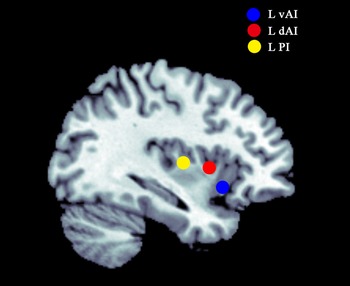
Following previous work (Deen et al., Reference Deen, Pitskel and Pelphrey2011; Li et al., Reference Li, Liu, Ma, Li, Duan, An and Chen2015; Peng et al., Reference Peng, Lin, Wu, Gong, Yang and Wang2018), seed-based dFC analyses were performed by six spherical seed regions of interest (ROIs) with a radius of 6 mm centered on six MNI coordinates (Fig. 1): left ventral anterior insula (L-vAI, MNI = −33, 13, −7), right ventral anterior insula (R-vAI, MNI = 32, 10, −6), left dorsal anterior insula (L-dAI, MNI = −38, 6, 2), right dorsal anterior insula (R-dAI, MNI = 35, 7, 3), left posterior insula (L-PI, MNI = −38, −6, 5), and right posterior insula (R-PI, MNI = 35, −11, 6). The dFC variability characteristics of the insula were calculated using the temporal dynamic analysis toolkits in DPABI software. The Hamming sliding window was selected for the whole-brain blood oxygenation level dependent signal time series: 50 TRs window length and step width of 1 TR were selected for dFC analysis. The minimum window length should be no less than 1/f min (1/0.01 s = 100 s) according to previous articles (Leonardi & Van De Ville, Reference Leonardi and Van De Ville2015; Li, Duan, Cui, Chen, & Liao, Reference Li, Duan, Cui, Chen and Liao2019). Also, other window lengths (30 TRs and 70 TRs) and shifting step (1 TR) were tried to further examine their possible effects on dFC results (Liao et al., Reference Liao, Wu, Xu, Ji, Zhang, Zang and Lu2014). In total, 151 sliding windows of dFC were obtained. For each sliding window, correlation maps were produced by computing the temporal correlation coefficient between the truncated time series of the insula subregions and all the other voxels. To improve the normality of the correlation distribution, each correlation map was converted into z-value maps using Fisher's r-to-z transformation. Then, the dFC maps were computed by calculating the standard deviation of 151 sliding-window z-value maps. Then, z-standardization was applied for the dFC maps. Finally, all the dFC maps were smoothed using a 6 mm full width at half maximum Gaussian kernel.
Three seeds of the insula in the left hemisphere. L, left hemisphere; vAI, ventral anterior insula; dAI, dorsal anterior insula; PI, posterior insula.

Statistical analysis
All indicators (i.e. demographics and cognitive function) were measured for normal distributions by goodness-of-fit testing (Kolmogorov–Smirnov test and Levine's test of equality of error variances) using SPSS 24.0 software (SPSS, Chicago, IL, USA). First, when comparing group differences in terms of demographics and clinical data (except for gender), one-way analysis of variance (ANOVA) analyses (normal variable) were used if continuous variables were normal; likewise, the Kruskal–Wallis test was used if continuous variables were skewed followed by the Bonferroni post-hoc test. The χ2 test was performed to compare the differences in gender among three groups. All tests were two-tailed, and a p value <0.05 was considered statistically significant.
Second, since the frequency analysis revealed a significant difference in gender between both groups, we tested for group differences on the scores on the MMPI-2 using a multivariate analysis of covariance with BD subject type (BD II with SA and NSA) as a fixed factor and including gender as a covariate keeping gender constant. Bonferroni correction was applied to account for multiple testing, with the threshold for significance was set to p < 0.003 (adjusted α = 0.006, 0.05/13).
Third, the one-sample t test was performed to demonstrate the within-group dFC variability distribution of each insular seed in BD II with SA group, BD II NSA group and HCs. The significant level was set at a p value <0.05 (uncorrected). To further examine the difference in dFC variability patterns among the three groups, one-way ANOVA was performed on the standard deviation in the z value at each voxel within the union mask of one-sample t test results of the three groups. Age gender, years of education, and the mean FD were included as nuisance covariates in the comparisons. The Gaussian random field (GRF) theory was used for the cluster-level multiple comparison correction (voxel p < 0.005; cluster significant: p < 0.0125, GRF-corrected). The brain regions showing significant difference based on the results of one-way ANOVA were defined as ROIs for further post-hoc analysis for the comparison of each of the two groups with Bonferroni correction, p < 0.05.
Finally, to assess the relationship between altered dFC values and the suicide symptom and severity, we predicted the SSI-Beck score for the BD participants with SA using a multivariate regression model. We used altered dFC values in the SA groups as features. The SSI-Beck scores in the SA groups were specified as regression targets to perform regression analysis. The k-fold (k = 10) cross-validation method was applied to establish a robust and reliable model as was applied in previous studies (Guo, DuBois Bowman, & Kilts, Reference Guo, DuBois Bowman and Kilts2008; Peng et al., Reference Peng, Zhang, Li, Su, Wang, Liu and Liang2020). This method involves splitting the dFC data into K blocks, with software automatically and evenly dividing all subjects into each block in a random manner. At each cross-validation iteration, K − 1 blocks as training data and the other blocks as test data were assigned. Then, the SSI-Beck score for patients in the test dFC data were predicted using the estimated parameters from the training dFC data. Then, we calculated the Pearson's correlation coefficient between the predicted SSI-Beck score and the observed SSI-Beck score to indicate whether the predicted SSI-Beck score could be correlated with the observed SSI-Beck score with the statistical significance level of p < 0.05. We also applied multivariate regression model and the k-fold scheme to predict the SSI-Beck score by static FC values, in order to determine whether the dFC values could be more advantageous than static FC values in predicting the SSI-Beck scores.
Validation analysis
Another two supplementary window lengths (30 TRs and 70 TRs) were applied to validate the main results of dFC with the window length of 50 TRs.
Results
Group differences of demographic and clinical data, and cognition performance
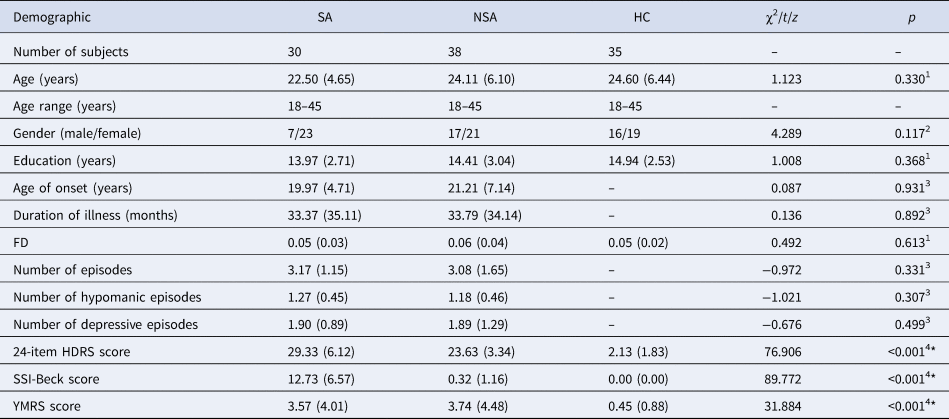
Table 1 shows the demographic and clinical data of all participants in this study. There were no significant differences in the terms of age, sex, and years of education among the three groups. No significant differences in age of onset, duration of illness, and number of episodes were found between the two patient groups. BD II with and without SA showed significantly higher relative to the HCs on the 24-item HDRS and YMRS total scores (all p < 0.001). The 24-item HDRS total score in BD II with SA was higher than that in BD II NSA (p = 0.015), no significant differences were observed in the YMRS total score between the two patient groups. BD II with SA showed significantly higher on the SSI-Beck score than BD II NSA and HC groups (all p < 0.001).
Demographic and clinical data of participants

BD II, bipolar II depression; SA, suicide attempt; NSA: non-suicide attempts, HC, healthy control; HDRS, Hamilton Depression Rating Scale; SSI-Beck, Beck Scale for Suicidal Ideation; YMRS, Young Mania Rating Scale.
*p < 0.05 significant.
1 One-way ANOVA analyses.
2 χ2 test.
3 Mann–Whitney U test.
4 Kruskal–Wallis test.
Psychological characteristics in BD II patients with a recent SA
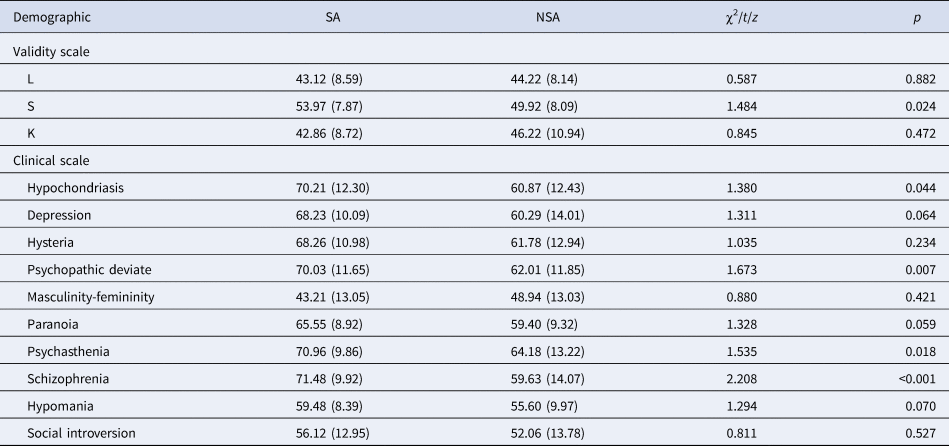
Table 2 shows that BD patients in the SA group scored significantly higher than the NSA group on hypochondriasis, psychopathic deviate, psychasthenia, and schizophrenia clinical scales (p < 0.05, uncorrected). After Bonferroni correction with the threshold at p < 0.003 (adjusted α = 0.006, 0.05/13), we found that the SA group scored significantly higher on the Sc clinical scales (p < 0.001) as compared to the NSA group.
Mean, s.d., F scores of MMPI-2 for both groups of BD II participants

MMPI-2, Minnesota Multiphasic Personality Inventory-2, s.d., standard deviation; BD II, bipolar II depression; SA, suicide attempts; NSA: non-suicide attempts, L, lie, K, correction, S, superlative self-presentation.
Values are presented as mean ± s.d.
Group differences of dFC variability values
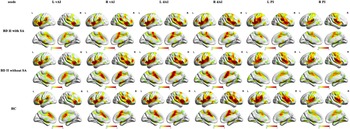
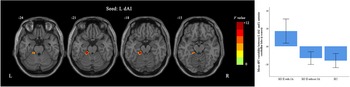
The one-sample t test revealed the dFC variability patterns for each insular seed in the three groups (Fig. 2, p < 0.05, uncorrected for visual inspection). Table 3 and Fig. 3 show the comparisons of dFC variability values among the three groups for each insular seed (voxel p value <0.005; cluster significance: p < 0.0042, GRF-corrected). Post-hoc analysis was performed for the significant different regions among the three groups (Table 3 and Fig. 3; p < 0.005, Bonferroni correction). When compared to BD NSA and HCs, the BD II with SA group exhibited decreased dFC variability values between the left dAI and the left anterior cerebellum (p < 0.005). There was no significant difference between HCs and BD II NSA group.
dFC patterns of the bilateral insula in the BD II with SA, BD II NSA and HC groups. Shades of red represent increased dFC regions. dFC, dynamic functional connectivity; vAI, ventral anterior insula; dAI, dorsal anterior insula; PI, posterior insula; BD II with SA, bipolar II disorder with a history of SA; BD II NSA, bipolar II disorder without a history of SA; HC, healthy control; L (R), left (right) hemisphere.

Significant dFC variability value differences among the three groups for each insular seed (voxel p value <0.005; cluster significance: p < 0.0042, GRF-corrected). Post-hoc analysis was performed for the significant different regions among the three groups (p < 0.005, Bonferroni correction). dFC, dynamic functional connectivity; GRF, Gaussian random field; dAI, dorsal anterior insula; L (R), left (right) hemisphere.

Significant dynamic FC variability differences among three groups

FC, functional connectivity; GRF, Gaussian random field; BA, Brodmann area; MNI, Montreal Neurological coordinate; dAI, dorsal anterior insula; SA, suicide attempts; NSA: non-suicide attempts; L (R), left (right) hemisphere.
Prediction of dynamic FC variability values in BD II patients with SA for SSI-Beck score
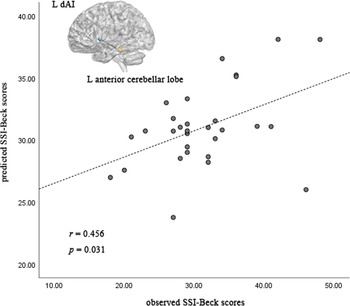
Furthermore, we found that the dFC variability values in the BD II patients with SA could be utilized to predict the severity of suicidality (r = 0.456, p = 0.031) (permutations = 1000) (Fig. 4), while static FC values were not appropriate for this prediction. In addition, the combination of dFC variability values and Sc clinical scores were not predictive of the SSI-Beck score.
dFC variability values in the BD II patients with SA and BD II patients could be utilized to predict the severity of suicidality (r = 0.456, p = 0.031) (permutations = 1000). dFC, dynamic functional connectivity; dAI, dorsal anterior insula; SSI-Beck, Beck Scale for Suicidal Ideation; L (R), left (right) hemisphere.

Correlational analysis
We found that the dFC variability values were positively correlated with the SSI-Beck scores (r = 0.528, p = 0.003). However, there were no significant correlations between dFC and any clinical variables (age of onset, number of episodes, 24-item HDRS score, and duration of illness) in BD II patients with SA. Meanwhile, we did not find any correlations between the decreased dFC variability of the left dAI and left anterior lobe of cerebellum and MMPI-2 personality traits in the SA group.
Discussion
The main findings of this study showed the BD II depression with a recent SA has decreased dFC variability between the left dAI and the left anterior cerebellum than that in NSA group and HCs. We found that the dFC variability values were positively correlated with the SSI-Beck scores. Importantly, the altered dFC variability could be used to predict the severity of suicidality, while static FC values were not appropriate for this prediction. In addition, our results also indicated that the SA group scored significantly higher on the Sc clinical scales as compared to the NSA group. To the best of our knowledge, this study was the first to investigate the insular dFC in unmedicated BD II depression patients with a recent SA, as well as to explore the psychological characteristics of this disorder.
Decreased dFC variability values of subgenual insula in BD II depression with SA
In the current study, the BD II patients with SA showed decreased dFC variability values between the left dAI and the left anterior cerebellum. Previous studies have indicated that the cerebellum plays an important role in cognitive processing, emotional control, and regulation in BD patients (Gong et al., Reference Gong, Wang, Qiu, Chen, Luo, Wang and Wang2020b; Johnson et al., Reference Johnson, Christensen, Fiedorowicz, Mani, Shaffer, Magnotta and Wemmie2018). Suicidal behavior in BD patients has been associated with significant reductions in gray matter volume (Hwang et al., Reference Hwang, Lee, Tsai, Chen, Yang, Lirng and Tsai2010), regional cerebral blood flow (Amen et al., Reference Amen, Prunella, Fallon, Amen and Hanks2009), white matter integrity (Johnston et al., Reference Johnston, Wang, Liu, Blond, Wallace, Liu and Blumberg2017), and regional homogeneity (Cao et al., Reference Cao, Chen, Kuang, Ai, Fang, Gan and Lv2015) of cerebellar regions. Furthermore, the altered FC in the left cerebellum has also been found in depressed patients with SA (Zhang et al., Reference Zhang, Chen, Kuang, Cao, Zhang, Ai and Fang2016). Taken together, these results may suggest that the structural and functional changes in the left cerebellum could be a potential biomarker of suicidal behavior. Meanwhile, previous study also indicated a decreased functional network connectivity between insula–cerebellum network in the suicidally depressed group compared to the non-suicidal depressed and HC groups (Jung et al., Reference Jung, Choi, Han, Kim, Kang, Paik and Ham2020), as well as decreased FC in a network including the insula and the cerebellum in suicide relatives (Wagner et al., Reference Wagner, de la Cruz, Kohler, Pereira, Richard-Devantoy, Turecki and Jollant2019). Moreover, the salience network (SN) is a large-scale paralimbic–limbic functional network anchored to the anterior insula and the cerebellum (Dosenbach et al., Reference Dosenbach, Fair, Miezin, Cohen, Wenger, Dosenbach and Petersen2007; Huang et al., Reference Huang, Botao, Jiang, Tang, Zhang, Tang and Wang2020; Seeley et al., Reference Seeley, Menon, Schatzberg, Keller, Glover, Kenna and Greicius2007) that evaluates and processes internal and external stimuli to facilitate the selection and deployment of appropriate behavioral responses (Menon & Uddin, Reference Menon and Uddin2010; Seeley et al., Reference Seeley, Menon, Schatzberg, Keller, Glover, Kenna and Greicius2007). The reduced SN coherence more easily engages in suicidal ideation (Schwartz, Ordaz, Ho, & Gotlib, Reference Schwartz, Ordaz, Ho and Gotlib2019). These findings suggest that impaired insula–cerebellum circuit function might contribute to the pathogenesis of suicide behavior in patients with BD II depression.
However, we are not aware of any study that has investigated the alterations of dFC between the insula and cerebellum in BD with SA. The dFC reflects the neural system's functional capacity and the spontaneous fluctuations in moment-to-moment behavioral variability (Kucyi, Hove, Esterman, Hutchison, & Valera, Reference Kucyi, Hove, Esterman, Hutchison and Valera2017). Importantly, dAI can integrate various information from the cognitive and emotional processes, and this integration is achieved due to its mediation ability in controlling dynamics of various functional networks (Namkung, Kim, & Sawa, Reference Namkung, Kim and Sawa2017; Uddin, Reference Uddin2015; Uddin, Kinnison, Pessoa, & Anderson, Reference Uddin, Kinnison, Pessoa and Anderson2014). Therefore, a possible interpretation of our findings is that lower dFC between the insula and cerebellum demonstrates a lack of flexibility changes and reduced switching frequency in spontaneous brain activity, and further may indicate an abnormal emotional response to internal and external stimuli, which may increase the vulnerability of suicidal behavior in patients with BD. A recent study indicated that the changes in frontostriatal FC would accompany suicidality reductions following transcranial magnetic stimulation (TMS) in patients with comorbid post-traumatic stress disorder and depression (Barredo et al., Reference Barredo, Berlow, Swearingen, Greenberg, Carpenter and Philip2021). Meanwhile, researchers have also found that low-frequency repetitive TMS can restore the dFC of sensorimotor and cognitive control domains in patients with subcortical stroke (Qin et al., Reference Qin, Liu, Guo, Liu, Li and Xu2021). Concordant with another study (Philip, Barredo, Aiken, & Carpenter, Reference Philip, Barredo, Aiken and Carpenter2018), these findings may suggest that TMS modulates and potentially normalizes functional relationships between neural networks were associated with clinical improvement. Importantly, these findings offer new insight into the dynamic neural mechanisms underlying the effects of TMS. We believe that targeted modulation of insula–cerebellum connectivity with TMS may be a promising therapeutic strategy for suicidality in patients with BD II depression. Yet, the application of TMS in the BD treatment remains limited (Konstantinou et al., Reference Konstantinou, Hui, Ortiz, Kaster, Downar, Blumberger and Daskalakis2021); further clinical trials are needed to determine its effects on the amelioration of suicidal behavior.
Prediction of SSI-Beck score from dFC variability values in BD II depression with SA
More importantly, in the current study, we found that the altered dFC variability values could be used to predict the severity of suicidality in BD II depression patients with SA. Although several previous studies demonstrated that the temporal variability of dynamic amplitude of low-frequency fluctuations (dALFF) would predict the severity of SI in both MDD and BD patients (Gong et al., Reference Gong, Chen, Zhou, Jia, Zhong, Chen and Wang2020a; Li et al., Reference Li, Duan, Cui, Chen and Liao2019), we are not aware of any study that has reported employing dFC variability values to predict the severity of SI in BD II depression with SA. Interestingly, we found that dFC variability values could successfully predict the severity of SSI-Beck score in the SA group while static FC values could not, suggesting the classification features from dFC proved more powerful and sensitive in terms of distinguishing SA from NSA in BD II depression patients relative to static FC. These neuroimaging efforts could improve our ability to identify the suicide risk of patients with BD II depression and further advance the establishment of effective suicide prediction and prevention models.
Psychological characteristics of BD II depression with SA
The profiles of MMPI-2 showed that patients in the SA group scored significantly higher than the NSA group on hypochondriasis, psychopathic deviate, psychasthenia, and schizophrenia clinical scales. These results were consistent with previous studies depicting an association between high scores on Pd, Pa, and Sc clinical scales and suicidal behavior (Daigle, Reference Daigle2004; Lee et al., Reference Lee, Keum, Kim, Cheon, Cho and Koo2020). It can be inferred that suicide attempters are more paranoid, suspicious, hostile, impulsive, and tend to get angry easily even with minor triggers in relation to themselves, and have difficulties in interpretation of various situations. Of note, we found that the SA group scored significantly higher on the Sc clinical scales after Bonferroni correction. A previous study suggested that a high Sc score may indicate a feeling of alienation from the surroundings and higher sensitivity to the social environment (Lee et al., Reference Lee, Keum, Kim, Cheon, Cho and Koo2020), which also suggests a low emotional intelligence level in BD (Frajo-Apor et al., Reference Frajo-Apor, Kemmler, Pardeller, Huber, Macina, Welte and Hofer2020). And low emotional intelligence level means the patients may have difficulties in monitoring emotions and guiding thinking and action, and latter leading to risky and adverse behaviors, and develop the vulnerability to suicidal behavior (Korkmaz et al., Reference Korkmaz, Danaci Keles, Kazgan, Baykara, Gurkan Gurok, Feyzi Demir and Atmaca2020). These findings may suggest that the increased use of immature defense mechanisms such as splitting may constitute the risk factors for SA in patients with BD II depression.
Although the number of previous prior studies attempted to reveal the underlying correlations between the neuroimaging alterations and personality characteristics of BD patients with SA (Mahon, Burdick, Wu, Ardekani, & Szeszko, Reference Mahon, Burdick, Wu, Ardekani and Szeszko2012; Matsuo et al., Reference Matsuo, Nielsen, Nicoletti, Hatch, Monkul, Watanabe and Soares2010; Nery-Fernandes et al., Reference Nery-Fernandes, Rocha, Jackowski, Ladeia, Guimaraes, Quarantini and Miranda-Scippa2012; Reich, Gilbert, Clari, Burdick, & Szeszko, Reference Reich, Gilbert, Clari, Burdick and Szeszko2019). Unfortunately, due to the small sample size, we did not find any correlations between the decreased dFC variability values of the left insula and left anterior lobe of cerebellum and MMPI-2 personality traits in BD patients with SA. Additionally, the current results indicated that the combination of dFC variability values and Sc clinical scores were not predictive of the SSI-Beck score. However, a previous study has found significant negative relationships between the emotional intelligence and regional gray matter density of the anterior insula and cerebellum in healthy young people (Takeuchi et al., Reference Takeuchi, Taki, Sassa, Hashizume, Sekiguchi, Fukushima and Kawashima2011). Meanwhile, a recent study has shown that individuals with higher psychopathic trait scores associated with weaker dFNC from the insula, cerebellum, and SN functional domains (Espinoza et al., Reference Espinoza, Anderson, Vergara, Harenski, Decety, Rachakonda and Kiehl2019). Moreover, another study also found that the high emotional susceptibility trait appeared to be related to decreased intrinsic FC between the left anterior insula and the left cerebellum (Ebisch et al., Reference Ebisch, Bello, Spitoni, Perrucci, Gallese, Committeri and Pizzamiglio2015), and the high scores on emotional attention are linked to an increased risk of suicide (Aradilla-Herrero, Tomas-Sabado, & Gomez-Benito, Reference Aradilla-Herrero, Tomas-Sabado and Gomez-Benito2014). Therefore, further research with a larger population of participants may provide a more complete picture of the interrelationship and causal relationship between the personality traits and brain functional alterations in BD patients with SA.
Limitations
However, some limitations to the present study should also be considered. First, this study was designed as a cross-sectional and retrospective study, the progressive changes did not be observed. Second, the sample size was relatively small in this study, which may limit efforts in generalizing these findings. Third, we recruited both in- and out-patients diagnosed with BD II depression, and may had varying degrees of severity and persistence of depressive symptoms. The SA group suffered greater depression severity than the NSA group. However, we have taken the depression severity as the covariate when comparing the group differences in the dFC variability values. This confounding factor may have a potential effect on the dFC variability values. Meanwhile, we only consider the MMPI-2 personality traits and the dFC variability of insular subregions into the analysis in the present study. Previous research has identified childhood trauma as a potential risk factor for SA in BD (Adiguzel, Ozdemir, & Sahin, Reference Adiguzel, Ozdemir and Sahin2019; Janiri et al., Reference Janiri, Sani, Danese, Simonetti, Ambrosi, Angeletti and Spalletta2015). The polygenic risk for anxiety was associated with comorbid anxiety disorders and SAs in BD (Lopes et al., Reference Lopes, Zhu, Purves, Song, Ahn, Hou and McMahon2020). A previous study has found that the serotoninergic neurotransmission gene polymorphisms were associated with these personality traits in BD patients (Pawlak et al., Reference Pawlak, Dmitrzak-Weglarz, Maciukiewicz, Kapelski, Czerski, Leszczynska-Rodziewicz and Hauser2017). Furthermore, there were complex interactions between childhood maltreatment, genetic vulnerability and brain function on the clinical expression and suicidal behaviors of BD (Aas et al., Reference Aas, Bellivier, Bettella, Henry, Gard, Kahn and Etain2020; Segura et al., Reference Segura, Mitjans, Jimenez, Fatjo-Vilas, Ruiz, Saiz and Arias2019; Yin et al., Reference Yin, Galfalvy, Zhang, Tang, Xin, Li and Mann2020). Therefore, we can further explore the underlying complex interactions between physiological, environments, genetic vulnerability, and the brain functional abnormalities in BD II depression patients with SA.
Conclusions
In summary, our findings suggested that the BD II depression patients with SA exhibited the dysfunction of insula–cerebellum connectivity and scored significantly higher on the Sc clinical scales. Moreover, the dFC variability values between the left dAI and the left anterior cerebellum could be considered a neuromarker for predictive models of the severity of suicidality. Targeted modulation of insula–cerebellum connectivity may be a promising therapeutic strategy for suicidality in patients with BD II depression. Further clinical trials are needed to determine its role in the amelioration of suicidal behavior.
Supplementary material
The supplementary material for this article can be found at https://doi.org/10.1017/S0033291722000484.
Data
The data that support the findings of this study are available from the corresponding author upon reasonable request.
Acknowledgements
Funding for this work was provided by the National Natural Science Foundation of China (nos. 81801347, 81971597, and 81671670), the National Key Research and Development Program of China (no. 2020YFC2005700), Key-Area Research and Development Program of Guangdong Province (no. 2020B1111100001), and Guangdong Basic and Applied Basic Research Foundation, China (nos. 2021A1515011034 and 2021A1515110130). The founders have not played any roles in study design, data collection, analysis, manuscript writing, and decision to publish. The authors thank the patients, volunteers, and their families whose participation made this work possible.
Author contributions
Yanbin Jia and Ying Wang designed the trial and prepared the manuscript. Lai Shunkai, Pan Chen and Shuming Zhong contributed equally to this work, and are the first co-authors. Yanbin Jia, Shunkai Lai, Shuming Zhong, Pan Chen, Guanmao Chen, Ting Su, Yiliang Zhang, Hui Zhao, Jiali He, Shuya Yan, Yange Luo, and Hanglin Ran acquired the data. Shunkai Lai, Pan Chen, and Shuming Zhong carried out the statistical analyses and drafted the initial manuscript. All authors interpreted the data, revised the paper critically for important intellectual content, approved the final version, and agreed to be accountable for all aspects of the work.
Conflict of interest
Each author has declared that there are no conflicts of interest in relation to the study presented here.