

IntroductionFootnote 1
In a recent publication, Toby Green has argued that imports of currency and/or currency materials into West and West-Central Africa caused inflation in these regions as early as the seventeenth century.Footnote 2 In this article, I argue that we have reasons to believe that the evidence Green presents supposedly showing inflation is quite unrepresentative, and that we should be skeptical of using this as a reliable proxy for the general price levels in these regions. The issue of inflation in precolonial Africa requires further research, and must in the meanwhile be interpreted with great caution.
What is Inflation?
Inflation is “a process of continuously rising prices” or “a long-term sustained increase in the general level of prices.”Footnote 3 Evidence suggesting inflation can be found from antiquity onwards from various places in the world. Prior to the twentieth century, however, periods of inflation were often followed by periods of deflation, i.e. falling prices, and were often not very severe compared to the levels of inflation that occurred in many economies around the world during the twentieth century.Footnote 4
There are many theories as to why inflation occurs. One of the most influential is the monetarist interpretation, to which Toby Green refers in his article.Footnote 5 In essence, the monetarist interpretation leans heavily on the Quantity Theory, which explains inflation by the demand and supply of money. Irving Fisher was a key pioneer of this theory, and Fisher’s Equation of Exchange has been highly influential. The equation reads MV = PT, where M is the stock of money in an economy, V is the velocity of money, P is the price level and T is the volume of goods exchanged in the economy.Footnote 6 One important implication of the equation is simply that if the stock of money (M) increases faster than the volume of goods exchanged in the economy (T), then the price level (P) must increase – i.e. the economy experiences inflation – assuming the velocity (V) of money remains constant.
Fisher himself was well aware of the challenges faced when actually trying to measure the price level in an economy, since the theoretical price level P cannot be observed empirically. The only facts we can observe are the prices of particular goods and services.Footnote 7 In this context it is important to remember that inflation means a rise in the general price level. The prices of particular commodities might rise or decline for a number of different reasons – seasonal effects in the supply of crops, innovations that decrease the production costs of a specific commodity, structural changes in demand, et cetera. There is also a possibility that price changes can cancel each other out, so that a price increase for commodity X – for example driven by an increase in demand – is accompanied by a decrease in price for commodity Y. Inflation, however, will only occur if the general price level in society increases.
These ideas have since led to a whole field of scholarship dedicated to how one ought to measure inflation properly. Surveying the field, David Lebow and Jeremy Rudd note that three things are of key importance: 1) deciding on the scope of (i.e. what prices to include in) the price index; 2) measuring the individual price changes correctly, and; 3) choosing a method for constructing an aggregate index.Footnote 8 For the purpose of this article, the first two issues are of the greatest importance.
The basket used for measuring inflation should in theory include all commodities traded in the economy, but in practice some form of sampling will always be necessary. It is then of key importance to ascertain that the contents of the basket are representative of the transactions taking place in the economy. One way of deciding the scope of the index is to opt for a fixed basket of goods and services to be included. The difficulty of measuring inflation becomes exacerbated if one tries to measure it over long periods of time, due for example to the introduction of new commodities or changes in the quality of specific commodities. An alternative has therefore been proposed in the form of cost-of-living indices, which allow for changes in the particular commodities included in the basket – but aim to keep the utility of the basket constant over time. This instead introduces a different challenge: that of actually measuring the utility of consumption.
Currencies and Market Expansion
Some scholars studying precolonial African history have taken an interest in the issue of currencies and inflation. One key finding in previous research on precolonial African economic history is that there was considerable importation of currencies or currency materials into many African economies during precolonial times.Footnote 9 In a classic contribution, Marion Johnson researched the cowrie shell money used in large parts of West Africa. In her research, Johnson showed that increasing volumes of cowrie shells were imported into West Africa to be used as currency. This would in time lead to inflationary processes, to the extent that Johnson calls the period around the middle of the nineteenth century “The Great Inflation.”Footnote 10 In their book The Shell Money of the Slave Trade, Jan Hogendorn and Marion Johnson later expanded upon this research, and explicitly argued (referring to the Quantity Theory of money) that prices in the cowrie-using zone were probably quite stable until the mid-nineteenth century, despite a steady inflow of cowries into the region.Footnote 11
In his recent article, Toby Green attempts to contribute to this research, arguing that the imports of locally used currencies into West and West-Central Africa created inflation in these regions, not just during the nineteenth century as Marion Johnson argued, but as early as the seventeenth century. If Toby Green is correct, the volumes of currency imported were large enough to have a substantial impact upon the price levels in Africa by the seventeenth century. One key argument in Green’s article is thus that “the mass import of currencies had huge inflationary consequences.”Footnote 12
More money in circulation in an economy does not however necessarily lead to inflation. Even according to stylized models such as Fisher’s Quantity Theory, this will depend on the interaction between the money supply and the volume of transactions in the economy (assuming no substantial changes in the velocity of money). If the volume of transacted goods increases, for example through increasing production or through a shift from subsistence to commercialized production, there is thus a need to have more money in circulation simply in order for price levels to remain stable. This is also what some other scholars have argued happened in precolonial Africa. Marion Johnson argued for example that it is “certain that the cowrie-using economy must have been an expanding one during this period.”Footnote 13 Joseph Inikori has similarly argued that the rising imports of currencies were a reflection of growing internal markets, requiring more money in circulation.Footnote 14 Paul Lovejoy has even argued that the currency flows (in his case of cowries) could be used as an indicator of the long-distance trade between Central Sudan and the regions along the coast that were the primary importers of the cowrie shells.Footnote 15
Unfortunately, we have very few means of actually studying the development of internal markets in precolonial Africa, since virtually all written documents, until the nineteenth century at least, were produced by European or Arab observers, and then are concerned mainly with the development of the slave trade in particular, or at best with markets in enclaves for example along the African coast.Footnote 16 Trying to find data that allows for the quantification of market growth in West Africa, which the issue under consideration here would seem to require, would seem even more futile. The imports of currency materials per se cannot therefore settle the issue of whether there was inflation in precolonial Africa or not.
Studying Inflation in Precolonial Africa
In contrast to modern-day scholars measuring contemporary inflation, studies of historical inflation have generally faced a considerable data constraint. Whereas modern-day statisticians can easily gather all the data they would want for a supposedly representative basket of goods, and are limited merely by the resources available for the task of assembling samples of prices, historians have to make do with the limited price data that is available in surviving historical sources. The richness of the archives differs of course over time and across space. Due to this data constraint, historical studies of prices over long periods have often been based on the price trends for a few commodities, in particular some staple crops, such as wheat or rye in Europe or rice in China. Lacking more complete data, this practice remained in use for a long time, since food ultimately constituted a major item of consumption in most pre-modern households. Even if price series for a more representative basket of goods could be constructed, the price of basic foodstuffs would therefore still have considerable weight in the aggregate price index. The price trend for staple crops could thus be argued to be a crude proxy for the general price level trend in the economy. More recent research, for example by scholars associated with the Global Price and Income History Group, has however made more ambitious attempts to construct price histories based on a wider selection of goods.Footnote 17
There have been few attempts to study prices in precolonial Africa directly, probably due to the fact that there is a distinct lack of sources to enable such studies. The problem of limited amounts of price data is thus by no means unique to precolonial Africa, but in this case it stems from a limited availability of quantifiable data in general. This is partly a result of the widespread practice of subsistence agriculture and limited market development, and partly a result of there being few written sources that recorded such data, even if or where there was market trading in staple commodities.
Some evidence of prices for various goods can certainly be found in certain sources from precolonial Africa, such as travel accounts written by Europeans or Arabs, or account books of traders. The availability of such sources varies widely depending on the time period and region studied. It does not however seem controversial to state that any data that can be found in these sources is generally highly fragmentary and only yields very small samples of data.
Due to the severe lack of primary sources containing quantifiable data, historians studying Africa have often been forced to use what isolated observations there might be in various different sources. Isolated observations of prices might however be very unrepresentative, and in some cases even recorded for the particular reason that they were atypical. In some travel accounts from precolonial West Africa, it is for example possible to find cases when the author is discussing the price of some local crop or foodstuff. These observations are occasionally made just because the price at that particular point in time was extraordinary. To give the reader some examples, in his travel accounts Jean Barbot noted a corn price of “10 pieces-of-eight for a bin of two bushels,”Footnote 18 but this was because an infestation of locusts had raised the price. In a similar manner Ludewig Ferdinand Rømer discussed how much the price of millie.Footnote 19
could fall “according to inland conditions.”Footnote 20 What a more normal, or average, price would be is not revealed by these sources. While Barbot was clear that the price he observed was raised due to locusts, so that a careful historian could deal with the observation accordingly, other isolated price observations found in similar types of sources might not always be as clearly identified as being unrepresentative.
Careful work with the primary sources might in some cases assemble price data into fair-sized samples. One important contribution to this field of research is the work of Robin Law. In a set of articles, Law assembled price data from eighteenth-century Dahomey for various commodities, such as slaves, livestock, palm oil, and corn. Law argued that this price data exhibited both short- and long-term fluctuations in the prices of the goods studied.Footnote 21 Some of the data presented by Law is more detailed, showing price fluctuations for some commodities over shorter periods of time. The data showing long-term development is in contrast based on quite fragmented data, which Law was the first to acknowledge. With small and fragmented samples of data, seeming trends might in reality be due to mere statistical artefacts, or be explainable for example by seasonal or short-term fluctuations, or temporary external shocks, rather than by long-term trends. For that reason, we cannot rule out the possibility that some of the changes in the prices of the goods studied by Law might reflect seasonal or short-term fluctuations, rather than long-term trends. Taken together, however, the data assembled by Law does seem to prove that inflation was indeed taking place in precolonial Dahomey.
In contrast to Robin Law’s research, based on the prices of a number of different commodities in Dahomey, the part of Toby Green’s recent article that attempts to study the issue of inflation directly, by studying the prices paid for articles (rather than indirectly by analyzing the importation of currency materials, as discussed earlier), is based solely on the price paid for slaves in a handful of transactions.Footnote 22 Since the number of transactions presented is very limited, the data from these particular transactions might suffer from the same problem as was discussed previously in the case of staple crops, i.e. being unrepresentative of the general price for that particular commodity. An additional, and perhaps even larger, problem for Green’s study is however that the development of slave prices seems to be a very poor proxy for the general price level. This latter point can be illustrated by looking at the case of the Gold Coast in the eighteenth century in more depth.
Markets and Prices on the Gold Coast
The case of the Gold Coast is interesting because of the unique availability of primary sources that enable the construction of price series for certain staple goods, which might be very hard or even impossible to find in many other parts of Africa. Data can be found in the accounts of the English Royal African Company (RAC), which maintained forts along the Gold Coast. In order to do so, the Company purchased a lot of locally produced staple goods, including for example “corn” (maize and/or millet), palm oil, yams, salt, fish, firewood, and other commodities. These transactions were recorded in the account books of the Company, including information on the volume of the transaction and the price paid in total for the transaction. The prices were recorded either directly in weights of gold (divided into marks, ounces, ackeys, and takus of gold), or in pounds sterling (then generally also reporting the exchange rate used when converting the gold price into pounds sterling). The Company does not seem to have recorded prices for these commodities systematically prior to 1699. After 1760, furthermore, the Company seems to have reorganized its strategy for provisioning: ceasing to purchase staple goods from what seem to be local producers in the local markets, and instead purchasing them at a set price from one of the Company’s own merchants. This seems to have insulated the Company from any local price fluctuations for the staple goods. The data does however seem usable for a period of around sixty years, and then provides what in an African context must be considered a comparatively rich data-set.Footnote 23
Previous research on the economic history of the Gold Coast has suggested that it was a comparatively highly commercialized economy, by African standards, even by the seventeenth century.Footnote 24 Some scholars have furthermore argued that the slave trade created incentives for further commercialization of the economy, through the demand for provisions for the slave trade.Footnote 25 In contrast to many other parts of Africa, the Gold Coast imported comparatively little currency material, and was for a long time instead a key exporter of the local currency material, gold. Price trends on the Gold Coast might thus be intimately connected to the development of gold mining and trade in the region. If there was a decrease in the output from local mines, for example, this could make gold more scarce, which theoretically could lead to deflation.
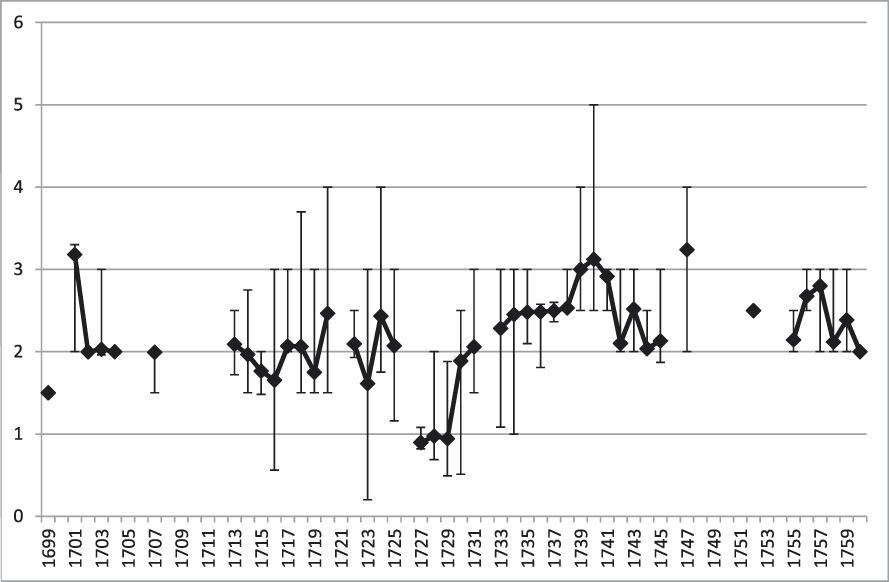
Earlier research suggests that the prices for slaves increased on the Gold Coast at least during the eighteenth century. Joseph Inikori has reported that during the period from 1697 to 1747, the prices of male slaves increased by 330 per cent on the Gold Coast, and the price of female slaves by 238 per cent.Footnote 26 My own research on prices on the Gold Coast, on the other hand, finds no evidence of a secular price trend for staple food crops. One example is shown in Figure 1, showing the price of what in the source is termed corn (i.e. millet or maize) from 1699 to 1760.
The price of corn on the Gold Coast, 1699–1760 (ackeys gold/chest, weighted average price with minimum and maximum prices).Footnote 27

As can be seen in the graph, there are some considerable fluctuations in the price of corn over this period. The median price was two ackeys per chest of corn. The weighted average price in some years exceeded three ackeys per chest, whereas in other years it dropped to as low as one ackey per chest. Occasionally, the Company would have to pay considerably higher prices for some specific transactions – the most expensive purchase was when the Company purchased corn for five ackeys per chest. The data for the other staple commodities, palm oil, yams, or firewood, assembled in my own research, also exhibits considerable fluctuations.Footnote 28
The rather drastic fluctuations in price illustrate the problem of attempting to draw conclusions about time trends from fragmented data. If one were to pick a handful of observations from the dataset underlying figure 1, chances are that the sample would exhibit some form of trend over time – either positive or negative, depending on exactly which observations were picked. If the first observation was one of the expensive purchases of corn in 1701, for example, chances are that the whole sample would seem to exhibit a downward trend.
There is however no obvious time trend in any of the four price series I have assembled, with the potential exception of firewood, which if anything might seem to exhibit a declining price over time. The latter finding is however to a large extent driven by a very small number of outliers in the dataset for firewood, so that result is not necessarily robust. Attempting to analyze the data assembled in multivariate regressions – taking the annual climate, seasonal effects, and specific shocks such as wars or the slave trade into account – I could furthermore not find any evidence of a secular time trend for the price of either corn or palm oil, whereas the price of yams might have declined somewhat.Footnote 29
Over the first half of the eighteenth century, then, the prices paid for slaves on the Gold Coast thus seem to exhibit very different trends than the trends for other commodities traded. This is important in relation to the previous research in the field: slave prices were neither representative, nor even a reasonably acceptable proxy, for the price trend for other goods on local markets on the Gold Coast. With price trends moving in different directions – no trend for some staple goods, potentially declining prices for some others, but rising prices for slaves – determining whether or not there was inflation in the Gold Coast economy could be reduced to a technical issue of the relative weighting of the aggregate price index.
It would however seem more reasonable to consider how the external slave trade differed from local trade in other goods. African slave prices changed for a number of different reasons, often quite unrelated to factors determining the prices of other goods. Gareth Austin has argued that the market prices for slaves were largely determined by two different forces: a demand effect from overseas and local markets, and a supply effect determined by the slave-raiders’ capacity to produce slaves, influenced not least by the devastating socio-economic effects that slave-raiding had in Africa.Footnote 30 Whereas the latter effect could very well have impacted on other sectors of the African economies too, the former effect ought to have had little impact upon the markets (and thus price levels) in West Africa, given that slaves were virtually the only important export from most of the region, aside from gold.Footnote 31 Austin furthermore cautions about the different geographies of these different markets: while slaves were made to walk by themselves long distances, so that price changes along the coast could have an impact quite far inland, markets for foodstuffs were probably highly localized at this time.Footnote 32
Conclusion
The Quantity Theory of money would certainly suggest the possibility that inflation might have been a consequence of currencies or currency materials being imported into precolonial Africa. This theoretical proposition does not however settle the issue, since internal market expansion for example might have required an increased supply of currency just to keep price levels stable, as many previous scholars have suggested. Given that we have a hard time quantifying the growth of markets, it is necessary to study the issue of inflation in precolonial Africa by looking at the actual development of prices.
In this regard, Toby Green’s article is based on a small number of examples of prices from the slave trade alone. In this article I have reported empirical price data from the Gold Coast in the first half of the eighteenth century. This data shows that, at least in that case and at that time, slave prices and prices for staple foodstuffs exhibited very different trends. Since the prices paid for slaves were to a large extent driven by the growing demand for slaves in the Americas, the same situation might have been the case in many other parts of Africa as well, and at other periods of time. The development of slave prices ought thus not to be used as a proxy for the development of the general price level in African societies.
The evidence presented from the Gold Coast furthermore suggests that there was no inflation in that part of West Africa at that time – while prices for slaves rose, the prices for other commodities exhibited no such trend. This article does not however argue that the case of the Gold Coast shows that there was no inflation anywhere else in precolonial West Africa. Robin Law’s previous research from Dahomey, in contrast, clearly suggests that there was inflation in that society around the same period of time. The key argument of this article is rather that we must be cautious about inferring from the imperfect sources we have available that there was inflation in any particular precolonial African society. We must be even more cautious about generalizing across broader regions, such as West Africa (let alone the whole continent of Africa). Different societies might have experienced very different trends, as the contrasting cases of Dahomey and the Gold Coast show. If or when additional sources on precolonial African prices can be found, further research in this area might very well shed additional light on this issue for other parts of Africa.
Klas Rönnbäck is an Associate Professor of economic history at the University of Gothenburg. His research interests include the socio-economic impacts of slavery and the slave trade, as well as colonialism and imperialism. In 2016, Routledge published his book Labour and Living Standards in Pre-Colonial West Africa: The Case of the Gold Coast. E-mail: klas.ronnback@econhist.gu.se