Implications
French dual-purpose breeds globally represent 29% of the French dairy livestock (Institut de l’Elevage (idele), 2015d). They produce both meat and milk; however, they have until now mainly been selected for milk production. Carcass traits of young bulls can be improved by selection in the Montbeliarde, Normande and Simmental breeds and their selection should not lead to a substantial decrease of genetic trends on milk production. The carcass traits of young bulls will be included in the breeding goals of French dual-purpose breeds after the study of their relative economic weights compared with those of the other traits under selection.
Introduction
Farms breeding in dual-purpose cattle benefit from two main sources of income: dairy and beef production. Their profitability can be increased through genetic improvement of animal performances. In France, genetic evaluations for milk production traits have been routinely published for four decades. However, evaluations for meat production of dual-purpose breeds (Montbeliarde, Normande and Simmental mainly) have until now exclusively relied on relatively indirect traits such as muscularity collected on lactating cows at the same time as dairy type traits. The development of genetic evaluations for direct meat production traits for these breeds recently began with an evaluation focusing on veal carcass traits, first released in April 2015 (idele, 2015c).
Breeding objectives should include all traits having an impact on breeders’ income. French dual-purpose breeds are conducted mostly as dairy breeds as far as genetic selection is concerned: they widely use genomic selection. The extra genetic gain permitted by the implementation of genomic selection gives the possibility of broadening the scope of breeding goals without compromising existing genetic trends. In order to update the breeding goals in French dual-purpose breeds by including meat production traits, genetic parameters have to be estimated, along with their correlations with other traits already under selection. In our case, the relationship between carcass traits of young bulls and milk production is very important. Previous studies on this topic have been carried out (Suess et al., Reference Suess, Tyler and Brungardt1968; Colleau et al., Reference Colleau, Dupont, Muller, Daburon, Chambeyron and Malterre1982; Gere et al., Reference Gere, Bartosiewicz, Kaltenecker and Lippai1983; Syrstad, Reference Syrstad1983; Van Veldhuizen et al., Reference Van Veldhuizen, Bekman, Oldenbroek and Van der Werf1991; Liinamo and Van Arendonk, Reference Liinamo, Ojala and Van Arendonk1999; Liinamo et al., Reference Liinamo and Van Arendonk2001), but in most part these studies were based on small datasets.
The objectives of the present study were to prepare the implementation of an evaluation for carcass traits of young bulls in the Normande, Montbeliarde and Simmental breeds. This implied developing a proper evaluation model and estimating the relevant genetic parameters for the available traits (carcass weight (CW), age at slaughter (AS) and carcass conformation (CC)) and estimating their correlations with other traits already evaluated (milk production, type and veal calf production traits).
Material and methods
Data
Slaughter information of young bulls were extracted from the NORMABEV (French technical interprofessional association for cattle and meat, defined by the Association nationale INTER-professionnelle du BEtail et des Viandes (INTERBEV), 2015) database, gathering information for all cattle slaughtered in France. Records contained performances such as animal CW, AS, CC and carcass fatness. Descriptive and technical information including birth herd, finishing herd, slaughterhouse, age and parity of dam at calving and existence of a twin were also available. Pedigree information came from the French genetic national database.
From this data set, only data from young bulls were extracted, that is, from males slaughtered between 12 and 24 months and whose commercial category were A (young bull) on the Union scale for the classification of carcasses (Regulation (EU) no. 1308/2013). Animals born between 2006 and 2012, with known sire, dam and CW were selected. Records of twins or animals born after embryo transfer were deleted. Animals with performances deviating by more than 4 phenotypic standard deviations from the overall mean were deleted.
Eventually, records of 156 226 Montbeliarde, 160 361 Normande and 8691 Simmental young bulls were used in the study. Considering the limited amount of Simmental data compared with the two other breeds, model choice was essentially conducted on Montbeliarde and Normande data and its conclusions were applied to the Simmental breed.
Data selection for the estimation of genetic correlations
A central component of the study was the estimation of genetic correlations between carcass traits of young bulls and traits currently included in total merit index of the breeds or potentially included in the near future (veal calf production, dairy production, cow morphology). The traits considered were measured on different animals (young bulls for young bull production, veal calves for veal calf production and cows for dairy production and morphology) and evaluated using very different and sometimes complex models. In order to simplify estimation, we chose a two-step approach as in Ducrocq et al. (Reference Ducrocq, Boichard, Barbat and Larroque2001), based on the use of preadjusted performances instead of raw performances (see below for details), to estimate genetic correlations between these different sets of traits. In general, an animal’s preadjusted performance for a particular trait is a weighted average of its raw performances corrected for all non-genetic effects in the evaluation model specific for the trait. It can therefore be described as the sum of a genetic value and a residual error. In the case of carcass traits, there is only one performance per trait. Preadjusted performances for other traits than carcass traits of young bulls were extracted from by-product files produced at the end of each routine genetic evaluation in France. The evaluation model for each trait is described elsewhere by idele (2015a, 2015b and 2015c). The Simmental breed was not evaluated for veal calf production. Therefore preadjusted performances for veal calf production were unavailable for this breed.
Veal calves and cows were selected if they were paternal half-sibs of young bulls with slaughter information. In order to reduce computation time when needed (depending on the breed and trait), we sampled a limited number of animals per sire and we randomly kept animals born from a subset of the farms.
Eventually, 115 214 Montbeliarde and 135 863 Normande records were kept for the study of correlations between young bull and veal calf production traits, 105 635 Montbeliarde, 192 963 Normande and 20 339 Simmental records for correlations with cow morphological traits and 117 638 Montbeliarde, 119 104 Normande and 17 077 Simmental records for correlations with dairy production.
Traits considered
The young bull traits evaluated were CW, CC and AS. Carcass performances were estimated using the SEUROP classification system, although referred only to the five main classes E, U, R, O and P in France.
CW is measured no later than 1 h after slaughter. It is defined as 0.98 times the weight of the animal after removal of its head, hide, feet, thoracic organs, some internal and external fats, and abdominal organs (Cartier and Moevi, Reference Cartier and Moevi2007).
Under the SEUROP system, conformation is graded S, E, U, R, O or P, from best to worst and grades are subdivided into +,=or – subclasses (Cartier and Moevi, Reference Cartier and Moevi2007). These scores were converted to numeric values, ranging from 1 (less muscular) to 15 (more muscular) and considered continuous.
Carcass fatness (graded from 1 to 5 in the EUROP system, see Cartier and Moevi, Reference Cartier and Moevi2007) was not analyzed as there was very little variability between animals: >97% of the records were graded 2 or 3 (74% graded 3) in Montbeliarde, 95% (82%) in Normande. In addition, the fatness grade given to an animal sometimes mainly depends on the market needs rather than on the actual performance of the animal (Fouilloux M.N., personal communication).
AS is measured in days. It is calculated as the difference between slaughter date and birth date. In the literature, AS is considered either as an explanatory variable of the two other traits or as a trait by itself. For reasons which will be presented later, we chose to include it as a trait in our analysis, as historically done in French genetic evaluations for carcass traits (idele, 2014 and 2015c).
To convince ourselves that this choice did not alter our conclusions, we decided to compare the two approaches: the three-trait model presented later in this paper and a two-trait model (CW and CC), including a linear and quadratic regression on AS. Mimicking a genomic validation study, we estimated correlations, as measures of the accuracy of evaluations, and regression coefficients, as estimates of the evaluation bias, between preadjusted performances and EBVs in a validation population consisting of sires with no offspring performances (see Supplementary Material S1).
Carcass traits of veal calves, whose genetic correlations with carcass traits of young bulls were estimated in this paper, include another trait, specific to veal calves: meat color. It is graded from 0 (white, best) to 5 (red, worst).
We estimated correlations between carcass traits of young bulls and two types of morphological traits in cows: size and muscularity traits. The size traits we focused on were height at sacrum, chest width, chest depth, body depth, width at pins and width at hips, depending on the breed. Height at sacrum, chest width and body depth are measured as recommended by the International Agreement of Recording Practices (ICAR, 2014). Chest depth is the distance on a 1 to 9 scale between the top of the spine and the bottom of the chest just behind limbs (Organisme de Selection de la race Montbeliarde (OS Montbeliarde), 2015). Hip width is the measure of the distance between the two extreme points at the back of the cow (Simmental France, 2014). Width at pins is the measure of the distance between pins (Amelis, 2015). The muscularity traits analyzed were muscularity at withers, thighs, loin, top line and global muscularity depending on the breed. All are subjective scores on the muscularity of a particular part of the body (Simmental France, 2014; Amelis, 2015; OS Montbeliarde, 2015).
Age at slaughter distribution
AS was not following a normal distribution: many animals were slaughtered between 22 and 24 months. Animals slaughtered between 676 and 730 days had roughly the same mean CW and CC as animals from the main slaughter season (535 to 675 days) with higher variability. As these two groups showed similar performances, it did not seem plausible that they were raised according to very different systems or belonged to different commercial categories. All these animals were therefore kept in the study.
‘Younger’ animals were then defined as animals with only one summer season during their lives and ‘older’ animals as animals with two summer seasons. This allowed us to model carcass traits for these two types of animals differently, without choosing an arbitrary limit for AS.
A preliminary analysis considering performances of CW and CC of younger and older animals as different traits was run. Results showed very high genetic correlations between younger and older traits (>0.98 for both CW and CC); it was hence decided to consider younger and older performances as identical traits. Consequently, two alternatives to model differences between younger and older animals were studied. One was to ignore differences between these animals, while the other considered a residual variance heterogeneity between younger and older animals for CW and CC.
Model
The GLM procedure in SAS software (Copyright© 2002 to 2012 by SAS Institute Inc., Cary, NC, USA) was used to determine whether a particular factor other than the animal genetic value had a significant effect on the traits.
After determination of the relevant fixed factors to be included, two models were tested.
 $$y_{{ijkl}} \,\,{\equals}\,\,\mu {\plus}c_{i} {\plus}p_{j} {\plus}s_{k} {\plus}a_{l} {\plus}{\varepsilon}_{{ijkl}} $$
Model (1) was a three-trait animal model, with y ijkl the observed performance for CW, AS and CC in respectively kg, days and grade, μ the overall mean, c i the fixed effect of the contemporary group defined as the interaction between year of slaughter, season of slaughter (January to March, April to June, July to September and October to December) and finishing farm, p j the fixed effect of the interaction between the dam parity and class of age at calving (less than 24 months, 25 to 36 months, 37 to 48, 49 to 60, 61 to 72, 73 to 84, 85 and more), s k the season of birth (February to July, August to October and November to January), a i the animal’s random genetic value and ε ijkl a random residual term.
 $$y_{{ijkl}} \,{\equals}\,\mu {\plus}c_{i} {\plus}p_{j} {\plus}s_{k} {\plus}a_{l} {\plus}\xi _{{ijkl}} $$
Model (2) was the same model as model (1), with ξ ijkl a random residual error, accounting for heterogeneous residual variances for CW and CC. These heterogeneous residual variances were included in model (2) in the form of different weights given to performances of animals with one or two summer seasons. The weights were determined using the preliminary bivariate analysis assuming that performances of younger and older animals were different traits; the weight used for older animals was the ratio between the residual variance of the trait for younger and older animals. A weight of 1 was applied to CW and CC residual variances of younger animals in all breeds. The genetic variance used was the younger animals’ one.
Correlations with other traits
As mentioned above, the two-step procedure described in Ducrocq et al. (Reference Ducrocq, Boichard, Barbat and Larroque2001) was used to estimate correlations between carcass traits of young bulls and other traits under selection. In this procedure, preadjusted performances for carcass traits of young bulls and other sets of traits were first obtained using separate genetic evaluations. They were then considered as phenotypes and analyzed together using a simple multitrait model including the fixed effect of year of birth and the random animal genetic value, in order to estimate their genetic correlations. The variable amount of information included in each preadjusted performance was reflected by its associated weight and was accounted for by considering heterogeneous residual variances inversely proportional to their recorded weight (Ducrocq et al., Reference Ducrocq, Boichard, Barbat and Larroque2001). Lassen et al. (Reference Lassen, Sørensen, Madsen and Ducrocq2007) showed that this two-step approach gave estimates of genetic correlations very similar to those of a full multitrait model. This method was also validated by Pfeiffer et al. (Reference Pfeiffer, Fuerst-Waltl, Schwarzenbacher, Steininger and Fuerst2015).
Estimation of genetic parameters and breeding values
(Co)variance components were estimated using the Restricted Maximum Likelihood methodology applied to the different models described above with the WOMBAT software (Meyer, Reference Meyer2007). Records were selected such that each level of fixed effects contained at least four animals and each sire had at least five offspring. Eventually, 119 642 Montbeliarde, 112 843 Normande and 5456 Simmental records of slaughter performances were used.
Estimated breeding values (EBVs) were calculated using the BLUP methodology, with an in-house software (GENEKIT). The purposes of this study were (1) observe genetic trends over the 7 years of data, (2) compare EBVs and reliabilities between models, (3) know whether sires could be evaluated for carcass traits with the minimal reliability suitable for release (0.50) and (4) determine preadjusted performances for the study of genetic correlations with other sets of traits. Reliabilities were calculated according to Harris and Johnson (Reference Harris and Johnson1998). Records were selected such that each level of fixed effects contained at least three animals and that each sire had at least five offspring. Eventually, 129 440 Montbeliarde, 128 456 Normande and 6175 Simmental records were used. In the Montbeliarde breed young bulls were sired by 1499 sires, with a mean of 86 offspring (ranging from 5 to 6395); 55% had <20 offspring. 108 914 dams were represented. In the Normande breed, young bulls were sired by 1130 sires, with a mean of 114 offspring (ranging from 5 to 5678); 62% had <20 offspring; 102 437 dams were represented. In the Simmental breed, young bulls were sired by 177 sires, with a mean of 35 offspring (ranging from 5 to 553); 61% had <20 offspring; 4923 dams were represented.
Results
Phenotypic means
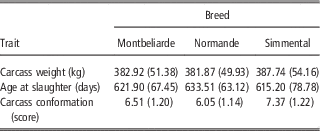
Young bulls from the two main breeds had very similar performance means (Table 1). The Simmental breed had a better conformation than the two others and a slightly higher variation for AS (Table 1).
Phenotypic means (standard deviations) of carcass traits of young bulls

Model choice
In the two main breeds, the fixed effect of the contemporary group was highly significant (P<0.001) for all three traits. The fixed effect of the interaction between parity and age of the dam was significant to highly significant (P<0.01 to <0.001) and the fixed effect of the season of birth had low to high significance (P<0.05 to <0.001) depending on the trait and breed.
Accounting for heterogeneous residual variances: comparison between models (1) and (2)
In the two main breeds, correlations between EBVs estimated using models (1) and (2) were very high (between 0.991 and 0.997). The two models can be considered as nearly equivalent in ranking animals.
Mean reliabilities for sires obtained using model (1) or (2) were almost identical and variances of EBVs were similar. Genetic trends were very similar between the two models (results not shown).
Taking into account weights in the genetic evaluation did not significantly increase computing time and memory. Hence, it was decided to keep model (2) for the evaluation, as it better accounts for the higher variability of records of older animals.
Genetic parameters
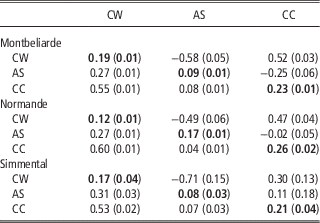
In the three breeds, estimates of the three traits heritabilities were low to moderate (Table 2). Among the three, CC was the most heritable and AS the least heritable. The three breeds had similar genetic parameters, the Normande breed having the highest heritabilities for AS and CC and the lowest one for CW. Lower values of AS are beneficial (earlier slaughter), therefore any negative correlation with AS is favorable. Low to moderate favorable correlations between each two-by-two combination (except for the correlations between CC and AS in the Normande and Simmental breeds, which were close to zero) of the three traits were obtained (Table 2). The Montbeliarde breed had stronger genetic correlations between carcass traits of young bulls than the Normande. As the Simmental analyses showed higher residual errors, henceforth we will focus on the analyses of the two other breeds for comparison.
Genetic parameters (standard errors) on the young bull population studied

CW=carcass weight; AS=age at slaughter; CC=carcass conformation.
Values are bolded to highlight heritabilities (on diagonals). Heritabilities are on the diagonal, genetic correlations above, residual correlations below.
Reliabilities and genetic trends
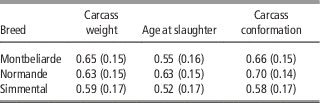
Mean reliabilities for young bull sires were between 0.55 and 0.70 depending on the breed and trait considered (Table 3). In total 958 sires (out of 1499) in Montbeliarde, 950 sires (out of 1130) in Normande and 82 (out of 177) in Simmental had reliabilities above 0.50 for the three traits.
Mean sire reliabilities (standard deviation)

A genetic gain between animals born in 2006 and in 2012 of 0.22 genetic standard deviation for CW and 0.02 for CC, as well as a favorable decrease of 0.55 genetic standard deviation for AS were observed in Montbeliarde. In Normande, the corresponding values were 0.10, −0.17 and 0.67.
Genetic correlations with other traits
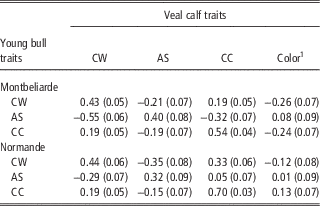
Genetic correlations between each two-by-two combination of carcass traits of young bulls and veal calves were low to high (0.01 to 0.70, Table 4). These values were consistent between the Normande and the Montbeliarde breeds. The Normande breed had slightly stronger correlations between CW, AS and CC of veal calves and CW and CC of young bulls than the Montbeliarde breed. It had slightly lower correlations between CW, AS and CC of veal calves and AS of young bulls than the Montbeliarde breed. Genetic correlations between carcass traits of young bulls and the corresponding traits for veal calf production were quite high (0.43 to 0.44 for CW, 0.32 to 0.40 for AS and 0.54 to 0.70 for CC, Table 4).
Genetic correlations between carcass traits of young bulls and veal calves

CW=carcass weight; AS=age at slaughter; CC=carcass conformation.
1 Meat color, graded from 0 (best, white) to 5 (worst, red).
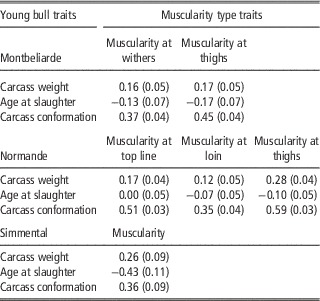
Between young bull production and muscularity traits of lactating cows collected at the same time as other type traits, genetic correlations were medium to high (0.35 to 0.59, Table 5) for CC, low to medium (0.12 to 0.28, Table 5) for CW and null to low and favorable (0.00 to −0.17, Table 5) for AS, except in the Simmental breed where the latter correlation was high and favorable (−0.43, Table 5). The Normande breed had slightly higher correlations than the Montbeliarde breed between these two sets of traits.
Genetic correlations between carcass traits of young bulls and muscularity traits of lactating cows

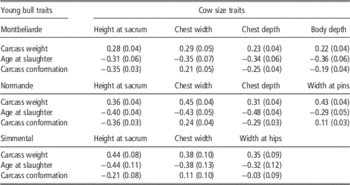
All maternal size traits had moderate correlations with CW (0.22 to 0.45) and AS (−0.48 to −0.29). In all breeds, CC was positively genetically correlated with traits measuring cow width (at pins, at hips and chest) and negatively correlated with cow size (height at sacrum, chest depth, body depth) (Table 6). The three breeds had similar genetic correlations between these two sets of traits, the correlations between CC and size traits being slightly stronger in the Normande breed than in the Montbeliarde breed.
Genetic correlations between carcass traits of young bulls and size traits of lactating cows

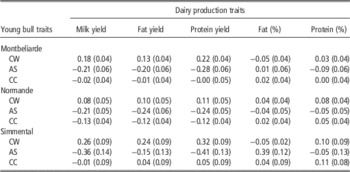
Milk, protein and fat yield had a low to moderate and favorable (−0.15 to −0.41) genetic correlation with AS in all breeds (Table 7). Correlations between CW and these three traits were low to moderate (0.13 to 0.22) for the Montbeliarde breed, low (0.08 to 0.11) for the Normande breed and moderate (0.24 to 0.32) for the Simmental breed (Table 7). Correlations between these traits and CC were null in Montbeliarde and Simmental and slightly negative in Normande (Table 7). The Simmental breed showed the strongest correlations between carcass traits of young bulls and milk production traits, followed by the Montbeliarde and then the Normande breed.
Genetic correlations between young bull carcass traits and dairy production traits

CW=carcass weight; AS=age at slaughter; CC=carcass conformation.
In the three breeds and for all young bull traits, correlations with protein and fat percentage were close to zero (except in Simmental, for AS and fat percentage).
Discussion
The objectives of the present study were to estimate the genetic parameters of carcass traits of young bulls in French dual-purpose breeds and their genetic correlations with production traits of veal calves, lactating cow morphology and milk production traits. Meat production traits have received little attention in French dual-purpose breeds until now. Integrating them in breeding objectives could decrease genetic trends on milk production as the breeding goal becomes broader. Therefore it was important to know their correlations with milk production traits in order to know whether their inclusion in breeding goals could be reasonable or not.
We chose to treat AS as a trait rather than as a covariate because we consider that it is not just a management trait: it also measures the precocity of animals, as young bulls reaching sooner a minimal finishing status are sold earlier than those reaching it later. As such, it is a trait breeders are interested in improving. Statistically, the complex nature of the relationship between CW or CC and AS is better described using a multivariate analysis than by correcting CW and CC fitting AS as a covariate. Such a correction assumes that the relationship between AS and other carcass traits is strictly the same in the whole population. However, growth rate is known to vary depending on management but also on individual characteristics of genetic and non-genetic origin. This is confirmed by our results, with heritability estimates of AS between 8% and 17%, and genetic correlations between AS and CW which are relatively high (−0.49 to −0.71) and more importantly, which are opposite to residual correlations (+0.27 to +0.31). In such cases, multivariate analyses are known to better correct for biases and to lead to a higher accuracy of genetic evaluations (Thompson and Meyer, Reference Thompson and Meyer1986). A multivariate analysis leads to a data-driven weighting of genetic and non-genetic components of AS. Treating AS or age at selling for veal calves as traits is not new (Sbarra et al., Reference Sbarra, Mantovani, Quaglia and Bittante2013; Bittante et al., Reference Bittante, Cecchinato, Dal Zotto, De Marchi and Penasa2011; Penasa et al., Reference Penasa, Cecchinato, Dal Zotto, Blair, López-Villalobos and Bittante2012), in particular in France where is has been successfully evaluated routinely in beef cattle for many years (idele, 2014). As mentioned earlier, we compared the three-trait model presented in this paper and a two-trait model (CW and CC), including a linear and quadratic regression on AS. The latest led to slightly larger, possibly overestimated heritabilities of CW, as in Sbarra et al. (Reference Sbarra, Mantovani, Quaglia and Bittante2013). For the two main breeds, we observed very similar accuracies (correlations between preadjusted performances and EBVs) and regression coefficients (of preadjusted performances on EBVs) on a validation population between the two approaches for CC. For CW, we observed very similar accuracies between the two methods and slightly better regression coefficients when treating AS as a trait (see Supplementary Material S1). To conclude, in our data sets, the two methods are somewhat equivalent in terms of accuracy, but considering AS as a trait appears more logical and slightly limits the risk of bias in the evaluation of CW.
A residual heterogeneous variance between animals with one or two summer seasons was taken into account for CW and CC. The final model (model 2) is a compromise between complexity and unbiasedness, so that it can easily be implemented in routine evaluations.
Estimates of genetic correlations between carcass traits of young bulls obtained using the two-step approach described by Ducrocq et al. (Reference Ducrocq, Boichard, Barbat and Larroque2001) were compared with those from model (1) to check whether this approach could be used to estimate genetic correlations with other sets of traits in our study. In the two main breeds, genetic correlations between carcass traits of young bulls estimated using both methods varied by a maximum of 0.14 (roughly twice the standard error). The stability of genetic correlations observed using the two-step approach compared with a regular multitrait model was consistent with other studies (e.g. Lassen et al., Reference Lassen, Sørensen, Madsen and Ducrocq2007). Therefore it was used to estimate genetic correlations between carcass traits of young bulls and other sets of traits.
Trait means and distributions were similar (CC mean and AS variability being slightly higher in the Simmental breed) for the three breeds. Heritabilities were low to moderate in the three carcass traits: they can hence be improved by selection. Similar heritabilities were observed in the three breeds, except for the relatively higher heritability of AS in the Normande breed. There are many reported estimations of genetic parameters of carcass traits, varying widely depending on the breed, the considered population and the study: heritability estimates for carcass traits of beef bulls of dairy or dual-purpose breeds range from 0.08 to 0.54 for CW and from 0.10 to 0.49 for CC (Dijkstra et al., Reference Dijkstra, Oldenbroek, Korver and Van der Werf1990; Van Veldhuizen et al., Reference Van Veldhuizen, Bekman, Oldenbroek and Van der Werf1991; Van der Werf et al., Reference Van der Werf, Van der Waaij, Groen and De Jong1998; Parkkonen et al., Reference Parkkonen, Liinamo and Ojala2000; Eriksson et al., Reference Eriksson, Näsholm, Johansson and Philipsson2003; Hickey et al., Reference Hickey, Keane, Kenny, Cromie and Veerkamp2007; Kause et al., Reference Kause, Mikkola, Strandén and Sirkko2015). However the highest values often have high residual errors. Our estimates (from 0.12 to 0.19 for CW and 0.21 to 0.26 for CC) fit in these intervals.
Eriksson et al. (Reference Eriksson, Näsholm, Johansson and Philipsson2003), found heritability estimates of 0.42 for CW and 0.26 for CC on Simmental young bulls. Our estimates for CC fit these results. However our estimates for CW heritability were much lower, maybe because their model included a random contemporary group effect (fixed effect in our model) and Eriksson et al. (Reference Eriksson, Näsholm, Johansson and Philipsson2003) used AS as a fixed effect (instead of a separate trait in our study). Sbarra et al. (Reference Sbarra, Mantovani, Quaglia and Bittante2013) found higher CW heritability estimates when using AS as a covariate than when it was absent from the evaluation model for CW. Their estimates of CW heritability on young bulls of Italian beef breeds varied from 0.13 to 0.24 (without considering AS as a covariate) and estimates for AS heritability ranged from 0.28 to 0.39, with variability of AS similar to ours. Our CW heritability estimates agree closely with those. In contrast, our estimates for AS heritability are much lower, mainly because of a smaller genetic variance of AS. This might be due to breed differences: beef breeds, especially the ones considered by Sbarra et al. (Reference Sbarra, Mantovani, Quaglia and Bittante2013), are usually characterized by later maturity than dual-purpose breeds.
Genetic correlations between each pair of carcass traits of young bulls were similar in the two mains breeds. Genetic correlations in Simmental deviated slightly from those, but had higher standard errors, due to the smaller sample. In general, genetic correlations were low to moderate and favorable; hence the studied traits can easily be improved simultaneously.
Our estimates of genetic correlations between CW and CC ranged from 0.30 to 0.52, which showed a genetic tendency for heavier animals to also be more muscular. Correlations between CC and CW reported in the literature vary widely, from low and negative (−0.10) to high and positive (0.62) (Dijkstra et al., Reference Dijkstra, Oldenbroek, Korver and Van der Werf1990; Van der Werf et al., Reference Van der Werf, Van der Waaij, Groen and De Jong1998; Parkkonen et al., Reference Parkkonen, Liinamo and Ojala2000; Eriksson et al., Reference Eriksson, Näsholm, Johansson and Philipsson2003; Hickey et al., Reference Hickey, Keane, Kenny, Cromie and Veerkamp2007; Kause et al., Reference Kause, Mikkola, Strandén and Sirkko2015). For Simmental beef bulls, Kause et al. (Reference Kause, Mikkola, Strandén and Sirkko2015) found a correlation of 0.46 between CW and CC, which is very close to our estimates.
Our genetic correlations between AS and CC (from −0.25 to 0.11) are consistent with those found elsewhere (idele, 2014 and 2015c).
Genetic correlations between AS and CW estimated in our study varied from −0.71 to −0.49, meaning that animals with high genetic value for CW tend to be slaughtered earlier than animals with lower genetic values for CW. Estimates of this correlation in the literature vary from −0.39 to 0.05 (Sbarra et al., Reference Sbarra, Mantovani, Quaglia and Bittante2013; idele, 2014 and 2015c). Our estimated correlations are negative, as in Sbarra et al. (Reference Sbarra, Mantovani, Quaglia and Bittante2013) who reported values from −0.29 and −0.08, but are larger in absolute value. Once again, this might be due to breed differences.
The genetic correlations between carcass traits of young bulls and other traits were consistent among the three breeds.
Estimated correlations between carcass traits of young bulls and milk production traits were low and negative to moderate and favorable. Hence, including young bull production traits in breeding goals is possible without decreasing genetic trends on milk production more than what just a lower weight in the breeding goal will cause. These estimates were in accordance with most studies estimating correlations between beef bull production and milk traits (Suess et al., Reference Suess, Tyler and Brungardt1968; Gere et al., Reference Gere, Bartosiewicz, Kaltenecker and Lippai1983; Syrstad, Reference Syrstad1983; Liinamo et al., Reference Liinamo and Van Arendonk2001). The latter authors reported genetic correlations between first lactation milk production traits (milk, fat and protein yield) and bull and heifer carcass traits of 0.05 to 0.08 for CC and of 0.29 to 0.32 for CW on Finnish Ayrshire. Our estimates in the Simmental breed agree closely with those results. Differences with the Normande and Montbeliarde breeds might be due to the breed.
Genetic trends observed over 6 years of data on the two main breeds were consistent with the genetic correlations found between carcass traits and milk production. AS was the trait most correlated with dairy production traits and showed the largest favorable trend. CW had low correlations with dairy production in Normande and slightly higher ones in Montbeliarde and showed small positive trends in the two breeds. CC was not correlated with dairy traits in Montbeliarde and had low and negative genetic relationship with milk production traits in Normande and showed no trend in Montbeliarde and a small and negative trend in Normande.
These results are also consistent with a recent study of selection responses on the Normande breed (Cadet A., personal communication), where a selection on the current French total merit index was simulated and responses to selection observed for all available traits. AS was the carcass trait showing the largest (favorable) response, when CC and CW both had negative responses.
Correlations estimated between young bull production and cow morphology showed that selecting for more muscular cows leads to the production of better beef bulls. Moreover, selecting for taller and wider cows leads to faster-growing offspring (better CW and AS), while selecting for wider cows allows to select for better conformed young bulls.
Estimated genetic correlations between carcass traits of young bulls and veal calves showed that sires producing better veal calves for slaughter purposes are also the ones producing better young beef bulls. Our estimates were similar to those reported in the literature (Dijkstra et al., Reference Dijkstra, Oldenbroek, Korver and Van der Werf1990; Oldenbroek et al., Reference Oldenbroek, Laurijsen and ten Napel1987; Van der Werf et al., Reference Van der Werf, Van der Waaij, Groen and De Jong1998) and in particular very close to those of Van der Werf et al. (Reference Van der Werf, Van der Waaij, Groen and De Jong1998) on dairy and dual-purpose breeds, ranging from 0.42 to 0.63 between young bull and veal calf corresponding traits. These correlations were high and positive, but different from one, which confirms that evaluating young bull production and veal calf production separately is more efficient.
In general, genetic correlation results were favorable for all three breeds: carcass traits of young bulls were mainly favorably correlated to traits already under selection. These correlations were usually more favorable in the Normande breed than in the Montbeliarde breed with meat and conformation traits and more favorable in the Montbeliarde and the Simmental breed than in the Normande breed with milk production traits.
Conclusion
Heritability and correlation estimates obtained for carcass traits of young bulls indicate that CW and CC can easily be improved by selection in French dual-purpose breeds. Furthermore, genetic correlations estimated between carcass traits of young bulls and dairy production (low and unfavorable to moderate and favorable) show there is a real potential for evaluations of carcass traits of young bulls: selecting on young bull production is not antagonistic with an improvement of milk production genetic level. Except for AS, genetic correlations between carcass traits and dairy traits are low. Therefore, selecting only on dairy traits might not be enough to obtain a genetic progress on carcass traits. In order to improve carcass traits, this set of traits should be included in breeding goals. Of course, including new traits in breeding goals may reduce the rate of improvement of other traits already included. Economic studies are necessary to determine the optimal relative weights of traits in breeding goals. Such a study recently started in the Normande breed (Cadet, Reference Cadet2015).
Acknowledgments
The authors would like to acknowledge NORMABEV for granting them access to slaughter data, Apis-Gene for financial support and the reviewers for their useful suggestions and comments. This study was conducted in the Mixed Technology Unit ‘Gestion Génétique et Génomique des populations bovines’.
Supplementary material
To view supplementary material for this article, please visit https://doi.org/ 10.1017/S1751731116002184