Implications
The dietary non-phytate phosphorus (NPP) requirement of broilers from 4 to 6 weeks of age was evaluated to be 0.31% in the present study, which is lower than the dietary NPP requirement (0.35%) recommended by National Research Council (NRC) (1994). This result is of important significance for reducing the feed cost and P excretion of broilers.
Introduction
P, an important mineral element, is essential for animals and plants. However, excessive quantities of inorganic P are commonly added into broiler diets for maximum growth and bone development, partly because the P requirement of broilers has not been well evaluated (Yan et al., Reference Yan, Kersey and Waldroup2001; Dhandu and Angel, Reference Dhandu and Angel2003; Karimi et al., Reference Karimi, Bedford, Sadeghi and Ghobadi2011). The P is an expensive mineral, and dietary supplementations with excessive quantities of P would increase the feed cost of broilers (Woyengo and Nyachoti, Reference Woyengo and Nyachoti2010). Besides, plenty of P which is not utilized by broilers is excreted in manure, resulting in environmental P pollution, even other minerals as well, such as eutrophication of surface waters (Sharpley, Reference Skinner, Adams, Watkins and Waldroup1999). One way of reducing P excretion is to feed broilers with the diets containing the minimum safety margin of the NPP level. Therefore, the minimum optimal dietary NPP level of broilers should be studied in order to minimize the feed cost and environmental P pollution.
The NPP recommendation for broilers by NRC (1994) is based on previous papers published between 1952 and 1983. However, today’s commercial birds differ very much from those before 1983, in terms of growth, feed conversion efficiency, nutrient utilization, carcass quality and bone characteristics (Havenstein et al., Reference Havenstein, Ferket, Scheideler and Larson1994 and Reference Havenstein, Ferket and Qureshi2003a). And also, modern diets are much better formulated to meet the nutrient requirements of the fast-growing commercial birds (Havenstein et al., Reference Havenstein, Ferket, Scheideler and Larson1994 and Reference Havenstein, Ferket and Qureshi2003b). Obviously, the NPP requirements of modern broilers might be lower than those of broiler strains before 1983.
Growth performance, bone ash and tibia bone strength of broilers are commonly used indices for evaluating P requirements of broilers in previous studies (Yan et al., Reference Yan, Kersey and Waldroup2001; Dhandu and Angel, Reference Dhandu and Angel2003; Karimi et al., Reference Karimi, Bedford, Sadeghi and Ghobadi2011; Liu, Reference Liu2012). A recent study from our laboratory indicated that tibia bone mineral content (BMC) and density (BMD), and middle toe ash content were sensitive criteria for estimating the NPP requirement of broiler chickens from 1 to 3 weeks of age, and the optimal dietary NPP level based on these sensitive criteria is 0.39% (Liu, Reference Liu2012), which is lower than the current recommendation (0.45%) of dietary NPP by NRC (1994). In addition, total body BMC and BMD were used as criteria to directly reflect the bone quality and integrity, and highly correlated with total body ash of chickens (Swennen et al., Reference Swennen, Janssens, Geers, Decuypere and Buyse2004). Therefore, it is speculated that total body BMC and BMD might be sensitive criteria to evaluate dietary NPP requirements of broilers.
Liu (Reference Liu2012) from our laboratory systemically studied an optimal dietary NPP level of broilers fed a conventional corn–soybean meal diet from 1 to 3 weeks of age. Few studies have been done to evaluate dietary NPP requirement of broilers in the later growth stages, and the reported results are inconsistent, ranging from 0.16% to 0.36% (Yan et al., Reference Yan, Kersey and Waldroup2001; Dhandu and Angel, Reference Dhandu and Angel2003; Karimi et al., Reference Karimi, Bedford, Sadeghi and Ghobadi2011), maybe due to the differences in breeds, indices for evaluating NPP requirements and experimental duration. Therefore, the present experiment was conducted to further study the optimal dietary NPP requirement of broilers fed a conventional corn–soybean meal diet from 4 to 6 weeks of age by investigating the impact of dietary NPP level on the growth performance, serum parameters, bone characteristics and P metabolism-related gene expressions of birds.
Material and methods
Birds and diets
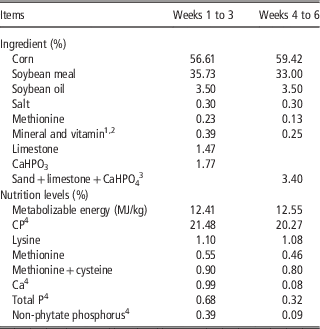
All experimental procedures were approved by the Animal Research Center at the Veterinarian Office of Beijing, People’s Republic of China. Before the initiation of the present study, a total of 500 one-day-old male broilers (Arbor Acres; Huadu Broiler Breeding Corp., Beijing, China) were housed in electrically heated, thermostatically controlled stainless steel cages (100×50×45 cm) equipped with fiberglass feeders and water troughs. The birds were raised in 63 cages of eight birds per cage. A 24 h constant light schedule was adopted. Room temperature was maintained at 34°C during the first 3 days, and then gradually reduced to 25°C at the end of week 3. Birds were fed the corn–soybean meal diet (Table 1) containing 0.39% NPP on an as-fed basis (Liu, Reference Liu2012) with supplemental feed grade CaHPO4·H2O (Beijing Chemical Company, Beijing, China) from weeks 1 to 3, and the diet was formulated to meet or exceed the nutrient requirements of starter broilers as recommended by NRC (1994).
The composition and nutrient levels of the complete diet for broilers at 1 to 3 weeks of age and the basal diet for broilers at 4 to 6 weeks of age (as-fed basis)

1 Provided per kilogram of diet (day 1 to 21): vitamin A, 12 500 IU; vitamin D3, 4250 IU; vitamin K3, 2 mg; vitamin E, 16 IU; vitamin B1, 1 mg; vitamin B6, 2 mg; vitamin B2, 8.5 mg; vitamin B12, 0.01 mg; choline, 700 mg; pantothenic acid calcium, 10 mg; niacin, 32.5 mg; folic acid, 1 mg; biotin, 0.158 mg; aureomycin, 100 mg; Fe (FeSO4·7H2O), 80 mg; Cu (CuSO4·5H2O), 8 mg; Mn (MnSO4·H2O), 100 mg; Zn (ZnSO4·7H2O), 60 mg; I (KI), 0.35 mg; Se (Na2SeO3), 0.15 mg.
2 Provided per kilogram of diet (day 22 to 42): vitamin A, 10 000 IU; vitamin D3, 3400 IU; vitamin E, 12.8 IU; vitamin B1, 0.8 mg; vitamin K3, 1.6 mg; vitamin B6, 1.6 mg; vitamin B12, 0.008 mg; vitamin B2, 6.8 g; folic acid, 0.8 mg; pantothenic acid calcium, 8 mg; choline, 500 mg; niacin, 26 mg; biotin, 0.126 mg; Fe (FeSO4·7H2O), 60 mg; Cu (CuSO4·5H2O), 8 mg; Mn (MnSO4·H2O), 80 mg; Zn (ZnSO4·7H2O), 40 mg; I (KI), 0.35 mg; Se (Na2SeO3), 0.15 mg.
3 Each diet was formulated by changing the quantities of fine sand, limestone and CaHPO3. Washed fine sand contained no detectable P and Ca.
4 Analyzed values.
At 22 days of age, 360 birds were selected and randomly allotted by BW to one of 10 dietary treatments with six replicate cages of six birds per cage for each treatment. Birds were fed P-unsupplemented corn–soybean meal basal diet and the basal diet supplemented with 0.05%, 0.10%, 0.15%, 0.20%, 0.25%, 0.30%, 0.35%, 0.40% or 0.45% inorganic P in the form of feed grade CaHPO4·H2O for 21 days. The basal diet (Table 1) was formulated to meet or exceed the nutrient requirements of grower broilers as suggested by NRC (1994) except for Ca and P.
A single large batch of the mash basal diet, void of CaHPO4·H2O and CaCO3, was mixed at first, and then divided into 10 sublots according to the experimental treatment. Each sublot was mixed with CaHPO4·H2O, CaCO3 or fine sand (Waldroup et al., Reference Waldroup, Kersey, Saleh, Fritts, Yan, Stilborn, Crum and Raboy2000; Yan et al., Reference Yan, Kersey and Waldroup2001; Liu, Reference Liu2012). Fine sand was washed several times before use, and contained no detectable P and Ca. The dietary NPP levels were 0.09%, 0.14%, 0.20%, 0.24%, 0.30%, 0.34%, 0.38%, 0.45%, 0.49% and 0.54%, and dietary total P levels were 0.35%, 0.40%, 0.46%, 0.50%, 0.56%, 0.60%, 0.64%, 0.71%, 0.75% and 0.80% by analysis on an as-fed basis, respectively. The dietary Ca concentrations were 0.91%, 0.89%, 0.92%, 0.91%, 0.92%, 0.90%, 0.88%, 0.88%, 0.90% and 0.90% by analysis on an as-fed basis, respectively.
During the experimental period, chickens were maintained on a 24 h constant light and allowed ad libitum access to experimental diets and tap water, and room temperature was maintained at 24°C. BW and feed intake of birds per cage were recorded and corrected for mortality to calculate average daily gain (ADG), average daily feed intake (ADFI) and feed : gain (F : G) ratio during weeks 4 to 6.
Sample collections, preparations and analyses
At the end of the experiment (day 42), two birds per cage were selected according to the average BW of the cage. Blood samples were collected from each bird via cardiac puncture with 5 ml vacuum tubes, and then centrifuged at 3500 r.p.m. for 15 min at 4°C to harvest serum. Serum samples were frozen at −20°C for later analyses. The birds were killed by cervical dislocation. The duodenal segments were isolated immediately from the gastrointestinal tract, flushed with ice-cold 1‰ diethylpyrocarbonate (DEPC)-treated water and the duodenal mucosa was scraped off with ice-cold microscope slide, and immediately frozen and stored in liquid N2 for assay of Na+-Pi IIb gene expression. The bone marrow was isolated from the left tibia after repeatedly washing the surface of the bone with DEPC-treated water, and immediately frozen and stored in liquid N2 or −80°C for assays of alkaline phosphatase (ALP) gene expression or ALP activity. In addition, the left kidney samples were also excised immediately, and frozen and stored in liquid N2 for determining gene expression of Na+-Pi IIa. The right tibia and toe were excised, and frozen (−20°C) for determinations of bone characteristics. In addition, another four birds were selected from each treatment and slaughtered by cervical dislocation, depilated and frozen for determining the total body BMC and BMD.
Serum parameters and bone marrow alkaline phosphatase activity
Serum was thawed and then analyzed for inorganic P concentration using the vanadate–molybdate method (Gomori, Reference Gomori1942). The ALP activities in serum and bone marrow, and serum Ca concentration were determined by microplate reader with commercial kits (Nanjing Jiancheng Bioengineering Institute, Nanjing, China). Serum parathyroid hormone (PTH) concentration was analyzed by radioimmunoassay instrument (xh6080; XI'AN, China) with commercial kits (China Institute of Atomic Energy, Beijing, China).
Bone mineral content and density
Frozen tibia, toe and dead body were thawed at room temperature for 2 h, and tibia bone was defleshed and patella was removed, and cuticles of toe were removed. The BMC and BMD were determined by dual-energy X-ray absorptiometry (DEXA) using the case of small animals model (DCS-600; Aloka, Tokyo, Japan). After the scan, tibia bones were immediately rebagged and frozen until analysis of bone strength (Onyango et al., Reference Onyango, Hester, Stroshine and Adeola2003).
Bone strength measurement
The tibia bone strength was determined by a three-point bending test (Electronic Universal Testing Machine Wd-1; Changchun Non-Metallic Materials Testing Machine Factory, Changchun, China). The tibia bone was put on a fulcrum point with 70 mm apart. Loading point was located in the midpoint of fulcrum points. The value of breaking force was determined by the shear test at a speed of 5 mm/min with a 50 kg loading cell until fracture occurred (Crenshaw et al., Reference Crenshaw, Peo, Lewis and Moser1981). The ultimate breaking force of the tibia bone was indirectly obtained, according to the load v. deformation curve recorded by computer.
Bone ash percentage
The tibia and toe were dried at 105°C for 24 h, and defatted by Soxhlet extraction in diethyl ether for 48 h, and then dried at 105°C for 24 h and weighted to determine the tibia and toe weight. Tibia and toe were ashed in porcelain crucibles at 600°C in a muffle furnace for 24 h to determine bone ash weight and calculate bone ash percentage.
Diet and bone ash analyses
Diet samples were ground to pass through a 0.50 mm screen and mixed thoroughly before analysis for CP, Ca, total P and phytate P (PP). The CP level in the basal diet was analyzed according to the Kjeldahl method (Thiex et al., Reference Thiex, Manson, Anderson and Persson2002). Ca concentrations in diets and bone ash were determined by inductively coupled plasma spectroscopy (Model IRIS Intrepid II; Thermo Jarrell Ash, Waltham, MA, USA). Total P concentrations in diets and bone ash were determined with a spectrophotometer (procedure 3.4.11; Association of Official Analytical Chemists, 2000). Validations of the Ca and P analyses were conducted using bovine liver powder (GBW (E) 080193; National Institute of Standards and Technology, Beijing, People’s Republic of China) as a standard control material. The PP contents in diets were analyzed according to the ferric precipitation method described by Selle et al. (Reference Sharpley1996). Therefore, dietary NPP was calculated as the difference between total P and PP.
Isolations of total RNA and reverse transcription PCR
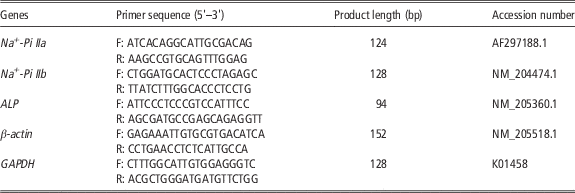
The total RNA was isolated from duodenal mucosa, kidney and bone marrow by using TRIZOL reagent (Invitrogen Life Technologies, Carlsbad, CA, USA) according to the manufacturer’s instructions. The total RNA integrity was analyzed by denatured agarose gel electrophoresis stained with gelred. The RNA concentration was determined by using the NanoDrop ND-1000 spectrofluorometer (NanoDrop Technologies, Wilmington, DE, USA). First-strand complementary DNA was reverse transcribed from 1 µg of total RNA using SuperSriptTM III first-strand synthesis system for reverse transcription PCR kit (12371-019; Invitrogen Life Technologies) following the manufacturer’s instructions and oligo (dT)20 as a primer. Real-time PCR analysis was performed on an ABI 7500 real-time PCR system (Applied Biosystems, Foster City, CA, USA), with SYBR-Green PCR Master Mix (Applied Biosystems). The amplification reaction conditions consisted of 10 min at 95°C and 40 cycles of 94°C for 15 s and 60°C for 1 min. According to the sequences of the genes published in GenBank, primer sequences for Na+-Pi IIb, Na+-Pi IIa, ALP, β-actin (housekeeping gene) and glyceraldehyde-3-phosphate dehydrogenase (GAPDH, housekeeping gene) and messenger RNA (mRNA) were listed in Table 2. Each specimen was measured independently in triplicate. Relative mRNA expression of target gene was calculated using the
 $$2^{{{\minus}\Delta \Delta C_{t} }} $$
method reported by Livak and Schmittgen (Reference Livak and Schmittgen2001), and values were normalized by β-actin and GAPDH as an internal control (Vandesompele et al., Reference Vandesompele, De Preter, Pattyn, Poppe, Van Roy, De Paepe and Speleman2002).
Primer sequences of chicken Na+-Pi IIa, Na+-Pi IIb alkaline phosphatase (ALP), β-actin and glyceraldehyde-3-phosphate dehydrogenase (GAPDH)

Na+-Pi IIa=kidney type II sodium/phosphate cotransporter; Na+-Pi IIb=intestine type II sodium/phosphate contransporter.
Statistical analyses
Data from the experiment were subjected to one-way ANOVA with the GLM procedure of SAS (Statistical Analysis Systems Institute Inc., Reference Schreiweis, Orban, Ledur, Moody and Hester2003). The cage served as the experimental unit. Data from mortality of broilers were transformed to arcsine before statistical analysis. When treatment effect was significant, the difference of means was analyzed by LSD method. Orthogonal comparisons were applied for linear or quadratic responses of dependent variables to independent variables. And then, broken-line models were set up by conducting non-linear regression analyses using the PROC NLIN procedure of SAS (Statistical Analysis Systems Institute Inc., Reference Schreiweis, Orban, Ledur, Moody and Hester2003), and the breaking points of these broken-line models were estimated and defined as dietary NPP requirements of broilers (Yu and Morris, Reference Yu and Morris1999; Waldroup et al., Reference Waldroup, Kersey, Saleh, Fritts, Yan, Stilborn, Crum and Raboy2000). P-value was considered at P<0.05.
Results
Growth performance and mortality
Data were presented in Table 3. Dietary NPP level influenced ADG (P<0.0001), ADFI (P<0.0001) and mortality (P<0.04) of broilers, but not F : G (P>0.23). The ADG and ADFI increased linearly (P<0.0001) and quadratically (P<0.002) as dietary NPP levels increased. The ADG of birds reached a plateau. Mortality of the broilers fed the 0.09% NPP diet was higher (P<0.05) than those fed other NPP levels.
Effect of dietary non-phytate phosphorus (NPP) level on growth performance and mortality of broilers from 4 to 6 weeks of ageFootnote 1

ADG=average daily gain; ADFI=average daily feed intake; F : G=feed : gain.
1 Values represent the means of six replicate cages (n=6).
2 Linear effect of dietary NPP levels.
3 Quadratic effect of dietary NPP levels.
Serum parameters and bone marrow alkaline phosphatase activity
Data were listed in Table 4. Dietary NPP level affected serum inorganic P concentration (P<0.0001) and ALP activity (P<0.02), but not serum Ca (P>0.15) and PTH (P>0.76) concentrations, and bone marrow ALP activity (P>0.76). Serum inorganic P concentration increased linearly and quadratically (P<0.0001) with increasing dietary NPP levels, and reached a plateau at about 0.29% dietary NPP level. However, only a quadratic response (P=0.01) was observed in serum ALP activity with the lowest ALP activity (P<0.05) at the 0.39% NPP level.
Effect of dietary non-phytate phosphorus (NPP) level on plasma parameters and bone marrow alkaline phosphatase (ALP) activity of broilers at 42 days of ageFootnote 1

PTH=parathyroid hormone.
1 Values represent the means of six replicate cages (n=6).
2 Linear effect of dietary NPP levels.
3 Quadratic effect of dietary NPP levels.
Bone characteristics
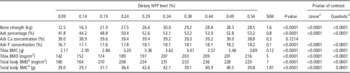
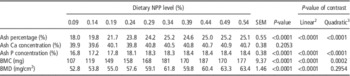
Data were given in Tables 5 and 6. Dietary NPP level had an effect (P<0.0001) on tibia, middle toe and total body bone characteristics except for tibia and middle toe ash Ca concentrations (P>0.20). As dietary NPP levels increased, middle toe BMD increased linearly (P<0.0001), and all other bone characteristics indices increased linearly (P<0.0001) and quadratically (P<0.0003), and reached plateaus at about 0.29% to 0.34% dietary NPP levels.
Effect of dietary non-phytate phosphorus (NPP) level on tibia bone and the whole body skeleton parameters of broilers at 42 days of ageFootnote 1

BMC=bone mineral content; BMD=bone mineral density.
1 Values represent the means of six replicate cages (n=6).
2 Linear effect of dietary NPP levels.
3 Quadratic effect of dietary NPP levels.
4 Values represent the means of four replicate cages (n=4).
Effect of dietary non-phytate phosphorus (NPP) level on middle toe bone parameters of broilers at 42 days of ageFootnote 1

BMC=bone mineral content; BMD=bone mineral density.
1 Values represent the means of six replicate cages (n=6).
2 Linear effect of dietary NPP levels.
3 Quadratic effect of dietary NPP levels.
Phosphorus metabolism-related gene expressions
Dietary NPP level influenced mRNA expression levels of duodenal Na+-Pi IIb (P<0.02), kidney Na+-Pi IIa (P<0.0001) and bone marrow ALP (P<0.009) (Table 7). The mRNA expression levels of duodenal Na+-Pi IIb and kidney Na+-Pi IIa decreased linearly (P<0.003) and quadratically (P<0.03) with increasing dietary NPP levels, whereas neither linear nor quadratic response (P>0.05) was observed for the bone marrow ALP mRNA level. These results indicated that the above gene expression indices were not suitable for evaluating dietary NPP requirements of broilers.
Effect of dietary non-phytate phosphorus (NPP) level on messenger RNA (mRNA) expression levels of key functional proteins and enzymes involved in P metabolism in tissues of broilers at 42 days of ageFootnote 1

Na+-Pi IIb=intestine type II sodium/phosphate contransporter; RQ=relative quantity; Na+-Pi IIa=kidney type II sodium/phosphate cotransporter; ALP=alkaline phosphatase.
1 Values represent the means of six replicate cages (n=6).
2 Linear effect of dietary NPP levels.
3 Quadratic effect of dietary NPP levels.
4
The targeted mRNA abundances were calculated as the RQ of the target mRNA to internal control mRNA; RQ=
$$2^{{{\minus}\Delta \Delta C_{t} }} $$
(C
t
=threshold cycle).
The dietary non-phytate phosphorus requirements of broilers
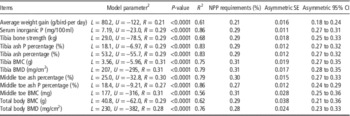
Results of the dietary NPP requirements of broilers as estimated by the non-linear regression analyses were presented in Table 8. Based on fitted broken-line models (P<0.0001) of ADG, serum inorganic P concentration, tibia bone strength, tibia bone ash percentage and P percentage, tibia BMC and BMD, middle toe ash percentage and P percentage, middle toe BMC, total body BMC and BMD with dietary NPP levels, respectively, optimal dietary NPP levels were estimated to be 0.21%, 0.29%, 0.29%, 0.29%, 0.29%, 0.31%, 0.29%, 0.30%, 0.27%, 0.29% and 0.28% for broiler chickens fed a conventional corn–soybean meal diet from 4 to 6 weeks of age.
The dietary non-phytate phosphorus (NPP) requirements of broilers from 4 to 6 weeks of age as estimated based on fitted broken-line modelsFootnote 1

CI=confidence intervals; BMC=bone mineral content; BMD=bone mineral density.
1 Defined as the breaking points of broken-line models of the selected variables as calculated by a non-linear least squares analysis (Yu and Morris, Reference Yu and Morris1999; Robbins et al., Reference Robbins, Saxton and Southern2006).
2 In a model, L=Y value at the breaking point, U=slope ratio of line at X<R and R=value of X at the breaking point.
Discussion
In recent years, broken-line models have been often used for estimating dietary NPP requirements of broilers (Waldroup et al., Reference Waldroup, Kersey, Saleh, Fritts, Yan, Stilborn, Crum and Raboy2000; Yan et al., Reference Yan, Kersey and Waldroup2001; Karimi et al., Reference Karimi, Bedford, Sadeghi and Ghobadi2011). Therefore, in the present study, dietary NPP requirements of broilers have been evaluated by broken-line models. A nutrient requirement for animals is usually defined as the minimum dietary content requirement for the maximal performance (Sterling et al., Reference Sterling, Vedenov, Pesti and Bakalli2005). However, the maximal performance of animals is difficult to determine because there are several criteria for each nutrient (Huang et al., Reference Huang, Lu, Luo and Liu2007). Therefore, the choice of responsive criteria used to estimate requirement is vitally important. The growth performance is the commonly used response criterion for estimating the NPP requirement of boiler chickens. In the present study, the optimal dietary NPP level required to obtain the optimal ADG of male broilers is 0.21% based on the broken-line model, which is similar to the result of Yan et al. (Reference Yan, Kersey and Waldroup2001), in which the male broilers fed the corn–soybean meal diet containing 0.19% dietary NPP from 22 to 42 days of age could reach the maximal weight gain. However, there were usually no differences in weight gain of broilers during this phase with inorganic P supplementations (Skinner et al., 1992; Dhandu and Angel, Reference Dhandu and Angel2003). The above disparities among different studies might be due to differences in broiler breeds, diet types, dietary Ca levels, dietary NPP levels during the starter phase and NPP levels in the basal diets with no inorganic P addition, etc. For instance, higher dietary Ca levels or Ca : P ratios decreased the feed intake of birds (Rao et al., Reference Rao, Raju, Reddy and Pavani2006; Powell et al., Reference Powell, Bidner and Southern2011), and can also affect P absorption and utilization. Therefore, the evaluated NPP requirements might be different under different dietary Ca levels or Ca : P ratios. In addition, the fitted broken-line model with ADFI was not good, and its R 2 (0.51) was relatively too low, therefore, ADFI was unsuitable for evaluating dietary NPP requirements of broilers although it was significantly affected by dietary NPP.
Bone ash percentage is another commonly used criterion for estimating dietary NPP requirements of broilers. In the present study, the optimal dietary NPP level required to obtain the optimal tibia ash percentage was estimated to be 0.29% based on the broken-line model, which was lower than those reported by Yan et al. (Reference Yan, Kersey and Waldroup2001), Dhandu and Angel (Reference Dhandu and Angel2003), Karimi et al. (Reference Karimi, Bedford, Sadeghi and Ghobadi2011) and also recommended by NRC (1994). Although tibia ash percentage is a sensitive criterion for NPP requirement evaluation (Dhandu and Angel, Reference Dhandu and Angel2003), it is inevitable to slaughter birds for tibia sample collection. However, other studies have indicated that it could be avoided to kill birds when the middle toe ash percentage was used as a sensitive criterion for NPP requirement evaluation (Liu, Reference Liu2012). Therefore, middle toe ash determination is a quicker and cheaper method compared with tibia ash assay. In the present study, the optimal dietary NPP level required to obtain the optimal middle toe ash percentage was estimated to be 0.30% based on the broken-line model, which was very close to that estimated by the tibia ash percentage, indicating that the middle toe ash percentage is as sensitive as the tibia ash percentage in dietary NPP requirement evaluation of broilers.
Bone strength was defined as the force required to break the bone (Crenshaw et al., Reference Crenshaw, Peo, Lewis and Moser1981), and was a direct responsive criterion for the risk of bone fracture. Rowland et al. (Reference Rowland, Harms, Wilson, Ross and Fry1967) concluded that tibia bone strength was a sensitive criterion to evaluate Ca or P requirement of poultry. Consistent results have been observed in the present and other studies (Skinner et al., 1992; Liu, Reference Liu2012). In the present study, the optimal dietary NPP level required to obtain the optimal tibia bone strength was estimated to be 0.29% based on the broken-line model, which was very close to those estimated by the above tibia ash and middle toe ash percentages. However, Dhandu and Angel (Reference Dhandu and Angel2003) reported that bone strength was not affected by dietary NPP, possibly due to the shorter experimental duration (only 10 days, from 32 to 42 days of age), use of older (32-day-old) birds and higher NPP level (0.15%) in the control diet in this study.
The BMC and BMD, which were determined by DEXA, could well reflect the extent of skeletal integrity. Onyango et al. (Reference Onyango, Hester, Stroshine and Adeola2003) reported that BMC and BMD of broiler chickens could sensitively respond to the changes of dietary Ca and P concentrations, and also had a strong correlation with tibia bone ash content. These two indices were successfully used for evaluating the P availability in turkey (Akpe et al., Reference Akpe, Waibel, Larntz, Metz, Noll and Walser1987). However, no other researchers have used these indices as criteria to estimate the NPP requirements of chickens, except for Liu (Reference Liu2012) from our laboratory, who reported that tibia BMC and BMD were sensitive criteria for NPP requirement estimation of broilers from 1 to 3 weeks of age. In the present experiment, we observed that tibia BMC and BMD, the total body BMC and BMD and middle toe BMC were sensitive criteria for NPP requirement estimation of broilers. The optimal dietary NPP levels estimated based on the broken-line models of these indices were 0.28% to 0.31%, which were very close to those estimated by other bone characteristics indices. In addition, tibia BMC and BMD, especially the total body BMC and BMD and middle toe BMC could be effectively and accurately detected in vivo by DEXA (Akpe et al., Reference Akpe, Waibel, Larntz, Metz, Noll and Walser1987; Swennen et al., Reference Swennen, Janssens, Geers, Decuypere and Buyse2004; Schreiweis et al., Reference Selle, Ravindran, Cadogan, Walker and Bryden2005; Baird et al., Reference Baird, Eggett and Fullmer2008). Therefore, the total body BMC and BMD, and middle toe BMC as determined by DEXA might be new, sensitive and non-invasive criteria to evaluate the dietary NPP requirements of broilers.
Both serum and bone ash P concentrations have also been used as criteria for the estimation of NPP requirements of chickens. However, bone ash P concentration was not as sensitive as serum P concentration (Karimi et al., Reference Karimi, Bedford, Sadeghi and Ghobadi2011; Liu, Reference Liu2012). In the present study, P concentrations in serum, tibia ash and middle toe ash were equally sensitive to respond to the changes of dietary NPP levels. The optimal dietary NPP levels estimated based on the broken-line models of these indices were 0.27% to 0.29%, which were very close to those estimated by most of the above other indices.
Gene expression analyses have provided a useful means to estimate the Se requirement of rats (Sachdev and Sunde, Reference Sachdev and Sunde2001), Zn requirements (Huang et al., Reference Huang, Lu, Luo and Liu2007; Liao et al., Reference Liao, Li, Lu, Liu, Li, Zhang, Wang and Luo2013) and Mn requirement (Li et al., Reference Li, Lin, Lu, Xi, Wang, Hao, Zhang, Li and Luo2011) of broilers. In the present study, however, the mRNA expression levels of duodenal Na+-Pi IIb cotransporter, kidney Na+-Pi IIa cotransporter and bone marrow ALP were not suitable for evaluating dietary NPP requirements of broilers, because there was no clear plateau or quadratic change in these gene expression levels with increasing dietary NPP levels, although these indices were significantly affected by dietary NPP. The above results suggest that not all gene expression analyses will be good for nutrient requirement estimations of animals, depending upon different minerals and indices.
The results from the present study indicate that the optimal dietary NPP requirements of broilers as evaluated by different indices are different, ranging from 0.21% based on ADG to 0.31% based on tibia BMC and BMD and middle toe BMC. When nutrient requirements of animals vary with different response parameters, the maximal requirement value should be chosen so as to meet all metabolic requirements of animals (Huang et al., Reference Huang, Lu, Luo and Liu2007; Li et al., Reference Li, Lin, Lu, Xi, Wang, Hao, Zhang, Li and Luo2011; Liao et al., Reference Liao, Li, Lu, Liu, Li, Zhang, Wang and Luo2013). Therefore, in order to meet the P requirements of broilers for all P metabolisms, it is recommended that the 0.31% dietary NPP level would be optimal for broiler chickens fed a conventional corn–soybean meal diet from 4 to 6 weeks of age. This is lower than the dietary NPP requirement (0.35%) recommended by NRC (1994), which would be good for reducing the feed costs and P excretions of broilers.
In conclusion, the results from the present study have implied that the total body BMC and BMD, and middle toe ash P and BMC might be new, sensitive and non-invasive criteria to evaluate the dietary NPP requirements of broilers, and the 0.31% dietary NPP level would be optimal for broiler chickens fed a conventional corn–soybean meal diet from 4 to 6 weeks of age.
Acknowledgments
This work was supported by the National Natural Science Foundation of China (project no. 31472116; Beijing, People’s Republic of China), the Agricultural Science and Technology Innovation Program (ASTIP-IAS08; Beijing, P. R. China) and the China Agriculture Research System (project no. CARS-42; Beijing, P. R. China).