For many observers, revolution and international conflict go hand in hand.Footnote 1 From China to Libya to Uganda to Iraq, the domestic upheaval of revolution often culminates in international strife. But not all revolutions lead to conflict. The Eastern European revolutions that followed the collapse of the Soviet Union did not lead directly to large-scale armed conflicts between countries, nor did revolutions in countries such as Myanmar, the Yemen Arab Republic, or Peru.
When and why do revolutions lead to international violence? Past research focused mainly on how international systemic factors heighten the risk of war after revolutions. We argue, however, that postrevolutionary domestic political structures matter greatly. We build on recent research arguing that revolutions tend to bring leaders with risk-tolerant, revisionist foreign policy preferences to power, leaders who often resort to international force. We show that the kind of political regime that emerges in the wake of a revolution affects the extent to which those leaders are able to turn to violence internationally. When revolutions culminate in personalist dictatorships, those countries initiate substantially more international conflict in the ten years after the revolution than when other types of political systems emerge. This matters greatly because nearly half of all revolutions have resulted in personalist regimes.
We develop and test two complementary explanations for why postrevolutionary regime type matters. Both build on the insight that the individuals who lead revolutions are particularly likely to have revisionist international preferences and to have high tolerance for risky strategies. First, personalistic regimes place fewer constraints on these (often-revisionist) revolutionary leaders, allowing them to initiate conflict at a higher annual rate than revolutionary nonpersonalist leaders. Second, personalistic political systems tend to ensconce leaders and allow them to enjoy longer tenure in office. In nonpersonalistic regimes, the leaders of revolutions are more likely to be removed from office after a short spell and replaced with more moderate nonrevolutionary leaders with fewer international ambitions. Thus, in personalist regimes the original revolutionary leaders remain in power for a higher proportion of the postrevolutionary period than in nonpersonalist regimes, leading to more conflict during that period. We also find that revolutionary leaders and personalist regimes each have independent effects on the likelihood of conflict initiation, but the main contribution of this article is to consider how the two variables interact. We show that the type of postrevolutionary government affects the extent to which revolution fosters international armed conflict. Overall, we find that personalist regimes account for 71 percent of the international conflicts initiated by states with a recent domestic revolution.
These insights help explain striking patterns in the historical record. Leaders such as Mao Zedong in China, Saddam Hussein in Iraq, Idi Amin in Uganda, and Muammar Qadhafi in Libya all seized on the upheaval of their revolutions to build personalist dictatorships. The domestic political structures they created in turn allowed these leaders to survive in office and enact their revisionist international policy preferences for years or even decades. In contrast, leaders who face the more institutionalized environment of a nonpersonalist regime tend to face greater constraints on conflict initiation, and also tend to be replaced more quickly by more moderate leaders who are less eager to change the international status quo. Saw Maung of Myanmar, Al-Sallal of the Yemen Arab Republic, and Velasco Alvarado of Peru all ushered in revolutions that did not engender personalistic regimes. Our findings suggest that Myanmar, the Yemen Arab Republic, and Peru likely would have instigated more international conflict if those revolutions had resulted in personalist dictatorships.
Existing Literature
For decades, scholars have studied how domestic revolutions affect international relations, especially the likelihood of war. Although some have sought to explain the complex factors leading to revolution, we treat revolutions as the starting point and investigate their consequences.Footnote 2 Scholars concur that states with a recent domestic revolution are unusually prone to international disputes and wars.Footnote 3 The consensus has been supported by empirical work, often using historical case studies. More recently, quantitative research has also found that revolutionary states are particularly conflict-prone.Footnote 4
Despite this consensus about the international effects of domestic revolutions, scholars have largely overlooked the important question of whether those effects depend on the type of postrevolutionary government that emerges. Walt, for example, argues that revolutions increase the likelihood of conflict by altering systemic factors such as the offense-defense balance, perceptions of hostility, and the information available to state leaders.Footnote 5 He also offers an account of how domestic politics increase the probability of war, but he explicitly rejects an emphasis on domestic factors. He does not explore whether his hypothesized mechanisms apply to all postrevolutionary states, or primarily certain types of postrevolutionary regimes.Footnote 6
Other scholars place more emphasis on how the domestic characteristics of revolutionary leaders and movements may cause international conflicts, but like Walt they do not explore whether these effects vary according to the types of political institutions present. Skocpol, for instance, argues that successful revolutionary leaders are particularly good at organizing and mobilizing their populations for campaigns of mass violence, a skill that was required for them to be successful in the domestic revolutionary struggle. Consequently, revolutionary states have greater capacity for aggression.Footnote 7 Gurr shares Skocpol's view that revolutionary leaders tend to be aggressive internationally, but for different reasons.Footnote 8 He argues that revolutionary leaders who have secured power and maintained their positions through the use of violence domestically are disposed to respond violently to future challenges, even if those challenges arise internationally.
Maoz combines the domestic and systemic views by arguing that revolutionary states face pressure to engage in conflict from both internal and external sources. Internally, the new ruling elite feels pressure to “mobilize support for the regime through scapegoating.”Footnote 9 Externally, the pressure comes from the threat and opportunity perceived by foreign powers. Again, whereas Maoz provides evidence of an overall relationship between revolution and conflict, he does not examine whether the effects apply equally to different types of postrevolutionary governments.
Theory: Revolutions, Personalist Regimes, and International Conflict
Recently, scholars have extended some of these existing arguments, focusing on how revolutions select for leaders that have characteristics that make them particularly likely to instigate conflict.Footnote 10 Colgan, for example, defines revolutionary leaders as individuals who personally helped transform the existing social, political, and economic relationships of the state by overthrowing or rejecting the principal existing institutions of society.Footnote 11 Revolutionary leaders are therefore a strict subset of all leaders that come to power as a result of the use of force—such as coups, assassinations, and revolts—because revolutions result in substantial transformations of the very organization of social, economic, and political life.Footnote 12
Colgan argues that the same types of individuals who succeed as revolutionaries tend to be more risk tolerant and ambitious to alter the status quo than typical leaders. These characteristics in turn make it more likely that the leader will seek to instigate international conflict. In other words, the same characteristics that allowed revolutionaries to succeed in their domestic struggle also make such leaders more likely to instigate international conflict once they have obtained office.
This argument builds on a growing body of research suggesting that the characteristics of individual leaders matter for state behavior.Footnote 13 Foreign policy decisions are ultimately made by individuals, and not all leaders behave the same way under the same conditions. The possibility that revolutions select for certain types of leaders therefore provides a fruitful starting point for exploring how domestic political institutions may condition the effect of revolution on international conflict.
Political Institutions and Conflict Initiation in the Aftermath of Revolutions
If revolutionary leaders have preferences and risk tolerances that dispose them toward international conflict, domestic institutions could have a profound impact on the conflict propensity of postrevolutionary states. We focus in particular on the initiation of international conflict, because this is the activity over which leaders have the most agency. Although much scholarship has focused on how institutional differences between democracies and dictatorships affect conflict initiation, newer research indicates that when it comes to the initiation of international conflict, a more important distinction is whether the regime—democratic or not—features institutions that allow domestic political actors to constrain their leaders, or whether it is a personalist dictatorship in which such institutions are largely absent.Footnote 14
We define personalist dictatorships as regimes in which one powerful individual dominates the government apparatus and its instruments, including the military, the ruling party (if one exists), and the state bureaucratic apparatus. The hallmark of personalist regimes, also known as despotic or sultanistic regimes, is that they lack institutions to facilitate coordination by regime elites to check the powers of the individual ruler, such as an effective politburo, party hierarchy, merit-based rules for military promotions, or rules ensuring the turnover of leaders.Footnote 15 This lack of coordinating institutions, in turn, means that personalist leaders typically have free rein to appoint friends, relatives, and other cronies to important offices in both the government and military, and can then closely monitor their activities, ensuring that key regime insiders remain loyal.Footnote 16 For example, Saddam Hussein designed elaborate overlapping security apparatuses in Iraq for the express purpose of keeping watch over subordinates and protecting the regime from a coup. Any individual who might build an independent support base was rotated to a different position, or removed. These arrangements meant that no one inside the regime could prevent Saddam from entrusting the most important positions to family members, such as his sons, whose fates were already closely entwined with his own. Other leaders, such as Mao Zedong in China, had slightly less byzantine security arrangements and relied less on kinship ties, though the playbook—monitoring subordinates and ousting anyone who became too powerful—remained the same.
In contrast, in democracies and nonpersonalist dictatorships, leaders face more powerful institutions, whether through elections, a politburo that meets regularly, or tacit agreements among military leaders on how succession will be determined. In nonpersonalist military juntas or single-party regimes, leaders must therefore work to please elite constituencies, and there are always rivals who would willingly seize office if the leader violates the internal rules and norms of the regime.Footnote 17 Because the leader is not able to fashion the internal security apparatus to act as his personal protection agency, these potential rivals can also coordinate to put their plans into action.
Focusing on political institutions in this way reveals two mechanisms through which the type of postrevolutionary regime could affect the conflict behavior of postrevolutionary states: by reducing constraints on leaders while they remain in office (thereby raising the annual rate of conflict initiation), and by ensconcing the individuals who led the revolution in power (thereby allowing conflicts to accumulate over time).
Personalist Regimes Provide Fewer Constraints on Conflict Initiation
A first mechanism through which regime type could affect the behavior of postrevolutionary states is by shaping the extent of domestic constraints faced by the leader(s). Many scholars have argued that leaders who are constrained by or accountable to a domestic audience should be less likely to initiate conflict than less accountable leaders, for two related reasons. The first is that nonpersonalist leaders are more likely to be punished for poor war outcomes than personalist leaders, which could mute the willingness of nonpersonalist leaders to take on the risk of war.Footnote 18 Second, revolutionary leaders in nonpersonalist regimes might be able to constrain the leader from initiating a conflict in the first place.Footnote 19 Typically, we expect domestic audiences to have more dovish preferences than the more hawkish revolutionary leaders, and in nonpersonalist regimes the preferences of the domestic audience are more likely to affect the behavior of the state. We test this idea by assessing whether personalist revolutionary leaders are more likely to initiate conflict than nonpersonalist revolutionary leaders.
Personalist Institutions Ensconce Belligerent Revolutionary Leaders
The second way domestic institutions shape the conflict propensity of postrevolutionary states is by ensconcing revolutionary leaders in office, allowing them to translate their preferences into foreign policy during the postrevolutionary period. In other words, personalist institutions influence who occupies office in the postrevolutionary period: the incumbent who led the revolution, or a more moderate replacement.
For instance, the Chinese revolution, the Iranian revolution, the Ba'athist revolution in Iraq, and the Cuban revolution each swept away existing political institutions and replaced them with more personalized regime structures that allowed the leaders to remain in power for many years, during which those leaders were able to enact their belligerent preferences. Other revolutions, however, have produced political systems in which nonrevolutionary leaders have a better chance of replacing revolutionary leaders. For example, historical accounts suggest that Velasco Alvarado of Peru sought to initiate a war against Chile as a way of regaining the territory it had lost in a previous war.Footnote 20 Velasco greatly increased military spending and laid plans for war, but he was replaced by a nonrevolutionary leader before he could make those plans a reality. More generally, when revolutions do not result in personalist dictatorships, the original revolutionary leader is more likely to be replaced by nonrevolutionary politicians who have not been selected for a propensity for international violence in the same way.Footnote 21
In sum, personalist institutions raise the likelihood of conflict initiation in the postrevolutionary period by affecting who holds power. Previous research has shown, and we confirm, that states are more likely to instigate conflict when one of the individuals who helped to lead the revolution holds office.Footnote 22 When the revolution culminates in a personalist regime, those revolutionary leaders are able to remain in office well into the postrevolutionary period, and thus are able to enact their revisionist policy agendas. When the revolution produces a nonpersonalistic political system, a less radical leader is likely to replace the incumbent more quickly. To clarify, our argument is not that a revolutionary leader's annual rate of conflict initiation increases over time. Instead, we theorize that revolutionary leaders initiate conflict at a high, but fairly steady annual rate. Because they are less likely to be replaced by more moderate nonrevolutionary leaders when the regime is personalist, the result is a higher average rate of annual conflict initiation in the postrevolutionary period. We show direct evidence of both of these claims in the empirical analysis.Footnote 23
Why Do Revolutionary Personalists Not Deter Conflict?
Before proceeding to our hypotheses, one might ask whether interstate bargaining could offset the patterns we described, since regime type and revolutionary politics are both observable. We think not, for two reasons. First, the relatively high-risk tolerance and revisionist preferences of revolutionary personalist leaders should narrow the range of mutually acceptable bargaining outcomes, and the size of the bargaining range is important for the probability of conflict. A large bargaining range means that leaders would have to grossly miscalculate to fail to perceive an acceptable peaceful bargain. But when the bargaining range is small, the likelihood of war is higher because even small miscalculations or a small amount of private information could mean that the parties are no longer able to find a mutually agreeable bargain to avoid war.Footnote 24 Second, risk tolerance and revisionist preferences reduce the value of the status quo relative to war, which means the leader is more likely to challenge the status quo. More challenges to the status quo generate more opportunities for conflict because each time there is a challenge, states again face the tradeoff between demanding greater bargaining concessions and minimizing the risk of war.Footnote 25 For these reasons, we expect that postrevolutionary personalist regimes will be more likely to initiate militarized disputes.
Hypotheses
In sum, this discussion leads to a series of three complementary hypotheses: one that articulates our central proposition (H1), and two that address the mechanisms behind it (H2 and H3).
H1
In states that recently experienced a revolution, personalist dictatorship is associated with greater militarized dispute initiation.
H2
Revolutionary leaders are more likely to initiate international conflict when their regime is personalist than when it is not.
H3
When revolutions culminate in personalist regimes, the regime is led by a revolutionary leader for a higher proportion of the postrevolutionary period than when the revolution does not result in a personalist regime, because personalist leaders tend to survive in office for longer periods of time.
Does the Nonrandom Occurrence of Personalism Complicate the Analysis?
One question that naturally arises is which revolutions lead to a personalist regime, and which do not? After all, it seems unlikely that personalist regimes arise purely at random. We do not seek to provide a full explanation for the onset of personalist dictatorships—that question is too large to be properly explored here. However, we do need to consider the question sufficiently to avoid either endogeneity because of reverse causation, or bias because of omitted causal variables.
A first possibility is that preexisting international conflict and/or enduring interstate rivalries might make it more likely for a personalist regime to emerge following a revolution, for example, if revolutionary leaders used external conflict(s) to consolidate power and divert attention away from internal problems. In other words, revolutions could lead to interstate conflict, which in turn might lead to the establishment of personalist regimes, rather than the other way around. Although this is possible, we report the results of several tests for reverse causation. We found no evidence that enduring rivalries foster the emergence of postrevolutionary personalist dictatorships, nor that external conflict is concentrated in the immediate aftermath of a revolution, when the postrevolutionary regime type is being selected.
Second, perhaps regime type is affected by regional dynamics that in turn affect the probability of conflict.Footnote 26 It seems plausible that personalist dictatorships are most likely to emerge in geographic regions with weak or developing institutions and little experience with democracy. Indeed, in our empirical analysis, we find that thirteen out of the eighteen cases of revolutions that result in new personalist dictatorships (that is, where one did not exist before the revolution) occurred in Africa or the Middle East. A potential threat to inference occurs if geographic region is an omitted variable that affects the probability of both personalism and interstate conflict. Consequently, we control for geographic region, and a host of other potential omitted variables, in our robustness checks.
In sum, although a full explanatory model for the emergence of personalist dictatorships lies outside the scope of this article, our analysis suggests that neither endogeneity nor omitted variables drive the causal relationships theorized here.
Data and Methods
Operationalizing Revolution and Personalism
The time period for our analysis is 1946 to 2000.Footnote 27 To measure revolutions, we use a data set developed by Colgan.Footnote 28 We first create a dichotomous variable revolution, with a value of 1 for the state-year in which a revolutionary leader first came to power and 0 otherwise. Revolutions are identified using two principal criteria.Footnote 29 The first is whether the government came to power through use of armed force, widespread popular demonstrations, or similar uprising (an “irregular transition”). The second criterion is that once in power, the government must have implemented radical domestic changes for the purpose of transforming the organization of society, including its social, economic, and political institutions and practices. In all cases, the focus is on domestic policy, rather than foreign policy. The measure takes into account seven possible areas of change: the selection and power of the national executive; the structure of property ownership; the relationship between state and religion; the official political ideology; the official state name and symbols; the institutionalized status of ethnicity and gender; and the presence of a governing revolutionary council or committee. Dramatic changes in policy in at least three of the seven categories are required for the government's policy to be considered revolutionary. For example, the Iranian revolution in 1979 changed the relationship between state and religion (political dominance by clerics), the power and selection of the national executive (replacement of the monarchy by a clerical Supreme Leader), the status of women (inequality in inheritance law and segregation of the sexes), and the official name of the country (changed to the Islamic Republic of Iran), as well as many other changes.
As we mentioned, revolutions are quite distinct from related events such as coups or assassinations. In the data set, 28 percent of the leaders who used force to come to power are coded as revolutionary leaders. The data set does not code founding leaders of new countries as revolutionary (thereby excluding wars of independence or colonial transitions), nor leaders installed by foreign governments through international military actions. A full list of revolutions and revolutionary leaders is provided in the online appendix. Greater detail on the coding rules, along with an explicit comparison with related data is available elsewhere.Footnote 30
Identifying revolutions is difficult, and no list of revolutions will resonate with everyone perfectly. Using Colgan's coding rules to identify revolutions at least ensures consistency across cases and mitigates unintentional selection bias. In our robustness checks, however, we also take advantage of the ambiguous coding variable in Colgan's data set to identify only the “unambiguous” revolutions (listed in the appendix). We reanalyzed our regressions using only this set of “unambiguous” revolutions, with little impact on the results.
Having identified revolutions, we then create our principal independent variable for testing H1, postrevolutionary period. This variable is coded as 1 if the country experienced a revolution within the last ten years, and 0 otherwise. Although ten years is an arbitrary length of time, it is consistent with the practice of previous scholars.Footnote 31 Moreover, in our robustness checks, this ten-year period was varied using different cutoffs (for example, eight- or twelve-year cutoffs), and the results were substantively unchanged (and in fact sometimes grew stronger).
We also define a variable called revolutionary leader, which simply measures whether the state leader in question came to power by leading a revolution. It is possible for more than one leader to have led an irregular transition (for example, Naguib and then Nasser in Egypt in 1952), but the leadership is restricted to its senior leaders. Thus both Lenin and Stalin came to power through an irregular transition as leaders of the Russian Revolution, but not Khrushchev, even though he fought in the Red Army at a young age. The variable revolutionary leader is coded positively as long as the first generation of revolutionary leaders is in power.Footnote 32
Next, we operationalize the concept of personalist dictatorship. We began by using Weeks's data on authoritarian regimes.Footnote 33 To identify personalism, Weeks uses eight characteristics of the regime,Footnote 34 with additional rules for democracies and monarchies.Footnote 35 These indicators of personalism are coded independently of a leader's subsequent international behavior, based on observable domestic institutional features of a regime.
We then took two additional steps to fill in missing values. First, we updated the Weeks data to fill in missing data where possible, based on our own research.Footnote 36 Second, we used a data set collected by Geddes, Wright, and Frantz (GWF) to fill in missing data from the post-Soviet states and some other countries missing from the Weeks data set.Footnote 37 Note, however, that we also use the unmodified Weeks data set to test for robustness, and find very similar results (see discussion below).Footnote 38 Our full data set is available online.Footnote 39
The Weeks approach to coding personalism best matches our conception of personalist leaders because it focuses explicitly on the extent to which the leader faces political constraints on the use of force. For instance, both Mao and Stalin are considered personalist leaders in Weeks's coding because both leaders managed to eliminate powerful domestic audiences and surround themselves with loyal cronies who were unwilling or unable to criticize the leader's policies. In contrast, the GWF typology treats both Mao and Stalin as (nonpersonalist) single-party leaders because the regime featured a dominant party that controlled much of political life at lower levels of the regime, even though the individual leader maintained an iron grip on power.Footnote 40 In general, a comparison of the Weeks and GWF codings of personalism indicates that although the two lists are similar, the GWF coding undercounts personalism according to our conception, sometimes categorizing regimes as single-party regimes when the Weeks data would consider the leaders themselves to be relatively free of constraints and the regime thus personalistic.
Nonetheless, because the Weeks data are not available for the post-Soviet states and some other country-years, we fill in missing values with the GWF data, even though the GWF typology somewhat undercounts personalist leaders according to our conception. We opt for this approach because otherwise we would need to throw out a substantial number of observations, including the post-Soviet revolutions. Again, using this hybrid version of the Weeks/GWF data produces the same substantive conclusions as using the unmodified Weeks, only with more observations.Footnote 41
Dependent Variables and Model Specification
To test our hypotheses in which international conflict is the dependent variable (H1 and H2), we draw on the Militarized Interstate Disputes (MIDs) data set, which catalogues all “historical cases in which the threat, display or use of military force short of war by one member state is explicitly directed towards the government, official representatives, official forces, property or territory of another state.”Footnote 42 We begin with a dyadic analysis of conflict initiation, because countless studies have shown that important predictors of international conflict, such as geographic contiguity and distance, relative military power, alliance status, and trade interdependence are inherently dyadic phenomena that cannot be measured accurately in a monadic country-year analysis. Therefore we follow common practice and use logit models with directed dyad-years as the unit of analysis.Footnote 43
Our primary dependent variable initmid marks whether Side A of the dyad initiated an MID against Side B (by being the first to threaten or use military force) in any given year.Footnote 44 Additionally, initfatal counts only MIDs that resulted in at least one death of official military personnel. Oneal and colleagues suggest that fatal MIDs are less prone to reporting bias than lower-level incidents, which may not be covered consistently around the globe by news sources.Footnote 45 To control for temporal interdependence, we include cubic splines (or, as a robustness check, cubic polynomials since the last MID initiation).Footnote 46 We also cluster the standard errors by directed dyad to account for possible unobserved differences across country pairs. After presenting our core results, we discuss tests we conducted to assure that the relationships we observe are not a product of endogeneity.
To check robustness, we also carry out a monadic analysis in which country-years, rather than directed dyad-years, are the unit of analysis. For these models, we code a variable initmidn that counts the number of MIDs that a country initiated in any given year, that is, is the first state to threaten or use military force in a conflict (Side A). Second, initfataln counts the number of fatal MIDs initiated. We test H1 and H2 using a negative binomial model because the dependent variables are event counts (that is, the number of MIDs) and the negative binomial model accounts for overdispersion in our dependent variables.Footnote 47 We again include cubic splines to control for temporal interdependence, and cluster the standard errors by country to account for unobserved differences across states.
For H3 the dependent variable is leadership tenure, the number of years that the leader remains in office.
Control Variables
We also include a number of control variables that might be correlated with revolution, personalism, and international conflict. These are gathered from a set of well-known quantitative models of MID initiation.Footnote 48 As with revolution and personalism, we lag all of these control variables by one year.
capabilities: Many scholars have argued that more powerful states have wider-ranging interests than minor powers and thus may be more conflict-prone. For the dyadic analysis, we therefore control for each state's military capabilities and major power status, as well as Side A's proportion of dyadic capabilities. For the monadic analysis, we include the raw military capabilities score of the country, and a dummy variable indicating whether the state is a major power.Footnote 49
alliances: Next, we include a measure of alliances, which may proxy for geopolitical interests.Footnote 50 In the dyadic analysis, we control for the similarity of the two states’ alliance portfolios, and also how closely allied they are with the most powerful state in the system (in this period, the United States). In the monadic analysis, the alliance variable counts the country's number of alliance partners.
contiguity: Another important predictor of international conflict is geographic contiguity. In the dyadic analysis, we include a dummy variable for contiguity up to 400 miles of water, and also the logged distance between the two countries in the dyad.Footnote 51 In the monadic analysis, we count how many countries are contiguous to the state, either by land or across no more than 400 miles of water.
civil war: Gleditsch, Salehyan, and Schultz show that states undergoing civil war are significantly more likely to become involved in MIDs.Footnote 52 We therefore include variables indicating whether each country in the analysis was experiencing a civil war in that year.Footnote 53 Including this variable also creates a harder test of the hypotheses regarding revolution, since many revolutions are associated with periods of civil war (for example, the Iranian Revolution).
trade interdependence and openness: Many scholars have argued that trade can dampen incentives to use military force against a trading partner.Footnote 54 In the dyadic analysis, we therefore include a variable marking the lower trade dependence in the dyad using data by Gleditsch.Footnote 55 In the monadic analysis, we include the logged value of the country's total trade as a proportion of its GDP.
Empirical Results
Revolution, Personalist Dictatorship, and International Conflict Initiation
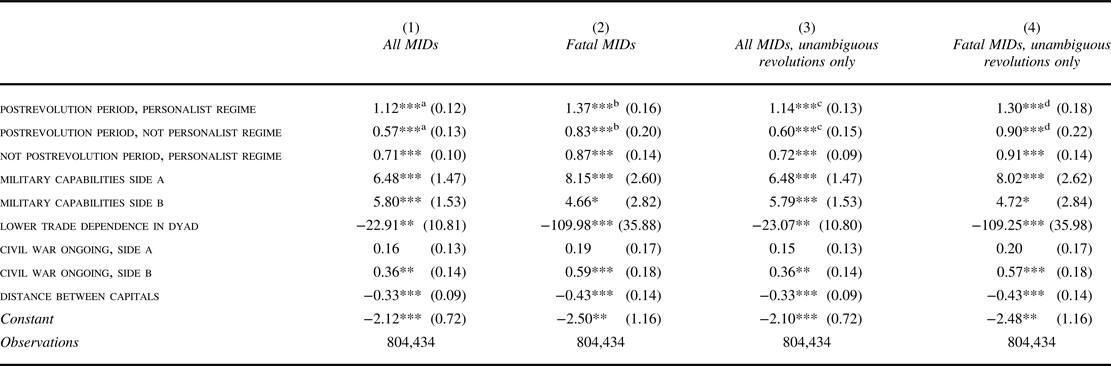
The first hypothesis we assess is that postrevolutionary states initiate more conflict when the postrevolutionary regime is personalist than when it is not (H1). To test it, we compare the coefficients on postrevolution period, personalist regime (see Table 1) with those for postrevolution period, not personalist regime, carrying out two-tailed Wald tests to assess the significance of the differences in these coefficients. Recall that coefficients in logistic regression are typically reported in terms of the change in log odds. We simply exponentiate the coefficients to recover the amount by which a one-unit change in the predictor variable changes the odds that the state initiates an MID.Footnote 56
Revolutions, personalist regimes, and MID initiation (dyadic)

Notes: Models are estimated using a logit model with standard errors clustered by directed-dyad, and include additional control variables: cubic splines to control for temporal interdependence; whether or not the two states are geographically contiguous; the major power status of each state in the dyad; the initiator's share of military capabilities; the two states’ similarity of alliance portfolio; and each state's similarity of alliance portfolio with the system leader. All regime predictor variables are lagged by one year. Unit of analysis is the directed dyad-year. Robust standard errors in parentheses. ***p < .01; **p < .05; *p < .1.
aWald test: different at p < .0006.
bWald test: different at p < .0142.
cWald test: different at p < .0022.
dWald test: different at p < .0935.
The results from Table 1 indicate that postrevolutionary personalist regimes have more than three times greater odds of initiating MIDs than countries that are neither postrevolutionary nor personalist.Footnote 57 Moreover, postrevolutionary personalists have 1.7 times greater odds of initiating MIDs than their nonpersonalist counterparts, a difference that is significant at p < 0.0006. They also have 1.7 times greater odds of initiating fatal MIDs than leaders of nonpersonalist postrevolutionary regimes, significant at p < 0.0142. Thus the evidence supports H1: regime type explains variation in dispute initiation in the aftermath of revolution.
The differences are equally stark when restricting the list of revolutions to “unambiguous” revolutions. Here, being personalist again increases the odds of conflict for a postrevolutionary state by a factor of 1.7, significant at p < 0.0022. When we restrict the analysis of “unambiguous” revolutions to fatal MIDs only, postrevolutionary personalists have 1.5 times greater odds of initiating fatal MIDs than their nonpersonalist counterparts, significant at p < 0.0935.
Note also that the coefficients on postrevolutionary nonpersonalist and not postrevolutionary personalist are positive and significant, indicating that, consistent with previous work, revolution and personalism also exhibit independent effects on the likelihood of conflict initiation.
Other variables generally perform as expected by the existing literature. A country is more likely to initiate an MID against another country when the two states are geographically proximate; when a country or its potential opponent is militarily strong; when the countries do not trade extensively; and when the countries have few alliances in common. Civil war in Side B also increases the likelihood of a MID initiation.
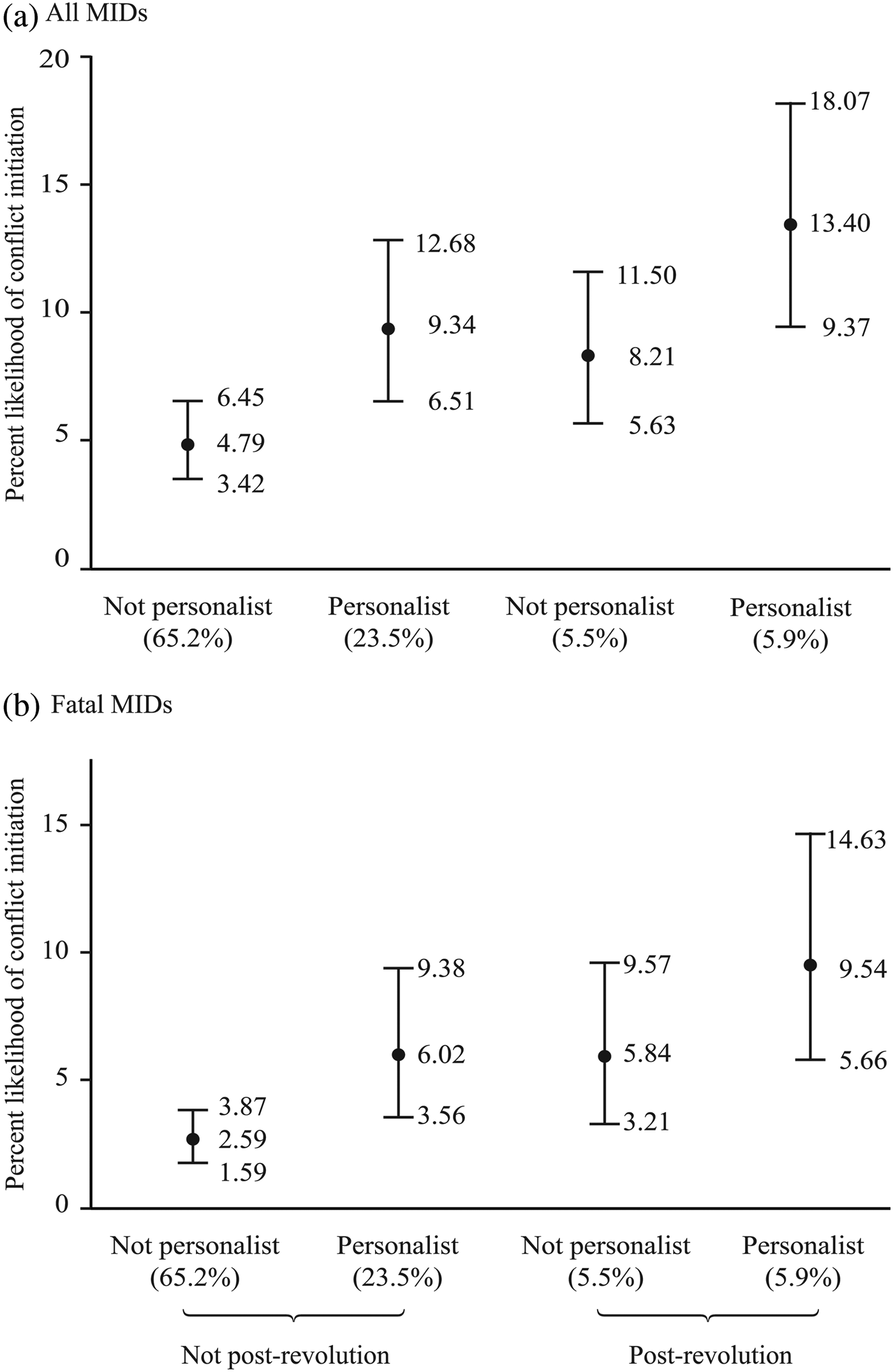
Figure 1 demonstrates the substantive importance of the effects of personalism and the postrevolutionary period. Using estimates generated by Clarify, the graph shows the predicted percent of the time that State A will initiate an MID against state B in a given year, according to the various combinations of revolution and personalism, with 95 percent confidence intervals around the point estimates.Footnote 58 We base the simulations on Model 1 (for Figure 1A) and Model 2 (for Figure 1B), and set all control variables to their median values except for contiguity/distance and military power, which in our hypothetical example we set at higher values since conflict rarely occurs between distant, militarily weak states.Footnote 59
Revolutions, personalist regimes, and MID initiation: Hypothetical scenario between contiguous, strong states

For all MIDs (Figure 1A), the baseline chance that State A will initiate an MID against State B when it is neither postrevolutionary nor personalist is 4.8 percent. States that are revolutionary but not personalist are 1.7 times as likely to initiate conflict (8.2 percent versus 4.8 percent), whereas states that are both personalist and revolutionary are 2.8 times as likely.Footnote 60 For fatal MIDs (Figure 1B), states led by personalist leaders in a postrevolutionary period are 1.6 times as likely to initiate MIDs as states that are postrevolutionary but not personalist, and 3.7 times as likely to initiate MIDs as states that are neither postrevolutionary nor personalist. Note that this simulation-based approach is different from simply comparing coefficients, as we did earlier for Table 1, and builds in additional uncertainty around the estimates because it models the predictions as a function of numerous covariates. Thus, although the difference between personalist and nonpersonalist postrevolutionary states was highly significant in Model 2 in Table 1 (p < 0.0014), the confidence interval for postrevolutionary personalists in Figure 1B just touches the point estimate for postrevolutionary nonpersonalists, because of uncertainty around the other values of predictor variables.
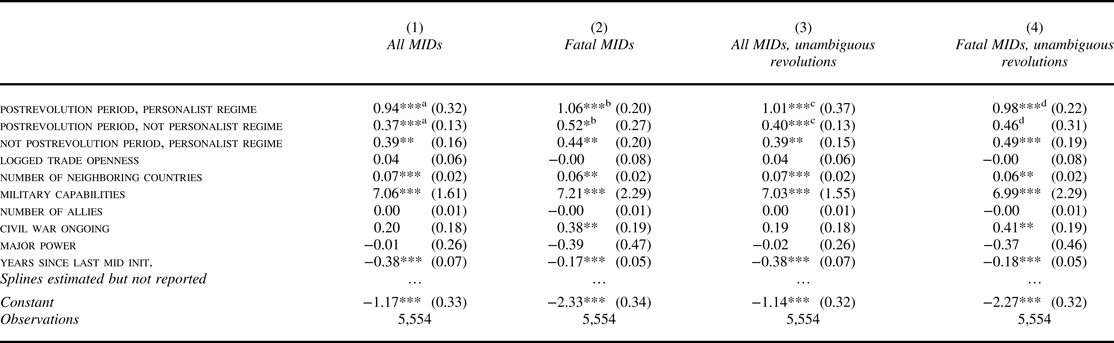
Next, for robustness we carry out a monadic analysis of MID initiation. Table 2 shows the results of a negative binomial regression with the number of MIDs initiated as the dependent variable. Model 1 focuses on all MID initiations, whereas Model 2 analyzes fatal MID initiations. We can exponentiate the coefficients to recover the change in the annual rate of MID initiation.
Revolutions, personalist regimes, and MID initiation (monadic)

Notes: Models are estimated using a negative binomial model with standard errors clustered by country, and include cubic splines of the time since the last MID initiation to control for temporal interdependence. All other regime predictor variables are lagged by one year. Unit of analysis is the country-year. Robust standard errors in parentheses. ***p < .01; **p < .05; *p < .1.
aWald test: different at p < .080.
bWald test: different at p < .027.
cWald test: different at p < .106.
dWald test: different at p < .077.
The table indicates that personalist regimes in a postrevolutionary period initiate 2.6 times as many MIDs as countries that are both nonpersonalist and not in the aftermath of a revolution. Postrevolutionary states with a personalist regime initiate MIDS at about a 1.8 times greater rate, and fatal MIDs at a 1.7 times greater rate, than nonpersonalist postrevolutionary states. Wald tests indicate that these differences are statistically significant at p < 0.08 for Model 1 and p < 0.03 for Model 2. Similarly, in the aftermath of “unambiguous” revolutions, using a more restrictive coding of revolution, postrevolutionary personalist regimes have a rate of MID initiation that is 1.8 times higher than postrevolutionary nonpersonalists (p < 0.11), and a rate of fatal MID initiation that is 1.7 times higher (p < 0.08). As in the dyadic analysis, revolution and personalism also have independent effects on conflict initiation, though these effects are not as strong as when the two coincide.
Why Do Personalist Postrevolutionary Regimes Fight More?
Having established that, in the aftermath of a revolution, states led by personalist regimes are more belligerent than states with other domestic institutions, we next evaluate why. The first part of our explanation has to do with individual leaders. (H2) suggests that personalist revolutionary leaders initiate MIDs at a higher annual rate than revolutionary leaders who do not preside over personalist regimes, due to lower domestic constraints. We therefore turn our attention to the revolutionary leaders who helped fashion the original revolution, rather than focusing on postrevolutionary periods. This allows us to investigate how institutions affect the conflict propensity of revolutionary leaders regardless of how long they remain in office.
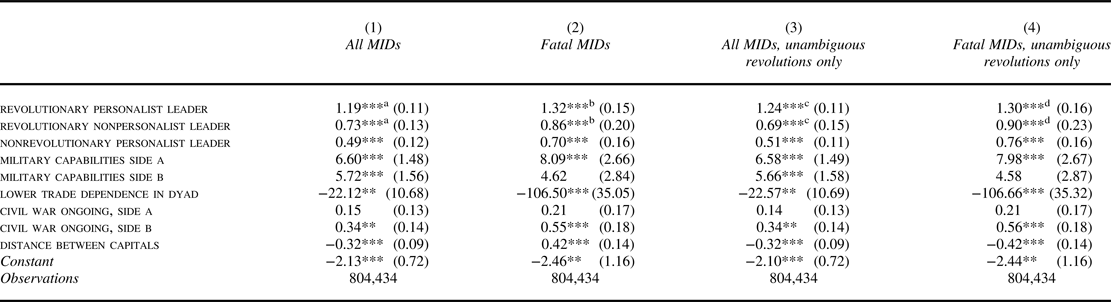
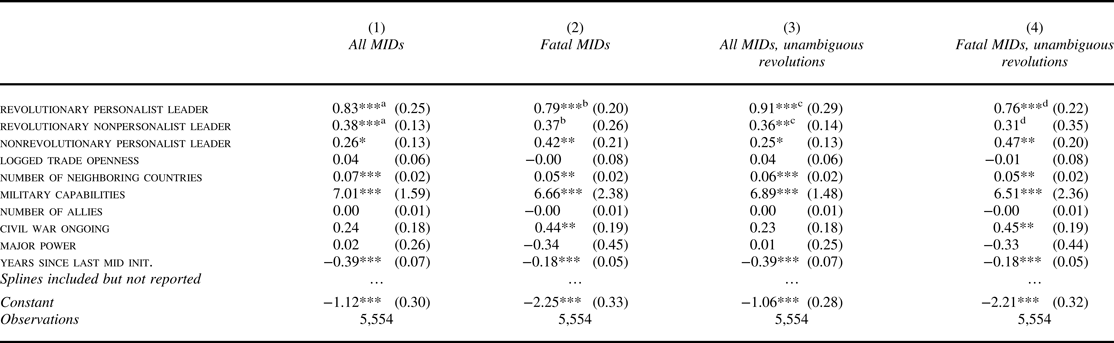
Table 3 shows the results of this analysis. Model 1, which analyzes all MID initiations, indicates that revolutionary leaders have about 1.6 greater odds of MID initiation when they lead a personalist regime than when they lead a more institutionalized, nonpersonalistic, and hence more constraining political system. A Wald test indicates that this difference is significant at p < 0.001. Similarly, revolutionary leaders of personalist regimes have 1.6 times greater odds of fatal MID initiation as revolutionary leaders of nonpersonalist systems, a difference significant at p < 0.025. Columns (3) and (4) show that, as before, the results are similar using the more restrictive “unambiguous” definition of revolutionary leaders.
Revolutionary leaders, personalist regimes, and MID initiation (dyadic)

Notes: Models are estimated using a logit model with standard errors clustered by directed-dyad, and include additional control variables: cubic splines to control for temporal interdependence; whether or not the two states are geographically contiguous; the major power status of each state in the dyad; the initiator's share of military capabilities; the two states’ similarity of alliance portfolio; and each state's similarity of alliance portfolio with the system leader. All regime predictor variables are lagged by one year. Unit of analysis is the directed dyad-year. Robust standard errors in parentheses. ***p < .01; **p < .05; *p < .1.
aWald test: different at p < .0010.
bWald test: different at p < .0247.
cWald test: different at p < .0005.
dWald test: different at p < .0900.
Table 4 shows a similar analysis using the monadic set-up, with similar results. Revolutionary leaders initiate about 1.6 times as many MIDs when they lead a personalist regime than when they lead a nonpersonalist regime, a difference that is significant at p < 0.065. Similarly, revolutionary leaders of personalist regimes initiate 1.5 times more fatal MIDs than revolutionary leaders of nonpersonalist systems, a difference significant at p < 0.083. As before, the results are similar using the more restrictive “unambiguous” definition of revolutionary leaders.
Revolutionary leaders, personalist regimes, and MID initiation (monadic)

Notes: Models are estimated using a negative binomial model with standard errors clustered by country, and include cubic splines to control for temporal interdependence. All regime predictor variables are lagged by one year. Unit of analysis is the country-year. Robust standard errors in parentheses. ***p < .01; **p < .05; *p < .1.
aWald test: different at p < .065.
bWald test: different at p < .083.
cWald test: different at p < .046.
dWald test: different at p < .190.
Next, we focus on the second mechanism: that personalist regimes increase MID initiation in the postrevolutionary period by allowing revolutionary leaders, who are particularly likely to have revisionist preferences, to remain in office (H3). Therefore personalism allows revolutionary leaders to occupy office for a greater proportion of the postrevolutionary period (of ten years, for example) when the regime is personalist than when it is not, accumulating a greater number of conflict initiations.
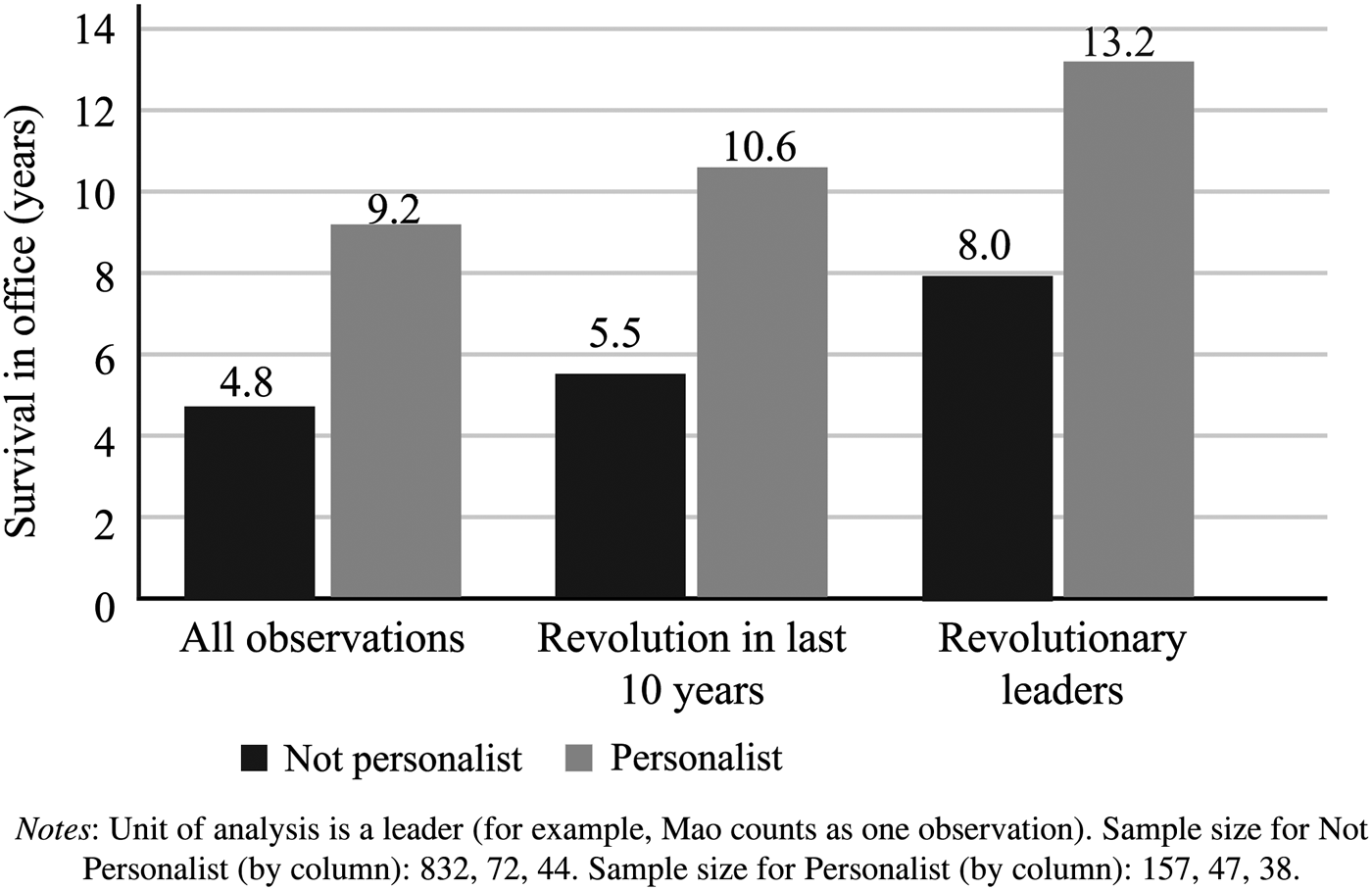
The evidence is consistent with this contention. First, recall that the analyses shown in Tables 3 and 4 demonstrated that revolutionary leaders are indeed more likely to initiate MIDs on an annual basis. Separate tests confirm that this finding also applies specifically within the ten-year postrevolutionary period. Second, Figure 2 indicates that revolutionary leaders occupy office longer into the postrevolutionary period when their regime is personalist than when it is not. The unit of analysis is the leader, so, for example, Mao counts as one observation. Overall, whether or not they led a revolution, personalist leaders survive almost twice as long (9.2 years) as nonpersonalist leaders (4.8 years), a difference that is statistically significant according to a standard t-test.Footnote 61 Leaders who first come to power in the ten-year period during or after a revolution survive in office for 10.6 years when the regime is personalist, compared with 5.5 years when the regime is not personalist. Conditional on having led a revolution, leaders survive for 13.2 years when the regime is personalist and 8.0 years when the regime is not.Footnote 62
Personalist regimes ensconce revolutionary leaders

To be clear, we do not argue that revolutionary personalists instigate conflict at an increasing annual rate the longer the leader has been in office. Instead, when revolutionary leaders are in office for a larger proportion of the postrevolutionary period, they instigate more conflicts in the aggregate, based on a fairly steady (but high) annual rate. We substantiate this empirically in the appendix. The result is a greater aggregate number of MIDs in the postrevolutionary period.
Why Postrevolutionary Regime Type Matters
Having examined why states are more belligerent in the aftermath of revolution, we finally show that our focus on personalist regimes is particularly important because postrevolutionary governments are in fact disproportionately likely to take the form of personalist dictatorships. Revolutions encourage the emergence of a personalist dictatorship for two reasons.
First, there is a selection effect: revolutions are unlikely to succeed unless they are led by a charismatic, forceful, risk-tolerant, politically savvy, and ambitious leader, and these are precisely the types of individuals most likely to create personalist dictatorships. Compared with nonrevolutionary leaders, revolutionary leaders are therefore particularly likely to have the desire and political skill to create a personalist regime in which they reign supreme.
Second, because revolutionary movements by their very nature overturn the political institutions of the previous government, revolutionary leaders are especially likely to be able to consolidate a personalist dictatorship. Such leaders face few, if any, limits on their formal legal powers in the immediate aftermath of the revolution, and therefore often have the opportunity to structure the regime as they wish.Footnote 63 The sorts of norms and rules that allowed, for example, the post-Stalin and post-Mao Communist Parties to constrain their leaders have simply not yet developed. Thus, the absence of preexisting institutions that might otherwise allow elites to coordinate or share political power makes it unusually likely that leaders of postrevolutionary governments will successfully establish personalist dictatorships, when compared with other political settings.Footnote 64
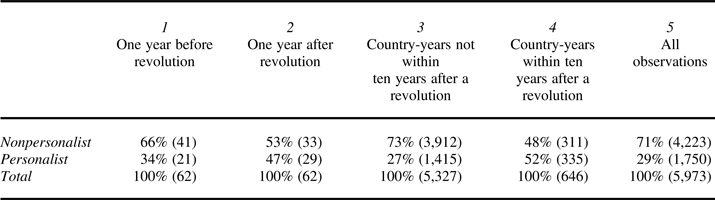
Table 5 shows a variety of ways to assess how revolutions affect the likelihood of personalist dictatorship. First, columns (1) and (2) indicate that among the sixty-two revolutions for which we have pre- and postrevolution regime type data,Footnote 65 states are 1.4 times as likely to be personalist in the year immediately following the revolution (47 percent) as in the year immediately preceding the revolution (34 percent). Stated differently, twenty-nine of the sixty-two cases either installed a personalist regime, or allowed a new personalist regime to take the place of an old one. Although simple, this test is highly informative, because it compares each country with its prerevolutionary self, and therefore controls for most other aspects of a country that could explain a relationship between revolution and personalism.Footnote 66 Despite the small sample size, the difference in the incidence of personalism before and after a revolution is significant at the .07 level. Moreover, this analysis probably undercounts the effect of revolution on personalism because it omits nine cases of revolution in which we do not have prerevolution regime type data (and three cases of revolution for which we do not have postrevolution regime type data). In the nine cases in which we lack prerevolutionary regime type data but have postrevolution regime type data, 56 percent consolidated into personalist regimes. Columns (3) to (5) also indicate that when looking at all of the state-year observations, personalist regimes are nearly twice as likely to exist in the ten-year wake of a revolution (52 percent of observations) than at other times (27 percent of observations).
The relationship between revolution and personalist regimes

Notes: Numbers following the percentages give the number of observations. Unit of analysis is a state-year. Columns (3) and (4) use all observations in the data set, whether or not they ever had a revolutionary government.
Overall Result: Personalist Dictatorships Account for Most Postrevolutionary Conflict Initiations
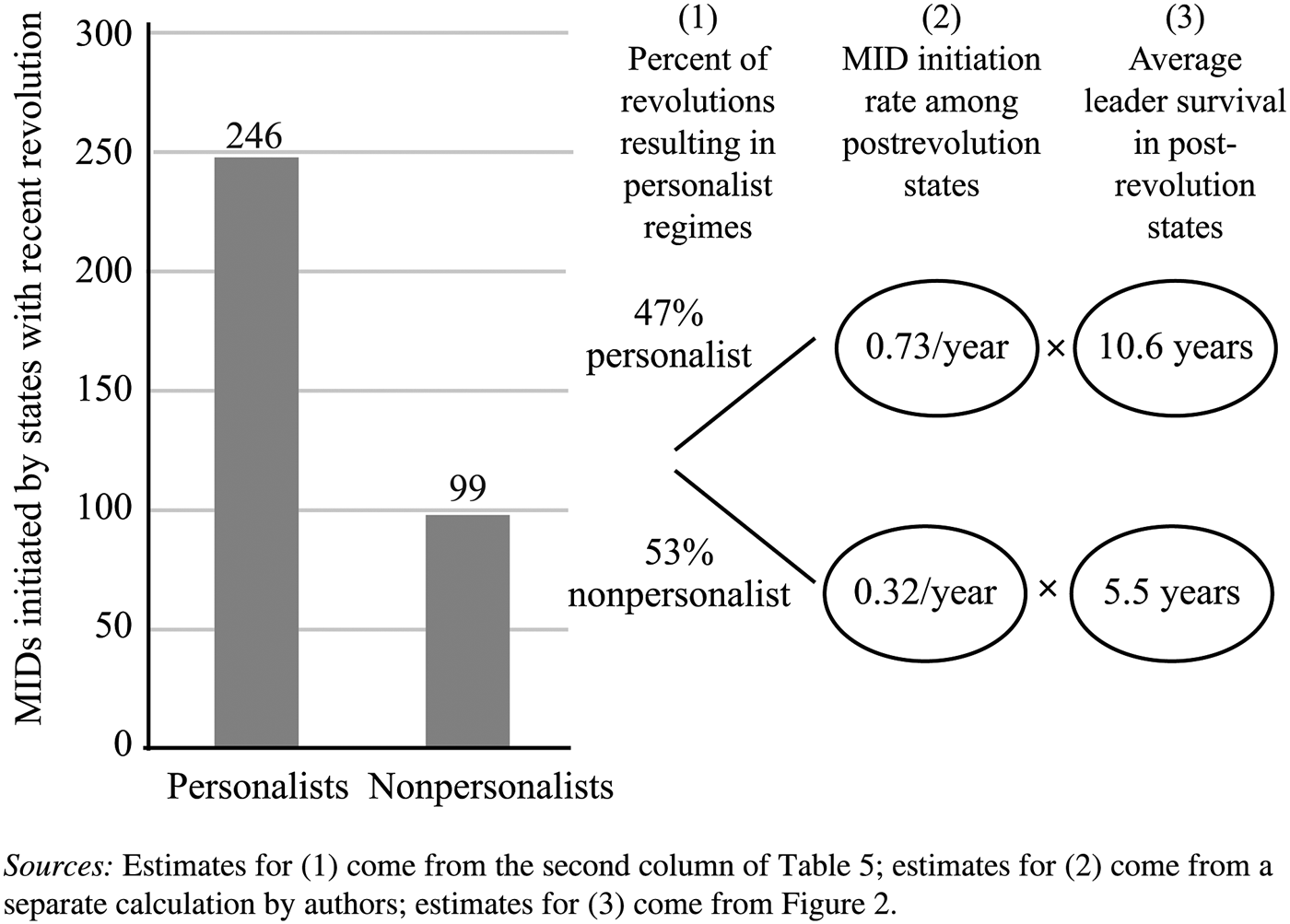
Figure 3 shows that fully 71 percent of the MIDs instigated by states in the ten-year period following a domestic revolution are initiated by personalist regimes. This overall finding is driven by three factors highlighted in this article. First, revolutions generate personalist regimes at a much higher rate than average: at least 47 percent of revolutions have culminated in a personalist regime. Second, revolutionary leaders tend to have higher average rates of MID initiation when the regime is personalist than when it is not (H2). Third, in personalist regimes, revolutionary leaders manage to survive in office for much longer than in nonpersonalist regimes (H3). Together, these three factors account for the high number of international conflicts instigated by postrevolutionary personalist regimes.
The relationship between revolution, personalism, and conflict

Robustness
In Tables 1 to 4, we checked that the results were robust to alternative codings of revolution (all revolutions, and only those that are coded as unambiguous) and different dependent variables (all MIDs, and only those involving at least one fatality). We also carried out the analyses using both dyadic and monadic specifications. In addition, we carried out an extensive set of further robustness tests. Replication data and instructions, including all of the robustness checks, are available online.Footnote 67
First, we verified that our use of the hybrid Weeks/GWF measure did not affect our core results by running the same analyses using the unchanged Weeks (Reference Weeks2012) data rather than our hybrid measure. For Models 1 and 2 (Table 1), the coefficients change slightly because about 17 percent of the observations are dropped because of missing data, but the relative differences between postrevolutionary regimes that are personalist and those that are not remain large and statistically significant (p < .0056 and p < .0177, respectively). In Models 3 and 4, which focus on “unambiguous” revolutions only, the differences remain substantively large and significant at the p < 0.0097 and p < 0.0935 levels.Footnote 68
Second, we implemented a series of additional tests, including:
• Dropping some control variables (for example, the Gleditsch trade measure) and adding others (for example, Polity scores).
• Dropping important countries such as China or the Soviet Union from the analysis to ensure that influential countries were not driving the results.
• Dropping the Tanker Wars from the analysis to ensure that the results were not driven by the large number of attacks on international shipping carried out by Iran and Iraq during the 1980s.
• Dropping all observations associated with the founding leaders of new states, which might be incorrectly classified as nonrevolutionary.Footnote 69
• Using different thresholds for considering a regime to be personalist.
• Controlling for low-intensity civil wars.Footnote 70
• Controlling for the trade dependence of Side A, rather than the lower trade dependence in the dyad.
• Controlling for previous experience with democracy.
• Adding a dummy variable for the Cold War.
None of these changes altered our central findings.Footnote 71
Finally, we consider whether the results hold when we restrict the analysis to only high-fatality MIDs (in which at least twenty-five deaths occur). We again find the same pattern, though the rarity of these events limits the degree of statistical confidence in some models.Footnote 72
Evaluating the Possibility of Endogeneity
A skeptical reader might ask whether there is an endogenous relationship between our dependent variable, international conflict, and our primary independent variables, revolutions and personalist dictatorship. Earlier, we described our measures of revolution and personalist regime and established that there is no endogeneity introduced by the coding of these variables. Here, we discuss other possible forms of endogeneity. First, we attempted to mitigate one possible concern—that war causes revolutionFootnote 73—by lagging all of the predictor variables. A second kind of endogeneity is more difficult to remedy: personalism might emerge in the aftermath of a revolution because international war is anticipated in the future.Footnote 74 This would be compatible with our empirical results: international conflict follows revolution and personalism temporally. For instance, a population located in a geographic region that is prone to international conflicts might be fearful of being attacked, and thus choose to put a personalist leader in power who could fend off attacks, or even act aggressively to pursue the population's interests.
We took three major steps to address this possibility. First, we controlled for geographic region by inserting regional dummy variables in a reanalysis of Table 1; the results did not materially change. Second, we investigated the possibility of reverse causation because of preexisting rivalries. The logic here is that if the old regime has many international enemies, then perhaps personalist regimes are more likely to emerge out of revolution in anticipation of future conflict. We tested for this possibility using data from Bennett to identify interstate rivalries, and we found no evidence that preexisting rivalries make it more likely that a personalist regime emerges out of a revolution.Footnote 75 Third, diversion and opportunism would be most likely in the immediate aftermath of the revolution (for example, years 1 to 3). We would then expect the correlations observed in Table 1 to depend heavily on those early years after the revolution. If, on the other hand, the nature of personalist rule (few constraints, etc.) is most causally important, then the higher likelihood of MIDs would persist long after the initial aftermath of the revolution. We tested this possibility by simply dropping all observations that occur in the first three years after the revolution, and the results do not materially change.Footnote 76
Overall, these analyses suggest that endogeneity is not a major concern. Instead, it is useful to view a revolution as a starting point: having observed a revolutionary government come to power, scholars and policy-makers could reasonably want to know about its future conflict propensity. At a minimum, our results demonstrate that revolutions are most dangerous for peace when they culminate in regimes with extremely low constraints on leaders—personalist dictatorships.
Discussion and Conclusion
Scholars have long recognized that in the wake of domestic revolution, states are much more likely to become involved in international conflict. But although a growing body of research has found support for this general empirical relationship, there is much less understanding of the great variation in the aggressiveness of postrevolutionary regimes and the mechanisms driving it.
This study provides part of an explanation. In contrast to previous work on revolutions and conflict that focused on international systemic factors, we argue that the leaders and domestic regime structures of revolutionary governments play a key role in explaining their strong propensity to initiate conflict. Postrevolutionary states are more belligerent when they result in personalist regimes than when they result in other kinds of domestic political systems. This is both because personalist regimes feature fewer constraints on leaders and because personalist regimes tend to allow belligerent revolutionary leaders to survive in office for a greater proportion of the postrevolutionary period. Our findings are especially important because revolutionary movements have a strong tendency to result in personalist dictatorships. Indeed, whereas only 27 percent of country-years (1946 to 2000) were under personalist rule when a country had not had a recent revolution, almost half of postrevolutionary country-years were personalist dictatorships. Revolution appears to be a breeding ground for personalist rule.
This link between revolution and personalist dictatorship is an important part of the reason that revolutionary regimes are so belligerent. Although both personalism and revolution independently increase the likelihood that a state initiates international conflict, revolutions that install a personalist dictator appear to generate significantly more international conflict than those that do not. The empirical results are stronger in the dyadic analyses than the monadic ones, but overall the evidence points to a significant difference between personalist and non-personalist regimes following a revolution. In sum, scholars who wish to understand why some countries are more conflict-prone than others must not overlook the importance of domestic political revolutions and the leaders and institutions that they produce.
Our analysis has a number of implications for future research. Most generally, our findings cast further doubt on the wisdom of treating states as black boxes and ignoring domestic political factors.Footnote 77 A large literature has found that domestic political institutions affect leaders’ policy choices, and more recently, scholars have (re)turned to the importance of individual leaders.Footnote 78 We extend these insights by arguing that revolutions tend to usher specific types of leaders into office, and often result in political institutions that place few constraints on those leaders. Future research might study how institutions and political events empower certain kinds of leaders, which may matter for a variety of policy questions.
This study's findings therefore have considerable implications for questions beyond the initiation of international conflict. First, revolutions and regime type may be important for other security-related issues such as the likelihood of economic sanctions and the transnational nature of the civil wars that often follow revolutions (for example, Iran in the early 1980s).Footnote 79 Second, our conclusions are relevant to the study of a range of political economy variables, from exchange rate regimes to military expenditures, which can be shaped by revolutions or authoritarian regime type.Footnote 80 Understanding that revolutions select for certain kinds of leaders, and that revolutions appear to frequently result in personalist regimes, may therefore shed light on causal mechanisms in international political economy. Third, revolutions often produce a period of contested domestic legitimacy and human rights abuses even as constitutions, courts, and other institutions are redesigned; we demonstrate that the regime established in that period sets a pattern for interactions with outsiders, which may stymie the efforts of international organizations.Footnote 81
Of course, all of these issues raise the question of why some revolutions lead to personalist dictatorships whereas others lead to less centralized forms of government. Researchers would do well to explore whether structural or historical factors make the emergence of personalist regimes more likely, and what strategies emerging dictators use to centralize their rule. Understanding the determinants of the postrevolutionary form of government may generate significant policy insights, especially for policymakers seeking to intervene in an ongoing revolution and alter its course toward a preferred outcome.
Supplementary Material
Replication data and an online appendix are available at http://dx.doi.org/10.1017/S0020818314000307.