Introduction
The Oriental fruit moth (OFM), Grapholitha molesta (Busck), is a cosmopolitan insect that causes extensive damage to stone and pome fruit crops worldwide. In 1913, the OFM was first reported in the eastern United States attacking stone fruits, and by 1942 had already reached the West coast peach and nectarine production regionsReference Rice, Kirsch, Ridgway, Silverstein and Inscoe1. In the Midwestern United States, OFM was detected in peaches in the mid-1920s, and in recent years, it also has become an important pest problem in applesReference Howitt2,Reference Hull and Krawcyzk3. In Michigan, the OFM, together with the codling moth (CM), Cydia pomonella L., redbanded leafroller (RBLR), Argyrotaenia velutinana (Walker) and obliquebanded leafroller (OBLR), Choristoneura rosaceana (Harris), comprise the main lepidopteran pest complex of peach, pear and apple.
The primary tactics for control of this apple pest complex over the past 40 years have been organophosphorous (OP) and carbamate insecticides. These broad-spectrum insecticides remain crucial to pest control in Michigan apple orchards. Therefore, growers may face a crisis if OP and carbamate insecticides are lost due to the emerging regulatory constraints imposed by the Food Quality Protection Act (FQPA) of 1996 (Public Law No. 104–170) and Pesticide Reregistration Implementation Act of 2003 (FIFRA 7 U.S.C. 136 et seq.). This situation has been further exacerbated by the increased resistance of key pests such as CM, OBLR, spotted tentiform leafminer, Phyllonorycter blancardella (F.), white apple leafhopper, Typhlocyba pomaria (McAtee), and rosy apple aphid, Dysaphis plantaginea (Passerini), to several common OP insecticidesReference Reissig, Stanley and Hebding4–Reference Waldstein and Reissig8. In the absence of OP compounds, synthetic pyrethroids (SP) are the most likely class of insecticides that apple growers will apply to manage insect pests. However, a growing reliance on these broadly toxic and highly disruptive compounds may present yet another threat: secondary pest outbreaks similar to the end of the chlorinated hydrocarbon era and the introduction of SP into tree fruit productionReference Croft and Hoyt9–Reference Whalon and Croft11. New OP insecticide replacements commonly known as reduced-risk insecticides, including imidacloprid, thiamethoxam and indoxacarb, have recently been registered that may provide alternatives to broad-spectrum materials. Although the reduced-risk features of selectivity and minimal contact toxicity inherent to these compounds make them environmentally desirable, the selective nature of these compounds will likely mean that multiple sprays are required to suppress the apple pest complex below economic injury levelsReference Wise and Gut12,Reference Wise and Gut13. In addition, it poses a severe challenge to apple growers facing a complex of pests and a low tolerance for damage. A novel approach to meeting this challenge would be to employ new and innovative strategies that combine the manipulation of the apple agro-ecosystem with the use of new insecticides.
The planting of hedgerows along the perimeter of orchards is a cultural modification that has proved useful in horticultural production. The action of the hedgerow is to slow wind speed and modify the environmental conditions behind the tree barrier. Their main use has been as windbreakers in areas where winds reduce pollination or cause damage to fruit and tree structuresReference Chandler and Chandler14,Reference Childers and Childers15. In Europe, the value of vegetative buffers for reducing drift potential onto sensitive terrestrial and aquatic areas has been recognized. According to HewittReference Hewitt16, the use of windbreakers in the Netherlands's orchards resulted in a reduction in spray drift of 68 to more than 90%. However, living hedgerows have not been well researched for their potential as a pest management strategy by serving as an impediment to immigration or emigration of insects. In addition, the impact of the barrier may be enhanced by treating it with repellents or low rates of insecticides (pyrethroid) to repel or irritate pest species that frequently invade orchards from outside sources, i.e., CM, leafrollers and apple maggotReference Maxwell17–Reference Welsh and Grove20. Previous studies on the movement of key insect pests into and out of Michigan fruit orchards demonstrated that plum curculio, Conotrachelus nenuphar (Herbst), apple maggot, Rhagoletis pomonella (Walsh), and several leafrollers orient their flight below 3 mReference Whalon and Croft18,Reference Whalon and Croft21–Reference Bush and Whalon26. Other species like tarnished plantbug, Lygus lineollaris L., pentatomids, leafhoppers, particularly the X-disease vectors Paraphlepsius irroratus (Say) and Scaphytopius acutus (Say), and rose chafer, Macrodactylus subspinosus (Fab.), prefer to fly just above the ground cover in the air boundary layer. Deployment of barriers in experimental peach plots in Michigan revealed that physical net barriers effectively reduced the immigration of aphids and reduced the number of lepidopteran pests (primarily leafrollers) captured in pheromone trapsReference Bush and Whalon25,Reference Bush and Whalon26.
In light of the recent emergence of OFM as a major pest in apple, we initiated studies on the ecology and management of this pest in apple. The primary objective was to compare the population dynamics and management of OFM using broad-spectrum insecticides (‘Conventional IPM’ program) versus an ‘Enhanced IPM’ program which relies on hedgerow barriers, selective control tactics which included pheromone mating disruption, reduced-risk insecticides and low rates of pyrethroids applied to the hedgerow barrier. The secondary objective was to determine the impact of hedgerow barriers on the vertical distribution of OFM in an effort to separate the insecticide effects from the non-lethal effects of hedgerow barriers on G. molesta control.
Materials and Methods
OFM population dynamics under two pest management regimes
Experimental plots
The study was conducted from 1996 to 2000 at the Michigan State University Clarksville Horticultural Experiment Station (CHES) at Clarksville, MI (latitude: 42.8733 North; longitude: −85.2604 West; elevation: 273 m). This experiment station is located in the west central region of Michigan, at the heart of Michigan's apple growing region. The experimental plots consisted of eight 0.21 ha apple orchards that were established in 1994 to conduct research on novel pest controls in apple. One hundred and four trees of each of three cultivars, ‘Ida red’/’Mark’, ‘Empire’/’M 9 EMLA’ and ‘Liberty’/’Mark’ (cultivar/rootstock), per plot were planted on a 1.5 m within row by 4.5 m spacing. There were four rows per variety, 26 trees in length, running in a north–south direction, and trained to a slender spindle system with a target height of 3.0 m. Each tree was supported by a 2.5 m metal tube and high tensile wire stretched across the row at a 2.2 m height.
The eight small orchards were established as four pairs of plots distributed on the experiment station property such that a distance of at least 100 m separated all pairs. A hedgerow barrier was established surrounding the perimeter of one orchard of each pair. The hedgerow consisted of three rows of hybrid poplar, Populus deltoides Bartr. ×Populus nigra L. (adjacent to apples), one row of Italian alder, Alnus cordata L. (nectar reward), and one row of white pine, Pinus strobus L., surrounding the perimeter of the apple orchard. Alleyways with the hedgerow orchards were planted with the grass mix, ‘Crusader’ (Seed Research of Oregon, Corvallis, OR), that included rye grass with the endophitic fungus Acremonium lolii (Latch, Christensen and Samuels). The purpose of this grass mix was to prevent the establishment of Lygus bug, L. lineollaris (Palisot de Beauvois), a major pest of apples in this region. Alleyways within the non-hedgerow orchards were planted with an orchard grass, Kentucky blue grass and fescue mix. This grass cover is common in Michigan's apple orchards. Apple trees and hedgerows were irrigated with a trickle irrigation system. Trees were irrigated during each growing season with scheduling based on satisfying 100% of a ‘Class A Evaporative Pan’. Over the 5-year course of the study, apple trees reached a height of ca. 3 m and barriers reached a height of 4–5 m.
Management programs
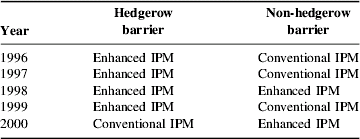
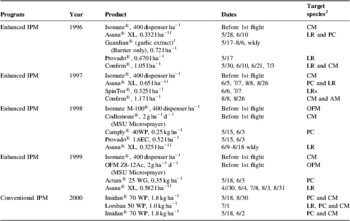
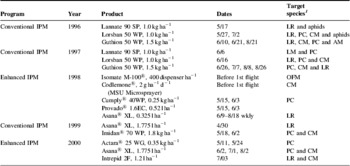
Two IPM programs were employed for managing OFM, one program based on selective insecticides and mating disruption, and the other based on broad-spectrum insecticides (Tables 1–3). Selective insecticides applied for OFM control included Confirm® (tebufenozide), Intrepid® (methoxyfenozide), Actara® (thiamethoxam), or Avaunt® (indoxacarb). Broad-spectrum insecticides applied for OFM control included Guthion® (azinphosmethyl), Imidan® (phosmet) or Lannate® (methomyl).
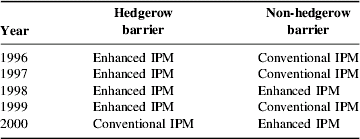
Treatment arrangement on hedgerow and non-hedgerow apple orchards.
Pest management program applied to experimental apple orchards surrounded by hedgerow barriers to control the apple pest complex. Clarksville, MI (1996–1999).

1 Barrier only.
2 CM=codling moth; PC=plum curculio; LR=leafrollers; AM=apple maggot; OFM=Oriental fruit moth.
Pest management conducted in experimental apple orchards without hedgerow barriers. Clarksville, MI (1996–1999).

1 LR=leafrollers; PC=plum curculio; CM=codling moth; AM=apple maggot; OFM=Oriental fruit moth; LM=leafminers.
In 1996, 1997 and 1999, non-OP selective insecticide treatments and mating disruption were applied in the hedgerow barrier plots. This combination of hedgerows and products will be called hereafter ‘Enhanced IPM’ program. The traditional OP insecticide treatments were applied in the non-hedgerow plots hereafter called ‘Conventional IPM’ program (Table 1). The hedgerow barriers were hand-gun treated with Asana® XL (esfenvalerate) at a very low rate of 0.332 liter ha−1 every 28 days, with the intent of repelling immigrating OFM and other pests (Tables 1 and 2). The repellent was delivered in 30 l of water per plot at an oblique angle to the outside row of the barrier planting to preclude penetration into the apple orchard. To test the barrier effects and allow for statistical contrasts, the treatments applied to barrier and non-barrier plots were adjusted in 1998 and 2000. In 1998, the ‘Enhanced IPM’ program was applied to both hedgerow and non-hedgerow barrier plots, with the objective of separating barrier effects from those of the reduced-risk insecticides. In 2000, to assure that hedgerow effects were not due to insecticide treatments, the ‘Enhanced IPM’ program was applied to non-hedgerow plots and the ‘Conventional IPM’ program to hedgerow plots. This is in contrast to the 1996, 1997 and 1999 arrangement of treatments.
Arthropod monitoring
Male flight of OFM was monitored weekly from early May to September using pheromone-baited traps. A single delta trap baited with a standard pheromone lure (Scenturion, Inc., Clinton, WA) was placed in the center of each plot. Traps were placed 1.8 m above the ground in the middle portion of the apple tree canopy. Lures were replaced monthly and sticky inserts were changed once per generation.
Experimental design and analysis
As already indicated, the experiment was a paired plot design. Thus, the impact of the treatments, hedgerow and non-hedgerow barrier, and the associated selective or broad-spectrum control tactics, on the OFM adult population was analyzed using a paired t-test. Prior to data analysis, weekly moth captures were transformed to (X+1)1/2 to normalize the distribution and analyzed using Stat View (Abacus Concepts, Inc., Berkeley, CA).
Vertical movement of OFM
To assess the effect of height on OFM flight behavior, the vertical positioning of the OFM overwintering, second and third generations was measured by placing Delta traps baited with standard red septa lures (Scenturion Inc., Clinton, WA) at three different heights—0.95, 1.95 and 3.20 m—in 2000. This supplemental experiment was conducted in an orchard not treated with insecticides at the Michigan State University Trevor Nichols Research Complex, Fennville, MI (latitude: 42.5951 North; longitude: −86.1561 West; elevation: 214 m). The plot was an 18-year-old Red Delicious orchard (0.550 ha) with trees planted at a distance of 7.0 by 7.0 m in a north–south direction and tree height averaging 6.0 m. The orchard comprised 12 rows of 10 trees each. We selected four rows, two in the center of the orchard and two additional rows proximate to the eastern and western borders of the orchard. The rows served as blocks (n=4 blocks), 21.0 m apart from each other. Each row was divided into three plots, three trees each. A trap-height treatment was assigned randomly to experimental unit trees and subsequently treatments were rotated clockwise after each inspection. A distance of 8–10 m separated the treatment trees or experimental units within each plot. OFM monitoring began in early May and ended in late August. Traps were inspected, and moths were counted and removed, every other day. Lures and sticky trap inserts were replaced at the start of each OFM flight (three changes).
OFM fruit damage evaluation
Since pheromone traps provide information only on the distribution of male moths, a different measure was needed to assess female distribution. This was accomplished by inspecting fruit high and low in the tree canopy to determine the distribution of OFM injury, which indirectly measured the distribution of female oviposition sites. The damage assessment was made on 17 June, 2000, a timing that corresponded to end of the emergence of the OFM overwintering generation and before the beginning of the natural physiological fruit thinning process know as ‘June drop’. At this time, OFM fruit damage is easily discernable from the damage caused by CM, C. pomonella L. During this period, OFM larvae were in the fifth instar or pupating, while CM larvae were in the second or third instar. The fruit evaluation was conducted at two elevations: low, 0.95–1.95 m and high, 3.20 m. Six samples of 50 fruits each were collected per block from six randomly selected individual trees; 25 from the top (high, ∼3.20 m) and 25 from the mid section of the tree canopy (low, 0.95–1.95 m).
Statistical analysis
The experiment was established as a randomized block design and moth vertical distribution analyzed as a two-way ANOVA with elevations (0.95, 1.95 and 3.20 m) and blocks (n=4) as the main factors. Fruit damage at the two different elevations was analyzed as a two-way ANOVA in which height (low and high) and blocks were the main factors. Moth captures and fruit damage are not normally distributed, therefore we tested data for independence of the variance from the observations’ mean by conducting a preliminary ANOVA analysis to evaluate the assumptions of ANOVA. Trapping data were transformed to log(X+1) or (X+1)1/2 becausethe variance was not independent of the mean moth catchReference Zar27. Also, percentages of fruit damage were transformed to angular values because proportions or percentages form a binomial rather than a normal distributionReference Zar27.
Results
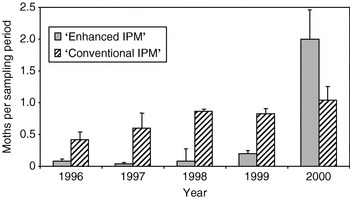
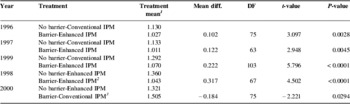
The ‘Enhanced IPM’ program exhibited a significant (P⩽0.05) reduction in adult OFM moth captures in comparison with the ‘Conventional IPM’ program (Table 4, 1996, 1997, and 1999). In 1998, the reduced-risk materials used in the ‘Enhanced IPM’ program were applied to both hedgerow and non-hedgerow plots to directly compare the hedgerow effect on moth captures. Under this protocol, again moth captures were significantly lower in the hedgerow than in the no hedgerow plots (Table 4 and Fig. 1). In 2000, the hedgerow plots were treated with the ‘Conventional IPM’ program, while the ‘Enhanced IPM’ was applied in the no hedgerow plots. Under this reversal of the treatment protocols followed in 1996, 1997 and 1999, moth captures were significantly higher (P<0.05) in the hedgerow than in the non-hedgerow plots (Table 4 and Fig. 1). This plot reversal yielded an unexpected result that suggested a synergism between the reduced-risk materials and the hedgerow barriers of the ‘Enhanced IPM’ program.
Comparison of the OFM mean moth population captured in pheromone traps placed in apple orchards with hedgerow and non-hedgerow barrier under an ‘Enhanced IPM’ or ‘Conventional IPM’ program (1996–2000).

Mean comparison of OFM adult moth captures in pheromone traps from hedgerow barrier orchards versus non-hedgerow treated under either an ‘Enhanced’ or ‘Conventional’ IPM program.

1 Mean OFM adult captures in pheromone traps transformed to SQR(X+1) for linearization.
2 Barrier and non-barrier orchard treated alike under the ‘Enhanced IPM’ program.
3 Barrier plots treated under the ‘Conventional IPM’ program; non-barrier orchard treated under the ‘Enhanced IPM’ program.
Vertical distribution of OFM in apple
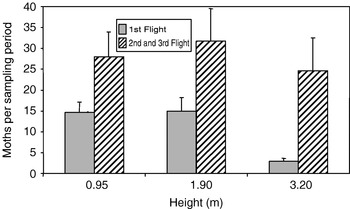
Moth captures in traps placed at mid, low or high in the canopy are summarized in Figure 2. During the flight of the overwintering generation, significantly more moths were captured in the two lower canopy positions than in the highest position of 3.2 m (F=45.99; df=2, 179; P⩽0.001). Mean catches of close to 15 moths per trap were recorded at 0.95 or 1.9 m, while fewer than three moths per trap were caught high in the canopy. In contrast, the numbers of individuals captured at all heights in the second and third generations were not significantly different (P>0.05; Fig. 2).
Vertical distribution of adult OFM monitored with pheromone traps at three different heights in a non-pesticide-treated apple orchard.

Fruit damage evaluation
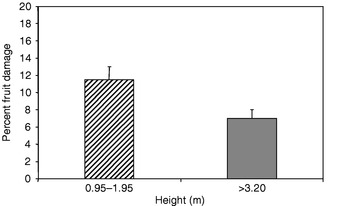
Since there was no difference between the two lower positions in moth capture rates, the proportion of fruit damaged was assessed at two heights (0.95–1.95 and >3.20 m) and reflected the average overwintering moth captures. At or above 3.20 m, the mean fruit damage percentage was 7.0±1.1 and below 1.95 m, it was 11.5±1.5% (mean±SE) (Fig. 3). The mean difference in fruit injury between the two canopy heights was significant (F=5.38; df=1, 40; P=0.02).
Fruit damage at two different heights caused by the offspring of the OFM overwintering generation in a non-pesticide-treated apple orchard.

Discussion
The OFM population densities at CHES research farm during the experimental period were low, 2.0±0.46 per sampling period (mean±SE). This was in contrast to the population density in the unsprayed plots at the Trevor Nichols Research Complex at Fennville, MI where densities were purposely allowed to reach high levels for experimental purposes, 27±6 per sampling period (mean±SE). Clarksville OFM moth captures resemble those typically found in Michigan's most intensive apple producing region which surrounds the metropolitan Grand Rapids area (MSU CAT Alerts 1996–2000).
Our research demonstrated that living hedgerows treated with a repellent substantially reduced the population density of OFM in replicated apple orchard trials. This confirms initial findingsReference Bush and Whalon25,Reference Bush and Whalon26 on the potential utility of tree barriers to manage key lepidopteran peach pests. The apparent reluctance of overwintering OFM adults to fly higher than 3.0 m (as demonstrated by the OFM vertical distribution study) may also have contributed to the success of the repellent hedgerow barrier strategy. We believe that most of the individuals trapped in these plots were likely immigrants colonizing the orchards. In the non-hedgerow orchards, immigrant OFM easily penetrated despite the organophosphate-based spray program. On the other hand, immigration into the hedgerow repellent plots required flight over a 3.0–6.0 m high repellent barrier or through a 6 m horizontal living hedge of dense foliage composed of five rows of three different non-host species.
Other Tortricid moths, including the CM and some leafrollers, have exhibited flight behavior above 3.0 m. It has been shown that CM explores the apple tree canopy from 1.0 to 4.0 m above the ground but concentrates its activity in the upper part of the tree canopy, between 3.0 and 3.5 m above the groundReference Ahmad and Al-Gharbawi28,Reference Howell, Schmidt, Horton, Khattak and White29. The OBLR also exhibits a similar behavior; more mating occurs between 3.0 and 4.0 m above the ground than at the lower part of the apple canopy under 1.0 mReference Lawson, Reissig, Agnello, Nyrop and Roelofs30,Reference Agnello, Reissig, Spangler, Charlton and Kain31.
In this study, OFM flight behavior was apparently different from that exhibited by the other Tortricid moths. Overwintering adults preferred the mid section of the tree canopy, and <10% of the moths were caught 3.20 m above the ground. The remainder of the moth captures occurred between 0.95 and 1.95 m in the mid-section of the canopy. These results seem to indicate that overwintering OFM adults are weak flyers. Rothschild and MinskReference Rothschild and Minsk32,Reference Rothschild and Minsk33 found similar OFM moth distribution in peaches, although their study showed that approx. 29% of moths were captured above 2.0 m versus 71% between 1.0 and 2.0 m. In addition, the flight of 2nd and 3rd OFM generations encompassed the whole apple tree canopy. Rothschild and Minsk'sReference Rothschild and Minsk32,Reference Rothschild and Minsk33 study suggests that OFM summer generations explore more of the habitat during the mate finding process. We speculate that this change in behavior relates to the physiological conditions of the overwintering individuals. The prolonged arrested development during diapause may reduce the flight capacity of the overwintering generation. Conversely, summer generation individuals encounter conditions of abundant food and suitable microclimate, thus accumulating greater fat reserves yielding better ovipositional fitness than those experiencing long periods of adverse environmental conditions. Data furnished by Phillips and ProctorReference Phillips and Proctor34 infer this conclusion as well. Phillips and ProctorReference Phillips and Proctor34 demonstrated that overwintering OFM female fecundity was much lower than that of subsequent summer generations (7.5% versus 14% respectively). In addition, overwintering generation egg to adult mortality apparently reduced the progeny to only 23% of those observed during either summer generations.
This hedgerow repellent system may have important implications for more sustainable, low insecticide orchard pest management. Early establishment of a pest population in the orchard is crucial for the success of the following generations. Therefore, we infer from our results that limiting the number of OFM immigrants reduced the size of the following generations, yielding lower overall seasonal densities. On the other hand, the unexpected results for the reversal of treatments observed in Table 4 support the contribution of the combination of the hedgerow and the reduced-risk materials in the ‘Enhanced IPM’ program for reducing OFM moth captures.
The observed vertical movement of the overwintering generation as measured by pheromone trap catches supports earlier observations by Hughes and DornReference Hughes and Dorn35 indicating that the OFM is a relatively weak flyer; most of the population exhibits short flights, 40–400 m long. However, our data indicated that this characterization might only be true for the overwintering generation because the succeeding generations explore the whole tree canopy. This is also an important finding for the deployment of OFM pheromone mating disruption dispensers because the difference in succeeding generation's utilization of the tree may influence dispenser and monitoring trap placement.
In eastern and Upper Midwestern United States orchard production regions, tree fruit producers face accelerated suburban and rural sprawl. Therefore, with the influx of non-agricultural neighbors, tree fruit producers must contend with an array of new local, county and state ordinances against standard operational practices that may produce noises or chemical trespass. The Clarksville Horticulture Experiment Station is in proximity to one of Michigan's fastest growing population centers, Grand Rapids. Not unlike other areas affected by suburban sprawl and human encroachment, producers in this region are searching for alternative production strategies that mitigate line-of-sight, noise, and chemical drift. In states like Michigan where orchards are grown in close proximity to water, additional issues arise from evolving promulgation of the Endangered Species Act of 1973 and Clean Water Act of 1977 (Public Law 93–205 and Public Law 95–217) leading to an additional need for pesticide drift and orchard operation buffers, barriers and filter-strips aimed at mitigating chemical trespass, noise reduction and impacts on water and endangered species. Hedgerow barriers may play an increasingly important role in addressing some of these concerns.
To date, several commercial producers have planted hedgerow barriers in Michigan's sprawl affected production regions. Certainly, this strategy will need to be examined and evaluated over a number of years and in high pest pressure settings, yet this study suggests that hedgerows may afford some pest management advantages along with sound mitigation and chemical drift interception reported elsewhereReference Hewitt16.
Acknowledgements
We express our sincere appreciation to Andrea B. Coombs, Deepa Ramsinghani and Peter McGee for their excellent technical assistance and support for data collection and processing. This project was funded by GREEEN (Generating Research and Extension to meet Economic and Environmental Needs) and Gerber Products Company.