[It] is not I who am on trial here today, but the Law of the New Hebrides.
In 1906, Britain and France jointly annexed the New Hebrides. A y-shaped archipelago in the southwest Pacific Ocean, the New Hebrides—which became Vanuatu upon independence in 1980—comprised some eighty islands characterized by high levels of linguistic and cultural diversity.Footnote 1 At the moment of annexation, there were also Presbyterian, Anglican, and Catholic missionaries and Euro-American planters and traders, who overlaid religious and national divisions onto the existing social and linguistics ones.Footnote 2 Anglo-French rule under the New Hebrides Condominium added a hybrid legal system to this complex mix. During the colonial period, four distinct jurisdictions existed, indicative of the divided, rival nature of governance. These included joint Condominium law, British common law, French civil law, and from 1928, a native code and courts.Footnote 3 The plurality and ambiguity of the legal system left ample space for critique and for alternative, extrajudicial justice, as this article explores.
“Extrajudicial” justice was evident in the spaces of European settlement, service delivery, and administration, such as hospitals, schools, plantations, and district agencies, despite the fact that these areas most closely aligned with, and operated under, Condominium law.Footnote 4 The divided colonial administration itself created a space for extrajudicial justice, given the limits of due process and appeal. During the opening decades of Condominium rule, the frequent closure of the Joint Court, the lack of a native criminal code, and the continued presence of the Joint Naval Commission (JNC) acting as a summary tribunal gave authorities the ability to apply administrative justice in an arbitrary manner. More generally, their practical jurisdiction was hampered by the small size and divided nature of the colonial administration, enabling individuals and groups to pursue justice outside the formal court system.Footnote 5 In this context, cases of extrajudicial justice that came under colonial scrutiny and approbation are of particular interest for what they reveal about both the limits of law in the New Hebrides and the factors that spurred the administration to intervene and repress certain incidents.
One such incident occurred in September 1915, when missionary Dr. David Crombie and his nursing staff brought the British hospital on Iririki, an island facing the Condominium capital of Port Vila, to a standstill. Crombie threatened the imminent and permanent closure of the establishment, a drastic action apparently necessitated by the failure of the bumbling colonial administration and courts to protect the female nursing staff from “drunk and dissolute natives” roaming the premises in the dark tropical twilight.Footnote 6 This threat followed on the heels of Crombie's own conviction in the British court for an act of vigilante justice against trespassers on the hospital grounds. His frustration was enhanced by the fact that Numbus, an indigenous intruder, had been captured and charged, but escaped conviction in March the previous year. These events in 1914 and 1915 were a lightning rod for local politics, and are useful for exploring broader tensions over the nature and efficacy of colonial rule in these islands.
Crombie's critique of Condominium rule and the resultant judicial debates over the unwanted presence of indigenous men at the hospital demonstrate how interimperial politics manifested locally. Given its divided Anglo-French administration, the New Hebrides Condominium illustrates par excellence the legally plural and dynamic nature of colonial rule across much of the imperial world, as emphasized in scholarship by Lauren Benton, Richard Ross, Lisa Ford, and others.Footnote 7 These fault lines are best highlighted by case studies that demonstrated how justice operated outside the statute books, and underline the discrepancies between law on paper and law in practice. As Martin Wiener has argued in his study of inter-racial murder cases across the British Empire, trials involving defendants and victims of different races (as well as gender or economic status) required concrete resolution—through judgment and sentencing—of the tension between the hierarchies of difference underpinning empire and the stated equality of all before the law.Footnote 8 Similarly, inter-racial sexual crimes (or fears of such crimes), given their highly emotive character and intersections between race and gender, produced one of the most significant disputes over the application of the law in colonial New Hebrides.Footnote 9
Crombie's case exposed the limitations of the Anglo-French and British legal regimes in the colony and their alternatives. The anxieties over the application of criminal justice in the New Hebrides thus extended out of the courtroom and encompassed discussions among settlers, Islanders, missionaries and officials. They incited local European frustration, as well as debate over the role of the legal system in a colony divided among imperial powers, religious denominations, and economic interests. This article suggests that there was a widely held perception of Europeans that the law and courts of the colony and of each administration in the Anglo-French Condominium existed to protect their interests and those of their compatriots, ahead of the interests of indigenous subjects or other European nationals, regardless of proper procedure and evidence. It also underscores the ongoing tension between official attempts to adhere to the principle of color-blind justice, and the popular belief that indigenous men who transgressed the boundaries of race and morality needed to be convicted and punished to reinforce the proper racial hierarchy in the New Hebrides.
The events of 1914–15 also illustrate how women's experiences, specifically the hospital nurses, were co-opted to underpin political agendas and wider imperial debates, particularly in the context of Anglo-French rivalry so central to the colonial experience in the New Hebrides. I highlight the ways in which racial and gendered rhetoric intersected with both justifications and contestations over the practice of colonial justice in the Pacific. This article considers what these events and the related trials reveal about the practice of justice in a divided colony, and how race and gender were entwined in local interimperial politics. To fully understand the explosive nature of the incidents discussed, one must contextualize Crombie and his hospital in the broader social and political situation of the New Hebrides in the early twentieth century.
The New Hebrides as an “Unprecedented Juristic Experiment”
By the last quarter of the nineteenth century, conflict over land claims and labor recruitment practices in the New Hebrides had escalated to the point that the existing Anglo-French position of mutual nonintervention became untenable. The oscillation between competition and co-operation that had characterized Anglo-French relations in the Pacific thus culminated in an attempt to overcome imperial rivalries with the joint colonization of the New Hebrides. The first, underwhelming solution—the JNC of 1887—provided for British and French naval intervention in the islands. Charged with “the duty of maintaining order, and of protecting the lives and property of British and French subjects,” the JNC empowered warships to patrol the waters, policing crimes against Europeans through a shipboard tribunal that acted as a summary court without due process, representation, or appeal and through violent, punitive expeditions: “rough justice indeed” for many ni-Vanuatu.Footnote 10 The Commission's operation was, however, shackled by practical limitations, mostly notably in its inability to adjudicate on land issues, the major source of conflict. The two navies were also expected to act in concert, but this proved difficult given the infrequency of their patrols. Consequently, the British and French felt forced to revise the underpowered JNC in the context of escalating violence between ni-VanuatuFootnote 11 and newcomers regarding land ownership and recruitment practices, and established the Anglo-French Condominium in a 1906 Convention.Footnote 12
The New Hebrides Condominium was governed by a joint administration, with the British and French governments each appointing a resident commissioner, accountable to the governor of the Western Pacific High Commission in Suva, Fiji and the governor of New Caledonia in Nouméa, respectively. Although the signing of the 1906 Convention represented a high-water mark in Anglo-French cooperation, the quotidian functioning of the Condominium was marred by almost intractable differences between British and French intentions and involvement in the New Hebrides. The Anglophone presence on the islands was dominated by Presbyterian and Anglican missionaries, who were alarmed by increasing numbers of French colons (settlers). They expressed concerned over the negative impact of land loss and wage labor on their island converts (or potential converts), as well as potential loss of influence if French interests developed unchecked. The latter was also a source of apprehension in the nearby Australian colonies (and after 1901, the newly federated Commonwealth of Australia), already wary of the French penal colony of New Caledonia on their doorstep.Footnote 13 Responding to these pressures, British officials focused on limiting French power in the region, to mitigate missionary fears and Australian anxieties; French officials focused on a swift and favorable resolution of land issues to enable increased economic development of the islands by their nationals.
The Condominium functioned more as two parallel administrations than as one, with essentially separate police forces, prisons, currencies, and courts. The Bislama (Vanuatu pidgin) term for the Condominium, tufala gavman, encapsulates the divided nature of New Hebrides colonialism: “the government of two fellows.” The Condominium quickly became unwieldy and unsatisfactory, and prompted calls for either a single imperial administration or partition of the islands. In response, the 1906 Convention was revised in London in 1914. The ratification of the resultant Protocol was delayed by the outbreak of World War I and not implemented until 1922. The 1914 Protocol made few substantial changes to the original agreement and remained largely in place until independence in 1980.Footnote 14
Throughout this period, the Joint Court or Tribunal Mixte was theoretically the apex of Anglo-French rule. Given that the joint annexation of the islands was driven by concerns over land disputes and conflicts over labor, the creation of a legal system to adjudicate on such issues was a key justification for further imperial intervention. However, the attempt to meld two legal traditions and judicial cultures in an “unprecedented juristic experiment” of the Condominium and the Joint Court proved difficult.Footnote 15 Gilchrist Alexander, a former British judge to the Joint Court, described it as “a small international body…in a setting and with a machinery unique and cumbrous…it was calculated to drive one to distraction.”Footnote 16 With neither power ready to concede jurisdiction over its own subjects, the 1906 agreement also resulted in separate British and French national courts, where individuals were tried according to their own law and procedure. These national courts were limited to civil and criminal cases between their own subjects.Footnote 17
Disputes between British and French, or European and ni-Vanuatu—at least with regard to land—were heard before the Joint Court. Although established primarily to resolve and confirm disputed land titles, the Joint Court also punished infractions regarding labor recruitment or the sale of alcohol or arms to ni-Vanuatu, and presided over most criminal and civil cases that crossed lines of nationality or race. In structure, like much of the Condominium, the bench of the Joint Court was unwieldy: it comprised a British judge, a French judge, a president and a public prosecutor appointed by the King of Spain (in a nod to the Spanish “discovery” of the archipelago), and a registrar, along with a Native Advocate to represent ni-Vanuatu rights. This “cour franco-brittanique-espagnole-hollandaise” looked far more impressive in appearance than in practice.Footnote 18
The court opened in 1910, after court buildings and official housing had been constructed in a manner fitting the prestige of each power, and was subject to frequent closures thereafter. As Alexander noted, “I suppose that the amour propre of each nation demanded that these costly buildings should be constructed”; however, funds for the actual operations of the court were scarce.Footnote 19 Plagued by problems of language and translation, procedure, delays, and closures, the court also held no power to execute sentences, leaving individual national administrations to enforce the verdicts and punishments meted out, much to the ire of the Joint Court judges.Footnote 20 The sentences imposed were limited to imprisonment of up to 1 month or fines of £20, and even these were often not enforced.Footnote 21 The theatrical and sometimes farcical functioning of the court and its impact made it the frequent subject of satire and critique as the “joy court.”Footnote 22
The result was three distinct courts in which the few hundred Europeans based in the islands could be tried or could bring civil cases, whereas the approximately 50,000 ni-Vanuatu were effectively stateless.Footnote 23 It seemed there were “three justices in the New Hebrides: one for the French, one for the British and one for the natives.”Footnote 24 The 1914 Protocol explicitly denied ni-Vanuatu nationality or citizenship of either imperial power, thus limiting their options for representation, legal recourse, and economic opportunities throughout the Condominium period.Footnote 25 During the opening decade of the twentieth century, there were no courts in which ni-Vanuatu could bring cases to deal with internal conflicts, no due process, and no right to appeal Joint Court judgments. Although provision for a Native code was included in the 1914 Protocol, no moves were made for its practical enactment until the establishment of Native Courts in 1927–28.Footnote 26 As missionary George W. Paton wrote in 1923, “it is a disgrace to any administration that the greater part of its inhabitants should not be subject to any criminal law and should be at the mercy of an arbitrary tribunal.”Footnote 27 The appointment of a Native Advocate nevertheless indicated a humanitarian bent to Anglo-French rule, although the first advocates were largely ineffectual.
Overall, the judicial arrangements satisfied few. The limited authority of the court meant that the judiciary found itself subject to harsh critiques, as well as undermined by settlers, missionaries, and Islanders who chose alternative strategies of justice outside the courtroom.Footnote 28 These limits were dramatically exposed by the complaints from Dr. Crombie and the British hospital in 1914 and 1915.
The most detailed commentary on the drama is provided by Edward Jacomb, an English-born, British- and French-trained lawyer based in the colony from 1907 to 1919. After a short and tense period as the assistant to the British resident commissioner, Jacomb founded his own legal practice to represent ni-Vanuatu land claims in the Joint Court, encouraged by local missionaries. Jacomb became a critic and vocal campaigner against Anglo-French governance of the New Hebrides, publishing various books on the subject and corresponding with missionaries and humanitarian societies to advocate for sole British rule.Footnote 29 Within the “judicial monstrosity” of the Joint Court, Jacomb felt that “in fighting for natives one has usually to be content with a portion of their rights.”Footnote 30 He further mused: “No wonder the natives are dying out. Recruiters care for nothing but their immediate profit, the French Administration cares for nothing but the immediate profit of its fellow countrymen, the British Administration cares for nothing at all.”Footnote 31 The inaction of the British administration in particular was a frustration Jacomb and Crombie held in common, as will be returned to subsequently.
Jacomb's outspoken views did not make him a popular figure in the Condominium; however, his publications and diaries provide a rich source on New Hebridean colonial politics. The incidents of nocturnal intrusion at the hospital feature in Jacomb's diaries and correspondence, as do the court cases that resulted, in which he advised Dr. Crombie. Various British and French official archives complement his reports. However, in tracing these incidents across empires, the perspectives of women and ni-Vanuatu—so central to the events discussed in further detail subsequently—are notably absent. Dr. Crombie claimed to speak for the nurses at the Iririki hospital, while Jacomb positioned himself as the defender of ni-Vanuatu, and it is almost exclusively through their accounts that the experiences of women and Islanders are recorded.
Policing and Punishing Intrusions at Iririki Hospital
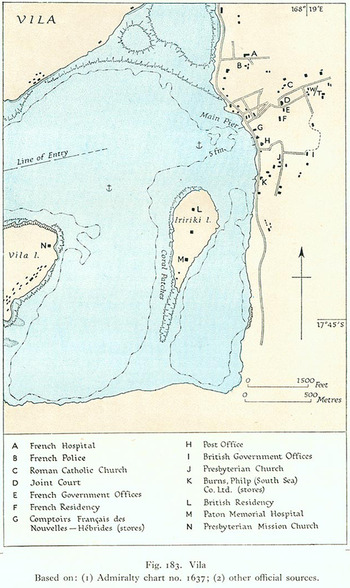
The Presbyterian mission-run John G. Paton Memorial Hospital, along with the British Residency, was located on Iririki Island in Port Vila harbour (Figure 1). Its location, although slightly removed from the township, did not offer protection from an increasing stream of unwanted native midnight visitors, much to the disquiet of its director, Dr. Crombie. The issue first came to a head in March 1914. A Tanna man and member of the British Resident's boat crew, Numbus, disembarked on Iririki in the depth of the night, and in his quest to meet one of the indigenous nurses, found himself instead in the quarters of the European nurses. Disturbed, Nurse Matson emerged from her cottage seeking to identify the source of the noise that had woken her. She called into the lurking shadows when the ni-Vanuatu man “suddenly sprang at her, seizing her by the arm and bent his head down to look closely in her face.”Footnote 32 Matson screamed and fled; Numbus was apprehended.
Map of Port Vila including Iririki Island, early 1940s.

In many ways, the incident appears a fairly minor one. Numbus did not physically harm Matson, nor did he demonstrate clear intention to do so, perhaps only seeking to identify her when she followed him in the dark. However, she was very shaken by the midnight meeting, and her fear instilled the hospital with a sense of insecurity and panic. A small wave of anxiety over “black peril” erupted around the British Residency: exaggerated, often unfounded fears of indigenous male sexuality that frequently resulted in intense policing of both non-European males and European women. Tropes of the degradation and mistreatment of women were deployed in explanations for racially differentiated forms of justice in the New Hebrides, and in the colonial world more widely.Footnote 33 This occurred in the New Hebrides despite the fact that “[the] natives are not in the habit of attacking white women here. They are merely after their own women, which though no doubt reprehensible is natural and not dangerous to us.”Footnote 34
The subsequent ineptness of colonial officials in reacting to the night's events caused even greater consternation and complaint among the hospital staff. The Natives’ Prohibition Regulation of 1909 gave officials sufficient power to prevent the much-feared nocturnal intrusions, but was never adequately enforced, in part because of the inadequate resources of the colonial government.Footnote 35 As a result, midnight arrivals on Iririki continued unchecked. Crombie was particularly aggrieved by the fact that the policing in Port Vila was insufficient to prevent the theft of a boat from the short shoreline along the township, enabling undesired visitors to reach Iririki unfettered. The short stretch of sea between the island and the mainland was supposed to act as a sort of moat for the British Residency, creating a sense of isolation from the growing colonial town.Footnote 36 As much an ideological as a practical defence, this barrier—an attempt to exclude the unsavory aspects of colonial society from the heart of British power in the New Hebrides—was easily breached. In this manner, the island was an appropriate metaphor for Britain's reluctant imperialism in the New Hebrides, as well as the permeability of the artificial boundaries and hierarchies underpinning the colonial project. By contrast, the French Residency in the township of Vila arguably reflected the French Empire's more welcome embrace of the New Hebrides into its colonial possessions.Footnote 37
Numbus's presence alone on the hospital grounds was not enough to bring criminal charges against him, and, therefore, there was confusion among judicial officials over how to best deliver the legal punishment that they felt he clearly deserved. A bureaucratic error resulted in eventual charges of breaking and entering with attempt to commit larceny being brought before the Joint Court, a count for which the prosecution had no evidence.Footnote 38 To the fury of many British officials and local European residents, Numbus was acquitted.Footnote 39 Had he instead been charged with intent to commit assault, Jacomb suggests that the outcome of the court case would have been different.Footnote 40 In the ensuing debate, contested visions of justice and punishment emerged among the colonizing community.
Much to the ire of those who felt that Numbus must be punished irrespective of how his crime was defined, in this case the law did appear to be largely color blind.Footnote 41 However, Jacomb suggested that this was not always the case, making a jibe at the French judiciary at the same time: “We have had a great deal too much down here of the French idea of accusing natives of one thing and convicting them of another.”Footnote 42 Unlike many officials, Jacomb held a clear perspective on moral duty in the fair and accurate application of justice. Although he believed that Numbus's actions fell on the wrong side of the law, and expressed disappointment in the incompetent functioning of the legal bureaucracy, his voice stands out as one of the few who advocated against the man's inappropriate conviction for attempted larceny. His stance against the potentially “rotten” results of inattention to proper procedure reflected his greater disillusionment with the management of the New Hebrides Condominium by Britain and France alike.
By contrast, Crombie led the crusade for conviction, arguing that an example needed to be made of Numbus to protect the virtue and peace of mind of both ni-Vanuatu and white women. Calling for new and stricter regulations controlling “native” movements in the Port Vila area, he subsequently gave this account of the case: “Every help was given by the staff of the Hospital to the prosecution, but this man was found not guilty, and walked out of the Court, a free man, without a word of blame or censure being said to him. It is said the prosecution was bungled, but whether this was so or not, the result was most unfortunate, as it left on the native mind the impression that they could trespass on private property during the night, and even enter private houses, and insult women, and that the law could not touch them.”Footnote 43
His statement demonstrates a concern for the status of Condominium and British law in the eyes of colonial subjects, highlighting the constant struggle to assert dominance in the face of unruly, untamed, and often uninterested “natives.” Individuals such as Crombie expressed far greater apprehension over the effectiveness of British rule in the New Hebrides than the colonial state itself demonstrated in its half-hearted process of colonization.
The British administration reacted in typical fashion to the furor: with complete inaction. The British resident Merton King neither passed new regulations (which he had limited power to do without French cooperation) nor increased police patrols, brushing off Crombie's indignant letters and growing frustration.Footnote 44 Meanwhile, according to Crombie at least, life at the hospital deteriorated for the nursing staff because of increased nocturnal visitations and an underlying sense of anxiety. To the staff, it appeared that “continued impunity ha[d] apparently bred greater daring.”Footnote 45 This uneasy status quo continued until the night of August 17, 1915, when tensions again erupted.
In the small hours of the morning, a small boat drew into the Iririki beach. Two “native” men, somewhat intoxicated, made their way around the hospital premises, trying and failing to open the front door to the nurses’ cottage before departing. As in the previous incident, the ni-Vanuatu men appeared to be desirous of visiting the indigenous nurses. There are discrepancies in the details, motivations, and emotions in retellings of subsequent events by the two ni-Vanuatu men Jack and Toby (via a French policeman), Jacomb, and Crombie, although the basic outline was similar.
At his wits’ end, Crombie took the law into his own hands, taking action in a manner that he felt the Condominium was unable or unwilling to do. He pursued the boat, still in sight within the harbor, intent on retributive justice. Although the drunken men attempted to strike at him with a knife, Crombie forcibly took them back ashore in order to punish them in “a fitting manner.”Footnote 46 He describes himself using the humane “method of suggestion” and causing no physical injury.Footnote 47 However, his punishment, recounted here by Jacomb, highlights the everyday violence of colonial rule: “Crombie then did a very foolish thing, or rather series of things. What he should have done was to give them both a jolly good licking and let them go. Instead he tied them up, got all the women employees to smack their faces with their hands, then gave them chloroform, marked both their forearms with a letter H (for Hospital), and ended up by shaving their heads!”Footnote 48
Although Jacomb took issue with Crombie's rather drastic and humiliating methods, the statement suggests that both thought a level of physical violence against the ni-Vanuatu men was acceptable and would likely have passed without note. There was, however, a longer history of the use of tattooing in missionary and colonial punishment that perhaps influenced Crombie's actions.Footnote 49 Using corporal discipline clearly lay within the bounds of colonial law; it was the other more humiliating aspects of Crombie's devised punishment that overstepped the boundaries of moral and legal permissibility.
The following morning, the two men were returned to the mainland to their French employer the Comptoirs Français des Nouvelles Hébrides (CFNH), with a note from Crombie that he did not intend to inform the authorities, as he had punished them himself.Footnote 50 Herein lay Crombie's misfortune. His actions came to the attention of the French resident. The matter was quickly passed to the French police who interpreted the matter very differently.Footnote 51 Crombie's actions were viewed in the context of ongoing French frustrations with Presbyterian missionaries. As early as 1910, official French reports identified abuses by Presbyterian missionaries as a hindrance to French colonization and economic development, as their actions spread discontent among indigenous subjects while the mission hypocritically criticized French settlers. The well-resourced Presbyterians were accused of “abusing their spiritual power” to become “true political chiefs,” noting that “the majority of missionaries intervene directly into the repression of crimes and offences,” just as Crombie had done.Footnote 52 Reminiscent of earlier missionary attempts to create their own jurisdiction on the island of Tanna, the case reignited French anxiety and anger toward the Presbyterians.Footnote 53 The reporting policeman accused Crombie of being guilty of forgetting the sentiments of humanity.Footnote 54 Although Crombie emphasized that he acted in self-defense and humanely, the French argued that ni-Vanuatu men had endured “a veritable torture” and “a night of cruel suffering.”Footnote 55 Lacking the jurisdiction to prosecute, the French resident forwarded a complaint to his British counterpart.
Small as the colony was, news of the event had already made its way to King's ears; however, it was the French complaint that spurred the British administration into action. Crombie received summons to appear in the High Commissioner's Court, charged with the assault and false imprisonment of the ni-Vanuatu men, now identified as Toby and Jack. Piqued, he sought counsel from Jacomb, who advised him to plead guilty: to plead otherwise could have dire consequences for Britain's reputation in the New Hebrides, involving as it would a harsh and unwelcome critique of the Condominium for continuing to allow roaming natives to disturb British employees. He correctly surmised that the judge would take a more lenient view if Crombie avoided an overt condemnation of colonial rule. On September 6, 1915, Crombie was found guilty of both charges, and fined 10 shillings.Footnote 56
The fine was a minor punishment, but both Crombie and the French Resident Jacques Miramende were indignant. Miramende protested to his British counterpart as well as to his superior, the high commissioner of France for the New Hebrides in Nouméa, who reported to the minister of colonies on the insignificance of the fine, especially given the profile of the offender as “the most prominent Presbyterian missionary in the archipelago.”Footnote 57 The French administration reported that the judge had shown extreme leniency to his “compatriote et coreligionnaire.”Footnote 58 The outcome added fuel to French official disenchantment that “certain Englishmen, the missionaries in particular, can do anything without ever being punished.”Footnote 59
By contrast, Crombie accepted that he had technically breached the law, although he asserted the righteousness of his actions in seeking to protect women's virtue:
Here am I, a man who has never lifted a hand against a native in my thirteen years career in the New Hebrides, who has hardly even raised his voice in speaking to them, called out in the middle of the night by terrified women asking for protection, ill for a week after with the nervous and physical strain involved; while these two degraded beings brutalised by the vices of civilisation, these potential assassians [sic], are allowed to go free, and boast that they can terrify women, white and black, and try to force a way into their sleeping apartments, and that no one can touch them. I feel, your Honour, that is not I who am on trial here today, but the Law of the New Hebrides.Footnote 60
To his frustration, as in the Numbus case, when it finally awoke from its inactivity the British national court of the Anglo-French Condominium proved willing to support indigenous rights and convict Europeans for offenses against ni-Vanuatu subjects. It appeared to Crombie and his Australian nursing staff that the Condominium, and especially their national British administration, had condemned them to live in constant fear, without recourse to justice. The law of the territory seemed neither to offer them protection, nor to tolerate them applying justice as they saw fit in the absence of hegemonic imperial rule. To the ongoing frustration of British settlers, the British administration and Resident Merton King in particular proved disinclined to offend the French and more willing than they were to enforce the law.Footnote 61
Protesting this intolerable state of affairs and supported by the hospital director, the European nurses Miss Matson and Miss Finlay resigned. In Crombie's words: “no women with any feeling of self-respect would live on the island, where brutalised men could roam at will.”Footnote 62 More drastically, Crombie wrote to the British and French resident commissioners advising them of the resultant closure of the John G. Paton Memorial Hospital.Footnote 63 Crombie felt compelled to follow this course of action and explained the likely consequences for the colony:
Both the European nurses have given notice and will leave for Sydney by the next steamer. I myself can no longer take the responsibility of having native women helpers in the hospital and intend returning them at once to their villages. It naturally follows from this that the hospital can no longer be kept open…I shall be unable to receive any more patients, native or European…I fear that it may be a very long time before [the hospital] will be reopened, for the story which Miss Matson and Miss Finlay will have to tell to the Sydney and Australian Press on their return to the Commonwealth will hardly be likely to encourage other ladies, or doctors, to come to Vila to suffer similar indignities.Footnote 64
His words are matter-of-fact, but threatening. The incendiary fears over “black peril” (specifically the perceived dangers that indigenous men posed to white women) were linked to the perceived and real limits of colonial authority in these remote and seemingly untamed islands. Presenting himself as the lone and valiant defender of female respectability and peace of mind amid the many threats of the colonial outpost, Crombie implied that the British administration had forced his hand in the matter. His message was clear: colonial officials must now take responsibility for protecting the women against the “plague” of the black peril. One thus sees a clash of differing ideologies of humanitarianism, between the administration's emphasis on the legal protection of “natives” and Crombie's assertion of the need for protection for medicine and medical practitioners, especially women, serving the indigenous population.
The threats of resignation and hospital closure appeared to be as much for theatrical effect, aimed to spur government action, as they were borne out of fear and anxiety.Footnote 65 The action of closing the hospital is described variously by Jacomb and by Crombie as a “game” and a “bomb,” designed to send ripples through the British Residency.Footnote 66 Jacomb in particular felt that the controversy was rather exaggerated.Footnote 67 This is not to say that the women involved did not feel genuinely insecure as a consequence of the midnight intrusions, but rather that the actual menace was exaggerated to achieve a certain result. The harm done was primarily psychological; however, it proved a powerful stimulus behind cries for the Condominium to more closely control the indigenous population. After November 1915, correspondence on the issue ceased. Later that year, Dr. Crombie relocated to Macarthur in Australia, his departure seemingly prompted by the unsatisfactory resolution of these events.Footnote 68 It is unclear for exactly how long the hospital remained closed, but by mid-1916 a new doctor, Hogarth, had arrived in the New Hebrides to replace Crombie.Footnote 69
Race and Rivalry: Making Sense of Condominium Law in Action
Overall, despite Crombie's statements, the furor caused by these nocturnal commotions did not leave a lasting mark on the operation of the colonial administration in the New Hebrides. However, they do reveal much about the colonial unease over the control of the (male) indigenous population and the contested nature of the colonial legal regime, which was far from hegemonic in the New Hebrides. In the aftermath of the incident, Crombie wrote to Jacomb that “The idea will get abroad among these half-savage creatures, that the Law of the New Hebrides is the protector of their lawlessness.”Footnote 70 On the face of it, the anxieties and actions motivating the missionary doctor were underpinned by the need to protect the female nurses—European and ni-Vanuatu—under his watch at the hospital from the threatening, ungovernable indigenous men. The politics of colonial rivalry, however, were critical in shaping the legal outcome of this case.
Many British residents (predominantly missionaries) wanted their administration to take a more proactive stance in advancing and protecting their affairs above those of ni-Vanuatu or French residents, and such desires clearly fed into the frustrations surrounding this “black peril” case. As Amirah Inglis has explored in the case of Papua New Guinea, the notion of “black peril” could be invoked to serve a political end.Footnote 71 Although largely silent in the archive, the female body thus lay at the heart of the judicial debates: as a physical body in need of protection from physical and moral assaults, and as a slate upon which broader colonial and anticolonial opinions could be inscribed and circulated. The female body in the colonial Pacific thus provided a powerful and emotive image across the lines of race, religion, and imperial administration.
Iririki, as an island removed from the larger populace of Port Vila, seems an odd and inconvenient place to build a hospital, but must be understood in the context of the reluctant British colonization of the New Hebrides. The security of women, especially white women, in the colonial hospital was predicated on a façade of separation from the unsettling and uncivilized elements of what remained an unfamiliar and largely unconquered environment for European settlers, as well as political separation from the French whose administration was located on the Efate mainland. There had been no previous incidents of rape at Iririki hospital, and just one at the French hospital in Port Vila. Willy (a ni-Vanuatu laborer engaged by a French settler, M. Milliard) was convicted of raping an indigenous patient while drunk, and was imprisoned in Vila for 5 months by the Joint Naval Commission in June 1909; however, it is notable that this case did not attract the same level of attention as the perceived threats to the European women.Footnote 72 However, the ease and frequency with which unexpected male visitors appeared on the British premises highlights the porous nature of the boundaries upon which the fiction of separation was built. Numbus, Toby, and Jack did not seek white women on their nocturnal jaunts; all admitted to looking for the ni-Vanuatu nurses.Footnote 73 However, the possibility of an attack was sufficient to arouse the anxiety over “black peril” expressed by Crombie, and apparently by Nurses Matson and Finlay. The very presence of the unknown ni-Vanuatu men created an atmosphere of disquiet, which was a reminder of how tenuous Condominium rule was in the early twentieth century.
These fears over the possible sexual or violent intentions of indigenous men and of the inability of colonial rule to control them existed in tension with the fact that, as Margaret Rodman has explored, indigenous male prisoners roaming unconstrained, and often with knives, around Iririki were not perceived as a threat.Footnote 74 The contradiction can perhaps be partially resolved when one examines the broader contest over the application of justice in the colony as presented in the two court cases discussed. Certain British residents and officials clearly felt that the law existed to protect and promote their own safety and interests, rather than to provide justice for all. Confident of their own superiority and of their superior rights, the acquittal of Numbus and conviction of Crombie upset their hierarchically ordered view of the colonial world, and of the law's function in upholding the racial order. The perceived inadequacy of the legal and police system led Crombie to impose his own system of vigilante justice. He did so because the colonial legal regime had failed to establish its legitimacy among both the missionaries and the colonized subjects.
Crombie's actions thus demonstrate the alternative strategies by which individuals and groups pursued their own forms of justice when unsatisfied with the official legal regimes, and the degree to which these were accepted. Although Crombie employed violent and humiliating retributive justice, many other alternative forms of justice emerged in the New Hebrides. Such attempts often went beyond individuals imposing their own brand of justice, toward the creation of alternative systems of law. Examples included the short-lived communes of Faureville in 1895 and Franceville in 1889, where settlers proclaimed their own government, civil and criminal law, and policing over settlers and indigenes alike, and the Presbyterian mission courts on Tanna from circa 1905–12, where the missionaries and Christian chiefs attempted to extend jurisdiction over converts and nonconverts through the suppression and punishment of dancing, kava drinking, adultery and other “moral” infractions.Footnote 75 As in Crombie's case, both the communes and the mission laws were repressed by the JNC or the Condominium as improper incursions on colonial authority. However, the continued use of summary convictions and punitive expeditions under the JNC, rather than the Condominium court system, through the opening decades of the twentieth century highlights the blurred boundaries between legal and extrajudicial strategies among the colonial administration itself.Footnote 76 Extrajudicial strategies were thus embedded in the legal structures of the colony itself. Well into the Condominium period then, different groups held differing and often incompatible visions of the principles and purpose of colonial law and courts. These alternatives to, or rejections of, Condominium law indicate deep divisions between Europeans in the New Hebrides as much as with ni-Vanuatu colonial subjects.
In Crombie's case, extrajudicial justice overstepped the accepted boundaries, both because of its humiliating nature and because of its potential to humiliate the British administration in front of their French counterparts. For the French employers of the indigenous laborers Jack and Toby, the French police, and French administration, this was a story of Presbyterian over-reaching in a narrative that stretched back into the pre-Condominium era. In general, the French were more concerned about the influence of Presbyterian missions in Vanuatu than that of British officials. The French characterized their counterparts as reactive rather than proactive, and perceived them as being influenced by and biased toward the pressures exerted by missionaries within the islands, and by public opinion in Australasia.Footnote 77 They were largely correct in this assessment, as missionary agitation and Australian public opinion were an important impetus for Britain's continued, although reluctant, involvement in the colonial New Hebrides. By contrast, the French government's stake in the major landholding company, the Société Française des Nouvelles-Hébrides (SFNH), its land claims and plantations meant that the French administration was directly involved in and affected by French economic development in the New Hebrides in a way that the British were not. Such differences in economic strategy influenced and overlapped with their ideological outlook, as the French advocated against the paternalistic British and missionary interference in ni-Vanuatu society that sought to repress custom and prevent ni-Vanuatu engagement in labor and trade.Footnote 78
These economic and political divisions were reflected in the courts. For example, the most common infraction of the Anglo-French Convention to come before the Joint Court was the sale of liquor to natives. The majority of offenders were French. However, a far greater proportion of the fines collected were from British subjects, as the French administration made virtually no effort to enforce the penalties imposed on individuals convicted under their jurisdiction.Footnote 79 The head of the French police Berhault stated in 1923 that he “had no intention of bringing French citizens before the Joint Court whatever their offences might be.”Footnote 80 His statement reflected a long-standing French policy aimed at advancing the economic interests of their nationals, and the high commissioner argued “[i]f French law is sweeter and less brutal than English law, the fault is not with those charged with applying it.”Footnote 81
Jacomb felt that such differences stemmed from the fact that the French resident and his officials sought to maintain favor with the settlers, as residents unpopular with the local community were quickly replaced. The French resident was, according to Jacomb, at the “beck and call” of his nationals.Footnote 82 Certainly, the French administration had eleven resident commissioners come and go during the term of British Resident Merton King from 1907 to 1924. In this way, British disinterest and differences in official appointments to the colony resulted in a stricter adherence to the letter of the law, whereas the French administration appeared far more sympathetic to their own citizens in dealings with ni-Vanuatu. Crombie had earlier complained that “Frenchmen can break it [the law] with apparent impunity. One would wish that the law could be applied impartially.”Footnote 83 Of course, Crombie's notion of impartiality was itself questionable and, as noted, the French had their own complaints about British partiality toward missionaries.
For all its shortcomings, the British administration would not stand by and see its authority blatantly undermined, especially in front of the judging eyes of the French administration and residents. Hence Crombie was convicted, despite many colonial agents unofficially expressing support for the spirit of his actions. Clearly, the anxieties surrounding these incidents of “black peril” at the hospital on Iririki were as much about the politics and effectiveness of Condominium administration, the Anglo-French relationship, and the new legal regime as about the likelihood of sexual threats to the nursing staff. Crombie's case reveals the often-conflicting pressures placed on the colonial judiciary in the Pacific. Local British settlers and missionaries felt that the administration owed them a duty of care, and ought to place their interests and rights ahead of those of Islanders, or of French subjects in the New Hebrides (and vice versa for French settlers). Such expectations proved out of sync with British Condominium officials, who had little to gain from acquiescing to public pressure by convicting indigenous trespassing at Iririki hospital. As Lisa Ford argues with regards to murder trials in settler colonies, “[m]uch more was at stake in these trials than murder; they redefined sovereignty and its relationship to territory and jurisdiction.”Footnote 84
A critical motivating factor behind the actions of the colonial administrations in the New Hebrides was the necessity of maintaining hegemony and respect in the face of challenges to their administration's tenuous legal regime. Official inaction had given Crombie the motivation to go above the law and impose his own brand of justice on the hospital trespassers, and the colonial administration needed to reassert its authority as dominant. In this situation, the conviction of Crombie was more a signal that officials would not tolerate British citizens encroaching upon or ignoring their jurisdiction than the application of a deep-seated commitment to protecting indigenous rights. This is not to deny that certain officials had strong humanitarian motivations. Rather, divergent and conflicting understandings of humanitarianism shaped the conflict between Crombie and officials, and intersected with the official priority to protect British colonial authority. The British administration emphasized “natives’” legal protection (and punishment), whereas Crombie prioritized physical and violent protection of the boundaries and hierarchies of the hospital as a site of care, respectability, and morality.
To understand the official response to Crombie's actions, it is crucial to contextualize the case in terms of the tense diplomatic and missionary relationships between the dual administrations. The complaint from their French counterparts regarding the illegal detention and assault of French employees essentially forced the British administration's hand in the matter of Dr Crombie's prosecution. Although the dual administrations of the Anglo-French Condominium were at liberty to disregard certain transgressions by their nationals toward ni-Vanuatu, once an issue or complaint escalated to the level of diplomatic correspondence between the two sides of the Condominium, it became much harder to ignore. The humanitarian rhetoric of justice and protection for ni-Vanuatu contributed to the successful conviction of Crombie for the violence against Toby and Jack, but in the end, the need to preserve their standing with their French counterparts and insubordinate settlers spurred the British judiciary into action. Thus, the administration was motivated by the pragmatics of saving face in the Anglo-French relationship, as much as by an ideological commitment to equal justice. These events also highlight the difficult task facing New Hebrides officials in establishing and maintaining legal authority and respect in the diverse and divided colony. In such cases, the law of the New Hebrides was indeed on trial.