INTRODUCTION
As the first report in a series on the taxonomy and ecology of free-living nematodes from Patagonian inland lagoons and coastal waters, the present paper describes two new species belonging to the genus Diplolaimelloides Meyl, Reference Meyl1954, and two new identification keys at species level, one for Diplolaimelloides and one for Diplolaimella Allgen, Reference Allgen1929, adding new citations and new localities in Patagonia.
The family Monhysteridae is predominantly limnic and terrestrial (Lorenzen, Reference Lorenzen1966) with some marine species. Diplolaimella Allgen, Reference Allgen1929 and Diplolaimelloides Meyl, Reference Meyl1954 species can be found in extreme environments around the world, from salty to brackish water inland, groundwater and coastal areas. Some species of both genera have been cultured easily in laboratories, for example D. meyli Timm, Reference Timm1961 and D. brucei Hopper, Reference Hopper1970, each showing activity within a wide salinity range of 3–5 to 45‰ (Allgen, Reference Allgen1933; Moens & Vincx, Reference Moens and Vincx2000; Warwick, Reference Warwick1981).
The taxonomy of these two genera has been reviewed by Timm (Reference Timm1966), Gerlach & Riemann (Reference Gerlach and Riemann1973), Tsalolikhin (Reference Tsalolikhin1985) and diagnosed by Coomans & Eyualem-Abebe (Reference Coomans, Eyualem-Abebe, Abebe, Traunspurger and Andrássy2006). In these previous keys the most important characters considered have been presence or absence of ocelli or amphids, distance of ocelli or amphidial fovea from anterior end, tail length and de Man's ratios.
MATERIALS AND METHODS
Samples were collected from Patagonia inland lagoons and from upper littoral coastal sediments at three latitudes (42–43°S 64–65°W; 46–50°S 64–65°W; and 51–52°S 69–70°W).
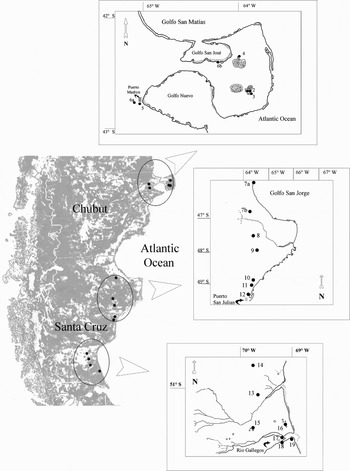
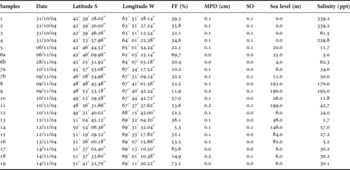
Five sediment samples were taken with a cylindrical Plexiglas core, 10 cm depth and 2.8 cm in diameter. They were preserved in 5% formaldehyde in filtered seawater, sieved through both 500 µm and 50 µm mesh sieves. The nematodes present on the 50 µm sieve were separated by Ludox TM and then counted and identified to species level. The specimens studied in the present paper were found at 21 separate locations (Figure 1; Table 1). Nematodes were fixed following the method described by Ditlevsen (Reference Ditlevsen1911) and preserved in anhydrous glycerine on slides sealed with Canadax resin.
Map of Patagonia showing the sampling stations.

Geographical position of sampling stations and environmental parameters.

Morphometric data were obtained from camera lucida drawings using a Zeiss microscope with differential interference contrast (DIC). The measurements are in microns. Sediment analysis were carried out by dry sieving and classified according to the Wentworth scale. References have been obtained from NeMys, Deprez (Reference Deprez2006). Type specimens were deposited in the Museo Nacional de Ciencias Naturales ‘Bernardino Rivadavia’, Argentina. De Man's ratios, a, b and c used in this paper are calculated as standard.
Abbreviations used in the text are: Abd, anal/cloacal body diameter; Aw, amphidial fovea width; Al, amphidial fovea length; A%, amphid diameter as a percentage of the corresponding body diameter; Bdcs, body diameter at level of cephalic setae; BdA, body diameter at level of the amphid; Bdnr, body diameter at level of nerve ring; Bdph, body diameter at level of pharyngeal end; Bdo, body diameter at level of ocelli; B/S, bursa/spicule ratio; Col., collector; Csl, cephalic setae length; DaA, distance from anterior end to amphid; DaO, distance from anterior end to ocelli; Daa/c, distance from anterior end to anus/cloacal opening; Danr, distance from anterior end to nerve ring; Daph, distance from anterior end to pharyngeal end; Daex, distance from anterior end to excretory pore; Dav, distance from anterior end to vulva; V%, distance from anterior end to vulva opening in percentage of the total length; G, gubernaculum length, along the arc; Gcd, gubernaculum length in cloacal body diameters; L, total length; Lfilt, length of filiform part of the tail; %fil, % of tail length that is filiform; Lspin, length of spinneret; Mbd, maximum body diameter; Nppb, number precloacal papillae in bursa; Npp, number precloacal papillae; Npopb, number postcloacal papillae in bursa; Npop, number paired postcloacal papillae after bursa; Npo, number unpaired postcloacal papillae after bursa; O%, ocelli diameter in percentage of corresponding body diameter; Od, ocelli diameter; S, spicule length, along the arc; Scd, spicule length in cloacal body diameters; Sl/Gl, spicule–gubernaculum length ratio; Tl, tail length; Ta, tail length in cloacal body diameters.
RESULTS AND DISCUSSION
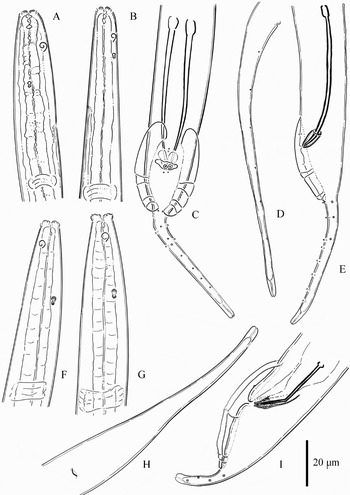
(A–E) Diplolaimelloides tehuelchus sp. nov. (A) Anterior end of male; (B) anterior end of female; (C) tail region and copulatory apparatus in ventral view; (D) tail of female; (E) tail region and copulatory apparatus in lateral view. (F–I) Diplolaimelloides warwicki sp. nov. (F) Anterior of female; (G) anterior view of male; (H) tail region of female in ventral view; (I) tail region and copulatory apparatus in lateral view.

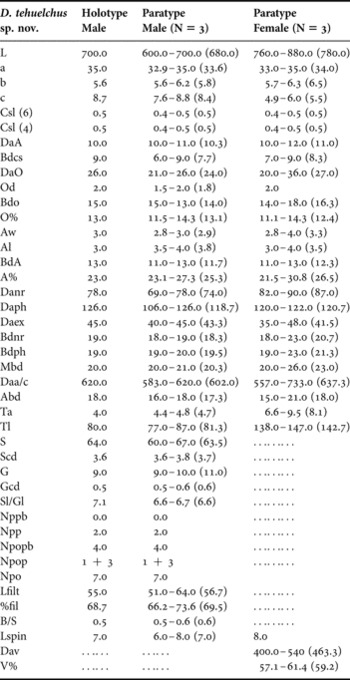
Measurements (µm) of Diplolaimelloides tehuelchus sp. nov. (range, mean value in parentheses).

TYPE MATERIAL
Holotype, MACN-In 37065; allotype, MACN-In 38066. Col. R.M. Warwick, 9 November 2004, Patagonian lagoon (9).
Type locality: coordinates: 48° 53′55″S 67° 40′70″W, Santa Cruz province, Argentina.
Paratypes: MACN-In 37067. Col. R.M. Warwick. Idem type locality.
HABITAT
Diplolaimelloides tehuelchus sp. nov. type specimens were found in sand (median particle size 250 µm, according to Wentworth scale), with a water salinity of 195 ppt, in a lagoon located 16 km from the sea and 190 m above sea level. This species also was found in another six lagoons (1, 2, 11, 14, 13 and 16), at Río Gallegos River estuary (17) and in a saltmarsh (20) at península Valdes (see Figure 1).
ETYMOLOGY
From the name of the first human population of the area, Tehuelche.
MATERIAL EXAMINED
Measurements: see Table 2.
DESCRIPTION
Male: body cylindrical, almost uniform in diameter, but tapering gradually from level of nerve ring to head end and narrowing abruptly in tail region. Cuticle apparently smooth. Head equipped with two circles of sensilla; 6 inner labial sensilla, papilliform and very difficult to see; 6 outer labial and 4 cephalic sensilla setiform. Amphidial fovea slightly more than a single spiral 25.3% of corresponding body diameter; anterior margin of amphid 10.3 µm from anterior body end. Ocelli with lens, anterior margin of ocelli 24 µm from anterior end. Stoma sclerotized at anterior and posterior chambers. No denticles in buccal cavity. Pharynx cylindrical, gradually enlarging in posterior portion but without bulb. Cardia distinct between pharynx and intestine, about 20 µm long. Ventral gland situated at ventral to right side of intestine, secretory–excretory pore posterior to the ocelli 43 µm from anterior end. Reproductive system monorchic. Testis outstretched, right of intestine. Spicules well sclerotized, nearly straight and cephalated. Gubernaculum formed by one central cuneus and two pieces, corpus and capitulum joined together forming tubes around the spicules, 9.3 µm. Two mid-ventral pre-cloacal papillae 3 µm from the cloacal opening and a pair just posterior to cloacal opening (Figure 2C). Bursa with four papillae on each side arranged as 2 + 2 and all posterior to cloacal opening. Four pairs and seven unpaired caudal papillae present posterior to bursa, paired in arrangement 1 + 3 (one midventral and three in subventral position) and the seven impaired papillae along the tail in midventral position. Tail filliform for 69.5% of its length; spinneret present.
Female: similar to males in general body shape, anterior sensilla, amphids and ornamentation body cuticle. Reproductive system monodelphic and prodelphic. Ovary outstretched, right of the intestine. Tail conical and filliform 30% of its length, with long spinneret.
DIAGNOSIS
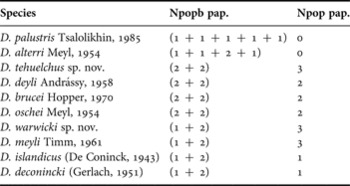
Diplolaimelloides tehuelchus sp. nov. is characterized by having two precloacal midventral papillae, and one pair midventral postcloacal papillae inside bursa area; four bursal papillae (on bursa alae) posterior to the cloacal opening in 2 + 2 arrangement; one pair midventral and three pairs subventral and seven unpaired midventral postbursal papillae, short gubernaculum, and spicules longer than 50 µm.
DISCUSSION
From all valid species reviewed (see Table 4), this new species resembles D. deyli Andrássy, Reference Andrássy1958, found in Egypt and South India (see key) and D. brucei Hopper, Reference Hopper1970 from Louisiana, USA, by having four papillae on bursa 2 + 2 arrangement. Diplolaimelloides tehuelchus sp. nov. can be distinguished from them by the shape and position of the ocelli, Sl:Gl ratio (3.7 in D. deyli; 1.3 in D. brucei), de Man's ratio b (6.9 in D. deyli; 6.5 in D. brucei), the presence of midventral precloacal and postcloacal papillae inside bursa area, the four pairs of midventral and sublateral papilla and the seven unpaired midventral papillae on tail after bursa.
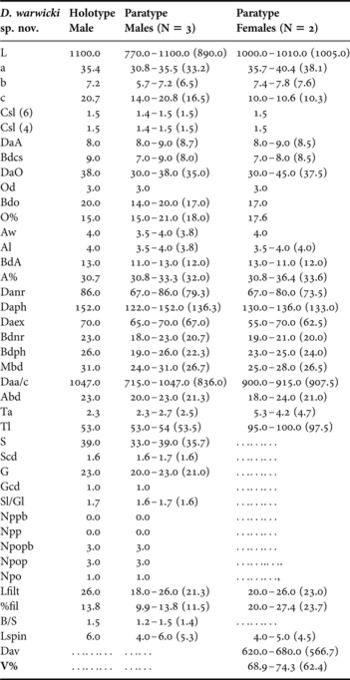
Measurements (µm) of Diplolaimelloides warwicki sp. nov. (range, mean value in parentheses).

Number and pattern of bursal papillae (Npopb pap.) and number of caudal papillae patterns (Npop pap.) in all Diplolaimelloides species.

TYPE MATERIAL
Holotype, MACN-In; allotype, MACN-In 38069. Col. C.T. Pastor de Ward. 28 November 2004, Patagonian coastal salt marsh, Fuerte San José Beach, península Valdes, (6a). Type locality: coordinates: 42° 25′53″S 64° 07′05″W, Chubut province, Argentina.
Paratypes: MACN-In 37070. Idem type locality.
Habitat: Diplolaimelloides warwicki sp. nov. type specimens were found in very fine sand (median particle size 140 µm, according to Wentworth scale), with a water salinity of 62.3 ppm (Table 1), in an upper littoral lagoon with a cyanophyte–chlorophyte bloom.
ETYMOLOGY
Dedicated to R.M. Warwick in recognition of the help given during the sampling for this project.
MATERIAL EXAMINED
Measurements: see Table 3.
DESCRIPTION
Male: body cylindrical, almost uniform in diameter, tapering slightly towards the anterior end and narrowing abruptly in tail region. Cuticle apparently smooth. Head equipped with two circles of sensilla; 6 inner labial sensilla, papilliform and very difficult to see and a circle of 6 outer labial and 4 cephalic sensilla, setiform. Amphidial fovea about a single spiral, 32% of corresponding body diameter, its anterior margin 8.7 µm from anterior body end. Ocelli with lens, anterior margin of ocelli 35 µm from anterior end. Stoma sclerotized at anterior and posterior chambers. Denticles not observed. Pharynx cylindrical, gradually enlarging in posterior portion but without bulb. Cardia distinct between pharynx and intestine. Ventral gland not seen, secretory–excretory pore posterior to the level of the ocelli and anterior to the nerve ring. Reproductive system monorchic. Testis outstretched, right of intestine. Spicules slender and arcuated with a sharp angle, cephalated. Muscles of copulatory apparatus were not seen. Gubernaculum formed by a long cuneus and two pieces corpus and capitulum, joined together, forming short tubes around the spicules distal end. One precloacal papilla 5 µm from the cloacal opening. Bursa present with three papillae on each side (1 + 2), all posterior to cloacal opening and the posterior two close together at cloaca. Three pairs of caudal papillae in sublateral position just posterior to bursa and one midventral unpaired papilla. Tail with short filliform portion (11.5% of total tail length) and with spinneret. Caudal glands were not seen.
Female: similar to males in general body shape, anterior sensilla, amphids, ocelli and body cuticle. Reproductive system monodelphic and prodelphic. Ovary outstretched, right to the intestine. Tail conical, with short spinneret. Caudal glands were not seen.
DIAGNOSIS
Diplolaimelloides warwicki sp. nov. is characterized by the angular shape of the spicules and a long gubernaculum.
DISCUSSION
From all valid species reviewed (see Table 4), D. warwicki sp. nov. resembles D. meyli, Timm, Reference Timm1961, by having 1 + 2 bursal papillae and three sublateral caudal papillae. Our species can be distinguished from D. meyli by the spicule shape, longer gubernaculum (10 µm in D. meyli) and small Sl:Gl ratio (4.7 in D. meyli).
Diplolaimella and Diplolaimelloides are two closely related genera, they usually share the same ecological environments. Timm (Reference Timm1966) gave the most recent keys for them. We found new records of Diplolaimella. We included a new Diplolaimella key based on a different set of characters, with the aim to include four species described after 1966. We add here a list of valid species of Diplolaimella and Diplolaimelloides genera followed by a key to all valid species considering male characters only. In both genera we had found (in an ecological paper published separately) a ratio male:female near to 50%. Keys on females only, probably could be done using cephalic and gonadal characters, but it would be difficult, especially if old descriptions were to be included.
Valid species of Diplolaimella: D. allgeni Schneider, 1937; D. chitwoodi Gerlach, 1957; D. devengatensis Jacobs et al., 1990; D. gerlachi Pastor de Ward, Reference Pastor de Ward1984; D. ocellata (Butscheli, 1874); D. ophthalmophora Timm, 1952; D. punicea Timm, 1952; D. schneideri (Chitwood & Murphy, 1964); D. stagnosa Lorenzen, Reference Lorenzen1966; D. thailandica Kito & Aryuthaka, 1998.
KEY TO MALES OF ALL KNOWN SPECIES OF DIPLOLAIMELLA
1. Pattern of male postcloacal genital papillae, five pairs 2
– Pattern of male postcloacal genital papillae, other 4
2. Spicules shorter than 25 µm 3
– Spicules longer than 25 µm … … … … … … … … … … … … …D. schneideri (Chitwood & Murphy, 1964)
3. Without denticles in the stoma… … … … … … … … … … … … … …D. thailandica Kito & Aryuthaka, 1998
– With 2–3 denticles in the stoma … … … … … … … … … … … … … …D. devengatensis Jacobs et al., 1990
4. Pattern of male postcloacal genital papillae, four pairs 5
– Pattern of male postcloacal genital papillae, other 6
5. Postcloacal genital papillae, similar in size … … … … … … … … … … … … … … D. ocellata (Butscheli, 1874)
– Last postcloacal genital papillae larger than others … … … … … … … … … … …D. stagnosa Lorenzen, 1966
6. Pattern of male postcloacal genital papillae, three pairs……D. gerlachi Pastor de Ward, Reference Pastor de Ward1984.
– Pattern of male postcloacal genital papillae, less than three pairs 7
7. Without ocelli D. allgeni Schneider, 1937
– With ocelli 8
8. c value greater than 5 … … … … … … … … … … … … … … D. chitwoodi Gerlach, 1957 USA and Brazil
– c value less than 5 9
9. Gubernaculum cuneus large … … … … … … … … … … … … … D. punicea Timm, 1952 Maryland, USA
– Gubernaculum cuneus smaller … … … … … … … … … … … .D. ophthalmophora Timm, 1952 Bay of Bengal
Valid species of Diplolaimelloides: D. alterri Meyl, Reference Meyl1954; D. brucei Hopper, Reference Hopper1970; D. deconincki (Gerlach, 1951); D. deyli Andrássy, Reference Andrássy1958; D. islandicus (De Coninck, 1943); D. meyli, Timm, Reference Timm1961; D. oschei Meyl, Reference Meyl1954; D. palustris Tsalolikhin, Reference Tsalolikhin1985.
KEY TO MALES OF ALL KNOWN SPECIES OF DIPLOLAIMELLOIDES
1. With five papillae in bursa 2
– With less than five papillae in bursa 3
2. Bursal papillae in pattern (1 + 1 + 1 + 1 + 1)… … … … … … … … … … . . D. palustris Tsaliolikhin, Reference Tsalolikhin1985
– Bursal papillae in pattern (1 + 1 + 2 + 1) … … … … … … … … … … … … … … … D. alterri Meyl, Reference Meyl1954
3. With four papillae in bursa 4
– With three papillae in bursa in pattern (1 + 2) 6
4. With three male tail papillae (1 + 1 + 1) … … … … … … … … … … … … … . . … D. tehuelchus sp. nov.
– With two male tail papillae (1 + 1) 5
5. Spicules longer than 45 µm… … … … … … … … … … … … … … … … … … … D. deyli Andrassy, 1958
– Spicules shorter than 40 µm… … D. brucei Hopper, 1970
6. With one male tail papilla (1) 7
– With more tail papillae 8
7. Spicules shorter than 30 µm… … … … … … … … … … … … … … … . D. islandicus (De Coninck, 1943)
– Spicules longer than 30 µm … … … … … … … … … … … … … … … … . . D. deconincki (Gerlach 1951)
8. With two male tail papillae (1 + 1) … … … … … … … … … … … … … … … . … . D. oschei Meyl, Reference Meyl1954
– With three male tail papillae (1 + 1 + 1) 9
9. Spicules angular and long gubernaculum (20 µm) … … … … … … … … … … … … …D. warwicki sp. nov.
– Spicules arquate and short gubernaculum (9–10 µm)… … … … … … … … … … … . D. meyli, Timm, 1961
DISTRIBUTION OF SPECIES
Diplolaimella ocellata (Butscheli, 1874) and D. tehuelchus sp. nov. have been found in coastal areas with a great input of organic matter and debris from the land like salt marshes (sites 6a and 17) or in inland lagoons (sites 1, 2, 3, 5, 6b, 7a, 9, 11, 14, 13 and 16). On the other hand D. gerlachi Pastor de Ward Reference Pastor de Ward1984, is the most common species and it has been found in coastal and inland samples (sites 3, 5, 6a, 6b, 7a, 7b, 12, 14, 17, 18 and 19); D. oschei Meyl Reference Meyl1954 and D. warwicki sp. nov. prefers coastal salt marshes areas (sites 6a, 7b and 18); see Figure 1.
GENERAL DISCUSSION
From our experience characters usually considered in the previous keys, i.e. the presence or absence of ocelli or amphid, distance of ocelli or amphid from anterior end, tail length and De Man's ratios, in Diplolaimella and Diplolaimelloides, are measurements that exhibit a range of variation, between localities and they are very similar between different species, so it is important to add more reliable characters to help in the discrimination of species. We propose here new keys to these two genera adding the use of bursal and tail papillae plus spicules and gubernaculum morphology in adult males. These diagnostic characters have been constant within each species in all the specimens we have examined from Patagonia.
ACKNOWLEDGEMENTS
We gratefully acknowledge to Dr R.M. Warwick and to Héctor Zaixso (CONICET) for the help given during the sampling collection of this project.